Your ShelfYour Projects

Review and Herald, Vol. 91, No. 15.

THE WORK

Review and Herald

Apr 9, 1914

Review and Herald Publishing Association · Takoma Park Station, Washington, D. C. · Apr 9, 1914

THE WORK

AND

THE WORKERS

ONE lady agent in the Middle West has already ordered 1,800 copies of the April Life and Health,—the Sanitation, Hygiene, and Business Man's number. Only a few left!

The Protestant Magazine’s March Number

ThE first editorial in the Baltimore Catholic Review (Cardinal Gibbons's official organ) for February 7, treats of the March number of the Protestant Magazine, containing President Wilson's letter about Secretary Tumulty, Professor Prescott's letter to President Wilson, etc. Have you seen this number?

The Protestant Magazine Replaces American Sentinel

ONE of the leading professors of Augustana College, Canton, S. Dak., writes: "Years ago I used to take the American Sentinel, and I enjoyed that paper very much for the position it took with reference to religious liberty. Its position on that question was identical with the Lutheran position. I understand that the Protestant Magazine is taking the place of the American Sentinel, and if such is the case, I wish to subscribe for the same. Please send sample copy that I may find out the price, etc. I may also want some back numbers." In a sense, both the Liberty and Protestant magazines are taking the place of the American Sentinel, that was published weekly.

Sell Bundles of Life and Health

Take a few hours off, sister, and try selling a bundle of 20 copies of the April or May Life and Health. Life will look different after you return from a short missionary trip of this kind!

Give Protestant Clergymen the Magazine

THE Protestant clergymen are just waiting anxiously to read that February and that March number of the Protestant Magazine. Give them a chance to see the magazine, and watch the results!

A Lutheran Pastor Secures Subscriptions

A Lutheran pastor in Connecticut has already sent in thirteen subscriptions for the Protestant Magazine. He writes: "I expect to obtain many more than these. We propose to have our people subscribe for the Protestant Magazine, have them read it, and, finally, have them hand their copies to others." He requests the agency.

The Pilgrim Fathers, Church Monopoly, and True Patriotism

You will be much pleased with the beautiful cover design of the new number of Liberty, just out. On the front is a two-color full-page picture of the "Mayflower," and on the back, one of "The Landing of the Pilgrim Fathers." We have named this the Pilgrim Fathers, Church Monopoly, and True Patriotism number. Get it, read it, sell it, circulate it! Send $2.00 for 50 copies.

Investing in Protestant Magazine Circulation

A PROMINENT wholesale merchant of St. Augustine, Fla., writes thus to the Protestant Magazine: "February issue received. Is first-class and ought to have the widest publicity. I inclose check for $25 to be used in placing this February number where it will do the most good. Wishing you success in exposing Romanism, I am." Who else will invest $25 in 500 copies to be mailed to select addresses by the publishers?

Protestant Circulation by Conference

A FEW days ago the Ohio Conference had ordered 5,163 copies of the February and 4,050 of the March Protestant—a total of 9,213 copies; the Massachusetts Conference had already passed the 10,000 mark. The District of Columbia is third, with 5,452 copies of these two numbers to its credit; East Michigan is fourth, with a combined sale of 4,639. These figures do not, of course, include hundreds of subscriptions and single copy orders.
Courtesy of the Religious Telescope

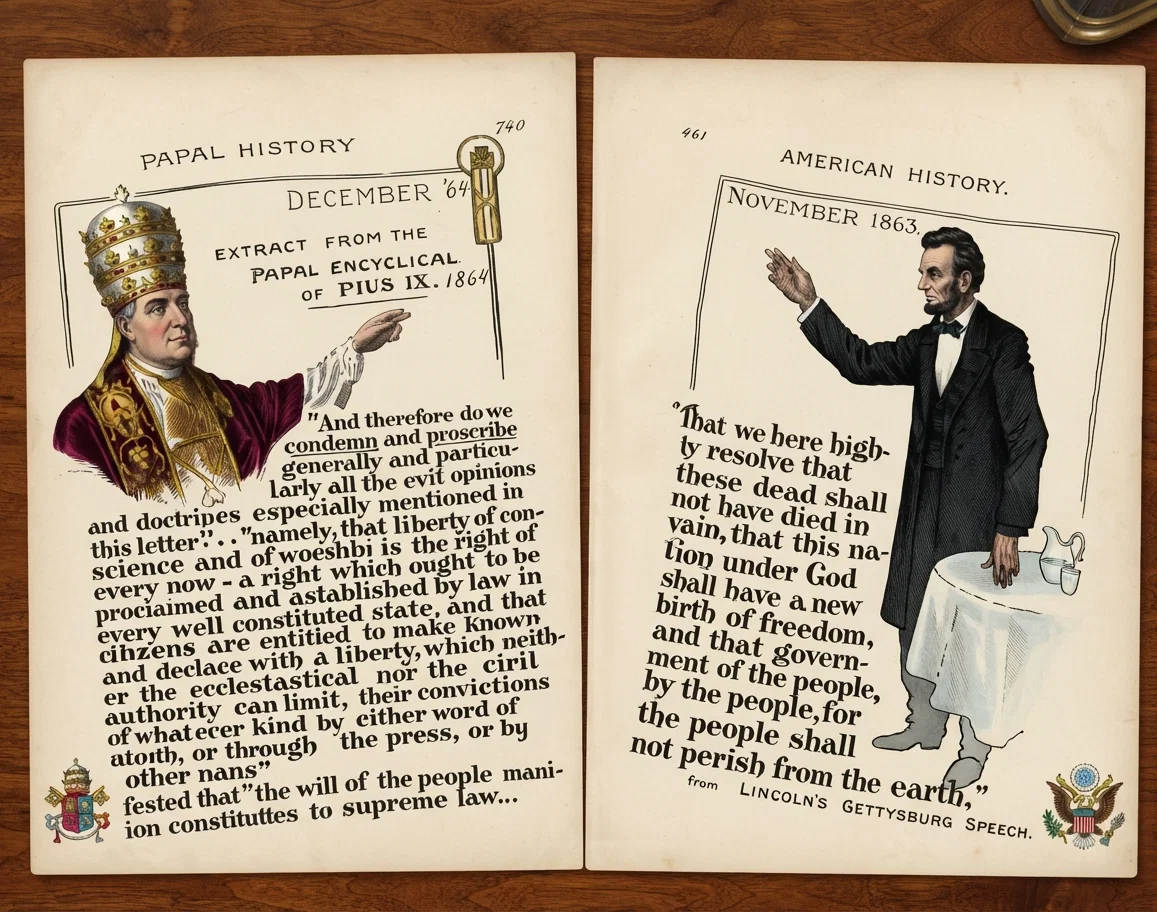
Food for Serious Thought in Connection With the Lincoln Anniversary

The following extracts from the encyclical letter of Pope Leo XIII, Libertas praestantissimum, published June 20, 1888, will furnish further proof of the un-American doctrines taught by authority in the Roman Catholic Church: —
"When once man is firmly persuaded that he is subject to no one, it follows that the efficient cause of the unity of civil society is not to be sought in any principle external to man, or superior to him [that is, not in the Pope or the Roman Church], but simply in the free will of individuals; that the authority in the state comes from the people only; and that, just as every man's individual reason is his only rule of life, so the collective reason of the community should be the supreme guide in the management of all public affairs. Hence the doctrine of the supremacy of the greater number, and that all right and all duty reside in the majority. But, from what has been said, it is clear that all this is in contradiction to reason. [Compare this with Lincoln's statement.]
"Although in the extraordinary condition of these times the church usually acquiesces in certain modern liberties [such as liberty of speech, liberty of the press, and liberty of conscience], not because she prefers them in themselves, but because she judges it expedient to permit them, she would in happier times exercise her own liberty. . . . One thing, however, remains always true — that the liberty which is claimed for all to do all things is not, as we have often said, of itself desirable, inasmuch as it is contrary to reason that error and truth should have equal rights."—"The Great Encyclical Letters of Pope Leo XIII," New York, Benziger Brothers, pages 145, 146, 158.

Protestant Magazine Historical Proofs

One of Six Full-Page Photographic Proofs of Rome's Unchristian and Un-American "Church and State" Teachings Found in the April "Protestant Magazine"
OVER 17,000 copies of this April number sold before the first of April! Preparing to run a second edition. The sixth edition of the February, the third of the March, and the first of the April number are still selling rapidly! See the "Picture Section" cartoons, photographs of Rome's textbooks teaching the union of church and state, also map of Washington, D. C., showing how the Papacy occupies the national capital. Other notable articles: "The Aftermath of the Wilson Letter," "Romanizing Future American Citizens," "Ancient and Modern Babylon," "Roman Catholicism in the Light of Scripture and History—No. 1" (continued series), "The Bible and the Church," "Catholic Claims Tested," "Protestants and Roman Catholics at the White House," "The Vatican and Congress," "The Tango and the Confessional," "Mr. Tumulty's Letter to the Editor," "Notable Utterances of Priest D. S. Phelan," and other features too numerous to mention. Among the very first orders received for this Historical Proofs number was one from New York City, calling for 1,500 copies. Send $2.00 for 50 or $1.00 for 20 copies of the February, March, or April numbers, mixed or otherwise. If you desire, we can begin your subscriptions with the February or March issues — BUT NOT WITH THE JANUARY NUMBER, NOW OUT OF PRINT FOR SOME TIME. Invest $1.25 in FIVE "TRIAL" subscriptions for your friends, for FOUR MONTHS; or send $1.50 for FIVE subscriptions for SIX MONTHS. Address your tract society or the Protestant Magazine, Washington, D. C.

Mount Zion's Song

MRS. G. W. AMADON
How glad upon the mountains are The feet of those who bring from far Good tidings of the Prince of peace, When sin and its long train shall cease!
"I have not said to Israel's seed, Seek me in vain; for me ye need: My hand to guide you far and near; My love in suffering, strength in fear."
'Tis said by one whose ready pen Has sometimes searched the hearts of men, That David's psalms would ne'er been sung If David's heart had not been wrung.
God bids, Behold the goodly land, With verdant fields and shining strand, Fountains and rivers, brooks and rills, That spring from depths of vales and hills,
Its fragrant fruits and grains and vines, Pomegranates, honey, oil, and wine, Barley and wheat on fruitful soil Which doth repay thy pleasant toil.
And then he shows the city grand Where twelve times twelve thousand stand, With crowns and harps and waving palms, Singing in praise to Christ the Lamb.
And Christ himself will open wide Those gates, for thee, his church, his bride. That city's walls, its streets of gold — Their glories will to us unfold.
And joy, and gladness, love supreme, Through endless years shall be thy theme. Fatigue, unrest, nor woe, nor pain, Shall ever pierce thy heart again.
"If thou obey, my counsels heed, Then thou shalt be of Israel's seed. If Zion's heart has here been wrung, Mount Zion's song will there be sung.
And on through heaven's eternal day, When God shall wipe all tears away, That joyous, loyal, countless throng, Will sing that mighty triumph song.
St. Joseph, Mich.

The True Theme of Teaching and Preaching

G. B. STARR
THE early disciples of Christ, it would seem, had just one theme, which served for the beginning, the middle, and the end of all their teaching and preaching, public and private, with Jew or Gentile, high or low, rich or poor: "And daily in the temple, and in every house, they ceased not to teach and preach Jesus Christ." Acts 5:42. They had met and learned to love Jesus. They had become convinced that he himself was just what all the world needed; and so Jesus Christ, "the Messiah;" Jesus, "the Creator," the "Sacrifice" for sin; "the Lamb of God, that taketh away the sin of the world;" Jesus, "the Light of the world," "the Water of life," "the Lord our righteousness," "the way, the truth, and the life," "the Mediator of the new covenant," "the resurrection and the life," "the Prince of Peace," "the Rock of Ages," "the Root of David," "the Son of the living God," "the Word of God," "the Word of life," "the coming King," was the theme of their conversation, their preaching, and their song; and they loved to emphasize that "we preach not ourselves, but Christ Jesus the Lord; and ourselves your servants for Jesus' sake;" and for the very good reason that "God, who commanded the light to shine out of darkness, hath shined in our hearts, to give the light of the knowledge of the glory of God in the face of Jesus Christ." 2 Cor. 4:5, 6. How, then, could men whose hearts had been flooded with creative light, talk of aught else but the source of that light?
When it pleased God "to reveal his Son in me," says Paul, it was "that I might preach him among the heathen." Gal. 1:16. Paul's manner from that time was to reason "out of the Scriptures," "that Christ must needs have suffered, and risen again from the dead; and that this Jesus, whom I preach unto you, is Christ." Acts 17:3. The people recognized clearly the theme of his preaching, for they said "he preached unto them Jesus, and the resurrection." Verse 18. Some even endeavored to cast out devils "by Jesus whom Paul preacheth." Acts 19:13. Paul also felt quite clear to write to the churches that they were not to receive any one who preached "another Jesus, whom we have not preached," and not to receive another spirit nor another gospel. 2 Cor. 11:4.
The disciples never failed to turn every opportunity offered into the direct preaching of Jesus. The example of Philip illustrates this. After listening to the Ethiopian read Isa. 53:7, 8, as soon as Philip "opened his mouth," he "began at the same scripture, and preached unto him Jesus." Acts 8:26-35. Jesus himself set them and us the example of thus preaching him from all parts of the Sacred Writings: "And beginning at Moses and the prophets, he expounded unto them in all the Scriptures the things concerning himself." Luke 24:27. See verse 44. So Philip went to a city of Samaria, and "preached Christ unto them" (Acts 8:5); and Paul straightway "preached Christ in the synagogues, that he is the Son of God." Acts 9:20. It mattered not who the preacher was in those days, Christ was the theme, as Paul says: "For the Son of God, Jesus Christ, who was preached among you by us, even by me and Silvanus and Timotheus." 2 Cor. 1:19.
So intent were these early preachers upon publishing the gospel of Christ, that they rejoiced when his enemies took up the subject. "Some," said they, "indeed preach Christ even of envy and strife; and some also of good will: the one preach Christ of contention, not sincerely, supposing to add affliction to my bonds: but the other of love, knowing that I am set for the defense of the gospel. What then? notwithstanding, every way, whether in pretense, or in truth, Christ is preached; and I therein do rejoice, yea, and will rejoice." Phil. 1:15-18.
No people ever lived who could and ought more fully to preach Christ than Seventh-day Adventists, his remnant people: for to them is opened the whole field from the earliest prediction of "the Seed of the woman," through prophecies and symbol, through gospel and revelation, to his second appearing in the cloudsof heaven; it is always this same "Jesus Christ, which before was preached unto you: whom the heaven must receive until" his work is finished and he comes again in the clouds of heaven.
It is impossible to present any truth in its true setting "as the truth is in Jesus" (Eph. 4:21) without making Jesus himself the principal figure in every discourse. It was "one like the Son of man" who came with clouds to the Ancient of days, to whom there was given "dominion, and glory, and a kingdom, that all people, nations, and languages, should serve Him," whom Daniel saw; it was this same Son of man that John the revelator sees coming with clouds to take his kingdom; and it is this same Jesus whom it is our privilege to hold up high before the people, in song, in prayer, in discourse, and call for their submission to him as Lord of lords and King of kings. All heaven rings with his praise. Glory to Christ is the theme of every song. Rev. 5:11-13. And so, with the benediction of Paul to the Romans, we close this article: "Now to him that is of power to stablish you according to my gospel, and the preaching of Jesus Christ, according to the revelation of the mystery, which was kept secret since the world began, but now is made manifest, and by the scriptures of the prophets, according to the commandment of the everlasting God, made known to all nations for the obedience of faith: to God only wise, be glory through Jesus Christ forever. Amen." Rom. 16:25-27.
Melrose, Mass.

Overwork and Illness

Early Counsels on Medical Work—No. 2

Overwork and Illness

[Compiler's Note.—"Our people are generally waking up to the subject of health," wrote Elder James White in an editorial in the Review, Dec. 13, 1864, "and they should have publications on the subject to meet their present wants, at prices within reach of the poorest." He announced the early issuance of a series of pamphlets, under the general title, "Health; or How to Live."
The strong conviction of Elder and Mrs. White that the reforms to be outlined in these pamphlets were of great importance, is thus expressed in a note in the Review (Jan. 24, 1865), calling attention to the publication of the first of the series:—
"We wish to call the attention of the brethren everywhere to these works, prepared with especial care, on the important subject of a reform in our manners of life, which is greatly needed, and, as we view it, will surely be accomplished in whatever people find themselves at last prepared for translation."
During the first five months of 1865 this series was completed. These health pamphlets, six in number, contained articles from Sister White on "Disease and Its Causes," and on allied subjects, and many extracts from the writings of various physicians and others interested in health reform principles. Hygienic recipes were included, also hints on the use of water as a remedial agency. The harmful effects of alcohol, tobacco, tea and coffee, spices, and other stimulants and narcotics, were further emphasized.
The winter of 1864-65 was a time of stress and trial. While uniting with his wife in the preparation of health matter for publication, Elder James White found it necessary to labor untiringly in behalf of Sabbath keepers who were being drafted for service in the army. This work was attended with perplexity and anxiety, and drew heavily on his sympathies, besides overtaxing his physical strength. The administrative cares of the General Conference held in May, 1865, added to his weariness.
Worn with the labors of writing and publishing, and of looking after many interests connected with the general work, Elder White and his wife were, nevertheless, given no rest. Immediately after the Conference session, they were called to Wisconsin and Iowa, where they endured many hardships. Soon after their return to Michigan, Elder White was stricken with partial paralysis.
An account of these afflictions, and of the impetus they indirectly brought to the health reform movement a few months later, is given by Sister White in the issues of the Review dated Feb. 20 and Feb. 27, 1866, a portion of which appears below.
This story, as prepared for publication, has been read by Sister White, and a few editorial changes from the original have been made.]
At the close of the General Conference we found ourselves excessively exhausted in physical and mental strength; yet duty seemed to urge us West; and we dared not remain at home. We had not for years past consulted our own ease and pleasure, and God had sustained us. Would he not sustain us now? We thought it the safest course to venture, and, summoning all the energy we could, we started on our journey.
We attended meetings in Wisconsin, and went to the farthest limit of our strength. Our diet was not such as would nourish. . . .
We felt it to be our duty to visit Iowa before returning to Michigan. We had no knowledge of the rebellion of — and —, but felt that there was a work for us to do in that State. We first heard of the rebellion on our way to Pilot Grove, Iowa, only a few hours before we met its leaders face to face in the meetinghouse. We labored with intensity of feeling to save the poor sheep who had been wounded and torn and left bleeding by these unfaithful shepherds. Our efforts were crowned with success. While engaged in meeting opposition, falsehood, and insult, prejudice and jealousy, we had thought little of our health. The blessed results that followed our labors, cheered us amid the gloom which we felt as we beheld what these two shepherds had accomplished in their dreadful work of tearing to pieces the flock of God.
Our overtaxing labors in Iowa told upon the strength of my husband. His labors in meeting this rebellion were of such a nature as to arouse his zeal, and lead him beyond what prudent consideration for his health would have allowed. If, on his return home, he could have had a period of entire rest, and entire freedom from anxiety and care, he would have recovered from the effects of that journey. But the work that these false ministers had been doing for months in preparing for a determined rebellion, . . . made it necessary for us to write again, to save the honest from being deceived. . . .
When the time came to fill our appointment in Memphis, we needed rest of body and mind. For months we had been under a constant strain. Our nights were spent in broken sleep, because of bodily infirmities. Yet we spurred up our exhausted energies, arose at midnight, walked about a mile to the railway station, and stepped on board the train which was to take us to Detroit. At Ridgeway, we were obliged to wait about two hours for the arrival of a train from the East, before the stage would leave for Memphis. My husband lay down upon a bench in the station, and slept for about fifteen minutes, and this relieved his weariness in a measure. We rode about seven miles, to Brother Gurney's, and obtained some rest and sleep, to prepare us to attend the evening appointment.
The meetings in Memphis called for strenuous labor, and while in attendance my husband performed an amount of labor sufficient for two men possessing a good degree of strength. His vital energies were exceedingly depressed, yet his zeal in the cause of God urged him on presumptuously to exhaust, by overwork, the little strength that remained.
Our meetings closed on Sunday evening, after eleven o'clock. We retired after midnight, and arose at daybreak to take the stage for the cars. The cars missed connection, and we did not reach home till past midnight.
My husband slept but little that night, and would not be prevailed upon to rest the next day. He thought his business required him at the office. Night found him exhausted, and his sleep was broken and unrefreshing; yet we arose in the morning at five o'clock to take our usual walk before breakfast. We stepped into Brother Lunt's garden, and while my husband attempted to open an ear of corn, I heard a strange noise. Looking up, I saw his face flushed, and his right arm hanging helpless at his side. His attempt to raise his right arm was ineffectual—the muscles refused to obey the will.
I helped him into the house, but he could not speak to me until in the house he indistinctly uttered the words, "Pray, pray." We dropped on our knees and cried to God, who had ever been to us a present help in time of trouble. My husband soon uttered words of praise and gratitude to God, because he could use his arm. His hand was partially restored, but not fully. . . .
My husband and I felt the need of drawing near to God. And as by confession and prayer we drew near to God, we had the blessed assurance that he drew near to us. How unspeakably precious was the sense of God's boundless mercy toward us, his afflicted children! The stroke that had fallen upon my husband might have been fatal, or left him with one half of his body palsied and dead. We wept for joy, that amid our affliction the care of God wastoward us. The mighty Maker of the world—the omnipotent Ruler of the universe, was our Father! Precious, exceedingly precious, were these seasons of communion with God! Much of the time my husband was happy in the Lord. Day and night, the praise of God was upon his lips, and the sick room was truly a heavenly place.
(To be continued)

Does the History of Turkey and Egypt Since 1798 Fulfill the Prophecy of Dan. 11:

Does the History of Turkey and Egypt Since 1798 Fulfill the Prophecy of Dan. 11: 40-44?—No. 23

WE have now come to a most important event in the line of history we have been tracing—Turkey's loss of national independence in the year 1840. This has never since been regained. Eventually this will lead to the removal of the capital from Constantinople to Jerusalem, where, according to the prophecy, "he shall come to his end, and none shall help him." Dan. 11: 45.
Every step in Turkey's history from the point we have now reached, onward to the end, must be of deep interest to the student of the prophecies relating to Turkey.
The destruction of the Turkish army, the desertion of the navy, and the half-submissive and conciliatory appeal of Turkey to her rebel vassal, Mehemet Ali, for a settlement of their differences, made it clear to the powers of Europe that Turkey must have help from some source or fall into the hands of Mehemet Ali. They knew that the sultan would rather place himself on the mercy of any European power than to treat with his merciless conqueror. But they all feared to allow any one power to become Turkey's guardian. The delicate and complicated situation then existing is fully explained by the historians. Alison Phillips says:—
"The attitude of Russia was for the moment doubtful. She was not averse to an independent agreement between the pasha and the Porte, which would relieve her from her obligations under the treaty of Unkiar-Skelessi, and at the same time would not deprive her of her preponderant position at Constantinople, untrammeled by any concert with the other powers. But this was precisely what the other powers wished to avoid. While commending the conciliatory attitude of the Porte, Marshal Soult therefore wrote to depreciate any negotiations on its part with Mehemet Ali save through the good offices of its allies; and Palmerston wrote strongly to the same effect. As to any possible attempt on the part of Russia to interfere under the treaty of Unkiar-Skelessi, in the event of the Russian fleet entering the Bosporus, the British ambassador was to demand that the British fleet should be allowed to do the same."—"Cambridge Modern History," Vol. IX, pages 562, 563.
In order to prevent Egypt, or Russia, or any power from gaining advantages not acceptable to the other powers, and to secure time and opportunity to give the question adequate study, the powers united in sending a note to the sultan requesting the suspension of all negotiations for peace, or the settlement of his difficulties, with any power. Concerning this note, Frazer says:—
"On the twenty-seventh July, the ambassadors of the five great powers of Europe—England, France, Prussia, Russia, and Austria—made the following communication to the sultan: 'The undersigned received instructions this morning from their respective governments, in pursuance of which they have the honor of informing the Sublime Porte that the five powers have agreed to discuss and settle together the Eastern Question. They accordingly invite the divan to suspend a definite arrangement without their concurrence, and to confide in the benevolent dispositions of the mediating powers.'"—"Turkey; Ancient and Modern," by R. W. Frazer, page 447.
This collective note arrested all negotiations between Turkey and Egypt, and, in fact, between Turkey and all other powers. It also prevented the Egyptian army from making an advance move on Constantinople.
The powers were nearly a year discussing the different phases of this question, but, at last, with the exception of France, they reached an agreement, which they signed in London, July 27, 1840. By this treaty Turkey voluntarily surrendered her national independence to the European powers. As this is an event of great interest, and concerning which much has been said and written, we shall here reproduce the most important articles of this treaty, and then trace the history of its execution.

"In the Name of the Most Merciful God

"His Highness, the sultan, having addressed himself to Their Majesties, the queen of the United Kingdom of Great Britain and Ireland, the emperor of Austria, king of Hungary and Bohemia, the king of Prussia, and the emperor of all the Russias, to ask their support and assistance in the difficulties in which he finds himself placed by reason of the hostile proceedings of Mehemet Ali, pasha of Egypt,—difficulties which threaten with danger the integrity of the Ottoman Empire, and the independence of the sultan's throne,—their said Majesties moved by the sincere friendship which subsists between them and the sultan; animated by the desire of maintaining the integrity and independence of the Ottoman Empire, as a security of the peace of Europe; faithful to the engagement which their contract by the collective note presented to the Porte by their representatives at Constantinople, on the twenty-seventh of July, 1839; and desirous, moreover, to prevent the effusion of blood which would be occasioned by a continuance of the hostilities which have recently broken out in Syria between authorities of the pasha of Egypt and the subjects of the sultan. Their said Majesties, and His Highness, the sultan, have resolved for the aforesaid purposes, to conclude together a convention, and they have therefore named as their plenipotentiaries, that is to say, Their Majesties, the queen of the United Kingdom of Great Britain and Ireland, the Right Honorable Henry John Temple, Viscount Palmerston, . . . His Majesty, the emperor of Austria, king of Hungary and Bohemia, the Sieur Phillip, Baron de Neumann, . . . His Majesty, the king of Prussia, the Sieur Henry William, Baron de Bulow, . . . His Majesty, the emperor of all the Russias, the Sieur Philipp, Baron de Brunnow, . . . and His Majesty, the most noble, most powerful, and most magnificent Sultan Abdul-Medjid, emperor of the Ottomans, Chekib Effendi, . . . who having reciprocally communicated to each other their full powers, bound to be in good and due form, have agreed upon and signed the following articles:—
"Article 1. His Highness, the sultan, having come to an agreement with Their Majesties . . . as to the conditions of the agreement which it is the intention of His Highness to grant to Mehemet Ali, conditions which are specified in the separate act hereunto annex; Their Majesties engage to act in perfect accord, and to unite their efforts in order to determine Mehemet Ali to conform to that agreement, each of the high contracting parties reserving to itself to cooperate for that purpose according to the means of action which each may have at his disposal. . . .
"Art. 2. If the pasha of Egypt should refuse to accept the above-mentioned agreement, which will be communicated to him by the sultan with the concurrence of their aforesaid Majesties, Their Majesties engage to take at the request of the sultan, measures concerted and settled between them, in order to carry that agreement into effect. In the meanwhile, the sultan having requested his said allies to unite with him in order to assist him to cut off the communication by sea between Egypt and Syria and to prevent the transport of troops, horses, arms, and warlike stores of all kinds, from the one province to the other, Their Majesties, the queen of the United Kingdom of Great Britain and Ireland, and the emperor of Austria, king of Hungary and Bohemia, engage to give immediately, to that effect, the necessary orders to their naval commanders in the Mediterranean. Their said Majesties further engage that the naval commanders of their squadron shall, according to the means at their command, afford in the name of the alliance all the support and assistance in their power to those subjects of the sultan who may manifest their fidelity and allegiance to their sovereign. . . .

"Annex

"Separate act to the convention of the fifteenth of July, 1840. His Highness, the sultan, intends to grant and to cause to be notified to Mehemet Ali, the conditions of the agreement hereinafter detailed.
"Section 1. His Highness promises to grant to Mehemet Ali, for himself and his descendants in the direct line, the administration of the pashalic of Egypt; and His Highness promises, moreover, to grant to Mehemet Ali, for his life, with the title of Pasha of Acre, and with the command of the fortress of St. John of Acre, the administration of the southern part of Syria. . . .
"The sultan, however, in making these offers, attaches thereto the condition that Mehemet Ali shall accept them within the space of ten days after communication thereby shall have been made to him at Alexandria by an agent of His Highness; and that Mehemet Ali shall, at the same time, place in the hands of that agent the necessary instruction to the commanders of his sea and land forces, to withdraw immediately from Arabia, and from all the holy cities which are therein situated, from the island of Candia, from the district of Adana, and from all other parts of the Ottoman Empire, which are now comprised within the limits of Egypt, and within those of the pashalic of Acre, as above defined.
"Sec. 2. If within the space of ten days, fixed as above, Mehemet Ali should not accept the above-mentioned agreement, the sultan will then withdraw the offer of the administration of the pashalic of Acre; but His Highness will still consent to grant to Mehemet Ali, for himself and for his descendants in the direct line, the administration of the pashalic of Egypt, provided such offer be accepted within the space of ten days next following, that is to say, within a period of twenty days, to be reckoned from the date on which the communication shall have been made to him, and provided that in this case also, he places in the hands of the agent of the sultan, the necessary instructions to his military and naval commanders to withdraw immediately within the limits and to the ports of the pashalic of Egypt. . . .
"Sec. 7. If, at the expiration of the period of twenty days after the communication shall have been made to him (according to the stipulation of Section 2), Mehemet Ali shall not accede to the proposed agreement, and shall not accept the hereditary pashalic of Egypt, the sultan will consider himself at liberty to withdraw that offer, and to follow, in consequence, such ulterior course as his own interests and the counsels of his allies may suggest to him. . . .
"In witness whereof the representatives plenipotentiaries have signed the same and affixed thereto the seals of their arms.
"Done at London, the fifteenth day of July, in the year of our Lord, 1840.
"(L. S.) PALMERSTON, "(L. S.) NEUMANN, "(L. S.) BULOW, "(L. S.) BRUNNOW, "(L. S.) CHEKIB."
"The Map of Europe by Treaty," by Sir Edward Hertslett, Vol. II, p. 1008.

Personal Questions for All

Answers From the Bible and From the "Testimonies for the Church"

J. M. COLE
Do we take time to pray?
"Take time to talk with God." "Pray in faith." "Pray, believe, rejoice." "Not one sincere supplication is lost. The channel is open; the stream is flowing. It carries with it healing properties." "There needs to be among us a great deal more prayer."
Do we read the Word for personal, spiritual help?
"We are to meet every thrust of the enemy with the Word of the living God."
"'It is written,' was Christ's never-failing weapon."
Do we know that God loves us and has a personal interest in us and our work?
"Christ's laborers are very near his heart of love." "He desires to perfect his household through the perfection of his ministers." "In his sustaining power men and women become strong to resist evil."
Do we love this message as we do our own lives?
"Nothing else in this world is so dear to God as his church. Nothing is guarded by him with such jealous care."
Are all our minutes properly used?
"We cannot afford in the few days we have here on earth to spend our time in trifling and nothingness." "There is a time coming when those who have wasted their time and opportunities will wish they had sought him." "It is by neglecting your daily opportunities that you become fruitless and withered."
Do we constantly seek God to give us the spirit of harmony?
"As laborers together with God, they should seek to be in harmony with one another." "We cannot afford to spend the time working at cross-purposes with God." "Those who are truly converted will press together in Christian unity." "The words are ringing in my ears, 'Draw together, draw together!' The solemn, sacred truth for this time is to unify the people of God."
Are we seeking daily to be like him who was meek and lowly of heart?
"We must seek the Lord earnestly every day, . . . to be cleansed from every feeling of superiority." "Let there be no divisions in the church of God, no unwise authority exercised over those who accept the truth. The meekness of Christ is to appear in all that is said and done." "The desire for pre-eminence must die. One subject of emulation must swallow up all others,—who will most nearly resemble Christ in character? Who will most entirely hide self in Jesus?"
Do we know that the center of S-I-N is I?
Paul said, "Take heed unto thyself."
Do we know that some men are "marvelously helped" by the Lord, so that wonderful things are accomplished by them for the advancement of God's people?
Do we know the history of the men who were "marvelously helped" by the Lord, and forgot God because their "names were" spread far abroad?
Read carefully again and again the record God caused to be written for us "upon whom the ends of the world are come." In 2 Chron. 26:4-23, it is said of Uzziah:—
"He did that which was right in the sight of the Lord;" "he sought God;" "as long as he sought the Lord, God made him to prosper;" he "made war with mighty power;" he was "marvelously helped;" "his name spread far abroad;" "he was strong."
"But when he was strong, his heart was lifted up;" "he transgressed against the Lord;" this caused "his destruction."
He then became presumptuous; God's servants "withstood" him; "he was wroth with the priests;" "they thrust him out from thence;" "he was cut off from the house of the Lord;" "he was also a mighty man in valor, but he was a leper."
"Bring into your ministry the power of God, remembering that the Lord is behind you. Let his love shine through all you do and say. Let the truth shine out in full brightness. Humble self before God. Christ will be your efficiency." "Guided by our Heavenly Father's hand, let us go forward, improving every opportunity to extend the work of God."
Please do not put these questions and answers aside after reading them over. May they find a place in our hearts, and be seen in our lives, is the earnest prayer of the writer.
Wellington, New Zealand.

Freedom's Song

OUR Saviour, 'tis to thee, Who died to make us free, To thee we sing. We seek thy love-lit face, O, boundless is thy grace, Just, equal all thy ways, Our Life, our King!
Omnipotent thy hand— Rule thou in every land: Thee we adore. Uplift the sad and poor; When tried, help us endure; Make our salvation sure Forevermore.
Supreme on land and sea, Our Prince and Glory be, Our joy and song. In tempest and in calm, Our shield from sin and harm; Beneath us be thine arm, So kind and strong.
Thy gospel we receive, Thy promises believe; Thy word is true. With thee in sweet accord, We shed thy light abroad. Come soon with thy reward, Our home make new.
Caney, Kans.
Continue reading: Editorial