It seems to be coming to that, "Christian unity" is all well enough for Sunday-law purposes, but when it comes to the emolument of religious politics, denominational claims must not be overlooked. With reference to the chaplaincy in the present Legislature of California, a contributor to the Oakland Tribune, two weeks before that body convened, stated the probable result, as follows:—
"No appointment in the next Legislature will be more deserved and more calculated to promote the best interests of the Republican party of the State than that of the Rev. Barton W. Perry, D.D., as chaplain of the Assembly. Dr. Perry is not only an enthusiastic Republican, as his great speech and work at the county convention fully demonstrated, but he well represents the Presbyterian Church of the State, having been editor of the church organ for two years. This church has 300 ministers and 23,000 members in the State, but has never had the honor of a chaplaincy in the Legislature.
"It is conceded that Sacramento will have the honor of naming the chaplain for the Senate, but he will not be a Presbyterian. We are also assured that Alameda County will have the honor of naming the chaplain of the next Assembly, and he will be a Presbyterian. But this is no more than what is due Alameda County and the Presbyterian Church, for both have always been loyal to the Republican party."
Now that the Legislature has convened and been organized, it turns out that the foregoing forecast was correct. Dr. Perry was chosen chaplain of the Assembly, and Rev. A. J. Sturtevant (Baptist), of Sacramento, was made chaplain of the Senate. It can hardly be said that it was all guesswork; it bears the stamp of being based upon political computation as to denominational influence and consequent claims upon political consideration. The professed Protestant denominations are uniting in strenuous efforts (in imitation of well-settled Roman Catholic policy) to make themselves a power in politics, but in so doing they are paying the way for a denominational partisanship which, sooner or later, must become as corrupt in its methods as any other club system.
Here is food for reflection: When the civil government was the open foe of Christianity, and to preach the doctrine was deemed treason to the State, the church exemplified the Spirit of Christ to a far greater degree, and wielded a far greater power for good, than it did after coming down to form an unholy alliance with the civil power. When the church seeks power in and of the State, it is a virtual denial or rejection of the power of the Spirit; then what can be expected but that God will withdraw His Spirit, and leave the apostate body to wallow in the pool where it chooses to cast its lot? W. N. G.
THE LAW AS TO BOYCOTTS.
THE Los Angeles Times in a recent issue says: "Yet another declaration as to the legal status of the boycott was rendered a few weeks ago, in an opinion of the Supreme Court of Michigan, in a case which arose out of a boycott of a firm of mill owners, by striking union teamsters. The strikers picketed the mills and issued circulars establishing a boycott on the firm. The court prefaced an injunction against the strikers with a statement of the law regulating the relations between employer and employee. According to the court, the law protects employers in the right to employ whom they please, at prices they and their employees can agree upon, and to discharge them at the expiration of their term of service for violation of their contract. So, also, the laborers have the right to fix a price upon their labor, and to refuse to work unless that price is obtained. They have this right singly or in combination. They may organize in order to improve their condition and secure better wages, and may use persuasion to induce men to join their organization or refuse to work except for an established wage. They may present their cause to the public in newspapers or circulars in a peaceable way, and with no attempt at coercion. This, however, marks the limit of either party's right. The injunction granted by the court restrained the strikers from picketing the premises and from distributing boycott circulars which were said to embody threatening language."
Commenting upon this decision, Bradstreet's says: "Labor, as the decision illustrates, possesses freedom of action and of combination, but that freedom must not be construed to include intimidation or coercion of others whose right to labor or to employ labor is equally free."
Small Church Memberships
According to R. M. Patterson, D.D., more than one-half of the Presbyterian Church of the country have a membership of less than 100 each. One-seventh has less than 25 each, and one-fifth of the Congregational Churches have less than 25 each.
PLENTY OF PREACHING, BUT NOT TO THE POOR.
"REPLYING to John Baptist's, 'Art Thou He that should come?' Christ, among other evidences of His Messiahship, quoted this: 'To the poor the Gospel is preached.' In another place we read, 'And the common people heard Him gladly.' Is it true to-day in this Christian land," asks the New York Evangelist (Presby.), "that the Gospel is preached to the poor, and that the common people have an opportunity of hearing the Word of God? In answer, visit almost any of our churches on a Sunday morning. The pews are occupied almost entirely by the wealthy, the cultured, the fashionable portion of society. The furnishings are elaborate, the music artistic, the sermon sometimes plain and practical, but more often metaphysical or oratorical. The common people, the workingmen and women, not to speak of the lowly and degraded, are conspicuous by their absence. One reason why they do not come is because they could not feel at home in such surroundings. Nor will it meet the case to say, as may be said, that efforts to reach those people were never so abundant or more successful. Witness the Salvation Army, the mission Sunday-school, and evangelistic work; for all these only accentuate and emphasize the social and class distinctions that never ought to be found inside the church of God. The very existence of such agencies implies that there are two kinds of sinners, the rich sinners and the poor ones; and for each of these a different Gospel must be provided."
And just the above condition is a sign of Christ's second coming. "The love of many shall wax cold." See Matt. 24:12-14.
COME QUICKLY.
By Helen Eller
Come quickly, O our Saviour!
Our souls cry out to Thee;
Our hearts are sore with longing
Thy blessed face to see.
This world is dark with evil;
Thy people mourn for Thee;
When will this earth be sinless?
When shall Thy coming be?
The Holy Bible tells us,
Gives us the signs from Thee
"When all these things occurring,
Then you may look for Me."
The dark day we have witnessed,
The falling stars as well,
And wars and wild commotions,
We know what these foretell.
They are the day-dawn heralds,
Thy coming to make known,
And now we only wait Thee
To come and claim Thine own.
Come quickly, loving Saviour;
We long Thy face to see,
And in this earth made sinless
Forever dwell with Thee.
HELEN ELLER.
Hedrick, Iowa.
JOTTINGS FROM THE ORIENT.
By H. P. Holser
MY last visit to Constantinople happened to be at the same time as that of the German kaiser. Some time before the advent of the distinguished visitor, the usual cleaning up took place. The streets were cleared of rubbish, and swept, some of the most conspicuous public buildings and minarets were whitewashed, beggars were put under arrest, and some of the streets over which the emperor was to pass were newly paved and sprinkled with clean sand.
In Palestine many of the bridges and roads were repaired, and streets paved and corrected, at the expense of the inhabitants of the locality. In one case where the road was lowered, it caused the collapse of a school building in charge of a lady missionary. When damages were claimed, the lady was informed that she must repair the building at her own expense, and also help pay for lowering the road. To cover the cost of new pavements, etc., in Jaffa, the sultan gave permission to levy a special tax on every box of oranges that should be exported for the next ten years. So much to show what the visit meant to the common people.
This tour of the kaiser embraced much which recalled the accounts of the kings and knights in the days of chivalry. In his train were statesmen, poets, painters, theologians, preachers, and the largest soldier in the German army—a modern Goliath.
The reception at Constantinople was quite enthusiastic. To the zealous Moslem the sultan is in the place of God. From his wishes there is no appeal; and as he received the emperor as his "best friend," every Moslem must treat him with the highest respect; and the kaiser's subjects must be treated in the same manner; hence at present, Germans are a privileged class in Turkey. Doubtless many advantages will be gained by them in commerce and finance. This is what the French foresaw; and, besides, the national enmity was the principal factor in the opposition of France to the emperor's visit, tho the opposition was carried on under cover of the traditional French protectorate of Christians in Syria and Palestine.
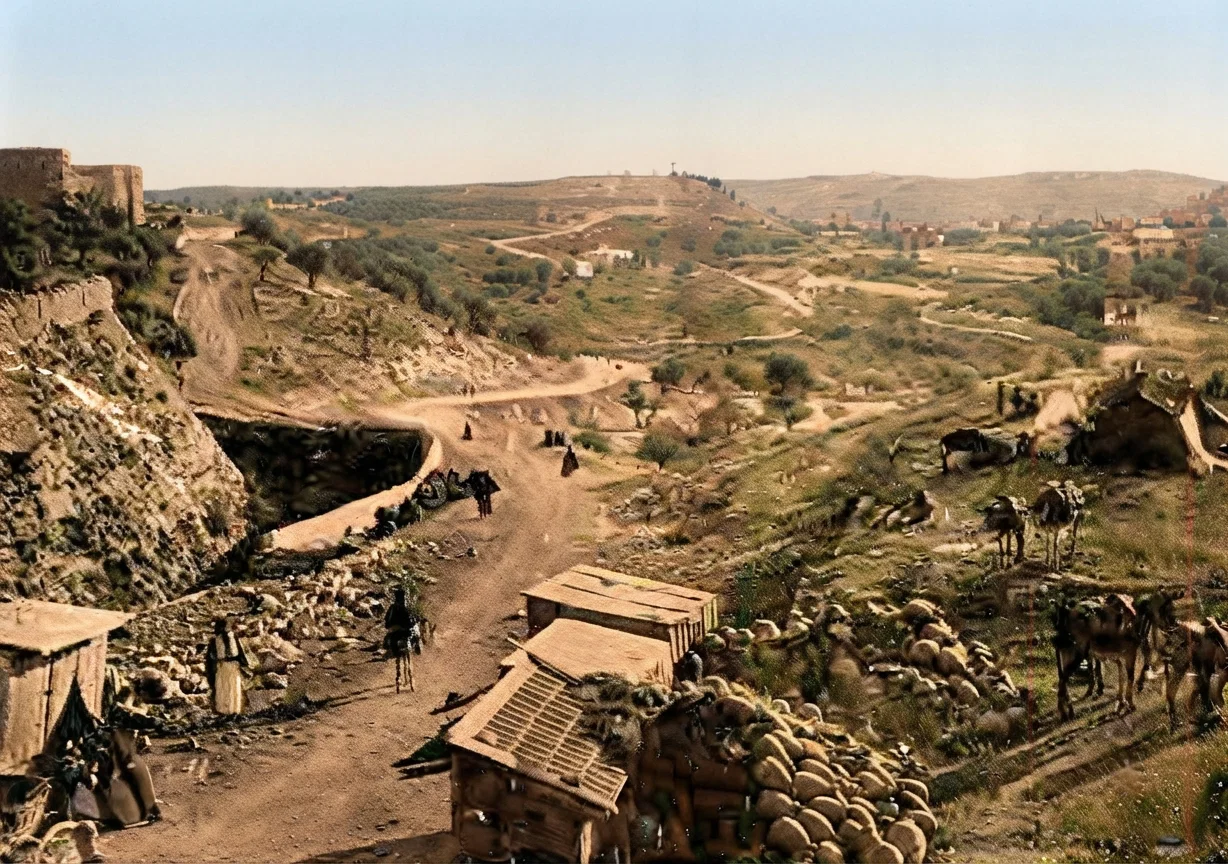
ROAD FROM JERUSALEM TO BETHLEHEM.
In the interests of Germany, the kaiser's tour was a sweeping success; in dramatic effect, it is unequaled in modern times; and it results in making Germany the most prominent and favored nation in the Orient. The emperor showed wisdom in not posing as the champion of Protestants, but as the head of German Christians of every creed, and manifested much tact in the presentation to Catholics of a piece of ground on Mt. Zion given him by the sultan. This not only augmented the rising fears of the French, but did much to make the emperor popular with his Catholic subjects everywhere.
During his sojourn at Constantinople, the emperor was usually active, visiting different parts of the city, the war harbor in the Golden Horn, the Bosporus and forts, and some places in the adjacent country. The sultan himself did not accompany his guest, as he dares not appear in public. His only movements are from his palace to a mosque near by, and from one palace to another, when he has a strong guard all along the line. During his short visit, the emperor doubtless saw more of the sultan's capital than the sultan himself has seen since his accession to the throne. The daily papers of Constantinople contained quite a number of illustrations of the imperial family, German officers, and Turkish dignitaries, but were remarkable for giving an account of the places to be visited by the emperor only after the visit was in the past.
The emperor was enthusiastically received in Palestine, specially by the German temple colonies at Mt. Carmel, Sarona, Jaffa, and Jerusalem. This was a wonderful event for these colonies. They were founded in the belief that in the literal restoration of the land of Palestine the temple would be rebuilt and the temporal millennium ushered in. Hence every move which tends to build up and make Palestine more prominent, is hailed with special joy by these colonists. They almost outdid themselves in their efforts to provide a suitable reception. The emperor's passage through the colonies was like a triumphal entry.
An interesting item in connection with this visit is the fact that Dr. Herzl, of Berlin, president of the Zionist congresses at Basel, and leader of the Zionist movement, met the emperor in Palestine and accompanied him to Damascus. A first step necessary to the success of the Zionists is to obtain permission for the Jews to settle in Palestine. Dr. Herzl sought and obtained promise of the emperor's aid in inducing the sultan to grant this permission. Altho the emperor's influence with the sultan is great, it is doubtful if he and the Zionists will succeed any better than the Roman emperor Julian and the Jews in their efforts to rebuild the temple, because the prophetic Word, which can not be broken, is against them.
To the Zionists, the Templars, and the Temporal Millennialists, the visit of the kaiser to the Orient is regarded as a step in the fulfilment of their hopes; but when read in the true light of prophecy, it only shows how the leading nations are becoming more involved in the Orient, where they will finally be gathered to the battle of Armageddon; and from this standpoint, it is a notable sign of the times, showing how rapidly and openly the way for the closing scene is preparing. H. P. H.
"LEST WE FORGET"—AN INDEPENDENCE DAY INCIDENT.
[From a news item in the The Evening Telegram, New York, July 5, 1898.]
THE patient was a tiny little girl—a sickly product of the slums, who had been found huddled in the corner of a side street suffering excruciating pain from severe burns on the soles of her feet . . . We asked her why she wore no shoes, but the question seemed to scare her strangely. It was only when the matron found in the little street arab's pocket a pawn ticket that the girl confessed and the mystery was evaporated. She told how her parents had started early in the day to celebrate the glorious anniversary of American independence, and she had been kept continually running for pints of beer, until the heat had made her drowsy and a dizziness had gathered on her. While on her last trip she had fallen, and dropped and lost the precious dime which was to buy beer for her brutal parents. Fearing to return home without the liquid refreshment—for she knew the beating which awaited her—she had done as her parents had often done before,—pawned her shoes to get the price of drink. She had not reckoned on the heated pavements and the blistering asphalt which lay in her path from the pawn-shop to the beer saloon, and thus her delicate little feet were burned until she could bear it no longer, and she fell to the sidewalk in agony.
This is no romance. It is a true story of an Independence day merrymaking. We sought to notify the parents, but they were past the point of understanding.
OUR WORK AND WORKERS.
By Editor
At Utilla, Bay Islands, a new church was dedicated November 13.
At Joplin, Mo., Brother L. W. Terry reports the addition of four members.
Brother H. M. Steward notes the conversion of four persons at Talona, Mo.
Four candidates were recently baptized at Talmage, Neb., says the Reporter.
The Minnesota Tract Society handled about half a ton of the special edition of the Signs.
The addition of two members to the church at Lovington, Ill., is reported by Brother C. H. Bliss.
During the recent season of prayer, two members were added to the church at Sigourney, Iowa.
Three converts are reported by Brother T. Painter, in connection with his labors at Danville, Va.
Seventeen persons were baptized at Council Bluffs, recently, after a discourse upon the subject by Brother L. Warren.
Four persons were baptized at Brockport, Pa., on the 18th ult. They were all members of one family,—father, mother, and two sons.
December 31, after a discourse by Brother S. H. Lane at South Side Church, Chicago, four candidates were baptized by Brother E. J. Hibbard.
It has been decided to establish a sanitarium at South Lancaster, Mass., under the auspices of the Medical Missionary and Benevolent Association.
At a recent meeting at Johnstown, Pa., three persons were baptized, and a time of praise and rejoicing is noted in a report to the Keystone Gleaner.
Under the labors of Brethren H. L. Bristol and F. H. De Vinney, at Lake Placid, N. Y., the conversion of four persons is reported as partial results.
The cause which we are advocating is represented at Port Said, Egypt, by a man who is a Swiss, and speaks German, French, Italian, and some English.
The addition of eight persons to our ranks, and the organization of a Sabbath-school of twenty-two members, at Midway, Mo., are reported by Brother H. D. Blood.
The mission at Peoria, Ill., was formally opened December 27. The exercises consisted of Scripture reading, prayer, and appropriate remarks by brethren and friends.
From Union College, College View, Neb., comes The Practical Educator, a new journal issued monthly, and printed on the college press. It is full of practical education; 8 pages and cover; 25 cents a year.
Some of our workers have written from the South Sea islands that our ship Pitcairn gives our people a good standing among the natives wherever it has appeared. The captain is known as a tangata maru, or kind man.
The Atlantic Conference has rented Chickering Hall, one of the most popular halls in New York City, for Sunday-night meetings during January, February, and March, on which nights Elder E. E. Franke will deliver a series of lectures.
From a report of President G. W. Reaser, of Upper Columbia Conference, in The Reaper, we learn that the brethren at North Yakima, Wash., are planning to build a new house of worship, and to turn the present edifice into a church school building.
A special course at Keene (Texas) Industrial Academy was commenced on the 18th inst., to continue ten weeks. The first three weeks will be given to studies adapted to public workers, then more detailed instruction will be given, the course to close with a canvassers' institute.
The Oriental Watchman says: "In Russia believers suffer hunger, cold, banishment, and death. Families are broken up and children left desolate. Our ministers flee from place to place to avoid arrest. Open preaching is impossible, yet within a few years more than a thousand persons have accepted present truth."
The Battle Creek College people have opened a training mission in Jackson, Mich. A centrally located three-story building has been secured for the purpose, with a hall on the second floor that will seat over two hundred persons. The usual lines of Gospel mission and Christian help work are being carried on by the students, under the direction of experienced mission workers.
READ AND PROFIT.
Is it true that you give to the cause of missions till you feel it?
If so, we would advocate the plan suggested by Mr. Moody, i. e., that you keep on giving until you do not feel it.
Don't you see it? When we give this Gospel to all nations as a witness, then—then shall the end be.
Worldly religions abound. Have you a knowledge of the Mighty One? Then expect strength to do exploits.
God is not mocked. In contributing to the missionary cause you are responsible as to how you give, where you give, when you give. Mark!
Have you the old-time fire? It will surely make you a missionary at heart.
"Is Jesus coming soon? Many learned and holy people say, Yes. If He does, many white-robed saints will get their crowns. But many will be without robes. Alas!"—Toronto Christian Worker.
MISSIONARIES WANTED.
By Christian Worker
A reliable exchange says that the following countries can be summarized as follows. This reports a great need:—
Korea, population 13,000,000, one missionary to every 194,000.
Morocco, population 6,000,000, chiefly Moslems, about sixty missionaries.
Brazil, population 16,000,000, with only 120 missionaries.
The 100,000 Chinese in America, 90,000 unreached by the Gospel.
Russia in Asia, population 16,000,000, nothing but a debased priesthood.
Algeria, population 4,000,000, chiefly Moslems, about 22 missionaries.
In missionary meetings and statistics, why is Afghanistan, with its closed doors and 5,000,000 people, invariably left out?—Christian Worker.
MISSIONS A SAFEGUARD.
By Daniel March, D.D.
THE only effectual safeguard against deadness and indifference, against worldliness and materialism, against vain speculation and false doctrine, against positive unbelief and renunciation of all faith, is to be found in keeping the divine commission to disciple the nations ever before the church and the world. Give that its due place in all doctrine, in all preaching, and praise, and prayer, in all plans and organizations for church work, in all training of the young, and in all collections for the treasury of the Lord, and then there will be little danger of letting down the standard of Christian living and consecration, little danger that many will cease to hold fast the form of sound words, or drift away from the firm anchorage of faith.—Daniel March, D.D.
SPEED AWAY.
SPEED away, speed away on your mission of light
To the lands that are lying in darkness and night.
'Tis the Master's command; go ye forth in His name;
The wonderful Gospel of Jesus proclaim;
Take your lives in your hand; to the work while 'tis day.
Speed away, speed away, speed away.
Speed away, speed away with the life-giving Word
To the nations that know not the voice of the Lord;
Take the wings of the morning and fly o'er the wave,
In the strength of your Master the lost ones to save;
He is calling once more, not a moment's delay,
Speed away, speed away, speed away.
Speed away, speed away with the message of rest
To the souls by the tempter in bondage oppress'd;
For the Saviour has purchas'd their ransom from sin;
And the banquet is ready, O, gather them in!
To the rescue make haste, there's no time for delay.
Speed away, speed away, speed away.
—Selected.
WHAT SHE THINKS OF THE PAPER.
By Editor
ONE person to whom the SIGNS had been sent for two years by a friend, thus writes of the paper:—
“it is one of the best papers for its scriptural teaching that I have ever received, and that is saying much, as I am a Baptist, and take several of my own denomination's papers. But the subjects treated in the SIGNS are brought out in such light that any one can get the exact meaning of the subject in such few words. Not only this, but I like it for its doctrinal teachings, as they do agree with the teaching of the Scriptures. The paper is read by my whole family and then it is given to my neighbors and friends to read. It seems to be enjoyed by all that read it. E. S. DOUGLASS.
“Burleigh, N. J.”
And so many other souls find it.
KEENE ACADEMY CORRESPONDENCE SCHOOL.
IN response to a number of calls from people in Texas and Oklahoma the Keene Industrial Academy has decided to start a school of correspondence for the benefit of those who for various reasons are unable to pursue a course of study at the academy. We think it best to offer only two lines of work at first, namely, Old Testament history and physiology. The former will be conducted by Prof. C. C. Lewis, and the latter by Dr. E. H. Mathewson. It is recommended that two hours' work each day be given to each subject, and that no person take more than one subject unless he can give four hours a day to the work, or is already somewhat proficient in the studies. The tuition for each subject will be $6.00 for forty-eight lessons.
For full particulars, with sample copies of the lessons, address, Keene Academy Correspondence School, Keene, Texas.
THE TALENTS. By M. C. Wilcox. A brief essay on "The Parable of the Talents," showing that the talents represent the various gifts of the Spirit which God bestows as he will upon those who are consecrated to him, with the duties and blessed privileges involved therein. Bible Students' Library, No. 77; 16 pp., price 2 cents.
The Sabbath School International Series.
LESSON V.—SABBATH, FEBRUARY 4, 1899.
MINISTRY OF JOHN THE BAPTIST.
In the Desert Near the Jordan, Spring of A.D. 27.
Note.—The texts inclosed in marks of parentheses, while not essential to the lesson study, will be found to throw much light upon the lesson, and are suggested for those who wish to study further.
1 "And in those days cometh John the Baptist, preaching in the wilderness of Judea, saying, Repent ye; for the kingdom of heaven is at hand. For this is he that was spoken of by Isaiah the prophet, saying,
The voice of one crying in the wilderness,
Make ye ready the way of the Lord,
Make His paths straight.
4 Now John himself had his raiment of camel's hair, and a leathern girdle about his loins; and his food was locusts and wild honey. Then went out unto him Jerusalem, and all Judea, and all the region round about Jordan; and they were baptized of him in the river Jordan, confessing their sins. But when he saw many of the Pharisees and Sadducees coming to his baptism, he said unto them, Ye offspring of vipers, who warned you to flee from the wrath to come? Bring forth therefore fruit worthy of repentance, and think not to say within yourselves, We have Abraham to our father: for I say unto you, that God is able of these stones to raise up children unto Abraham. And even now is the ax laid unto the root of the trees; every tree therefore that bringeth not forth good fruit is hewn down, and cast into the fire. I indeed baptize you with water unto repentance; but He that cometh after me is mightier than I, whose shoes I am not worthy to bear: He shall baptize you with the Holy Ghost and with fire: whose fan is in His hand, and He will thoroughly cleanse His threshing-floor; and He will gather His wheat into the garner, but the chaff He will burn up with unquenchable fire."
1 "Now in the fifteenth year of the reign of Tiberius Cæsar, Pontius Pilate being governor of Judea, and Herod being tetrarch of Galilee, and his brother Philip tetrarch of the region of Ituræa and Trachonitis, and Lysanias tetrarch of Abilene, in the high-priesthood of Annas and Caiaphas, the word of God came unto John the son of Zacharias in the wilderness. And he came into all the region round about Jordan, preaching the baptism of repentance unto remission of sins; as it is written in the book of the words of Isaiah the prophet,
The voice of one crying in the wilderness,
Make ye ready the way of the Lord,
Make His paths straight.
5 Every valley shall be filled,
And every mountain and hill shall be brought low;
And the crooked shall become straight,
And the rough ways smooth;
6 And all flesh shall see the salvation of God.
7 "He said therefore to the multitudes that went out to be baptized of him, Ye offspring of vipers, who warned you to flee from the wrath to come? Bring forth therefore fruits worthy of repentance, and begin not to say within yourselves, We have Abraham to our father: for I say unto you, that God is able of these stones to raise up children unto Abraham. And even now is the ax also laid unto the root of the trees; every tree therefore that bringeth not forth good fruit is hewn down, and cast into the fire." And the multitudes asked him, saying, "What then must we do?" And he answered and said unto them, "He that hath two coats, let him impart to him that hath none; and he that hath food, let him do likewise." And there came also publicans to be baptized, and they said unto him, "Master, what must we do?" And he said unto them, "Extort no more than that which is appointed you." And soldiers also asked him, saying, "And we, what must we do?" And he said unto them, "Do violence to no man, neither exact anything wrongfully; and be content with your wages."
16 "And as the people were in expectation, and all men reasoned in their hearts concerning John, whether haply he were the Christ."
SUGGESTIVE QUESTIONS.
While Jesus was yet with His parents in Nazareth, who began preaching in the wilderness of Judea? Matt. 3:1. (Luke 3:1; John 1:28.)
What was the burden of his message? Verse 2. Note 1. (Matt. 4:17; 10:7.)
What question did the publicans ask concerning their duty? Verse 12. Note 3. (Luke 7:29; Rom. 3:4.)
What very practical answer did they receive? Verse 13. (Luke 19:2, 8; Lev. 6:4.)
What counsel did John give the soldiers who inquired as to their work? Verse 14. (Ex. 23:7; Phil. 4:8.)
What condition of mind did the people find themselves in because of John's words? Verse 15.
Side Lights.—"Desire of Ages," pp. 97-108; "Spirit of Prophecy," vol. 2, pp. 41-57.
NOTES.
"At hand," that is, has come nigh. This was the herald of an expected Leader to take them forth from their wanderings in the wilderness of sin. See note 6 of lesson 3. Those to whom the Baptist preached were like their prototypes of old while in Egypt,—outside of God's kingdom, in the service of another king. Therefore the message to them in the wilderness was to be ready to sustain the better administration which was at hand, and so enter the kingdom of heaven.
Being the high priests.—At this time the Roman emperor claimed and exercised the right to appoint and depose the Jewish high priests, as he chose. All who served in this office must please the emperor. Annas, tho a sagacious and purchasable man, was not able to hold the office undisturbed. Appointed by Cyrenius, imperial governor of Syria, in A.D. 7 (Luke 2:2), he was obliged to resign at the beginning of the reign of Tiberius Cæsar, A.D. 14. He managed, however, to secure the office in turn for five of his sons, and for his son-in-law, Caiaphas, with whom he managed to be associated up to and beyond the time of the crucifixion of Christ Acts 4:6. See "Desire of Ages," p. 30.
Publicans, those holding public office, chiefly tax-gatherers. Doing this work under appointment of, and in the interest of, the Roman Government, this class was odious and despised in the eyes of their countrymen, not only as traitors, but extortioners of large profits out of the national degradation. They received, like all the others, an answer just suited to their needs.