Your ShelfYour Projects

Signs of the Times, Vol. 39, No. 49.

Question Corner

Signs of the Times

Dec 17, 1912

Pacific Press Publishing Association · Mountain View, California · Dec 17, 1912

Question Corner

"IF YE WILL INQUIRE, INQUIRE YE."

This Inquirers' Department is conducted for the purpose of helping those who are studying the Bible. The answers are oftentimes only suggestive. They are never to be considered infallible, only as they agree with the infallible Word. The writer who may answer them does not consider that his opinion is infallible. He will simply give the best that he has, and plead with the inquirer to search the Word. Such questions only will be answered as, to the editors, seem to minister to the good of the readers and to the mission of the paper. We can not answer repeatedly in the same volume questions upon the same scripture. The name and address must accompany question, not for publication, but as an evidence of good faith, and that answer may be made by letter if deemed advisable. No letters are answered which do not contain the name of the writer. It is well always to enclose stamp for reply.

3938 — The Tithe

Is the tithe for any special purpose, and that alone?
The tithe of the people anciently was used for the Levites, and the tithe of the Levites was used for the priests. In our own work we have used the tithe alone for evangelical work, the work of the ministry, the work of giving to the world the great truth of the gospel. There are those who believe in the tithing system, in various churches, and outside of churches, who use that tithe for everything in benevolent and religious lines; but it has seemed to us that the tithe is sacred for the one thing of giving the gospel to the world, and that these other funds fall into the class of offerings of various sorts. So the Lord teaches in Malachi 3, a prophecy evidently which refers to the last days, to the Christian dispensation, that His children have robbed Him in tithes and in offerings, and then asks that the whole tithe be brought into the storehouse, that there may be meat in His house. That is, the offerings men can give as they desire, can control them as they desire, can give them to any purpose they desire; but the tithe is to be brought into God's house, and God's ministers are to be supported from what is in His house. Such would seem to be the obligation that would naturally rest upon church-members. If one is not a church-member, he would be free to use his tithe outside of regular lines; but it would seem to us that one should not only use his tithe aright, but he should also unite with the Lord's children.

3939 — Reasons for Keeping Saturday

What are your strongest reasons for keeping Saturday, or what we call Saturday, for the Sabbath? Where is all of your scripture for doing so? Does your Sabbath begin at twelve o'clock at noon on what we call Saturday, and end at twelve o'clock noon on what we call Sunday? Do you make a distinction between the names "Sunday" and "Sabbath"?
1. We do not keep Saturday, that is, truly converted, Sabbath-keeping Christians do not. Saturday is a civil day, beginning at twelve midnight, and ending at twelve midnight. But the Sabbath begins at sunset on what is called Friday evening, and ends at sunset on what is called Saturday evening; consequently the days are not synchronous, or identical.
2. Our reasons for keeping the Sabbath are: First, the commandment of God: "Remember the Sabbath day, to keep it holy. Six days shalt thou labor, and do all thy work: but the seventh day is the Sabbath of the Lord thy God: in it thou shalt not do any work, thou, nor thy son, nor thy daughter, thy man servant, nor thy maid servant, nor thy cattle, nor thy stranger that is within thy gates: for in six days the Lord made heaven and earth, the sea, and all that in them is, and rested the seventh day: wherefore the Lord blessed the Sabbath day, and hallowed it." Secondly, the example of our Lord Jesus Christ, who kept His Father's commandments, who did no sin, who left us an example, that we should follow in His steps. John 15:10; 1 Peter 2:21, 22. He therefore observed the Sabbath (Luke 4:16, and elsewhere). Surely there can be no stronger reasons than the eternal law of God, sanctioned and confirmed by prophet, apostle, and Jesus Christ, and the example of our Lord Himself.
3. "Where is all your scripture for doing so?" It is all through the Bible. All there is said in the Bible at all regarding a weekly Sabbath applies wholly and exclusively to the seventh day. Take, for instance, the institution of the Sabbath in Gen. 2:2, 3, and connect with it Mark 2:27, 28, — "The Sabbath was made for man," and for man in the beginning, before there was a division of races, or nations, or tribes. See Ex. 20:8-11; also the whole of Exodus 16, showing how God marked it out during the falling of the manna; Isaiah 58:13; 66:22, 23; Luke 23:56. Then regarding the whole law of God, of which the Sabbath is a part, see Matt. 5:17-20; Ps. 111:7, 8. The last generation of men who will welcome the Lord Jesus Christ keep the commandments of God and the faith of Jesus. Rev. 14:12. These are only a small portion of the scriptures there are to confirm the great Sabbath truth.
4. "Does your Sabbath begin at twelve o'clock?" No; as before stated, it begins at sunset. "From even unto even, shall ye celebrate your sabbath." Lev. 23:32. See also Neh. 13:15-22, which clearly shows that the Sabbath began at sunset, when the heavy shadows began to creep in; and this also is intimated in Matt. 8:16; Mark 1:32; Luke 4:40. If the context is read, it will be seen that this day was the Sabbath. The Jews would not bring their sick to be healed on the Sabbath day, on account of their superstition; but as soon as the sun set, they came with all their sick; showing that the Sabbath closed at sunset. This is also in harmony with the making of the days in Genesis 1, — "The evening and the morning were the first day," "the second day," "the third day," and so on, giving man, wherever he may be on the earth, a sure knowledge of the beginning and the closing of the day, and also the blessed privilege of welcoming the Sabbath when it comes, and bidding farewell to it as it goes, — something which the Sunday keeper knows nothing of.
5. "Do you make a distinction between the names 'Sunday' and 'Sabbath'?" Certainly we do. "Sunday" is the purely heathen name of the day, so called in honor of the sun, to whom it was dedicated. Sabbath is the divine name, which comes from God's rest upon that day.
If our correspondent wishes to enter into the Sabbath question in a broader study, we commend to him "The Lord's Day the Test of the Ages," a little pamphlet costing 10c, which covers the Sabbath in all dispensations.

3940 — Melchizedek

Who was Melchizedek? Was he from another world?
The Bible calls him "the priest of the most high God." See Hebrews 7; Genesis 14. He is also said to be "the king of peace," and "the king of righteousness," which is also "the king of Salem," for "Salem" means peace. It has been strongly advanced that Melchizedek was a visitor from another world, and the head of another world, even as Adam was designed to be the head of this world, and that in God's plan for a time he visited this world, and Abraham paid him homage. Great as Abraham was in God's sight, he paid homage to the Melchizedek whom he met. We have not space here to trace the evidences which would seem to indicate that it is quite probable that Melchizedek was such a being as this. It certainly is worthy of great study.

3941 — Putting Away and Marrying

Will you please explain Matt. 5:32; 19:9?
Both scriptures are in perfect harmony, and teach practically the same thing. "Whosoever shall put away his wife, saving for the cause of fornication, causeth her to commit adultery: and whosoever shall marry her that is divorced committeth adultery." And the 9th verse of the 19th chapter reads, "Whosoever shall put away his wife, except it be for fornication, and shall marry another, committeth adultery." It seems that the exception is very clearly and definitely marked, that if there is fornication, the wife or the husband could be put away, or divorce secured; and the innocent party would be free to marry again under that exception. The other one, by turning from the lawful husband or wife and committing fornication, had become dead to the former partner. But it does not give the guilty party the right to marry again on a Scriptural basis, and whoever marries the guilty party partakes with that guilty party in the sin. This, it seems to us, is the teaching of the text. We know there are those who believe that divorced persons should never marry again, from whatever cause; but in both of these cases the Lord has given us a very clear exception, and the other texts should be understood in harmony with it. Sometimes there are those who have thus separated, and the guilty party has married in harmony with the laws of the world, not knowing, or realizing, or appreciating, and perhaps not caring, for what is said in the Scripture regarding it. Their course, so far as the law of the land is concerned, has been perfectly legal. Children have been born to such marriages, and afterward those souls have embraced the gospel message of truth. What should they do? We would say that they had better remain married just as they are. When they came to Christ, He accepted them just as they were, and did not design by that to break home ties, or marriage ties, or take away from the father or the mother the responsibility of caring for their offspring. What our Lord is saying here He is saying to His own children. The only way to do is to let the marriage bed be undefiled; but if one proves false, there is no reason why the other should go on forever crippled. To the sinning one God offers free and full pardon. Let him or her go on in humble obedience to God the rest of his life.

3942 — What Kind of Stars?

Kindly explain Gen. 1:16. What kind of stars are here meant? and how does the creation of sun and moon at that time agree with astronomy?
Gen. 1:16 seems to be simply the statement of a fact. The language may be the language of appearance. "In the beginning God created the heavens and the earth," and the sun and the moon may have been created at that time, but they had not appeared, and would not have been seen if some one had been dwelling on the earth previous to the fourth day; but at the time of the fourth day, the great cloud-envelope which enswathed the earth was removed, and the sun and the moon appeared, and, of course, in the night the stars also. All that is expressed in Gen. 1:16 is that God "made the stars also." It says nothing about as to when they were made. The thought given in the Revised Version, if we omit "He made" (italicized words which are not in the original), is that God gave the greater light to rule the day, the lesser to rule the night, "the stars also" to rule the night; that is, the inhabitants of the world would have these at night. We know nothing in this that is against true astronomy.

3943 — The Different Races

Can it be proved from the Bible that all the different races of people sprang from Adam?
Yes, if we believe the Bible. We have a line of Adam's descendants down to Noah. The earth was then depopulated, with the exception of Noah and his family. According to the same Word, from the three sons of Noah, and doubtless from Noah himself, sprang the inhabitants of this world, and the distribution into families, or tribes, as indicated by Genesis 10. From the cradle of the race, the descendants of these sons spread out into the different parts of the earth; and from them sprang the various races of earth. Some have thought that the Chinese (yellow men) sprang from Noah himself. From Shem sprang the Semitic families, such as the Assyrians, Israelites, etc.; from Ham the colored races, and from Japheth the white races. See "The Origin of Nations," by G. Rawlinson.

Schedule for Ten Days Closing December 31, 1912

Schedule for Ten Days Closing December 31, 1912
Sunday December 22 Revelation 3, 4; Ps. 139 Monday " 23 " 5, 6; Ps. 47 Tuesday " 24 " 7, 8; Ps. 141 Wednesday " 25 " 9, 10; Ps. 142 Thursday " 26 " 11, 12; Ps. 143 Friday " 27 " 13, 14; Ps. 37 Sabbath " 28 " 15, 16; Ps. 144 Sunday " 29 " 17, 18; Ps. 147 Monday " 30 " 19, 20; Ps. 146 Tuesday " 31 " 21, 22; Ps. 148
We conclude in this the book of the Revelation, with Psalms 139, 47, 141-143, 37, 144, 147, 146, 148. We began our reading of the Scriptures with the Paradise of God as the earth came from the hand of its Creator. We have passed over, in our reading, God's view, as well as remedy, of the awful condition of sin, and we close with Paradise restored, and God's children safe at home. The earth teaches us the paths of sin; God's Word, the paths of righteousness through the vale of sin to the everlasting regions beyond. We hope that all our readers who have taken this journey through the Scriptures may find the Paradise home at last.

A Lesson from the Experience of Judas

It was a grief to the Saviour that His disciples failed to comprehend the character of His kingdom. He plainly stated to His followers the humiliation, suffering, and death that awaited Him; but they seemed to be unable to understand it, and on the way to the scene of the Saviour's trial and death, disputed among themselves who should be greatest in His kingdom. Judas was numbered among the twelve. He was accepted, not because he was perfect, but notwithstanding his imperfections. Peter, James, and John were not perfect characters, but they were received by the Master in order that they might be molded by the words He should speak, and the example He should set before them. Judas had witnessed the power which the disciples had over the unclean spirits, and could testify that the devils were subject unto them.
But the often repeated statements of Christ in regard to His kingdom not being an earthly kingdom, created thoughts of disaffection in the mind of Judas. He had marked out a line upon which he expected Christ to work. He had planned that Christ should deliver John the Baptist from prison, and, lo! John was left to be beheaded in prison, and Jesus withdrew Himself and His disciples into a country place, instead of avenging the death of John. Judas wanted more aggressive warfare established, and thought that if Jesus would not hold them back from carrying out their schemes, they would be more successful. Doubt became more established in his mind as he saw the gathering enmity of the Jewish leaders, and saw the challenge go by unheeded by Christ when they requested that He should show them a sign from heaven. His heart was open to unbelief, and the enemy supplied mind and heart with thoughts of questioning and rebellion. Why did Christ dwell so much upon that which was discouraging, portraying His trials and persecutions, and describing the trials and persecutions which His disciples must endure? Why did He refer to His own humiliation and death? Were their hopes to be all disappointed? Was it not the prospect of having a high place in the new kingdom which God was to establish that led him to espouse the cause of Christ? Judas had not decided that Jesus was not the Son of God, he had not made up his mind that He performed miracles through the agency of Satan; but yet he was questioning, and seeking to find some way by which he could explain the mighty works which He did.
The other disciples were as unwilling as was Judas to receive the statement concerning Christ's humiliation and death, for it seemed to them to mean an end to all their hopes; but when Christ presented before them His true mission, they were not offended, but appreciated the spiritual good that was to come, altho they but dimly perceived its nature. "Jesus said unto them, I am the bread of life: he that cometh to Meshall never hunger; and he that believeth on Me shall never thirst. . . . Verily, verily, I say unto you, Except ye eat the flesh of the Son of Man, and drink His blood, ye have no life in you. Whoso eateth My flesh, and drinketh My blood. . . . dwelleth in Me, and I in him. As the living Father hath sent Me, and I live by the Father: so he that eateth Me, even he shall live by Me. This is that bread which came down from heaven: not as your fathers did eat manna, and are dead: he that eateth of this bread shall live forever. . . . Many therefore of His disciples, when they had heard this, said, This is an hard saying: who can hear it? When Jesus knew in Himself that His disciples murmured at it, He said unto them, Doth this offend you? What and if ye shall see the Son of Man ascend up where He was before? It is the spirit that quickeneth; the flesh profiteth nothing: the words that I speak unto you, they are spirit, and they are life. But there are some of you that believe not. For Jesus knew from the beginning who they were that believed not, and who should betray Him. And He said, Therefore said I unto you, that no man can come unto Me, except it were given unto him of My Father."

Rejecting Truth

Jesus, the Lord of life and glory, was about to suffer an ignominious death, and He spoke plain truth in order that the characters of all those who professed to be His disciples might be developed, so that the true and faithful might not have added to their trials the discouragement that these doubters and questioners should bring upon them at His death. Judas was among those who said, 'This is an hard saying; who can hear it?' 'From that time many of His disciples went back, and walked no more with Him. Then said Jesus unto the twelve, Will ye also go away? Then Simon Peter answered Him, Lord, to whom shall we go? Thou hast the words of eternal life. And we believe and are sure that Thou art that Christ, the Son of the living God. Jesus answered them, Have not I chosen you twelve, and one of you is a devil? He spake of Judas Iscariot the son of Simon: for he it was that should betray Him, being one of the twelve.'
It was at this very time that Judas made shipwreck of faith. After this he permitted doubt, envy, suspicion, bitterness, and hatred to be his guests. He became jealous at once when he was not included among the three who were chosen to witness the transfiguration of Christ upon the mount. When the disciples disputed by the way as to who should have the supremacy, his voice was often heard. In all that Christ said to His disciples, there was always something with which he disagreed, and the leaven of disaffection was fast developing under the influence and presence of Judas. When he witnessed the manifestation of the fervent love of Mary as she anointed the feet of Christ with the precious ointment, his very spirit seemed turned to gall. He manifested his covetous nature, and displayed his malice and hatred.
Judas was not a doer of the words of Christ. He had had every advantage given him in order that he might learn lessons concerning Him who brought to light life and immortality, but he failed to overcome his selfish spirit, and cherished covetousness, which is idolatry, and did not cleanse the soul temple of its defilement. Every human soul has some mastering passion which must be overcome or it will overcome him and plunge the soul into ruin. Christ said: 'Wo unto the world because of offenses! for it must needs be that offenses come; but wo to that man by whom the offense cometh! Wherefore if thy hand or thy foot offend thee, cut them off, and cast them from thee: it is better for thee to enter into life halt or maimed, rather than having two hands or two feet to be cast into everlasting fire.'
Each one has a work of overcoming to do. If the objectionable trait of character is not overcome, Satan will take advantage of the defect, and thereby defile the whole man.
While Jesus was at Bethany, He told His disciples of what was to come to pass in a few days from that time. At the Passover the case of Judas was decided. Satan took control of heart and mind. He thought that Christ was either to be crucified, or would have to deliver Himself out of the hands of His enemies. At all events, he would make something out of the transaction, and make a sharp bargain by betraying his Lord. He went to the priests and offered to aid them in searching for Him who was accounted the troubler of Israel. Thus it was that the Lord was sold as a slave, purchased by the temple money used for the buying of the sacrifices.
Satan bound Judas to his side to be his human agent to work the death of the Son of God. But conscience was not yet dead in Judas, and when he saw Jesus deliver Himself into the hands of those who would condemn and crucify Him, Judas rushed in to the priests, exclaiming: 'I have sinned in that I have betrayed the innocent blood. And they said, What is that to us? see thou to that. And he cast down the pieces of silver in the temple, and departed, and went and hanged himself.' As he saw Jesus given into the hands of His enemies, he remembered the words He had spoken in Gethsemane, 'Betrayest thou the Son of Man with a kiss?' His master passion had spent its force, and reason again held sway; but he felt nothing but despair. He knew that Christ was the Son of God, and that he was His betrayer. The leaders of Israel heartily despised his base conduct. Tho they had taken advantage of his covetousness and hatred, yet when he repented, and turned to them with a confession of his guilt, they spurned him, and left him to die in his sins. Judas failed to have a place among the sanctified, because he failed to learn of Christ the daily lessons that He would teach His followers, of meekness and lowliness of heart. He failed to learn the lessons of faith that the other disciples finally learned, and thus became heirs of God and joint heirs with Jesus Christ.

Signs of the Times

"Even as we have been approved of God to be entrusted with the Gospel, so we speak; not as pleasing men, but God, who proveth our hearts."

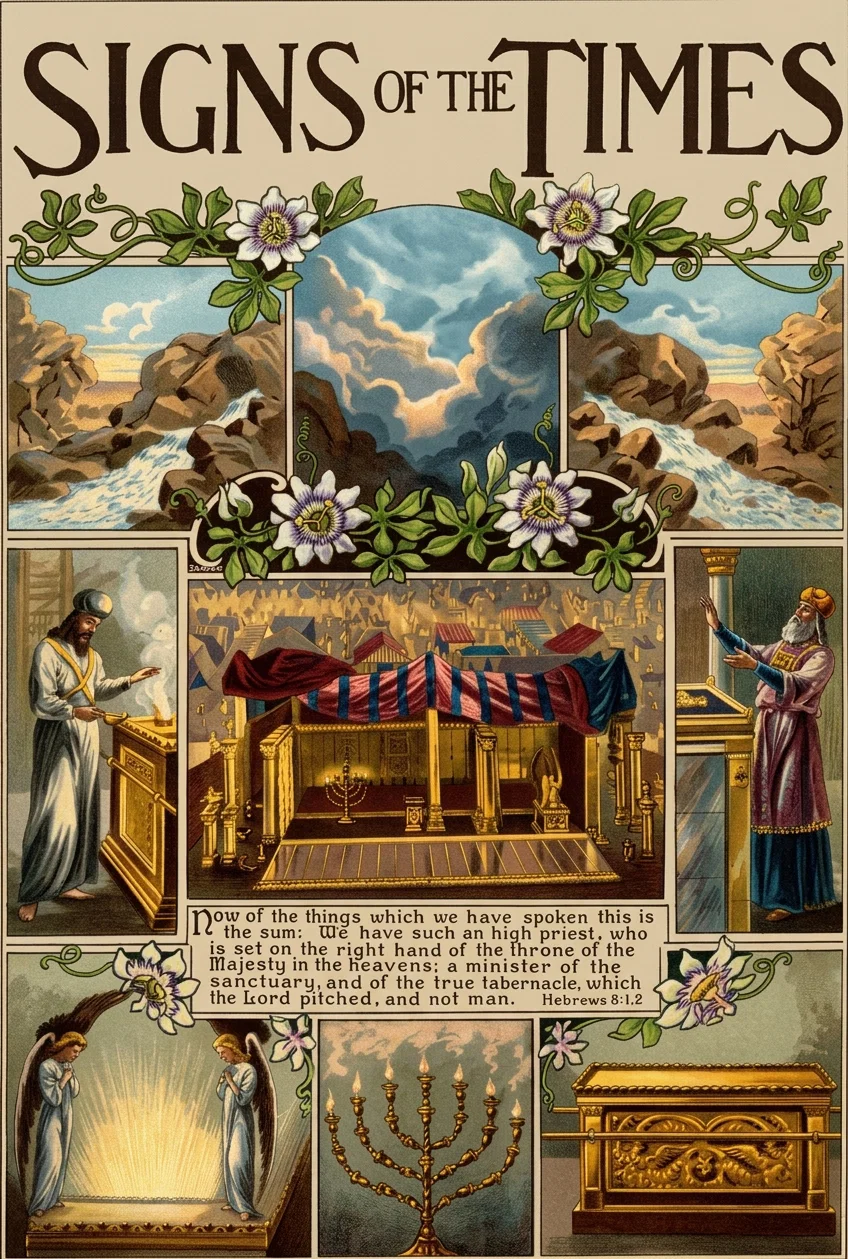
The Levites; Garments of the Priests

The Levites

ONE entire tribe of Israel was set apart for the service of the sanctuary. When we remember the last words spoken to Levi by his father Jacob, as he lay on his death-bed, we might wonder that the tribe of Levi was chosen for that sacred work. When Jacob remembered the sins of Levi, he pronounced almost a curse instead of a blessing upon his son, and closed it with these words: "I will divide them in Jacob, and scatter them in Israel." Gen. 49:5-7.
Wondrous is the love of our God, that can change a curse into a blessing. Neh. 13:2. Only a mighty God can change scarlet sins, and make them white as snow. Isa. 1:18. The impulsive nature that under the control of Satan drives a man to commit desperate crimes, is not removed when he is converted. It is the same impetuosity, consecrated under the control of Christ, that makes the same man a valiant warrior for the Lord. Saul, the desperate persecutor, when converted was Paul, the leading apostle. The fearless character that when controlled by Satan led Levi to murder the Shechemites, when controlled by the grace of God enabled the Levites to take their stand boldly on the Lord's side when the mass of Israel went over into idolatry. Ex. 32:26-29. God then turned the curse into a blessing; He said because they had observed His law and kept His covenant, they should teach Jacob His judgments and Israel His law. Deut. 33:8-11.
In order that their influence for good might be more widely felt throughout Israel, the Lord, instead of giving them one portion of the land for their inheritance, as He had given the other tribes, appointed as the portion of the Levites forty-eight cities scattered among all the tribes. Num. 18:20; 35:1-8. Truly they were divided in Jacob and scattered in Israel; but the curse was turned into a blessing. Our God is the same "yesterday, and to-day, and forever." When He pronounces evil against a nation or individual because of their wickedness, if they turn from their evil, God says He "will repent of the evil" He "thought to do unto them," and as in the case of Levi, a blessing will come instead of the curse. Jer. 18:7-10.
The term "Levite" was applied to all the priesthood, but only the descendants of Aaron were to hold the office of priest. The remainder of the tribe were to do the service of the sanctuary under the direction of the priests. The Levites were not allowed to officiate as priests at the altar of burnt offering, nor to do any of the priest's work within the veil. The Levites were to serve or minister to the priests; but the priests were to minister for the people before the Lord. Num. 18:1-8. The Levites were consecrated to the work of the sanctuary by the whole assembly of Israel laying their hands on the heads of the Levites before the Lord, and then Aaron offered "the Levites before the Lord for an offering of the children of Israel." Sacrifices were also slain to complete the consecration. Num. 8:9-14. The Levites were taken by the Lord instead ofthe first-born of Israel. Num. 8:17, 18. While journeying in the wilderness, they carried all that pertained to the tabernacle; but altho they carried the sacred furniture of the sanctuary, they were never permitted even to look upon it. Neither could they offer sacrifices or burn incense. Num. 4:20.
After the temple was built, the work of waiting on the priests in the sanctuary service was given to the Levites. They prepared the showbread, often led the singing, collected the tithe, and did a large amount of work in connection with the service of the Lord. 1 Chron. 23:24-32.
In the time of David, they began the service of the sanctuary at the age of twenty. At fifty years of age they were "to return from the warfare of the service." Num. 8:25, 26, margin. They were not discharged; they still had charge of the work, but were not expected to perform arduous duties. The work of the Levites was largely confined to the court, and thus typified the work of the gospel ministry of the present day.

Garments of the Priests

The garments worn by the ordinary priests were of white linen, a fit emblem of the "Spotless One" of whom their ministry was a type. The white robe was woven in one piece, and extended nearly to the feet, confined at the waist with a white linen girdle, embroidered in blue, purple, and red. A white linen turban or bonnet covered the head. These articles, with the linen breeches which were worn by all officiating priests, completed the costume of the common priests. These garments of white linen were made for "glory and for beauty." Ex. 28:40-42. Only the family of Aaron could wear the beautiful garments of the priest; but there are robes of "fine linen, clean and white," in store for every overcomer. Rev. 19:8. Even in this life, Christ clothes His faithful ones with "the garments of salvation" and "the robe of righteousness." Isa. 61:10.
The pure white garments were worn by the high priest on ordinary occasions; but when he entered the most holy place to make atonement for the people, he was clad in gorgeous robes which fitly represented our High Priest as He confesses the names of His people before the judgment-seat of the Judge of the whole earth. The high priest always wore the long, white linen robe of the common priest. Over this was a robe of blue woven in one piece, beautifully ornamented around the skirt with golden bells and pomegranates of blue, purple, and scarlet. The ephod, a beautiful embroidered sleeveless garment of gold, blue, purple, scarlet, and white, was worn over the blue robe. This was shorter than the other garments, and confined at the waist by a beautifully embroidered girdle of the same color.
On the gold-embroidered shoulders of the ephod were two onyx stones. The names of the twelve tribes of Israel were engraved on these stones, six names on each shoulder, thus typifying the Mighty One who bears the perplexities and burdens of His people upon His shoulder. Isa. 9:6. While the robe of blue, with its golden bells and the handsomely embroidered ephod, was beautiful, yet the crowning feature in all the gorgeous robe of the high priest was the breastplate worn over his heart as he officiated in the holy of holies before the Lord. The breastplate was of the same material as the ephod. It was in the form of a square, and measured a span. There were twelve precious stones, arranged three in a row, and set in gold. On each stone was engraved the name of one of the tribes of Israel.
The stones of the breastplate were the same as those forming the foundation of the New Jerusalem. In the breastplate were two brilliant stones, called the Urim and Thummim. By means of these stones, the mind of the Lord could be ascertained through the high priest. When questions were asked, if light encircled the precious stone at the right, the answer was in the affirmative; but if light encircled the stone at the left, the answer was negative. The breastplate was attached to the ephod, and that is why we read of David calling for the priest to bring the ephod when he was undecided as to what course to pursue, that he might know the mind of the Lord.
There was one other article belonging to the high priest's garments,—the miter. It was a gold plate bearing the inscription "Holiness to Jehovah." This was fastened by a blue lace to the white linen bonnet or turban worn by the priests. No priest was allowed to wear the priestly garments, except when officiating in the work of the sanctuary. Eze. 44:19. There was a beautiful significance to the high priest's wearing the names of all Israel on his shoulders and over his heart as he performed the work which typified the judgment when the cases of every one will come up in review before God. The breastplate was called the breastplate of judgment. Ex. 28:15. These names engraved on the stones were a beautiful type of the names of the overcomers which Christ will confess before the Father and the angels. Stone is an enduring substance; but far more enduring is the Book of Life, where the confessed names are written to remain forever. Rev. 3:5.

TYPE

Ex. 28:32. The high priest's garment was woven all of one piece. Ex. 28:15-21. The breastplate of judgment contained the names of the twelve tribes, and was worn over the heart of the high priest as he performed the work which typified the judgment work.

ANTITYPE

John 19:23. Christ's earthly garment was woven in one piece. Rev. 3:5. As each individual name comes up in review before God in the judgment, Christ will confess the names of the overcomers, and their names will remain in the Book of Life.
Continue reading: God’s Message for To-Day