Your ShelfYour Projects

Signs of the Times, Vol. 36, No. 37.

The End of Right Study

Signs of the Times

Sep 22, 1909

Pacific Press Publishing Association · Mountain View, California · Sep 22, 1909

The End of Right Study

My son, if thou wilt receive my words, And lay up my commandments with thee; So as to incline thine ear unto wisdom, And apply thy heart to understanding; Yea, if thou cry after discernment, And lift up thy voice for understanding; If thou seek her as silver, And search for her as for hid treasures: Then shalt thou understand the fear of Jehovah, And find the knowledge of God. For Jehovah giveth wisdom; Out of His mouth cometh knowledge and understanding: He layeth up sound wisdom for the upright; He is a shield to them that walk in integrity; That He may guard the paths of justice, And preserve the way of His saints.

Question Corner

[To Our Inquirers.—(1) The name and address of all who ask questions must accompany questions, not necessarily for publication, in token of good faith, and that we may reply by letter if thought best. All communications will be considered confidential if so desired, and no name will be published unless requested. But we have no time to give to anonymous or unsigned epistles or articles. (2) Let the questions be to the point. Do not say, “Explain Josh. 7:1-8,” but state the thing upon which help is desired. (3) Questions can not be answered immediately in this department. Sometimes it will mean a month or more of waiting. We can not reply to the same question frequently. Read answers to other questions; you may find reply to yours. (4) Members of the Bible Band will kindly enclose stamp if answer is desired by letter. Others will please enclose ten cents. This does not begin to meet expenses oftentimes. (5) “Foolish . . . questions avoid.”

2939.— The Seventh Day.

How do we know that the seventh day as we now record it is the same seventh day as in Bible times? W. M.
There are a goodly number of reasons which we can only mention in brief. First of all, is it reasonable to suppose that God would give a commandment to keep a certain day, naming that day so positively, so definitely, and yet permit man to be so utterly uncertain in regard to his duty and to the truth of God’s object in the giving of the law? No one who believes God to be a God of love, could hold to this for a moment.
2. Whatever may have been the condition of things previous to the Exodus from Egypt, God pointed out the true seventh day by a threefold weekly miracle for forty years in the fall of the manna, as recorded in Exodus 16. Whatever may have been the condition of His people spiritually, they could not misunderstand the day which God Himself miraculously marked. That was the day enjoined by the fourth commandment. Ex. 20: 8-11. Therefore fifteen hundred years before Christ His people knew the day.
3. There is no question as to the knowledge of the day during the Jewish dispensation. They all knew it and all who were faithful kept it. That was the same seventh day which they were keeping when our Lord Jesus Christ came to this world. He found them observing that day; He Himself regarded it. Luke 4:16. In His deeds of blessed ministry He tells us “It is lawful;” that is, in harmony with the law, “to do well on the Sabbath day.” Matt. 12:12. When He died, it was still honored by His disciples. Luke 23:56.
4. That same seventh day was the day just before the first day of the week. Read the first verse of Luke 24; read Mark 16:1, 2, and there learn that the Sabbath day kept by His disciples, honored by our Lord, was the day which came just before the first day of the week.
5. There has been no change of time or question of change of time from that day to this—as demonstrated by all history and astronomy.
6. Not only has it been demonstrated by history and astronomy, but before us is a chart of the week in 160 languages and dialects of the world. Some of the peoples to whom these languages belong have had no connection with each other; have been entirely separate in their history and in their customs; and yet every one of these languages shows the week to be identical, and 108 of the 160 show the seventh day to be the Sabbath, a holy day. It is a testimony that can not be set aside. That chart was prepared by the late William M. Jones, D.D., of London, a noted antiquarian, and His Royal Highness, Prince Louis Lucien Bonaparte, a noted European linguist.
It might be said in conclusion that all of the various creeds of the Christian church have demonstrated the same thing by keeping what they call the day of the resurrection, the first day of the week, commonly called Sunday.

2940.— Historic Dates.

I enclose a slip containing statements concerning our Lord’s life. Are they true? W. F. K.
They do not pretend to be wholly reliable. The sheet itself declares: “The above dates are correct for all practical purposes.” They are not really to be depended upon. For instance, the crucifixion of Christ occurred in A.D. 31 instead of A.D. 32; His resurrection and ascension, of course, the same year. Jesus’ public ministry was nearer three years and six months than it was three years and three months. The best way in such a case as this is to look up good authorities. You will find the birth and death and resurrection of Jesus traced quite fully in “Man’s Sin and Saviour,” by Uriah Smith, also “Thoughts on Daniel,” and “The Sanctuary and Twenty-three Hundred Days.”

2941.— Under the Law.

What is the meaning of “not under the law”? Does it mean that we are not obliged to obey the law? H. J.
In the text in Rom. 6:14, to which our querist has reference, it does not mean that we are not to obey the law, but it means that we are not held in condemnation by the law, and so the expression is generally used. The man who sins is bound down by the law; he is held in bondage, in subjection; “shut up” as the apostle expresses it in Gal. 3:23. Grace takes him out from under that condemnation by imparting to him, through faith, the righteousness of God, so that the Lord looks upon him now as clothed with the character of Christ. That same faith brings him into perfect harmony with God’s law, so that God writes the law in his heart. Heb. 8:10. He is no longer, then, under the law, or condemned by the law, but the law is in his heart, and he rejoices in all its glorious beauty. That law, too, witnesses in perfect harmony with the righteousness which God has given him by faith. Rom. 3:21-23. The law therefore no longer condemns him, but he says with the psalmist, “O how love I Thy law! it is my meditation all the day.” Ps. 119:97. This is in perfect harmony with the apostle John: “For this is the love of God, that we keep His commandments: and His commandments are not grievous.” 1 John 5:3.

2942.— The Marriage Contract.

According to the Scripture, is a civil contract necessary in marriage? Do the usual promises make a couple man and wife? If so, why could a couple not make those promises and become united without the aid of a third party? A friend contends that the unity is recorded in heaven when the couple become engaged and promise everlasting love and fidelity. Is a ceremony necessary? I read that in Bible times a man served his bride’s father so many years, then she became his wife. L. D.
The Scripture tells us that we should submit ourselves to “every ordinance of man for the Lord’s sake.” Most governments require a regular marriage ceremony by priest, preacher, or justice of the peace. Each one of these becomes, under the law, a civil officer authorized to perform marriage, however the religious ceremony may be regarded. In several states, what is called a “common-law marriage” was legal, and that may be even true now. We have not a copy of the latest marriage laws before us. In “common-law” marriage the parties themselves promise before witnesses to regard each other as man and wife; but such marriages are and ought to be discouraged. It belongs to the public, it belongs to the children which may be the fruit of such marriages, and it belongs to decent usage, that the parties should be married in the regular way. It always looks as tho there were something wrong if this is not the case. Of course, if the law of the country or of the tribe demanded only certain contract between the two parties, written or verbal, more perhaps would not be necessary; but it seems to us that no woman, at least, would be satisfied with anything else than a proper marriage with some kind of a marriage ceremony and some kind of a legal officer to perform it. So also the honorable man.
We have but one record in the Bible of a man’s serving his bride’s father, and that was in the case of Jacob for Rachel. That had nothing to do with the marriage law or custom; simply and solely, it related to those two parties. Jacob was anxious to get Rachel for a wife; Laban was anxious to get as much as he could out of Jacob; consequently the service. They had, however, their laws and ceremonies which have not been recorded to satisfy our curiosity.

2943.— The Race of Adam.

In your opinion, was Adam a white person, or black, or ruddy? J. J. S.
The word “Adam,” we are told by some authorities, means “red,” or “ruddy.” It is the word usually translated man. It would seem from the Bible that the Semites were the propagators of Adam’s characteristics and complexion to some extent, altho, of course, greatly degenerated. They belonged to the white race, and yet a healthy white race with ruddy complexion.

OUR BIBLE BAND

Schedule for the Week Ending Oct. 2, 1909.

Morning Evening
Su. Sept. 26 Isa. 1, 2 Gal. 5
Mo. " 27 " 3, 4 " 6
Tu. " 28 " 5, 6 Eph. 1
We. " 29 " 7, 8 " 2
Th. " 30 " 9, 10 " 3
Fr. Oct. 1 " 11, 12, 13 " 4
Sa. " 2 " 14, 15, 16 " 5:1-16

Suggestive Notes.

Our morning readings begin with the writings of the evangelistic prophet, as Isaiah is often called; a book that is filled full of Gospel truth. It is one of those books which has been the special target of modern criticism, but which in its inherent excellence bears its own best testimony to its authenticity and divinity. It was written from 760 to 700 years B.C., as we are told in the first verse, during the reigns “of Uzziah, Jotham, Ahaz, and Hezekiah.” Isaiah was therefore a prophet of Judah. Chapters 1 to 5 speak of the backsliding of God’s people then, and use their condition as types of last-day apostasies.
Chapter 2 especially points out the great fact that even in the midst of this apostasy there will be a cry which will go up, of universal peace, a peace for which there is no true ground; for the very ones that declare it are themselves apostate. On the other hand the Lord declares that in the last great day all the glory of men shall be laid low and Jehovah alone shall be exalted.
Chapter 6 records a vision given to the prophet Isaiah, a vision fulfilled when Israel was cast off as a nation. We next have—chapters 7 to 9—the story of a conspiracy against Judah. The king reproves them for the lack of faith in God. The conspiracies of those days are used as types of the conspiracies which shall be formed in the last days.
A wonderful prophecy is given us of Christ Jesus in chapter 9:6, 7. The same general features are characteristic of chapters 10 to 12. Reproofs of great sins in the days of the prophecy, look forward to similar conditions in the last days, and the great deliverance at the coming of Christ.
Chapters 13 to 16 are predictions concerning Babylon, Palestina, and Moab.
Our New Testament readings begin with the 5th chapter of Galatians and close with the 16th verse of the 5th chapter of Ephesians. The book of Ephesians was addressed primarily to the Christians in the great city of Ephesus in Western Asia, and written about the year A.D. 64. It is one of the most wonderful books of the New Testament in its deep, spiritual truth, and will bear much study, meditation, and prayer. It shows God’s plan to be the same in eternity, in Christ Jesus, in time, in the Holy Spirit’s operation—all the manifestations of Deity—working through manifold grace, to fit a people, whose characters were before marked out, to be to all eternity “to the praise of His glory.”

Noted Mountains of Scripture

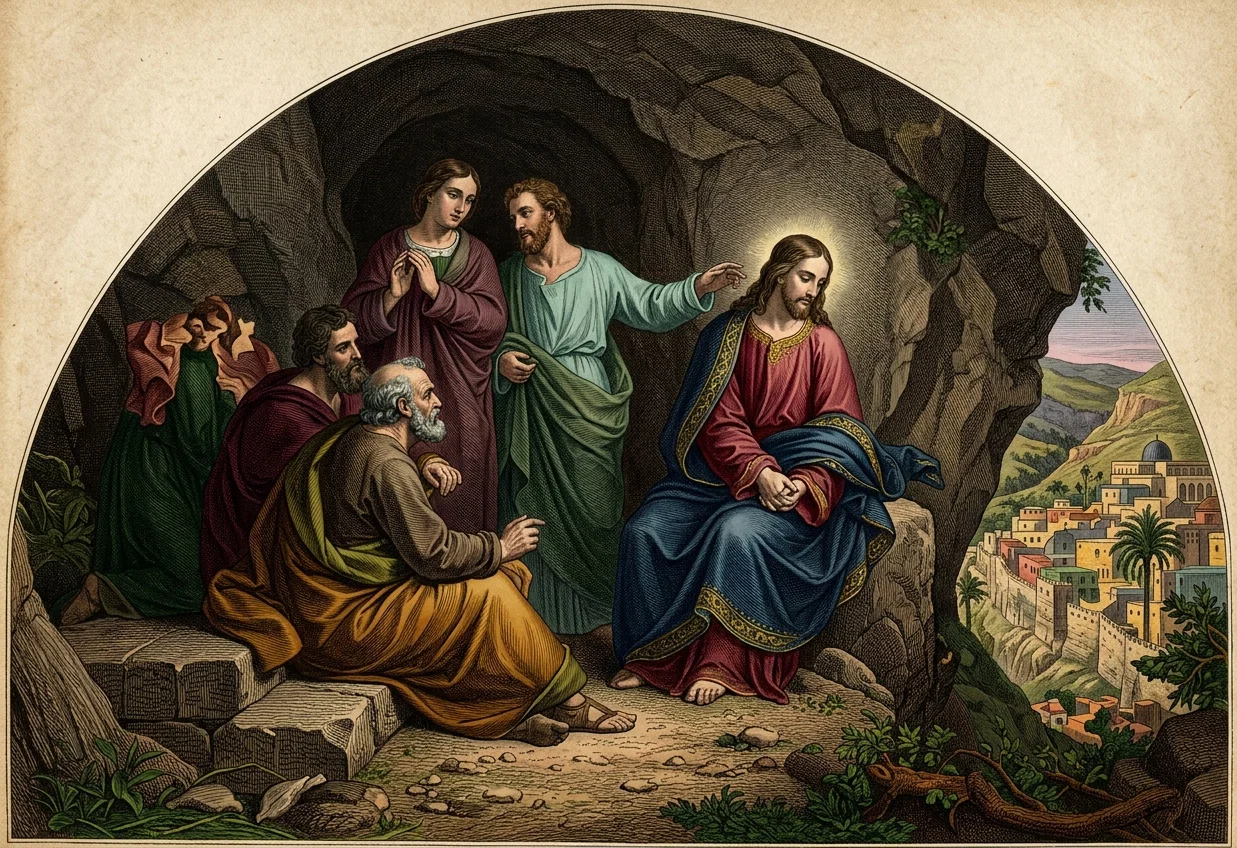
From its sacred summit Jesus foretold the fate of Jerusalem.
Who does not love, if not literally to dwell on the mountaintops, to contemplate the grand and beautiful lessons taught by their lofty heights, reared above rock-ribbed sides and massive foundations?
The Lord, from time to time in the work for His children on the earth, has chosen such sublime sites for His manifestations of grandeur, truth, and love; and it is our purpose in this article to notice some of these eminences which have, in addition to their natural attractions, an historic and sacred interest, because of these associations clustering around them.
See Ararat, standing nearly 18,000 feet high, as a boundary stone between three empires, still called Noah’s mountain.
There disembarked that wonderful company, the saved of the Lord, after that memorable voyage from one world to another, from the world that then was to the world that now is. 2 Peter 3:6, 7. What a train issues forth, as the Captain of their salvation opens the door which He Himself had shut—only eight human souls, followed by birds and beasts of every description, clean and unclean, the former by sevens and the latter by twos. The same Master will cause our bark to ride safely every destructive wave if we but let Him guide the helm.

Mount Moriah

From Ararat let us go to Mount Moriah. At its name what a flood of memories surge upon us! We think of the test of faithful Abraham, to whom the Lord said, “Take now thy son,” and lest he should mistake which son was meant, he specified, “thine only son, whom thou lovest, and get thee into the land of Moriah; and offer him there for a burnt-offering.” Abraham promptly set out with Isaac and two of his young men, doubtless quietly withdrawing without making a full explanation of his mission to Sarah, whose mother-love might have made it very difficult, if, indeed, not impossible, for him to carry out his purpose of yielding implicit obedience to, and faith in, the divine command. That was certainly a solemn journey, if not a sorrowful one, but Abraham, who “staggered
not at the promise of God through unbelief,” must have had a grand experience along the way, recalling the precious promises of the Lord, and, no doubt, instilling into Isaac’s mind and heart valuable lessons of faith and love. As they near the appointed place even the naive query of Isaac does not weaken the father’s purpose. “My father, . . . behold the fire and the wood: but where is the lamb for the burnt-offering?” The answer was, “My son, God will provide Himself a lamb for a burnt-offering.” This is what Moriah means—provided by Jehovah. How could Abraham go so far as to bind that
beloved son, place him on the altar, and raise the knife to slay him!—Because he knew Isaac was to live and become the father of many nations, according to God’s immutable word, and he accounted Him able to raise him up, even from the dead, if need be, that His promise might be fulfilled.
On the same mountain the temple was afterwards built, the pride and joy of the Jewish nation. In its holy precincts the Saviour walked and taught, and from its courts, grieved to see its profanation by selfish, mercenary money-changers, He miraculously expelled those who had made His house a den of thieves. But we must not linger here too long.

Mount Sinai

Let us now take a view of Sinai’s sacred heights, where were enacted the sublimest scenes recorded on the pages of Holy Writ, and no sublimer description can be given than is found therein. “The Lord came from Sinai. . . . He came with ten thousands of saints: from His right hand went a fiery
law for them.” Deut. 33:2. “And it came to pass on the third day in the morning, that there were thunders and lightnings, and a thick cloud upon the mount, and the voice of the trumpet exceeding loud; so that all the people that was in the camp trembled.” “The mount was altogether on a smoke, because the Lord descended upon it in fire.” Do you think, dear reader, if you and I could have heard the law of God uttered with His own mighty voice amidst circumstances of such awful grandeur, we could ever esteem it lightly? On that occasion there was erected the grandest cathedral ever seen by mortal eyes, if, indeed, its walls and dome composed of hosts of shining angels were discerned. Thus and here was given the FIRST sermon on the mount.
Coming down nearly fifteen centuries later, the sermon recorded in Matthew 5, 6, and 7 was given on another mount and uttered by the selfsame voice. Did He retract anything He had said in the previous sermon? Did His words nullify any portion of that law? Listen: “Think not that I am come to destroy the law, or the prophets; I am not come to destroy but to fulfil. For verily I say unto you, Till heaven and earth pass, one jot or one tittle shall in nowise pass from the law, till all be fulfilled.” Matt. 5:17, 18. O, the gracious words that fell from His lips on this occasion!
Read, meditate, and feed upon them at your leisure.
We must leave for the present the precious precepts enunciated from this Mount of Blessing, and go to another, made sacred by the Saviour’s transfiguration. He took with Him that trio who usually accompanied Him on special occasions, and there they saw another trinity, Jesus, Moses, and Elias. The face of Jesus shone as the sun, and His raiment was of a dazzling whiteness. Moses and Elias came to talk with Him of His passion. Luke 9:31. Who more fitting to come on such a mission could be found in heaven? Methinks I can hear them saying the one to the other, “It means everything to us whether the Son of Man successfully carries out the plan of redemption. Let us go down and encourage Him.”

Mount of Olives

There is Olivet. Let us gaze for a moment on this memorable eminence. Will it not be with strong feelings of joy and sadness mingledFrom its hallowed summit Jesus foretold the fate of Jerusalem, and doom of apostasy. On its slope lies Gethsemane—that garden where Jesus was wont to go and pray; and how it pains the heart to recall that last—prayer-meeting, I was going to say,—but, alas, Jesus prayed alone! Those who should have watched, and mingled their strong cries and tears with His, were overcome with sleep.
“’Tis midnight; and on Olives’ brow The star is dimmed that lately shone; ’Tis midnight; in the garden now, The suffering Saviour prays alone.
“’Tis midnight; and from all removed, The Saviour wrestles lone with fears; E’en that disciple whom He loved Heeds not his Master’s grief and tears.
“’Tis midnight; and for others’ guilt The Man of sorrow weeps in blood; Yet He who hath in anguish knelt, Is not forsaken by His God.
“’Tis midnight; and from other plains Is borne the song that angels know; Unheard by mortals are the strains That sweetly soothe the Saviour’s wo.”
This fearful struggle ended, we see Him on Mount Calvary—the spotless Lamb of God, a perfect sacrifice, acceptable, well-pleasing to the Father.
Forty days later we see Him again on the Mount of Olives with His happy disciples. He talks with them, and while He is speaking His feet leave the earth. They see Him rise higher and higher. With hands uplifted, He pronounces a parting blessing. What does He say? “Lo, I am with you alway, even unto the end of the world.” That promise reaches down to us in this last generation. Not with mourning and lamentations, but with great joy did His disciples return unto Jerusalem. So may we rejoice with joy unspeakable, for that “same Jesus . . . shall so come in like manner as ye have seen Him go into heaven.” He will come as declared in 1 Thess. 4:16, 17, and take His saints to the mansions prepared for them. John 14:1-3. Here they spend a millennium of thrilling interest and immortal joys with their Lord and Saviour.
In the midst of all these are they forever carried away and beyond all these earth scenes the memory of which is still dear to our hearts? Have they no further interest in Ararat, Moriah, Sinai, or Olivet? Let us see.
In Zech. 14:4, we read that the Lord’s “feet shall stand in that day upon the Mount of Olives, which is before Jerusalem on the east, and the Mount of Olives shall cleave in the midst thereof toward the east and toward the west, and there shall be a very great valley.” With the eye of faith we can see those sacred feet which parted from the earth at this very spot, touch Olives’ hallowed brow, and it melts away, so to speak, into a vast, elevated plain, in which are merged all these mountains, the Mount of Beatitudes, the Mount of Transfiguration, Mount Moriah, and even Sinai and Ararat; for on this plain is to rest the New Jerusalem, a city 375 miles square with an extension of the sea of glass, making an expanse of holy ground outside the city sufficient for the assembling of all the redeemed hosts.
This is the city that is to come down from God out of heaven to be the queen city of Christ’s new-earth kingdom. It will rest on a plateau high above the beautiful hills of the new earth seen from a great distance, a dazzling object of inspiration and joy to the nations of the saved, dwelling in all portions of the earth. As saith the Lord, “Beautiful for situation, the joy of the whole earth, is Mount Zion, . . . the city of the great King.” Ps. 48:2.
O, reader, shall we not walk in the light of God’s truth here? Then in that day we shall “walk in the light of the Lord” and bask in the sunshine of His love throughout the ceaseless ages of eternity.
Mrs. H. A. St. John.

The Sabbath Through the Ages

IX. The Sabbath at the Crucifixion

By Charles L. Taylor
Why did the Son of God come to earth? What led Him to choose that wonderful course of humiliation, poverty, reproach, suffering, death?
Undoubtedly many answers would be given to these questions, all of which might be correct, at least in part. The Scriptures themselves furnish a variety of replies, according to time and place when different writers were led to speak. But when all has been said that can be said, we are forced to accept as the great basic reason which sums up all other reasons, that Jesus, the Son of God, died to satisfy the claims of His Father's broken law.
This is an important truth clearly taught. “By one man sin entered into the world.” Rom. 5: 12. “All have sinned.” Rom. 3: 23. “Sin is the transgression of the law.” 1 John 3: 4. “Christ died for our sins,” “and not for ours only, but also for the sins of the whole world.” 1 Cor. 15: 3; 1 John 2: 2. “Christ hath redeemed us from the curse of the law, being made a curse for us.” Gal. 3: 13. “The wages of sin is death.” Rom. 6: 23. “The soul that sinneth, it shall die.” Eze. 18: 4.

In the Light of Calvary

The majesty, the holiness, the perfection, the absolute unchangeableness of God's great moral law can never be understood, even in part, except in the light of Calvary. To transgress its least part, brings a terrible loss. The sin of Adam, tho apparently small, brought upon the human race the irrevocable penalty of death, and yet the sentence was only in proportion to the deed itself. The law of heaven had been broken! And so infinite was that break, because of the character of the law broken, only the life of the Son of God was sufficient to heal the breach and restore man to his Maker.
The death of Christ testifies in trumpet-tones to the whole universe of worlds that the law of Jehovah is immutable.
“But,” says one, “what has this to do with the matter of the Sabbath?” Ah, it has everything to do with it. The Sabbath is an inseparable part of the law which was transgressed, and is just as holy, infinite, moral, and immutable as any other and all other parts of the law. Did Jesus’ death show the law to be divine and its claims unalterable? Then did His cross and its sacrifice of divinity proclaim the Sabbath to be fixed as the hills and that man is under perpetual obligation to keep it in letter and in spirit.
How supremely foolish then for man to reason that the death of our Lord abolished the Sabbath! It was because it could not be abolished, yea, could not even be altered or modified, that His death became a necessity. As we have already seen, the shedding of His blood was but the ratification of the everlasting new covenant which puts the Sabbath law along with the whole law into the very heart.
In the light of the foregoing, it is perfectly natural and normal to find that the Sabbath of the fourth commandment (which we now see belongs to the new covenant), the Sabbath which had come down without break or change from the very gates of Eden, was faithfully kept by the followers of Jesus after the crucifixion. At the very time when, as some have thought, the disciples were to observe another day, there we find them worshiping upon the Sabbath day, the same seventh day that Jesus, with themselves, had kept before His death. And how could they have done otherwise and be in harmony with truth when, by the death of the Son of God, the Sabbath had come to them as a covenant blessing?
The record of that first Sabbath after the cross is wonderfully clear and concise. “And the women also, which came with Him from Galilee, followed after, and beheld the sepulcher, and how His body was laid. And they returned, and prepared spices and ointments; and rested the Sabbath day according to the commandment.” Luke 23: 55, 56.
The Sabbath day according to the commandment was the seventh day. “The seventh day is the Sabbath day of the Lord thy God.” Ex. 20: 10. And the seventh day of the commandment was the seventh day of creation, sanctified and given to mankind in Eden. Gen. 2: 1-3. The day kept by those consecrated women was, therefore, the Sabbath which had been kept from the very beginning by patriarch, priest, prophet, and king; and honored both in life and in death by the Lord Jesus Himself. Think of the mighty import of this fact.
But we are told another truth in this connection that should not be overlooked. The day which was so sacredly observed by the women of Galilee was none other than the seventh day of the week. We may know this with all the certainty of the word of God, for the word tells us (Luke 24:1)that the day succeeding the Sabbath was “the first day of the week.” Here is a divine connection between the Sabbath and the week. We have seen in a previous article that the Sabbath appointment of Gen. 2:3 is the only reason that can be found for the cycle of seven days, and that nearly all the great nations of antiquity recognized this fact in their records of the week; but here is an inspired statement which forever seals the truth of what has been stated. It would be perfectly proper to insert the words, “of the week,” into the Sabbath commandment, thus making it read, “The seventh day of the week is the Sabbath of the Lord thy God;” because, when the women kept the Sabbath “according to the commandment,” they kept the day which came just before the first day of the week, and that was the seventh day of the week.
And all that is told us concerning those holy women, is for the purpose of bringing home to our hearts the relation which we should sustain to the Christ and to the Sabbath. The lesson is this: If the first Sabbath after our Lord’s death should be observed, then every succeeding Sabbath demands the same recognition. And, further, we are to learn that the cross of Calvary in no wise abrogates, changes, limits, or modifies the command, “Remember the Sabbath day to keep it holy.”
There is also a beautiful, practical lesson to be gathered from that Sabbath experience of the Galilean women. So holy was the sacred day and so binding were its obligations, that not even the obsequies of their divine Lord were allowed to be performed until the setting sun, twenty-four hours later, announced the arrival of another day. To keep the Sabbath “according to the commandment” is to have so holy a life and so holy a conception of Sabbath rest, that no earthly consideration, however dear, shall for a moment find place in the sacred precincts of the devoted day.
Was it simply a coincidence that Jesus lay in the tomb, resting from all His labors, during the Sabbath hours?—Possibly. The fact remains, however, that He did, and that that day in the tomb was His last day as our earthly Prophet. Upon His resurrection He became our great Priest-King, and upon the first day of the week began His new work for mankind.
May God’s blessing enable you and me so to drink in the divine truths of both the cross and the Sabbath that in our lives they may ever have place and produce there a divine harmony.

The Business of Religion

It is living in communion with nature that makes the naturalist, and living in communication with the universe that makes the astrologer. Painters and poets and scientists are the product of communion with the arts and sciences. The only blacksmith worthy of the name is the man who, by living in communion with his smithy, has made himself master of his trade.
So in the world of spiritual things. If we would be spiritual, we must live in communion with the spiritual Being.
There are men and women without number who dabble in the arts and sciences but never make their mark in the world. Of all the countless thousands who essay to become great, only a few become masters. Why? Because they have not sacrificed themselves upon the altar of their quest — because they have permitted other interests to dissipate the oneness of their devotion.
So in the world of spiritual things. How is it possible for those to become master Christians who only occasionally busy their thoughts with spiritual concerns — only occasionally read their Bibles, only occasionally go to church?
Religion is a business to be mastered.—Rev. E. H. J. Andrews.

“In Everything Give Thanks”

It can be done; and according to Dr. George M. Mackie, it is not a strange thing even now in Oriental lands. He tells us this in a recent Sunday School Times. Writing from Beyrout, he says:
“‘Thanks be to God,’ ‘Praise to God,’ these are the most frequently used expressions in Oriental intercourse. In sickness and pain, in anxiety and sorrow, inquiry brings the invariable reply, ‘Praise God.’ On one occasion the writer met on the outskirts of Beyrout two Druse women, evidently mother and daughter. The younger appeared to be a wife who had been dismissed by her husband in a fit of temper, and as she went toward the frigid welcome in the old home, and thought of the little child, or children, she had left behind her, she was in such bitterness of spirit that she did not think of veiling her face as she passed me. The tears were flowing down her cheeks, but as she walked along she kept slapping her open hand on her mouth as if to keep back rebellious words, and saying rapidly, ‘Lord, I thank Thee, Lord, I thank Thee, I thank Thee.’”
“In the Jewish prayer-book a list of eighteen thanksgivings is presented for daily repetition, and besides these a form of Hebrew words is supplied as an ascription of praise for various occasions, such as the returning festivals, the Sabbath day, the new moon, when eating or drinking, tasting fruit or vegetables, smelling fragrant barks, spices, plants, and oils, when hearing thunder, seeing lightning, or when meeting any man eminent in sacred or secular learning.”
Surely the Christian has far more abundant reasons for giving thanks.

Quodlibet

THERE is a Brook of purling rills, that chatters as it flows, ’Mid pasture fields where skies are fair, With waters tumbling far and near, Like chiming bells so silvery clear. This Brook is Joy.
There is a River, strong and deep, which surges on with angry roar; The fields around are vast and drear, The swimmer strives in mortal fear, And sees the shore but can not near. This Stream is Grief.
There is a Lake, where sunbeams dance and light a shimmering way; There all is calm, with waters clear— The waters of this inland mere, Which mirror back God’s upper air. This Lake is Peace.
There is a Sea where men may sail, and never strand their bark; Where white-capped waves run free and fair, And ripples play and frolic there, ’Mid sunbeams shot through purest air. This Sea is Love.
And Brook, and River, Lake, and Sea, Flow on in finest melody; The major and the minor key Make cadence through eternity— Forever. —Mary Chesley, in “Argosy.”

Christian Life Imperishable

The Christian life has no dotage, but grows clearer and brighter and more inspiring as the years take their flight. While the physical senses fail as age increases, faith finds a new fruitage and fixes itself more deeply in the eternal verities. A feeble physical condition does not necessarily mean a feeble faith. The spiritual senses are strengthened and become more sensitive as the things of time become more dim, and eternity begins to dawn. Faith is the eternal anchor of the soul, that enters into that within the veil, and lays hold upon the imperishable.—Christian Observer.

Heaven a Place

Of course heaven is a place. God's people are to have future existence, and it is impossible to live without having location. As long and as surely as we are individuals, we are to have a locality in which our individual existence is to be experienced. If people become too vague and misty to conceive of locality in connection with the heavenly life, they are liable to become unbelieving and uncertain as to the continuance of their own personal identity. We believe that God is to continue His people in self-conscious identity, and that He is to give them assurance of their continued personality in a real and delightful environment.—Herald and Presbyter.

Christ Forbade War

NOTHING can be clearer than that the leaders of Christianity, immediately succeeding Christ, from whom authentic expressions of doctrines have come down to us, were well assured that their Master has forbidden to the Christian the killing of men in war or the enlisting in the legions. One of the chief differences which separated Roman non-Christians and Christians was the refusal of the latter to enlist in the legions and be thus bound to kill their fellows in war as directed. Apparently in no field of its work in our times does the Christian church throughout the whole world, with outstanding individual exceptions of course, so conspicuously fail as in its attitude to war.—Andrew Carnegie.

Afflictions and Extraordinary Graces

EXTRAORDINARY afflictions are not always the punishment of extraordinary sins, but sometimes the trial of extraordinary graces. — Matthew Henry.

God in the Furnace

AS SURE as God ever puts His children into the furnace, He will be in the furnace with them.—C. H. Spurgeon.
Continue reading: Parousia and Epiphany