Your ShelfYour Projects

Signs of the Times, Vol. 32, No. 36.

THY WILL BE DONE

Signs of the Times

Pacific Press Publishing Association

THY WILL BE DONE.

BY JOHN GREENLEAF WHITTIER.
We see not, know not; all our way Is night,---with Thee alone is day; From out the torrent's troubled drift Above the storm our prayers we lift, Thy will be done!
The flesh may fail, the heart may faint, But who are we to make complaint, Or dare to plead, in times like these, The weakness of our love of ease? Thy will be done!
We take with solemn thankfulness Our burden up, nor ask it less, And count it joy that even we May suffer, serve, or wait for Thee, Whose will be done!
Tho dim as yet in tint and line, We trace Thy picture's wise design, And thank Thee that our age supplies Its dark relief of sacrifice. Thy will be done!
And if, in our unworthiness, Thy sacrificial wine we press; If from Thy ordeal's heated bars Our feet are seamed with crimson scars, Thy will be done!
If, for the age to come, this hour Of trial hath vicarious power, And, blest by Thee, our present pain, Be Liberty's eternal gain; Thy will be done!
Strike, Thou the Master, we Thy keys, The anthem of the destinies! The minor of Thy loftier strain, Our hearts shall breathe the old refrain, Thy will be done!

Since the Fire

THE night after our fire we began placing orders for such books, pamphlets, and tracts as could be had from other publishing houses. They are now being received daily and are being stored in our temporary headquarters. Here are a few of them:

STORY OF DANIEL THE PROPHET

A biography of this wonderful prophet of God, by Elder S. N. Haskell. Entirely new in its conceptions and designs. The scriptures narrating the story are printed in parallel columns with the author's delineations and interpretations. This one feature of the book alone renders it very serviceable and desirable.
In connection with the story of this remarkable life, a clear and forcible exposition of the prophecies is also given. The author has endeavored, not to arouse controversy, but to suggest thoughts, both in the story and side references, that will create a religious interest and further study of the things of God.
The book contains both a scriptural and general index of subjects, has eighteen chapters and 369 pages. Price $1.00.

SEER OF PATMOS

The story of the "Seer of Patmos" is a treatise upon the book of Revelation given in narrative style, interesting alike to old and young. As in the "Story of Daniel" the texts are given in full in the margin, and there are forty pages of questions which are particularly helpful to those who wish to use the volume as a text-book. There are twelve full-page engravings, and a large number of chapter headings and text illustrations. Price $1.00 post-paid.

THE GREAT EARTHQUAKE

Five hundred copies of this booklet had been sent to one of our agents just before the fire. He has given us the privilege of using them, so while they last they will be sold at the old rates—25c per copy, post-paid.

GREAT CONTROVERSY AND HERALDS OF THE MORNING

Large editions of these books are being manufactured for us by a responsible firm in Kansas City. No one should be deterred from entering the field thinking that the books can not be supplied.
Prospectus for "Heralds of the Morning" is now ready. Price, post-paid, 50c.
Great Controversy prospectus is being printed and bound by the Review & Herald at Washington, D. C. Price 90c, post-paid.

SIGNS OF THE TIMES BOOKLET.

The following is a list of contents of a booklet recently written by a Conference Missionary Secretary to assist individuals and Missionary Societies in carrying on systematic and effective work with the SIGNS OF THE TIMES:

CONTENTS.

1. What the "Signs" Has Accomplished. (a) Number of its Converts in One Conference. (b) Five Noteworthy Examples. 2. Club Rates for Churches. Showing Exact Cost of Any Club—5 to 100 Copies—For Any Period—One Week to One Year. 3. "Signs" Rates. (a) Single New Subscriptions. (b) To Foreign Countries. (c) Renewal Subscriptions. (d) In Clubs. (e) To Agents.
  1. Who are Agents?
  2. How to Organize and Pay for a Church Club.
  3. How to Use the "Signs."
This booklet is filled with encouraging items and valuable suggestions.
Your State Tract Society will be glad to send you copy free; or address SIGNS OF THE TIMES, Mountain View, Cal.

DEAR EDITORS:

FROM A "SIGNS" AGENT.

DEAR EDITORS:

Long have I enjoyed working with the Signs. Many precious experiences from this source! I have come to feel that wherever I go I must each week visit fifteen or more families with the Signs either for three, six, or more month's subscriptions. During the past years I have found it the best factor by far (tho other methods are good) in interesting people in the truth and opening up Bible readings.
This summer here in Belding I have sold from my regular club the paper for five cents a copy. Experience is teaching me that this can be done. People are glad to get it at five cents per copy each week as well as at club rates. One gentleman who is buying it thus wishes Bible readings. In selling the Earthquake Special two Bible studies have been begun this week. In face of all the prejudice there are many who love the good old ways pointed out in the paper. Soon we may expect to reap the harvest here from the results of the little paper. A blind man who has a stand here has them on his counter for sale. He is not of our faith, but is becoming interested.
Yours in faithfulness.
J. C. BROWER.
Belding, Mich.

BEST STORIES from the BEST BOOK

A good supply of this book in English, German, Danish, and Swedish is on hand. Price is as follows: Board, with cloth back . . . . . . . . . . . . 50c Full cloth . . . . . . . . . . . . . . . . . . . . . . . . . . . 75c

LITTLE FOLKS BIBLE NATURE

A shipment of this valuable book for little folks is also on hand. Prices are— Board, with cloth back . . . . . . . . . . . 25c Full cloth . . . . . . . . . . . . . . . . . . . 40c

MAKING A MAN OF GOD.

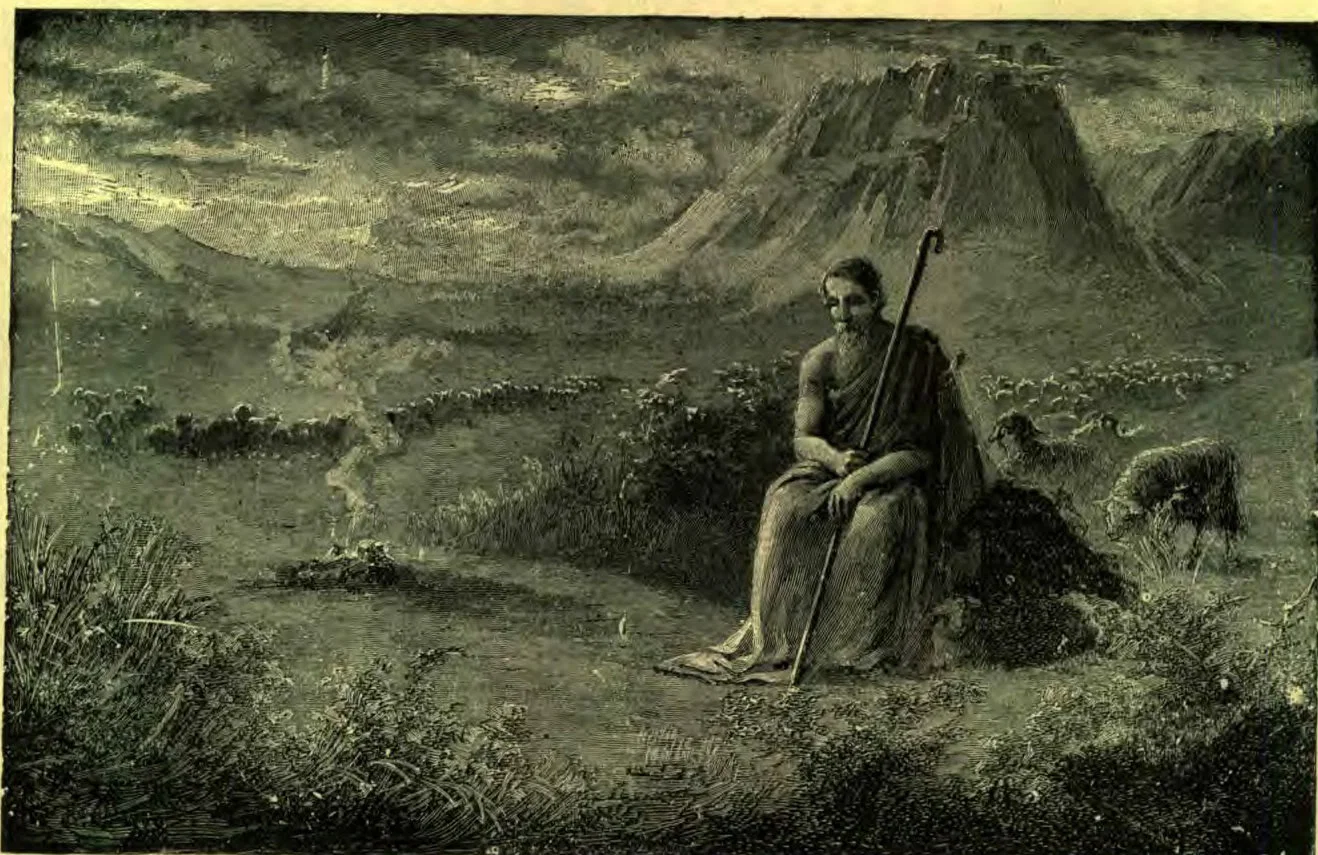
MOSES the meek above all men; Moses, the prince of Egypt; Moses, "learned in all the wisdom of the Egyptians;" "Moses, the man of God, who was faithful in all his house." By such terms is the great leader of God's host from Egypt to Canaan designated.
Estrated originally for "Patriarchs and Prophets." MOSES A SHEPHERD.
BORN in Egyptian slavery of a noble mother who feared God; born when the ban of tyranny was resting the most heavily upon his oppressed people; born under royal decree immediately to die; yet by God's providence Moses was preserved by the very royal family who sought to forever subjugate his people and destroy him.
At a wonderful time in the history of his race did he first see the light. About thirty-seven centuries ago found the seed of Abraham, the Hebrew, in Egypt. For over two hundred years they dwelt in its moral darkness, and much of the time were they in hard bondage of servitude, which grew more galling as the Hebrews increased. Finally the royal decree went forth to slay all the infants of two years old and under, in order that the race of Hebrews might not become too numerous, and take the kingdom.
IN such time Moses was born. Hidden by his mother as long as she dared to conceal him, she placed him in a little ark of bulrushes and committed him to the goodness of God, placing the little boat where the princess royal came down to bathe in the sacred Nile. The little babe was brought to her, excited the pity and mother love of
her heart, and she adopted the doomed Hebrew child as her son, employing, unwittingly, yet in God's providence, Moses' own mother to act as his nurse in whose care he was placed for twelve years. During this time we may well believe that the history, traditions, and prophecies relating to his own people were faithfully and prayerfully taught him; and this teaching of the providential dealing of God shut his soul forever against the corrupting influences of abominable Egyptian idolatry.
AT the end of this period he entered upon his education as king. He was taught art and science, literature, engineering, and warfare; in short, he was educated in all the wisdom of the Egyptians, and was mighty in word and deed. Tradition tells us that he was a great warrior, and waged active warfare in successful campaigns. He was heir to the throne of Egypt, at that time the mightiest and greatest throne of the entire world.
BUT what was all this to the noble youth who had chosen otherwise. How his mission as the deliverer of God's chosen people came to him, we do not know. It was to some extent a matter of general knowledge. It fired him with zeal, and when the test came to decide between the nation of slaves and the throne of Egypt, he did not hesitate, "choosing rather to share ill-treatment with the people of God, than to enjoy the pleasures of sin for a season; accounting the reproach of Christ greater riches than the treasures of Egypt, for he looked unto the recompense of the reward. . . . He endured as seeing Him who is invisible." Heb. 11: 25-27.
YET notwithstanding his purpose, he was not yet where God could use him. With faith in his mission, Moses had not yet learned his own insufficiency. He was a warrior by training. Why could not the numerous and hardy Hebrews be mobilized and led against Egypt? His heart burned to redress the wrongs of his people. So when he saw an Egyptian smiting a Hebrew, he promptly killed him, buried the body in the sand, and passed on. The next day he found two fighting Hebrews, and endeavoring to pacify them, the oppressor referred to his slaying the Egyptian the day before, and spurned his interference and leadership. Moses turns away disappointed, for "he supposed that his brethren understood that God by his hand was giving them deliverance." Ex. 2: 11-14; Acts 7: 25-27. Ungrateful and unappreciative doubtless his people were; but Moses was too self-sufficient for God to use.
MOSES, having identified himself with the Israelites who responded not to his efforts to help them, was forced to flee from Egypt. Discouraged and alone, he went to Midian, a related tribe, and settled down to a shepherd life. Forty years later God called him, sent him to Egypt, wrought through him great deliverance for his people, humbled the proudest nation then on earth, by him led a whole people from bondage to freedom, and gave to the world a code of laws which has been the wonder and the wisdom of the ages.
WHAT made him the man he became?—Chiefly two things: First, his purpose, inwrought into his very being by a godly, faithful mother, manifested in his decision to do what he deemed the right at any cost to himself.As soon as he came to the years of understanding, his purpose was manifest. Heb. 11:24. With the dazzling prospect of Egypt's throne before him, he refused it as a matter of principle. He might have argued that upon the throne he could have delivered his people, but he knew its corrupting influences. Therefore chose he the reproaches of Christ rather than "the treasures of Egypt." No young man will achieve success in life of any kind without a purpose. That purpose may seem to lead him to defeat and misfortune and loss, but it makes character; and if it be a righteous purpose, it will survive all diseases of earth. The weakness of the age is the great mass of purposeless young men and women. So many are creatures of impulse, now and then a good impulse, but impulse without purpose. The constant yielding to impulse unsettles the mind, and opens the way to the indulgence of all worldly lusts. Young men, young women, have a purpose in life; have a purpose for the day, for the hour. Let the purpose control the impulse.
The second great element in the making of "Moses the man of God" was the post-graduate course of forty years in Midian. Amid the throngs of men, we forget God. In the gilded courts of life we are constantly subject to deception. We see nearly always the better side, not the true inwardness. We ever walk over whited sepulchers filled with corruption. Man is ever prone to put the best outward, to hide the poor, the corrupt, the false, the base. God called Moses out into the country, amid all the glorious surroundings of nature. Brook and bird and mountain and tree stood for what they were, and made stronger and truer his purpose. The bright shining sun on its daily round, the paler moon in her ever-constant change, and the myriads of brilliant stars, garnishing the clear heavens, revealed day and night the glory of God. In God's providence, Moses was given the care of the foolish, the helpless. The sheep is not a wise animal. There is little in them to appeal to our sympathy but their gentleness, their defenselessness. Peculiarly helpless and tender are the young lambs of the flock; and surrounded as they were in that eastern country by the fierce Syrian wolves or the prowling jackals, they became a constant source of care and anxiety on the part of the faithful shepherd. Here Moses learned his great lesson of man's littleness and helplessness, and God's greatness and majesty and wisdom and love. Here, as shepherd of Jethro's flock, he learned to care for the flock of God in the weary, wilderness wandering of forty years. It developed patience, tenderness, love for the foolish and erring. It was the germ of love that developed the soul of the mediator, "Yet now, if Thou wilt forgive their sin—; and if not, blot me, I pray Thee, out of Thy book which Thou hast written." Ex. 32: 32. He had, like his divine Master, identified himself with the flock. Such an one God could call. He saw God's revelation in the burning bush. Distrusting himself, he ever sought God, and talked with the Majesty of heaven, face to face, as man talketh to his friend. Having looked upon God, he feared not the face of man. Meek, but mighty; for he walked with God. Let the lesson, merely suggested, sink into our hearts. Let a holy purpose rule our lives. Let the education which God would give to all be paramount to all else. "The fear of the Lord is the beginning of wisdom."

WISE COUNSEL CONCERNING INVESTMENT.

A SHARP contrast is drawn—between the relative values of the riches of this world and the treasures that may be laid up in heaven—in the counsel of Jesus to a certain man who came to Him for instruction. The man was a ruler having honorable position; he was young, therefore naturally supposed that he had before him a good measure of time to enjoy life; he was rich, having the means to make temporal life enjoyable under ordinary circumstances. Everything that men naturally seek after in this world was at his command.
There was one thing, however, that he desired which seemed to him an essential complement of his material possession. He knew, as all men do, that the years of this life, even to a young man, are few at best. He wanted eternal life in which to enjoy the honor and the wealth that he already possessed. That was the height of his ambition. So he came to Jesus, with his heart full of selfishness, to inquire how he might gain eternal life.
Jesus at once referred him to the law of God, and said, "If thou wilt enter into life, keep the commandments." The young man claimed that he always had done this. The Lord did not formally dispute the claim, but immediately put it to the test: "If thou wilt be perfect, go and sell that thou hast, and give to the poor, and thou shalt have treasure in heaven; and come and follow Me."
This was a fair, logical test; if the young man was keeping the commandment, "Thou shalt love thy neighbor as thyself," he would instinctively, unhesitatingly divide his substance with any who had need. In fact, he never could have become very rich in this world's goods without knowing that his wealth was a trust reposed in him as a steward, to be used as the Giver should direct.
But the contrast to which we would call especial attention is between the life that is attached to this world's riches and that which goes with the treasures laid up in heaven. "It is easier for a camel to go through the eye of a needle, than for a rich man to enter into the kingdom of God." The one thing that stood between the rich young ruler and eternal life was his covetousness, his love of money; it hindered his faith in the word of Christ. Through this trait the god of this world had blinded his eyes to his eternal interests; it were better for him to dispose of the riches altogether and become a co-laborer with Christ.
By holding on to his worldly treasures, the rich man must be content to enjoy only a temporal life of brief, uncertain tenure; but by withdrawing his capital from perishable investment and depositing it in the bank of heaven through the medium of God's cause in the earth, it becomes not only greatly enhanced in value, but with the investment goes an eternal life insurance policy.
This counsel of the Lord regarding investment was given to one whom He loved (Mark 10⁠:⁠21), and under such circumstances even a fallible man would give the best advice of which he was capable. Shall we not learn wisdom from the words of Him who is the source of all wisdom on all matters, temporal and spiritual? "For where your treasure is, there will your heart be also." G.

SERVING TWO MASTERS.

JUST an expression may contain the key that will unlock the whole principle that actuates a widespread movement. Discussing the street-car strike prospects in San Francisco, the president of the Carmen's Union said: "We would allow OUR MEN to work under the present schedule for two or three weeks."
Such straws show how men who join such leagues give away their liberties to a few leaders whom they are obliged to support. The idea of a man's dictating to another man's hired assistants how long they shall work, or under what conditions they shall work, or whether they shall work at all! Then the idea that men of sufficient intelligence to become expert workmen in any respectable calling should acknowledge themselves incapable of making their own bargains! Is it not enough that the hired laborer should be under the dictation of the employer who pays him, without contributing to the support of another "boss" to dictate to him when and when not to work?
Surely this can not long be reckoned as a free country, when the producing classes are willing to give away their liberties in such wholesale manner. When men are willing to pay for the burden of a double dictation concerning their labors, they certainly have lost the keener sense of liberty. It is no wonder that human slavery is on the increase, and that so many of the victims seem willing to have it so.
But, "who art thou that judgest another man's servant?" The Word of God says, "To his own master he standeth or falleth." Again we are told that "no man can serve two masters; for either he will hate the one, and love the other; or else he will hold to the one, and despise the other."
This great truth is fully illustrated in the principle of labor unionism; and the strange part of it is that the laborer is obligated always to "love," or at least to obey, the dictator who has no interest in his employment, and to "despise" the master who pays him for his service. It is decidedly strange to see otherwise intelligent men taking orders from the one whom they pay, and assuming to dictate terms to the employer who pays them. But the world is full of strange anomalies in these last days. G.

OUR DIVINE-HUMAN PRIEST

THE CLEANSING OF THE SANCTUARY.

THE cleansing of the sanctuary is a work of judgment, preliminary to the last final separation of classes. This will be readily seen by the following evidences:
1. In the type the cleansing of the sanctuary, on the great "Day of Atonement," was a work of judgment, passing its sentence of approval or condemnation upon every soul. It mattered not what had been the course of each one previous to that day, he may have kept his vows and been faithful to God; he may have offered daily sacrifices; yet if on the Day of Atonement he failed, he would bear his iniquity, and be cut off from his people. Lev. 23:28-32. The work was, therefore, a yearly determination of classes among the professed people of God. The cleansing of the sanctuary on that day was not from physical uncleanness, but was a removing of all remembrance of sin. Even so in the antitype before Christ comes; the sins of those who have sought Him, and been found faithful, will be blotted out, while those whose sins are retained will have their names blotted out of the book of life. Acts 3:19; Rev. 3:5; Heb. 9:22-24.

The Mystery of God.

2. The Gospel of Jesus Christ is designated in several scriptures as "the mystery of God." Col. 1:25-28; 1 Tim. 3:15; Eph. 6:19. The closing of that mystery is a judgment work, as is every work where trial or probation is involved. Hence, connected with the preaching of the Gospel is ever the warning of the judgment, which will determine how souls have used their privileges of the Gospel. See Eccl. 12:13, 14; Rom. 2:12, 16; 2 Tim. 4:1-4; Acts 24:25; Rev. 14:6, 7. Now at the close of the time period given by the prophets, the Gospel work will be finished. Listen:
"And the angel which I saw stand upon the sea and upon the earth lifted up his hand to heaven, and swear by Him that liveth forever and ever, who created heaven, and the things that therein are, and the sea, and the things which are therein, that there should be time no longer; but in the days of the voice of the seventh angel, when he shall begin to sound, the mystery of God should be finished, as He hath declared to His servants the prophets." Rev. 10:5-7.
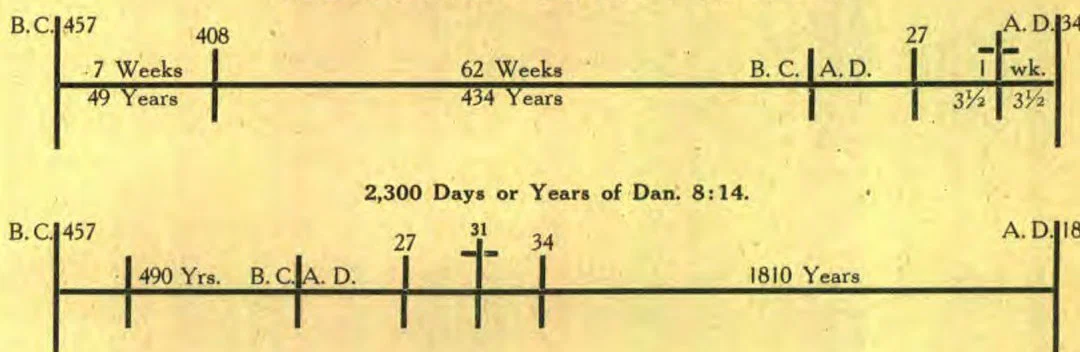
Various prophets deal with the Gospel and the judgment. One only—Daniel—predicts the time when the Gospel work will be closed by the last ministrations of our great High Priest. The time then referred to is prophetic, which as definite time then closed. Men may endeavor to readjust dates till the day of doom, setting the time for Christ to come; but they will ever be wrong, as prophetic time reaches later than 1844, where ended the 2,300 days.
This finishing of the mystery comes in the beginning of the days of the sounding of the seventh trumpet, which covers the time of the judgment. Rev. 11:15-18. The [[FIGURE]] sixth trumpet ceased its sounding Aug. 11, 1840, at the close of the prophetic time period of Rev. 9:15. The seventh began its sounding in 1844. In the years (the length of time indefinite) to follow, the mystery of God should be finished, the Gospel work would close; the judgment would pass upon all cases. This compound statement is therefore in harmony with Dan. 8:14, "Unto 2,300 days [years], then shall the sanctuary be cleansed."

The Judgment Proclaimed.

3. God's work in heaven corresponds with God's work on earth. When Jesus closes His work in heaven, His servants will proclaim to the world that truth as a part of the Gospel message. When in the days of primitive Christianity the disciples were sent forth, they proclaimed the Gospel of salvation with the emphasis on a risen Saviour. They preached of the judgment, but it was a "judgment to come." Acts 24:25; 17:31. But when Christ is closing His work in the heavenly sanctuary, His servants will proclaim, "The hour of His judgment is come." Rev. 14:6, 7. And that message has been going to the world since 1844; and it corresponds with the cleansing of the sanctuary.

A Period of Time.

4. This judgment work covers a period of time. Says the wise man: "God shall judge the righteous and the wicked; for there is a time there for every purpose and for every work." Eccl. 3:17.
Again, the righteous dead are not raised and then judged, and their reward apportioned; their cases are determined before the resurrection and Christ's coming. This is evident from Luke 20:35: "But they that shall be accounted worthy to obtain that world and the resurrection from the dead, neither marry, nor are given in marriage." The previous judgment determines who are worthy. So, when Christ comes, the righteous dead are not raised and then changed to immortality; they are raised from the dead immortal. 1 Cor. 15:51-54. It was this resurrection out from among the dead, which Paul strove for. Phil. 3:11.

Characters Forever Fixed.

Once more: Before Christ comes, all souls will have decided each his own case. God's Gospel message will go with a loud voice to all the world. Rev. 14:6-14. His people will be called from the great Babylon of human devisings back to the pure truth of God. The prophet, carried in heavenly vision forward to that day, cried: "Multitudes, multitudes in the valley of decision; for the day of the Lord is near in the valley of decision." Joel 3:14. When that decision is irrevocably made, then Heaven's Court will issue this proclamation: "He that is unjust, let him be unjust still; and he which is filthy, let him be filthy still; and he that is righteous, let him be righteous still; and he that is holy, let him be holy still. And, behold, I [Jesus] come quickly; and My reward is with Me, to give every man according as his work shall be." Rev. 22:11, 12. Characters are fixed a little period before Christ comes, covered by the word "quickly." Certainly, then, Heaven's Court has designated the class to which each soul belongs. And how reasonable this is, not because God needs to take the time to know this; but that the universe may know that "just and true" are the ways of the King of Ages. Rev. 15:3.
The sittings of this court began in 1844, began, as it must, with the generations of old inscribed on the books of heaven. It comes down step by step, generation by generation, till the present is reached, the living adjudged, and the great drama of test and trial because of sin is over forever.
But during all this time our great and merciful Divine-human Priest pleads for us. He is touched by the feeling of our infirmities. He knows our temptations. He has felt them all, met them all, and feels and meets them all in us, so closely has He bound Himself with humanity. But we may reject Him and all the priceless treasures His Gospel brings. We may turn from His wounded and entreating and open hands. We may despise the cross which has purchased for us infinite riches. Then His judgment will leave us to ourselves, to the choice we have made. We can not escape it. It is ours by no arbitrary decree. It is ours because we have chosen it; because day by day, moment by moment, we have chosen it and woven it into our character and made it ours forever. Are you ready to meet the record, soul, the record written in heaven because you have first written it in your character? Are you willing to meet it? If not, then let us plead with you in the little time that lingers before His judgment shall close its sessions to make Him your captain, His righteousness your character and garment, His Word your guide, His Spirit your life.
"And the vision of the evenings and the mornings [the 2,300 days] which hath been told is true."
The Seventy Weeks or 490 Years of Dan. 9:24-27.

THE ENCOURAGEMENT OF MATTHEW 1.

IN the first chapter of Matthew is a comprehensive summary of prophetic fulfilment, a wonderful testimony to the validity of God's promises to Abraham. It contains a ground of faith that is built on actual, unerring sight—a sight magnified to large proportions by the great telescope of the Holy Spirit to those who believe God's Word.
This chapter is one that is too commonly passed over as an ordinary genealogical record. It is a review of facts, a continuous train of circumstances, connecting the promises, "I will make of Thee a great nation" (Gen. 12:1-3) and "My covenant will I establish with Isaac" (chapter 17:19-21) with the birth of Him in whom the promises were and are to be verified. Notwithstanding all the obstacles which had been thrown in the way during the forty-two generations that had elapsed, the record of lineage had been preserved, proving the legitimacy of the succession of the Son of Mary, and His claim to the heirship of the material promise to Abraham—a promise which included the whole world. Rom. 4:13.
Abraham had been promised that his Seed should possess the gate of His enemies (Gen. 22:17), and the possession of the gate of an enemy was to control the very entrance to his fortress, and such a vantage-ground was victory. The Seed here mentioned was Christ, as we are plainly told in Gal. 3:16. And the succession was to come from Abraham through Isaac, as Abraham was enjoined, "In Isaac shall thy Seed be called." Gal. 3:18.
So our heirship comes of our being in Christ; for, "if ye be Christ's, then are ye Abraham's seed, and heirs according to the promise." Gal. 3:29. We thereby become "heirs of God, and joint-heirs with Christ." Rom. 8:17. "Now we, brethren, as Isaac was, are the children of promise" (Gal. 4:28), therefore anything that proves progress in the fulfilment of the promise becomes of vital importance to us, and should be of more than passing interest.
Turning then to Matthew 1 we read: "The book of the generation of Jesus Christ, the son of David, the son of Abraham. Abraham begat Isaac; and Isaac begat Jacob; and Jacob begat Judah and his brethren," etc. Continuing down the unbroken line to verse 6, we read that "Jesse begat David the king. And David the king begat Solomon," etc. David was the first in the line who became king; therefore he is made a landmark in the progress of the fulfilling promise by its being renewed in him. God swore with an oath to him, that "of the fruit of his loins, according to the flesh, He would raise up Christ to sit on his throne." Acts 2:30; Ps. 132:11.
Then with increasing interest we follow down the line from David and Solomon till we near the close, and read that "Matthan begat Jacob; and Jacob begat Joseph the husband of Mary, of whom was born Jesus, who is called Christ." Here is a complete genealogical record for forty-two generations (verse 17)—a record which the enemies of Christ, seeking every possible pretext for denying His Messiahship, never dared to attack in the open. In Luke 3 this record is fortified by a parallel line on the side of Mary the mother of Jesus.
The birth of Jesus, then, as recorded in Matthew 1, also in Luke 1 and 2, is a prominent landmark in the fulfilment of the Gospel promises of the Old Testament. Then follow the testimony of the old prophet Simeon, and that of Anna the prophetess, to the true Messiahship of Jesus. Luke 2:34, 38. And when the time came for His public ministry to begin, John the Baptist was sent from God to prepare the way before Him and to declare Him to the world. To John's testimony was added, at the baptism of Jesus, the verbal acknowledgment of God the Father, "This is My beloved Son, in whom I am well pleased." Matt. 3:17.
During His ministry Jesus fulfilled all that had been spoken of Him by the prophets, even to the laying down of His life, and being raised again from the dead. What may be called the crowning landmark is that of His resurrection, because in that is the assurance of the eternal life of all who believe; for "if the Spirit of Him that raised up Jesus from the dead dwell in you, He that raised up Christ from the dead shall also quicken your mortal bodies by His Spirit that dwelleth in you." Rom. 8:11.
The record in the first chapter of Matthew is an assurance to all believers in Christ that the promises to Abraham are to his spiritual seed; that such as fell to the literal seed by the way were merely incidentals in the carrying out of the great purpose of the promises, in which they might partake through faith, but not by virtue of natural birth, which was a most valuable privilege or opportunity, but not of itself an assurance of heirship. "We are the circumcision, which worship God in the Spirit, and rejoice in Christ Jesus, and have no confidence in the flesh." Phil. 3:3. Matthew 1, then, is a most important testimony that by faith in Christ we have an undeniable part in the heirship with Abraham to the world, and a joint heirship with Christ in the throne of David.
The promise to Christ is, "He shall be great, and shall be called the Son of the Highest; and the Lord God shall give unto Him the throne of His father David; and He shall reign over the house of Jacob forever; and of His kingdom there shall be no end." Luke 1:32, 33. And the promise to the believer is, "To him that overcometh will I grant to sit with Me in My throne, even as I also overcame, and am set down with My Father in His throne." Rev. 3:21.
The first chapter of Matthew is encouraging as proof of our right, through faith in Christ, to the promised blessing of Abraham.
G.

Question Corner

1890.—Socialism and Unionism.
  1. What is Socialism?
  2. What is the difference between Socialism and Unionism? O. D. L.
It is almost impossible to define Socialism, there are so many different kinds, a dozen or thereabouts; but in a general way, as defined by the Standard Dictionary, it is "A theory of civil polity that aims to secure the reconstruction of society, increase of wealth, and a more equal distribution of the products of labor through the public collective ownership of land and capital (as distinct from property), and the public collective management of all industries. Its motto is 'Every one according to his deeds.'" It is confounded more or less with communism, nationalism, anarchism, and nihilism. There are two or three kinds of Christian Socialism. Christian Socialism has been defined as opposed to the competitive system, elevation of the working classes by a just and general application of their rights and essential brotherhood, instituted on ethical and spiritual principles as the true bond of society, and promotion of cooperative associations. This definition may or may not satisfy a Socialist; it will depend upon the school to which he belongs.
2. By Unionism we suppose is meant trades-unionism, which is simply the practise of those who associate together as a trades-union, simply organized association of various workers in any trade formed for the protection and promotion of their common interests, especially as affecting their wages and time. They are developing, however, more and more toward the socialistic and political idea; but in the very origin and nature of the movement it necessarily has no distinct connection with either.
1891.—Mortality and Immortality. How would you explain the following? " 'As in Adam [error] all die, even so in Christ [truth] all shall be made alive.' The knowledge of man is a myth, for man is immortal. The false belief that spirit is not submerged in matter at some future time, to be emancipated from it,—that belief alone is mortal. Spirit (God) never germinates, but is the same yesterday, today, and forever. If spirit (God) created error, that error must have existed in the mind of God, and this dethrones the perfection of the Deity.'" C.
Really the thing needs no answer to those who believe the Bible, for the Bible expressly implies that man is mortal. We have no more reason to doubt the Bible statement as regards man's conditions than we have to doubt all that is said concerning Jesus Christ. In short, the very fact that Christ is presented as a Saviour from sin and death demonstrates that man is mortal and subject to death. Absolutely there was no use for Christ's coming to give man life if man possessed life in himself. Nowhere in God's Word is the whole man defined as spirit or as body. It took the two to make the man. Deprived of either one, he is no longer man. The expression "spirit never germinates" is based on the narrowest sort of comprehension of God's illimitable creative power. In this poor, sin-cursed world we see nature performing her functions under perverted law. At its very best it is not normal, and yet poor, puny, man proceeds to reason from these abnormal circumstances and abnormal environments that things elsewhere throughout all the universe can exist and operate only as his limited observation and study has led him to conceive. The simple Word of God is sufficient to meet all these things. God did not create error. Error came by perversion of God's truth.
Continue reading: OUR GREAT TREASURE-HOUSE