A portable appliance for stimulating the activity of the skin by hot vapor, causing profuse perspiration. Beneficial for “breaking up a cold,” “breaking chills,” relieving soreness of the muscles, rheumatism, inactivity of skin, diabetes, and disorders of the liver, kidneys, and other chronic ailments.
Full directions for use sent with each cabinet. Our cabinet is well made, and we guarantee satisfaction in every way.
THE NEW GOOD HEALTH BATH CABINET sold by the Good Health Publishing Company, is the only cabinet indorsed or used by the physicians of the Battle Creek Sanitarium. Order to-day.
Write for descriptive circulars with full information. Agents wanted to represent us.
Golden Text.—“Let us therefore follow after the things which make for peace.” Rom. 14:19.
(1) “Now concerning things sacrificed to idols: We know that we all have knowledge. Knowledge puffeth up, but love edifieth. (2) If any man thinketh that he knoweth anything, he knoweth not yet as he ought to know; (3) but if any man loveth God, the same is known by Him. (4) Concerning therefore the eating of things sacrificed to idols, we know that no idol is anything in the world, and that there is no God but one. (5) For though there be that are called gods, whether in heaven or on earth; as there are gods many, and lords many; (6) yet to us there is one God, the Father, of whom are all things, and we unto Him; and one Lord, Jesus Christ, through whom are all things, and we through Him. (7) Howbeit there is not in all men that knowledge; but some, being used until now to the idol, eat as of a thing sacrificed to an idol; and their conscience being weak is defiled. (8) But food will not commend us to God: neither, if we eat not, are we the worse; nor, if we eat, are we the better. (9) But take heed lest by any means this liberty of yours become a stumbling-block to the weak. (10) For if a man see thee who hast knowledge sitting at meat in an idol’s temple, will not his conscience, if he is weak, be emboldened to eat things sacrificed to idols? (11) For through thy knowledge he that is weak perisheth, the brother for whose sake Christ died. (12) And thus, sinning against the brethren, and wounding their conscience when it is weak, ye sin against Christ. (13) Wherefore, if meat causeth my brother to stumble, I will eat no flesh for evermore, that I cause not my brother to stumble.”
NOTE.—This lesson is the quarterly temperance lesson, and the whole chapter should be studied in connection with Rom. 14:1-23 and 1 Cor. 10:17-33. Remember in your study of this lesson that the Corinthian church had been out of heathendom only about five years.
SUGGESTIVE QUESTIONS.
(1) With what question does this lesson deal? What is a common possession of mankind? But what is it likely to do? What is of greater worth? Verse 1. Note 1. (2) What is true of the wisest person? Verse 2. (3) What is better than any knowledge of earthly things? Verse 3, last clause. What is the only thing that will bring this about? Verse 3, first clause. (4) What do we know concerning idols and things sacrificed to idols? But what knowledge have we in regard to God? Verse 4. (5) But what did Paul recognize the existence of? Verse 5. (6) What do we know concerning God the Father? What concerning our Lord Jesus Christ? Verse 6. (7) What must we recognize concerning others? Through long continuance in idolatry, what would some be inclined still to do? To what would this lead? Verse 7. Note 2. (8) In what alone may we not expect to find God’s commendation? What is eating alone unable to do for us? Verse 8. (9) Nevertheless, of what must the Christian be careful? Verse 9. (10) What would be the probable result if Christians partook of meat known to have been offered to idols? What would make this result possible? Verse 10. Note 3. (11) For what, then, would a Christian so indulging become responsible? Verse 11. (12) In so doing, against whom are we sinning? (13) In view of this responsibility, what example did Paul determine to set before his brethren? Verse 13.
NOTES.
1. “Knowledge puffeth up.”—All profess to have knowledge of what things are best for them; but that knowledge without a love or care for others only increases that individual’s estimation of his own importance, and permits him to set a pernicious example before others. Knowledge of what is not harmful to us is not sufficient. Others may fall where we consider ourselves able to stand. Love will enable us to give greater consideration to our influence and its results than we do to satisfying our own desires. Many of the members of the Corinthian church knew that the food was not changed by being offered to idols; so they had no compunctions of conscience against eating it. There were others of weak consciences, who still were beset by the shadows of their former superstition. By seeing other and better instructed Christians eating this food, they would eat it also, altho their consciences were against it. By breaking over their conscience, they weakened it, and thus weakened their own Christian character, and were in danger of ultimate fall; and for this result the better instructed Christian would be largely responsible.
2. Chargeable for another’s fall.—Our course becomes a serious matter when another’s destruction can be traced back to our act. Many who call themselves Christians do not hesitate to take part in what they call “an innocent game of cards.” Others take part with them in such pastimes, thinking it all right, because church members do it and are their partners in it; but they go farther, and go down. The card-playing church member is responsible in their fall. It was his business to have set an example that would uplift; failing to do it, he denied his Master and ruined a soul. Just so with theater-going; just so with novel-reading. Our influence is not something that can be gathered up and buried with us—it goes on and on in the lives of those who have been helped or ruined by what we have done or failed to do. “None of us liveth to himself.”
3. Paul’s example.—Paul’s expressed determination in this thing is the only true and safe position for the Christian to take, and no true Christian will hesitate to take it. It is the principle of personal sacrifice for others’ good, and that principle must rule in the lives of all who are His.
America’s Bed for 1903
The plants to make this attractive and showy bed are worth from $2.75 to $5.00, according to size, but you can have the Seeds to grow them, FREE OF CHARGE, by enclosing this advertisement with your cash order amounting to $1.00 or more. See large illustration and full description in Landreths’ Catalogue.
Write to-day for the Catalogue
D. LANDRETH & SONS, Philadelphia, Pa.
LESSON 8.—FEBRUARY 21.—EXPERIENCES OF ISRAEL FOR OUR LEARNING.
(6) “We have sinned with our fathers, We have committed iniquity, we have done wickedly.
(7) Our fathers understood not Thy wonders in Egypt: They remembered not the multitude of Thy loving-kindnesses, But were rebellious at the sea, even at the Red Sea.
(8) Nevertheless He saved them for His name’s sake, That He might make His mighty power to be known.
(9) He rebuked the Red Sea also, and it was dried up; So He led them through the depths, as through a wilderness.
(10) And He saved them from the hand of him that hated them, And redeemed them from the hand of the enemy.
(11) And the waters covered their adversaries; There was not one of them left.
(12) Then believed they His words; They sang His praise.
(13) They soon forgat His works; They waited not for His counsel,
(14) But lusted exceedingly in the wilderness, And tempted God in the desert.
(15) And He gave them their request, But sent leanness into their soul.
(16) They envied Moses also in the camp, And Aaron the saint of Jehovah.
(17) The earth opened and swallowed up Dathan, And covered the company of Abiram.
(18) And a fire was kindled in their company: The flame burned up the wicked.
(19) They made a calf in Horeb, And worshiped a molten image.
(20) Thus they changed their glory For the likeness of an ox that eateth grass.”
QUESTIONS.
1. In what respect did the psalmist say that their descendants were like the fathers?
2. What specific confession was made?
3. What did the fathers fail to understand?
4. What did they forget?
5. Where did their rebellious spirit break forth?
6. What did God do for them? Why?
7. What was His purpose in all this?
8. What did God do to the Red Sea? What was the result?
9. How easily were they then brought through the sea?
10. From what were they thus saved?
11. From whom were they redeemed?
12. With what experience did their enemies meet?
13. How complete was their destruction?
14. What influence did this have upon the faith of God’s people?
15. How did they give expression to their feelings?
16. How long did they maintain this attitude toward God?
17. What shows their headstrong impatience?
18. What did they say?
19. How is their conduct characterized in its relation to God?
20. What response did God make to their demands?
21. What experience came upon them as a consequence?
22. How did the people treat Moses and Aaron?
23. What judgment came upon Dathan?
24. What happened to Abiram and his friends?
25. What other judgment came upon the people?
26. What was the result of this judgment?
27. How did they show that their hearts had not been converted from the idolatrous practices of Egypt?
28. In what way did they express their estimate of their Deliverer?
NOTES.
1. This psalm opens with an exhortation to praise and thanksgiving and the acknowledgment that God’s people to-day are repeating the history of His chosen people in the wilderness.
2. VERSE 7. Observe how extensively this experience is being repeated in the lives of the majority of professed Christians. How rarely the multitude of God’s mercies are recounted! This is the source of strength, the means by which Satan will always be defeated.
3. VERSE 8. God is now gathering out a people for His name. Acts 15:14. We may not only be among that people, but we may share in gathering them, with this closing message, from every nation, kindred, tongue, and people. Through this people God will make known His mighty power; for He will vindicate His righteous character before the universe. This is the highest reason that can be assigned for God’s great love in pardoning and saving sinners. Compare Eze. 36:22, 32; Isa. 43:25; 48:9; Jer. 14:7; Ps. 6:4; 23:3; 25:11; 31:16.
4. The song of Moses (Ex. 15:1-19) does not belong to the Jewish people alone. It points forward to the final victory, when the Israel of God will sing not only the song of Moses, but the song of the Lamb (Rev. 15:2, 3). Those who will sing that song of triumph then must learn to sing it now.
6. “The history of the wilderness life of Israel was chronicled for the benefit of the Israel of God to the close of time. The varied experience of the Hebrews was a school of preparation for their promised home in Canaan. God would have His people in these days review with a humble heart and teachable spirit the trials through which ancient Israel passed, that they may be instructed in their preparation for the heavenly Canaan.”
7. For significance of their idolatrous worship, see “Patriarchs and Prophets,” Appendix, Note 7, page 758.
Ladies' Hands
By Mrs. Rev. S. E. V.
My experience with PEARLINE leads me to think it milder on the hands, and it takes less of it than of — to soften hard water. I am pleased with results.
Mrs. Rev. S. E. V.
One of the Millions.
686
FOR SALE
NINETY-FIVE acres of land, timbered, two miles from town. Some clear. Fine land for vegetables and fruit. Mild climate. Terms to suit purchaser. Address, Mrs. C. S. Lindley, Emporia, Va.
Four New Tracts
By Editor
The above design is taken from the first page of one of the four new tracts which have been extensively noticed. It contains 16 well-filled pages on the signs of our times. Following are some of the sub-headings: Hard Times, Extravagant Living, Unions and Combinations, Distress of Nations, and The Next Event. It closes with the following verse:—
“Swifter than a weaver’s shuttle,
Pass our days in rapid flight;
Soon will come the day unnumbered,
When we’ll know no more of night.
There’s a little time to labor,
Just a little time to pray,
Then the Master comes in beauty,
And begins the endless day.”
It is published as Bible Students’ Library No. 174. The price is 72 cents per hundred. During the past week we have sent out over 50,000 copies.
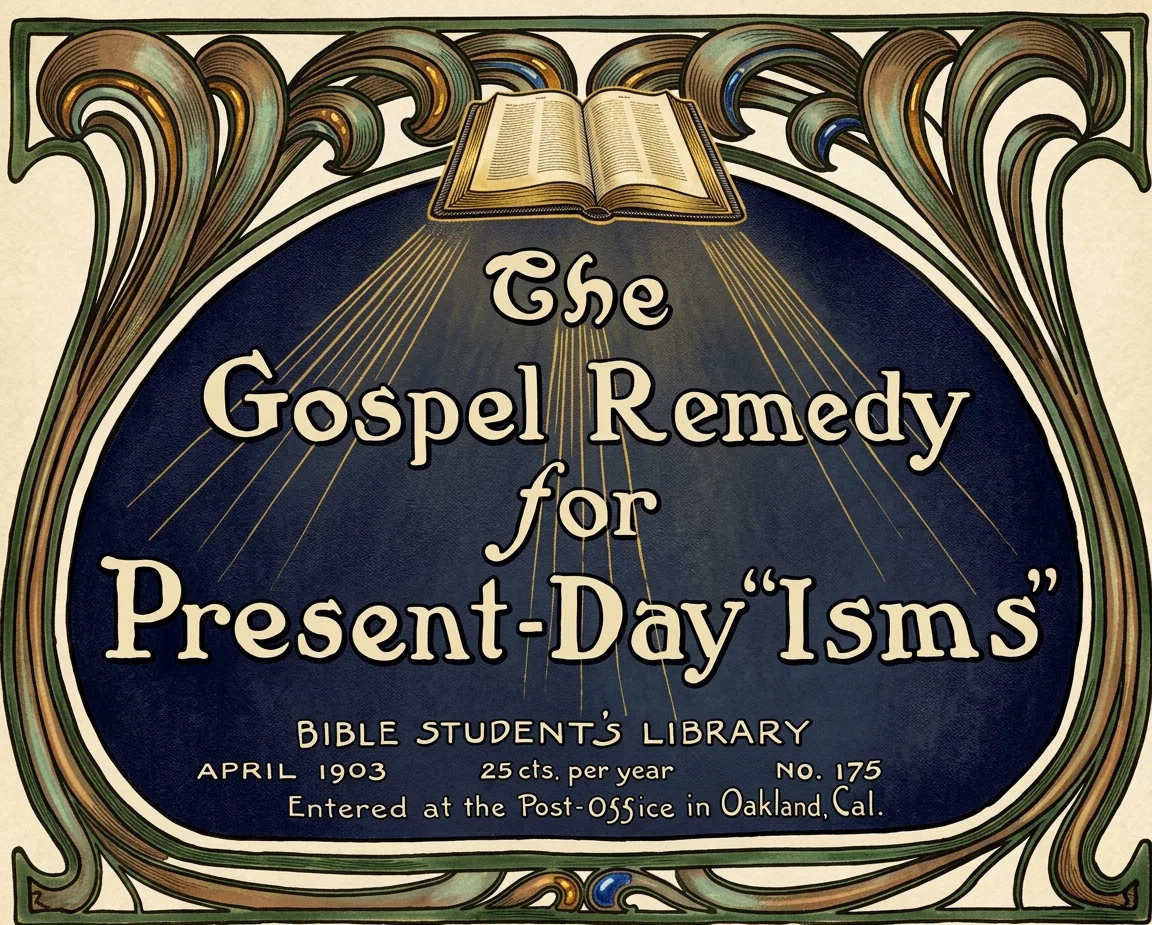
From the above sketch you will get an idea of another tract in this same series. It is a number which certainly deserves a careful study by every one. It is to be published as No. 175 of Bible Students’ Library series, and its price is also 72 cents per hundred. Almost 50,000 copies of this tract have been sent out during the past few days.
We Would See Jesus
Two weeks ago we showed the cover design of this tract also. Since that time more than 100,000 copies have been mailed, and the demand seems to have only commenced. The following are some of its sub-titles: We Would See Him for We Love Him, We Would See Him as He Was, We Would See Him as He Is, We Shall Be Like Him, He Will Come for His Own, Then Shall the Elect Be Gathered.
This tract is issued as No. 173 of Bible Students’ Library. The price is also 72 cents per hundred.
The fourth tract in this series is not yet ready; it will be noticed later.
Address Orders to Your State Tract Society
LET THE CHILDREN HELP
For some time the Publishers have offered to send any child TEN COPIES of the “SIGNS” FREE OF CHARGE for ONE WEEK
The only requirement was that he TRY to sell the papers received and use the money thus secured for a capital on which to work in selling more papers.
THE FOLLOWING LETTER HAS RECENTLY COME TO HAND:—
“Signs of the Times,” Oakland, Cal.
Dear Sirs: My two little boys have sold, when next week’s issue is out, 6,260 copies of the “Signs” since last March (1902). . . . It all started from the twenty-seven cents which the boys earned selling the “Signs.”
Let all the children who would like to earn some money selling Signs send their names and addresses at once to the publishers, and ten papers of the latest date will be sent you FREE OF CHARGE immediately. Do not delay.
ADDRESS
SIGNS OF THE TIMES, OAKLAND, CAL.
An Appeal from Washington, D. C.
By Editor
On the first page of this paper will be found a reproduction of a photograph of a church recently purchased in Washington for $12,000. It is too great a debt for a small congregation. That church, while in a locality, is not a local church. In a peculiar sense it belongs to every friend of religious liberty. While it will belong to, and will be controlled by, Seventh-day Adventists, in vastly broader sense than a small denomination's name would signify, it stands for a principle, which in time of crisis appeals to every soul, the principle of liberty, religious liberty. It will stand in Washington, the nation's capital, as a protest against the repeal and subversion of those principles of liberty which made this nation what it was for a hundred years, a beacon light pointing all the nations of earth the way to freedom from all religious tyranny. That church will stand in Washington as the exponent of absolute separation of Church and State, a solemn protest against all enactment of religious dogma into civil law. And it will stand for this, not because it opposes either religion or State; but for the sake of both religion and the State. It is therefore of national interest, and every lover of the principles of religious liberty, for which Roger Williams, Thomas Jefferson, and others stood so grandly, will be anxious to see it stand free from debt, a living exponent of character-building truth. It is for these reasons that we heartily endorse the appeal by the pastor of that church, J. S. Washburn, found on page 12. How many want a part in it? The SIGNS will receive and forward all funds committed to its trust.
Standing for Liberty.
By Editor
How few are the papers in the United States that stand for religious liberty—freedom of conscience—as compared with a few years ago! Here are two which we will mention: On the east Coast of the country, in New York, is published the Sentinel of Liberty; on the west coast, the SIGNS OF THE TIMES. Both of these papers stand for liberty for the individual, whether he be Jew or Gentile, citizen or foreigner, Catholic or Protestant, white or black, yellow or brown. This is the Golden Rule, and for it we propose to ever stand.
Is Sunday of God?
If Sunday is a Christian institution, Christ will care for it, and He asks no aid of civil power, of earthly arms. In its own intrinsic vitality it will stand, and forever support all who plant their feet upon it. If the Sunday is not of God, it will go down, and no amount of human legislation can bolster it up. It will not only go down, but it will carry to its doom all identified with it. The great question for every soul to decide in this crisis is, Is Sunday of God? or is the Sabbath of God? Jesus Christ said, “Every plant, which My heavenly Father hath not planted shall be rooted up.” Are not Sunday-law men endeavoring to cherish and foster a plant doomed to destruction?
Begin at the Bottom and Climb
Booker Washington began in his leaky cabin and little school of thirty. It has grown to sixty-seven buildings and 1,218 students; and he has grown with it. If he had been placed over an institution with sixty-seven buildings and 1,218 students, in all probability he would have utterly failed. But he was willing to begin at the bottom and climb. Many white persons want a full-fledged institution to start with. They feel that they must start high to make a success, as Darius Green, of flying-machine fame, felt it was necessary to start at some elevation. They sooner or later fall as did Darius, as effectually if not as dramatically. It is better to learn to walk and run before we attempt to fly. It is better to be willing to try our talents in a small place before we try the larger. It is better to grow up or be built up than to be merely puffed up.
Wireless Telegraphy
Wireless Telegraphy is not a new thing in true Bible science. God has often spoken with His children, and daily and hourly messages are wafted to Him on the wings of prayer and praise. Perhaps a better term would be divine telepathy, or thought transference. Psychologists are now working on that problem, and Dr. Parkhurst of New York is reported as saying, in a sermon of January 25: “Mental telepathy is already a demonstrated fact when exercised by certain individuals at short range.” He believes that it will be so developed that telegraph wires will be eliminated, and the high stations of the Marconi system tossed into the junk heap. But telepathy is full of the possibilities of evil. It demands a passivity of mind, a subjection of mind, to creature control which Satan and his evil spirits will manipulate. Man may yield his mind passively to his Maker always with advantage to himself, always with added strength of will and thought. But he who yields to creature control does it at the expense of a weakened will and mind, and makes of himself a prey of the evil one.
Not for a Year Alone.
By Editor
When we stated some time ago that the California Conference of S. D. Adventists had agreed to pay the expenses and salaries of missionaries who went from this State out into the regions beyond “for a year,” it conveyed a wrong impression. It was for a year and more, the time indefinite, but till the fields where these missionaries should go would be, or should be, able to support them. We make this correction because other conferences have seemed to get the idea that California supported these missionaries only for a year, and so they have been agreeing to do the same for missionaries sent from their respective fields. We are glad to correct the wrong impression. Let no definite time be set. Let the need be the criterion for the time.
False Prediction of a Tidal Wave
By Editor
A “scientific” man of central California predicts that San Francisco and Oakland will be submerged by a great tidal wave, and great and wide-spread damage will be done Jan. 25, 26, 1903. All this is based on scientific secret formula, which, of course, it would not be wise to give to the public. We are writing this on January 23, and we appeal to all our readers to give no attention to the numerous prophets who “speak a vision of their own heart and not of the mouth of Jehovah.” Heed the great, glorious, consistent Word of God.
Where He Obtained It.
—In Ingersoll's lecture, “What Must I Do to Be Saved?” he gives utterance to these words:—
And I believe in the gospel of Liberty, in giving to others what we claim for ourselves. I believe there is room everywhere for thought, and the more liberty you give away, the more you will have. In Liberty extravagance is economy. Let us be just. Let us be generous to each other.
But where did he get this?—Consciously or unconsciously, directly or indirectly, he obtained it from the Christian religion. No other religion of the world ever taught true and perfect liberty. It is solely because of the influence of Christianity that infidels have liberty to blaspheme. They will wish sometime they had not abused it, but then they will be reaping the fruit of their own sowing. That which a man chooses in the seeding he must abide in the reaping.
Religious Liberty for All
Nearly all men—we know of no exceptions—believe in liberty of conscience, religious liberty for themselves. Even the pagans, and most ultra-papists, and Mohammedans, believe this. But this is not true religious liberty. The man who believes that, believes it for the other fellow as well as for himself. He may not believe the other man to be right; he may believe him to be fearfully wrong, but he will, at the same time, demand equal liberty for the other man as for himself; but if he will not do this, he does not know the first principles of religious liberty. Jesus Christ was superlatively right. His enemies were positively wrong. But He said: “If any man hear My sayings, and keep them not, I judge him not; for I came not to judge the world, but to save the world.” He who sets himself to judge his neighbor, assumes authority which our Lord did not assume.
Worse than Infidelity.
There came to our table, under date of September, 1902, a monthly paper called Prophetic Age, containing an article on “America a Prophetical and Sign Nation.” The article is filled with all sorts of fallacious reasonings and teachings, from which the writer draws this conclusion: “Now, if this nation is to measure the time of the end, it will expire Sept. 3, 1903. On that day it will be one hundred and twenty years old. There is no other application to this measure of time.” By this he refers to the one hundred and twenty years before the Deluge. It is by just such far-fetched, fanciful, and time-setting theories as this that the cause of Christ’s second coming is brought into disrepute. It is worse than all the scoffing of infidelity. “Of that day and hour knoweth no man.” We wonder if he will be disappointed on that date? Does he really believe it?
What Patrick Henry proclaimed as a political choice
is to every individual a moral alternative. He cried, “Give me liberty, or give me death!” Every individual is naturally a sinner, subject to death. “All have sinned, and come short of the glory of God.” Rom. 3:23. “Sin, when it is finished, bringeth forth death.” James 1:15. The sinner is a captive. Rom. 7:23; 2 Tim. 2:26. Jesus Christ came to set captives free. Isa. 61:1. So, in a moral sense, it is liberty or death with every one that is born into the world. Then why not seek for liberty, when it is freely offered to every one? John 3:16. “If the Son therefore shall make you free, ye shall be free indeed.” Ch. 8:36. Under the penalty of death is the natural condition; liberty through faith in Christ is the only alternative.
The Old Versus the New.
In order to attract the people, a church in New York introduced a novelty in the shape of a whistling solo by a young lady. Recently, a clergyman in Delaware opened his discourse by whistling his text,—from notes in imitation of the song of a meadow-lark, which he had heard in his vacation, and which reminded him of a certain passage of scripture. The old way of attracting men is that given by our Lord Himself, “And I, if I be lifted up, will draw all men unto Me.” “O Christian brother, lift up Jesus Christ, the Way, the Truth, and the Life, and let Him draw.”