Your ShelfYour Projects

Signs of the Times, Vol. 29, No. 5.

LESSONS FROM THE FIRST CHAPTER OF REVELATION

Signs of the Times

Feb 4, 1903

Pacific Press Publishing Company · Oakland, California · Feb 4, 1903

LESSONS FROM THE FIRST CHAPTER OF REVELATION.

BY MRS. E. G. WHITE.

Verses 10–20.

See Article in Missions Department and Note on Last Page.
“I WAS in the Spirit on the Lord’s day,” writes the prophet of Patmos, “and heard behind me a great voice, as of a trumpet, saying, I am Alpha and Omega, the first and the last; and, What thou seest, write in a book, and send it unto the seven churches which are in Asia; unto Ephesus, and unto Smyrna, and unto Pergamos, and unto Thyatira, and unto Sardis, and unto Philadelphia, and unto Laodicea. And I turned to see the voice that spake with me. And being turned, I saw seven golden candlesticks; and in the midst of the seven candlesticks one like unto the Son of Man, clothed with a garment down to the foot, and girt about the paps with a golden girdle. His head and His hairs were white like wool, as white as snow; and His eyes were as a flame of fire; and His feet like unto fine brass, as if they burned in a furnace; and His voice as the sound of many waters. And He had in His right hand seven stars; and out of His mouth went a sharp two-edged sword; and His countenance was as the sun shineth in his strength. And when I saw Him, I fell at His feet as dead. And He laid His right hand upon me, saying unto me, Fear not; I am the first and the last: I am He that liveth, and was dead. And, behold, I am alive forevermore, Amen; and have the keys of hell and of death. Write the things which thou hast seen, and the things which are, and the things which shall be hereafter; the mystery of the seven stars which thou sawest in My right hand, and the seven golden candlesticks. The seven stars are the angels of the seven churches; and the seven candlesticks which thou sawest are the seven churches.”
It may seem wonderful to us that Christ should reveal Himself to John as He is, strange that He should thus address Himself to the churches. But we should remember that the church, enfeebled and defective tho it is, is the object of Christ’s supreme regard. Constantly He watches over it with tender solicitude, and strengthens it by His Holy Spirit. Will we, as members of His church, allow Him to impress our minds and to work through us to His glory? Will we heed the messages He addresses to the church? Let us determine to be among the number who shall meet Him with joy at His coming, and not among those who“shall wail because of Him.” Let us make certain our redemption by obeying the messages that He gives to His church.
Christ bears to the church the words of consolation: “Because thou hast kept the word of My patience, I also will keep thee from the hour of temptation, which shall come upon all the world, to try them that dwell upon the earth. Behold, I come quickly; hold that fast which thou hast, that no man take thy crown. Him that overcometh, will I make a pillar in the temple of My God, and he shall go no more out; and I will write upon him the name of My God, and the name of the city of My God, which is New Jerusalem, which cometh down out of heaven from My God, and I will write upon Him My new name.”
To the overcomer is promised a crown of unfading glory, and a life that measures with the life of God. “To Him that overcometh,” Christ declares, “will I give to eat of the tree of life, which is in the midst of the paradise of God.” “Eye hath not seen, nor ear heard, neither have entered into the heart of man, the things which God hath prepared for them that love Him.” Let us strive to obtain an abundant entrance into the kingdom of our Lord. Let us diligently study the Gospel that Christ came in person to present to John on the Isle of Patmos,—the Gospel that is termed, “The Revelation of Jesus Christ, which God gave unto Him, to show unto His servants things which must shortly come to pass.” Let us remember always that “blessed is he that readeth, and they that hear the words of this prophecy, and keep those things which are written therein; for the time is at hand.”

“CHRISTIAN SCIENCE.”

IV. Self-Contradictions and Inconsistencies.

IT is difficult to know where to begin the discussion of this section, because Mrs. Eddy’s theory is so contrary to all recognized phenomena of life that she is continually using words and expressions that contradict her own position. Indeed, her entire system is so strained and unnatural that it seems an impossibility to use language that is always consistent with it. A few examples will make these contradictions very apparent.
In “Science and Health” (page 582) she defines matter as “illusion.” On page 173 she says: “Nothing we can say or believe regarding matter is true, except that matter is unreal,” and she many times repeats in various forms the same idea. Her whole theory is based on the claim that matter has no existence; that everything is mind or spirit, that mind is intangible to material sense; that is, we do not see, hear, feel, taste, or smell matter, because these are illusions of what she calls “mortal mind;” “for Spirit [a synonym for mind] and matter can not mingle.” Page 80. She says, “Material sense is an absurd phrase, for matter has no sensation” (page 481), and “the corporeal [that is, material] senses are the only source of evil or error. Christian Science shows them to be false.” Page 485. She asserts, “Christian Science sustains with immortal proof the impossibility of any material sense, and defines these so-called senses as mortal beliefs, whose testimony can neither be true of man nor his Maker.” Page 484. Yet she is continually using expressions contradictory to this position.
For example, she says, “Christian Science strongly designates the thought that God is not corporeal, but incorporeal,—that is, bodiless.” Page 10. But her next words are, “Mortals are corporeal,” which must mean that they have a body. Again: “Jesus was the Virgin’s Son. In the flesh He was appointed to speak God’s word to human flesh,” etc. Page 228. But as flesh is illusion (page 577), she makes it read, “In the illusion He was appointed to speak God’s word to human illusion.” And that is a fair sample of many of her illogical statements. She says, “The invisible Christ was incorporeal, whereas Jesus was a corporeal or bodily existence” (page 229); that Jesus had the same body after His resurrection that He had before (page 350), and that He had “material blood.” Page 330.
She tells us, “If you wish to know the spiritual fact, you can discover it by reversing the material testimony, be it pro or con.” Page 22. That is, if you believe you see a tree, deny that belief; say there is no tree there. If you hear an explosion, deny hearing it; call it only an illusion. If you are cold and hungry, assert that you are warm and full-fed—not a very comforting doctrine, to be sure, and one that “Christian Scientists” rarely carry out. Who ever saw one of them that did not eat, sleep, wear an overcoat or wrap in the winter, keep up a good fire for warmth, and otherwise live like common people? But Mrs. Eddy says of eating, “The fact is, food does not affect the real existence of man.” Yet she hastens to admit that “it would be foolish to venture beyond our present understanding, foolish to stop eating until we gain more goodness.” Page 387.
Is it not manifestly foolish to put one’s trust in a theory which, at its very best, leaves one compelled to live like a common sinner? But her excuse for eating and doing otherwise like the rest of us, will not stand. Did she not just tell us that “food does not affect the real existence of man”? Did she know that when she wrote it? If she did, then she can live without eating. But if she did not know it she should not have written it. She claims to have discovered this science in 1866, and asserts over and over that she and others have demonstrated and proved it. Yet, after all this experience for over a third of a century, she says it would be foolish to stop eating, tho “food does not affect the real existence of man!” Out with such nonsense. If her theory is correct, no one eats; we only delude ourselves into that idea and, having discovered the delusion, she surely should cease to be deluded.
On pages 116 to 118 she several times repeats this claim that food does not sustain life, and says on page 373, “Heat and cold are the products of mind.” These illustrations might be multiplied almost without end.
So abundant are these self-contradictions that statements can be found in Mrs. Eddy’s book to contradict almost every point made in these articles. Yet the writer has been very careful that all quotations and statements should correctly represent the paragraph or subject from which they have been taken. To illustrate, in the first article several quotations were given which denied the possibility of sin, called it a material illusion, and told us Being (or spiritual man) could not fall. This is in harmony with her general theory; yet she says, “We must cause the error to cease that brought sin and death” (page 214), and, “the way to escape the misery of sin is to cease sinning,” for “sin is the image of the beast, to be effaced by the sweat of agony.” Page 222. Indeed, so absolutely contradictory is her theory to every thought of the mind, to every evidence of the senses, and to every fact of existence, that, in order to justify her own position, she calls every one else crazy. She says, “There is a universal insanity, which mistakes fable for fact throughout the entire round of the material senses,” and calls it “this general craze.” Page 406.
But here is a hard problem. She says, “Good [her synonym for God] itself never causes evil or creates aught that can cause evil” (page 258), that “there is but one Mind” (page 226); that Mind (as she also calls God) created all (page 206); that “there is no room for His opposite” (page 234); that “nothing possesses reality or existence except Mind” (page 226); that Mind can not cause evil (page 259); that the devil is only a lie, a false belief, an error (pages 575, 245); and that God controls all (page 239). Then will Mrs. Eddy kindly tell us the source of mortal mind, with all its illusions about material things? God did not create these errors, man could not create them, and she assures us there is no devil. She informs us we are strangely afflicted with delusions and illusions, yet has left no possible source from which they could originate.
Still further, her every effort to propagate her faith is a contradiction of her theory. She has written a book which we are urged to buy, read, and believe, because it is the only source from which we can learn the truth. But when we read it, it tells us to deny every evidence of our five senses; for every evidence they offer is false, and matter has no existence. Therefore we have no hands to handle her book, no eyes to see it, and no mouths to pronounce its words. And the book itself is only an illusion; for, according to Mrs. Eddy, there is neither printing-press, type, nor paper. And when we accept the illusion, she insists we shall delude her into the belief that we pay her $3.00 for the supposed book, tho there can be no money. That is, she denies the existence of the five senses, and then appeals to those very senses to examine and approve (what she calls) evidence of their own non-existence. This is confusion worse confounded, and we beg to be excused. We do not care to be deluded into following an illusion. We remember the good Book says, “While they promise them liberty, they themselves are the servants of corruption; for of whom a man is overcome, of the same is he brought in bondage.” 2 Peter 2:19.
We will next consider the healing of disease and excuses for failures. J. O. BEARD.

“MERCY OVERSTEPS JUSTICE.”

A BROTHER was in discouragement and darkness. By looking at the magnitude of his sins so constantly he had lost his hold upon God; they had weighed him down, and Satan had succeeded in getting him completely disheartened. I had written him trying to encourage and help the dear soul, using an illustration in which I made the statement that a father would have more tender care for a son who had been severely injured even in direct disobedience than to there and then punish him for the transgression, tho he had said he would do so. His pity for the suffering son would be so great that his compassion would be shown instead of his justice, and he would tenderly care for the suffering disobedient.
A reply came back: “Your illustration would lead me to think that God’s mercy had overstepped His justice in my case. But I am wholly to blame myself for my present condition. Do you not think that justice must be administered as well as mercy?”
Here is my reply; and, thinking that some other discouraged brother or sister may be benefited by the thoughts, I send it for publication.
You say that you are wholly to blame for being away from God. Of course you are. Any and all ofus are wholly to blame for that, or for any other sin. God has made such entire provision for sin and against sin that if we sin, or when we do sin, we are wholly to blame for it. There is not a person on this earth who can blame any one but himself for his departure from God, or for staying away from Him. But that does not prove that I should not do all I can in co-operation with God to get your soul out of the enemy’s hands again. So long as God is doing so much to help you, you should not complain about others doing so much to help you, too, or think that you can not get back again. The fact that you are wholly to blame and recognize it, is the best of evidence that God is working for you by His Spirit; and it ought to encourage you much to know that this is the best of evidence that there is hope; so take courage.
You say that my former illustration would lead you to think that mercy overstepped justice in your case. Would to God that I could get you to believe that fully. That is a fact. Read Rom. 5: 20: “But where sin abounded, grace did much more abound.” The “mercy-seat” was placed over the law in the ark to show to sinners that mercy for the time being triumphs over justice, to give them hope that they may escape the penalty of the law. With sin abounding as it does, what would be the hope of a single soul if MERCY did not overtop Justice and cause Justice to stand silently aside with bowed head for a time?
“Mercy and truth [law] are met together; righteousness [law] and peace have kissed each other.” Ps. 85: 10. Here is a condition of things where Justice and Mercy stand side by side; where they have made a loving agreement; where Justice does not go before Mercy to mete out its righteous deserts upon the offenders against God’s holy law; where sweet Peace holds Righteousness and Justice, under a flag of truce, in its loving embrace. Justice submits to be subject to Mercy, and Righteousness agrees to let Peace reign for a time.
You ask if I do not think that justice should be administered as well as love and mercy. I certainly do, but not now. If justice were administered as generally and as promptly as it is deserved, no one could be saved; for Justice would overtake and destroy all before Mercy could reach them and be accepted. It would be so in every case. Do you know of any one in all your life who has accepted mercy before he deserved to have justice administered to him? Why was it that God directed the children of Israel to appoint cities of refuge to which the man-slayer might go for mercy and protection? Was it not to teach us that Mercy is a refuge from Justice? So long as the guilty remained in the city of mercy the avenger could not mete out justice to him. Yes, justice should and will be administered; but God has so planned it that justice is stayed for a time to give the guilty, deserving soul a chance for life, even tho he is guilty and deserving of punishment,— and because he is so.
Justice will be meted out, but not till after Mercy triumphs to the salvation of every sinner who takes advantage of the delay of Justice. The philosophy of the plan of salvation is, that God has intentionally, purposely, deliberately, delayed to mete out justice till mercy has been exhausted in its refusal and rejection by the last sinner, and there are no more who will accept it. Then the justice of God will break loose with the more fury for having been dammed up by mercy, and will break over the defenseless heads of the rejecters of mercy. Then there will be no more hope for a single soul. But so long as mercy abounds more than sin, so long is there hope for you. We will constantly pray that you may accept the pardon which Mercy still extends to you; that you will do this before the elements of nature are let loose in the earth; before Mercy has forever folded her pinions of love and protection, and God visits judgment upon the impenitent. But make haste. Your brother in love,
E. W. WEBSTER.

“THE REVELATION OF JESUS CHRIST.”

XII. As God Would Have Us See.

Before beginning the study of this chapter there are two things worthy of our consideration: (1) The true point of view; (2) the correspondence in God’s work.
1. Some men view the earth with its people from a scientific standpoint, and make all other outlooks subsidiary to that view-point; some see it from a political, others from a social or speculative. “Vision” means simply “seeing”; and the only true visions, or seeings, are the seeings of God. Not as mortal, earthly men see—limited in vision by imperfect knowledge, wrong education in perspective, national, personal, political, and religious prejudices—would God have His people see. The only true view-point is to go up with God and view, with Spirit-anointed eyes from His throne, earth with its people. The only true seeing is the seeing of God. Where John says, “I saw,” Ezekiel tells the things seen were “visions of God.” Eze. 1:1; 8:3.
This prophecy beginning with the fourth chapter of Revelation is emphatically the seeings of God as regards this world; and he who comes into harmony with it, in the spirit of it, will look upon this world in a different light than he ever saw it in mortal view.
2. God’s work in heaven corresponds with God’s work on earth. The symbols that John saw before the throne were symbols of the agencies of God and the work He is doing in the earth. Knowing His work in either place, the instructed child of God knows the work that He is carrying forward in the other.
The fourth chapter of the Revelation opens a new scene in John’s vision. It does not mean that what John saw came afterward, or that it was to occur after the events recorded in the specific letters to the seven churches; it simply declares that the scenes recorded in the fourth chapter and onward were seen by him after the events of the first three chapters were seen. Let us question the text:—
What did John see after the visions of the seven churches?
“After these things I saw, and behold, a door opened in heaven.”¹ Verse 1.
What did he hear?
“The first voice that I heard, a voice as of a trumpet speaking with me, one saying, Come up hither, and I will show thee the things which must come to pass hereafter.”¹
What then occurred, and what did he see?
“Straightway I was in the Spirit; and behold, there was a throne set in heaven, and One sitting upon the throne.” Verse 2.
How does John endeavor to describe the glory of the One sitting upon the throne?
“He that sat was to look upon like a jasper stone and a sardius; and there was a rainbow round about the throne, like an emerald to look upon.”³ Verse 3.
What did John see round about the throne?
“And round about the throne were four and twenty thrones; and upon the thrones I saw four and twenty elders sitting, arrayed in white garments: and on their heads crowns of gold.”⁴ Verse 4.
What came from the throne?
“And out of the throne proceed lightnings and voices and thunders.”⁵ Verse 5.
What more did John see before the throne?
“And there were seven lamps of fire burning before the throne, which are the seven Spirits of God; and before the throne, as it were a glassy sea like unto crystal.”⁶ Verses 5, 6.
What did the prophet see round about the throne?
“And in the midst [margin “before,” ch. 7:17] of the throne, and round about the throne, four living creatures full of eyes before and behind.”⁷ Verse 6.
What description is given of these creatures?
“And the first creature was like a lion, and the second creature was like a calf, and the third creature had a face as of a man, and the fourth creature was like a flying eagle.”⁸ Verse 7.
What does John hear proceed from these creatures?
“And the four living creatures, having each one of them six wings, are full of eyes round about and within; and they have no rest day and night, saying, Holy, holy, holy, is the Lord God, the Almighty, who was and who is and who is to come.” Verse 8.
How does this song affect the elders?
“And when the living creatures shall give glory and honor and thanks to Him that sitteth on the throne, to Him that liveth for ever and ever, the four and twenty elders shall fall down before Him that sitteth on the throne, and shall worship Him that liveth for ever and ever, and shall cast their crowns before the throne.” Verses 9, 10.
What is the song which they sing?
“Worthy art Thou, our Lord and our God, To receive the glory and the honor and the power; For Thou didst create all things, And because of Thy will they were, And were created.”⁹ Verse 11.

Exposition and Comment.

1. Heaven is as literal a place as our God is a literal Being, as our great High Priest is literal. While we have no description to write of God the Father, while He is omniscient, omnipresent, He is also a personal Being, having a Personal Presence somewhere, self-limited, in some place as He is in no other place. If God were one great all-embracing, intangible, incomprehensible sphere, as much in one place as in another, then surely God’s Word has deceived His children! Because, while that Word does tell us that He is everywhere present by His Spirit, in constant, living touch with all parts of His vast creation, it also reveals Him as having a Personal Presence in that country of His imperial realm called Heaven. Thence came the Son. To that place He returned. Thence He will come again. From that great Central Heaven, that “Celestial Alhambra,” go radiating out to all the circling worlds the swift messengers of God, angels of light, bound on their exalted, tireless ministry of love for their King. To that place the redeemed will go. There they will be confessed before the Father by the Son. And while now He dwells “in the light which no man can approach unto, whom no man hath seen nor can see,” because of sin, yet in that great day when every mark of sin shall have been obliterated forever by His love and His power, His children “shall see His face.” If He were only such as ancient Pantheism, or its modern phases of “Christian Science” or “Theosophy,” would teach us, He could have told us that in His Word, and we could have understood it as well as multitudes now understand the teachings of those through whom “the father of lies” would take from us our Father-God and Brother-Saviour. It was into the heaven of our God that the door opened before the beloved disciple.
2. “Come up hither.”—So God called Moses up into the mount with Him (Ex. 24:12); so also Ezekiel (Eze. 40:2); on the mountain also the transfiguration was shown (Mark 9:2). So God would have the heralds of His Gospel come up upon higher spiritual planes. “O thou that tellest good tidings to Zion, get thee up on a high mountain.” Isa. 40:9. The servant of God must be above the low plane of the dusty deserts and miasmatic sloughs, and foglands of earth if he would see in God’s seeing. Mark also that John, and we with John, were not called up to the throne of God to satisfy our curiosity about heaven, but to see “the things which must come to pass hereafter.”
3. John did not see the person of the Father; rather it was a glory like the changing hues of intense light shining through all the indescribable lights and shades, the coruscations and scintillations, the brilliancies and beauties of the water-green jasper and red carnelian; while over this overwhelming glory arched the covenant bow of God. Emerald.—A beautiful green stone from which flashed the colors of the rainbow, a token of God’s mercy. To that center of all true seeing, are God’s people called with John to behold with clearer vision God’s dealings with men.
4. “Four and twenty elders.”—Compare with the twenty-four courses of priests in the temple. 1 Chron. 24:1–19. Clothed in white raiment would indicate a righteous character, robes washed in the blood of Christ; and the crowns of gold would show conquerors over sin. Christ Jesus is our great High Priest. When He died the graves were opened. After He arose some of the dead came forth. Matt. 27:52, 53. When He ascended on high “He led captivity captive” (margin, “a multitude of captives,” Eph. 4:8), trophies of His victory over sin and death, assistant priests or ministers for man’s salvation in the sanctuary on high, and representing in their own persons all those whom God will use mightily in His work in the earth,—the clean of hand and pure of heart.
5. “Lightnings, voices, thunders,” indications of the glory, the goodness, the power, of God. Compare with Ex. 19:16; Rev. 8:5; 11:19; 16:18. In all these other references is clearly shown God’s wrath against sin.
6. “The seven lamps of fire” and “the glassy sea” were found in the earthly sanctuary in the sevenfold candlestick and the laver at which the priests washed. John saw what they represented, the seven Spirits of God, the one all-pervading Life of God, the agency of all God’s potency in creative and redemptive affairs and the laver of regeneration, the washing of the Word. Titus 3:5, margin; Eph. 5:26.
7. “Round about the throne.”—Not “in the midst,” but before and “round about.” “Living creatures,” so called by Ezekiel. “Beasts” is a very bad translation. It is literally “living ones.” Ezekiel sees these upon the earth, below the firmament, while the throne was above the firmament. To the human eye the movement of the living creatures and the wheels seemed confusion, but out of it all God brought supreme order, and control. In a larger sense the symbol of the throne covers all God’s kingdom. “Jehovah hath established His throne in the heavens; and His kingdom ruleth over all.” All that is in His kingdom is in a sense in the presence of and round about His throne. “Thus saith Jehovah, Heaven is My throne, and the earth is My footstool.” Hence all the things of earth may be well spoken of as in His immediate presence.
8. Into this wonderful symbolism comes the lion, the ox, the man, the flying eagle. Over these there have been endless speculation. That they are not real creatures is evident from a comparison of Ezekiel 1 and Revelation 4. The former has each of the four faces on each of the four symbols, yet he calls all one “living creature.” In Ezekiel each one has four wings, in John’s record each one has six wings. There are other differences also. These creatures have been said to be God’s living throne, but the position of the creatures and context forbid this. They have been said to represent the four ages, antediluvian, postdiluvian, and Levitical Christian, and the ages of glory which follow. Others have said that they stand as four great characteristics of God: His greatness and majesty (the lion), His strength and patience (the ox), His knowledge and wisdom (the man), His exalted and ever glorious reign (the flying eagle). And these things are true of God in fact, and the symbols are fitting; but let us study the subject further in the light of God’s work among His people.
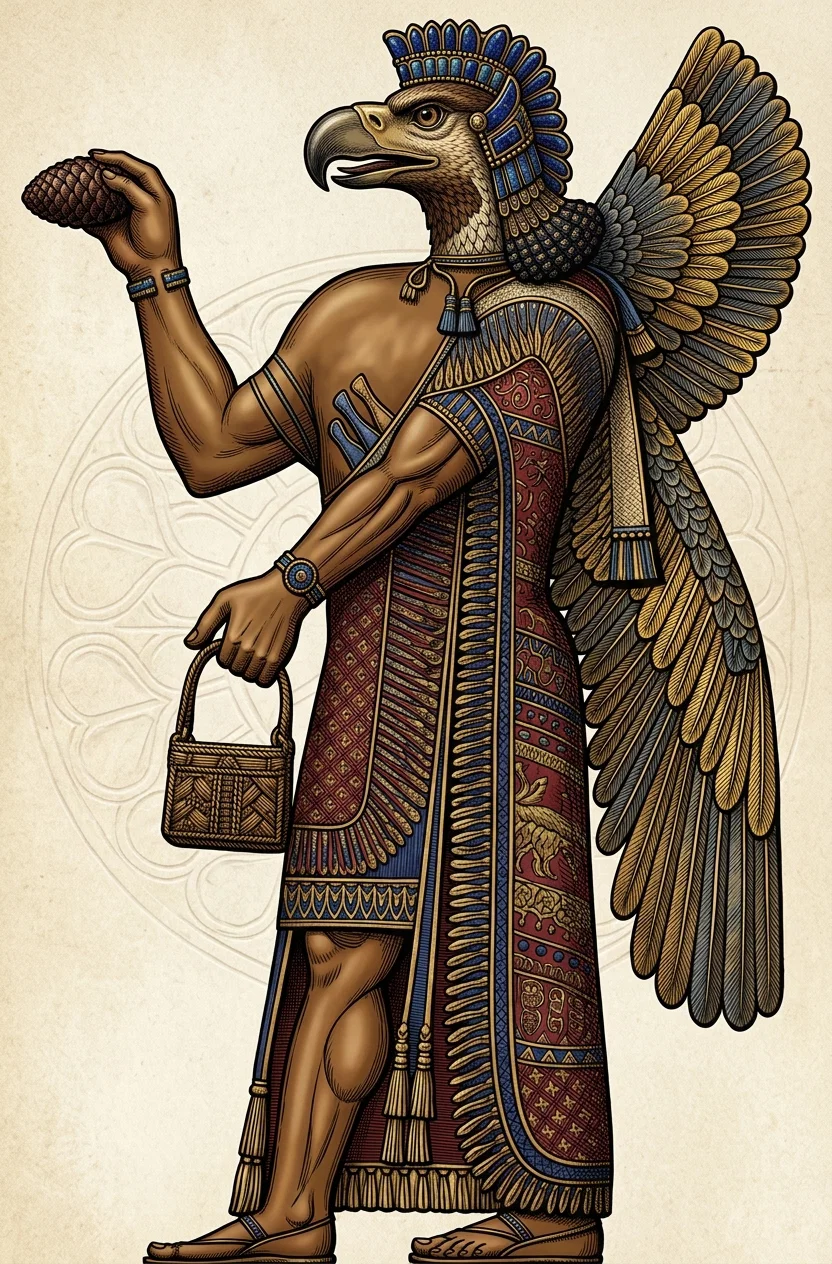
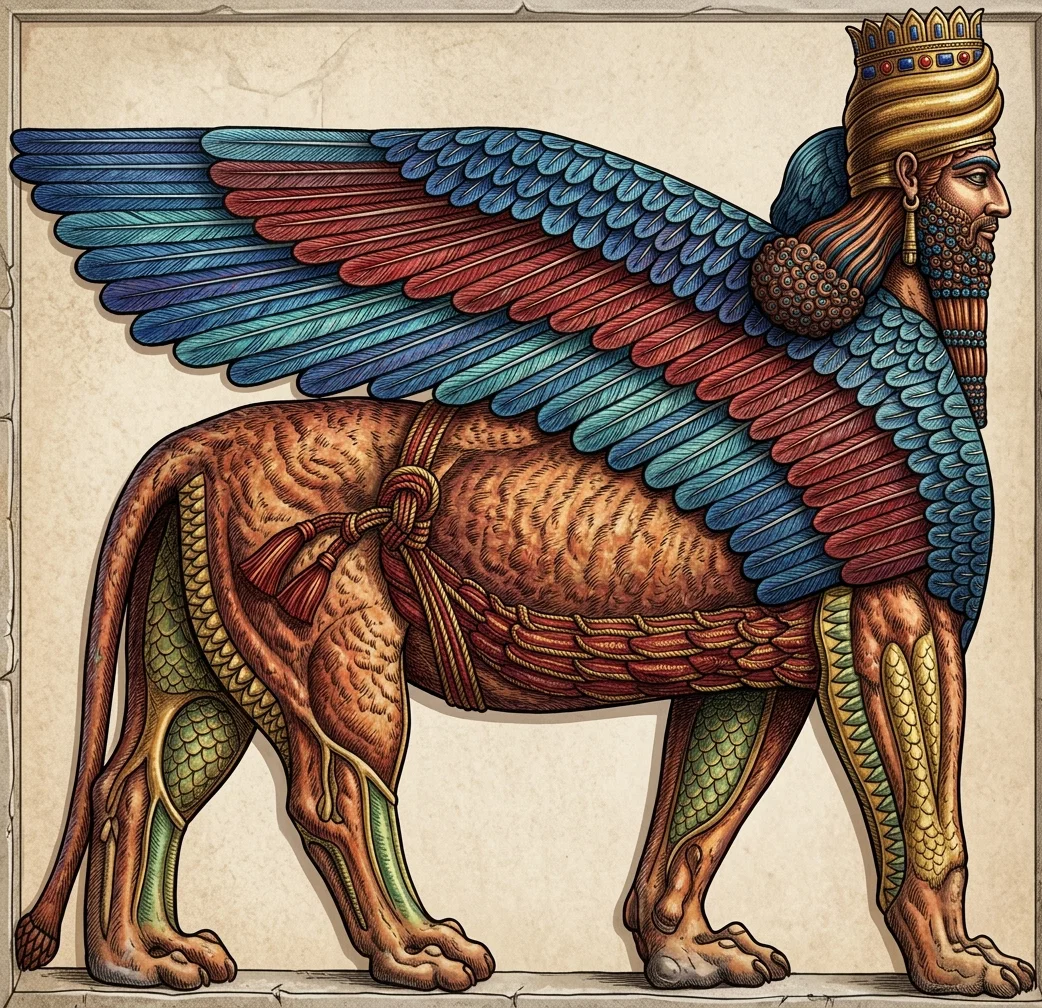
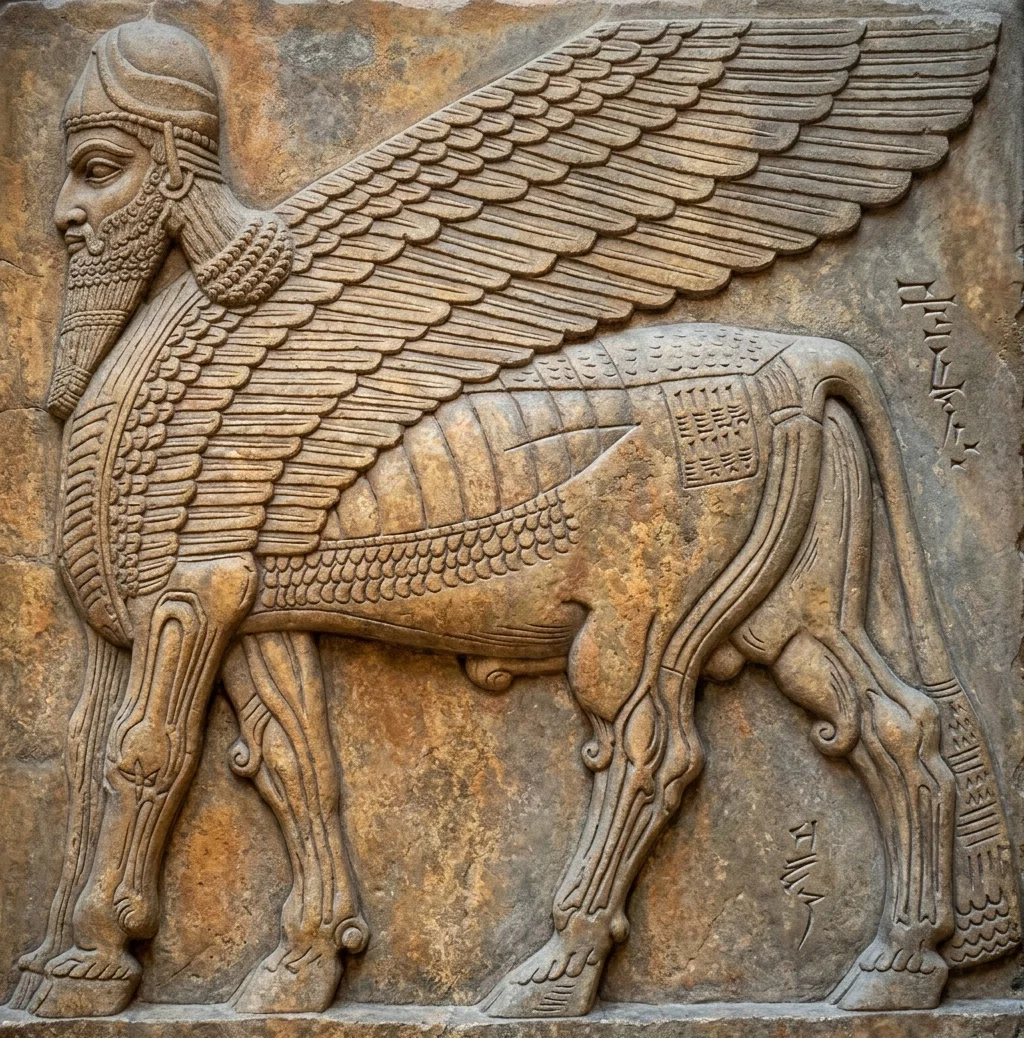
Anciently, the people of God pitched about the sanctuary, wherein was God’s holy law, above which abode the glorious Shekinah, the visible symbol of God’s presence, in four grand divisions under four standards: Judah’s, said to be a lion; Ephraim’s (or Joseph), an ox; Reuben’s, a man; Dan’s, an eagle. These standards stood for the hosts of God, through whom He designed to do His work for the world. Outside of the nation of Israel we find these same symbols repeated and combined in various forms in Babylon and Assyria, etc. For instance, we have as representations of Deity the eagle-headed man, the eagle-winged, man-headed lion, the man-bull, winged man with horns, etc. What may we conclude from all this?—This, at least, that these symbols represent the various organizations and powers of earth, which heavenly agencies are directing, and which God is so using to His glory, despite the seeming incongruities, that they are said to cry, “Holy, holy, holy, is the Lord God, the Almighty.” He makes even the wrath of man to praise Him. What to man is incomprehensible, vague, uncertain, calamitous, is to God clear and certain; and He is making all things work together for good to them that love Him. “Full of eyes” would well describe the great multitude of persons in the sea of restless, ever-moving, never-resting humanity. The most prominent, striking feature to one looking over a gathering of persons is the ever-restless eyes, looking, peering, searching, every way, everywhere.
What, then, did John see from the view-point of God’s throne?—Briefly this: God’s glory, God’s ministers, cleansed and Spirit-filled, God’s all-pervading Spirit, and cleansing word, and the great mass of restless, seething humanity, incongruous, unnatural, yet ever used by God despite all the incongruities and contradictions to His own glory. “The wrath of man shall praise Thee.” “We can do nothing against the truth, but for the truth.”
9. “Worthy art Thou.”—It is the song of God’s children, those who look at the events of earth,—at the fast passing human panoramas,—not from the limited low outlooks of earth. Those who come up to the heights of God and see with His seeings, behold as do these cleansed and crowned elders how even all the efforts of Satan and the fruits of sin on earth are demonstrating in constant progression through the working out of God’s plan that He only is holy, and worthy of praise and glory and honor and power. Surely God’s people, those who believe in Him, should not be mourning pessimists, but join in the glorious song of praise to our God.

Fuel for Our Faults

EVERY time you surrender to doubt, anger, fear, jealous envy, or whatever you know to be wrong, you simply augment the fault you despise. You are adding more fuel to the flame, instead of putting it out. If you keep the fuel away from the fire, it will go out, because there will be nothing on which it can feed.—Success.
Continue reading: DOING THINGS ON SUNDAY