"For this is a word of promise, According to this season will I come, and Sarah shall have a son. And not only so; but Rebecca also having conceived by one, even by our father Isaac—for the children being not yet born, neither having done anything good or bad, that the purpose of God according to election might stand, not of works, but of Him that calleth, it was said unto her, The elder shall serve the younger. Even as it is written, Jacob I loved, but Esau I hated.
"What shall we say then? Is there unrighteousness with God? God forbid. For He saith to Moses, I will have mercy on whom I have mercy, and I will have compassion on whom I have compassion. So then it is not of him that willeth, nor of him that runneth, but of God that hath mercy. For the scripture saith unto Pharaoh, For this very purpose did I raise thee up, that I might show in thee My power, and that My name might be published abroad in all the earth. So then He hath mercy on whom He will, and whom He will He hardeneth.
"Thou wilt say then unto me, Why doth He still find fault? For who withstandeth His will? Nay but, O man, who art thou that repliest against God? Shall the thing formed say to him that formed it, Why didst thou make me thus? Or hath not the potter a right over the clay, from the same lump to make one part a vessel unto honor, and another unto dishonor? What if God, willing to show His wrath, and to make His power known, endured with much long-suffering vessels of wrath fitted unto destruction: and that He might make known the riches of His glory upon vessels of mercy, which He afore prepared unto glory, even us, whom He also called, not from the Jews only, but also from the Gentiles? As He saith also in Hosea,
"I will call that My people, which was not My people;
And her beloved, that was not beloved.
And it shall be, that in the place where it was said unto them, Ye are not My people,
There shall they be called sons of the living God." Rom. 9: 9-26.
THE foregoing quotation begins by referring to the "word of promise" that was made to Abraham that "Sarah shall have a son." When this promise was made to Abraham, he was about ninety years old, and Sarah was an old woman. And then after the promise was given to him there was a long period of waiting and testing. It was not finally fulfilled until Abraham was a hundred and Sarah was ninety. It was the believing of this simple promise of God when everything from the natural and scientific standpoint would have said to him, It is impossible for it to be carried out, that gave righteousness to Abraham. Abraham believed God. He could not conceive of God as promising an impossibility. There is where the great success in Christian life and Christian experience is to be found. It is in taking the word of promise just as it comes to us from God and standing upon it. To those who do this, God will fulfil His word every time.
God's power enables Him to tell the character of individuals before they are born, and therefore He can tell what they will do. He was able to say of the sons of Isaac before they were born that "the elder shall serve the younger." And knowing what their characters would be He could love Jacob and hate Esau. But notwithstanding all this foreknowledge, the Lord does all that infinite power can do to help the very characters that He hates. For if Esau will yield as does Jacob, the Lord will be able to give him the righteous character the same as He has given it to his younger brother.
"He saith to Moses, I will have mercy on whom I have mercy, and I will have compassion on whom I have compassion." This text standing alone might lead a person to think that God's salvation is an arbitrary matter, but a careful study of the illustration that is made of the case of Pharaoh will help us to see the facts. "For the scripture saith unto Pharaoh, For this very purpose did I raise thee up, that I might show in thee My power, and that My name might be published abroad in all the earth." God desired to have His name published abroad in all the earth. He came to the powerful and influential King Pharaoh to offer him the privilege of doing it, but he refused to acknowledge Jehovah.
The Lord did many mighty things in the king's presence that were intended to inspire faith in the true God, and that would have resulted in his complete conversion. But instead of allowing these things to influence him as the Lord desired that they should, Pharaoh hardened his heart. He resisted the very influences that were sent from heaven to save him, and in resisting those influences he cut himself off from doing the work for the salvation of men in the world that he might have done. For if the king of Egypt, with all the influence he had in his realm, had proclaimed in favor of the true God, as did Nebuchadnezzar with a similar opportunity, there is no telling how many of his subjects might have been turned into the ways of salvation; and besides the king himself could have been saved.
God knew the opportunities the character of Pharaoh would afford for manifesting the divine power to the world, and for this purpose the Lord raised him up. That is, He raised him to the throne of Egypt at that time, or as suggested by some of the best commentators, He caused him to stand there. Pharaoh was used by the Lord to show His power, and in this way to reach and save men. The Lord is intent on reaching and saving people, and He will use any instrumentality that will serve this purpose the best. In that particular time it was Pharaoh.
"What if God, willing to show His wrath and to make His power known, endured with much long-suffering vessels of wrath fitted unto destruction: and that He might make known the riches of His glory upon vessels of mercy, which He afore prepared unto glory, even us, whom He has called, not from the Jews only, but also from the Gentiles?" The Lord had to endure the character of Pharaoh. He had to suffer long with the stubbornness and wickedness of the rebellious king of Egypt. The Lord manifested infinite patience in making one display of power after another in order to induce him to allow His people to go peaceably. If Pharaoh had heeded these entreaties and warnings, he would have been saved much suffering and affliction, both for himself and also for his nation. But he was stubborn and refused to yield, or to be entreated of by the divine messengers.
All these things are placed in the Bible for lessons for us who are living in these days. God is entreating you now to turn to Him with the whole heart. Will you heed the entreaty? or will you resist it as Pharaoh did?
The Protestant Oak Is Dying
Rhode Island started under Roger Williams a preeminently Protestant state, founded on purely Protestant principles, absolute separation of church and state. According to the Western Watchman (Catholic) the state census of 1905 shows that "more than half the population is Catholic; and the proportion of Protestants are dwindling gradually." And the item closes by saying: "The Protestant oak is dying at the root."
Religious Socialism.
By Editor
A printed article has come to us from the officers of what is called "The Christian Socialist Fellowship" which met in New York the last of May. The organization is only two or three years old, but already they declare that the Protestant churches are rapidly being honeycombed by the Socialist movement. Fully three hundred of the clergy of the country are already openly allied with the movement. Hundreds of others are secretly in sympathy with it. The object of the "Christian Socialist Fellowship" is declared to be "To permeate churches, denominations, and other religious institutions with the social message of Jesus; to show that Socialism is the economic expression of the Christian life; to sound the class struggle by established industrial democracy; and to hasten the reign of justice and brotherhood upon the earth." While it is declared that the movement is not political, yet it is admitted that thru political actions its principles are to become operative.
We note this as a matter of news, yet we would remark that there is no such thing as the "social message of Jesus." The only message which He gave, and still gives, is to the individual heart—the Gospel, which is "the power of God unto salvation." There are social fruits flowing from it; there are many other blessed consequences of the reception of that Gospel which follow as a matter of course, but the prime end of the Gospel is the individual salvation or regeneration of character of the individual.
Sunday and the Civil Law.
By John S. Wightman
[Kansas City, Mo., is the storm-center for a medieval Sunday law. The following from the Kansas City Journal of May 19 lucidly discusses the question]:
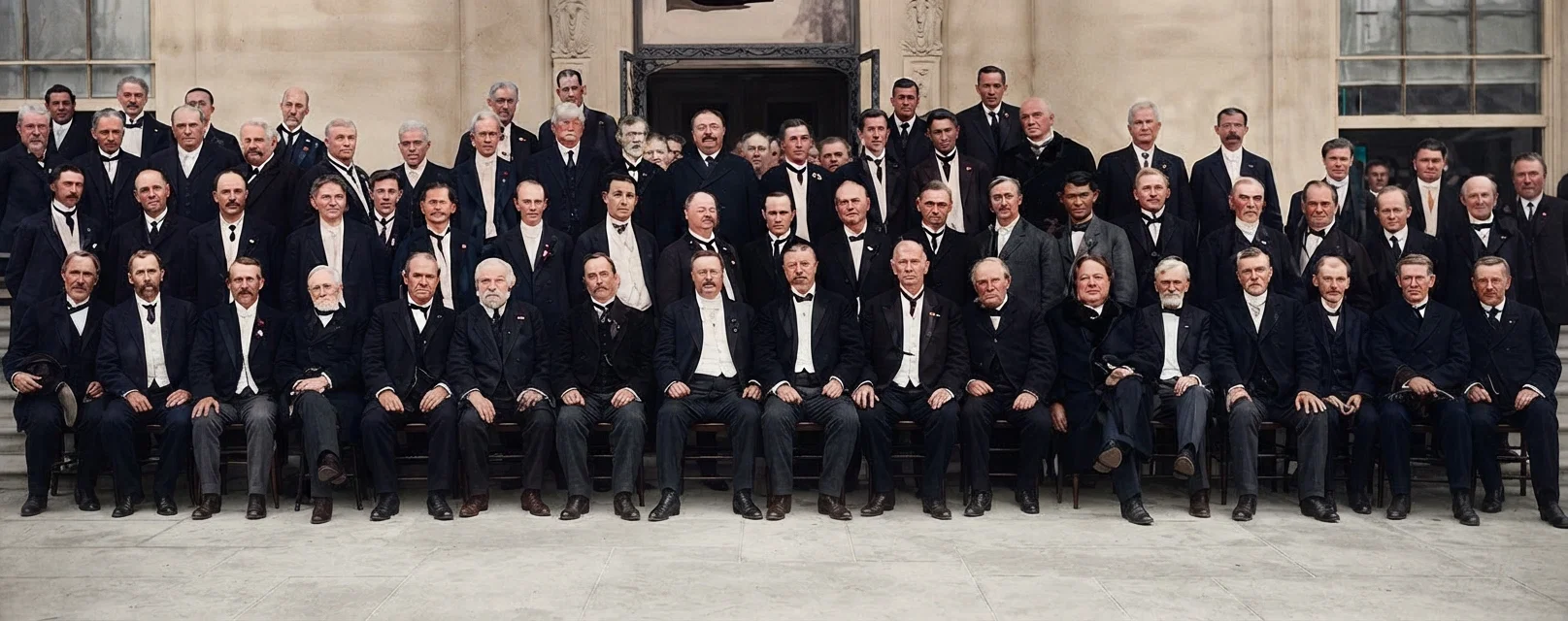
From Stereograph Copyright 1908, by Underwood & Underwood, N. Y. Photograph of Recent Governors' Congress in Washington, Including the President, Vice-President, Governors and Guests, Probably the Most Notable Group of Statesmen Ever Photographed.
IN all that has been said in the public prints concerning the Sunday-law enforcement crusade in Kansas City, the uppermost question has been,
"What is, and what is not, permissible on Sunday? What constitutes 'labor' on the 'Christian Sabbath' according to the act of assembly?" whereas, it seems to the writer, the larger question relating to the matter of Sunday laws ought to have been, and is:
Should Sunday as a religious institution be protected at all by civil law?
It was well stated, as early as 1829, in the memorable United States Senate report adverse to the discontinuance of the mails on Sunday: "Our government is a civil and not a religious institution. . . . The proper object of government is to protect all persons in the enjoyment of their religious as well as civil rights, and not to determine for any whether they shall esteem one day above another, or esteem all days alike holy."
In singular contradiction to the American system of government separating absolutely the respective spheres of the civil and the religious, we find the several states, with rare exceptions, requiring the people to accept, and to observe, a religious institution; and the grand jury of Jackson County is summoning certain Hebrew storekeepers before it, and demanding "in the name of the people" that Saturday or Sunday—one or the other—be observed as a day of rest. All know that the Jew observes Saturday solely for religious reasons: the Sabbath with him since the days of Sinai rests alone upon a divine command; and now that the grand jury is willing to accept—agreeably to the Missouri Sunday statute—the religious seventh day in lieu of the Sunday, it can no longer be claimed, in justice, that Sunday is a civil institution and that only, and its enforcement wholly a "local question of the police power of a state," designed for the physical and moral benefit of its citizens.
Sunday is a religious institution. To deny it is absurd. And upon the point of its compulsory observance by law, the same Senate report says: "If a solemn act of legislation shall in one point define the law of God or point out to the citizen one religious duty, it may with equal propriety proceed to define every part of divine revelation, and enforce every religious obligation, even to the forms and ceremonies of worship, the endowment of the church, and the support of the clergy." Congress is expressly prohibited by the Constitution from legislating upon the subject of religion, and the declarations of the various bills of rights of the states—with hardly an exception—acknowledge, and even enlarge upon, the same fundamental principle of government. James Madison wrote: "Religion is essentially distinct from government and exempt from its cognizance. A connection between them is injurious to both." George Washington clearly states the whole question of "unalienable rights" in religion, in a sentence: "Every man who conducts himself as a good citizen is accountable to God for his religious faith, and should be protected in worshiping God according to the dictates of his own conscience."
Protection of men in their equal rights—not enforcement of law-enshrined dogmas—is the desirable thing, to the end that the individual may enjoy the privilege "to worship God according to the dictates of his own conscience," and this should be the common denominator or collective of the state policy. The sovereign people should not leave to that inquisitorial relic of barbarism—the grand jury—either power or discretion to say to any man that he shall receive a religious institution of the people; that he "shall esteem one day above another, or esteem all days alike holy."
The danger—to the state—is not so much that of Sunday enforcement; it is, in fact, the larger and far more serious question of religious legislation. Sunday laws prove to be the entering wedge of a church-and-state system, the ecclesiastical dominating and speaking thru the civil institution. History furnishes an awful warning of the consequences of such a system; in the last analysis, the wreck and ruin of empires.
In 1848, in a religious-liberty convention in Boston, William Lloyd Garrison offered a resolution, which was adopted, as follows:
"Resolved, That if the Legislature may rightfully determine the day on which people shall abstain from labor for religious purposes, it may also determine the place in which they may assemble, the rites and ordinances which they shall observe, the doctrines which they shall hear, the teachers which they shall have over them, and the peculiar faith which they shall embrace; and thus entirely subvert civil and religious freedom."
As true to-day as it was in 1848! But how remedy the situation? Certainly not in the criminal court presided over by Judge Wallace, nor in the grand jury room. They—the officials—in enforcing the Sunday law are following the direction, and carrying out the will, of the people as expressed in the act of assembly—the crystallization of public opinion.
To remedy the situation, let the law be repealed. 'Tis the only consistent course. At a single blow in the right place the people may be delivered from an intolerable condition, and return to a fundamental principle of government, under which the religious right of the individual, and hence of all individuals, is fully safeguarded.
California has set a splendid example to the states—with no Sunday law whatsoever; the people are prosperous and contented, and lawlessness and crime are far less in actual proportion to population than in states where Sunday laws are severe. Repeal the law, and there can be no possibility of a return to those early colonial days, when (June 10, 1650) the general court in solemn assembly enacted the following: "Further be it enacted, that whosoever shall profane the Lord's day by doing servile work, or any such like abuses, shall forfeit for every default ten shillings, or be whipped." Let it be remembered that from the "fine of $1.00 and costs" imposed in a Kansas City criminal court it is but a step to the public whipping-post, and that, too, "in the name of Christ."
JOHN S. WIGHTMAN.
Tuberculosis
Tuberculosis.—According to Dr. Frank Billings, President of the National Tuberculosis Association, there are one million persons in Illinois who are suffering from tuberculosis in some degree. For eleven months of 1907, 4,076 persons died in Chicago from that disease; and yet it is not an inherited disease. He states that "there are only twenty or thirty cases of authenticated inheritance in medical history. The disease is acquired, but often the soil for its growth is inherited." It is spread to quite an extent by carelessness on the part of those who are afflicted, and by their friends. Dr. Billings says that "we can not get at the exact extent of the disease in this country. In Vienna between 60 and 70 per cent of all the patients in the hospitals are tuberculous." But just recently we have been told by physicians that pneumonia is making even more rapid progress than tuberculosis.
What a comment this is on man's deterioration on account of sin! When created, man had control over all forms of creature life; all were below him, and he was master; and now he succumbs to the very lowest forms of life, so infinitesimal that some are almost indiscernible by the microscope. And these facts of Scripture and science point to the remedy. Man must have life sufficient to overcome all these infinitesimal parasites that would prey upon him. That life is waiting for receptive faith in Jesus Christ.
Almost everything of note is taking on world-size in these days, and is becoming world-potent for good or evil. For instance, the World's Sunday-School Association, of which the Rev. F. B. Meyer, B.A., of London, England, is president, has an army of workers estimated to be equal to the full time of 2,000 field secretaries, without pay, besides its general officers and employees, and the officers of the auxiliary associations. The president visits Africa this year in the interests of the Association, and Australia next year. The Twelfth International Convention at Louisville, Ky., June 18-23, 1908, gives promise of being the largest Sunday-school convention ever held. The general secretary is Marion Lawrence, Hartford Building, Chicago.
Let Them Be the Witnesses.
By Editor
WE received just recently a long letter from a Christian Scientist who takes issue with the articles appearing in the Signs of the Times some time ago on Christian Science. Those articles stated that Christian Scientists held "Science and Health," Mrs. Eddy's book, of higher authority than the Bible. This was clearly shown in these articles. If our inquirer wishes more definite proof he can take his own letter. He declares:
"We believe the Bible, we believe the truth about the truth, and we believe the truth about error. We know as much about the prophecies as you do. 'Jesus came to do away with the prophetic dispensation. He said all who came before Him were thieves and liars.' Now you would take us back to that thieving, lying dispensation, would you? How do you harmonize that saying of Jesus?"
We do not need to quote further. The whole letter is in perfect harmony with these contradictory statements. It is sufficient to say to this mistaken soul, as to others, that Jesus did not refer, in the expression quoted, to His own servants, the prophets thru whom the Spirit of Christ spoke (1 Peter 1:10, 11), but to the deceivers, who claimed that salvation was to be found in them. The Gospel of God is built upon "the foundation of the apostles and prophets" of which the chief corner-stone is Christ. To say that the teachings of the former dispensation were lying teachings is to repudiate Christ and His teaching, for He declared to His own people: "Had ye believed Moses, ye would have believed Me: for he wrote of Me; but if ye believe not his writings, how shall ye believe My words?"
A Plea for Equal Rights.
THE following is part of a long argument on a Sunday ordinance in Collingswood, N. J. The writer is not a Sabbath-keeper, tho evidently a Christian. His words ought to commend themselves to every fair-minded man:
'On Sunday you wish to pray in the closet. It does not interfere with me. You do not think it either necessary to ask my consent, or proper for me to deny you the right to exercise your wish, do you? On Sunday I wish to play in the open, or perhaps engage in a game of chess in my home. It does not interfere with you. Why should you think your consent necessary or that it should be proper to deny me the right to exercise my wish? The ordinance does so deny me.
'On Sunday you wish to spend a portion of your time in a church in devotional exercise. The noise you make should not be permitted to interfere with me. You do not think the granting or withholding of my consent that you may do this necessary or proper, do you? On Sunday I wish to spend a portion of my time, say, in a bowling-alley. The noise I make must not be permitted to interfere with you. As is proper, I pay for the use of the equipment and the place: you do the same in your collections. Why should you think it necessary to grant or proper to withhold your consent that I should exercise this wish? The ordinance does so deny me.'
Current Events and Disasters
Bubonic plague still continues in Venezuela, La Guaira, the seaport of Caracas, being closed to traffic with the interior. New cases are reported daily.
Anarchy has received a blow in Spain. The Senate has passed stringent laws for the suppression of newspapers which publish news of anarchism, suspected clubs are to be closed, and citizens who propagate anarchism are to be expelled.
Four hundred men were thrown out of employment of the Southern Pacific Company by the closing of machine shops in West Oakland, Cal., June 5. The indications are that the company will concentrate a large part of its shop work in large centers.
Despatches from London dated June 1 report the rumor of a collision of the Red Star steamship "Vaderland," carrying 1,600 persons, with an unknown steamer in a storm on the North Sea. Other wrecks are reported, but the fate of the crews and passengers has not been learned.
Tornado in Charles City, Iowa, June 7; 200 buildings destroyed; one man killed; four children missing. Tornado, same date, in Wisconsin, near Mauston, killing farmer and son, and destroying farm buildings. The storm in Montana caused drowning of eleven persons, and $1,000,000 loss of property. June 7, street-car jumps track in St. Louis, four fatally injured.
French census reports for 1907 show that last year the mortality in France exceeded the birth rate by 19,000. The mortality among young children is causing alarm. Ignorance and poverty of the parents are the causes given for many deaths, and it is estimated that 60,000 to 80,000 babies could be saved annually in France if the state took the necessary preventive measures.
It is simply enormous the amount of wood that is used every year in the manufacture of paper. Almost four million cords, the exact number 3,962,660 cords, were used in the United States last year in the manufacture of paper pulp; twice as much as was used in 1899. Of this, 3,700,000 cords were spruce. Paper manufacturers are now looking toward hemlocks, and other woods, but how this slaughter must affect the forests!
The Associated Press of June 7 reported six men dead, eight in a dangerous condition, and twenty-five or thirty others confined to their homes from breathing foul air in the Gold King mine at Gladstone, six miles from Silverton, Colo. The burning of the engine house cut off the power supplying fresh air to the mine. All but three escaped at the first warning. The other victims were from the rescuers who endeavored to save their companions.
The Presbyterians have voted to hold their next general assembly in Denver in 1909. At its recent session it voted $1,200,000 for home missions, and $1,600,000 for foreign missions. There was also planned an immense evangelistic campaign to reach every part of the world under the general direction of Rev. J. Wilbur Chapman. Mr. John H. Converse, President of the Baldwin Locomotive Works, is the financial head of the movement, having given more than a quarter of a million of dollars to that kind of work during the last seven years. He has been supporting Dr. Chapman especially.
The Famine Situation in India.—The Oriental Watchman, published at Karmatar, India, has this to say concerning the famine in that country: "According to the last reports, there are now in various parts of India upward of 2,000,000 on the famine relief. This is notwithstanding the harvest of the early spring crops. Conditions in the main are rapidly growing worse." The same paper states that "the American board of commissioners at Boston for foreign missions has received advices from the interior of Turkey showing unusually severe famine conditions. Bread is double its usual price; wheat and other cereals are considerably higher than last year, and prices for other necessities are four or five times higher than fifteen years ago."
The World’s Largest Clock
It is not long ago that the largest clock in the world was in London. That was exceeded a few years back by a twenty-five-foot dial on the Philadelphia City Hall. Now that has been far surpassed by a clock erected on the Colgate Soap Company's factory at Jersey City, which has a dial thirty-eight feet in diameter by day and forty by night; that is, the periphery of the day-time dial is rows of electric lights which show only by night. The hour-and-minute-hands are fifteen and twenty feet long respectively. The minute-hand weighs with its counterpoise 640 pounds; every half minute its tip moves eleven and one-half inches, and in the course of a day travels the distance of more than half a mile.
Religious Legislation.
By Fred Pardee Hanchett
Now are the days of Roman hate returning,
When Christians unto beasts were thrown to die.
Now are the hearts of men and women yearning
For human law to aid (?) the law most high.
Why stand ye, thoughtless citizens, debating
A question you should never yield to men?
Ah, history is even now relating
The evils that thru you have come again.
Free-born am I, and equal with my neighbor;
No set of men—"reformers"—in their dreams
Can fix my day of rest, nor limit labor,
Nor legislate for me on holy themes.
No priestly despot can define nor alter
The tenets of my fealty to God;
Nor all his maledictions cause to falter
My footstep, while I dwell upon the sod.
To work, to rest, to worship at my pleasure,
Is e'en a choice bequest from One on high;
Then will I to the last defend the treasure,
Nor render it to men, tho I should die.
Nor will I bow, nor bend in weak submission
To man, nor woo the right to buy and sell—
In neither hand nor forehead bear permission—
The beastly mark of bondage unto hell;
But will, as I have strength, essay to render
To God His own; and unto Cæsar, too,
The whole of Cæsar's—service, legal-tender;
And unto others as I'd have them do.
But vicious laws are filed—our rights denying—
By evil forces join'd in church and state,
Which, in the name of Heaven—God defying—
Maintain injustice, and engender hate.
FRED PARDEE HANCHETT.
Patent-Medicine Drunkenness
Dr. L. D. Mason, vice-president of the American Society for the Study of Inebriety, Alcohol, and Drug-Necrosis, raises warning against other things besides whisky drinking. "Thousands," he declares, "are victims of patent-medicine drunkenness," and states that one prominent temperance lecturer of his acquaintance drinks so much of this stuff that he is constantly under the influence of this intoxicant. Most of these patent medicines are seventy-five per cent cheap whisky. He remarks that it is a serious question for temperance societies, and when they secure pledges, they should include the use of patent medicines. Tea and coffee drinkers also are generally intemperate, keeping themselves constantly under the influence of these stimulants, with injury to their sight and other senses. This is known to a great many physicians, but not all of them are ready to speak out.
American Meat Shipped from England
American meat is to be shipped from England to America, a despatch from London under date of June 5, states; 210,000 pounds of this American meat will be shipped from London, Glasgow, and Liverpool by fast steamer to supply a shortage in this country.
Enter Bibles, Exit Opium in China.
REV. G. H. BONDFIELD reports an astonishing increase to the already great circulation of Bibles in China. During last July and August, usually slack months, the British and Foreign Bible Society's depot at Shanghai sent out 96,000 volumes more than during the corresponding months of 1906. The total issues from Shanghai for the first eight months of 1907 were over 943,000 volumes.
Mr. Bondfield adds: "I do not know where we shall be if this demand continues. It upsets all calculations, makes estimates of little value, and brings gray hairs to those responsible for meeting the demands."
Bonfire of Opium Pipes.
Hospital "Monteagle." Showing effects of typhoon in Hong Kong, Sept. 18, 1906. Ocean liners washed ashore, and general wreckage.
In contrast to this, H. B. Morgan writes that the great autumn festival which was kept all over China in the week ending September 28 was celebrated in Hang-chow by a civic function—the burning on the City Hill, in view of the whole city of Hang-chow, of all the opium-pipes and wooden trays from the recently closed opium-dens. Gorgeous banners floated in the breeze. Each side of the pyramid of pipes was about six feet at the base and about seven feet in height. They were wrapt in bundles of thirty or forty, and the total number must have been between five and six thousand.
Mr. Morgan says:
"When I arrived, at 9 o'clock, a considerable number of people had gathered, some on the balconies of the tea-houses and other points of vantage. As time passed, various squads of uniformed students with the banners of their schools drew up at different spots to witness the proceedings. At 9:30 dry straw was piled around the stacks, and the whole deluged with oil. Then mandarin-chairs began to arrive, and large numbers of people poured up the various pathways leading to the hill. At the hour appointed the torch was applied, and the two piles of doomed instruments disappeared forever."
—Missionary Review.
Coaling H. M. S. "Terrible" in Hong Kong Harbor. Looking from the "Terrible" down into the Sampans and the crews at work. Great Britain once used her power to enforce the opium traffic. She is now aiding its suppression.
Fear and Respect for the Dead.
An old carpenter had had his shop by our church in Tsicheo for twenty-seven years. He did well in business for many years until flood, disease, and two opium-smoking sons brought the family to poverty. For two years they have not been able to pay the rent, which is 40,000 cash, or about $22.00, per year. The old carpenter died a few weeks ago, and was buried in a coffin for which he had been offered 400,000 cash. This amount of money was sufficient to hire eight carpenters for a year, or pay his rent ten times over. The family could have purchased a very good coffin for one twentieth of this sum. Nevertheless they obeyed what I suppose was his request and buried him in the most expensive coffin that has been in Tsicheo for many a year.
Again, a very poor woman, a member of the church, died recently. Relatives owed her more than 30,000 cash, which is a year's wages of an ordinary laborer. She pressed them to give her even a part of the debt to relieve her distress, but they would do nothing for her. Almost the only help she had at last came from the church. It was expected that the burial expenses would have to be met by subscription also. Hence it was quite a surprise when these same relatives, who had been so indifferent to her suffering while she lived, now came and provided her with a fairly good coffin, and allowed her to be buried according to the usages of the church.
It is sad to see the lack of true religion indicated by the big funerals, with their firecrackers, drums, gongs, and cymbals; with their paper cash, images for burning, streamers and decorations. Do they think by the noise to frighten God and compel entrance of the soul into paradise? Or is it that they think to show how popular and wealthy the deceased is, and so make God afraid to shut out a man of such a wealthy and powerful family? The real reason is not difficult to discover. They desire by making a great show before the world to ward off the thought of death in their own hearts, and erect bulwarks against an accusing conscience. And the pity of it is that they so nearly realize complete success in this gross materialism.—World-Wide Missions.