AND He spake a parable unto them, saying, The ground of a certain rich man brought forth plentifully; and he thought within himself, saying, What shall I do, because I have no room where to bestow my fruits? And he said, This will I do: I will pull down my barns, and build greater; and there will I bestow all my fruits and my goods. And I will say to my soul, Soul, thou hast much goods laid up for many years; take thine ease, eat, drink, and be merry. But God said unto him, Thou fool, this night thy soul shall be required of thee; then whose shall these things be, which thou hast provided? So is he that layeth up treasure for himself, and is not rich toward God.
By the parable of the foolish rich man, Christ showed the folly of those who make the world their all. This man had received everything from God. The sun had been permitted to shine upon his land; for its rays fall on the just and on the unjust. The showers of heaven fall on the evil and on the good. The Lord had caused vegetation to flourish and the fields to bring forth abundantly. The rich man was in perplexity as to what to do with his produce. His barns were full to overflowing, and he had no place to put the surplus of his harvest. He did not think of God, from whom all his mercies had come. He did not realize that God had made him a steward of His goods, that he might help the needy. He had a blessed opportunity of being God's almoner, but he thought of ministering only to his own comfort.
The situation of the poor, the orphan, the widow, the suffering, the afflicted, was brought to this rich man's attention; there were many places in which to bestow his goods. He could easily have relieved himself of a portion of his abundance, and many homes would have been freed from want, many who were hungry would have been fed, many naked clothed, many hearts made glad, many prayers for bread and clothing answered, and a melody of praise would have ascended to heaven. The Lord had heard the prayers of the needy, and of His goodness He had prepared for the poor. Abundant provision for the wants of many had been made in the blessings bestowed upon the rich man. But he closed his heart to the cry of the needy, and said to his servants, "This will I do: I will pull down my barns, and build greater; and there will I bestow all my fruits and my goods. And I will say to my soul, Soul, thou hast much goods laid up for many years; take thine ease, eat, drink, and be merry."
This man's aims were no higher than those of the beasts that perish. He lived as if there were no God, no heaven, no future life; as if everything he possessed were his own, and he owed nothing to God or man. The psalmist described this man when he wrote, "The fool hath said in his heart, There is no God."
This man has lived and planned for self. He sees that the future is abundantly provided for; there is nothing for him now but to treasure and enjoy the fruits of his labors. He regards himself as favored above other men, and takes credit to himself for his wise management. He is honored by his fellow townsmen as a man of good judgment and a prosperous citizen. For "men will praise thee, when thou doest well to thyself."
But "the wisdom of this world is foolishness with God." While the rich man is looking forward to years of enjoyment, the Lord is making far different plans. The message comes to this unfaithful steward, "Thou fool, this night thy soul shall be required of thee." Here is a demand that money can not supply. The wealth he has treasured can purchase no reprieve. In one moment that which he has toiled thru his whole life to secure becomes worthless to him. "Then whose shall those things be, which thou hast provided?" His broad fields and well-filled granaries pass from under his control. "He heapeth up riches, and knoweth not who shall gather them."
The only thing that would be of value to him now, he has not secured. In living for self he has rejected that divine love which would have flowed out in mercy to his fellow men. Thus he has rejected life. For God is love, and love is life. This man has chosen the earthly rather than the spiritual, and with the earthly he must pass away. "Man that is in honor, and understandeth not, is like the beasts that perish."
"So is he that layeth up treasure for himself, and is not rich toward God." The picture is true for all time. You may plan for merely selfish good, you may gather together treasure, you may build mansions great and high, as did the builders of ancient Babylon; but you can not build wall so high or gate so strong as to shut out the messengers of doom. Belshazzar the king "feasted in his palace," and "praised the gods of gold, and of silver, of brass, of iron, of wood, and of stone;" but the hand of One invisible wrote upon his walls the words of doom, and the tread of hostile armies was heard at his palace gates. "In that night was Belshazzar the king of the Chaldeans slain," and an alien monarch sat upon the throne.
To live for self is to perish. Covetousness, the desire of benefit for self's sake, cuts the soul off from life. It is the spirit of Satan to get, to draw to self. It is the spirit of Christ to give, to sacrifice self for the good of others. "And this is the record, that God hath given to us eternal life, and this life is in His Son. He that hath the Son hath life; and he that hath not the Son of God hath not life."
Wherefore He says, "Take heed, and beware of covetousness; for a man's life consisteth not in the abundance of the things which he possesseth."
"The First-Begotten of the Dead."
By Christian Record
COME, see the place where Jesus lay,
And hear again angelic watchers say,
"He lives, who once was slain.
Why seek the living 'midst the dead?
Remember how the Saviour said
That He would rise again."
O joyful sound! O glorious hour
When by His own Almighty power
He rose and left the grave!
Now let our songs His triumph tell,
Who burst the bands of death and hell,
And ever lives to save.
The First-Begotten of the dead,
For us He rose, our glorious Head,
Immortal life to bring;
What tho the saints like Him shall die,
They share their Leader's victory,
And triumph with their King.
No more they tremble at the grave,
For Jesus will their spirits save,
And raise their slumbering dust:
O risen Lord, in Thee we live,
To Thee our ransom'd souls we give,
To Thee our bodies trust. Amen.
—Christian Record.
The Law Is Holy and Just and Good.
By Mrs. E. J. Hildom
By Mrs. E. J. Hildom.
WHO can doubt this? Who would wish his family to disregard every precept of the law of God in their lives? Who would wish his neighbors to transgress these precepts continually? How could there be any order or safety in society except they were observed?
Well, if no one would wish all of them transgressed around him, why ignore any one of them? Each one is a part of the whole. If one can be set aside, so may all of them. One is just as sacred as another! Why not? "By the law is the knowledge of sin." The commandment was given "that sin by the commandment might become exceeding sinful." Some assume the right to mutilate the law of God because it crosses their practise. Has not some other one as much authority to take out another precept which crosses his practise? and some one else, another? until nothing would remain of this standard of right that is even recognized by civil authority. This would let the whole social structure fall in ruin around us, and what would be the result?—Chaos which no person could endure! Let man beware how he destroys the protection which the Creator has erected over his head.
The Social Cost of Strong Drink
By Joseph Chamberlain
If I could destroy to-morrow the desire for strong drink in the people of England, what changes we should see. We should see our taxes reduced by millions sterling. We should see our jails and work-houses empty. We should see more lives saved in twelve months than are consumed in a century of bitter and savage war.—Mr. Joseph Chamberlain, the great English statesman.
The Beginning of the Inquisition in Portugal No. 2
By Editor
[The following article in four parts is not from some ancient tome written by some prejudiced Protestant; it is from the Illustracao Portuguesa of June 18, 1906, a popular magazine of Lisbon, Portugal. We do not print it because we have ought of enmity or ill-feeling against one single Roman Catholic in this world. We have warm friends among them; we pray for them all. Many of them are Christians, far better than their creed. We publish the article to show a logical outworking and legitimate fruitage of the union of church and state. The members of the Roman Catholic Church are like other men and women by nature—neither better nor worse. If that church had not assumed to legislate and execute for God and demand that the state should submit to her creed, she would not have authorized the Inquisition. The Inquisition was but the logic of the church's claim and demand for power to punish heresy. Let all men take heed. Let those "Protestants" who are seeking religious legislation in behalf of Sunday learn the lesson. The translation of the article is not finished English; it has too much of the idiom of the Portuguese, but it does not misrepresent the original.]
LITTLE was necessary to merit oneself the honor of being persecuted by the Holy Inquisition. The least pretexts were sufficient.
A word, a gesture, a shadow of a thought, carried to the dungeons of the Holy Office. The denouncement was accepted without responsibility to the informer. To the Dominican censurer, infamy was the only crime for which punishment was not known. Anonymous documents were made bases of processes. Upon an infamy, a relic of a vengeance, the remains of a hatred, the perverse caprice of the first that might pass, a gibbet was erected, a funeral pyre was raised. Generally—almost always—the inquisitorial processes had a ridiculous and miserable base. In 1591, a gentle dame, Violante Mendes, and her husband, Francisco Borges, were sent to be burned by the inquisitor of Braga because their little son was seen playing with a little ivory calf that had its legs and little horns broken. In 1602, a poor Jew, Steven Nunes, was released to the secular arm, gibbeted, and burned in an auto de fe in Lisbon for the great crime of having ordered a beaver hat lined with silk.
Upon a phrase, upon the intention of a word, the denouncers, the consulters, the censurers of the Holy Office erected immense, complicated, Byzantine, and endless processes. Of all the creatures that passed, rapid as shadows, crossing themselves and trembling before the dark walls of the inquisitorial palace, there was not one that could have the certainty of not going there to sleep the day following. It was a real Terror; it was the Dominican Terror; it was the Terror of the church, the Terror of the black scapular, the Terror of rich ornaments. The people suffered the consequences of their work.
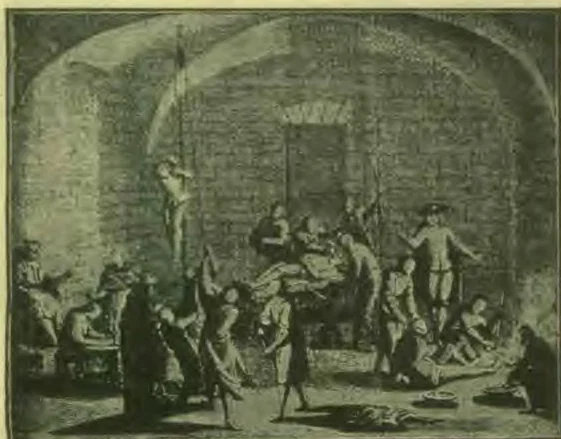
The Tortures of the Inquisition.—An Engraving of the Time.
But so that the unfortunate might remain at night in the inquisitorial prisons, the information of an enemy or the calumny of one who had hated was not absolutely necessary. The Holy Tribunal possessed a real secret police system, wisely and systematically organized, that introduced itself into families, that insinuated itself, that infiltrated itself under the vague title or form of confessors, doctors, jewelers, foremen; captivating, involving, provoking confessions, entering private lives,—finishing by denouncing, by shutting up in convents, by assassinating. This infamous and mysterious police, who had everything that the inquisition required, from the nobles of the highest rank to the Italian or Spanish adventurer, was constituted as Familiares of the Holy Office. A word, a simple nod of one of these men, and a life was condemned. There was no remission or mercy. Declared suspect, the poor being that fell into their hands was either immediately conducted to the palace of the inquisition by three or four dark creatures, with enormous white mantles in the Holland style, or in case of flight his capture was required by the secular power. Once in the place, the summary of guilt was made to him; this ended, the same Familiares in black, somber as statues, silent as specters, threw him in a rotten cloth to the depth of the inquisitorial dungeons. Then commenced the tragedy with all its terrible particulars. The flaming sword of Saint Domingos never pardoned.
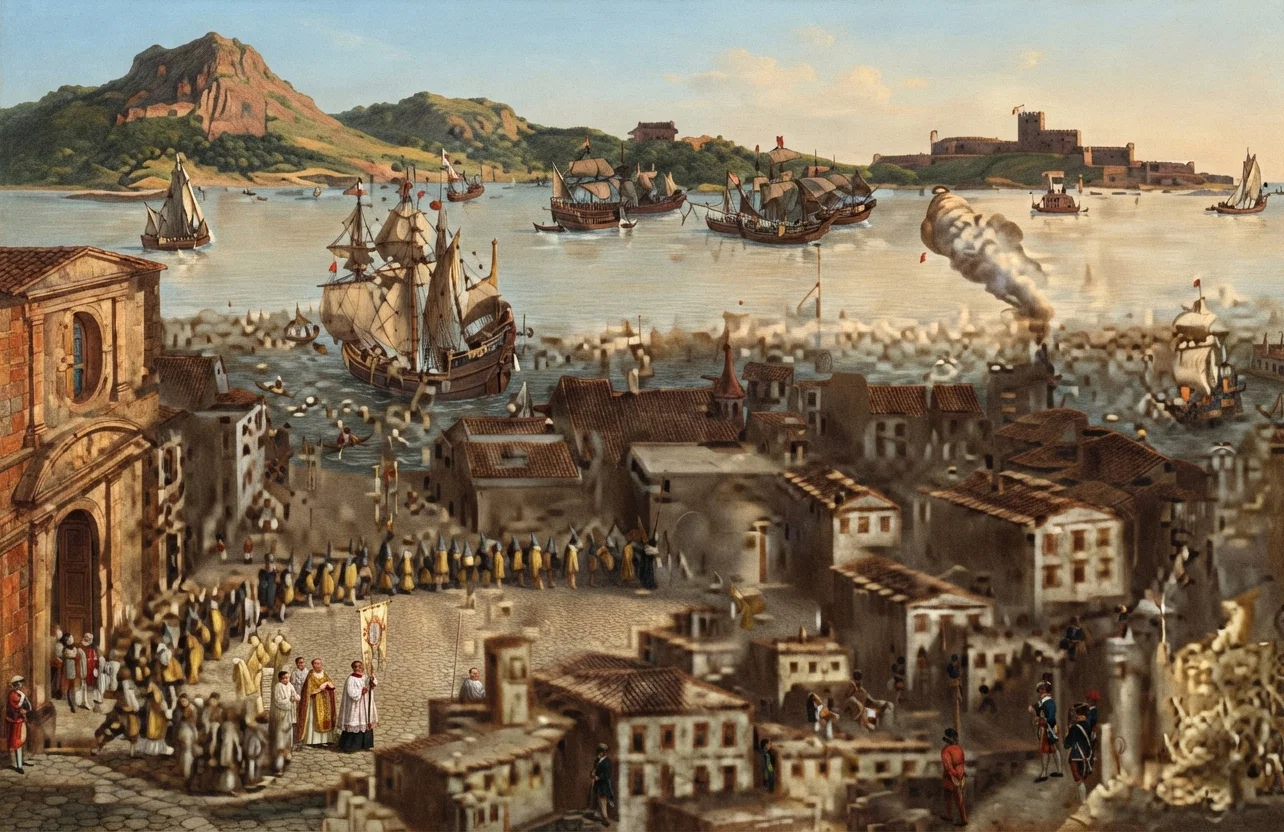
A Procession of an "Auto de fe" in Goa.
After a century of pacificating intrigues, no one calculates in the least what were the dungeons of the inquisition. They exceed the most repugnant that human perversity has produced. It was a wonder that one lived there, or that one breathed there, or that these sordid, deep holes were compatible with life. The most terrible secret prisons of the Holy Office would have a length of about five and a width of about three feet, a little more space than that occupied by a dead body. Dimly lighted by an opening high and narrow, enclosed by the wall of an interior court, the darkness within lasted eighteen out of the twenty-four hours. The arched ceiling weighed low upon the heads of the prisoners, the humidity congealed on their bones, and the exhalations of the two receptacles of filth, that only every eight days were removed, diminished little by little the existence, and created these hundreds of creatures into so many squalid and dried mummies, that a black samarra recovered. They were not permitted to speak to their own lawyers; fire was denied them in the coldest winter nights; they were not allowed a light from 4 P.M. until 7 A.M. Many became insane, and—infamy against which human nature revolts!—were carried in this condition to torture. Others died of infections, a form of typhoid, and their bones were carried in a small tumba to the first auto de fe, being piously carbonized with all ceremony and pomp. The strongest resisted to their own misfortune and suffering; and some—not a few during our three years of black Terror—sought in suicide freedom from the tortures that awaited them, smashing the cranium, with cries of pain and desperation, against the thick, rough stones of the prison walls.
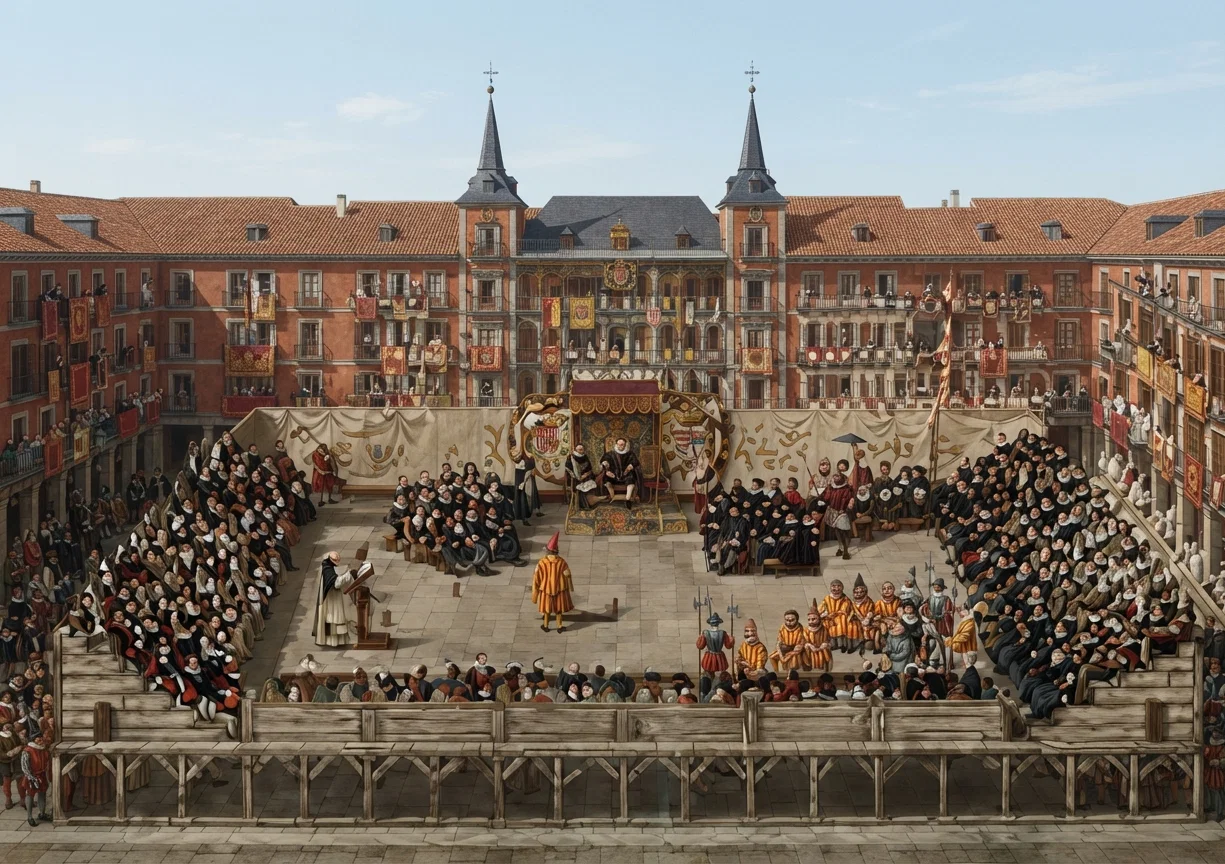
Reading of sentences by the Holy Office for an "Auto de fe," on the great square of Madrid. 1. King Philip and his court. 2. The inquisitors and their familiares. 3. The reader reading the sentences. 4. The culprit in special dress and cap. 5. Other prisoners.
This was what happened in 1685 to a poor Jew, Marcos Sommer, a seller of skins, accused of heinous sin, and awaiting in irons the establishment of the process, in the inquisitorial dungeons of Lisbon. With the horror of torments worse than death itself, the unfortunate one turned to suicide on his entrance, biting the wrists to open the arteries, finishing by bursting his cranium in a barbarous way against the solid masonry of the walls. At the end of fifteen days he showed signs of life; even as he was, two Familiares with masked faces, carried him in their arms to the torture.
In the meanwhile, in the palaces, full of laughter and gaiety, the inquisitorial bishops were carving fine roast pigs upon enormous silver trays, and the cardinal inquisitor continued to nurse, evangelically, the breasts of Maria de Motta.
(To Be Continued.)
What Sunday Laws Involve.
By A. Delos Westcott
It seems hardly possible that those who are asking the government to assume jurisdiction over the subject of religion by the enactment of Sunday laws can understand what is really involved in their course of action. The logic of it, as demonstrated by all the past, if put into words and addressed to the Creator, would read something like this:
"O Lord, our Creator, we have lost confidence in Thy government; we can not trust Thee any longer. Thou hast not punished the wicked as we think they ought to be punished. Thou hast been especially lax on this Sunday question. Thou hast permitted the base-ball and the foot-ball teams to run full blast every Sunday. Even the church-members employ the day very largely in picnicing, visiting, and merry-making. It was in Thy power to destroy or frighten them with lightning, tornado, earthquake, or pestilence, but Thou hast allowed them to go on undisturbed. When we scold them, they simply mock us, and we feel very much disturbed by their irreligious practises. We have seen for sometime that something would have to be done. After due deliberation, we have decided to transfer our allegiance in moral and religious affairs from Thee to the civil government. We believe we shall get better results. Several Congressmen have agreed to help us, and we hope to frighten the others into submission. The President has promised to do all he can to stop Sunday labor. Hereafter we shall get our religion from the civil government. We shall not need to read the Bible, or pray (except occasionally as a matter of form), for Congress and the courts will tell us what to believe and what to do. We intend, however, to keep our names on the church record, and continue to make a profession, because it looks better. We shall offer Thee a great many empty compliments, and continue to hold oyster suppers, bean socials, and fairs in Thy honor and in Thy house. We are going to restore the motto 'In God We Trust,' but we shall depend for practical assistance upon the army and navy. All Thou wilt need to do in the future is to govern the other worlds and get the mansions in heaven ready to receive us in case we should ever desire to change our residence. But probably Congress or the President will make arrangements for that. We would like to have Thee hold in check the earthquakes, tornadoes, floods, and other terrible disasters unless they are sent to punish Sunday-breakers. Hoping Thou wilt see the reasonableness of our decision, we bid Thee adieu, and join in a lusty chorus of 'Hurrah for Uncle Sam.'"
For a person to ask the civil government to assume jurisdiction over his own soul is high treason against the government of God. That is certainly bad enough. But what shall we say when a person shows a determination not only to deliver his own soul into bondage, but also the souls of all other people? That is exactly what any law on the subject of religion is designed to do. Any person who obeys the civil power in a religious matter, thereby transfers his allegiance from God to the civil power in that particular matter; and to admit the principle that the civil power may govern in one religious matter is to admit that it may rightfully govern in all religious matters. Hence to ask for a Sunday law or a Sabbath law is to declare that we divorce ourselves from God and render to the civil power that which belongs to God; and not only that, but we will try to force all others to do the same.
Thus it is plain that when a man asks for a Sunday law, whether he knows it or not, he is asking for a law to divorce other people from God, and to force them against their wills to transfer their allegiance in religious matters to the state. And the only alternative to this sacrilegious proceeding is religious persecution.
Christ said that "no man can serve two masters." It is therefore certain that no man can serve God and also serve the state at the same time and in regard to the same matter. And to choose to serve the state instead of to serve God is to set the state above God, and to disobey that command which says, "Thou shalt have no other gods before Me." A person who will assume such a responsibility, who will turn his back upon God and renounce his hope of eternal life by such a step, is a thousand times more to be pitied than any victim of religious persecution.
A few quotations of Scripture directed especially against this wicked proceeding will suffice to show its character:
"Thus saith the Lord; Cursed be the man that trusteth in man, and maketh flesh his arm, and whose heart departeth from the Lord. For he shall be like the heath in the desert, and shall not see when good cometh; but shall inhabit the parched places in the wilderness, in a salt land and not inhabited." See Jer. 17: 5-8.
"Wo to the rebellious children, saith the Lord, that take counsel but not of Me; and that cover with a covering but not of My Spirit, that they may add sin to sin: that walk to go down into Egypt, and have not asked at My mouth; to strengthen themselves in the strength of Pharaoh, and to trust in the shadow of Egypt! Therefore shall the strength of Pharaoh be your shame, and the trust in the shadow of Egypt your confusion." See Isa. 30: 1-3; 31: 1.
"Put not your trust in princes, nor in the son of man, in whom there is no help." See Ps. 146: 3-5.
1. His coming is not death; for at the time of the death of Lazarus He did not go to take the earthly life of Lazarus and give him a heavenly life, but to bring him from the dead.
Proof:
"Lord, if Thou hadst been here, my brother had not died." "He saith unto them, Our friend Lazarus sleepeth; but I go, that I may awake him out of sleep. Then said Jesus unto them plainly, Lazarus is dead." Verses 11, 14. "I am the resurrection, and the life; he that believeth in Me, tho he were dead, yet shall he live." Verse 25.
Again, when Jesus was about to go away He said of John, "If I will that he tarry till I come, what is that to thee?" "Then went this saying abroad among the brethren, that that disciple should not die: yet Jesus said not unto him, He shall not die; but, If I will that he tarry till I come, what is that to thee?" See John 21: 20-23.
NOTE.—It will be seen by these scriptures that the coming of Jesus means not death but life. His absence means death, and therefore His children die. When He comes the second time as the resurrection and the life, then shall they live.
2. Death is an enemy.
"The last enemy that shall be destroyed is death." 1 Cor. 15: 26.
3. His coming is not an outpouring of the Spirit.
"It is expedient for you that I go away: for if I go not away, the Comforter will not come unto you; but if I depart, I will send Him unto you." John 16: 7.
4. When Jesus comes He comes to give life to His children.
"For ye are dead, and your life is hid with Christ in God. When Christ, who is our life, shall appear, then shall ye also appear with Him in glory." Col. 3: 3, 4.
5. He comes to give reward to His children, and not until then will they be rewarded.
"For the Son of Man shall come in the glory of His Father with His angels: and then He shall reward every man according to his works." Matt. 16: 27. "And, behold, I come quickly; and My reward is with Me, to give every man according as his work shall be." Rev. 22: 12.
6. At His coming the nations and governments of earth will be destroyed with the wicked.
"And the nations were angry, and Thy wrath is come, and the time of the dead, that they should be judged, and that Thou shouldest give reward unto Thy servants the prophets, and to the saints, and them that fear Thy name, small and great; and shouldest destroy them which destroy the earth." Rev. 11: 18.
7. His coming will begin the reign of eternal righteousness. 2 Tim. 4: 1.
"When the Son of Man shall come in His glory, and all the holy angels with Him, then shall He sit upon the throne of His glory." Matt. 25: 31.
Your Relationship with Christ Jesus.
By A. L. Manous
1. Is THERE any neutral ground in our relationship with Christ?
"He that is not with Me is against Me."
2. How much of the affections does God demand?
"Thou shalt love the Lord thy God with all thy heart, and with all thy soul, and with all thy strength, and with all thy mind; and thy neighbor as thyself." Luke 10: 27.
3. How may we be assured that we will find God?
"And ye shall seek Me, and find Me, when ye shall search for Me with all your heart." Jer. 29: 13.
4. What is necessary in order that He may be our personal Saviour?
"Except a man be born again, he can not see the kingdom of God." John 3: 3.
5. How may we come into this new relationship with Christ?
"Believe on the Lord Jesus Christ, and thou shalt be saved." Acts 16: 31.
6. What evidence may he have that he truly believes?
"If a man love Me, he will keep My words: and My Father will love him, and We will come unto him and make Our abode with him." John 14: 23.
7. Is it worth while to serve God?
"Eye hath not seen, nor ear heard, neither have entered into the heart of man, the things which God hath prepared for them that love Him." 1 Cor. 2: 9.
8. Are you with Christ or are you against Him?
A. L. MANOUS.
Will the World Be Converted?
WOULD God that it might. Many believe that it will be. The bishops of the great Methodist denomination in their address to the recent General Conference at Baltimore, declare, as printed in the Daily Christian Advocate of May 8:
"The Gospel will win and is winning the world. The student of God's word and providence can see it. We do not believe His message a failure. We dare not preach that His promised victory is to be won by His sudden appearance after the failure of His Gospel and the coming of a new heaven and a new earth by a tremendous act of power. Christ works and wins thru men. He comes in and thru and by His church. 'Even so, Lord Jesus, come quickly. Amen.'"
Surely such a statement as that by a body of men so eminent is worthy of examination. Thousands will say, Amen, and rejoice at the utterance. But the thoughtful, clear-eyed student of the Bible and of world-conditions will ask, Is it true? Does God's word teach it? Do present conditions indicate the world's conversion? Is the world being won to Christ? The question of the failure of His Gospel is another matter.
Again, we say we would that the world might be converted by the preaching of the Gospel. We would that the old wreck might be so renovated en voyage by those on board that it might sail into port a new ship, laden only with the fruits of righteousness, decks clean swept, masts and spars straight and stanch, stays taut and strong, sails full-spread to a fair wind, bearing no marks of her sixty-century conflict with sin and Satan; not manned with a crew of blood-stained heroes, with gory swords and smoking guns, but strong and stalwart Christians, blood-washed and guilt-free. We would that all this might sometime be, aye, in the near future.
Did the world's conversion rest in God's willingness and power to save, it would be accomplished; but it does not. God in His infinite wisdom drew around mankind the sacred circle of free will, and into that domain even Deity will not enter to compel. Life and death, blessing and cursing, righteousness and sin, have ever been set before man, but he must make free choice; and the history of sixty centuries has demonstrated what the choice of the majority has been. God has manifested in warning, entreaty, in sacrifice, an unfathomable love. Christ, the Creator, gave Himself to die to save rebel man; but how few comparatively have responded to His love. Divine justice has been visited upon the transgressor, yet the careless world laughs on, and goes its way. Many have given their lives for the truth's sake, but the great mass trample upon their graves heedless of the truth for which they died, or if mindful, garnish their sepulchers and despise their teaching.
But what saith the Scriptures? Our Methodist brethren believe the Bible. One of the resolutions they passed was preceded by the preamble: "Whereas we recognize the Bible as the authoritative word of God, the 'entrance' of which 'giveth light.'" Surely, better than our desires, better than any human "optimistic" visions, is the truth of God, however unwelcome. It is better to tell the man afflicted with a fatal malady his true condition that he may set his house in order, than to deceive him with false hopes, and let him die unprepared. True "optimism" does not build on false hypothesis, however desirable. It looks on the best side of things as they are; but it does not call error truth. But what does the Bible teach?
1. The teaching of the prophecies of Daniel. The second chapter portrays before us in the form of a great image the great world empires of Babylon, Medo-Persia, Grecia, and Rome, to the end. That closes with the utter destruction of the image, and the setting up of the Stone-Kingdom which crushes and pulverizes, but does not convert.
The seventh chapter presents the same successive empires under symbols of cruel, rapacious beasts, growing more and more unnaturally cruel to the end, when they "by a tremendous act of power" are destroyed and burned.
The prophecy of the eighth and ninth chapters, and that of the tenth and eleventh, covering the same history, closes with violence, and then—the reign of Michael. But in none of these is there a suggestion of conversion, but ever of the opposite. In the prophecies to date every particular has been fulfilled. Surely, they will not prove false in teaching the destruction of a cosmos, even tho men are looking for its conversion.
2. The prophecies of the Revelation belie the theory of the world's conversion. Read the description of the seventh typical church—Laodicea (Rev. 3:14-21); of the sublime and awful events under the sixth seal (6:12-17); of the angry nations and sure judgments under the seventh trumpet (11:18); of the remnant persecuted church (12:17); of the dominant beast power, the impending judgment, of which God faithfully warns us, just preceding the second coming of Christ (13:8, 15-18; 14:6-14); of great, dominating, world-enthralling Babylon, intoxicated with power and steeped in iniquity, destroyed by sudden judgment, when she is rejoicing as a queen, out of whom God calls His people (18:4-8, 16, 19-24); of the triumph of God's children and of the regnant Word of God, tho all earth's foes are listed against them (15:2, 3; 19:11-21). The "no more curse" comes when God by a "tremendous act of power" destroys sin and incorrigible sinners from the universe.
3. Our Lord in a great discourse recorded in Matthew 24, Mark 13, and Luke 21, and in other scriptures, depicts the last days as evil, and likens them to the times of Noah and Lot, where historic concrete illustration emphasizes His clear declarations.
4. In the parable of the Wheat and Tares (Matt. 13:24-30, 37-43) the wicked are likened to tares, the righteous to wheat. The tares are not converted, nor weeded out. Both grow together till the time of harvest; then they are separated, the tares are burned, the wheat gathered into the garner. "The harvest is the end of the world." Verse 39. We know not how such teaching as this of our Lord can be fitted to the Whitbyan theory of the world's conversion.
5. The teaching of the apostle Paul and his coworkers is equally conclusive. "All that would live godly in Christ Jesus shall suffer persecution. But evil men and seducers shall wax worse and worse, deceiving and being deceived." 2 Tim. 3:12, 13. He declares that the "last days" will be "perilous times," because of the wickedness and sinfulness tolerated among those who have a form of godliness, but deny the power thereof. 2 Tim. 3:1-5. Those who cry, "Peace," he declares, will be deceived. 1 Thess. 5:1-3. Peter, James, John, Jude, all bear similar testimony of the same import.
Whether the Gospel is a failure or not depends on God's purpose, and God's purpose includes man's free will and his possible rejection of the Gospel. To say that the Gospel is a "failure" if the world is not converted is to set the power of Christ over against that of Satan struggling for the possession of an object having no choice in the matter. On the same supposition the Gospel is a failure if one soul is lost, if Lucifer himself is not saved. For it would be as much a test of lack of power to lose one soul as to lose a million.
The Gospel of God is not a failure. The eternal purpose of God proposes a sinless earth, filled with a righteous people, saved in accordance with His own perfect, gracious plan in Christ Jesus. Those who yield to His purpose are saved. They are the elect. Those rejecting His purpose are lost. They become no part of His election or purpose. There is no question of the success of all He has purposed in Christ Jesus. The grief of the Heart of the Universe is that men will not yield to it and be saved. The purpose will stand; but the conversion of wicked kingdoms and men is no part of that purpose.
Like a rift in that optimistic Methodist lute, played so skilfully by the bishops, comes a speech on a resolution concerning the "Social Problem." That resolution was presented by a committee representing six conferences, and the speech was made by William M. Balch, of Philadelphia, who said:
"It is a crisis in the conflict which confronts us. On the one side are predatory monopolies, with no less than continental sway, and luxury so shameless and enervating as almost to recall that of the Roman empire in its decadence; on the other side, extreme filth and misery of oppressed and disinherited multitudes and the DEADLY AND INCREASING CLASS HATRED which daily moves underneath our deepest foundations like unmeasured volcanic energies. . . . In such an emergency nothing can be more deplorable9than the MANIFEST FACT that the MASSES are not only INDIFFERENT to the church, but also suspicious that the church is indifferent to themselves."
"Be not deceived." Notwithstanding all that God and His people are doing, men, the mass of them, within and without the church, are multiplying humanly tolerated and "respectable" sins, multiplying "scientific" heresies, which take the edge from the Gospel sword, and hearts are hardening against truth. Old-time piety and integrity are rare. Faith in the great Bible facts of the atonement is wanting. The world is drifting on to its doom.
But, soul, Jesus Christ and the Gospel are not failures. Christ is able to save to the uttermost if you desire salvation. Help us to win souls from the wreck of sin.