Your ShelfYour Projects

Signs of the Times, Vol. 34, No. 27.

The Angel of Patience

Signs of the Times

Jul 1, 1908

Pacific Press Publishing Company · Mountain View, California · Jul 1, 1908

The Angel of Patience


A Free Paraphrase of the German By J. G. Whittier
To weary hearts, to mourning homes, God's meekest Angel gently comes: No power has he to banish pain, Or give us back our loss again; And yet in tenderest love, our dear And Heavenly Father sends him here.
There's quiet in that Angel's glance, There's rest in his still countenance! He mocks no grief with idle cheer, Nor wounds with words the mourner's ear; But ills and woes he may not cure He kindly trains us to endure.
Angel of Patience! sent to calm Our feverish brows with cooling palm; To lay the storms of hope and fear, And reconcile life's smile and tear; The throbs of wounded pride to still, And make our own our Father's will!
O thou who mournest on thy way, With longings for the close of day; He walks with thee, that Angel kind, And gently whispers, "Be resigned: Bear up, bear on, the end shall tell The dear Lord ordereth all things well!"

A Lamp Unto My Feet

"Thy word is a lamp unto my feet, and a light unto my path." —Psalms 119:105.

God Is Light

“God is light, and in Him is no darkness at all.”—1 John 1:5.

With Our Inquirers

“If ye will inquire, inquire ye.” This Inquirers' Department is conducted for the purpose of helping those who are studying the Bible. The answers are oftentimes only suggestive. They are never to be considered infallible, only as they agree with the infallible word. The writer who may answer them does not consider that his opinion is infallible. He will simply give the best that he has, and plead with the inquirer to search the word. Such questions only will be answered which, to the editors, seem to minister to the good of the readers and to the mission of the paper. We can not answer repeatedly in the same volume questions upon the same scripture. The name and address must accompany question, not for publication, but as an evidence of good faith, and that answer may be made by letter if deemed advisable. No letters are answered which do not contain the name of the writer. It is well always to enclose stamp for reply.

2545.—The Word “Soul.”

Will you be so kind as to define the word “soul”? Is it proper to use it in so many different forms? R. J. R.
The word “soul” in the Old Testament generally comes from the Hebrew word nephesh, that, from a primitive root meaning “to breathe.” That word is translated in the Old Testament by “any,” “appetite,” “beast,” “body,” “breath,” “creature,” “dead,” “desire,” “discontented,” “fish,” “ghost,” “greedy,” “he,” “heart,” “life,” “lust,” “man,” “mortally,” “one,” “own,” “person,” “pleasure,” “self,” “mind,” “slay,” “soul,” “tablet,” “they,” “thing,” “will,” etc., etc. This certainly is confusing. It would seem to any one that there ought to be a great deal more uniformity in the translation of the word nephesh; but it is never called immortal, deathless, or never dying. The Revised Version has endeavored to help this; but on the ground of not departing more than necessary from the Common Version, it has not been able to reduce greatly the number of English terms.
In the New Testament the word “soul” comes from psuche, from psucho, meaning “to breathe,” and is defined as the animal, sentient principle only, corresponding to the Hebrew nephesh. It is translated in the New Testament by the words: “heart,” “life,” “mind,” “soul,” “us,” and “you.” The term “soul” can generally, however, be held to these three meanings:
1. A person or persons. “Man became a living soul;” that is, a living person. Gen. 2:7. Eight souls were saved in the ark, that is, eight persons. 1 Peter 3:20. “Every living soul died in the sea;” that is, every living creature. In the same way we have “dead souls” spoken of in the Scriptures, that is, dead persons. For instance, in Num. 6:6 in our Common Version “dead body” is literally “dead soul.” Also in Num. 9:6, 7, 10; 19:11, 13, 16. All these texts clearly show the truth of the scripture, “The soul that sinneth, it shall die.”
2. It may mean simply “life”—the life which every living creature has, the vital breath of the physical organism, as in 1 Kings 17:21, “Let this child’s soul come into him again.” A little before in the same chapter we read that there “was no breath left in him.” In other words, the vital breath was given back by the Lord. The same thought is in Matt. 16:26, “Gain the whole world and lose his own soul;” that is, “life,” so rendered in the Revised Version.
3. Sometimes “soul” is taken to stand for the emotions, affections, ambitions, etc., of the heart, as in Ps. 103:1, “Bless the Lord, O my soul,” and many other passages.
It certainly will be seen that these three meanings are necessary, but these three will probably include all the others.

2546.—“What Shall This Man Do?”

Will you please explain John 21:21, 22? In the 21st verse what did Peter mean, and in verse 22, whom is Jesus talking about? Whom did He mean when He said: “If I will that he tarry till I come, what is that to thee? follow thou Me?” H. F. W.
Verse 20 tells us that Peter saw the disciple whom Jesus loved, and it was concerning this disciple that Peter asked, “What shall this man do?” This disciple was John, as he states in the 24th verse. The Lord had told Peter what to do—feed His sheep; feed His lambs; live for Him; teach His truth. Peter, with curiosity, like many at the present time, wanted to know about John. “Lord, what shall this man do?” Jesus did not tell him. He did not satisfy his curiosity; He as much as said, It is none of your affairs, Peter, as to what this man shall do, or what shall become of him; there is simply one thing for you to do—“Follow thou Me.” The answer that Jesus gave did not state anything at all. “If I will that he tarry till I come,” in other words, if it is My will that he live till I come again, “what is that to thee?” Note that John expressly says that Jesus did not say, “He shall not die,” but simply, “If I will that he tarry till I come;” in other words, He told Peter that his curiosity could not be satisfied. Peter was to die, John also was to serve Him even as Peter did. If John should die, that was the Master’s business; if he should live on till Christ came the second time, that was the Master’s business. That is all that is meant by it.
The one lesson, however, which we ought to get from it is this, that God gives us each work to do, and it is our privilege to know that work. If He gives our brother a different work than He does us, leave that with God; “to his own Master he standeth or falleth.”

2547.—Work on the Sabbath Day.

In the sixteenth chapter of Exodus we are told that the children of Israel should gather manna six days; on the seventh day, the Sabbath, they should not gather it, but remain in their place; implying that they should do no work. In Num. 15:32 we read that a man was found picking up sticks on the Sabbath day and they stoned him to death, showing there was a penalty for violating the Sabbath law. In Ex. 20:10 we are commanded: “Thou shalt not do any work.” The question is, Was this penalty removed? Does the taking away of the penalty change the law? If so, would that be a jot or tittle passed from the law? C. F.
God’s commandments are never designed to work hardship to humanity, but benefit. The Sabbath was made, not against man, but for man; not to be a cross, not to be a yoke of bondage, but always a helpful benefit. God does prohibit work upon that day—work for our own selfish purposes, or selfish pleasures, but He does not prohibit anything that is necessary for the maintenance of human existence or comfort. The prohibition, or the story in the fifteenth chapter of Numbers, was the story of not an ordinary transgression, not an infraction of the Sabbath law in order to meet one’s need, but a presumptuous sin. That is shown in the fact that Moses did not know what to do. He had to place the man in ward until the Lord had specially declared what ought to be done. Now if it had been given as a general law in Israel that men were to be stoned to death for building fires or cooking food, Moses would have known just what to do. But he did not understand this case. This one case is given to illustrate what is stated in verse 30, “The soul that doeth aught presumptuously, whether he be born in the land, or a stranger, the same reproacheth the Lord; and that soul shall be cut off from among his people.”
In the warm weather of the wilderness journeying, the children of Israel needed no fires. Their food, given of God, was prepared the day before according to His direction; and to build fires during that time in the wilderness was presumptuous sin against God. We have no record whatever that the prohibition against fire-building had to do with any other part of their existence as a nation, save in the wilderness wandering.
Isa. 58:13 and the example of our Lord Himself as recorded in Matt. 12:1-12 and other places are God’s own divine comments on the meaning of the Sabbath law as given in Ex. 20:8-11. This shows that the work that should not be done is our own work, for our own profit and pleasure, but it also shows that the Lord does not ask us to deprive ourselves of necessary food, or that we should not do work that would minister to the needs of those who are sick and suffering.
The penalty of the transgression of all God’s laws is found in the very transgression itself. “The wages of sin is death.” “Sin when it is finished bringeth forth death.” The laws which God gave to Israel as a nation while in this world did not take from, nor add to, the spiritual law which is given to every soul upon earth. In the transgression of that spiritual law is death.

2548.—Baptized for the Dead. 1 Cor. 15:29.

One of our correspondents, G. W. G., suggests the following translation and comment from Martin Luther: “Else what shall it profit them who are baptized in the place of the dead; that is, the subjects of baptism were taken to the cemeteries and baptized there, thus showing their faith in the resurrection.”
Dr. Adam Clarke, whose comment we have before quoted, remarks: “(1) The doctrine of the resurrection of our Lord is a grand doctrine among the apostles; they considered and preached this as the demonstration of the fruits of the Gospel. (2) The multitudes which embraced Christianity became converts on the evidence of this resurrection. (3) This resurrection was considered the pledge and proof of the resurrection of all believers in Christ, to the possession of the same glory into which He had entered. (4) The baptism which they received they considered as an emblem of their natural death and resurrection. This doctrine St. Paul most pointedly preaches. Rom. 6:3-5. (5) It is evident from this that all who died in the faith of Christ died in the faith of the resurrection; and therefore cheerfully gave up their lives to death, as they took joyfully the spoiling of their goods, knowing in themselves that they had in heaven a better and an enduring substance. Heb. 10:34. (6) As is the body, so the members; those who were properly instructed, and embraced Christianity, believed that as all who had died in the faith of Christ should rise again, so they were baptized in the same faith.”
Then after referring to the martyrs and those who were living in imminent danger of death, baptism being used as an emblem of sufferings, Dr. Clarke sums up as follows: “If there be no resurrection of the dead, those who, in becoming Christians, expose themselves to all manner of privations, crosses, severe sufferings, and a violent death, can have no compensation, nor any motive sufficient to induce them to expose themselves to such miseries. But as they receive baptism as an emblem of death, in voluntarily going under the water; so they receive it as an emblem of the resurrection into eternal life, in coming up out of the water; thus they are baptized for the dead, in perfect faith of the resurrection. The three following verses seem to confirm this sense.”

2549.—Least in the Kingdom of Heaven.

Please explain Matt. 5:19. It would seem one could enter heaven even tho he did break the least command and teach men so. Which one could be considered least? B. A. M.
If our inquirer will read the text carefully he will see that it does not say that such ones will enter the kingdom of heaven, but “He shall be called least in the kingdom of heaven.” Those who look upon loyalty to God in the right way and who only are prepared to give correct estimation will estimate that man the least of all. The Syriac version renders: “Shall be called little in the kingdom of heaven.” Another version: “Shall be counted of no esteem in the kingdom of heaven.” Doctor Albert Barnes in his comment on the text declares that they “are unworthy of the kingdom of heaven,” and that is the thought of the text. Doctor Adam Clarke understands the meaning to be: “He who, by his mode of action, speaking, or explaining the word of God, sets the holy precept aside, or explains away its force and meaning, shall be called least—shall have no place in the kingdom of Christ here, nor in the kingdom of glory above. That this is the meaning of these words is certain enough from the following verses.”

Christ Our High Priest

By Charles Lindsay Taylor
WHEN our Lord Jesus Christ as the prophet of Jehovah, as God's human messenger, as man among men, had accomplished His earthly mission, He ascended on high, there to continue, in another capacity, the great work of redemption.
Here on earth, He lived and worked, suffered and died. As prophet, He bore His message; as a man, He overcame in our behalf; as a son, He ascended the cross; and, by the offering of Himself as a vicarious sacrifice, He made it possible for all men to come close to the throne of the Infinite and there find pardon, peace, and power. At the cross He destroyed Satan's last hope, and having provided an offering by which all those who wished life might obtain forgiveness, He departed to the Father there to act as man's Priest-Mediator.
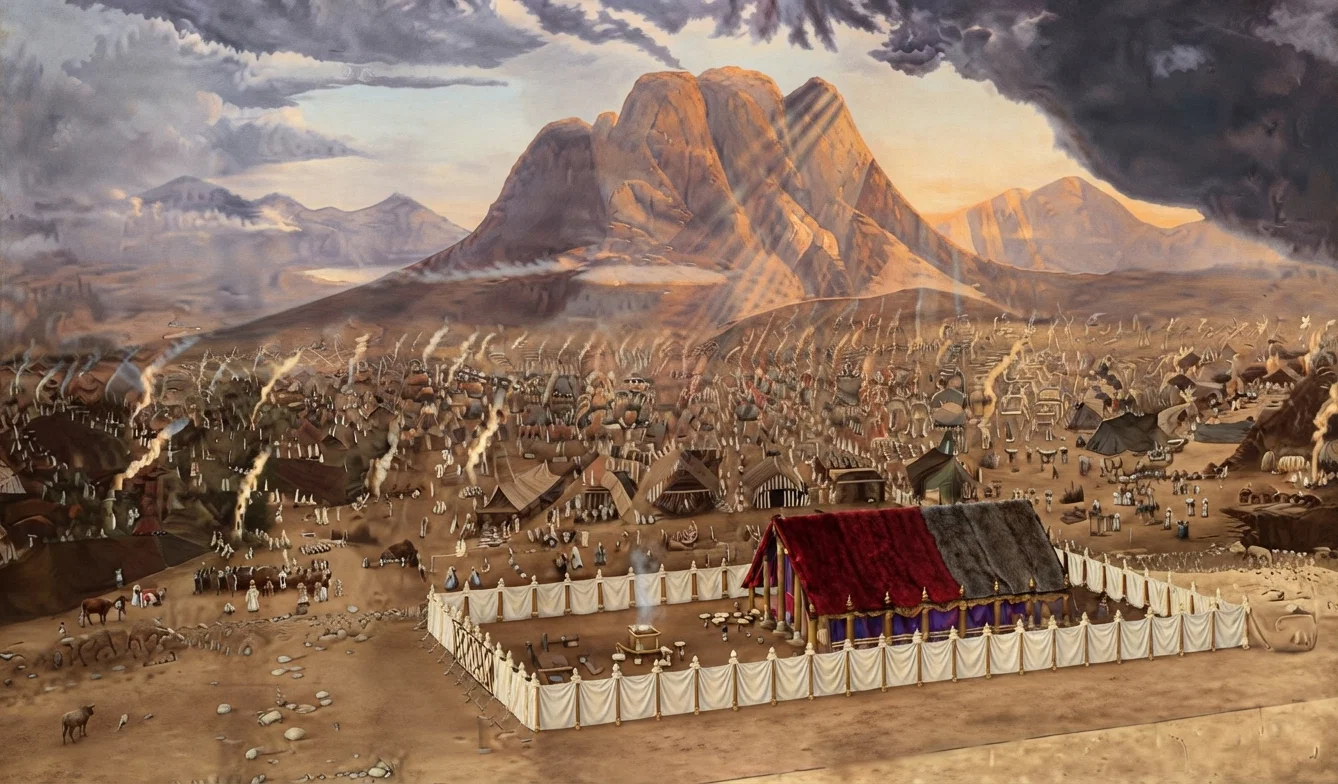
The Tabernacle in the Wilderness, the Services and Priesthood of Which Were Typical of the Sacrifice and Priesthood of Our Lord Jesus Christ for Sin.
His work as prophet laid the foundation and opened the way for His work as priest; and together His work as prophet and priest will open the door to His becoming, by and by, the King of nations. As prophet, priest, and king, He will bring to the fulness of perfect completion the glorious plan of salvation.
Turning to the good Book, we find these truths amply set forth. Speaking of our Lord's prophetic-human experience, the letter to the Hebrews says, "Tho He were a Son, yet learned He obedience by the things which He suffered; and being made perfect, He became the Author of eternal salvation unto all them that obey Him." And the next step in His great work of "fulfilling all things" (Eph. 4:10, marg.) is stated to be, "called of God an High Priest after the order of Melchizedek." Heb. 5:8-10.
It was to be Priest, to be our great Advocate, that Jesus ascended to heaven and took His place at the Father's right hand. "Seeing then that we have a great High Priest, that is passed into the heavens, Jesus the Son of God, let us hold fast our profession." Heb. 4:14. He is now "the Apostle and High Priest of our profession." Heb. 3:1. His appointment to this office came from the great God Himself, being a part of that plan laid before the foundation of the world. The Scriptures say, "The Lord sware and will not repent, Thou art a priest forever after the order of Melchizedek." Heb. 7:21.
Over and over again Inspiration repeats the thought that Jesus is Priest after the order of Melchizedek. And as the word is given for our encouragement, there must be in this assurance some special blessing for us. What is it?
In the days of Israel, God instructed His people to erect a sanctuary that He might "dwell among them." Ex. 25:8. He desired to dwell among His people with His glory shielded by the sanctuary building, that thus He might remove from their lives their sins and so make it possible for Him to dwell in them.
The matter of removing their sin and of bringinginto their experience His "everlasting righteousness" was carried forward by Jehovah thru the work of the priests. Man, in his sinfulness and impurity, could not approach into the presence of God except thru the person and work of one who had been divinely appointed and prepared. The priest alone could enter the dwelling-place of the Most High, and by the shed blood of the sinner's offering make reconciliation. See Lev. 4:27-35.
The earthly sanctuary was but a type. Our God dwells in the heavens. As sinners, as those who have been appointed to death, we can not see God, can not enter into His presence, and so we greatly need a representative at the divine tribunal. But this we are assured we have. "If any man sin, we have an Advocate with the Father, Jesus Christ, the Righteous." 1 John 2:1. "We have such an High Priest, who is set on the right hand of the throne of the Majesty in the heavens; a minister of the sanctuary, and of the true tabernacle." Heb. 8:1, 2. There, in the presence of the great God, where ten thousands of holy angels minister, where sins are recorded and forgiven, our Christ-Priest appears "for us." Heb. 9:24. In Him the faces and forms of lost men are brought before the Ancient of Days, and His precious blood becomes for them an everlasting, sin-canceling power.
But, mark! He is a High Priest "after the order of Melchizedek." Of Melchizedek it is written that "by interpretation" he was "King of Righteousness, and after that also King of Salem, which is King of Peace;" and that he "abideth a priest continually." Heb. 7:2, 3. "Consider how great this man was, unto whom even the patriarch Abraham gave the tenth of the spoils." Verse 4. And what a wonderful view this gives us of our Priest. Certainly He is our King of Righteousness, our "Prince of Peace." He "continueth ever" in "an unchangeable priesthood." Heb. 7:24. And because of this we may know that "He is able to save them to the uttermost that come unto God by Him, seeing He ever liveth to make intercession for them." Verse 25.
In the olden time the fact that priests were only human and had their work cut short by death meant much to God's people. The "cities of refuge" appointed to shelter and protect needy ones were but temporary at the best. Num. 35:25-28. Our "Refuge" is eternal, and saves to the uttermost, because our Advocate "continueth ever."
In the courts of glory our Friend to-day pleads for us. His pleadings are all-sufficient, provided that men will believe. He is still the Son of Man, and with outstretched arms He calls upon the sons of men to identify their interests with His, that when the day of His kingship shall come, He may reign over them eternally.
It is beautiful to understand even the theory of truth concerning our Saviour's priesthood; but, brother, sister, it is of the greatest importance that you and I, in our practical, every-day experience, know Him as our great High Priest, our Advocate and Friend. "For we have not an high priest which can not be touched with the feeling of our infirmities; but was in all points tempted like as we are, yet without sin. Let us therefore come boldly unto the throne of grace, that we may obtain mercy, and find grace to help in time of need." Heb. 4:15, 16.

The Kingdom of Christ.

WHAT sort of a kingdom did Jesus come into the world to establish? The Socialist says: “A state of society in which all have all things in common,” that is, communism. Question the man who, like the old deists, saw in the world nothing except the beautiful; Christ to him is an enigma. Even the gay theologians of to-day fail to recognize this dark enigma of sin in the human race and Christ’s relation to those who are in bondage.
Of late a deal of comment has passed from mouth to mouth over the words of Dr. Smyth, of New Haven, who in a Christmas sermon said among other things: “It is not merely worldliness that is coming in (the church), but much religion is withdrawing itself from the church.” He indicates that these are signs of a new age.
Go where we will, we find men excusing themselves, and we all are cognizant of the fact that there is death and decay in the church. Is God’s arm shortened that these conditions exist? Has the Holy Spirit withdrawn Himself?—No! God is the same God, immutable; but poor, mutable man is at fault,—he will not hear and act. Matt. 13:15, “For this people’s heart is waxed gross.” We must come into an experience where we recognize the fact that nothing save perfect obedience to His will can save us and make us influential citizens of His kingdom. We can not trust in mere rites or machinery. False zeal on the part of the people in the days of Amos led Jehovah to say: “Come to Bethel, and transgress; to Gilgal, and multiply transgression,” because theirs was a service void of spirituality.
Christ came not into the world to take part in the bickerings and strifes of men, as the Socialists claim. “The Gospel,” as a great German scholar remarks, “is not one of social improvement, but one of spiritual redemption. Forms of government were not for Him to change; ‘Render therefore unto Cæsar the things that are Cæsar’s.’ He came into the world realizing that man had gone astray; He came not as a Socialist, but as a Saviour, to bring men into the new and living way.”
In a lecture given by the last Bampton lecturer, St. Mary’s Oxford, he said, “I see the signs of a new religious order, the greatest the world has known, drawn from all nations and classes.” Does this mean a new Catholicism? Some of us believe we are living in the last days. We see the signs of His coming. It will be the consummation of His spiritual kingdom. We read in the word His message. Thank God for the light.
One thing we must do. We must not be deterred by the lethargy of others. Let us strive to possess the ingredients of character portrayed in Matt. 5:3-12. We must be “pure in heart;” and with this purity shall go out of our lives an influence which shall powerfully affect men. Matt. 5:13, 16.
Past history shows us that there was a time when men piled up bulls and goats and thought they were serving God. Men marched under Christian banners to fields of carnage to destroy their fellows. Men have gone out in the interest of science, and have forgotten that man is God’s masterpiece, and that it is our supreme duty to save men.
In Luther’s day, men were saying, Faith is a power vested in the church by mere outward authority. Luther went back to Paul. Paul was a runner. Faith to him was not an act but an activity. Luther caught Paul’s meaning. He said, Faith is a living, busy, active thing. We must be runners for God. Such living faith saves men.
Brethren, the doors of helpful opportunity are open before us. Christ stands calling for helpers. May we, armed by the divine panoply of God, go forward to deliver this message of truth to the world; then He shall come, and we shall hear Him say, “Well done,” and at that just bar find a joyful acceptance. GORDON F. GRANGER.

The Repairer of the Breach.

God’s holy law is like a wall About His church below; It warns men of the paths of sin In which the wicked go; And yet unhallowed hands have made A breach within that wall, And those who stumble at the breach Full soon without will fall.
A cry is made for workmen skilled To haste to build the wall,— To build where it is broken down, O hear the Master’s call! Lift up thy voice with trumpet sound And show the child of God Wherein he sins, wherein he fails To honor Christ his Lord.
The Sabbath day, sweet day of rest, The day the Saviour kept In life and death (for in the grave That day He calmly slept) Is by the church ignored and called A Jewish day of naught; Another day is lifted high And as a Sabbath taught.
Untempered mortar has been used To mend the breach man made, But better far it would have been If God had been obeyed, And now, O house of Israel, hear, Thy pleasure do no more, But keep the day that God has blessed And blessed forevermore.
Repair the breach with God’s own word, In paths of safety dwell, Delight thyself in Christ the Lord And of His glory tell. The heritage of Jacob thine, A watered garden fair; Proclaim the message of thy God, And of His blessings share. ELIZA H. MORTON.

Trusting God’s Promise in Darkness

I WOULD sooner walk in the dark, and hold hard to a promise of my God, than trust in the light of the brightest day that ever dawned.—C. H. Spurgeon.

Soul in Every Enduring Work

“We can never do a great work unless we put into it a part of our lives. Extract of soul must be mingled with every work that is to go into eternity.”
Continue reading: Gain That Is Loss