Signs of the Times, Vol. 55, No. 49.

CHRISTIAN OR PAGAN?

Signs of the Times

Dec 11, 1928

Pacific Press Publishing Association · Mountain View, California · Dec 11, 1928

CHRISTIAN OR PAGAN?

Christmas

CHRISTIAN OR PAGAN?
L. ERVIN WRIGHT
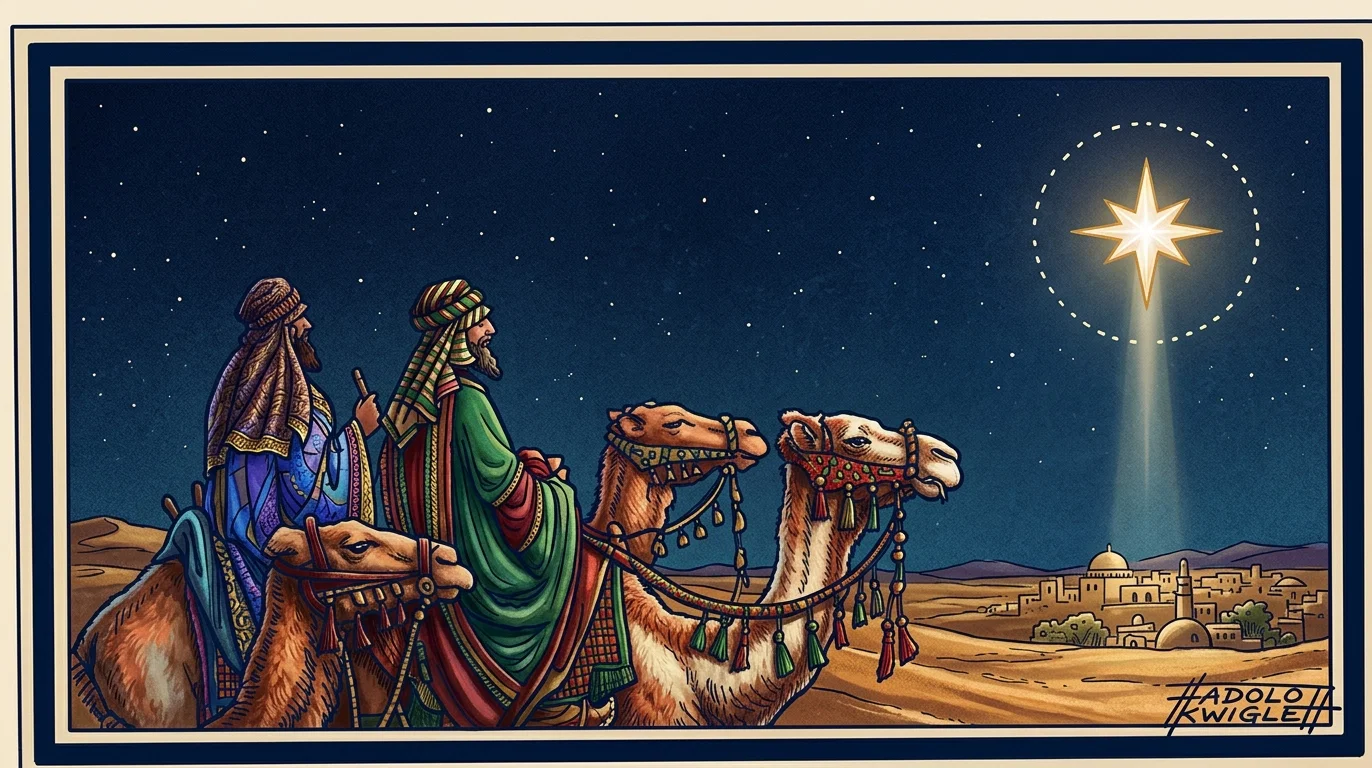
Nearly every month in the year has been assigned as the probable month in which Jesus Christ was born; for, so far as the Bible is concerned, it is silent concerning the date of Christ’s birth. That it was not on the twenty-fifth of December, or even in December, is generally agreed by the best authorities.
On the night of the nativity “there were in the same country shepherds abiding in the field, keeping watch over their flock by night.” Luke 2:8.
Gill, in his commentary on Luke 2:8, says: “There are two sorts of cattle with the Jews . . . there are the cattle of the house that lie in the city: the cattle of the wilderness are they that lie in the pastures. On which one of their commentators (Maimonides, . . .) observes, ‘These lie in the pastures, which are in the villages, all the days of the cold and heat, and do not go into the cities until the rains descend.’ The first rain falls in the month Marheshvan, which answers to the latter part of our October and the former part of November. . . . From whence it appears that Christ must be born before the middle of October, since the first rain was not yet come.”
Since it was not the custom for the shepherds of Judea to watch their flocks in the open fields later than about the end of October, it is evident that there were no shepherds abiding in the fields in December.
Then how came the twenty-fifth of December to be thought of as the birthday of Jesus Christ?
In short, this particular day was the birthday of the pagan sun god, which day apostate Christianity adopted as the birthday of Christ. There are several interesting points of specious similitude between the pagan god and the Christian God, which made it very easy for this to be done.
The worship of the sun by the ancient pagans was not an accident. It did not come about by man’s forgetting about the true God. It was begun in defiance to Jehovah under the high-sounding terms of superior intelligence and wisdom. In the early apostasy at Babel “the world by wisdom knew not God.” 1 Corinthians 1:21. And to ancient Babylon, God said, “Thy wisdom and
thy knowledge, it hath perverted thee.” Isaiah 47:10.
In another place Paul says of this apostasy that “when they knew God, they glorified Him not as God, neither were thankful; but became vain in their imaginations, and their foolish heart was darkened. Professing themselves to be wise, they became fools, . . . who changed the truth of God into a lie, and worshiped and served the creature rather than the Creator.” Romans 1:21-25, margin.
The ancients were well acquainted with the promise that a Saviour should be born into the world. (Genesis 3:15.) The hope of the antediluvian patriarchs was in the birth of the Seed; it was the hope of the postdiluvian patriarchs. From antiquity, man, groaning under sin, looked for the Desire of Ages.
Every patriarch was a priest-king, and was a type of the coming Seed as priest-king. But some patriarchs were particular types of the Messiah. The patriarch Noah was one of the greatest types of Christ. In the events of the Flood, various particulars were enacted by Noah, which prefigured certain particulars in the life of Christ. Peculiarly did Noah shadow out the birth, death, and resurrection of Christ.
But paganism mistook the figure, or type, for the reality, and pronounced Noah to be an appearance of the Seed. In fact, paganism alleged that every extraordinary personage, whose office it was to reclaim or punish mankind, was an avatar, or descent, of the Seed. Buddha was an alleged avatar. The grand lama of Tibet claims to be an avatar in this age.
The good patriarch Noah was deified by the early apostates’ thinking that in him had been fulfilled the promise of the coming of the Seed.
In one sense, the egress of Noah from the ark was symbolical of the birth of the Christ. The ark was the allegorical mother of Noah, and was also regarded as a virgin.
The ark was the great mother, or goddess, in the pagan theology. One of the names of the great mother in Egypt was Hathor, which, according to Bunsen, means “the habitation of god.”—“Egypt,” Vol. 1, page 401. And, according to Plutarch, the Egyptians esteemed Isis the mundane house, or habitation, of Horus, the seat of generation, the nurse of the world, and the universal recipient. This idea sprang into being because the ark had housed Noah during the Flood.
The Egyptian sun god Ra, who was not engendered, according to James Bonwick, was born from the side of his mother. (“Egyptian Belief and Modern Thought,” page 406.) The church father Jerome relates a belief current in his day that Buddha was born from a virgin’s side. (“Contra Jovinianum,” Book 1, sec. 22.) This peculiar circumstance instantly identifies the origin of these stories. The ark, according to Moses in Genesis 6:16, was constructed with a door in its side. Out of that door in the side of the ark, so they taught, Noah experienced his mystical or allegorical birth.
The door always played a prominent part in the pagan theology. In fact, temple doors, opening as caves, cells, or passageways, were made symbols of the great mother. Janus, the famous two-faced god, was also called Patulcius and Clusius, or the god of opening and shutting.
Macrobius observes that his altars were placed before the doors of his temples, to show that he presided over entrance and exit.
In the aboriginal chapel of the god Janus was an ancient ark, or ship, according to Septimus Serenus. On some of his coins may be seen on one side the impress of the double-faced Janus; on the reverse, a ship or the stern or prow of a vessel. On other of his medals may be seen not only his ship, or ark, but the imprint of a dove. Still other coins show on their reverse the same bird holding a branch in its beak, or surrounded with a chaplet of olive leaves. Needless to say, the ark, the dove, the olive, are all Deluge emblems.

THE TWOFOLD HERO DEITY

This twofold character of the hero deity was assumed when the ancients looked on the patriarch as an aged man at the beginning of the Deluge, but as a babe or youth or boy after that event. Being born from the ark, he became a youth again, and was represented in Egypt, in India, in Cyprus, in Assyria, in China, and in Mexico as a babe at the breast or in the arms of the great pagan mother goddess.
The death of the Seed, or Christ, was also prefigured by Noah’s stay in the ark during the term of the Deluge. Jonah, in the belly of the fish for three days and nights, was a type of the death, burial, and resurrection of the Christ. (Compare Jonah 1:17 with Matthew 12:39, 40.) In the case of Noah, who was in the ark, which was sometimes symbolized by the ancients as a great fish, it was three years according to the Oriental mode of computing similar periods. The entrance into the ark at the close of one year, the stay in the ark for a year, and the egress at the beginning of another year was counted as three years by the Oriental mind.
This is also seen in the computation of Christ’s entombment, which is also counted as three days and three nights, although Christ was in the grave only one complete day and the beginning and ending of two other days. The three-year period of Noah’s confinement was a prophecy of the three-day period of Christ’s entombment.

THE PAGANS AND THE ARK

The pagans not only regarded the ark as a symbol of the great mother, but the earth was her symbol also; hence the interior of the ark and a grave in the earth were interchangeably regarded as the womb of the great mother. This idea was borrowed from the patriarchal church. Job says: “Naked came I out of my mother’s womb, and naked shall I return thither.” Job 1:21. George Stanley Faber says: “The womb, from which Job came at birth, was the womb of his literal mother: but did he return thither, when he died? Assuredly not: he then entered into the womb of a figurative mother; from which, in God’s own good time, he hoped to experience a second birth, as he had already experienced one birth into a world of much trouble and affliction.”—“The Origin of Pagan Idolatry,” Vol. 3, page 624.
In the Scriptures a resurrection from the grave is spoken of as a birth. The great apostle Paul assures us that when God raised Jesus Christ from the grave, the prophecy in the second psalm, “Thou art My Son; this day have I begotten Thee,” received its fulfillment. (Acts 13:33; Psalm 2:7.) It is evident that the two expressions, “This day have I begotten Thee” and, This day have I raised Thee from the dead, are mystically of the same import. Paul also styles Christ “the first-born from the dead.” Colossians 1:18. And he also states that Christ “constituted the Son of God with power by the resurrection from the dead.” Romans 1:4, Greek.
Just as the interior of the belly of the fish was a symbolical hell, or grave, to Jonah in prefiguring the death and burial of Christ, just so the interior of the ark was the tomb, or grave, of Noah, who similarly prefigured Christ. The egress of Jonah from the whale and the exit of Noah from the ark alike typified the resurrection of Jesus Christ.
The ancient pagans believed in the immortality of the soul; hence we find them believing that the hero gods and great men were translated to the celestial bodies or were emanations from them. Thus the idea prevailed that the sun, the moon, and the stars were not inert matter; but, on the contrary, were wise and intelligent beings. The Stoics supposed each star to be the body of a deity; and Augustine informs us that they maintained that the stars were parts of Jupiter or the sun, and that they were all living creatures, and that they had rational souls. The sun, being the brightest of the visible heavenly bodies, was the residence, or body, of the hero god Noah. The many remarkable
opinions that the pagans entertained of the sun are by no means applicable to the literal sun, but rather to the career of Noah, as “the spirit of the sun.”

EGYPTIAN SUN GOD

For instance the Egyptian sun god Ra is said to have sprung forth from an egg. Again he is said to have been evolved from the primeval abyss of water. At other times, the sun god rises from the lotus flower floating on the water. And the heaven above was said to be a great ocean or watery abyss upon which the sun god embarked daily in his divine boat or ship. Now the egg and the lotus flower were both hieroglyphics of the ark of Noah. The ship, or boat, of Ra is a literal figure of the ark given an astronomical setting. And Ra being evolved from the primeval abyss of water is plainly a reference to the great father’s “birth” at the Deluge. And there was much even in the physical character of the sun, which led the pagans to adopt it as the astronomical representative of their hero deity.
The daily descent below the horizon and his daily rising above it exhibited to the devout pagan the disappearance and reappearance of their chief god, that is, the entrance and exit of Noah from the ark. And this was variously described as a death and a revival, or a deep sleep and an expergefaction, or an entrance into the womb and a new birth. And, accordingly, we are told that while the sun was invisible beneath the horizon he shadowed out the great father in a state of temporary death within his coffin, the ark, and that while he was visible above the horizon he represented the same great father as emerging from Hades and restored to life and liberty. Each day, at his rising and setting, the sun displayed or enacted the image of his human associate, Noah, by seeming to float on the surface of the heavenly ocean.
And each year, by his departure into the southern tropic and his return with new life and vigor into the northern, the sun again exhibited the allegorical death and revival of his mortal antitype.

THE SIGNIFICANT DECEMBER TWENTY-FIVE

The day of the winter solstice was the day regarded as the day of the periodic death of the sun, and was followed by his resurrection, when the sun began his ascendant course.
“This explains,” says Lenormant, “in the Dionysiac worship of Phocis, the simultaneous occurrence of the nocturnal ceremony performed by the Hosioi at the tomb of the god in the temple of Delphi, and the orgiastic festival when the women on the mountains awakened with their cries Licnites, or the new-born Dionysos, asleep in the mystic winnowing fan, which serves him for cradle. The symbolical Acadian name of the month which immediately follows the winter solstice, . . . ‘the month of the cave (or adyton) of the (sun) rising,’ undoubtedly contained an allusion to this. To understand the meaning of it, it is enough for all intents and purposes to recall the rites of the fes-
tival in honor of the new birth of the young sun, as celebrated by the Sarraceni, . . . when at midnight they entered the subterranean sanctuary, whence the priest presently came forth crying: ‘The virgin hath brought forth; the light is about to grow again.’ This ceremony took place each year on the 25th December, the day of the Natalis Solis Invicti, in the Oriental worship of the sun. . . . The day likewise for celebrating the great Persian festival of Mithras, when he was born of a stone in the depths of a dark grotto. We know that it was felt to be expedient to uproot these essentially popular festivals by substituting for them a festival applicable to the new religion, and therefore the heads of the church in the west fixed upon the 25th day of December, in the beginning of the fourth century, for the celebration of the birth of Christ, the exact anniversary being unknown. The Christ was to them, in a spiritual sense, the new sun, Sol novus, whose material birth the pagans celebrated on the day when its orb recommenced its heavenly ascension.”—“The Beginnings of History,” footnotes on pages 263, 264.
The tomb of the pagan god, his cradle, the mystic cave, and the dark grotto are all alike hieroglyphics of the ark.

SANTA CLAUS AND THE EVERGREEN

The idea of Santa Claus seems plainly to be derived from the fact that Noah was an old man at the beginning of the Deluge; and particularly in ancient Babylonia the sun god was pictured on the monuments as an old man with a long, flowing beard. The appearance of St. Nicholas at the winter solstice, when the sun is in the act of dying or is aged, seems more than a coincidence. And St. Nicholas is certainly none other than the pagan deity Nix or Nick revamped. And Lenormant says that the fundamental root in the name of Noah is to be found in the name Nix or Nick!
One of the most eminent emblems of the pagan sun god was a tree. In pagan Egypt it was the palm tree; in pagan Rome it was the fir. The pagans symbolized the sun god in his death as a huge tree cut down almost to the ground. The birth or resurrection of the sun god was symbolized by a youthful tree springing up by the old stump. A young tree, a living tree, an evergreen, was an appropriate emblem of the sun god as he was about to begin his new life cycle. This explains the use of fir or evergreen trees at the winter solstice.

THE HEART LONGING

Although Christmas is of pagan origin, underneath it all is the heart longing of men, groaning under sin, for better things, for a Saviour who can save men from sin. And while the mind of the world is at this season centered on Christmas, would it not be profitable to make up an inventory for 1928, and bury all that is out of harmony with Jesus Christ, and start the new year right by living a new life, a resurrected life, the new-birth life in Christ?

ROBERT HARE

“Waiting”

ROBERT HARE

Waiting, Lord, waiting while days come and go, Waiting while midnights pass solemn and slow, While eve and morning their numbers repeat, Waiting, Lord, still, Thy echoing feet. Sandled and dust-stained they walked by the sea, But now glory-shooned they are coming for me.
Touched with our weakness, oft friendless, alone, The mountains Thy temple, Thy pillow a stone, O tempest-tossed Stranger, on blue Galilee, How sweet are the echoes that whisper to me! Yet sweeter and greater and brighter by far, We long to behold Thee as heaven’s “Morning Star.”
Waiting, Lord, prophets rejoicing have told Of mansions and city with pathways of gold, Of glorified visions, eternal and fair, Built by Love’s hand, and just over there. Waiting, Lord, waiting for these and for Thee, The once lowly Master of blue Galilee.

The LAW of LOVE and the LOVE of LAW

“The law of love being the foundation of the government of God, the happiness of all intelligent beings depends upon their perfect accord with its great principles of righteousness.”
ERNEST LLOYD
LAW is a rule of order, or conduct, by authority. Love is an ardent affection of the heart, stirred by that which pleases us. Hence the two ideas that these words represent seem to have nothing in common. They occupy different spheres. We obey the laws of the state to avoid their penalty. How strange it would seem to hear a man exclaim, “I love the civil and criminal code of Indiana. I delight in the statutes of the state. I am glad and rejoice when they say, ‘Come up to the county treasurer’s office and pay the taxes.’” And equally strange it would be for a man to say, “I love my wife and children, because it is according to law.”
But the Bible brings together these two incongruous words. It teaches us to love the law, and assures us that the law is love. Did it ever occur to you that the one hundred nineteenth psalm is a love song? The delighted author of it sings, “Oh, how love I Thy law.” “I love Thy commandments above gold.” “Great peace have they which love Thy law.” And in the first psalm, we are told of the good man that “his delight is in the law of the Lord.” In the nineteenth psalm it is said that God’s law is “sweeter also than honey.”

WAS DAVID EXTRAVAGANT?

To those who read the Decalogue as written on tables of stone and regard it merely as a series of injunctions and prohibitions, the enthusiasm of David seems extravagant and absurd. But when we open the New Testament and study what Christ and His apostles say about the greatness of the law, we sympathize with the psalmist. Our Saviour plainly declares concerning the law: “I am not come to destroy, but to fulfill.” Matthew 5:17. He came not to end its work, but to fulfill its purpose,—to live out before His fellows its principles in His own flesh. Paul wrote to the Romans, “Love is the fulfilling of the law.” James says that this is “the royal law according to the Scripture, Thou shalt love thy neighbor as thyself.”
If, then, under the moral government of God love and law are synonymous, it is not only right but unavoidable that all who are loyal to God will both obey and love the law of God. We are made to love that which is lovely.

HIGHEST IDEAL

Yet it is not easy for us to think of love and law as identical, because we are accustomed to imperfect human laws imposed by authority. “Despotic governments arose early in the history of the race. The statutes of conquerors and tyrants were not intended to promote the happiness of their subjects, but to extend and strengthen their own power. Hence obedience was reluctant and compulsory. It is only in these later centuries and under the influence of Christian civilizations that the people have acquired the right to make their own laws.” And hence it is that we begin to have some affection for the constitutions and the codes that protect our freedom.
Wise laws, efficiently administered, are the bulwarks of society. They protect us and our homes. They guard our persons and our property. They are not musical, like poems. We can not sing them as we sing love ditties. They are often unattractive in form, defining crime and declaring the penalty it deserves. But the good citizen rejoices in them as the Hollander rejoices in the dikes that protect his country from the sea.
“Laws worthy of the love of the citizen and love for the laws because they are worthy; this is the highest ideal of civil freedom.”
And love for God’s great law of love, obeying from the heart and delighting in obedience, this is “the glorious liberty of the children of God.” Romans 8:21.
“If law in its highest form is love, then our human definitions are defective. It is more than a rule of conduct. It is the condition of happiness. It is a statement of the spirit in which we ought to live and must live if we would enjoy all that we are capable of enjoying. The law of God is not an enactment merely—it is a revelation. It announces not only the will of God the Father, but for what He made us and the way in which we can secure the end of our creation—to glorify and enjoy Him forever.”
God is love. God created us in His own image—to love as He loves. By loving we become like Him. We are His children and His heirs, for “every one that loveth is born of God.” Then we love these three, which are one: Law, love, God. By taking the law into our hearts we take in the Spirit and character of God Himself, and become identified with the source of all truth, purity, and blessedness.

GODLINESS, LAW, LOVE

“Godliness is obedience to law. It is love. It is to the soul that cultivates it what attraction is to the planets in the solar system. It holds the soul in its orbit. It keeps it in the sunlight of the Divine Presence. It clothes it with the graces of the Spirit, and causes it to bring forth fruit unto holiness, whose end is everlasting life.”
The Bible proves its divine origin by the originality of its revelations. What mere man would have been wise enough to unite law and love, and to foretell a time when loyalty to the Giver of both shall gird the earth like a halo of light, and when the fruits of lawlessness—sickness, sorrow, pain, disappointment, trouble, despair, death—shall be no more? Such a revelation could come only from God. Only such a revelation can meet the conscious desires and longings of our hearts. In contrast with it, how faulty and vain are all human theories for the salvation of human society! They are but castles in the air, mirages in the desert.
All our hopes rest on this rock: That God is love, and that the law He has enacted for mortal beings is a transcript of His own nature; that we, through faith in the sacrifice of Jesus for our sins, are to be holy and happy by becoming like Him who made us in His own image.

Christ’s Unselfish Love Revealed

“IF Christ dwells in us, we shall reveal His unselfish love toward all with whom we have to do. As we see men and women in need of sympathy and help, we shall not ask, ‘Are they worthy?’ but ‘How can I benefit them?’ ”

Is GOD Particular?

Some say that God is not so particular after all which day we keep as the Sabbath, just so long as we keep one day. But is that so?
CARLYLE B. HAYNES
IN LEVITICUS 16:12 God instructed the priests that when they offered incense they should fill their censers “full of burning coals of fire from off the altar before the Lord.”
This instruction did not seem to be of great importance to two priests, Nadab and Abihu, the sons of Aaron. They “took either of them his censer, and put fire therein, . . . and offered strange fire before the Lord, which He commanded them not.” Leviticus 10:1.
Presumably Nadab and Abihu reasoned as some people reason to-day. They could see no difference between fires. Fire was fire. All fire would burn incense. There was no difference between this fire and that fire. Why should they use the fire that God had commanded when other fire would do just as well?
So people reason with regard to the Sabbath. A day is a day. All days are alike. One is as good as another. It is true that God has said the seventh day is the Sabbath; but the first will do just as well. What is the difference? It is so inconvenient to keep the seventh, and everybody is keeping the first; and so, since it does not make any difference, we will just do the easiest way. So people reason, and so, trifling with the plain words of God, they lose their souls.

GOD’S COMMAND MAKES THE DIFFERENCE

Was there any difference between the two fires? Probably not so far as the fire itself was concerned. The thing that made the difference was the command of God. God had said this fire, not that. That God meant what He said, and held all men accountable for obeying it, the two priests who held God’s command so lightly soon discovered, for we read: “There went out fire from the Lord, and devoured them, and they died before the Lord.” Leviticus 10:2.
It is always safe to do just what the Lord says. God had said they should use a particular fire; and, while there may not have been much difference between fires, yet there was a difference, and that difference was made by the command of God. God had commanded a certain fire. That command made it different from all other fire; and no other fire would answer, as these disobedient priests discovered.

FIFTY THOUSAND SLAIN FOR DISOBEDIENCE

There is the record, on another occasion, that the ark was captured by the Philistines, and caused so much trouble in their land that they decided to send it back to its own land.
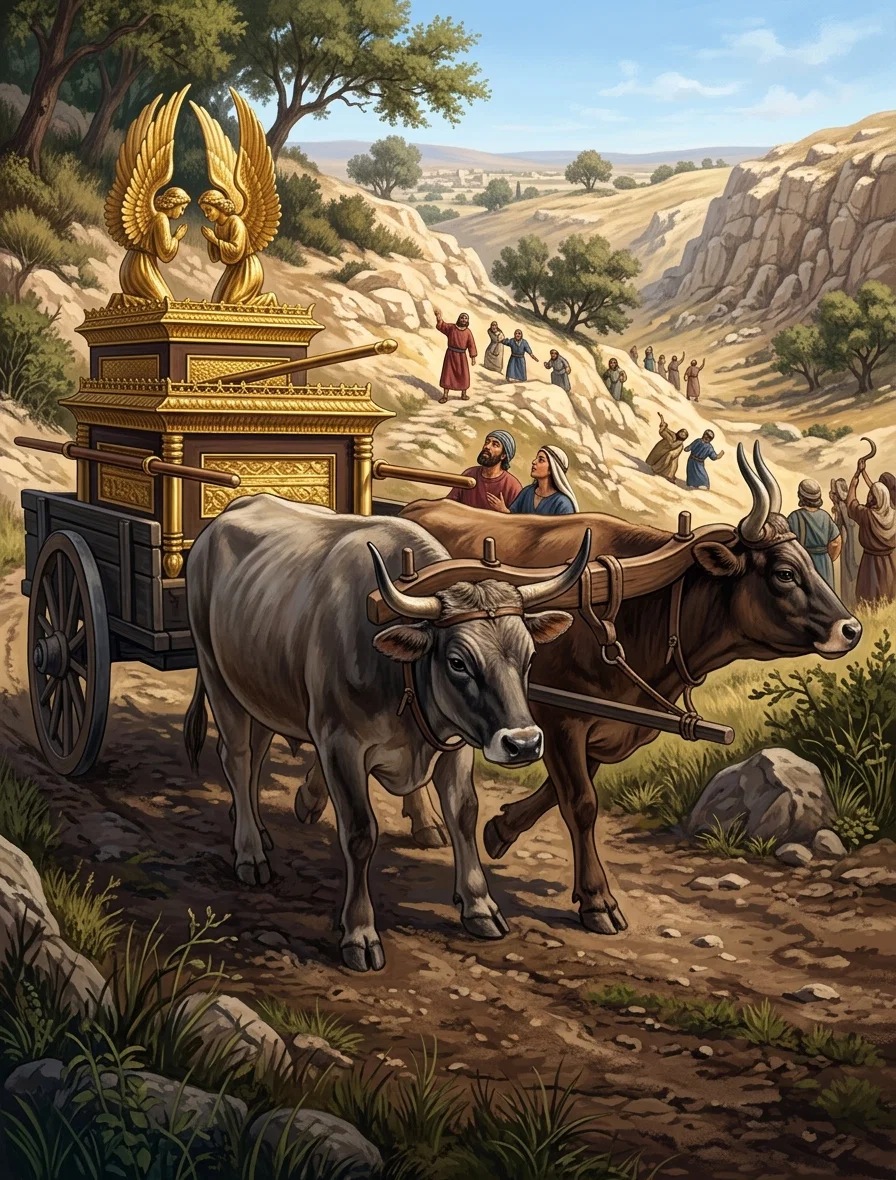
The Philistines built a new cart, harnessed two milch cows to it, and sent it away. “The kine took the straight way to the way of Beth-shemesh, and went along the highway, lowing as they went. . . . And they of Beth-shemesh were reaping their wheat harvest in the valley: and they lifted up their eyes, and saw the ark, and rejoiced to see it.” 1 Samuel 6:12, 13.
They were so rejoiced to see it that they forgot the command of God not to touch it, so they lifted the mercy seat and looked into the ark. “And He smote the men of Beth-shemesh, because they had looked into the ark of the Lord, even He smote of the people fifty thousand and threescore and ten men: and the people lamented, because the Lord had smitten many of the people with a great slaughter.” Verse 19.
Thus 50,070 more of the professed servants of God lost their lives by failing to remember and by neglecting just what God said.
There are those to-day who reason that if they offer one day to the Lord, though it may not be that day which He has commanded them to observe, it will make no difference. It makes just the difference between what God has commanded and what He has not commanded. If He declares one day to be the Sabbath, as He does in the fourth commandment, then that day is the only day it is safe to offer Him.

THE PLEA OF MOSES

When the ark came back to Beth-shemesh unguided and drawn only by two cows, the people ran out and laid hold on it despite the word of God. Fifty thousand and more were slain.
There is reason, then, in the admonition of Moses to the children of Israel just before they entered into the Promised Land and just as Moses was about to be removed from them by death. He pleaded with them to remember the exact words of God’s commandments, and heed them. “Now therefore hearken, O Israel, unto the statutes and unto the judgments, which I teach you, for to do them, that ye may live, and go in and possess the land which the Lord God of your fathers giveth you. Ye shall not add unto the word which I command you, neither shall ye diminish ought from it, that ye may keep the commandments of the Lord your God which I command you. . . . Keep therefore and do them; for this is your wisdom and your understanding in the sight of the nations, which shall hear all these statutes, and say, Surely this great nation is a wise and understanding people. . . . Only take heed to thyself, and keep thy soul diligently, lest thou forget the things which thine eyes have seen, and lest they depart from thy heart all the days of thy life: but teach them thy sons, and thy sons’ sons.” Deuteronomy 4:1-9.

THESE THINGS FOR OUR LEARNING

This admonition comes to Christian people with striking force to-day in the words of Paul when he urges us to consider the dealings of God with His ancient people as warnings, especially to those who live in the days of the end. “Now all these things happened unto them for ensamples: and they are written for our admonition, upon whom the ends of the world are come.” 1 Corinthians 10:11.
God declares the seventh day to be the Sabbath. There is no command in the Bible for the observance of Sunday. The Bible does not give the slightest hint of a Sunday institution. Christ never observed Sunday. The apostles never once kept Sunday. The Bible contains no prophecy that Sunday would ever take the place of the Sabbath, and no record that it ever has. Neither God, Christ, angels, nor inspired men ever uttered one word in favor of Sunday as a holy day.
On the other hand, God has placed His blessing on the seventh day, and sanctified it. He commanded it to be kept holy in the only commandment in the Bible for a weekly day of rest. He has placed in the Bible great and precious promises for those who will observe the seventh day. Everything can be produced in favor of the seventh day, nothing in favor of the first—no sanctity, no commandment, no penalty, no blessing.
Shall we obey God in this matter of Sabbathkeeping, and observe the day He has commanded us to observe; or shall we disobey Him, and observe a day that He has never once commanded us to keep? Which will you choose to do?
Remember, in this connection, that, according to James 2:8-12, it is this very law that contains the Sabbath commandment which will be the standard of the judgment when our cases come up in review before God. Our lives are to be measured by the law of Ten Commandments.
When we finally stand before the judgment bar of God and the law is applied to our lives, what shall we say if we have deliberately rejected His Sabbath? Shall we look up into the face of God and tell Him that we had been under the impression that it did not make any difference whether we did as He told us to do or not? Shall we tell Him that, while the Sabbath question had
been made very plain to us, yet we thought He would be just as well pleased if we kept Sunday, the day He never commanded, as He would if we kept the true Sabbath which He had commanded? Shall we add that it was much more convenient to keep Sunday, as all our neighbors were doing, and it meant a greater cross than we could think of bearing to observe the true Sabbath? Shall we say this to God? If we do, what do you think will be the result? Will God consider that we have obeyed Him or disobeyed Him?
As God pronounces upon the disobedient the just sentence of death for their violation of His righteous law, there will come to their minds His loving plea in a time long ago: ‘O that thou hadst hearkened to My commandments! then had thy peace been as a river, and thy righteousness as the waves of the sea.’ Isaiah 48:18.
Heed this plea now, before it is too late.
Continue reading: SUPERSTITION *or* GOD?