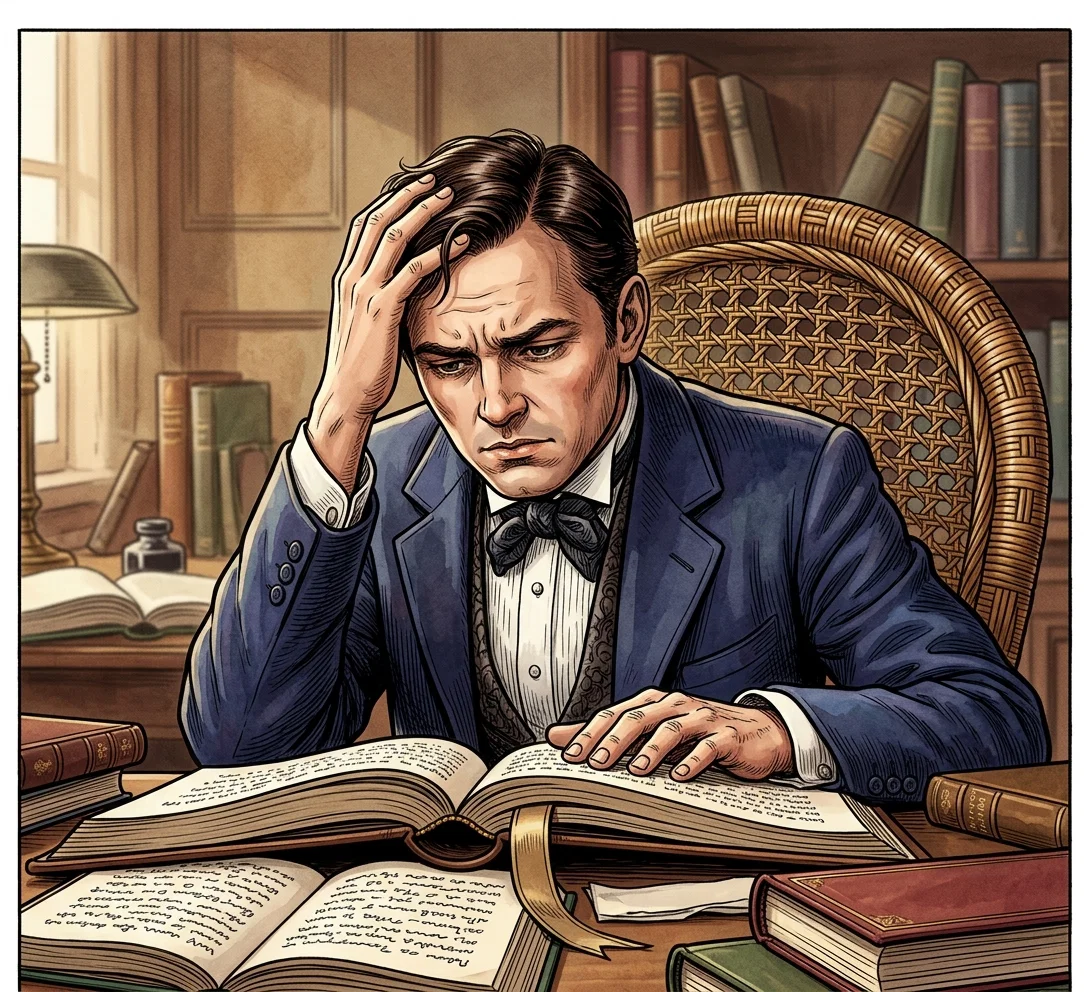
Men have always looked upon superstition as being somewhat more fashionable and smarter than faith in God and His word. When a highly educated man of science “knocks on wood,” this genuine superstition and mark of savagery does not arouse any comment. But think of the sensation he would create among his college students if he declared that he still believed in the Bible record of creation! It would be disquieting to say the least.
The old faith in God has been ridiculed and finally abandoned. People have been asked what they wished to do with it, and the crowd has shouted, “We do not want it to rule over us. Away with it! Let it be crucified!” So it has been put away out of sight,—laid in the new tomb, and sealed with all kinds of very scientific-looking seals. Better to be sure. And they are sure. Just as sure as Voltaire, the French philosopher, was when he boasted of undoing in a few years what Jesus and His word had accomplished up to that time.
WHERE VOLTAIRE LIVED
Some years ago the writer visited the house in Paris in which Voltaire wrote those proud and bitter words against Christ and the Bible. There is a little stone tablet in the wall, and the inscription tells the passer-by that Voltaire once lived here. But you would hardly notice the tablet in the wall, your eye being attracted by a display of books in all languages, in the large show windows; not Voltaire’s philosophic treatises, but—Bibles. The first floor of the house is occupied by the British and Foreign Bible Society! Here the words of Caiaphas, the high priest, would fit in perfectly: “He hath spoken blasphemy; what further need have we of witnesses?” Matthew 26:65.
No, it was not possible to keep the Master in the tomb, nor to keep His word there. True, the word had to prophesy a thousand two hundred and threescore days clothed in sackcloth. (Revelation 11:3.) Yea, for a time it seemed as though the beast from out of the bottomless pit had killed the two witnesses, the Old and the New Testament. (Verse 7.) All those from Sodom and Egypt were rejoicing over their dead bodies, “because these two prophets tormented them that dwell on the earth.” Verse 10. But “the Spirit of life from God entered into them, and they stood upon their feet; and great fear fell upon them which saw them.” Verse 11. Indeed, Revelation 11 tells us a wonderful story of man’s vain endeavors against the word of God.
CIVILIZED SAVAGERY
But in spite of these historic facts, doubt nowadays is considered smarter than faith, nota bene, faith in God! If you are only smart enough to eliminate this faith in God, then you are at liberty to believe almost everything else; and you will hardly be ridiculed for it, either.
Civilized savagery is worse than African savagery. Thousands of the heathen are willing, longing, yearning, to put their faith in a God of love, whom they do not know. We know Him; but many of us are too civilized to believe in Him. We are eager to believe many foolish things instead.
When the Zeppelin that was finally delivered to America by Germany made its trial flights, an observer could always see the head engineer with a long Prince Albert coat over his mechanic’s suit. He had worn the coat during some forty flights, and he believed it brought him luck. He did not dare to take to the air without it. He knew the wonderful machinery of his craft better than anyone else did, but he also knew of moments when man feels the working of certain powers in nature, powers that can not be overcome by the most wonderful machinery. In order to win the coöperation of these powers, or to keep them at least from doing him harm, he believed in wearing that coat as a charm.
Some persons carry a coin for luck. But usually the charm is worn on the watch chain, just as the wild men in Africa wear the amulet on a chain. Have you an amulet on your watch chain, brother?
THE JINXES
The savages are afraid of the unseen powers, and of the jinxes that are supposed to surround them in great numbers. These malevolent spirits are always ready to blink them or play some trick on them. The jinxes are jealous when one is well. A statement to that effect will set them busy stirring up trouble for the unlucky man who thus calls their attention to the fact of his well-being. The wild men in Africa break a piece of wood, endeavoring to overcome the influence of such unwise boasting by this magic action. In civilized countries—in spite of all the theories of evolution—most highly educated men still knock on wood for the same purpose,—civilized savagery!
Hunters among us seem to be just as much afraid of an old woman or a cat crossing their path in the early morning, as are the uncivilized tribes. When suddenly the hooting of the owl breaks the stillness of night, people here and in the jungles believe that some one is going to die.
Since the savage has his lucky and unlucky numbers, we civilized people do not want to do without such a genuine superstition. Hence we avoid, if possible, using the number thirteen on houses and hotel rooms. “Safety first,” is our slogan. Consequently the room next to Number 12 is 103, or 12-c.
Men are not willing to accept God as their Lord and tender Shepherd, but they will allow the moon, salt, spiders, mirrors, trees, and even little insects and pins to tyrannize over them.
THE ONE SOURCE OF FREEDOM
I once heard one woman suggest to another that she tie a red string around her little daughter’s arm, then the jinxes could not blink her. In Czecho-Slovakia I saw such a red string tied even around the branch of a Christmas tree, to keep it from drying out too quickly. Oh, these jinxes and their mischievous tricks! Indeed, it seems as though civilized man must be just as much on guard against them as is the savage. That is why you will find a horseshoe above the door in many homes. It brings good luck, and keeps the jinxes away.
These are—just a few—facts, disillusioning facts, indeed, for those who believe in the theory that science will make man free by freeing him from the “yoke” of faith in God. That is what the great deceiver promised our first parents in Paradise,—development into higher, freer beings. With the same promise he stuns those who listen to him to-day. They usually awaken only to find themselves bound, not by “cords of love” and faith in God, but by the iron chains of some form of fear and superstition.
Truly, as the great Liberator has said, “Whosoever committeth sin is the servant of sin. And the servant abideth not in the house forever: but the Son abideth ever. If the Son therefore shall make you free, ye shall be free indeed” (John 8:34-36), free also from all kinds of savagery, wild or civilized.
The “SIGNS” QUESTION CORNER
By William G. Wirth
Conducted by WILLIAM G. WIRTH, 5447 EL VERANO AVENUE, EAGLE ROCK, CALIFORNIA
If you have a question regarding Bible doctrine and Christian living, or on other subjects apropos to the field of the “Signs of the Times,” write out your question and send it in, preferably direct to Dr. Wirth. Anonymous questions will not be answered. Do not become impatient if your question is not answered immediately, for Dr. Wirth has scores of questions in waiting, and yours will be answered in order.
DOES GOD CREATE EVIL?
Mrs. M. F. Hollenbeck of Fall River Mills, California, asks for an explanation of Isaiah 45:7.
In Isaiah 45:7 when God says He “creates evil,” He means He brings trouble, affliction, punishment, upon men for their departing from Him. See also Isaiah 47:11; Amos 3:6. This does not mean that God is the author of evil as sin, as iniquity; for His character is altogether righteous. Says Habakkuk: “Thou that art of purer eyes than to behold evil, and that canst not look on perverseness, wherefore lookest Thou upon them that deal treacherously, and holdest Thy peace when the wicked swalloweth up the man that is more righteous than he.” Chapter 1:13; see also, Jeremiah 36:3, 31.
THE SABBATH ON OTHER WORLDS
A San Franciscan inquires as to whether the seventh-day Sabbath is observed on other worlds or not.
It is evident from Genesis 1:1 to 2:3; Exodus 20:8-11 that the seventh day of the fourth commandment was instituted as the particular Sabbath of this world. Whether this seventh day is the Sabbath of “other worlds” in the universe as well as ours the Bible does not reveal. Inasmuch as we human beings are the inhabitants of this earth, and always will be, and the seventh day is an inherent part of God’s order for this earth, and always will be (Matthew 5:5; Isaiah 66:22, 23), what may obtain in other parts of the universe does not affect our obligations on this planet.
Cruden, in his introductory statement on “Tithe,” in his “Complete Concordance,” has these pertinent words:
“There were three sorts of tithes to be paid from the people (besides those from the Levites to the priests. Numbers 18:26, 27, etc.) (1) To the Levites, for their maintenance. Numbers 18:21, 24. (2) For the Lord’s feasts and sacrifices, to be eaten in the place which the Lord should choose to put His name there; to wit, where the ark should be, the tabernacle or temple. This tenth part was either sent to Jerusalem in kind or, if it was too far, they sent the value in money, which was to be laid out for oxen, sheep, wine, or what else they pleased. Deuteronomy 14:22, 23, 24, etc. (3) Besides these two, there was to be, every third year, a tithe for the poor, to be eaten at their own dwellings, Deuteronomy 14:28, 29. Some are of the opinion that this third tithe was not different from the second before taken notice of, except that in the third year it was not brought to the temple, but was used upon the spot by every one in the city of his habitation: So that there were only, according to them, two sorts of tithes, that which was given to the Levites and priests, and that which was applied to making feasts of charity, either in the temple of Jerusalem, or in other cities.”
As to the “wine” and “strong drink” of Deuteronomy 14:26, it is true that the Hebrew originals of these words, yayin and shekar, suggest intoxication. As I have stated on other occasions, we must ever keep in mind that the Hebrews lived in different times than ours. The standards of that day are not the standards of our day. Then it was in accordance with the best social taste to have more wives than one and to possess human beings as slaves. It is not so now.
The social sentiment now is increasingly growing, on the whole, against intoxicating drinks. Prohibition is evidently here to stay and to make the world “drier.” In the days of Israel of the Old Testament, there was no such sentiment as Prohibition. To drink spirituous liquors was the commonly accepted procedure. It would have been strange to think otherwise. Therefore, God had to tolerate this evil as He had to tolerate the evils of polygamy and slavery. It is one of the remarkable proofs of the Bible’s divine authority that, written as it was in the environment of the free use of intoxicating beverages, it advanced the now-accepted principle of the benefits of their nonuse. See Proverbs 20:1; 23:29-32. Here is food for thought for those who would scoff at the Holy Word.
THE QUESTION OF MEATS
As to the expression of Paul: “Asking no question for conscience’ sake” (1 Corinthians 10:25, 27), it must be plain on its face that this by no means shows that we may eat and drink anything we wish. That which is filthy, unhealthful, and vile is divinely disapproved. We need to keep in mind 1 Corinthians 6:19, 20: “Know ye not that your body is a temple of the Holy Spirit which is in you, which ye have from God? and ye are not your own; for ye were bought with a price: glorify God therefore in your body.” Physically, therefore, we need to do right as we feel we must do spiritually. As Paul again writes: “Whether therefore ye eat, or drink, or whatsoever ye do, do all to the glory of God.” 1 Corinthians 10:31. We shall not go wrong if we abide by this rule.
As M. C. Wilcox well says in his “Questions and Answers,” Vol. I, page 196: “By noticing the context (of 1 Corinthians 10:25, 27) it will be seen that the question was whether it was harmful to eat meat which had been offered to idols. Sometimes, after this meat had been offered to idols, it was placed in the market for sale, and the conscience of some was troubled as to whether it would not be doing homage to idols to eat it after it had been so offered. Now, ‘an idol is nothing’ (1 Corinthians 8:4), and yet there were those who had been idolaters whose conscience would not allow them to eat anything that was offered to idols without injury to their conscience. In such a case the apostle tells us we should not eat, for the sake of him who has such scruples; but it was perfectly legitimate to purchase whatever was found in the market suitable for food, without asking any questions. Of course, this would not be true if the food was evil in itself.”
The fact that in the 27th verse Paul speaks about being bidden to a feast by “one of them that believe not,” or a heathen, does not alter the further fact that Paul, as shown above, is speaking of meat offered to idols. This, unless it was that which was expressly forbidden by command of God as I have shown, comes under the apostle’s “whatsoever is set before you, eat.” If the questioner will read the 28th verse in connection with the 27th, he will have no difficulty in understanding Paul’s meaning.
REMARRIAGE OF THE DIVORCED
E. J. Loftus of Southern California asks concerning our position on the remarriage of divorced persons. His question was inspired by the observations on this page anent this issue in the “Signs of the Times” of June 14, 1927.
If Matthew 19:1-9 is carefully studied, it will be seen that our Lord permits no dissolution of the marriage bond “except for fornication.” See Matthew 5:31, 32. This must obtain in all Christian marriages.
In Matthew 19:9 it is implied that a husband of a guilty wife may marry again, and, by parity of reasoning, a woman divorced from an immoral husband is free to take another husband. Divorce infers the possibility of marrying again. It is sometimes held that Mark 10:10-12 and Luke 16:18 deny remarriage, since they do not mention the exception given in Matthew 19:9. In answer to this, I would say that Mark and Luke, taking for granted the exception of Matthew 19:9, because fornication, in the very nature of the case, is a real dissolution of the marriage tie, simply stated Christ’s pronouncement in a general way. Matthew states it particularly. Mark’s and Luke’s general statement is probably also due to the fact that the law already provided for the punishment of adultery. (Leviticus 20:10; Deuteronomy 22:22ff.; John 8:3ff.)
It is to the credit of the Roman Catholic Church that it has so stoutly stood for the “sanctity and honor of the home,” as the questioner says. Protestants can learn much from this papal position. However, it would be too much to say that the Roman Catholic Church alone does this. There are Protestant persuasions that are just as firm in their attitude on defending the marriage relation as are the Catholics. It must be borne in mind, too, that even the papacy, through its Sacred Rota, permits marriage dissolution, under certain conditions, and remarriage.
EDITORIAL
By Editor
ASA OSCAR TAIT
ALONZO L. BAKER
“WILL HOLD THY HAND”
Last week we called attention to some of the prophecies of the Old Testament that were given concerning the Messiah, and it was the particular desire to lay special stress upon the prophetic promises that were given to the Master before He should come to this earth to assume human flesh and human nature, and thus to fight in person for humanity the divinely heroic battle against sin.
In His human form, although He was the infinite Christ, He must, nevertheless, as the “Son of man,” Himself test the power and show the trustworthiness of the mighty promises given through the prophets to the battling sinner who is striving for the mastery that results in the true principles of righteousness being enthroned within.
With these thoughts in mind, carefully read this additional portion of that wonderful forty-second chapter of Isaiah, all of which is addressed primarily to the Christ:
“Thus saith God Jehovah, He that created the heavens, and stretched them forth; He that spread abroad the earth and that which cometh out of it; He that giveth breath unto the people upon it, and spirit to them that walk therein: I, Jehovah, have called Thee in righteousness, and will hold Thy hand, and will keep Thee, and give Thee for a covenant of the people, for a light of the Gentiles; to open the blind eyes, to bring out the prisoners from the dungeon, and them that sit in darkness out of the prison house. I am Jehovah, that is My name; and My glory will I not give to another, neither My praise unto graven images. Behold, the former things are come to pass, and new things do I declare; before they spring forth I tell you of them.”
“Sing unto Jehovah a new song, and His praise from the end of the earth; ye that go down to the sea, and all that is therein, the isles, and the inhabitants thereof. Let the wilderness and the cities thereof lift up their voice, the villages that Kedar doth inhabit; let the inhabitants of Sela sing, let them shout from the top of the mountains. Let them give glory unto Jehovah, and declare His praise in the islands. Jehovah will go forth as a mighty man; He will stir up His zeal like a man of war: He will cry, yea, He will shout aloud; He will do mightily against His enemies.
“I have long time holden My peace; I have been still, and refrained Myself: now will I cry out like a travailing woman; I will gasp and pant together. I will lay waste mountains and hills, and dry up all their herbs; and I will make the rivers islands, and will dry up the pools. And I will bring the blind by a way that they know not will I lead them; I will make darkness light before them, and crooked places straight. These things will I do, and I will not forsake them. They shall be turned back, they shall be utterly put to shame, that trust in graven images, that say unto molten images, Ye are our gods.” Isaiah 42:5-17.
Thoughtful study of this remarkable passage of Scripture will reveal the terrible conflict that sin has occasioned. It will show the mighty stress through which the Master Himself was called upon to pass in order to make a way of escape for the sinner. As this scripture is studied, we will sense the force, more than ever, of that injunction of the Master’s, “Strive to enter in by the narrow door: for many, I say unto you, shall seek to enter in, and shall not be able.” Luke 13:24.
It is only when we attempt to break away from sin that we realize its exceedingly strong hold on us; it is only when we seek to conquer the bad habits that we have formed; it is only when we seek to have the love of God in our hearts take the place of our grudges and our hatreds and all our evil nature, that we have a realizing sense of the hopelessness of the task, except as we lay hold upon divine power. And how apropos is the statement at the beginning of this quotation from Isaiah, “Thus saith God Jehovah, He that created the heavens, and stretched them forth; He that spread abroad the earth, and that which cometh out of it; He that giveth breath unto the people upon it, and spirit to them that walk therein: I, Jehovah, have called Thee in righteousness.”
It requires the mighty power exercised in the creation of the heavens and the earth to cope with the powers of sin that have entrenched themselves in the hearts of men.
The Master entered human flesh to win this struggle in our behalf, and as He entered the conflict, the promise was given to Him by His divine Father, “I, Jehovah, . . . will hold Thy hand, and will keep Thee.” The infinite Christ, when He lays aside His divinity and becomes one of us, and accepts the title of “Son of man” as well as “Son of God,” must cling to divine power, and must sense that His Father is holding Him in the conflict. In this conflict He is to open the blind eyes, He is to make a way for the sinner to escape, He is to fill him with the confidence of victory; and, because of this great success, the triumph song is sung, as recorded in verses 10-13.
As we view the battle that the Master Himself fought, as so graphically expressed in scriptures like these from Isaiah, we realize what salvation has cost heaven; and we renew our consecration to Him who loved us so much as thus to give Himself for us. T.
Does TOBACCO SMOKING Produce ENERGY?
By D. H. Kress
D. H. Kress, M. D. Neurologist of the Washington, D. C., Sanitarium and Hospital, says,— “What we need is more building up and less whipping up.”
HERBERT PHOTO
Recently there appeared a full-page article in the Sunday magazine supplement of some of our newspapers, calling attention to some experiments conducted by Dr. Hazel Field, Associate Professor of Zoology at the Occidental College, Los Angeles, showing that, contrary to the general belief that smoking of tobacco acts as a depressant, it really has a stimulating effect and produces an increase of energy. The purpose of the article evidently was to convey the idea that tobacco smoking was not merely harmless but actually beneficial and desirable.
The experiments were conducted on white rats. The rats were exposed to the fumes of tobacco daily. Dr. Field says: “I used to hold the naïve belief that tobacco was a depressing agent. Imagine my consternation when I found out that tobacco is a stimulant.”
NO NEW DISCOVERY
This is no new discovery, doctor. Every smoker knows that smoking produces a feeling of well-being and exhilaration. Reporters can inform you that when they are suffering from what they term “brain fag,” and it seems impossible to write another line, they involuntarily reach for a cigarette, and, after taking two or three deep inhalations, the brain begins to function, and they are able to complete their write-up. In this respect the effect of the tobacco smoke is similar to that produced by a small dose of cocaine. Practically all the sensational and highly spiced novels are written by men and women while under the influence of some such stimulant.
Smoking also increases the heart action. It is a heart stimulant, and raises the blood pressure. By placing the sphygmograph over the radial artery and taking the pulse tracing, it will be observed that very shortly after resorting to smoking the heart beats more vigorously and the pulse tracing is more pronounced.
The trouble is, however, that, shortly after the stimulating effect of the smoke wears off, there follows a corresponding state of depression. This unnatural depression creates the demand for another smoke, or more stimulation. It is this that creates the smoke habit. The smoker finds that he is at his best only while under the immediate influence of the smoke.
In this respect the results of smoking are again similar to that experienced by the user of cocaine or morphine. This places nicotine in a class with these habit-forming drugs. The same effects that were obtained by the doctor in her experiments with tobacco smoke upon rats may be obtained by using morphine or cocaine in small doses. This is another evidence that tobacco, like these other drugs, is injurious and undesirable. In describing the immediate effect of smoke inhalation upon rats, the doctor is quoted as saying:
MADE FOOLS OF THEMSELVES
“They were playful, sportive, excited to the point of hysteria, sometimes. They would run from corner to corner, hop about excitedly, jump up and down the sides, nibble at food, and drag it around. They would kick the shavings, which served as their beddings, from one corner to another, then kick the stuff back again, foolishly indulging in vigorous acts of this nature. But the controls, the rats who did not smoke, never showed any such behavior.”
This excitation was altogether unnatural and abnormal. The rats that were not exposed to the smoke, she says, “never showed any such behavior.” Of course not. The fact is that the rats, while under the irritating influence of the smoke, made fools of themselves, just as young cigarette smokers sometimes do while under the immediate influence of the smoke.
Another point of interest and significance was observed from these experiments upon the rats, which are daily observed by every smoker; that is, this exhilaration was followed by a period of pronounced depression, which was not true of the rats not so exposed. It stated: “Also, smoking had a perceptible tendency to become a habit. That is, when the experimentals were not administered smoke for a few days, they became distinctly depressed.”
“Sometimes this depression due to enforced abstinence was very marked and significant. When the smoking was revived, the rats became alert again with surprising promptness.
“If the tobacco in any experiment was less active, that is, if its nicotine content was relatively small, the effect upon the rats was also much less than when the standard or better grade of tobacco was used in the pipes.”
AN EYE OPENER
This, again, is true of the influence of any habit-forming drug. Every drug addict knows this. The removal of the drug causes misery temporarily.
Dr. Field’s experiments are of value in that they show up the insidious and deceptive nature of tobacco, and should be an eye opener to every smoker, and should lead him to abandon its use. The doctor concludes by saying: “This is merely the beginning of a research which has many9important possibilities. With my limited resources, I have not been able to go as far and as deeply into this work as I should wish to. I intend to continue these investigations. For decades, almost centuries past, the question of tobacco smoking has been debated. Its champions, usually the poets and Bohemians who like to drink wine and smoke for sociability, have praised the tobacco weed to the skies.
“The puritanic moralists, on the other hand, have pronounced tobacco as a cursed thing, responsible for all sorts of maladies. But, nobody had taken the trouble to find out the facts. So I undertook these experiments. It was, for the present, practicable to experiment only with the animals, and not with human beings. Of course, you need not believe that what is true about the rats is necessarily true about men and women too. Still, the experimental results are significant.”
“The same method could be employed, I suppose,” Dr. Field hinted, “toward a new line of research for determining just how coffee affects a man or an animal.”
I can predict beforehand that she will observe effects very similar to those obtained from smoke inhalation, by experimenting with coffee, for coffee is in the same class with these other drugs. It is a temporary stimulant. This explains, too, why coffee drinking and tobacco smoking are so intimately associated. Coffee can not be carried around and taken whenever the feeling of depression comes on, while tobacco can be resorted to anywhere. The use of the one often leads to the use of the other. In countries where the use of coffee is prevalent smoking is also prevalent.
In my clinical work a few years ago, in treating smokers, I found that in practically every case heavy smokers were also heavy coffee drinkers. But why spend time in carrying forward such experiments with animals? It merely will give results that are being demonstrated and witnessed daily among men, women, and the youth in everyday life.
One error, or wrong impression, conveyed in the article should be corrected. The statement is made in large headlines: “Smoking Increases Energy.” Smoking does not increase energy. It liberates energy. Drugs can not produce or increase energy. They enable the addict to draw upon nature’s energy resources, and often to the point of depletion. This, in time, makes nervous wrecks of men and women, and also explains why we have so many nervous men, women, and children in America, and why nervous and mental diseases are so rapidly on the increase.
Tobacco is a mocker, whosoever is deceived thereby is not wise. What is needed is more building up and less whipping up.
RESTORING THE JEWS TO PALESTINE
By I. A. Crane
I. A. Crane
During recent years we have been hearing much concerning the return of the Jews to the Holy Land. By some this gathering of Israel and the consequent rebuilding of old Jerusalem is looked upon as a most certain sign that the millennium of peace is soon to be ushered in.
But those who look for such things seem never to give thought to the fact that the God who dealt with Israel is a God of perfect justice, and that if He dealt justly in causing them to be removed from the land, He certainly could restore them only when they manifest sincere repentance in forsaking the sins that caused their expulsion. The omission of the principle of divine justice in considering this subject is a reproach upon the name and character of God, and has led to much error and confusion. The great adversary of truth is pleased to find that many are ready and eager to believe that God is like man,—moved by hasty impulses rather than by a deep sense of justice and right.
The Jews were exiled because of apostasy from the service of God, the most prominent of which was failure to honor the Sabbath that had been given them as a sign that they were worshippers of the true God, their Creator. (Exodus 31:13, 17; Ezekiel 20:12-20.) That they had cast off their allegiance to God and heaped contempt upon the Sabbath is further shown in Jeremiah 17:21-27, where God promised them that if they would keep this sign of their loyalty to Him in its fullness of meaning, the city and nation would never be destroyed. See also 2 Chronicles 36:20, 21 and Nehemiah 13:17, 18.
The final destruction of Jerusalem and the exile of the Jews came as a result of their rejection of Jesus as the Messiah. This rejection of the Messiah was foretold by the Old Testament prophets. (Isaiah 53:3-8; Psalm 22:6-8.) Daniel also had foretold the very time when the Messiah should come, and that for “the overspreading of abomination” attendant upon His rejection; that He would “make it desolate” again, this time “even until the consummation,” or end. (Daniel 9:24-27.) Seeing all this, we read that Jesus wept over the impenitence of the city that knew not the time of her visitation. The time of her final destruction was drawing near, when she would be “laid even with the ground” and the Jews “led away captive into all nations, and Jerusalem . . . trodden down” by the Gentile nations until their probationary time should also end. (Luke 19:41-44; 21:20-24.) Oh, if they had only received Him when He came, how different would have been their history!
And in what condition do we find them to-day? Do we find them turning to the Lord in sincere repentance? Do we find the Jews as a people keeping the Sabbath, which shows them loyal to their Creator and Redeemer? Far from it. While they acknowledge that they should honor the Creator’s Sabbath, yet very few indeed are willing to sacrifice business and pleasure in order to keep it holy. Are they, to-day, as a people, recognizing Jesus as the Messiah and Saviour of Israel? A few are; but, as a race, there is nothing to indicate that they ever will. Only a “remnant” will be saved, just as Isaiah and Paul declared. (Isaiah 10:22; Romans 9:27.) As a people, the Jews are weekly desecrating the Sabbath, given as a sign by which they may show their loyalty to God. As a people, they are openly committed to the rejection of Jesus, the Messiah. Can a just God receive and restore them so long as they continue in transgression, and refuse to repent? God forbid! This can never be. God will receive every one of them that will return to Him in sincerity and truth; but the Jews, as a nation, unrepentant and unbelieving, He will never receive and restore. True Israel, that is, spiritual Israel, will be restored in the fullness of the promise when Abraham, Isaac, and Jacob, with all the faithful, shall receive the promise for which they have long been waiting. This will be at the resurrection of the just. See Hebrews 11:8-11, 40; Luke 13:28, 29; 14:14.
Take Up the Cross
By G. H. Morrison
There is still some duty you are called to; there is still some one who is in need of you; there is still some service in your power to render, and lying to your hand this very day. It is hard to take the cross up in the sunshine. It may be harder, to take it in the night. But, hard or not, that is what Peter did; and that is what you must do if you would triumph.—G. H. Morrison.