The days of Jehu have come again. America has vanquished Spain, and a religious paper, the Christian Work, echoes the ambition of many hearts in an editorial headed, “Now for the Turk!” The closing sentence is, “Send the boats!” by which is meant the navy, to bring the Turk to terms. This may be proper enough in a civil government, but it is hardly Christian principle or Christian work to destroy one’s enemies or to avenge one’s self. It reminds one of the zeal of Israel’s fiery king Jehu, who, after he had destroyed Joram, the nominal king, and Jezebel, his mother, mounted his chariot, invited the good Jehonadab to sit with him, and cried, “Come with me, and see my zeal for the Lord,” and went forth to destroy thousands more of Baal-worshipers, and then offered his devotions to the shrine of the golden calves. There are not wanting those who follow in the footsteps of Jehu to-day. “Now for the Turk!” “Send the boats!” are parallel to, “Come with me, and see my zeal for the Lord.” And America will do wonderfully well if, after she has freed Cuba and the Philippines from Spanish tyranny, she does not turn the people over to the tender mercies of the worshipers of the golden calves, the corporations of graceless greed.
Roman Catholic Priests in South America.
At the Protestant Reformation Society recently held in England, Dr. Harry Guinness said, according to the Prophetic News of June:—
“I have just returned from many lands where Roman Catholicism is undisturbed by Protestantism. On my way to Panama I met a young Roman Catholic who declared that it was a monstrous thing that Protestants should say Roman Catholic priests were not pure to the core. I said to him, ‘Wait till you get to Panama.’ There the depravity of the priests is awful. In the base of the bishop’s palace are the headquarters of all the gambling in Panama. Some prizes allowed the winners to have the soul of some friend liberated from purgatory. In Peru, out of many hundred priests, only eighty-nine came from Europe. On the coast I met some European priests from Spain, France, Italy, and Switzerland. I said to one of them, the head of a large monastery, that I thought the priests of Peru very depraved. The priest replied, ‘Sir, you are perfectly correct; there is not a sober, respectable priest among the lot.’ Another priest confirmed that statement.”
Catholicism in Russia.
In speaking on “The Relations of the Roman Church to Russia at Various Periods of Russian History,” the (New York) Russian Orthodox American Messenger of June 13 says of Roman Catholic success:—
“It was only in the South, owing to special local conditions, that they had any measure of success, and even there exclusively among the higher classes. Yet former failures did not discourage either the pope or the Catholics generally from endeavoring to introduce Catholicism or the union into Northern Russia. They are at it yet. Indeed, their hopes of success have become bolder and more arrogant than ever.”
And Roman Catholic success will become more marked in Russia and elsewhere as the years go by. Her success among the higher class is no evidence of the truthfulness of her claim, but it is a mighty help in controlling a nation politically. It is this that the Roman Church is seeking.
Spain’s Defeat as Divine Judgment
The Turks feel that America’s victory over Spain is the Lord’s vengeance upon that nation for the treatment of the Moors. And not a few Jews believe that it is God’s judgment upon Spain for her treatment of the Jews. And then how many Christians and non-Christians suffered at her hands!
THERE’S a cry in the wind to-night
From the land where the Lord is unknown,
While the Shepherd above, in His pitiful love,
Intercedes at His Father’s throne.
There’s a call from the dark to-night
That haunts the lighted room,
From His “other sheep” on the broken steep
At the edge of eternal doom.
There’s a pain at my heart to-night—
From the heart of God it came—
For I can not forget that He loves them yet,
And they’ve never heard of His name.
There’s a sob in my prayer to-night,
When I think of the million homes
Where never a word for the Lord is heard,
Nor a message from Jesus comes.
—Christian (London).
Samaria to Shechem
By H. P. H.
JOTTINGS FROM PALESTINE. No. 9.
Samaria to Shechem.
From the hill of Samaria we went six miles southwest, to Nablus, or the Shechem of the Old Testament. Most of the way the road leads through valleys; as we near Shechem, we strike the carriage road leading from Shechem to Joppa, the first of the kind we have seen all the way from Nazareth. In ancient times, when kings passed back and forth through this country with chariots, there must have been good roads; for, as illustrated in the account of Jehu, they sometimes drove “furiously.”
Along this road from Shechem to Joppa is a telegraph wire. As we near the town, there are more signs of life,—men working on the road, groups of women going to market, carrying their load on the head, and long strings of camels,—the freight trains of the Orient. Olive and fig trees are quite abundant in this region; water is plenty; and here and there we see an old dilapidated mill driven by water.
Shechem occupies a central point in the history of Israel. It was the first place in Canaan visited by Abraham; it was to Shechem that Jacob came on parting with Laban; here he bought a parcel of ground; it was here that his sons afterwards fed their flocks, when Joseph was sent to visit them; after the conquest of Canaan, Joshua assembled Israel here—six tribes towards Mount Gerizim to pronounce the blessings, and six tribes towards Mount Ebal to pronounce the curses; before his death, Joshua again assembled all Israel here for parting admonitions; and it was here that the national assembly was held when the ten tribes revolted from Rehoboam.
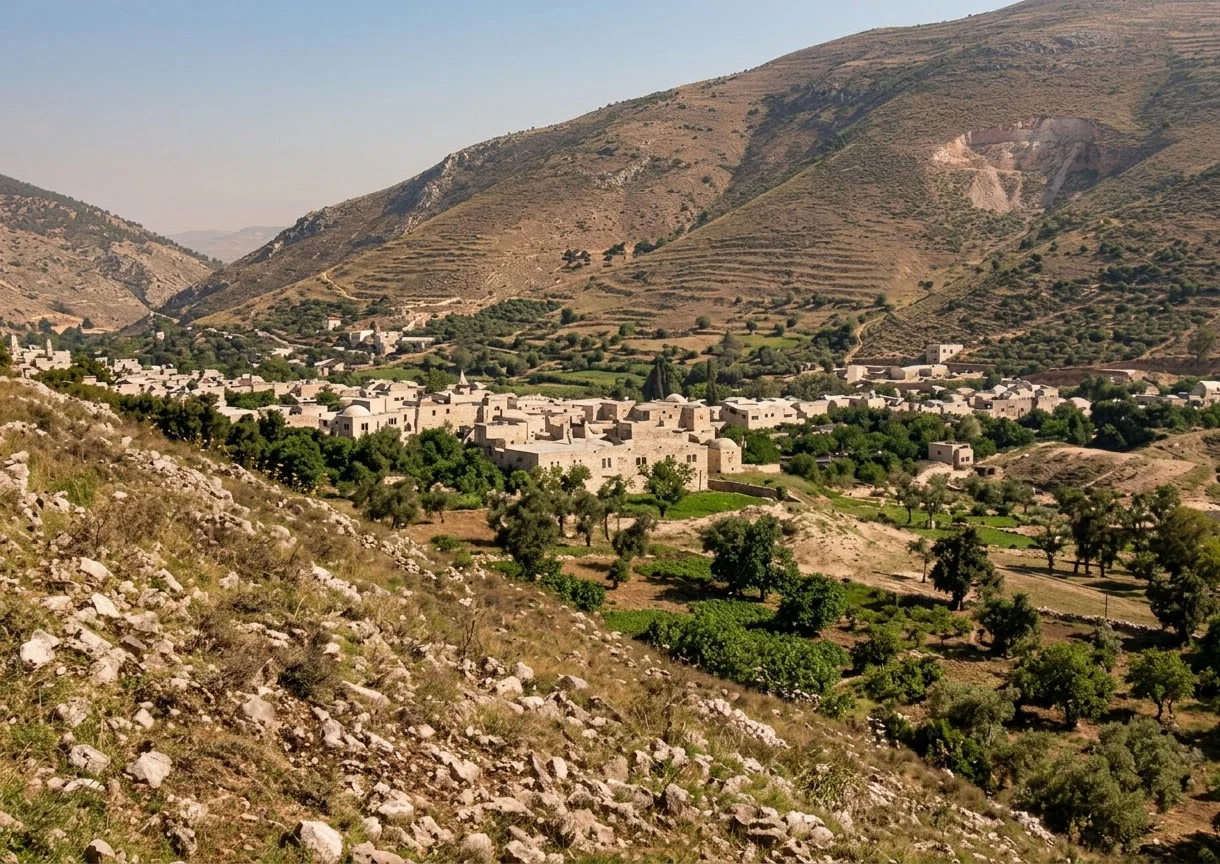
Shechem sits on a saddle between Mounts Ebal and Gerizim, on the watershed between the Jordan and the Mediterranean. Its present population is 20,000, all Arabic except one thousand Christians and two hundred Samaritans. The brisk trade which here centers from Joppa and the country east of the Jordan gives its market a lively character.
The town has but one long main street, through which we pass from west to east. This street is the main market, and hence was crowded with all sorts of wares, camels, and donkeys, so that it was difficult to squeeze through. In these cities there is no attempt at making a sidewalk; often, the whole street from wall to wall is jammed full. As a rule artisans of all sorts have their shops, which often consist of nothing but a nook under an arch, opening to the street; and usually those of like craft are grouped together. Whenever we meet camels, it is a time to give all our attention to our horses; in the country, we take a side path in the field, and give the camel the whole road; but here in these narrow streets the problem is a vexing one, for a horse prefers to keep his distance from a camel, tho the camel always marches along in solemn indifference.
Shechem is of special interest as having been the seat of the Samaritan worship. The Samaritans were a mixed race, an amalgamation of heathen from Babylon and vicinity, with a few of the poorer Israelites whom the Assyrians did not think worth carrying off. While outwardly adopting the first five books of Moses, and many features of the religion of the Jews, they retain their heathenism; and, as revealed in the New Testament, there was great enmity between them and the Jews. The Samaritans had a temple on Mount Gerizim, southeast of Shechem; but only a few stones now remain to mark its place.
SHECHEM, BETWEEN EBAL AND GERIZIM.
Of the Samaritan race, only 200 survive; these are in Shechem, where they have a distinct quarter of the town, and a synagog for their worship; they keep the feasts of the law of Moses, but offer sacrifices only once in a year,—at the Passover. Three times a year,—at the Feast of Tabernacles, the Feast of Weeks, and the Feast of Unleavened Bread,—they make pilgrimages to the summit of Mount Gerizim, to the spot where their temple stood. As in the days of Christ, they still hold this mountain as sacred. Their high priest claims to be a descendant of Aaron; he is supported by the tithes of his people. The race of Samaritans is gradually becoming extinct; in their numbers there are more men than women, and the Jews and others will not intermarry with them. They still look for the coming of the Messiah, expecting that He will appear about 6,000 years after creation. It is claimed that they still hold that the Samaritans only will enter Paradise.
Shechem is also a center for missionary operations. Latins, Greeks, and Protestants operate here; they maintain several institutions of charity and education; but the work done is mostly among Christians; it is claimed by those that have been here many years that the ground is very hard.
On emerging from the crowded street we had a clear view of Mounts Ebal and Gerizim, which are respectively 3,077 and 2,848 feet high. The foot of Gerizim is green with verdure; but Ebal is barren from the base. It is believed that the gathering of Israel under Joshua for pronouncing the blessings and the curses took place a short distance east of Shechem. From the summit of Mount Ebal the view is extensive; one can see the hills of Samaria, the Mediterranean, the site of Cæsarea in clear weather, Mount Carmel, the hills of Galilee, Mount Hermon, and a long range of hills east of the Jordan extending to the Dead Sea. The view from Gerizim is nearly as extensive.
But of the many things of interest about Shechem, Ebal, and Gerizim, nothing is so attractive as Jacob’s well, rendered immortal by the conversation of Jesus with the woman of Samaria. John 4. This woman came from Sychar, half a hour’s walk northeast of Shechem, at the foot of Mount Ebal. There is still a small village here. Jacob’s well is southeast of Shechem, near the center of the valley, between Gerizim and Ebal; its mouth is now about ten feet below the surface of the ground; we descend to it by steps through the ruins of a small chapel which the Crusaders built over the well. It is in possession of the Russian Church, and inclosed by a wall; a priest lives here to guard the well and to admit visitors.
The mouth of the well is covered by a large stone, having an oval opening about two by three feet. The priest lighted a candle, and with a long cord lowered it slowly to the bottom, showing all parts of the well; it is round, seventy and one-half feet in diameter, and about seventy-five feet deep. It is walled with hewn stones; and, tho so deep, has no water. Without doubt it was at this identical spot that the Saviour sat to rest at noon, and had that remarkable10conversation about the water of life. We, too, are wearied with the journey and feel like resting awhile, to meditate upon the scene which here took place, and the grand truths here uttered.
Sychar, about fifteen minutes distant, is in plain view from the well; also the summit of Gerizim, where stood the Samaritan temple, to which the woman referred when she said, “Our fathers worshiped in this mountain; and ye say, that in Jerusalem is the place where men ought to worship.” Jacob’s well is in the parcel of ground which Jacob bought when he returned from Laban, and which he gave to Joseph. When Israel left Egypt, they brought the bones of Joseph with them, and buried them in this parcel. About 110 paces from Jacob’s well is a monument of modern construction, called Joseph’s tomb, which is believed to mark the place where he was buried. The valley opening to the east of Jacob’s well is fertile, but is now indifferently cultivated. The whole scene forcibly reminds one of how literally the curses pronounced from Mount Ebal have been fulfilled. H. P. H.
WHAT CAN WE DO?
By Minnie Embree
As we read of the work that is being started in Oakland and San Francisco among the needy of those large cities, it makes our hearts rejoice, and we say, “I would like to help,” “If I were there, I would devote some time to the work,” or, “If I were rich I would gladly give a thousand dollars to such a worthy enterprise.” Let us ask ourselves the question, “If I were there, as a worker in the Helping Hand Mission, daily finding persons in need of clothing, persons suffering with the cold, would it not make my heart rejoice to receive a barrel or box of clothing which had been donated by some person or persons who wished to help in the good work?” or, “If I were there, finding so many hungry people, men, women, and children, babies crying for food, would it not gladden my heart should I receive a donation of beans, peas, dried fruit, etc.?”
Have you land? Has God made you the steward of a part of this earth? What do you owe to the poor? The Israelites of old were directed to leave for the poor all the products of their land every seventh year. Ex. 23:10, 11.
What can we do to help in the work of the Helping Hand Mission?—We can think of those who are suffering for food every time we sit down to our bountiful boards, and see if there is not some sacrifice we can make for the sake of the hungry and not injure our own health either. Mothers, when buying and making clothes for your children, leave off the unnecessary trimming, using the money and time to buy goods and make a dress for some poor little shivering child.
Go to your wardrobes and trunks and find the garments which have been outgrown and laid aside. If they are torn, mend them. Maybe you will find garments which some loved one has worn but will never wear again,—garments which you are keeping in memory of one whom death has called away. Keep them no longer, while people are destitute. Get your neighbors to help, and make up a box of clothing and send to the Helping Hand Mission, prepaying the freight. The children can write or print little letters or texts of Scripture to pin to the clothes which they have outgrown and which they send to needy children. They can also plant gardens, sell copies of the SIGNS OF THE TIMES and Youth’s Instructor, and do many other things to earn money with which to help.
If we do all we can, even tho it may not be very much, the Lord Jesus will say to us, “Inasmuch as ye have done it unto one of the least of these My brethren, ye have done it unto Me.” MINNIE EMBREE.
[Any one who may wish to respond to the foregoing suggestions should send their offerings to the Helping Hand Mission, 641 Commercial Street, San Francisco, Cal.—Ed.]
1 “And it came to pass after these things, that God did prove Abraham, and said unto him, Abraham; and he said, Here am I. And He said, Take now thy son, thine only son, whom thou lovest, even Isaac, and get thee into the land of Moriah; and offer him there for a burnt-offering upon one of the mountains which I will tell thee of. 2 And Abraham rose early in the morning, and saddled his ass, and took two of his young men with him, and Isaac his son; and he clave the wood for the burnt-offering, and rose up, and went unto the place of which God had told him. 3 On the third day Abraham lifted up his eyes, and saw the place afar off. And Abraham said unto his young men, Abide ye here with the ass, and I and the lad will go yonder; and we will worship, and come again to you. 4 And Abraham took the wood of the burnt-offering, and laid it upon Isaac his son; and he took in his hand the fire and the knife; and they went both of them together. 5 And Isaac spake unto Abraham his father, and said, My father; and he said, Here am I, my son. And he said, Behold, the fire and the wood; but where is the lamb for a burnt-offering? 6 And Abraham said, God will provide Himself the lamb for a burnt-offering, my son; so they went both of them together. 7 And they came to the place which God had told him of; and Abraham built the altar there, and laid the wood in order, and bound Isaac his son, and laid him on the altar, upon the wood. 8 And Abraham stretched forth his hand, and took the knife to slay his son. 9 And the angel of the Lord called unto him out of heaven, and said, Abraham, Abraham; and he said, Here am I. 10 And he said, Lay not thine hand upon the lad, neither do thou anything unto him; for now I know that thou fearest God, seeing thou hast not withheld thy son, thine only son, from Me. 11 And Abraham lifted up his eyes, and looked, and behold, behind him a ram caught in the thicket by his horns; and Abraham went and took the ram, and offered him up for a burnt-offering in the stead of his son. 12 And Abraham called the name of that place Jehovah-jireh; as it is said to this day, In the mount of the Lord it shall be provided. 13 And the angel of the Lord called unto Abraham a second time out of heaven, 14 and said, By Myself have I sworn, saith the Lord, because thou hast done this thing, and hast not withheld thy son, thine only son; 15 that in blessing I will bless thee, and in multiplying I will multiply thy seed as the stars of the heaven, and as the sand which is upon the seashore; and thy seed shall possess the gate of his enemies; 16 and in thy seed shall all the nations of the earth be blessed; because thou hast obeyed My voice. 17 So Abraham returned unto his young men, and they rose up and went together to Beer-sheba; and Abraham dwelt at Beer-sheba.
SUGGESTIVE QUESTIONS.
(1) After what things did the Lord especially test Abraham? How well did Abraham know the voice of the Lord? V. 1. Note 1. (2) What startling command did that voice give? What was still left untold? V. 2. (3) How long did Abraham wait before obeying? Who went with him? What did they take with them? V. 3. (4) What did Abraham see on the third day? V. 4. (5) What remarkably truthful statement did Abraham make to the young men? V. 5. (6) Upon whom did he place the wood? What other well-beloved Son carried the wood? Who carried the fire and the knife? V. 6. What do these symbols mean as types? (7) What endearing words now fell from the lips of Isaac? And where was his father? What did Isaac then vividly behold? What did he not yet see? V. 7. Compare with Christ in the garden. (8) What prophetic reply did Abraham make? Still how did they go on? V. 8. Did the heavenly Father and His only-begotten Son ever part in Spirit? (9) When they came to the place that the Lord had indicated, what four things did Abraham do? V. 9. (10) What did Abraham then stretch forth his hand to do? V. 10. (11) What voice did he hear addressing him? What did Abraham say? V. 11. (12) What command did the angel give him? What did the angel of the covenant say he knew? V. 12. Did Abraham now know the voice? Was Isaac the promised seed? (13) What substitute was here presented? V. 13. (14) What did Abraham call this place? What saying was common when Moses wrote? V. 14. Note 2. (15) Who called Abraham the second time? From what place? V. 15. (16) By whom did he make his oath? V. 16. Why? Heb. 6:13-18. (17) What promise is renewed in this oath? Gen. 22:17, 18. In what sense would Abraham’s seed possess the “gate of his enemies”? (18) Why was God now able to “give” His covenant? V. 18. Note 3. (19) To whom did Abraham and Isaac now go? and where did they all go together to dwell? V. 19.
Suggestive Readings.—“Patriarchs and Prophets,” pp. 145-155; “Spirit of Prophecy,” pp. 97-101.
NOTES.
ADDITIONAL STUDY.
1. Read Genesis 20 and 21, and note Abraham’s relations with Abimelech, his test of faith and obedience in sending away Hagar and Ishmael according to Sarah’s word.
2. That the everlasting covenant was made with others than Abraham, see 2 Sam. 23:5; Isa. 54:10, etc.
3. At his birth he was called Isaac, laughter, rejoicing. How does this illustrate the birth of Christ?
4. Satan’s design in tempting us is our destruction; God’s design is our salvation. Study carefully Heb. 11:17-19.
5. Name in order, and locate as far as possible, all the places where Abraham sojourned or pitched his tent since leaving Haran.
6. Abraham had forsaken home, countrymen, and earthly friends, had become a pilgrim in a strange land, had been entirely separated from Lot, had exiled Hagar and Ishmael, and now was asked to offer up his only-begotten son. Why was all this? See James 2:21-23.
7. How many times did the Lord renew His promise to Abraham? Note the additional surety in each case.
8. Draw a careful parallel between Abraham and Isaac’s experiences in this chapter, and that of the Father and Son before and at Calvary.
The Days That Shape Our Years
“Never a day is given
But it tones the after years,
And it carries up to heaven
Its sunshine or its tears;
While the to-morrows stand and wait,
The silent mutes by the outer gate.”
OUR WORK AND WORKERS.
A CAMP-MEETING IS now in progress at Richmond, Wis.
THE fall term of Union College, College View, Neb., will commence on the 14th inst.
BROTHER JOHN HOFFMAN has been called to Finland to assist in starting mission work.
BROTHER J. C. MIKKELSSEN reports the baptism of three candidates at Clear Lake, Wis., and one addition to the church at Baldwin.
IN the vicinity of Macyville, Kansas, there are but two Sabbath-keepers—two ladies—but they have a Sabbath-school of fourteen members, besides visitors, in a public schoolhouse.
THE Minnesota Worker announces the death of Brother D. P. Curtis, an aged and faithful minister. The entire conference will feel the loss of a recognized father and friend. He died after a critical surgical operation, August 15.
AS a result of the special course of instruction at the Battle Creek (Mich.) Sanitarium, some forty or fifty young men and women are to be sent into the field as instructors in health and evangelistic work. A vigorous educational campaign in these lines is expected.
BROTHER W. L. H. BAKER, wife, and child, arrived in this city from Australia on the 25th ult., and remained until the 29th, when they went on to Grinnell, Iowa, to visit Brother Baker’s father. Both Brother and Sister Baker were formerly connected with this office, but for about twelve years past they have labored in the Australian field, he having been president of the New South Wales Conference during the past conference year. They hope to return to that field.
PAUL gives us an example of practical Gospel service, in his labor at Ephesus. His report to the elders of the church in that city was, “I kept back nothing that was profitable unto you, but have showed you, and have taught you publicly, and from house to house.” Acts 20:20. Brethren D. E. Scoles and D. Nettleton have been working on the “house-to-house” principle in Rochester, Minn., and report “over two hundred orders for the SIGNS OF THE TIMES, and several for our Scandinavian and German papers.”
THE officers of the Texas Conference seem to realize that it means work to give the last message to “every creature” in that great State—great in area, tho in many parts sparsely populated. By the report of the distribution of laborers at the summer conference it is shown that the working force is scattered out about as far as they can reach and keep in convenient touch. The brethren who are used to laboring in small, thickly-populated States hardly realize what it means to cover 320,000 square miles, much of which is without railroad accommodation. Yet even this State has ideal conveniences and labor supply as compared with many other fields, especially in foreign countries. And the Lord has shown us that just at and during the judgment hour the “everlasting Gospel” must be preached to “every nation, and kindred, and tongue, and people.” From a human view the thing is impossible; but “with God all things are possible,” and He is to furnish the power. “Without Me ye can do nothing.”
PUBLICATIONS WANTED.
Mrs. M. C. Duncan, Cumby, Texas, calls for clean copies of any of our periodicals for missionary work. Please send post-paid.
Living by Faith
“Living by Faith.” (Spanish.) A translation of Bible Students’ Library No. 75; 16 pp.; price, 2 cents. Address, PACIFIC PRESS PUBLISHING CO., Oakland, Cal.
Lesson XIII.—Sunday, Sept. 25, 1898.
REVIEW.
Golden Text.—“No good thing will He withhold from them that walk uprightly.” Ps. 84: 11.
1. The Chief Places.—Note the interesting places brought out in our studies of the Ten Tribes: Jerusalem, the capital of the United Kingdom, the center of worship; Shechem, the place where the kingdom was divided; Samaria, the capital of the northern kingdom of the Ten Tribes; Jezreel, another royal residence; Gilead, whence came Elijah, the prophet; the brook Chereth and Zarephath, his hiding-places from the wrath of Ahab; Carmel, where the great test came between the false gods and the True; Horeb, the mount of God, to which Elijah fled, and where he had his vision; Bethel, where Amos delivered his message; Damascus and Assyria, and their connections with the history; Dothan, where an army was sent to apprehend Elijah; and so with other places. What lessons are found in connection with these localities?
2. The Chief Characters.—Note the chief characters of the history,—Rehoboam, weak, conceited, irreligious; Jeroboam, the first monarch of the northern kingdom, strong, quick, intelligent, yet unprincipled; he might have served Israel well, but instead led them into idolatry; Omri, the second king; Ahab, his son, and the husband of the notorious Jezebel; Elijah, the prophet of God; Elisha, his successor; Jehu, the rash and worldly reformer; Naaman, the Syrian leper; Jeroboam II., etc., to the end of the kingdom, under Hoshea. The dissolved state of the kingdom may be shown in the fact that during the 250 years or thereabouts which the kingdom existed, it had nine different dynasties, and nineteen different kings. Idolatry of the people does not establish a nation.
3. The First Religious Revolution.—The worship of the true God had been greatly weakened, and the people familiarized with idolatry, by the backsliding and idolatry of Solomon. Religion had become to a great extent a form, a superstition. It was a grand opportunity for Jeroboam I., when God gave him the Ten Tribes, to have restored, so far as was in his power, the true worship of Jehovah, but his ambitions were not so much for the glory of God as for the building up of his own kingdom. He knew that the people must worship, and therefore set up the two calves, one at Bethel, where an altar had been erected to the Lord by Jacob, the name meaning “House of God,” and one at Dan. These were doubtless considered as symbols of the true God; but they were patterns of the Egyptian sun-god, Apis. Against this worship God sent his prophet to warn the people; but with little effect. There were the remnant who were faithful, but the greater part of Israel departed from God.
4. The Second Religious Revolution.—The next great religious revolution was under the weak Ahab. To become popular he took for his wife Jezebel, a Zidonian princess, the daughter of Ethbaal. Her father was a sun-worshiper, and she herself seems to have been a most faithful devotee of the ancient cult. With Jezebel came the priests of the sun, and the terrible licentiousness of ancient nature-worship. The prophets of Baal numbered 450, and the prophets of “the groves” (Asherim) numbered 400, representatives of the worship of Astarte, the female principle of nature-worship. Israel was overspread with the abominations, and the whole land reeked with iniquity. Against this overflowing poison came Elijah in the strength of the Lord. As no message would move the ruler or the people, Elijah prayed for famine, that the people might learn the inefficacy of their sun-god. God heard his prayer. The rain was withheld. The land became parched, thirsty, weary. At the end of forty-two months came the great test for rain, between the faithful Elijah and the true God on the one hand, and the devotees of sun-worship on the other. The people nominally accepted the result that Jehovah was God, but the prophet knew that their hearts were not right. Jezebel, instead of being convinced, determined to slay the prophet, who fled for his life. Yet, amid all this idolatry, unknown to the prophet, God had his faithful remnant of 7,000 who had not bowed to Baal.
5. The Third Revolution.—This came under the fiery and ambitious Jehu. It was not a true reformation. Ahab’s seed were killed, and so were many Baal-worshipers, but Jehu led the people back to the worship of the golden calf. From this time to the end, idolatry of all kinds seems to have been prevalent.
6. The lessons are many. The time especially of Ahab, Jezebel, and Elijah, and also the persons, are types of our own time. Ahab is a type of civil power. Jezebel is the type of the apostate church in the Christian dispensation. Rev. 2: 20. The union of Ahab, the civil power of Judah, with the unscrupulous queen, who stood for idolatry above all things else, is a fitting type of the union of Church and State in all ages, always resulting in weakening and corrupting the State, and in the persecution of the true people of God. Elijah is a type of the people who will give the last message of the Gospel to the world, a warning against all corruptions of the true worship, against the spurious legal Sunday sabbath, a remnant of Baal-worship, against all union of Church and State. The history is worthy of study. False reformations are well typified by Jehu, who liberated the land from outward Baal-worship, but led the people to the worship of the golden calf. Is not this duplicated to-day? There are many other lessons worthy of note. Study them.