MANY of the secular papers of California are true American papers, and stand on true American ground regarding religious legislation. Some of them fear the effect evidently upon their subscription-list or sales, and endeavor to stand on both sides of the fence, while others with little or no understanding of the true principles of government and its relations to religion come out squarely for a Sunday law. As a sample of this case, we note an editorial in the San Jose Mercury of January 21. It starts out by saying:
"There is now a bill before the Legislature for making Sunday a legal rest day. We hope that this bill or one substantially its equivalent, reasonable in its provisions, will be enacted into law."
The character of this "reasonable" law was shown in our issue of last week; and the proposed law was shown to be, as any one who candidly and fairly examines it will see, most vicious indeed in its operation. Like all other Sunday-law measures, it demands that which can never be carried out, and would in its operation call for more and more stringent regulations, in fact its proponents tell us flatly that it is not the ideal law. The ideal law, they as clearly state, is that which our Puritan forefathers knew.
The last section of the bill, which demands that the prosecuting attorneys and constables and sheriffs shall enforce the law, leaving them no option whatever, under penalty of an unreasonable fine, and finally the loss of franchise, is one of the worst penalties that were ever attached to any law. It would demand a renewal of the Inquisition if it were carried out to its fullest extent. Another reason put forth in the Mercury is that "California is the only state in the Union which has no Sunday law. Indeed we believe it is the only commonwealth in the Christian world of which this is true. This puts us on the defensive. Why should we stand apart from and against the customs and laws of all other American states and most other civilized countries?"
One acquainted with the beginnings of the United States Government, and the principles which were made the basis of its Constitution, would never have written that sentence. Every government on the face of the earth outside of the United States has had a union of church and state; therefore, America not to be odd or different ought to have a union of church and state! Every government outside of America has demanded the support of a certain church or churches! America not to be different, not to make herself odd, ought to have followed in the same path! There are a hundred other things in the governments outside which differ greatly from the course that America has pursued. America ought to have followed in their pathway! She is "on the defensive" as long as she stands out against the customs of the nations of the world! Such an argument as this is unworthy to be called an argument. It is a special plea that every true man should set aside.
When the federal government of America was launched, she started out to do a new thing in the world. She wrote on the reverse side of her great seal "Novo ordo seclorum"—"a new order of things;" and that new order of things was a turning away from the customs and habits and laws and practises of the nations of the Old World which had fettered and ground men into the dust. The government stood for man, for the individual. As Bancroft expresses it, she dared to put in statute law the principles that were enunciated in Judea by the Man of Nazareth two thousand years before. And there were placed in the Constitution two provisions: One, that no religious test should ever be required of one holding office in the United States, and the other that Congress shall make no law respecting an establishment of religion, or prohibiting the free exercise thereof. That government had no Sunday law. When effort was put forth in 1829 and 1830 to close the mails on Sunday, in both House and Senate these petitions were turned down, and the people who petitioned Congress to depart from the foundations of the government were plainly told that
"the proper object of government is to PROTECT ALL PERSONS IN THE ENJOYMENT OF THEIR RELIGIOUS AS WELL AS CIVIL RIGHTS, and not to determine for any whether they shall esteem ONE DAY ABOVE ANOTHER, or esteem all days alike holy."
The Mercury further says:
"It is objected that to pass the bill is to legislate concerning religion. That is a mistake. True enough, at bottom, Sunday, or Sabbath, is a religious institution, has its basis in religious sanctions, but it is also a social and economic institution, and it is exclusively so that the state has to do with it."
And it defends this last statement by saying:
"Marriage is a religious ordinance, and the family as we have it is a religious institution, and yet the state strictly safeguards marriage and legislates concerning the family. Is this to legislate concerning religion?"
The illustration is entirely aside from its purpose. Marriage is a civil institution. It may be regarded as religious; stealing has been regarded as religious by some nations and tribes, and it has been taught as a part of the training of the soldier-citizen. Murder has also been taught as a part of religion; that it was a man's religious duty to kill his fellow men; and yet these laws guarding life and property are not in any wise religious. They pertain to the relationships between man and his fellows. They are laws guarding society. So with marriage. Marriage is just as legal between two atheists or two infidels as it is between two Christians. A civil contract in marriage is just as binding in almost every country of the world, and in every country of the world which is not cursed by religious legislation, as a religious ceremony or contract. The justice of the peace binds together husband and wife just as strongly as does the priest or clergyman.
This is recognized and has been recognized in all the civilized countries of the earth, and preeminently so throughout America. The sole purpose of the legality of marriage is to protect society against the crimes which would naturally grow out of illicit relations, and against the support of a mass of parentless, untaught, undisciplined children. It isn't a matter which pertains to the individual's relation to his God or to his church in any way, that the state exercises any supervision over the marriage contract. The illustration is so far-fetched, so wide of its mark, as to have no application to the cause of Sabbath legislation at all.
Religious Legislation.
That a Sunday law is religious legislation is admitted:
First, by the Mercury itself which tells us that "true enough at bottom, Sunday, or Sabbath, is a religious institution and has its basis in religious sanction." This is emphatically true. The very origin of the Sabbath is religious. The origin of the marriage institution is the relationship between man and his wife. "They twain shall be one flesh." The Sabbath institution is the mark of a relationship between man and his Creator; it is a "sign" between man and his Creator; it is the memorial of that Creator's work for man. It is to be kept, not in idleness or laziness, but "holy unto Jehovah." Idolatrous nations have had holidays and feast-days. They have had no holy rest day. The Sabbath in its very nature and origin is to be kept as a holy day, but not holy unto the state, nor holy unto the individual, but "holy unto the Lord."
Secondly, all Sunday laws have their origin among, and are promoted by, religious people. No one has ever known of a Sunday law in America which has had its origin among working men or among those who do not profess religion. These have been urged and befogged until they have given their consent to such a thing; they have been warned that all their rights would be taken away unless a day of rest was given them legally, but it is only by such persistent and unscriptural methods that these men have been induced to support or give their sanction to such a measure.
Thirdly, the God-given right to rest implies the God-given right to work. He who gave man the Sabbath as a blessing gave man also the right to reject the Sabbath. He who gave man the power to choose the right gave man also the power to choose the wrong, and so far as that relationship between man and his God is concerned, no man can have the right to regulate belief or conduct, simply because he has no power to do it. True service to God lies in motive and in affection and not in act. The act is but the reflection of the motive.
Fourthly, every exemption that has ever been granted to Sabbath observers has been granted on religious grounds. If the civil9Sabbath law has no bearing on religion and is purely a social and economic institution, why should any exemption whatever be granted? But the very exemption itself proves that the basis of the law is religious sentiment.
Fifthly, the enactment of such a law as that makes the government a party to religious controversy, for there is a centuries-old controversy regarding the day of the Sabbath. We have Judaism, the oldest living religion on earth, holding to the seventh day; we have two or three bodies of Christians holding to the same thing, believing in the origin of the Sabbath, believing in the law which safeguarded it, and they observe the seventh day. They are good citizens in every respect. The very fact that they have conscience sufficient and conviction strong enough to lead them to become singular for conscience' sake, shows on the very face of it that the same conviction and same conscience will lead them to carry out every other requirement of duty.
On the other hand, there are many who are observing the first day of the week, many of them just as conscientiously as the seventh-day keeper is observing his day. The one class contends that the true basis of the Sabbath is the command of God, and the example of our Lord Jesus Christ. Another class holds that there are some texts of Scripture which indicate a change, and the tradition of the church should be regarded.
Just as soon as the government adopts either one of these days it makes itself a party to religious controversy; and whenever it adopts either side of that controversy, it places itself against a class of its citizens that are just as honest and true in their convictions as others and ought to be regarded equally with them. Each of these classes presumably keep the day for conscience' sake.
In addition to that, the government demands that one class after having observed its own day shall keep another day, not because of any benefit which the government derives from it, but simply and solely because of the consciences of a large class of its citizens. This shows that it is not only a religious measure, but that it is utterly and absolutely unjust. It taxes the man who has the right to work if he will, from 14 2/7 to 16 2/3 per cent of his income in deference to the religious ideas and wishes of another class. It proportionally elevates the one class and debases the other. It places one class of citizens as friends of the government, and another class, if they followed their own convictions of duty, as out of harmony with the government, and they are classed as criminals and enemies to the commonwealth; and this again not because of any immoral conduct, but simply and solely on the basis of a religious conviction.
The founders of our government saw this and endeavored to place in the fundamental law that which should forever forbid it. True, there are Sunday laws in various states, but many of these came down from the Dark Ages, or Puritan times, and were allowed to remain on the statute-books when the colonies became states. Others have been passed in deference to religious opinion and that solely. California stands at the present time as the only state in the Union that abides by the "NEW ORDER OF THINGS;" and there she ought to stand, singular tho she may be, because she is singular in a right cause.
Upon this we shall have more to say next week.
Suggestive Notes.
Our Old Testament lessons cover from Leviticus 15 to Leviticus 27 inclusive. Chapter 15 deals with various forms of uncleanness. Chapter 16 has to do with the great day of atonement, the offerings that were made thereon, one for the Lord and one for Azazel, or Satan. This can only be understood by the study of the subject of the sanctuary in its services. It is typical of the last work of our Lord Jesus Christ when He shall forever atone for all those who have made peace with Him, and the instigator of sin, typified by Azazel, shall suffer his just deserts at the hand of a just God. We are now living in the time of the antitypical atonement.
Chapter 25 is instruction concerning the great year of jubilee, the fiftieth year, typical of the great jubilee when God shall make all His children free, and every one of His people who have been bound as slaves in the bonds of death shall be given eternal freedom. Chapter 26 is a wonderful prophecy of the Jews as a people, showing the conditions that are sure to follow obedience and disobedience, closing with chapter 27 concerning vows and tithes.
Chapters 17 to 23 contain various laws and rituals, warnings against various sins and impurities, dealing with the qualifications for the priesthood, instructing as to what beasts might be sacrificed. Chapter 23 is a presentation of the various feasts and sabbaths of the Lord. Here the annual sabbaths are brought to view, of which there are several, and we are expressly told that these are sabbaths besides the Sabbath of Jehovah, verse 38. Instruction is here given as to when these feasts begin and when they end, throughout the sacred year.
Our lessons in the New Testament begin with Matthew 27 and close with Mark 2. Matthew 27 presents the closing scenes in the trials of Jesus, the crucifixion on the cross, and the burial. Chapter 28 is one of the shortest chapters in Matthew, but it tells the gladdest message, that He is risen.
The second Gospel was written by Mark, the full name of whom was John Mark, Acts 12:12-25; 15:37, and cousin of Barnabas, Col. 4:10, R.V. His mother, Mary by name, Acts 12:12, lived at Jerusalem, and he is thought to be the young man whom he describes in chapter 14:51, 52, as he is the only one who mentions it, and he must have been about that age at the time. He started out timid-hearted, evidently because he departed from Paul and Barnabas and went home, but afterward Paul tells us he was profitable. He was with Peter when he wrote his first epistle, 1 Peter 5:13, in about the year 63, and it was at this time supposedly, that he wrote his Gospel. One of the characteristics of his Gospel is the presentation of our Lord Jesus Christ as the Son of God. He does not deal with details, but hurries to the great miracles and parables. "Forthwith," "immediately," "straightway" are favorite terms with him. His Gospel is considered the most chronological account of our Lord's ministry, doubtless the most graphic.
Chapter 1 starts out with the preaching of the Baptist, baptism, temptation, preaching of Jesus, and then we are led on through miracle after miracle, chapter 2 closing with His example and instruction concerning the Sabbath. Mark deals almost wholly with Jesus' ministry in Galilee.
Life and Liberty
By Thomas Jefferson
The God who gave us life, gave us liberty at the same time.—Thomas Jefferson.
Importunate Prayer.
By H.
SEVEN times the servant of Elijah went up to the top of the mountain to see the answer to his prayer. Six times he went and saw no sign of answer, but the seventh time there appeared the cloud—tho only "like a man's hand"—which was assurance of rain, for which the prophet prayed. And even before the rain came, the prophet declared to Ahab, "Prepare thy chariot, and get thee down, that the rain stop thee not." And in the meantime, the heaven was black with clouds, and wind, and there was a great rain.
For three whole weeks Daniel, clad in sackcloth, and eating "no pleasant bread," besought God for an understanding of the prophecies concerning his people, and for their deliverance. At the end of that season, an angel appeared unto him, who said, "Fear not, Daniel: for from the first day that thou didst set thine heart to understand, and to chasten thyself before thy God, thy words were heard, and I am come for thy words."
These men were examples of the class of people of whom the Saviour taught in the parable of the importunate widow and the unjust judge, "that men ought always to pray, and not to faint." He asks, "Shall not God avenge His own elect, which cry day and night unto Him, tho He bear long with them?" And answering His own question, He said, "I tell you that He will avenge them speedily."
God was pleased to answer the prayer of both of these men. In the case of Daniel the angel was sent immediately to make possible the granting of the petition; and still Daniel was left praying and pleading with God; and still he continued to pray, until the assurance was given him by the angel that his prayer was heard and the petition granted.
Truly God is no less pleased to answer the petitions of His servants now. These accounts are given for our instruction; the parable is for us; still it is true "that men ought always to pray, and not to faint." Tho the waiting seem long at times, angels of God may be striving with powers of earth to make possible the granting of our petition. The very prince of darkness may be contending with the messengers of heaven to hold back the blessing we crave. But "shall not God avenge His own elect? . . . I tell you that He will avenge them speedily." Then let every soul continue to call upon Him in prayer, for He will answer, tho He do bear long. H.
Some Signs of the Times in Ecuador.
By Delwin Rees Buckner
The Earth Waxed Old.
BEFORE the "fountains of the deep were broken up" and the flood of waters covered the face of the earth, God gave the wicked inhabitants of the old world ample opportunity to repent. Noah uttered his voice in warning, but he seemed to the careless multitude as one that mocked. But at length Noah and his believing household were shut up with God in the ark, and those who despised the voice of mercy received the merited fruitage for their seed-sowing of sin and stubbornness.
History is but a repetition of itself. The Bible has given us a faithful transcript of the past in order that we may not covet the wages of unrighteousness and fall after the manner of those of old. We have had revealed to us the record of the Flood, yet altho we stand upon the threshold of a more awful catastrophe, many are not preparing themselves to heed the counsel of God and flee the wrath to come.
There are many honest hearts in every part of the world, who have not yet fully accepted the light illuminating God's Ten Commandments. But these are living up to all the light they have and at the proper moment will unite with those who keep the law of God, and have the testimony of Jesus. The Catholic Church has greatly modified the commandments in all catechisms, but some other churches are not loath to abbreviate the ten words spoken from Sinai amid the outburst of the elements.
In Spanish America those bound by Catholic tradition and superstition — and these are the great majority — are taught by the priests to "guardar los días de fiesta;" to keep holy church feast-days, not only Sundays, but many others as well. May 28, the people of this city, Ambato, and of Ecuador in general, observed the day commemorating the ascension of our Saviour. As a rule, church days are days of gluttony and drunkenness, so that all sacredness, if there is any, is completely lost sight of. Some, indeed, are conscientious in their observance of days, and observe them to the Lord, but others, here as at home, consider the holier the day the better it is for yielding to the lustings of the flesh.
The Catholic Church teaches a "día del juicio," or day of judgment, when God will come to judge the quick and dead. Many believe that this day will soon come, and quite a number give as their reason the fact that animals and plants and trees, at one time scarcely touched by harmful insects or germs, are now greatly plagued by them. Each locality has its particular pest, tick or worm, locust or ant, parrot or puma. In Ecuador the principal product, the cacao bean, or chocolate, has more enemies than any other, and each year the pests which attack it increase in number and variety.
With man exposed to contagions of the worst type; with beasts and vegetable life exposed to attacks generally different from those to which man succumbs, yet quite as fatal, we can with reason see why many are beginning to believe in a near and personal Judgment.
The great majority in Ecuador are ignorant and utterly unable to read. A great many of the principal men in this locality and in others have and do read Las Señales, our paper from Chile. The poorer class must derive their idea of a day of wrath from observations of nature or from hearsay; the educated class, many of them very liberal in their opinions, can read the warnings of Christ's coming, and the signs which precede that event. Many do read, and read with approval.
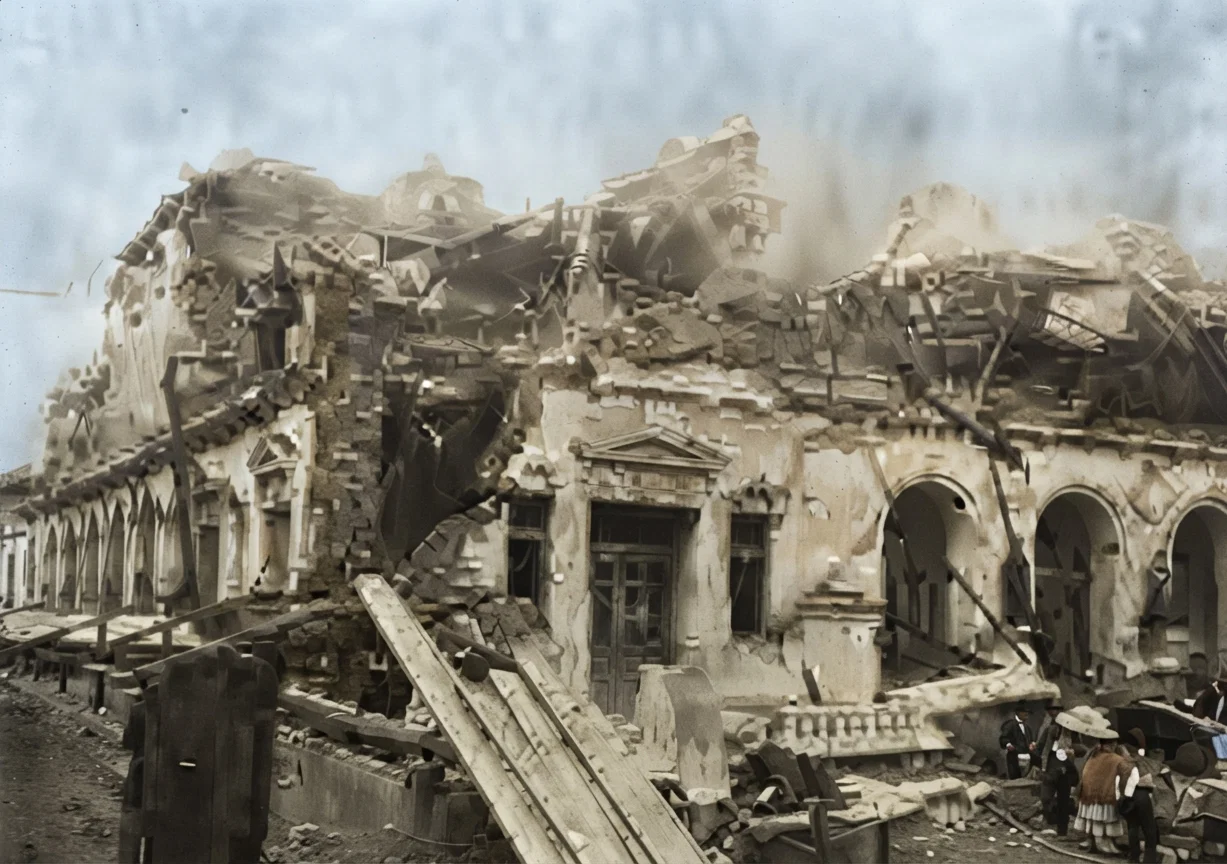
As I write this I can look out of the door and see the mountains covered with volcanic ash. About us we can see three volcanoes, two active and one silent, — I say silent, instead of extinct, for no one can say for a certainty that the inactivity will be for long.
After a South American Earthquake.
Nature in all parts of the world is too convulsed, and in too uncertain a state. The former two, Cotopaxi and Tunguragua, have thrown out so much ashes, sand, and lava during the last century and in previous ones that the neighboring districts are covered with it. Cotopaxi was in violent eruption in 1534. The Indians thought that nature fought against them, and gave up the struggle against the Spanish invaders. For two centuries it was quiet and then again broke forth. For twenty-six years it terrified the district about Quito. It sent out a rain of sand and ashes which covered vegetation, and lessened the fertility of the land. From 1870 to 1880 it was active again, and did considerable damage. Tunguragua was active also during the last century; Cotopaxi still belches forth smoke and often ashes and cinders, but there is another volcano, Sangay, further distant than Cotopaxi, more active, in fact, one of the volcanoes in most violent commotion in the whole world.
What a South American Earthquake Does.
Ecuador has had some violent earthquake shocks. Gonzalo Pizarro was frightened by an earthquake in 1541, as he was marching with his victorious army to Canelos, a city east of Quito in the Amazon Valley.
Quito was partially destroyed in 1587.
On Sept. 2, 1628, after another strong shock the municipal body elected Santa Teresa patroness of the city and special protectress against damage from earthquakes, but more disasters from this cause occurred, so that in 1651 the image of Nuestra Senora de Guadalupe (Our lady of Guadalupe) was publicly carried through the streets as was customary in times of calamity. However, earthquakes continued, and after these the people of Quito elected St. Michael, Archangel, also, as patron, thinking that the disasters would cease.
In 1660, the strongest shock yet felt occurred. The people seem to have lost a bit of their confidence in their images, for we hear of no new elections. In 1661 and 1662, the churches and edifices in Quito fell.
In 1678, another strong temblor occurred; in 1687, Ambato was stricken; in 1698, 6,500 people were buried in the ruins of Ambato, Latacunga, and Riobamba. In 1736, the churches of Latacunga were destroyed. Latacunga lies between Ambato and Quito.
In 1755, Quito experienced another earthquake shock; houses fell, and two years were required to rebuild the city.
In 1757, 400 persons perished in Latacunga.
In 1797, 4,000 people perished in Riobamba. Riobamba lies between Ambato and Guayaquil.
In 1859, Quito was ruined by an earthquake. The churches lost their towers, some of which have never been restored.
In 1868, August 15 and 16, occurred the greatest earthquake ever felt in Ecuador, a little to the north of Quito in the Provinces of Imbabura and Carchi. The president of the time, Garcia Moreno, places the number of deaths at from 15,000 to 20,000. The shock was felt in Guayaquil, but this city, altho experiencing many earthquakes, is to all appearances free from losses because the houses are, unlike the houses of the Sierra, of bamboo, plastered within and without, or of other kinds of wood.
In 1871, islands of from thirty to ninety feet in height appeared off the coast of Manabí.
In 1889, the coast rose in elevation, but little or no damage has been done by earthquake shocks alone along the coast. However, Guayaquil has had three disastrous fires, which destroyed the whole city, but its citizens, energetically, have built a new Guayaquil after each burning.
Hurricanes are rare in Ecuador. In 1877, occurred the last one of importance. They have occurred about once in thirty or forty years. As the banana and plantain have very shallow roots, and are planted in loose, moist soil, a strong wind would uproot all plants. As it is, they fall in some parts during a gentle breeze. The loss of these fruits would cause an economic revolution in the life of the people of the coast where the plantain and banana grow, as these fruits are the daily bread of the inhabitants of the lowlands as much as roasted barley flour is for the people of the mountains.
Only great calamities which personally affect them lead them to think more of the great day of wrath, and then, as a rule, they appeal to their images of the Virgin Mary, of Christ, of Joseph, or some other saint.
The Lord has spoken to this generation to repent, but few are accepting the solemn message of warning, and many, walking in their own lusts, are saying, "Where is the promise of His coming? For since the fathers fell asleep all things continue as they were."
DELWIN REES BUCKNER.
Persecution and Political Power
Every religious sect, however meek in its origin, commenced the work of persecution as soon as it acquired political power.—U. S. House of Representatives Report.
Liberty and Equal Justice
By Lord Mansfield
True liberty can exist only when justice is equally administered to all.—Lord Mansfield.
Uncertainty and Gloom.
By Editor
The noted writer, Max Norden, says:
"We seek in vain to-day among the rich a feeling of security in regard to their wealth and of simple enjoyment of it; neither do we find among the poor that patient acquiescence in the poverty which appears so inevitable and unchangeable to human eyes.
"An undefined fear of approaching danger haunts the man of wealth; he sees a menace in the present condition of men and affairs, indistinct but none the less real, so that he has come to look upon his possessions as a loan that can be demanded from him without reprieve, from one moment to another.
"The poor man is consumed by envy and greed of the wealth of the privileged few; neither in himself nor in the existing arrangement of the world and society, as he has learned to understand it, does he discover any convincing reasons for the fact that he is poor, and hence excluded from the table of life's pleasures. He listens with fierce impatience to a voice within him which whispers that his rights to the blessings of this life are as good as any man's.
"The rich man is dreading, the poor man is hoping and working to bring about a change in the present condition of property ownership. The faith in a continuance of its present state has been rudely shaken in the minds of all, even in those who will not acknowledge their secret doubts and anxieties.
"This universal mental restlessness and uneasiness exert a powerful and many-sided influence upon individual life. A dread of examining and comprehending the actualities of life prevails to a frightfully alarming extent, and manifests itself in a thousand ways. The means of sensation and perception are eagerly counterfeited by altering the nervous system by the use of stimulating or narcotic poisons of all kinds, manifesting thereby an instinctive aversion to the realities of appearances and circumstances. Individuals and society try to drown their sorrows in the flowing bowl, and hand in hand with this instinctive self-deception and attempt at temporary oblivion of the actual world goes the final plunge into eternal oblivion. Suicides are increasing in all the highly civilized countries."
It is all too true. Yet there is hope, told by "the old, old story," found in "the old, old Book." That hope is in Christ Jesus and the Gospel of God. It is an anchor which will hold in the roughest sea. It is a star which will shine brighter in the darkest gloom. It is a power which will strengthen the hearts to bear the worst of ills. It tunnels the dark river of death, and all earth's calamities, and emerges into immortality in the resurrection morning. Soul, that refuge and hope is for you.
Homicide in England and United States.
A Philadelphia paper remarks that the United States and England have exactly the same law on homicide, and that a judge in either country will charge on given facts almost the same thing; so that in theory and on the statute-books, human life has the same protection in both these English-speaking countries. Yet the English jury almost invariably convicts, while the American jury almost invariably tends to acquit, to disagree, or find a verdict for a minor grade of manslaughter wherever there are any conditions which confuse the main issue. The result is that among all lands England is one with the smallest number of homicides and the United States is one with the largest. Kentucky, for instance, has a larger proportion of violent deaths of men by the hands of their fellow men, than any country except Sicily; and parts of states, like some counties of Pennsylvania, have scores of homicides without a single conviction for murder in the first degree. It certainly is a strange comment on judicial procedure when such marked differences exist between two countries whose laws are so similar; that one should be almost without murders, and the other swarm with men who have taken the lives of their fellow men.
"Stupid Lutherans"—Revengeful Catholics.
By Editor
THE "Western Watchman," the editor of which is called the nestor of the Catholic press of the United States, has an article in its issue of November 19 entitled, "Those Stupid Lutherans." Five times in the article Protestants are called stupid; ignorance, bigotry, and hypocrisy are predicated of them; and they are called fools and knaves. Why?—Because they disagreed with President Roosevelt, who looks favorably upon a future Catholic President. The "Western Watchman" declares that Protestants would disfranchise every Roman Catholic to-day if they dared. Many would, doubtless. But that is not the point at issue. The closing paragraph of the article thus reads:
"This insult offered the Catholics of the United States by the Lutherans of the country will not be soon forgotten; and there are tens of thousands of Catholics who will record a vow never to vote for a Lutheran for office if he knows him to be such. And they are perfectly justified. No Lutheran should be allowed to hold office or vote in this country holding to such opinions as are expressed in this letter to Mr. Roosevelt. They are open and avowed enemies of the land and its institutions."
Now is not the REVENGEFULNESS of the "Western Watchman" as bad as the "STUPIDITY" it condemns? The matter between both of these classes is religious. Of course they do not agree. If each party is consistent to its faith they can not agree. And the trouble is not that they are disagreed in religion, but that they bring their religion into politics. No one can object to a Catholic or a Lutheran office-holder if he believes in the equal rights of men and leaves his religion outside of his political creed; if he but count all men equal before the law regardless of religion or non-religion.
Now if the Lutheran holds to religious liberty he will contend for the same rights for the Catholic which he demands for himself. If the Catholic believes in religious liberty he will contend as strenuously for the rights of his Lutheran neighbor, whatever that neighbor believes, as he will for himself. "Stupidity" and "bigotry" can never be cured by revenge. The "Western Watchman" justifies the Lutherans by its own position. Why not both espouse the cause of true civil and religious liberty?
The Jewish Council.
THE Philadelphia papers of January 20 and 21 give quite full accounts of the great Jewish Council which was held in that city. It was attended by leading rabbis and lay members from all parts of the country. Reviewing the thirty-five years' work in America, since the founding of the American Hebrew congregations, it was felt necessary to emphasize the need of a revival of Jewish traditions and of greater enthusiasm in instructing the younger generation. They deplored the fact that many Jews were allured by Christian Science teaching; that the only justification for the Jew in the world was in his religion; and that he ought to hold to that religion. But there was a protest against the teaching of religion in the public schools; that the Jew demanded his Constitutional right of freedom from such teaching; that the decision of the Supreme Court that this was a Christian nation, was not true; in fact, that a book ought to be prepared for general circulation showing that this is not a Christian nation. There was great division of opinion, however, upon this, and some thought it was speaking disrespectfully of the Supreme Court to in any wise antagonize the decision of 1892 written by Justice Brewer.
It was decided unanimously that indorsement should be given to a plan to conduct a campaign in every state of the Union to secure to the Hebrews the right to celebrate the seventh day of the week for worship, and keep their stores open on the first day of the week. Very loose ideas, however, in regard to this were presented. They ask the civil authorities to provide purely civic Sunday laws without mentioning any religious terms in them; just as tho that would alter the substance of the law. It was also thought best to publish some literature upon this, and unite with others who were opposed to religious legislation. One of the great difficulties with the Jews at the present time is that they have so little real conviction over the actual observance of the Sabbath itself, that their testimony or protest amounts to very little against Sunday legislation.
James Wilson’s Agricultural Service
By Editor
Mr. James Wilson, Secretary of Agriculture, has been for twelve years in the Cabinet. He is a Scotchman by birth. He has done most excellent work in his department, and we wish for the farmers' sake he might be retained.
Tennessee Has Voted Prohibition
Tennessee Has Voted Prohibition.—The governor has vetoed the bill, but the Legislature has passed it over his veto. The same issue came up in Washington in a bill to prohibit liquor-selling in the District of Columbia, but the House Committee killed it by a vote of 11 to 2.
Unemployment Hardship in Great Britain
It is said that there are seven million human beings in Great Britain who are suffering hardship now through unemployment. This is on the basis that every worker represents a family of five. The skilled workers unemployed number five hundred thousand, and unskilled, one million. This is surely a fearful condition, and how long will it be endured?
Sunday Law in Colorado
Colorado has a Sunday law, but the Colorado Springs Telegraph notes that at a recent Mercantile Association meeting, the convention voted for a more rigid enforcement of the Sunday-closing ordinances and asks the Legislature to pass a Sunday-closing law. That will ever be the case till the ideal Puritan law is reached. All the limited Sunday measures which are presented to our Legislatures are entering wedges simply.
International Prison Congress
By Editor
The International Prison Congress will meet in Washington in 1910; $50,000 appropriation has been asked of Congress in its behalf. Its deliberations next year will look toward prevention of crime, rather than to its punishment, to strike at the root of the growing tree among the juveniles. They have our sympathy. We wish their work might reach the fathers, mothers, and preachers.
Earthquake as Visitation from God
The Sacramento "Bee," referring to the recent terrible earthquake in Italy, states that "A man to-day who would deliberately declare the terrible slaughter of two hundred thousand souls to be a visitation from God would be viewed as a heathen rather than a Christian, and rightly so, too." And yet the Western Watchman, one of the ablest Catholic papers in the country, does not fear to declare that it is a visitation from God.