Your ShelfYour Projects

Signs of the Times, Vol. 36, No. 6.

The Love of God

Signs of the Times

Feb 10, 1909

Pacific Press Publishing Association · Mountain View, California · Feb 10, 1909

The Love of God

If I speak with the tongues of men and of angels, But have not Love, I am become sounding brass, or a clanging cymbal. And if I have the gift of prophecy, and know all mysteries and all knowledge; And if I have all faith, so as to remove mountains, But have not Love, I am nothing. And if I bestow all my goods to feed the poor, And if I give my body to be burned, But have not Love, It profiteth me nothing.
Love suffereth long, and is kind; Love envieth not; Love vaunteth not itself, Is not puffed up, Doth not behave itself unseemly, Seeketh not its own, Is not provoked, Taketh not account of evil; Rejoiceth not in unrighteousness, But rejoiceth with the truth; Beareth all things, Believeth all things, Hopeth all things, Endureth all things. Love never faileth:
But whether there be prophecies, they shall be done away; Whether there be tongues, they shall cease; Whether there be knowledge, it shall be done away. For we know in part, and we prophesy in part; But when that which is perfect is come, That which is in part shall be done away.
When I was a child, I spake as a child, I felt as a child, I thought as a child: Now that I am become a man, I have put away childish things. For now we see in a mirror, darkly; But then face to face: Now I know in part; But then shall I know fully even as also I was fully known.
But now abideth Faith, Hope, Love, These three; And the greatest of these is LOVE

2724.—The Law of God

[All proper questions on Bible and history will be answered on this page as soon as possible after receiving them. This will sometimes mean a month or more. We can not promise to reply to the same question often. Let those who ask read other answers; they may find reply to their own. Always enclose stamp if answer is required. Those outside our Bible Band, please enclose ten cents. This does not begin to meet expenses oftentimes. "Foolish . . . questions avoid."]

2724.—The Law of God.

Is the Law of God and Commandments of God one and the same? C. K.
They are many times. Sometimes God has given commandments which are purely ceremonial in their nature. These would not be considered, of course, as commandments of the moral law. The law of God includes in its wonderful scope all morality. The commandments of God may partake of the principles of the law. They may have to do with things which are purely local and ceremonial. Of course disobedience to such commands would involve moral principle. That is, disobedience would show that we dishonored God and had other gods before the Lord. In many cases in the Old Testament, especially in the Psalms, and the 119th psalm in particular, the term, "commandments" is used as a synonym of the law. The context will almost invariably tell us how much is comprehended in the word commandment.

2725.—A Present Hell.

Kindly explain Isa. 66:24, Mark 9:44, and Luke 16:24. These scriptures seem to indicate a place of burnings. C. K.
There is nothing necessarily in any of the texts which would indicate that there is such a place of burning now. In the New Testament the word "hell" comes, with one exception, from two different words—"Hades," the abode of the dead, both righteous and wicked, and "Gehenna," the future place of punishment of the wicked. "Gehenna" comes from the Hebrew words, "The valley of Hinnom," a place just outside of Jerusalem, where was cast all the offal of the city, together with the carcasses of malefactors who might be put to death. Upon all this refuse the worms constantly preyed, and what survived the worms was burned in order to avert pestilence. For this purpose constant fires were kept burning, even as the worms constantly preyed upon the refuse that was cast there. In this way Gehenna became the symbol of utter and complete destruction, and so Jesus uses it in Mark 9:44. You will note that the same figure is used in Isa. 66:24 where the righteous are represented as looking not upon the living wicked who are enduring torments, but upon the carcasses of those who had sinned against God. A carcass is a dead body.
The parable of the rich man and Lazarus in Luke 16 is too long for explanation in this department. Send for the tract, "Rich Man and Lazarus," Address publishers of this paper; price, single copy, two cents. The whole parable is not the history of some literal transaction, but a representation of other events which the tract fully explains.

2726.—How Long the Law?

In referring to Gal. 3:19, you say that the law was given because of transgression, till the Seed should come. The text does not read like that, but says it was added because of transgression. The added law was the ceremonial law, added because of the transgression of the moral law. M. H. P.
When was it added? Presumably our questioner would say at the time of the Exodus when the children of Israel came out of Egypt; but transgression carries us clear back to Adam. Was it not needed then just as much as later? It seems very clear to us that Gal. 3:19 is parallel with Rom. 5:20. The argument of the two books is the same. The great point which the apostle wishes to emphasize in both of the books is that we are justified by faith, not by the works of the law; therefore we read in Rom. 5:20: "And the law came in besides, that the trespass might abound."
Galatians says, "What then is the law? It was added because of transgressions, till the Seed should come." Are the texts not parallel, and do they not refer to the same thing? Man had fallen away so far from God's ideal that the law written in his heart had become so obliterated that it was necessary for God to place before His own children a written expression of His law—a standard by which they were to regulate their conceptions of duty—their conscience. We are expressly told that when He gave this law in its written form, He "added no more." Deut. 5:22. He therefore "added" the Ten Commandments in that written form to the conceptions of truth which the Israelites had before that time. The very Greek word which is used in Gal. 3:19 is also used in Heb. 12:19 where the children of Israel entreated that no word more should be spoken unto them. That is, no word more should be added. And so the Septuagint, or Greek translation of the Old Testament, uses the same word in Deut. 5:22; and until our Lord Jesus Christ shall come the second time, the Spirit of the Lord will use the law to point out sin and make it exceeding sinful.

2727.—Till the Times of the Gentiles Be Fulfilled.

Does Luke 21:24 teach us that the Jews shall return to Jerusalem after the time of the Gentiles is fulfilled? C. K.
No, it does not. It isn't speaking of the Jews returning to Jerusalem, but that Jerusalem shall be trodden down of the Gentiles, until the times of the Gentiles be fulfilled. That is, the nations which came in and possessed Jerusalem will hold it until the prophecies referring to Gentile dominion shall be accomplished. A parallel text to this, and one which will serve to explain it, is found in Ezekiel the 21st chapter, verse 26: "Remove the miter, and take off the crown; this shall be no more the same; exalt that which is low, and abase that which is high. I will overturn, overturn, overturn it: this also shall be no more, until He come whose right it is; and I will give it Him." Then the times of the Gentiles will be ended, and the Lord Jesus Christ shall take possession.

2728.—Provision for All.

Will any souls be lost who might have been saved had Christians put forth more effort? M. M.
We think there will be souls lost who might have been saved if effort and sacrifice had been put forth. It seems to us that this must be true for the following reasons. First, the offer of salvation is open to every soul upon earth, and God does not make this offer to tantalize poor sinners, but to bid them to hope that God's grace is sufficient to save any one whose sins may be scarlet and his iniquities crimson. For He is able to save to the uttermost all them that come unto God by Him. Therefore any one can be saved.
Secondly, we have no reason to believe otherwise than that thousands of children would have developed right character had they been saturated from the beginning with the great truths of God, as the Lord gave directions in Deuteronomy 6; but the parents failed, and the children developed characters of wickedness only, and were lost.
Thirdly, there are people that Christians are continually meeting with, who, if they had had a different example set before them, perhaps if a plea had been made to them at the right time, might have yielded to Christ, but the example was not set, the plea was not made, they hardened their heart against the Spirit of God and went on in their wickedness.
Now this does not mean that all did not have equal opportunity, for every soul is sometimes touched by the Spirit of God, and many do not yield to it. God did everything on His part. If human beings had been willing to sacrifice and labor, souls might have been won. We are told in the word of God that those who failed to warn souls of danger, the blood of the person thus perishing would be required at their hand. On the other hand, if the soul goes on in sin, every man must bear his own sin, because every one has light sufficient to guide him to the kingdom of God if he will but follow it—accept of it. And yet in all this God is just, as well as the Justifier of him that believeth in Jesus. We may not understand all the motives and ways, and whys and wherefores, and yet "God is no respecter of persons." If it were a matter of justice that He owed humanity, we could charge Him with the loss of souls, but never in justice does He save a soul, as regards the soul itself; but always in mercy. Justice would demand the destruction of every human being. God in His goodness offers mercy to all; but if men reject His mercy, they must die. And yet may it not be true that if there had been more of an exhibition of His wonderful love on the part of humans, some of the sinful of earth might have accepted of the offer of salvation which otherwise they passed by?
We are not discussing the theory of the question; that of itself alone may not profit, but we plead with our questioners so to live that they shall not be a stumbling-block to the wicked, but may be willing to buy up every opportunity of seeking to save the lost.

2729.—The Death of Judas.

The Scripture seems to give two different accounts of the death of Judas in Matt. 27:5 and Acts 1:18. C. K.
We think if our questioner will study the two accounts seriously he will find no contradiction between them. Each of them states what the other does not, and one of them goes farther than does the other. Matt. 27:5 simply declares that Judas hanged himself; while Acts 1:18 carries us farther than this, saying that "he fell headlong and burst asunder," etc. He probably hanged himself upon some steep declivity near Jerusalem, and it is very reasonable to believe that the rope, or cord, with which he hanged himself broke, and the consequences recorded in Acts 1:18 followed.

2730.—The Times of the Gentiles.

In the second chapter of Daniel, verse 44, it says, "In the days of these kings shall the God of heaven set up a kingdom, which shall never be destroyed." Would that indicate that these Gentile kingdoms would be in existence when the kingdom of God was being set up? Is there not a certain time allotted to Gentile rule, according to Luke 21:24? M. H. P.
Answering the last question first, there is a time allotted to Gentile rule, and that time began when the kingdom of Judah was overthrown and the kingdom of God upon earth was given into the hands of Gentile nations. Eze. 21:25 tells us that that condition of things will continue until He come whose right it is, then the kingdom will be given to Him. Regarding the first question, the language would not indicate that the setting up of the kingdom of Christ was a gradual process. In fact, the prophecy itself indicates otherwise, for the stone, the Messianic kingdom, smites the image on the feet, utterly destroys all earthly kingdoms, and takes the territory. What is meant by the 44th verse is that Christ's kingdom will not be set up in any of the other phases of earth rule, indicated by the metals in the image, but in the very last phase indicated by the mixture of iron and clay. There are no Christian nations, it is true, nor will there be till the Lord Jesus Christ shall reign from sea to sea and from the River to the ends of the earth.
No. 2731.—M. H. P.—Rev. 22:2, "the leaves of the tree were for the healing of the nations," in all probability refers to the nations of the saved which walk in the light of the city. The healing is the bringing back or the complete restoration to the glorious manhood which God placed here upon the earth. It would seem reasonable to believe that this might go on by gradual process; that men of little stature would, in partaking of the Tree of Life, be restored again to that full expression of human beauty designed of God in the beginning.

"Rejoice in the Lord Alway"

By Mrs. E. G. White
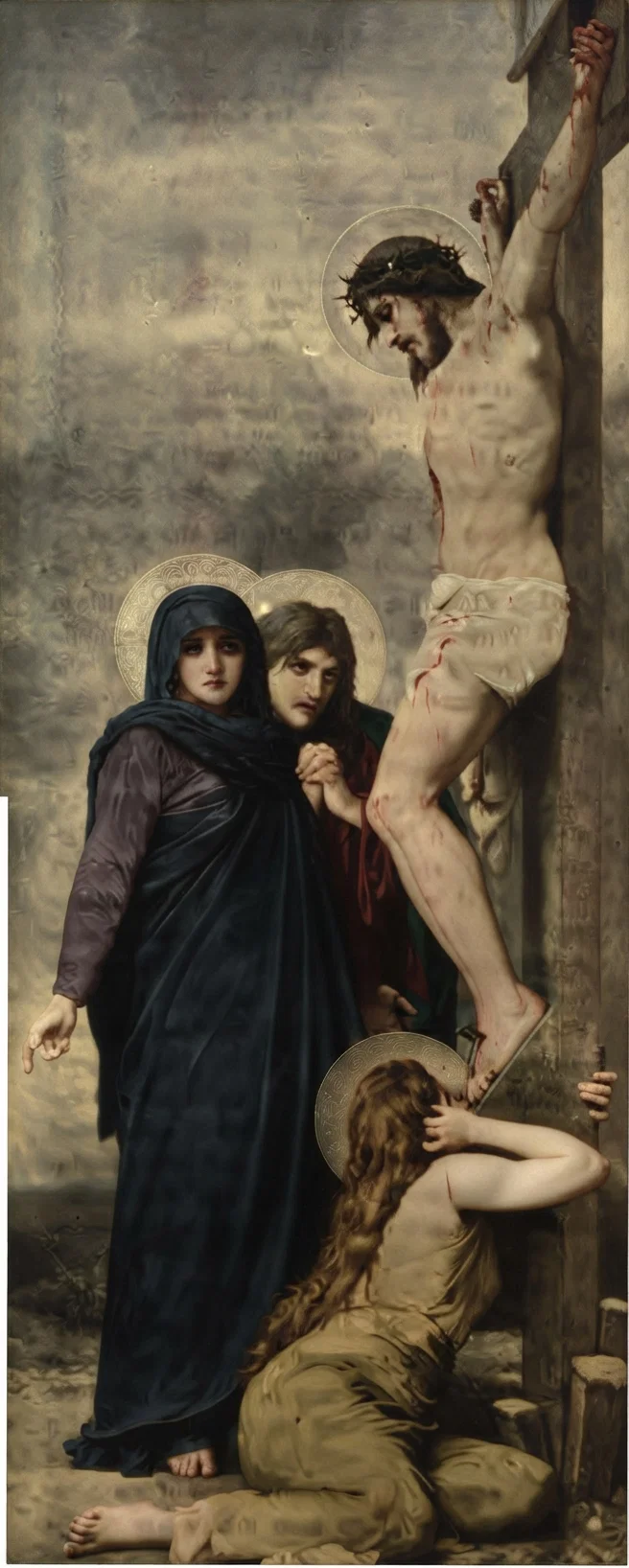
W. A. Bouguereau. THE CRUCIFIXION.
LIFE is disciplinary. While in the world, the Christian will meet with adverse influences. There will be provocations to test the temper; and it is by meeting these in a right spirit that the Christian graces are developed. The standard is high to which we must attain if we would be children of God, pure, holy, and undefiled; but how could we reach this standard if there were no difficulties to meet, no obstacles to surmount, nothing to develop patience and endurance? Trials are not the smallest blessings that come to us. They are designed to nerve us to determination to succeed. Instead of allowing them to hinder, oppress, and destroy us, we are to use them as God's means of enabling us to gain the victory over self.
Those who walk in wisdom's ways, even in tribulation, are exceedingly joyful; for He whom their soul loveth walks invisible beside them. At each upward step they discern more distinctly the touch of His hand; brighter gleamings of glory from the Unseen fall upon their paths; and their songs of praise, reaching ever a note higher, ascend to join the songs of the angels before the throne. "The path of the righteous is as the light of dawn, that shineth more and more unto the perfect day."

Talk Faith.

It is the duty of the children of God to talk faith, and not doubt. They are to be hopeful and cheerful in Him. Christ accomplishes our salvation by inspiring faith in our hearts and a belief in the truth. The truth makes free; and those whom the Son makes free are free indeed. God's children should honor Him by revealing a constantly increasing confidence in the assurance that He will accept every soul who serves Him in sincerity.
The Lord would have us take comfort in His promises, and praise Him much more than we do. He would have us cultivate the heart's best affection. Let the voice of thanksgiving and praise be heard in an acknowledgment of the grace of Christ vouchsafed to us. Render to the Lord the fruit of the lips. We are not as faithful as we should be in acknowledging the goodness and blessings of God. "Whosoever offereth praise glorifieth God."
When we are in perplexity and trouble we would do well to consider how much our salvation cost the God of heaven. "God so loved the world that He gave His only-begotten Son, that whosoever believeth in Him should not perish, but have everlasting life." We would do well to make an earnest study of the life of Christ. The only-begotten Son of God consented to leave the heavenly courts, and come to live with an ungrateful people who refused His gracious mercies. He consented to live a life of poverty and to endure suffering and temptation. Let us consider what Christ has endured to make our salvation possible. This will hush every murmur and complaint. If we teach our hearts to respond to God's love, our voices will ascend in thanksgiving when we are called to suffer in any way for Him who gave His life for us.
Christ was a man of sorrows, yet He had peculiar joys—joys that did not spring from earth, but were born of His connection with divinity. He is the Saviour of those who are perishing for lack of His life. He desires to make them partakers of the divine nature, and thus escape the corruption that is in the world through lust. Amid perplexities and distresses the believing soul may have the assurance of sonship with God. Looking to Jesus, he learns how to conduct himself under every circumstance. He has the experience of Christ to guide him, and the consolation of Christ to sustain him.

A Joyful Life.

The Lord does not desire His people to be sad and disconsolate. He does not want His obedient followers to cover the altar with their tears, but to walk happily and cheerfully along. "In the world ye shall have tribulation," He says, "but in Me ye shall have peace." "Peace I leave with you; My peace I give unto you; not as the world giveth, give I unto you." "These things have I spoken unto you that My joy might remain in you, and that your joy might be full."

A Heavenly Reward.

While the people are looking for earthly good, Jesus points them to a heavenly reward. But He does not place it all in the future life; it begins here. The Lord appeared of old to Abraham, and said, "I am thy shield, and thy exceeding great reward." This is the reward of all who follow Christ. Jehovah Emmanuel—He "in whom are hid all the treasures of wisdom and knowledge," in whom dwells "all the fulness of the Godhead bodily"—to be brought into sympathy with Him, to know Him, to possess Him, as the heart opens more and more to receive His attributes; to know His love and power, to possess the unsearchable riches of Christ, to comprehend more and more "what is the breadth, and length, and depth, andheight; and to know the love of Christ, which passeth knowledge, that ye might be filled with all the fulness of God,"—"this is the heritage of the servants of the Lord, and their righteousness is of Me, saith the Lord."
It was this joy that filled the hearts of Paul and Silas when they prayed and sang praises to God at midnight in the Philippian dungeon. Christ was beside them there, and the light of His presence irradiated the gloom with the glory of the courts above. From Rome, Paul wrote, unmindful of his fetters, as he saw the spread of the Gospel, "I therein do rejoice, yea, and will rejoice." And the very words of Christ upon the mount are reechoed in Paul's message to the Philippian church, in the midst of their persecutions, "Rejoice in the Lord alway; and again I say, Rejoice."

Tell of His Wisdom, Love, and Power.

We are not only to contemplate the glory of Christ, but also to speak of His excellencies. Isaiah not only beheld the glory of Christ, but he also spoke of Him. While David mused, the fire burned; then spoke he with his tongue. While he mused upon the wondrous love of God, he could not but speak of that which he saw and felt. Who can by faith behold the wonderful plan of redemption, the glory of the only-begotten Son of God, and not speak of it? Who can contemplate the unfathomable love that was manifested upon the cross of Calvary in the death of Christ, that we might not perish, but have everlasting life—who can behold this, and have no words with which to extol the Saviour's glory?
Christ accepts, O so gladly, every human agency that is surrendered to Him. He brings the human into union with the divine, that He may communicate to the world the mysteries of incarnate love. Talk it, pray it, sing it; proclaim abroad the message of His glory, and keep pressing onward to the regions beyond.
Trials patiently borne, blessings gratefully received, temptations manfully resisted, meekness, kindness, mercy, and love habitually revealed, are the lights that shine forth in the character in contrast with the darkness of the selfish heart, into which the light of life has never shone.

The Basis of Law

By G. D. Ballou

Fundamental Propositions.

THOSE who are in a habit of doing a little thinking for themselves will, I believe, appreciate a close view of the origin of law and be better able to appreciate the true character of some laws that are now upon the statute-books of various states. Seeing this, they will know better what position to take in regard to similar laws for which loud clamoring is being made in certain quarters.
To get right at the point, every man has a civil right to defend his life and property and the chastity of his family. In other words, he has the power of command over these things and some others. He may defend the life and property and chastity of any member of society; and if he takes life in the defense, he is exonerated from all blame by the civil authorities. Now when the citizen of a representative democracy or republic votes for a man to represent him in the halls of legislation, he delegates to his representative just those rights and civil powers which he himself possesses, and which he may himself exercise in cases of emergency, and he can delegate no others. So this representative goes to the halls of legislation with the delegated authority of his constituents to make laws in those matters concerning which each voter had personal power and authority to act for himself. When all these legislators representing the entire state assemble, they simply give authoritative expression as an organized assembly to those personal rights which existed in each citizen of the body politic as an inherent birthright. No one can fail to see the truthfulness of the foregoing propositions.
Now take another point. Not one of these citizens aforesaid has any authority whatever to command any of his fellow men with regard to the use of any portion of his time. He may not command his neighbor to sleep eight hours in twenty-four nor to rest one day in seven. It is simply none of his business how his fellow man makes use of his time.

The Application of Principle.

Hence in the matter of Sunday-rest legislation he has no authority whatever to delegate to his representative. Does this need repeating for emphasis? If so, read it again, and then ask yourself whence the legislators would derive authority enabling them to make Sunday laws.
The people have authority to delegate where they have personal rights; but here on this point having no personal rights and no authority to delegate, it leaves the legislature where, if it acts at all in this matter, it must act on usurped authority; for it has no other authority on which to act. This has ever been true of all religious legislation.
Religious zealots have influenced kings and other lawmakers to assume this authority to themselves. Even thus it is to-day and thus it will be until the King of Kings brings in the better day.
If you wish to see the iniquity of personal assumption in this matter, consider the contrast in the following illustrations.

Examples.

A man on returning to his home finds a fellow putting fire to the buildings. He commands him to desist, but the incendiary pays no attention. Exasperated beyond measure he shoots the villain down. If called to account, the court would exonerate the man from all blame in the matter. But suppose the same man to be a zealous National Reformer. He sees a neighbor laboring in a field adjoining his house on Sunday. Exceedingly offended he goes out and commands him to desist. But the neighbor, feeling he has a perfect right in this matter, continues to labor on as tho the command had not been issued, with the result that the exasperated one shoots him down as he did the incendiary. Now will the court clear him of the charge of murder?—Surely not. And why not?—Because what his neighbor did on Sunday was none of his personal business; so long as the neighbor did not physically disturb his worship. He was usurping authority which did not belong to him.
Let the points be made plain and kept before the people, that the citizen can not delegate authority which he does not possess; that he possesses no authority to command Sunday observance; and that hence legislators which make Sunday laws must do it by usurped authority.
Los Angeles, Cal., Jan. 15, 1909.

"Seek Ye the Truth."

ERROR abounds on every side. In the very least things of life, men are dishonest, and untrue, and untruthful. The "father of lies" has inspired the whole world with his spirit of deception. Yet in the midst of all this wickedness, there comes the call, "Seek ye the truth." Men of the world, the wickedness about us is not all there is. There is truth, for the word of God admonishes us to seek for it. As a treasure hidden deep in the darkness of the mine, it must be sought for. It does not come naturally, for the prince of this world has well-nigh universal control, and his constant purpose is to cover the truth from men. Therefore the word is to "seek." Little comes to the man who makes no effort; and those who succeed best are those who are the most strenuous. H.

The Coming of the King.

By E. Guy Talbott.
SOUND the trump, proclaim glad cheer; Shout hosannas, praises sing; Prepare, ye nations far and near, For the coming of the King.
Cry aloud the Saviour's name, Let all voices loudly ring; Let all people now exclaim: " 'Tis the coming of the King! "
O, what sorrow here on earth, For all who our Lord disdain; Evermore to suffer death, At the coming of the King.
O what joy will surely come To the faithful as they sing: "Glory, glory to the Lamb; Hallelujah! Christ is King!"

Early Instruction for the Young

LIFE, even at the outset, is full of temptations and dangers, which, to be met and avoided, requires instruction and warning. Far, far better that this instruction should reach the boy and girl early in life, from the lips of the wise and loving parent or teacher, than from the loose tongues of playmates, servants, or business acquaintances. Such knowledge must come to every young person, sooner or later, then let it come from the God-given source — the parent — and let it come early enough to forestall all the temptation and danger.
Continue reading: The Word of Prophecy