[This article on Daniel 7 is complete in three issues. We ask our readers to compare its symbols and predictions with history and fact.—EDITOR.]
It was Nebuchadnezzar, a heathen, who had the first dream. None, therefore, could say that the prophetic dreams of this book began in the religious excitement of a Jewish believer. The next dream was given to Daniel. Nebuchadnezzar's vision was introductory; its development was found in the vision of Daniel. The dream of chapter two dealt with metals; these, however, were little adapted to express many important movements running along with this line of history. In Daniel's vision of chapter 7, new features of these events are brought out by new symbols.
"In the first year of Belshazzar, king of Babylon, Daniel had a dream and visions of his head upon his bed; then he wrote the dream, and told the sum of the matters. Daniel spake and said, I saw in my vision by night, and, behold, the four winds of the heaven strove upon the great sea."
The "great sea" represents humanity. "And He saith unto me, The waters which thou sawest . . . are peoples, and multitudes, and nations, and tongues." Rev. 17:15. God lifts Daniel up to a high viewpoint and lets him see the forces which play upon humanity. Men are swayed by the fire of ambition and driven by the storms of war. The Scriptures use the winds as a fitting figure to represent the strife between nations. "And upon Elam will I bring the four winds from the four quarters of heaven. . . . For I will cause Elam to be dismayed before their enemies." Jer. 49:36, 37.
As Daniel gazed upon the nations in tumult, he beheld arise one after another the successive empires of history.
"And four great beasts came up from the sea diverse one from another."
Like the wild quadrupeds of mountain and jungle, the bellicose nations of earth prey upon each other. Unwittingly, man has, like God, chosen the same symbols to represent martial governments. We hear to-day of the lion of England, the bear of Russia, and of the American eagle. A glance thrown upon the postage-stamps of the different nations, upon the coins or on the national flags, will discover these different creatures, whether bird or beast, which have been selected to mirror the intended characteristics of the pictured country.
Babylon.
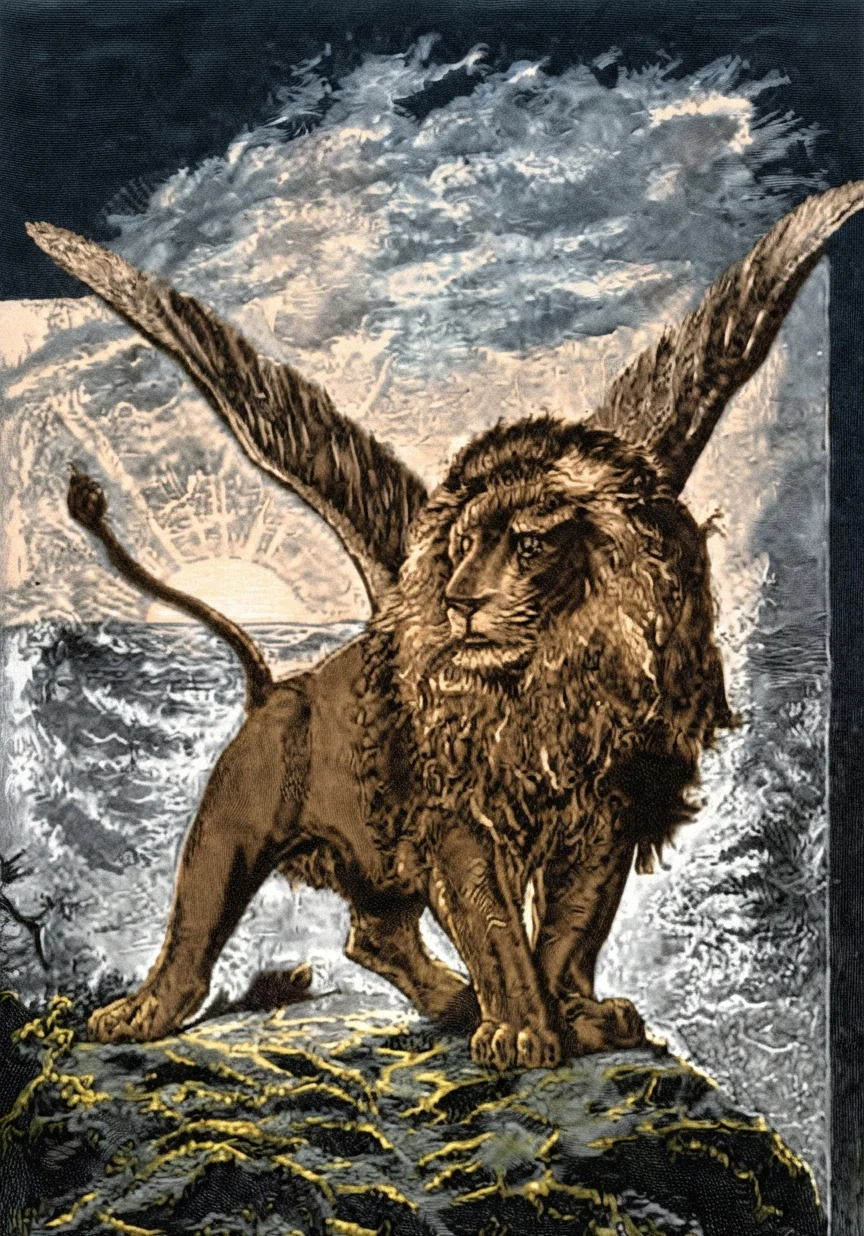
As the head of gold was made from the king of metals, so the king of beasts is the first animal which Daniel sees arise.
"The first was like a lion, and had eagle's wings: I beheld till the wings thereof were plucked, and it was lifted up from the earth, and made stand upon the feet as a man, and a man's heart was given to it."
By consulting further the Bible we find that the empire of Babylon is many times brought before us under the figure of a lion. "The lion," says Jeremiah, announcing the invasion of the Babylonians, "is come up from his thicket, and the destroyer of the Gentiles is on his way." The ancient palaces of these kings had their entrances flanked by the massive stone figures of winged lions; these have been brought to light by the excavator's spade. The eagle's wings denote the rapidity of Babylon's conquests. But Daniel lived to see the wings plucked when he beheld the conquering spirit of Nebuchadnezzar's successors diminish and their armies turn back before their enemies. The fearless heart of the conquering lion underwent a change: the heart of man, naturally weak when unsustained by God, as was Belshazzar on the night of his impious feast, supplanted the other. The lion stays his marauding and rises upon its feet as a man.
Media-Persia.
The kingdom of Babylon, however, fulfilled its mission. It had torn God's people. Led on by the Most High, it had given Israel a wholesome punishment. The Jews henceforth were the sworn enemies of idolatry. Another nation was already in sight to carry further the plans of the Eternal.
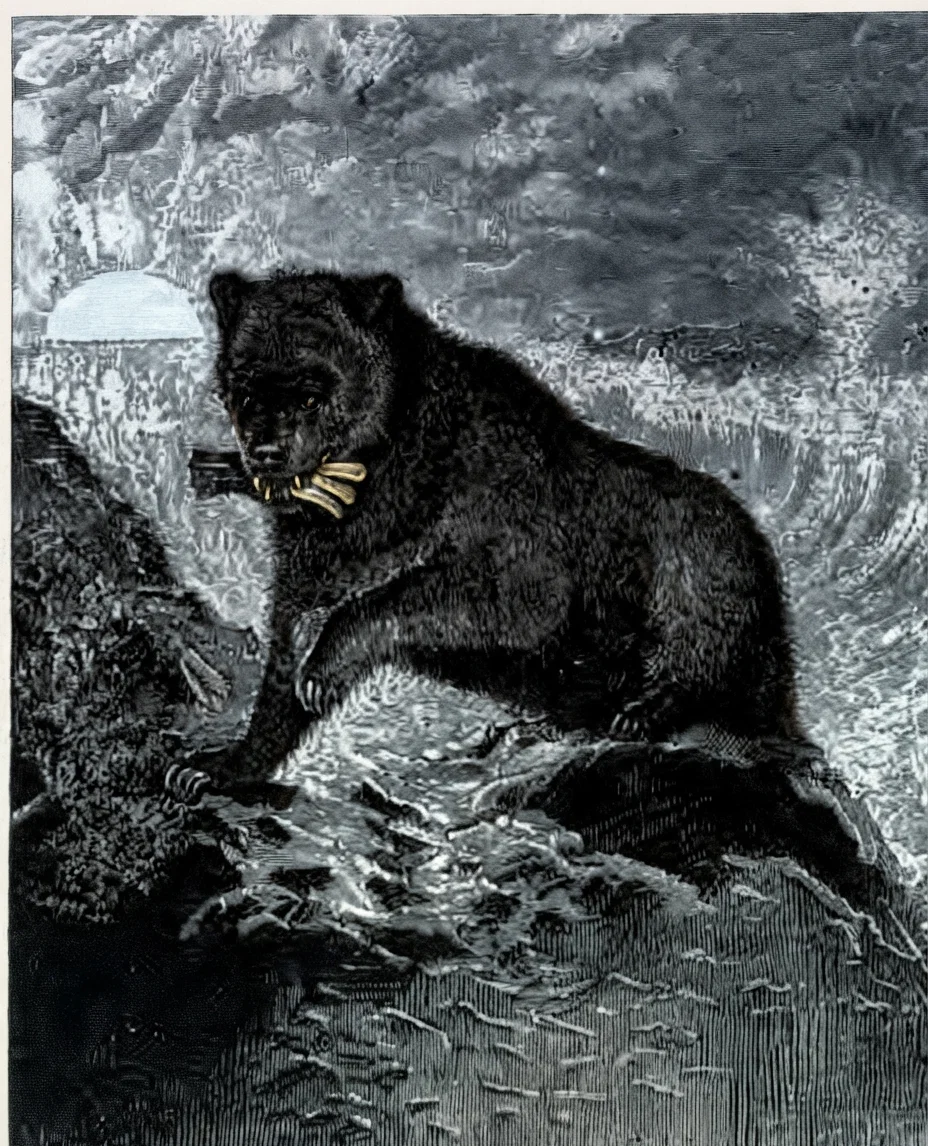
"And behold another beast, a second, like to a bear, and it raised up itself on one side, and it had three ribs in the mouth of it between the teeth of it; and they said thus unto it, Arise, devour much flesh."
The bear-like beast, which now appeared in sight, was the Medo-Persian kingdom. That it raised itself up on one side was due to the fact that the Medes were, first, the more prominent of two; later, however, under Cyrus the Great (538-529 B.C.) the Persians secured and held the leading place. Under him and his active son, Cambyses (529-522 B.C.), three great nations—the three ribs in the mouth of the bear—Babylon, Lydia, and Egypt, were successively conquered. The Persians were led to believe that their arms were irresistible, and the spirit of conquest kept saying, "Arise, devour much flesh."
But riches came in. The Persians were led, as is given in Daniel, chapter 11, to trust no longer in God, but in their riches.
Greece.
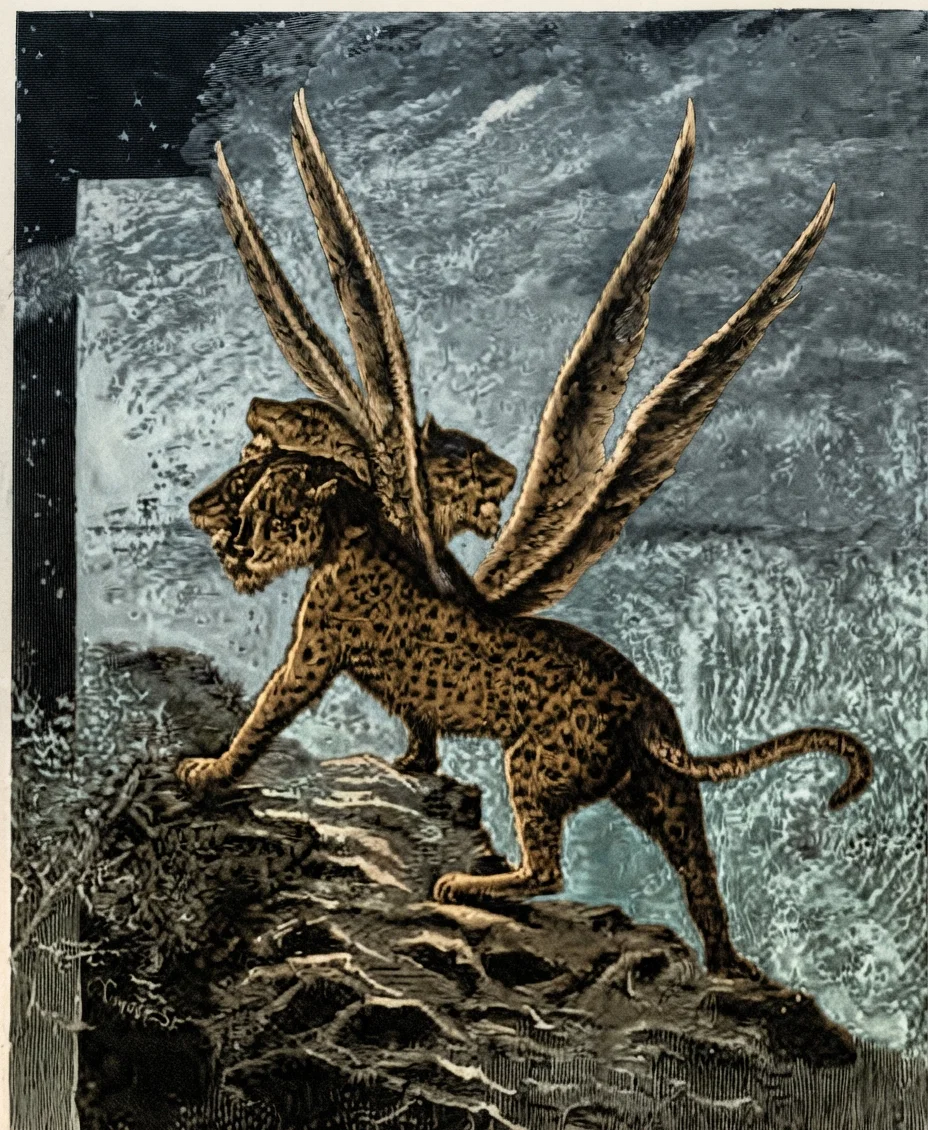
"After this I beheld, and lo another, like a leopard, which had upon the back of it four wings of a fowl; the beast had also four heads; and dominion was given to it."
Lighter afflictions failing to reform the Israelites, God brought upon them a heavier one. The rough handling by the bear was followed by the attacks of the leopard, or Greece. "The children also of Judah and the children of Jerusalem have ye sold unto the Grecians, that ye might remove them far from their border," cried Joel against Tyre and Sidon. Removed far from their native land and often treated as slaves, the Jews remembered the prosperity of the days when they walked in God's commandments. Their conquerors, the Grecians, scattered them widely over the earth, for the conquests of the Greek were wide. The four heads on the leopard represent the four generals to whom fell the great empire of that conqueror, in 301 B.C. Cassander received Greece and Macedon; Lysimachus, Thrace and Asia Minor; Seleucus, Syria and the East; and Ptolemy, Egypt.
Thus wonderfully do the records of man write afterwards the history which the record of God has written before. The dominion of the leopard ran the course foretold of it by God's word.6
Rome.
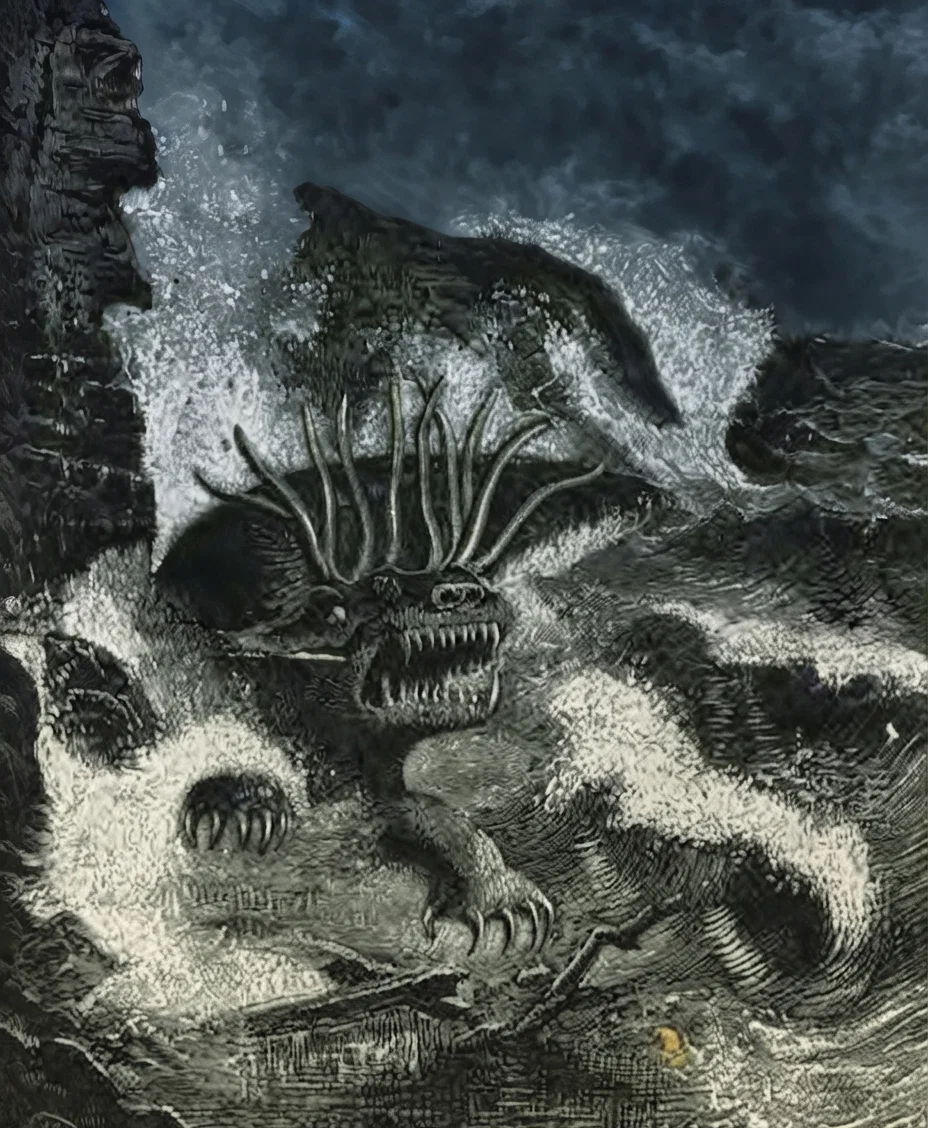
"After this I saw in the night visions, and behold a fourth beast, dreadful and terrible, and strong exceedingly; and it had great iron teeth: it devoured and brake in pieces, and stamped the residue with the feet of it: and it was diverse from all the beasts that were before it; and it had ten horns." Interpretation: "Thus he said, The fourth beast shall be the fourth kingdom upon earth, which shall be diverse from all kingdoms, and shall devour the whole earth, and shall tread it down, and break it in pieces."
If the Jews had found a master in the Grecians, in the Romans they found a more terrible one. The Roman Empire was the great leveler. So constantly had the Roman people under the Republic been engaged in war, that, during the space of about 475 years, the temple of Janus, whose gates were open in war and closed in peace, had been shut only twice. During the reign of Augustus, however, the whole world slept in peace. As the prophet had foreseen, Rome had trodden down all nations and had brought them into subjection. This was true not only physically, but also religiously. "During the whole duration of the Roman domination," says Gaston Boissier in his "La Fin du Paganisme," Vol. I, "I see not a single wise man, were he a skeptic like Pliny the Elder, or a freethinker devoid of all prejudices like Seneca, an honest and gentle philosopher like Marcus Aurelius, who appeared to have suspected that equal rights might be granted to all the religions of the Empire." (See Baron Pierre de Coubertin, in his "Evolution of France," page 305.)
(Continued next week.)
God, the Father, Revealing Himself
By T. E. Bowen
By T. E. Bowen
THE nature of truth is to make manifest. There is a definiteness and surety in truth that is an anchor to the soul. Upon truth the heart can securely rest. Error seeks to enshroud itself in mysticism and uncertainty.
Some people prefer to think of God as some spiritual nonentity wholly incomprehensible or undefinable. While it is true, finite minds can never comprehend the infinity of the power of the Creator, still it has pleased the Father to reveal Himself sufficiently to satisfy the heart of His children, and that which He has deemed wise to reveal is for us and our children to know; and to study these truths is not prying into secrets we should not know.
The infinite Creator has enshrouded Himself with glory unfathomable. No man can look upon this glory and live. The works of God seen in creation reveal His power, but disclose no clue as to His personality. Only in one way has He chosen to set before us this truth, and this is made manifest in the revealing of His Son. In Heb. 1:1-3 it is clearly stated that the Son, sent forth by the Father to represent Him in our fallen world, was manifested in the "express image of His [the Father's] person." The American Revised Version reads, "The very image of His substance." Rotherham's translation renders it, "An exact representation of His very being." This leaves no one in uncertainty. When those who saw Jesus were privileged to look into His face and converse with Him as friend does with friend, they saw one who in glory was an exact likeness of the invisible and unrevealed Father in heaven. Any other view can do nothing less than render the above words meaningless.
Philip desired to see the Father, little thinking that, should his request be granted, it would mean his instant death. Jesus replied: "Have I been so long time with you, and yet hast thou not known Me, Philip? He that hath seen Me hath seen the Father: and how sayest thou then, Show us the Father?"
For the very purpose of revealing the Father, both in character and personality, Jesus had been earnestly giving His life, and for Philip to ask this question near the close of His work revealed that so far as he was concerned he had grasped but little of the real mission of the Son of God. And this was true of all the disciples. The enemy was constantly working with them to dull their comprehension, and thus thwart the purpose of Christ in presenting clearly to their minds the relation they sustained to heaven and the Father's purposes concerning them. For this reason Jesus could not tell them then many things He desired that they should know.
They had walked with, talked to, and touched the only-begotten Son of the invisible God, yet they had but dimly comprehended who He was, and the import of His being revealed. "When on the day of Pentecost the Holy Spirit was poured out upon the disciples, they understood the truths that Christ had spoken in parables. The teachings that had been mysteries to them were made clear. The understanding that came to them with the outpouring of the Spirit made them ashamed of their fanciful theories. Their suppositions and interpretations were foolishness, when compared with the knowledge of heavenly things which they now received."7
"As a personal being, God has revealed Himself in His Son. 'Jesus, the outshining of the Father's glory, and the express image of His person,' was on earth found in fashion as a man. As a personal Saviour [both a Saviour to each of us personally, as well as Himself having a person], He came to the world. As a personal Saviour, He intercedes in the heavenly courts. Before the throne of God in our behalf ministers 'One like unto the Son of Man.' Christ, the Light of the world, veiled the dazzling splendor of His divinity and came to live as a man among men, that they might, without being consumed, become acquainted with their Creator. No man has seen God at any time, except as He is revealed through Christ."
It may help some to see this vital truth, — for if Satan can becloud the mind as to the personality of God, he has gained a tremendous victory in his game of life which he is playing for every soul, — to sensibly ponder that just as soon as the Son of God finished His ministration on earth among men, He no longer concealed His divinity by laying aside His divine glory. The same glory He had before He came as a babe in Bethlehem's manger, the Father bestows upon Him again. The glory enshrouding His person is, expressing it in our own words, more natural than the manner in which He lived during His stay among men. To come close to us, He must lay the glory all aside. So He prayed that last night He was with His disciples, "And now, O Father, glorify Thou Me with Thine own self with the glory which I had with Thee before the world was;" and again, "Father, I will that they also, whom Thou hast given Me, be with Me where I am; that they may behold My glory, which Thou hast given Me: for Thou lovedst Me before the foundation of the world." John 17: 5, 24.
Please note that while He was on earth they had not seen the glory, but had beheld His person, excepting at the transfiguration scene. He would still be in heaven the same Jesus (Acts 1:11) they had seen and learned to love, but there they were to behold His glory which they here could not behold and live.
That you may see the truthfulness of all this, we have but to refer to Paul's personal experience with Jesus very soon after the resurrection. Paul, in describing this scene to King Agrippa, said: "Whereupon as I journeyed to Damascus with the authority and commission of the chief priests, at midday, O king, I saw on the way a light from heaven, above the brightness of the sun, shining round about me and them that journeyed with me. And when we were all fallen to the earth, I heard a voice saying unto me in the Hebrew language, Saul, Saul, why persecutest thou Me? It is hard for thee to kick against the goad. And I said, Who art Thou, Lord? And the Lord said, I am Jesus, whom thou persecutest."
Here Jesus revealed His glory to one of our race, Saul, the young persecuting Pharisee. This glory caused them all to fall prostrate to the earth. This glory was brighter than the sun at midday — so much brighter that Saul was made blind, and was restored to sight only by Christ's miracle-working power manifested through the church. And this was Jesus, the same personal Saviour who had been manifested among men in loving ministry so long that He had become one common among men. He passed for the carpenter's son of Nazareth, whose earthly brothers were known, and who, because of His persistent saying that He was the Son of God, was condemned to death as a blasphemer.
"But," says one, "while I can see all this regarding the Son, yet what bearing has this upon the personality of the invisible Jehovah?" It certainly has all the answer that it has pleased the Father to make known. And here we rest. In sending us His Son, the Father revealed Himself. This is precisely what Jesus Himself said to Philip in answer to the direct request "Show us the Father" — "He that hath seen Me hath seen the Father."
There was no salvation in simply seeing Jesus. It was the divine fulness of knowing God, of entering into His divine purposes, and of yielding our lives and wills to Him, that Jesus came to make known to us. Yet in it all He sets forth something tangible and real, so that His followers are not left in uncertainty as to His Father in heaven. He revealed Him as full of compassion and love, and equally interested in the human race as He had manifested Himself to be by His own life of unselfish service.
It may be urged that Jesus said, "God is a Spirit: and they that worship Him must worship Him in spirit and in truth." Very true; but this does not do away with the personality of God. Jesus permitted Himself to be worshiped. In fact, it was proper that He should be worshiped; for the Father had proclaimed when the Son was born, "Let all the angels of God worship Him." The Son, then, being Himself God equal with the Father (altho subject to Him and to be worshiped) was, and is, as much a spirit as the Father Himself. "The last Adam became a life-giving Spirit" 1 Cor. 15: 45
And let it not be forgotten that this same Jesus, who here after His resurrection was showing to His astonished disciples that it was He Himself who had appeared to them, is the same Jesus who appeared to Paul at noontide clothed in dazzling brightness above that of the sun.
In these simple truths the Father has been pleased to reveal Himself through His Son to men. Let us not permit the enemy to throw us into uncertainty over plainly revealed truth which God has been pleased to make known regarding Himself, neither to yield to Satan's temptation to seek to pry into secrets which God in His wisdom has not unfolded. "Man can not by searching find out God. Let none seek with presumptuous hand to lift the veil that conceals His glory. 'Unsearchable are His judgments, and His ways past finding out.' It is proof of His mercy that there is the hiding of His power; for to lift the veil that conceals the divine presence is death.
No mortal mind can penetrate the secrecy in which the mighty One dwells and works. Only that which He sees fit to reveal, can we comprehend of Him. Reason must acknowledge an authority superior to itself. Heart and intellect must bow to the great I AM."
HE who would do some great thing in this short life must apply himself to the work with such a concentration of his forces as, to idle spectators who live only to amuse themselves, looks like insanity. — Foster.
"REMORSE is the echo of a slaughtered joy."
Napoleon’s Secret of Success
By Horace Bushnell
NAPOLEON was the most effective man in modern times — some will say of all times. The secret of his character was, that while his plans were more vast, more various, and, of course, more difficult, than those of other men, he had the talent at the same time, to fill them up with perfect promptness and precision, in every particular of execution. — Horace Bushnell.
Action, Not Thought
By Thomas Carlyle
THE end of man is an action, and not a thought, though it were the noblest.— Thomas Carlyle.
Our Bible Reading
By H.
The Second Advent and the Reward of God's Children.
1. What is the will of Christ concerning His followers?
"Father, I desire that they also whom Thou hast given Me BE WITH ME WHERE I AM, that they may behold My glory, which Thou hast given Me." John 17: 24.
2. On what condition will this be?
"If any man serve Me, LET HIM FOLLOW ME; and where I am, there shall also My servant be." John 12: 26.
3. What promise did He make to His disciples on this point?
"I WILL COME AGAIN, AND RECEIVE YOU UNTO MYSELF; that where I am, there ye may be also." John 14: 3.
4. How will His coming be?
"Behold, HE COMETH WITH THE CLOUDS, and every eye shall see Him." Rev. 1: 7.
"THE LORD HIMSELF SHALL DESCEND FROM HEAVEN, with a shout, with the voice of the Archangel, and with the trump of God." 1 Thess. 4: 16.
"As the LIGHTNING COMETH forth from the east, and is seen even unto the west; SO SHALL BE THE COMING of the Son of Man." Matt. 24: 27.
5. What will Christ bestow upon His people at His coming?
"Let not your heart be troubled: believe in God, believe also in Me. In My Father's house ARE MANY MANSIONS; if it were not so, I would have told you; for I go to prepare a place for you. And if I go and prepare A PLACE FOR YOU, I come again, and will RECEIVE YOU UNTO MYSELF; that where I am, there ye may be also." John 14: 1-3.
6. What takes place at His coming?
"For this we say unto you by the word of the Lord, that we that are alive, that are left unto the coming of the Lord, shall in no wise precede them that are fallen asleep. For the Lord Himself shall descend from heaven, with a shout, with the voice of the Archangel, and with the trump of God: and THE DEAD IN CHRIST SHALL RISE first; then WE THAT ARE ALIVE, that are left, SHALL TOGETHER WITH THEM BE CAUGHT UP IN THE CLOUDS, to meet the Lord in the air; and so shall we ever be with the Lord." 1 Thess. 4: 15-17.
7. How is this same event elsewhere expressed by the apostle?
"Behold, I tell you a mystery: we all shall not sleep, but we [the children of God] SHALL ALL BE CHANGED, in a moment, in the twinkling of an eye, at the last trump: for the trumpet shall sound, and THE DEAD SHALL BE RAISED INCORRUPTIBLE, and WE SHALL BE CHANGED. For this CORRUPTIBLE must put on INCORRUPTION, and this MORTAL must put on IMMORTALITY. But when this corruptible shall have put on incorruption, and this mortal shall have put on immortality, then shall come to pass the saying that is written, DEATH IS SWALLOWED UP IN VICTORY. O death, where is thy victory? O death, where is thy sting?" 1 Cor. 15: 51-55.
8. What did Jesus Himself promise?
"THOU SHALL BE RECOMPENSED IN THE RESURRECTION OF THE JUST."
9. What will His messengers then do?
"And He shall SEND FORTH HIS ANGELS with a great sound of a trumpet, and THEY SHALL GATHER TOGETHER HIS ELECT from the four winds, from one end of heaven to the other." Matt. 24: 31.
10. In the prophetic history of the world as given by Daniel, what takes place at Christ's coming?
"The SAINTS OF THE MOST HIGH shall receive the KINGDOM, and POSSESS THE KINGDOM FOREVER, even forever and ever." "The KINGDOM and the DOMINION, and the greatness of the kingdoms UNDER THE WHOLE HEAVEN, shall be given to THE PEOPLE OF THE SAINTS OF THE MOST HIGH: His kingdom is an everlasting kingdom, and all dominions shall serve and obey Him." Dan. 7: 18, 27.
11. What welcome words will be said to the faithful?
"Then shall the King say unto them on His right hand, Come ye blessed of My Father, INHERIT THE KINGDOM PREPARED FOR YOU FROM THE FOUNDATION OF THE WORLD." Matt. 25: 34. H.
What Our Lord Says.
By A. L. Manous
Why is the love of many growing cold?
“And because iniquity shall abound, the love of many shall wax cold.” Matt. 24:12.
Is there a cause for the love of many growing cold?