Your ShelfYour Projects

Signs of the Times, Vol. 26, No. 39.

FAITH AND REASON

Signs of the Times

Sep 26, 1900

Pacific Press Publishing Company · OAKLAND, CALIFORNIA · Sep 26, 1900

FAITH AND REASON.
THE highest conception of true reason is through the medium of faith. Faith is always reasonable, and faith always reasons in the only true reasonable way.
THE ground or reason for faith is the Word of God. Faith reasons that if God says so, it is therefore so; for it is impossible for God to lie. Thus, how clear it is that faith bases its reasonings on a foundation that is solid and secure. The Word of God is the only foundation that can not possibly fail, and thus it is made plain that all of the conclusions drawn from the reasonings of faith will be absolutely correct.
FAITH, using as it does the Word of God as its groundwork, does not trust to hearsay to ascertain what that Word is. It must know the Word for itself. It can not depend upon confessions of faith, or man-made theories of religious doctrines, but it must know the words that the Lord Himself has spoken. Hence faith goes to the Book of books, the Bible, and there it dwells, studying these words over and over again. And as the Word thus enters into the mind and heart, faith extends and grows into the broadest manhood, which is true Christianity.
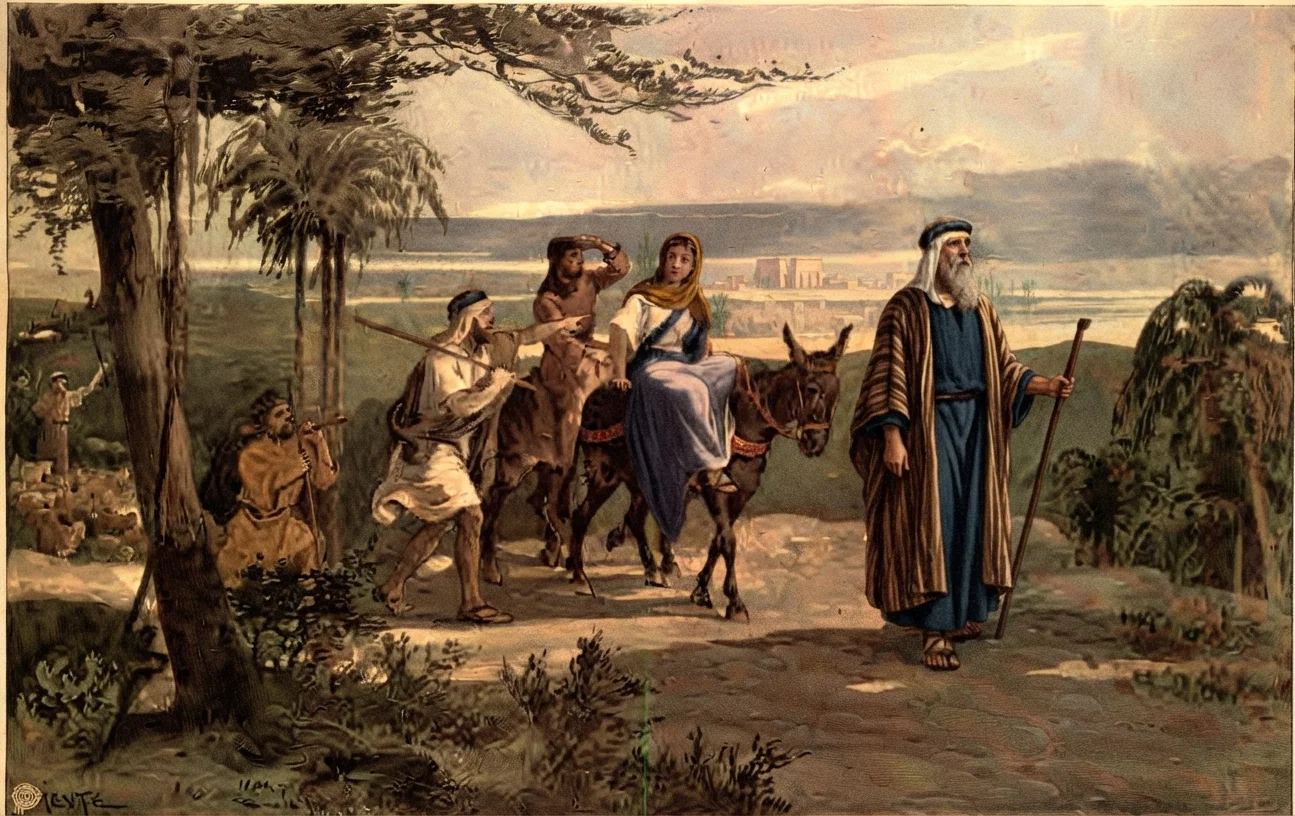
Abraham Going to Egypt.
THE surroundings of the individual will have but little effect upon him, provided his mind is centered in the Word of God. For upon this basis he is developing the heroism of true faith. It was while Abraham was in Egypt, surrounded by all of the vices and wickedness of that exceedingly wicked nation, that he was developing that great strength of faith that brought him to the place where he was called "the friend of God." While he was sojourning in the land of Canaan, he was in the midst of an idolatrous people. Vices and superstitions were all around him, but he did not hear the sounds that came from this quarter, for Abraham was listening to the voice of God. God spoke to Abraham, and the record shows that when He spoke Abraham "believed in the Lord; and He counted it to him for righteousness." Gen. 15:6.
THE life of Abraham is not the only record we have of men who have developed the fullest and broadest faith in the very midst of idolatries, superstitions, vices, and crimes. It was amid all the debasing influences of an Egyptian court that Moses kept his fidelity to God, and by listening to the voice of His Word was able, when he came to years of maturity, to choose "rather to suffer affliction with the people of God, than to enjoy the pleasures of sin for a season." Heb. 11:25. It was amidst all the luxuries and abandonments of vice surrounding a Babylonian court that Daniel developed his faith and fidelity to God. And so the record gives us instance after instance of individuals who were able to see beyond the glamor and glitter of this world to the solid realities of that which is before us in the world to come.
BUT these individuals reached these heights of faith not through the ordinary operations of human reason, but by the more reasonable course of believing the Word of God. The individual who stops to reason out things in the way that men generally reason will never reachany conclusion higher than his own finite impressions; his own circumscribed abilities will hold him within this narrow sphere, but when he adopts the great and true reason, and lays hold of God's Word by faith, he links himself at once with the infinite. His mortal existence of a few brief years here is swallowed up in the immortal eternity of the Father above. With endless years before him, and with constantly expanding abilities, he is ever growing toward the boundless expanse of joys and developments that God has for those who are sufficiently reasonable to lay hold of his Word as the only secure thing of the universe.
TO THE superficial thinker it seems folly to thus take God at His word, and to reason that because God has said so, therefore it is true. But he who will break away from the delusions of a superstitious and superficial world, can readily see that no mathematical theory could be more clearly demonstrated than the incontestable fact that God's Word stands secure, and that the individual who is resting upon that Word is standing upon the only ground that can never be shaken.
YOU often hear people say, "Be sure that you are right, then go ahead." The individual who desires to be sure that he is right in the great and vital question of spiritual truth, should know that the only thing that will enable him to have this assurance is the Word of God itself. God's Word is right, and the individual who has God's Word, and who knows that he has God's Word, and not a theory about it merely, knows perfectly well what is right and what is true.
THEN the only reasonable thing to do is to fortify the mind with the Word of God, that we may be resting all the time upon that solid foundation without which neither faith nor reason can stand.

AS LIGHTS IN THE WORLD.

GOD desires us to shine as lights in the world. Darkness has covered the earth and gross darkness the people; and Christ says to His followers, "Let your light so shine before men, that they may see your good works, and glorify your Father which is in heaven." We are to give the light of truth to others, ever asking, ever receiving, ever imparting, working in all simplicity through the sanctification of the Spirit.
Christ pointed out the position His people should occupy when He said, "Ye are the light of the world." From the members of the church is to go forth an influence which shall enlighten others. The Light-giver arranges the lamps so that all in His house (the world) may be enlightened. He has an inexhaustible supply of light, and He places those who truly believe in Him, where they will shine brighter and brighter. Constantly our light is to increase in brightness because we are constantly receiving light from the Source of all light. Beholding Christ, we are to become changed into His image, reflecting His light to the world.
Each soul united to Christ becomes a light in God's house. Each is to receive and impart, letting his light shine forth in clear, bright rays. We are held responsible by God if we do not let light shine to those who are in darkness. God has given each member of His church the work of giving light to the world, and those who faithfully act their part in this work will receive an increasing supply of light to impart. By His Spirit the Lord will mold and fashion the human agent, quickening his energies, and giving him light wherewith to enlighten others.
Life always shows itself in action. If the heart is living, it will send the life-blood to every part of the body. Those whose hearts are filled with spiritual life will not need to be urged to reveal this life. The divine life will flow forth from them in rich currents of grace. As they pray, and as they speak, God is glorified.
There is no limit to the Lord's efficiency. He is prepared to advance and to add new territory to His kingdom. But His people must do their part in carrying forward this work. "Ask, and it shall be given you," is the promise. Our part is to rest on the Word with unwavering faith, believing that God will do according to His promise. Let faith cut its way through the shadow of the enemy. When a questioning doubt arises, go to Christ, and let the soul be encouraged by communion with Him. The redemption He has purchased for us is complete. The offering He made was plenteous and without stint. Heaven has a never-failing supply of help for all who are in need.
It is the Saviour's delight to see His followers co-laborers with God, receiving bountifully all the means of fruit-bearing, and giving bountifully, as workers under Him. Christ glorified His Father by the fruit He bore, and the lives of His true followers will produce the same result. Receiving and imparting, his workers will produce much fruit. "Hitherto," Christ said to His disciples, "ye have asked nothing in My name. Ask, and ye shall receive, that your joy may be full."
The God of providence still walks among us, tho His footsteps are not seen, tho His positive and direct workings are not recognized or understood. The world in its human wisdom knows not God. The Lord designs that through human beings His glory, not the glory of men, shall be manifested. It is His light that shines through His agencies. Providence and revelation work in divine harmony, revealing God as first, and last, and best in everything.
Christ is drawing sinners to Himself by the cords of love, seeking to unite them to Himself, that they may be laborers together with God, not in pride and self-sufficiency, but in meekness and lowliness. When sinners are converted, God is glorified before the principalities and powers of heaven and earth. These converted ones are a spectacle to the world, to angels, and to men. "Ye are My witnesses," God says. By looking to Me you are to become transformed in character; and by the manifestation of Christlike forbearance and love you are to reveal this transformation.
By imparting to others the love and tenderness which God has so abundantly bestowed on us, we are to let our light shine. We should put every gift of God to the best possible use, making it a producer of good. To God we can give nothing which is not already His; but we can help the needy ones around us. We can supply them with the necessities of this life, and at the same time speak to them of the wonderful love of God.
Christ has identified His interests with those of His people. He has plainly stated that we can minister to Him by ministering to His suffering ones. Words of encouragement and cheer, spoken when the soul is sick and the pulse of courage is low, these are regarded by the Saviour as if spoken to Himself. The heavenly angels look on in pleased recognition. In no better way can we express our love to God than by unselfish, self-sacrificing actions, performed because the grace of God has been received into our hearts.
There are only two kingdoms in this world,—the kingdom of Christ and the kingdom of Satan. To one of these kingdoms each one of us must belong. In His wonderful prayer for His disciples Christ said: "I pray not that Thou shouldest take them out of the world, but that Thou shouldest keep them from the evil. They are not of the world, even as I am not of the world. Sanctify them through Thy truth; Thy Word is truth. As Thou hast sent Me into the world, even so have I also sent them into the world."
It is not God's will that we should seclude ourselves from the world. But while in the world we should sanctify ourselves to God. We should not pattern after the world. We are to be in the world as a corrective influence, as salt that retains its savor. Among an unholy, impure, idolatrous generation we are to be pure and holy, showing that the grace of Christ has power to restore in man the divine likeness. We are to exert a saving influence upon these in the world.
"This is the victory that overcometh the world, even our faith." The world has become a lazar-house of sin, a mass of corruption. It knows not God's children, because it knows Him not. We are not to follow its ways or imitate its customs. Continually we must resist its principles. Continually we must obey the words, "Let your light so shine before men, that they may see your good works, and glorify your Father which is in heaven."
MRS. E. G. WHITE.

REDEMPTION OF THE DOMINION.

THE dominion given to Adam embraced land, water, and air. He was given "dominion over the fish of the sea, and over the fowl of the air, and over every living thing that moveth upon the earth."
There are three distinct things embraced in this dominion, viz., land, water, and air. All were forfeited by our first parents and given over to the devil; hence we read, "Cursed is the ground for thy sake." Immediately we find the land bringing forth thorns and thistles. The water passed into the enemy's hands, and in obedience to his will it is lashed into fury by destructive storms.
"The air, which had hitherto been of a mild and uniform temperature, seemed to chill the guilty pair." Satan had become "prince of the power of the air." In obedience to him it conveys germs of disease and death everywhere; "for death is come up into our windows, and is entered into our palaces to cut off the children from without, and the young men from the street."
The redemption of the dominion will remove from land, water, and air every trace of the curse. This was beautifully taught in the sacrificial service; for "the whole Jewish economy is a compacted prophecy of the Gospel. It is the Gospel in figures, for from the pillar of cloud Christ Himself presented the duty of man to his fellow-man." The future home of the redeemed was not left out of those figures; but Christ, as the great Restorer of the lost dominion, was presented to the world, revealed in types and symbols.
There was only one way by which the earth could be redeemed from the curse. "Blood it defileth the land; and there can be no expiation for the land, but by the blood of him that shed it." Num. 35:33, margin; Gen. 4:10-12. It is not in the power of sinful man to redeem it; there is only one of the human family that has a right to redeem.
The earth was cursed through the sin of man, and the redemption of the earth was taught by the offerings made by man for his sins. When a sin-offering was made for priest, ruler, congregation, or common people, some of the blood was always to be poured out "at the bottom of the altar of the burnt-offering." Lev. 4:7, 18, 25, 34.
This blood poured upon the ground typified the blood of Christ, that would redeem the land from sin. Deut. 15:23; Lev. 17:11-14.
The greater part of the diseases in the earth is the result of impurities in the air and water. The blood of the offering made by one that was to be cleansed from the disease of leprosy, was brought in contact with both the air and water. "Then shall the priest command to take for him that is to be cleansed two birds alive and clean, and cedar wood, and scarlet, and hyssop; and the priest shall command that one of the birds be killed in an earthen vessel over running water; as for the living bird, he shall take it, and the cedar wood, and the scarlet, and the hyssop, and shall dip them and the living bird in the blood of the bird that was killed over the running water; and he shall sprinkle upon him that is to be cleansed from the leprosy seven times, and shall pronounce him clean, and shall let the living bird loose into the open field." Lev. 14:4-7.
The bird dipped in the blood, which typified the blood of Christ, flew through the air, a symbol of the precious blood that was to drop from Calvary's cross, and through its power remove from the air every taint of the curse, and give to man a new heaven and a new earth.
The killing of the bird over the running water was also significant of the work of Christ in redeeming the water from the hands of Satan. Cedar wood and hyssop were dipped in the blood, thus typifying the redemption of vegetation, "from the cedar that is in Lebanon even unto the hyssop that springeth out of the wall."
There was beauty in the type; but let us compare it with the antitype. The redemption price was being paid for the land when in the garden the Saviour "sweat as it were great drops of blood falling down to the ground." The price was fully paid when the precious blood, forced out by the cruel nails, fell upon the ground beneath the cross.
From the wound made by the spear "there flowed two copious and distinct streams, one of blood, the other of water."
The two extremes of vegetation were represented on Calvary. The cross was from the forest, and "they filled a sponge with vinegar, and put it upon hyssop, and put it to His mouth." During His trial they "platted a crown of thorns," and "put it upon His head, and a reed in His right hand." Wicked hands took the reed, and struck the crown, forcing the thorns into His temples, causing the blood to trickle down His face. He bore the curse of the earth.
Truly "Christ hath redeemed us from the curse of the law, being made a curse for us; for it is written, Cursed is every one that hangeth on a tree."
When Christ yielded up His life on the cross, He "rested from the work of redemption; and, tho there was grief among those who loved Him on earth, yet there was joy in heaven. Glorious to the eyes of the heavenly beings was the promise of the future. A restored creation, a redeemed race, that having conquered sin could never fall—this, the result to flow from Christ's completed work, God and angels saw. With this scene the day upon which Jesus rested is forever linked. For "His work is perfect," and "whatsoever God doeth it shall be forever." When there shall be a "restitution of all things which God hath spoken by the mouth of all His holy prophets since the world began," the creation Sabbath, the day on which Jesus lay at rest in Joseph's tomb, will still be a day of rest and rejoicing. Heaven and earth will unite in praise as "from one Sabbath to another" the nations of the saved shall bow in joyful worship to God and the Lamb." Mrs. H. Hurd Haskell.

GOD'S MEMORIAL.

"Thy name, O Lord, endureth forever; and Thy memorial, O Lord, throughout all generations." Ps. 135:13.
"Memorial: anything intended to preserve the memory of a person, an occurrence, or the like; something which serves to keep something else in remembrance; a monument."—Webster.
THE Bible gives us illustrations of this definition. When the children of Israel had crossed the Jordan, twelve stones were taken from the river, a stone for each tribe. And these stones were to "be for a memorial unto the children of Israel forever."
They were to be a standing memorial that that people passed dry shod over Jordan. "And He spake unto the children of Israel, saying, When your children shall ask their fathers in time to come, saying, What mean these stones? then ye shall let your children know, saying, Israel came over this Jordan on dry land." Joshua 4:7, 21, 22.
There was a memorial of the deliverance of the children of Israel from Egypt. It was the passover. "This day shall be unto you for a memorial; and ye shall keep it a feast to the Lord throughout your generations; ye shall keep it a feast by an ordinance forever." Ex. 12:14; 13:3-9. This was a yearly memorial, to be observed as often as the fourteenth day of the first month arrived, for this was the day the Israelites came out of Egypt and were delivered from bondage.
God has caused His creative work to be commemorated. We read: "The works of the Lord are great, sought out of all them that have pleasure therein. His work is honorable and glorious; and His righteousness endureth forever. He hath made His wonderful works to be remembered." Ps. 111:2-4.
He has given us a memorial by which to commemorate His great creative work. "Remember the Sabbath day, to keep it holy. Six days shalt thou labor, and do all thy work; but the seventh day is the Sabbath of the Lord thy God; . . . for in six days the Lord made heaven and earth, the sea, and all that in them is, and rested the seventh day; wherefore [for this reason] the Lord blessed the Sabbath day, and hallowed it." Ex. 20:8-11.
The Sabbath was to the children of Israel a sign or memorial from the Lord, and thus is the reason stated: "I gave them My Sabbaths, to be a sign between Me and them, that they might know that I am the Lord that sanctify them." Eze. 20:12.
The Sabbath was given to keep the Creator always in mind, and it is evident that if it had been faithfully kept there would not now be a heathen on the face of the whole earth. When the prophet would show the true God, and distinguish Him from all false gods, he uses this language: "But the Lord is the true God, He is the living God, an everlasting King. . . . Thus shall ye say unto them, The gods that have not made the heavens and the earth, even they shall perish from the earth, and from under these heavens." But the true and living God is the one that "hath made the earth by His power, He hath established the world by His wisdom, and hath stretched out the heavens by His discretion." Jer. 10:10-12.
Would an apostle point heathen worshipers to the true and living God, he makes use of the Sabbath commandment, or the fact on which it is based: "Paul stood in the midst of Mars' Hill, and said, Ye men of Athens, . . . as I passed by, and beheld your devotions, I found an altar with this inscription, TO THE UNKNOWN GOD. Whom therefore ye ignorantly worship, Him declare I unto you." And to do this he refers to God's great creative power: "God that made the world and all things therein." Acts 17:22-24.
The Sabbath was to be a sign or memorial of the true God forever. Again we read: "It is a sign between Me and the children of Israel forever; for in six days the Lord made heaven and earth, and on the seventh day He rested, and was refreshed." Ex. 31:17.
This sign was given to Israel forever. With propriety we may ask, Who are Israel? Paul can give us the desired information: "Who are Israelites; to whom pertaineth the adoption, and the glory, and the covenants, and the giving of the law, and the service of God, and the promises." Rom. 9:4.
The promises here spoken of refer to the promises made to Abraham: "Now to Abraham and his seed were the promises made. He saith not, And to seeds, as of many; but as of one, And to thy seed, which is Christ." Gal. 3:16. When we receive Christ, then we sustain the relation of children to Abraham. "And if ye be Christ's, then are ye Abraham's seed, and heirs according to the promise." Verse 29. And James, in writing to the Christian church, addresses them thus: "James, a servant of God and of the Lord Jesus Christ, to the twelve tribes which are scattered abroad." James 1:1.
When the saints are redeemed, they will all remember God's great creative power. "Thou art worthy, O Lord, to receive glory and honor and power; for Thou hast created all things; and for Thy pleasure they are and were created." Rev. 4:11. And these redeemed ones have stated times to meet and worship and adore the true and living God; for we read: "And it shall come to pass, that from one new moon to another, and from one Sabbath to another, shall all flesh come to worship before Me, saith the Lord." Isa. 66:23.
How long will this practise continue? "For as the new heavens and the new earth, which I will make, shall remain before Me, saith the Lord, so shall your seed and your name remain." Verse 22.
The Sabbath, which is the memorial of God's great creative power, will never cease to exist; for as long as it is a fact that God created the heavens and the earth, so long will the Sabbath exist as the memorial of that great event. When this sinful state of things gives way to a sinless new earth, the fact upon which the Sabbath institution is based will still remain; and the redeemed ones who will be permitted to live on the new earth will still commemorate the great creative power of God, while singing the song of Moses and the Lamb. Rev. 15:3. Thus the words of David at the head of this article will prove true: "Thy name, O Lord, endureth forever; and thy memorial, O Lord, throughout all generations."
Sioux Falls, S. D. G. W. ROGERS.

DAYS OF TROUBLE.

The storm clouds gather in the vaults above, And deep-toned thunders their dark caverns move. Their heaving motion tells of wind's mad strife; They call aloud for life, for human life.
The sea is lashing; white with angry foam, "Deep calleth unto deep," and answers come. Hark, hear their maddened tones, with dangers rife! They call aloud for life, for human life.
Old mother earth, who once, in love's embrace, Nursed in her bosom true the human race, Now heaving buries husband, child, and wife. She also calls for life, for human life.
But mightier still the voice that comes from far, Calling to arms, the gathering for war. The nations call, with cannon, drum, and fife; They loudly call for life, for human life.
They shall be satisfied, and drunk with gore; They'll fall into the pit, and reign no more. They staked their all, sad folly, such is life. They staked for life, but only human life.
But God will be, through storm and earthquake shock, "Jehovah-nissi" to His little flock, And from the "wrath of man" and nations' strife, He'll call to life, but blest eternal life. CLARENCE SANTEE. San Jose, Cal.

THE SIMPLICITY OF LIFE.

To the candid reasoner the subject of life beyond the grave has been made plain in the record which the Lord has given of the creation of man; so that without any great scholarship all who can read can understand the simplicity of life. There are many men who are interested in and study the anatomy of man, and so learn all about the framework of the human body. But the great problem to be solved, in which all men are interested, is, What is life in the body?
It is very generally believed that life in man is an immortal, invisible embodiment with an eternal conscious existence, and that it has been given a limited time to inhabit this visible body. These views are accepted by the world in general, and believed to be divine truth. But in the record which He has given us of the creation of man, the Lord has given no evidence whatever on which to base such a belief. The inspired Word says, "The Lord God formed man of the dust of the ground." The body, made from substances taken from the ground and skilfully framed together, was an instrument ready to be set into motion. So the Lord "breathed into his nostrils the breath of life; and man became a living soul." Gen. 2:7. Now the body was made of perishable substance (earth), and because of sin man must return again to the earth. "For dust thou art, and unto dust shalt thou return." Gen. 3:19.
The body was made from perishable substances, and the instrument of power which produced life is a perishable substance. For the record says, "The elements shall melt with fervent heat, the earth also." 2 Peter 3:10. So, according to plain statements made by inspired writers, every constituent element which composes the general makeup of man, is perishable, and life must cease, or perish with the materials.
An illustration will show what life is. The life in man is comparatively the same as the life or motion of a steam-engine; it is the effect produced by the power which is applied. This may seem quite absurd to the many who are wrangling and striving over words, to define them to suit the popular belief; but when we study the formation of man as recorded in Gen. 2:7, in connection with our practical knowledge and observation, it is easy, indeed, to understand what life is.
The steam-engine, in its complete structure, has no power within itself; it can not make even a single wheel turn; but by the application of steam the engine is set in motion. Now the steam is not the life of the engine, but the effect produced by the power of steam, when applied, is the life. And no machinery, of whatever nature it may be, can operate itself by itself; a power apart from itself must be applied to the machine to put it in motion. The power, then, which is applied is not the motion, neither is the motion produced without the power; but the motion is the product, or result of the power as it operates upon the machinery.
And so it is with the human body and every other body of flesh. The breath is not the life, neither is life in the body without the breath; life is the effect produced when the breath is breathed into the nostrils. The Lord, then, when He made man and every other body of flesh wherein there is life, made them as machines, with all their joints, organs, and tissues framed together, showing skilful workmanship on the part of the divine Creator. But with all the skill which He possesses, the Lord left every body of flesh which He created entirely helpless within itself to put the machinery of the body into action. The body, before life was produced in it, was devoid of all action, thought, or instinct. It was a mere dead machine or body, just as the engine is a dead engine without steam. Thought, therefore, is not produced, neither can it be until the power which operates the machinery of the body is applied, and acts directly upon the organ of thought. The brain, like all the other organs of the body, has its own peculiar office, and works mechanically and systematically, until through injury or disease it can no longer respond to the power applied; and then it ceases to act, just as the hands of a watch cease to indicate the time of day when its wheels stop running.
Then, to produce life in the body, the Lord created the air, a substance which, when He applied it in the process of breathing, brought the machinery of the body into action. So it is clear that the body is just as dependent upon the power which God has bestowed through the process of breathing, to bring its organs into action, as the engine is upon the power of steam to put its machinery into motion. It is readily seen, then, by the candid reasoner, that life and motion are simply the effect of the power applied. Therefore, when the power which operates the machinery of the body is withdrawn, life must inevitably cease.
Now we have shown that the atmosphere, or the breath we breathe, is not our life, but our life is simply the setting in motion of the organs of the body. When we realize how limited our power is to retain the breath in order that the machinery of our bodies may be kept running, we are better prepared to understand the true nature of life, its simplicity, and its duration.
The above illustration applies only to the life of the flesh, and not to the life of the redeemed. The life which the righteous shall receive in the resurrection, and by translation, will not be the result of merely breathing the air; but by the immediate Spirit and power of the Almighty we shall receive a life that will be equal in duration to that of our Saviour.
Perrydale, Or. WM. S. SCHWARTZ.

SHE TOUCHED HER.

SOME rude children in Madagascar were one day calling out, "A leper! A leper!" to a poor woman who had lost all her fingers and toes by the dread disease. A missionary lady who was near by, put her hand on the woman's shoulder, and asked her to sit down on the grass by her. The woman fell sobbing, overcome by emotion, and cried out: "A human hand has touched me. For seven years no one has touched me."
The missionary lady says that at that moment it flashed across her mind why it is recorded in the Gospels that Jesus touched the lepers. That is just what others would not do. It was the touch of sympathy as well as healing power.—Selected.

HEAPING UP TREASURES.

NUMEROUS scriptures show that many in the last days will possess immense fortunes. This is seen from the fact that when the Lord comes they will 'cast their silver in the streets, and their gold shall be removed.' Eze. 7:19. Their hoarded and ill-gotten treasures will be cast to the moles and the bats. Isa. 2:18-21; Zeph. 1:18.
The apostle James tells us that men will heap treasure together 'in the last days.' Chapter 5:3, R.V. No evidence is needed to prove that such is the present condition of things. The marvelous accumulation of wealth is looked upon with astonishment and alarm by the masses. They know that it portends trouble, and await the outcome with anxious expectancy.
As a sample of the accumulation of wealth, the New York World of Aug. 8, 1900, presents the following summary of the income of John D. Rockefeller and his brother William, the Standard Oil Company magnates:—
This man's wealth is so great that the oil industry, immense as it is, is not large enough to employ his riches. He owns an interest in innumerable railroads, banks, insurance and trust companies, mining corporations, and industrial enterprises.
He and his brother William control the New York, New Haven, and Hartford Railroad; the Missouri, Kansas, and Texas Railroad; and they are large owners in the Chicago and Alton Railroad; the Federal Steel Company; American Sugar Refining Company; American Glucose Sugar Refining Company; American Cotton Oil Company; National City Bank; Hanover National Bank; First National Bank of Chicago; Second National Bank of New York; the National Park Bank; Bank of Metropolis; the United States Trust Company; the Farmers' Loan and Trust Company; the Chicago Terminal Transfer Company; the Amalgamated Copper Company; the Anaconda Copper Mining Company; the Delaware, Lackawanna and Western Railroad; the Consolidated Gas Company; the Standard Gas Company; the Brooklyn Union Gas Company; the New Amsterdam Gas Company; the Union Gas Company; the Harlem River and Port Chester Railroad; the Leather Manufacturers' National Bank; the Mutual Life Insurance Company; the Cleveland, Akron, and Columbus Railroad Company; First Municipal Bond Insurance Company; the International Banking and Trust Company; and the Kern Incandescent Gaslight Company.
His investments in these corporations will bring his total income this year up to at least $60,000,000, and perhaps to $75,000,000. Based upon $60,000,000, his daily income for every one of the 365 days in the year is $164,383, one-fourth of which would be deemed an independent fortune by the average family.
An income of $164,383 per day is nearly $6,850 per hour, or over $112 per minute. And this is but an illustration of the vast increase of wealth throughout the world. If this can not be truly said to be 'heaping' up treasures, we hardly see what could be. And the Lord said this would be done in the 'last days.' The 'last days,' therefore, are here, and the Saviour is 'at the door.' How few are preparing to meet Him! Reader, are you preparing? G. B. THOMPSON. Rome, N. Y.

The Sweetness of Human Words

WHAT is music if sweet words, Rising from tender fancies, be not so? . . . . . . . . Not the rich viol, trump, cymbal, nor horn, Guitar, nor cittern, nor the piping flute, Are half so sweet as human words. —Barry Cornwall.
Continue reading: THE MEAT-OFFERING