Your ShelfYour Projects

Signs of the Times, Vol. 28, No. 17.

THE VATICAN AND ITS MEANING

Signs of the Times

Apr 23, 1902

Pacific Press Publishing Company · Oakland, California · Apr 23, 1902

THE VATICAN AND ITS MEANING.
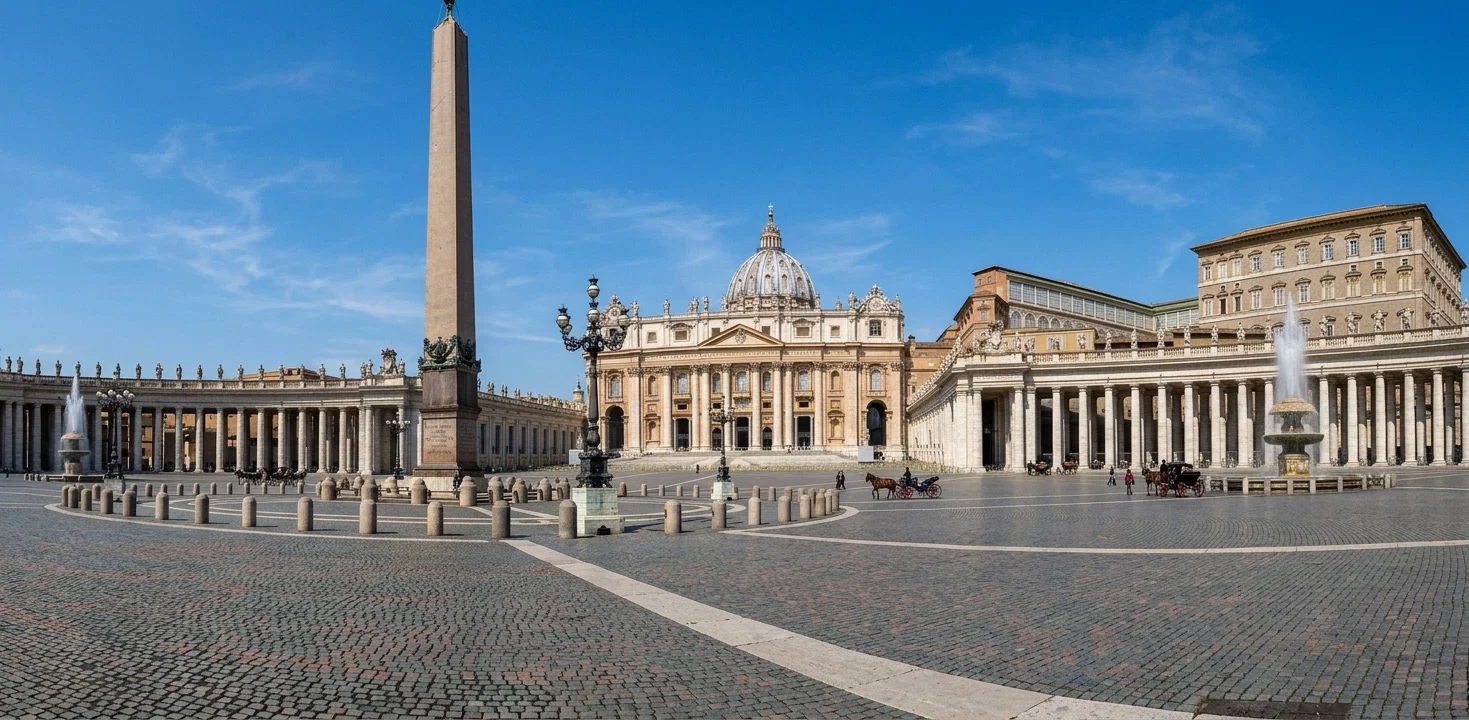
THE buildings shown in this picture are the Basilica of St. Peter and a portion of the Vatican palace, which one descriptive writer has styled “the noblest of princely palaces.”
ROME. Basilica of St. Peter and Vatican with Piazza and Colonnade.
“THE palace of the Vatican,” remarks the same writer, “is, indeed, not a palace, but a congress of palaces.” It is said to contain 16,000 apartments; but the “International Cyclopedia” thinks this an exaggeration. The same authority, however, credits the statement that the Vatican, with its gardens, etc., covers a space equal to the whole area of the city of Turin fifty years ago, at which time that city had a population of 130,000 souls.
THE history of the Vatican dates from the days of Constantine, who died A. D. 340; but the systematic scheme of improvement and embellishment to which is due its present magnificence, was not inaugurated until the time of Nicholas V., about the middle of the fifteenth century.
THE Vatican is the pope’s official residence, and headquarters of the Papacy for the entire world; it stands, therefore, for the whole papal system, the very soul of which is human instead of divine headship in the church.
THE Gospel teaches that “the head of every man is Christ.” 1 Cor. 11:3. It is an axiom that that which is true of every part is true of the whole; hence, being the head of every man, Christ is the head also of the church, as He is plainly declared to be in such texts as Eph. 4:15 and Col. 1:18, which, however, only put in other phrase the divine law of headship and brotherhood in the church: “One is your Master, even Christ; and all ye are brethren.” Matt. 23:8.
THE human poll is head of the body because it is the head of every member in the body; every part is responsive to its will. If any member were independent of the head, then were the body divided against itself, and there could be no real headship.
INSPIRATION has used this very figure of the human body to illustrate the relation not only of Christ to His church, but to each member of that church. “For as the body is one,” says the apostle, “and hath many members, and all the members of that one body, being many, are one body; so also is Christ.” 1 Cor. 12:12. And again, “Ye are the body of Christ, and severally members thereof.” Verse 27, R.V.
JUST as every member of the human body is responsive to the head, so every member of the true church, the body of Christ, is responsive to the great Head of the church. “Now there are diversities of gifts, but the same Spirit. And there are differences of administrations, but the same Lord. And there are diversities of operations, but it is the same God which worketh all in all.” 1 Cor. 12:4-6.
THUS the Gospel teaches that Christ is the head of the church because He is the head of each member of the church. In contradistinction to this the Papacy makes the pope the head of the church, and the head of every man because he is head of the church. Thus not only is the divine order reversed, but both the church and the individual are separated from Christ; first the church is put between the individual and Christ, and then the pope is put between the church and Christ; therefore the individual can come to Christ only by way of both church and pope.
NOR does this evil system of human versus divine headship in the church stop here. Indeed, this is but a small part of it. Not only are the church and the pope both put between Christ and the individual, but even then the Saviour must be approached not directly, but through saints who have been canonized by church and pope. Nor does it end here; for while the Scriptures teach that Christ “took not on Him the nature of angels; but He took on Him the seed of Abraham,” and was made “in all things” “like unto His brethren, that He might be a merciful and faithful High Priest in things pertaining to God,” the Papacy, by the doctrine of the immaculate conception of Mary herself, removes the Saviour so far from sinful men that the assurance of the Scriptures that “we have not an High Priestwhich can not be touched with the feeling of our infirmities,” ceases to have any meaning to one who believes the papal doctrine, not only of the nature of Christ, but of His mother, and of her father and mother before her.
GOD is a person, but His personality is all-pervasive; He is everywhere present by His Spirit. Until the fall of angels and of man, the whole moral universe was as responsive and obedient to the divine influence, through the Spirit, as is the material universe to the laws of attraction and repulsion. As all the circling spheres in the universe are obedient to the law which we call gravitation because each particle of matter is responsive to that law, so the Creator would have the whole moral universe obedient to the moral law because each integral part of the whole is in harmony with that law.
SIN is separation from God. Salvation is union with God. Man was alienated from God in the mass because the race was yet in the loins of our common father, Adam, when he sinned; and it is impossible that a clean thing should come from that which is unclean. But men are redeemed as individuals. “I will take you one of a city, and two of a family, and I will bring you to Zion,” the Lord says. Moreover it is written that “God so loved the world, that He gave His only begotten Son, that whosoever believeth in Him should not perish, but have everlasting life.”
GOD wants human hearts to respond to divine spiritual influences, just as the forces of nature respond to the material influences of sunlight and rain. “For as the rain cometh down, and the snow from heaven, and returneth not thither, but watereth the earth, and maketh it bring forth and bud, that it may give seed to the sower, and bread to the eater: so shall My word be that goeth forth out of My mouth.” Isa. 55:10, 11.
IT is the work of the Gospel to bring men to God. “Now then we are ambassadors for Christ,” says the apostle, “as tho God did beseech you by us: we pray you in Christ’s stead, be ye reconciled to God.” 2 Cor. 5:20.
THE only hope of any man is oneness with God. The divine life must flow into the soul uncontaminated by any human influence. He who was made human flesh nineteen centuries ago, and who overcame sin in that flesh, must live His life in the flesh of every man who shall at last have a home in His eternal kingdom. “I am crucified with Christ,” the apostle says; “nevertheless I live; yet not I, but Christ liveth in me: and the life which I now live in the flesh I live by the faith of the Son of God, who loved me and gave Himself for me.” Gal. 2:20.
NOR is this an experience possible only to an apostle; like salvation,—for it is salvation,—it is for “whosoever will.” “Behold,” says the Saviour, “I stand at the door and knock; if any man hear My voice, and open the door, I will come in to him, and will sup with him, and he with Me.” Rev. 3:20.
HE partakes of our poor fare, and in turn gives us the rich viands of His grace. He partakes of our human nature, is touched with the feeling of our infirmities, and in turn transforms us into His likeness, clothes us with His character ; for by Him “are given unto us exceeding great and precious promises; that by these ye might be partakers of the divine nature.” 2 Peter 1:4. He became what we were, that He might make us what He is. “O the depth of the riches both of the wisdom and knowledge of God! how unsearchable are His judgments, and His ways past finding out! . . . For of Him, and through Him, and to Him, are all things; to whom be glory forever. Amen.” C. P. BOLLMAN.

CHILD-TRAINING

THERE is a great work to be done for the Lord. Let not parents forget that their part of this work begins in the home. This is their first field of missionary effort. When they show that they know how to manage their own children, they give evidence that they are prepared to take part in church work.
Parents, you are under a solemn obligation to train your children for God. They are His heritage, and to you is given the work of preparing them for acceptance as members of the royal family. You are to give your children such a training that as they grow older, they will take part in the work of the Lord. They are to be taught to be burden-bearers. As they grow older, they will become more and more useful, better fitted to bear their share of the burdens of life.
Children are to be taught to be respectful to their parents and to one another. Thus they learn to be respectful to God. They are to be taught to appreciate the abilities God has given them, and to remember that Christ’s love for them calls for the surrender of all to Him. They are to be taught to do right because it is right; to control self, to be kind, loving, and gentle; to forget self in the effort to help others.
Parents, do all in your power to keep disagreements out of the home circle. If the children quarrel, remind them that God has said, “Let not the sun go down upon your wrath.” Teach them never to let the sun go down on angry feelings or sin unconfessed. Teach them that harmony should reign in the home, even as it reigns in heaven.
In dealing with your children, reveal God’s justice and His mercy. Repress every harsh word. Remember that fretting and scolding are as injurious to your children as profanity, and that too much management is as bad as no management at all. Be firm, but let no loud, angry words escape your lips. Rule your children with tenderness and compassion, remembering that “their angels do always behold the face of My Father which is in heaven.” If you desire the angels to do for your children the work given them by God, co-operate with them by doing your part. Work with loving tenderness; for this is the way Christ works.
Remember that your child has rights which should be respected. Be very careful never to bring against him an unjust charge. Never punish him without giving him an opportunity to explain. Listen patiently to his troubles and perplexities. Never tell others in his hearing of his faults, or of his clever sayings or doings. Even in the presence of his brothers and sisters these things should not be spoken of. By speaking of his bright words and acts, you encourage self-confidence. By speaking of his faults, you humiliate him without softening him. Hatred springs up in his heart against your course, which he regards as cruel and unjust.
Remember that during their whole lifetime your children will bear the impress of the instruction they receive from you. Think how far-reaching will be the influence of your efforts to train them aright. The lessons you give them, they will by and by give to their children. The influence you exert over them, they will exert over their little ones.
Parents who neglect their children in order to do missionary work, make a sad mistake. The course of their untrained, undisciplined children robs them of all influence for good. Parents, do not allow anything to come between you and the work God has given you to do for your little ones. But this will not debar you from doing missionary work outside the home. Teach your children to help other children. With proper instruction they can do much real missionary work. You will find them a great help to you in working for others.
As parents teach their children, they will themselves learn precious lessons. Thus they gain an education of the highest value. Thus they learn to work for others. They are preparing to do a high and holy work for God, with their children to assist them as His helping hand.
Remember that your children have been brought into the world without voice or consent on their part, and that they are to be treated with the wisdom and tenderness that their necessities demand. You know the way; your children, young and inexperienced, do not. They are helpless and ignorant. They need wise, careful guidance, that their feet may not stray into forbidden paths. Remember that you are moulding their characters for eternity. Patiently train them to habits of neatness, usefulness and purity. By your example show them the charm of becoming behavior. Do not become weary in your labor of love. The angel of mercy pauses not in his efforts until the last sinner has heard the message of mercy. Patiently, untiringly, work for your little ones. Think how young they are, how much they have to learn. Deal with them gently and lovingly. By the cords of unselfish love bind them to you and to Christ.
Too often parents give to the world the time and attention that belong to their children. If they would realize the responsibility resting on them, if they would do all in their power for their children, God would work with them, by His Spirit impressing the children’s minds. The Lord will not do the work He has given parents to do; but He will be their helper, co-operating with every sincere, unselfish effort they make.
May the Lord impress fathers and mothers with the sacredness of their responsibility. As you unite with the Lord in bringing up your children in His fear, you are preparing for—I was going to say higher responsibilities, but I can not. There is no higher responsibility than the training of children.
MRS. E. G. WHITE.

AVOID THE CLOAK OF VANITY.

Avoid the cloak of vanity, Or fling it from thee far away; No vileness seek; thy thoughts should be Of all that makes a blessed day.
Let rev'rence guide each step for thee, And aid thy comrades whilst thou may; Avoid the cloak of vanity, Or fling it from thee far away.
Not once in all thy days deny The gracious help of Him, Most High; For failure comes—ah! certainly To those who from His course wouldst stray; Avoid the cloak of vanity, Or fling it from thee far away.
Seiad, Cal. BENJ. PHILLIPS.

RESTORATION from BABYLON

BY ALONZO TREVIER JONES

SATAN’S MASTER-STROKE.

In a previous study we read that in vision there was shown to the prophet Zechariah, Joshua the high priest standing before the angel of the Lord, and Satan standing at his right hand to resist him. That is the key to the vicissitudes of this whole history.
The time was come when the cause of God must be restored, and His work done in the earth. In the nature of things, this must be done through human instrumentalities. Joshua, the high priest, was the chief of these human instrumentalities; and therefore stood in the vision as the representative of God and His work in the earth. On the other hand, Satan is the great adversary of God and His work everywhere, whether in the earth or in heaven. And when the time came for the cause and work of God to be revived and restored in the earth, Satan, as the great adversary of all that is of God, was prompt to create every kind of opposition. Accordingly he was seen standing at the right hand of Joshua—in the very place of opportunity and helpfulness—to resist him.
Satan had been actively engaged in this from the very first day that the work was begun in Jerusalem. It was his spirit and energy that actuated the Samaritan meddlers and their hired counselors at the court of Cyrus, Cambyses, and the false Smerdis. It was the personal presence of Satan in that three weeks’ contest at the court of Cyrus, that made the unbroken presence of the angel Gabriel essential there the three full weeks, and finally demanded even the presence and help of Michael to make victory certain.
But in spite of all Satan’s resistance the temple of God was finished and dedicated, and the full worship and service of God was there established. Yet he slacked not his plotting of resistance. He failed to accomplish anything of his purpose during the reign of Darius; but, in the reign of the successor to Darius he played a master-stroke, and arranged a most stupendous plot—nothing less than the sweeping away, in one day, all the Jews in the empire; the complete blotting out at one stroke of the whole worship, and even the whole people, of God. Of course it was a plot worthy only of Satan; but that even he should think that he could make such a plot succeed, would be astonishing, were it not for the peculiar train of circumstances that had developed the special instrumentality that he could use for his enormous purpose.
Darius died in B.C. 485, having reigned thirty-six years, and was succeeded by his son Xerxes, who was the Ahasuerus of the book of Esther. For the Hebrew Ahashverosh is the natural equivalent of the old Persian Khshayarsha, the true name of the monarch called by the Greeks Xerxes, as now read in his inscriptions. “The name of him whom the Greeks called Xerxes, as left by himself in his own inscriptions is Khshayarsha, which proves to be identical with the Ahasuerus of Holy Scripture.”—Oppert. And it is not strange that in the endeavor to pronounce such a name, the tongue of a Greek would reduce it to Xerxes. Thus Xerxes being truly the Ahasuerus of the book of Esther, this causes the book of Esther to stand chronologically in the Scriptures between the sixth and seventh chapters of the book of Ezra. Xerxes, king of Persia, was the son of Darius of Ezra 6, and the father of Artaxerxes of Ezra 7.
Political conditions, as developed by Darius in his last years, and left by his death, were such that, in order for Xerxes to complete the plans of Darius, he must “stir up all against the realm of Grecia;” as it had been stated by the angel to Daniel that Xerxes would do. Dan. 11:2. In furtherance of this enterprise, “Xerxes, being about to take in hand the expedition against Athens, called together an assembly of the noblest Persians, to learn their opinions, and to lay before them his own designs.”—Herodotus. This was in the third year of the reign of Xerxes; and this assembly was the one that is referred to in Esther 1:1-4:—
“In those days, when the king Ahasuerus sat on the throne of his kingdom, which was in Shushan the palace, in the third year of his reign, he made a feast unto all of his princes and his servants; the power of Persia and Media, the nobles and princes of the provinces, being before him: when he showed the riches of his glorious kingdom and the honor of his excellent majesty many days, even an hundred and fourscore days.”
That was the day of Persia’s greatest glory, and at the end of the six months’ council of preparation for the invasion of Greece, Xerxes made a grand feast for a whole week to the whole company of imperial officials:—
“The king made a feast unto all the people that were present in Shushan the palace, both unto great and small, seven days, in the court of the garden of the king’s palace; where were white, green, and blue hangings, fastened with cords of fine linen and purple to silver rings and pillars of marble: the beds [divans] were of gold and silver, upon a pavement of red, and blue, and white, and black marble. And they gave them drink in vessels of gold (the vessels being diverse one from another), and royal wine in abundance, according to the state of the king. And the drinking was according to the law; none did compel: for so had the king appointed to all the officers of his house, that they should do according to every man’s pleasure. Also Vashti the queen made a feast for the women in the royal house which belonged to king Ahasuerus.” Esther 1:5-9.
And because Vashti declined to make a display of herself to the drunken crowd, she was deposed from the position of queen.
Xerxes led into Greece a force, land and naval, amounting to 5,283,220 men. But in the successive defeats of Thermopylae, Salamis, Plataea, and Mycale, B.C. 480-79, his whole force was annihilated, and he returned to Shushan with only a body-guard. Shortly after his return, he issued his directions for the gathering together of the most beautiful maidens of the empire, that he might select a queen in the place of the deposed Vashti. Among these was Esther, the cousin and adopted daughter of Mordecai, a Benjamite who was an attendant in the king’s palace in Shushan. Esther was chosen.
“So Esther was taken unto king Ahasuerus into his house royal in the tenth month, which is the month Tebeth, in the seventh year of his reign [479]. And the king loved Esther above all the women, and she obtained grace and favor in his sight more than all the virgins; so that he set the royal crown upon her head, and made her queen instead of Vashti.” Esther 2:16, 17.
About this same time two of the king’s chamberlains laid a plot to kill him. The plot was discovered by Mordecai. He told it to Esther, Esther told it to Xerxes, investigation was made, the thing was proved, and the two men were hanged. Then a record of the whole affair was made in the official chronicles of the kingdom, in which was included the name of Mordecai and the part that he had taken in exposing the plot, and so saving the life of the king.
Not long after that, a certain prince whose name was Haman was promoted by king Xerxes, who thus “advanced him, and set his seat above all the princes that were with him.” Thus Haman was not only prime minister of the empire, but also the special favorite of the king; so that the king commanded all the servants “that were in the king’s gate” to bow to Haman and reverence him. Now Mordecai the Jew sat in the king’s gate; and he would not bow nor do reverence to Haman. His fellow-servants noticed this, and asked him, “Why transgressest thou the king’s commandment?” When they had for several days in succession called Mordecai’s attention to this, and still he would not bow nor do reverence to Haman, they told it to Haman, and also told him that this Mordecai who had thus refused to do him reverence was a Jew.
And just there is where Satan found his grand opportunity to make his master-stroke against the whole nation of Israel at once. Therefore “when Haman saw that Mordecai bowed not, nor did him reverence, then was Haman full of wrath.” But “he thought scorn to lay hands on Mordecai alone; for they had showed him the people of Mordecai; wherefore Haman sought to destroy all the Jews that were throughout the whole kingdom of Ahasuerus, even the people of Mordecai.” Esther 3:5, 6.
But why was this? What was the secret spring that Satan could touch there, to urge on one man thus to plan the destruction of a whole people? The answer is easy. Haman was “the Agagite.” That is, he was a direct descendant from king Agag, the king of the Amalekites whom Saul captured when he destroyed the Amalekites, and whom the prophet Samuel slew after Saul had brought him to Gilgal alive. And Mordecai was a Benjamite; of the very tribe of that Saul, king of Israel, who had destroyed the nation of the Amalekites. Here, then, was the chance for the remaining Amalekite and Agagite to visit vengeance upon this people, and destroy this whole nation, as this people had destroyed his nation so long before.
Possibly some one will say, “Well, was not that even justice, and fair enough?” The answer is, “No; it was but the continuation of the original treacherous and destructive purpose of the Amalekites who initiated the war shortly after Israel left Egypt, and before they came to Sinai. In Rephidim, between the wilderness of Sin and the wilderness of Sinai, the Amalekites laid an ambush for the children of Israel as they marched, and cruelly smote the hindmost; even all that were feeble, and when they were faint and weary. 1 Sam. 15:2; Deut. 25:17, 18. And it was for this that Saul had destroyed the Amalekites. Ex. 17:8-14; Deut. 25:19; 1 Sam. 15. And now it was in perpetuation of original and native Amalekite treachery and cruelty that Haman the Amalekite must scheme to blot out the whole people, simply because one of their number failed to bow and do him reverence.”
And Haman proceeded to put into effect his Amalekitish scheme. First he cast lots in the selection of the month in which the massacreshould be. It was in the first month that the lots were cast, and the lot fell on the twelfth month—in the twelfth year of Xerxes, B.C. 473—and the day fixed, was the thirteenth day of the twelfth month.
Having this preliminary arranged, Haman approached the king for the royal authority to execute his murderous plot. He—
“said unto King Ahasuerus, There is a certain people scattered abroad and dispersed among the people in all the provinces of thy kingdom; and their laws are diverse from all people; neither keep they the king’s laws: therefore it is not for the king’s profit to suffer them. If it please the king, let it be written that they may be destroyed; and I will pay ten thousand talents [about six millions of dollars] of silver to the hands of those that have the charge of the business, to bring it into the king’s treasuries.” Esther 3:8, 9.
Then Xerxes gave to Haman his imperial ring, and said, “The silver is given to thee, the people also, to do with them as it seemeth good to thee.” Then Haman caused the imperial secretaries to issue his murderous commandment to—
“the king’s lieutenants, and to the governors that were over every province, and to the rulers of every people of every province according to the writing thereof, and to every people after their language; in the name of king Ahasuerus was it written and sealed with the king’s ring.” Esther 3:12.
Then the letters were sent by the imperial post-riders “into all the king’s provinces, to destroy, to kill, and to cause to perish, all Jews, both young and old, little children and women, in one day, even upon the thirteenth day of the twelfth month, which is the month Adar, and to take the spoil of them for a prey.” The letters also commanded all the people to be “ready against that day.” So “the posts went out, being hastened by the king’s commandment, and the decree was given in Shushan the palace. And the king and Haman sat down to drink; but the city Shushan was perplexed.” Esther 3:7-15.
It may be thought strange that Xerxes should so readily fall in with Haman’s scheme, and apparently so thoughtlessly give over a whole people thus to sheer massacre. And yet when it is remembered that the very flower of the defensive strength of the empire had only lately been swept away in the campaign against Greece, it is not difficult to understand that, from the way in which the matter was presented to him by Haman, he might fear that this “lawless” people would take advantage of the weakness of the kingdom, and attempt a revolution. Thus he could easily convince himself that it was only for the safety of his kingdom that they should be forestalled.
The imperial decree had gone forth for the massacre of all the Jews in every province on the thirteenth day of the twelfth month. The king had commanded all the people to be ready against that day, to execute the decree. The time was fixed, and each passing day brought the devoted people only a step nearer to the fearful goal; and the law, being a law of the Persians and Medes, could not be changed.

THE CHURCH AT ANTIOCH IN SYRIA.

IN the persecution carried on by Saul immediately following the death of Stephen, the church at Jerusalem was scattered abroad; and wherever the disciples went, they proclaimed the good news of a crucified and risen Saviour. Acts 8:4. Some of these skirted the western coast of the Mediterranean Sea up through Phenice as far as Antioch in Syria, while others crossed over to Cyprus. Most of these, being Jews by birth, and having been taught to believe that salvation belonged alone to their nation, preached the Gospel to the Jews only. Acts 11:19.
Those, however, who went to Antioch were natives of the island of Cyprus, and of Cyrene in Northern Africa. For some reason they did not confine their labors to the Jews, but preached to the Greeks as well. The blessing of the Lord attended their efforts, with the grand result that multitudes were converted to the Lord. Tidings of this work having reached the ears of those left behind at Jerusalem, they could not forbear taking a hand in it, and so asked Barnabas to repair thither.
Barnabas hastened forward, and upon his arrival at Antioch saw that which made his heart glad. For the first time in his life he found Gentiles and Jews rejoicing together in a common salvation. So from the goodness of his own heart he exhorted all to adhere to their chosen course with tenacity. But he evidently feared that after the exuberance of their first love should subside, questions of racial prejudice would naturally spring up, which he could not alone settle. So without delay he passed on to Tarsus to find Saul (Paul), and persuade him to assist in the work of unifying the seemingly disjointed elements at Antioch. He was successful in finding Paul, who returned with him to his field of labor. There must have been some reason for Barnabas’ apprehension which led him to secure additional help; for it seems that the condition of things at Antioch was such that it required a long time and much hard labor to bring about satisfactory results. When we consider that in apostolic days few permanent pastors were employed, but that the labor of those called to the ministry was largely evangelistic, a whole year spent by two strong men at one point seems a long time.
But whatever conditions were encountered at the outset of these men’s labors at Antioch, they succeeded so well in their efforts that the church became united in heart and purpose. Indeed, so marked was the contrast between their earlier and later conduct, so nearly did their lives conform to the teachings of Christ, that they were the first to have the honor of being called Christians.
So great was the change in their lives that they seem to have been entirely divested of selfishness or self-seeking. As Christ, their pattern, left all His glory to reclaim the lost in a remote country, so these only required to know the needs of others, however widely separated and practically unknown, in order to become their helpers. As an instance of their zeal in this direction, it is recorded that while Barnabas and Paul were laboring among them, some prophets from Jerusalem came there, and one of them, named Agabus, stood up and predicted that there was soon to be a scarcity of food throughout all that region.
The famine was not yet present, and it was not certain just when it would come; but these people, true to their name and principle, determined to send relief beforehand to the poor brethren in Judea. At this distance, and in this day of self-seeking, the record reads strangely. Men do not now, however good their reputation may be, bestow means on strangers to assist them in time of a future need, especially when it is not known just how far in the future that need will be felt. Some can be induced to share a small part of their abundance with others in time of dire distress, but hardly on the plea that distress will come some time in the near future.
Then, again, men who believe that a time of sore distress is soon to come, generally provide for themselves against that time before helping those of whom they have little knowledge. But here was a people who, without first looking after their own supposed future needs, just as soon as they heard the prediction that a time of need would come, some time, soon, began to provide bounty for those who, they thought, would be worse off than themselves when the time did come.
More than this, the fact that they responded to the prediction of a stranger who had just come from the region wherein it was thought future need would be most pressing, shows that they were able so to discern the Spirit of God as to disarm them of suspicion regarding the motives of the strange prophet before them.
Without doubt, with their own limited resources, considerable time was required in which to collect their offering of charity. But it was at last secured, and sent to Judea by Barnabas and Paul. This course shows the principle by which that early church was actuated. No wonder they were called Christians. They deserved the name. It is a pity that more churches of the present day professing the same principles as did the people of Antioch, were not actuated by the same pure motives, and so were able to wear their name with more honor than they do.
J. O. CORLISS.

The Wages of Falsehood

No LIAR can ever be great except as a liar. He does not stand on the eternal foundations of truth. All great tides of power in the universe sweep along the lines of truth. Whoever works against them goes down. Ananias died quickly, all others, more or less so. The wages of this sin is death.—Bishop H. W. Warren.

Serving Humanity as Divine Service

“WE participate most truly in divine service when we serve humanity.”

RESURRECTION MORN.

It was Resurrection Morn At early dawn When Mary sought to sweeten death by precious balm.
It was Resurrection Day— Dawn fled away— Deep grief was turned to joy, weeping to glorious Psalm.
It is Resurrection Eve— Men now believe That Truth and Purity must rise and ever live.
It was Resurrection Morn At early dawn That Pharisee—devil incarnate—rose to die.
It was Resurrection Day— Dawn fled away— Affrighted soldiers took their gold—paid to shield a lie.
It is Resurrection Eve; Men now believe Lie and error shall shred and pass to the close of weave.
This is Resurrection Hour, When all power And faith, love, mercy, truth, and judgment mild, gathered In this Resurrection Age From Holy page, Should resplendent, beneficent shine, honor The Word, That this Resurrection life Pass not in strife So fierce that Angel warning calls are lost unheard.
ANNA C. FAY.

Learning to Be Dissatisfied with Yourself

If you can learn to be dissatisfied with yourself, if you can learn to feel that the best you do is only good by comparison, and because it might have been worse, you are on the right track.—San Francisco Examiner.
Continue reading: A LAY DISCURSUS ON THE SOUL