Your ShelfYour Projects

Signs of the Times, Vol. 39, No. 13.

The Great Challenge of Prophecy

Signs of the Times

Mar 26, 1912

Pacific Press Publishing Association · Mountain View, California · Mar 26, 1912

The Great Challenge of Prophecy
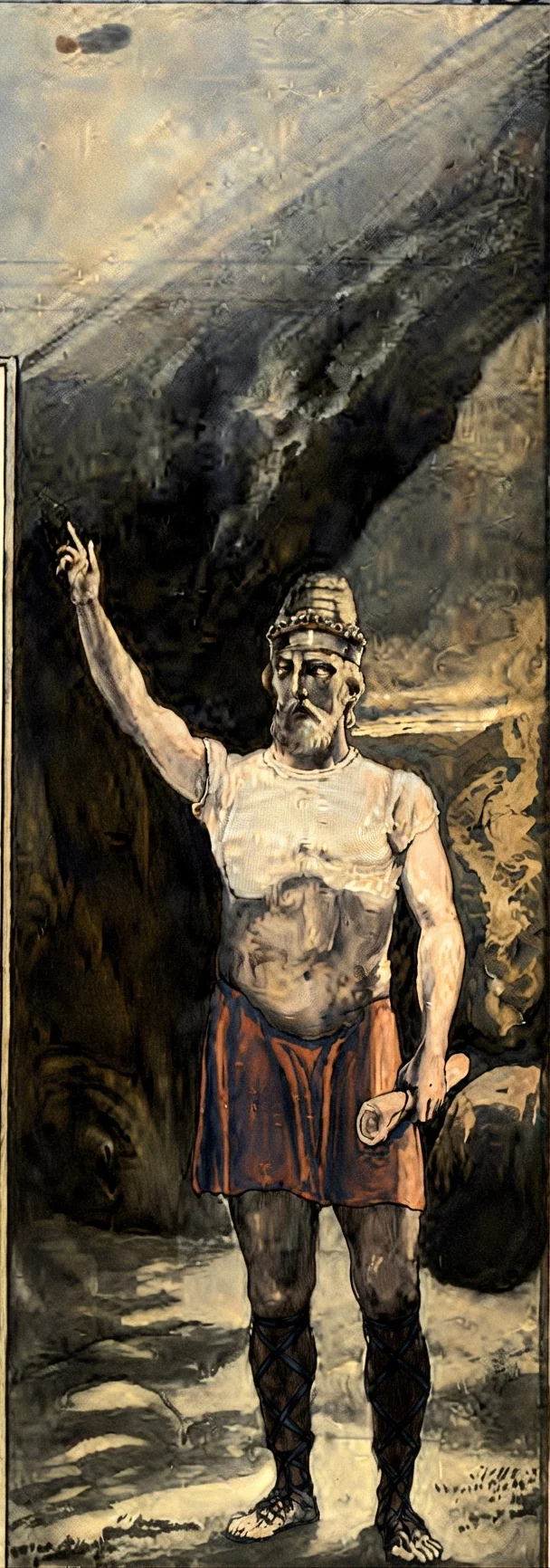
TO whom will ye liken Me, and make Me equal, and compare Me, that we may be like? . . .
¶ Remember this, and show yourselves men; bring it again to mind, O ye transgressors. Remember the former things of old: for I am God, and there is none else; I am God, and there is none like Me; declaring the end from the beginning, and from ancient times things that are not yet done; saying, My counsel shall stand, and I will do all My pleasure; calling a ravenous bird from the east, the man of My counsel from a far country; yea, I have spoken, I will also bring it to pass; I have purposed, I will also do it.
¶ Harken unto Me, ye stout-hearted, that are far from righteousness: I bring near My righteousness, it shall not be far off, and My salvation shall not tarry; and I will place salvation in Zion for Israel My glory. Isa. 46:5-13.

"IF YE WILL INQUIRE, INQUIRE YE."

This Inquirers' Department is conducted for the purpose of helping those who are studying the Bible. The answers are oftentimes only suggestive. They are never to be considered infallible, only as they agree with the infallible Word. The writer who may answer them does not consider that his opinion is infallible. He will simply give the best that he has, and plead with the inquirer to search the Word. Such questions only will be answered as, to the editors, seem to minister to the good of the readers and to the mission of the paper. We can not answer repeatedly in the same volume questions upon the same scripture. The name and address must accompany question, not for publication, but as an evidence of good faith, and that answer may be made by letter if deemed advisable. No letters are answered which do not contain the name of the writer. It is well always to enclose stamp for reply.

3701 — A Perversion of His Word

I send you a little question and answer appearing in the "Christian Witness and Advocate of Bible Holiness" of February 3, 1910. You may not have seen this explanation before. R. R. T.
For the interest of our readers we give the little clipping:
"Why do we not keep Saturday for the Sabbath instead of the first day of the week?
"Ans.—Christ endeavored in vain to correct the burdensome observance of the Sabbath, thinking it a sin to heal the sick or to turn them in bed. He saw the only relief possible would be the change of the day, making the Sabbath the memorial of the resurrection instead of the creation.
"Why did He not make the change Himself?
"Ans.—Because it was one of the things that His own disciples could not bear, and so it was left for the Holy Spirit to do this in a gradual way. Hence the disciples met for worship on the first day, and John was in the Spirit on the Lord's day, meaning the first day."
We may remark this, that the answer is an utter perversion of God's Word. Think of it — that the only way the Lord can correct a transgression of one of His laws is to change the law. What would men think of the dignity of an earthly power that would stoop to such an act?
Here is England, for instance, or the United States, that has a good law for its people, one founded in the very nature of things itself, one which would be of benefit to all; but there are those who have broken that law, and the government should say, "Well, the only possible way that I can get out of this trouble is to change the law." And then think of what this would involve regarding the Sabbath. Now Sunday is, as one writer has expressed it, "the wild solar holiday of all pagan times," a day that has been especially set apart for the worshiping of the heathen god the sun, and many times with the worst sort of licentious nature-worship. But the Lord is so hard-pressed because the Jews have perverted the Sabbath law, that He must perforce change from this day to a day that has been perverted a thousand times worse by the heathen! We do not know how inconsistency could go much farther. Then, too, if that be true, why not treat His other commandments in that way? The Jews had perverted every commandment of God's law. Our Lord especially mentions the fifth commandment. They had said that all their property was placed upon the altar—"corban;" it could not be used for their parents' support, and so they got rid of supporting their aged parents. If our Lord had been moved by such motives as are here presented, He would have said, "Well, now, that law has been perverted, and the best thing I can do is to change the law, and so I will give a different law regarding 'Honor thy father and thy mother.'" He did not so make a change; He has not so stated it in His Word. He has told us that that law can not be changed in one jot or tittle. Of course He did not make the change Himself, nor did His disciples make the change, nor did the Holy Spirit in any gradual way. All the change that came about in the observance of the holy day came about through apostasy. We do not mean by this that good men have not kept the first day of the week, believing that they were doing God's will. Good men have passed counterfeit bills, and did not know it. God judges man from motive, not always from knowledge. These good men who passed the counterfeit money would not have passed it had they known it; they would have chosen the genuine. And the good men who have observed the first day of the week would not have observed it had they known God's law and its meaning. They would have preferred the seventh day. John was in the Spirit on the Lord's day; but the Lord's Book tells us, in the Lord's own words, what day is the Lord's day. See Mark 2:27, 28; Isa. 58:13; Ex. 20:10.

3702 — Tormented Forever and Ever

Kindly explain the meaning of Matt. 25:41, and also Rev. 20:10.
Matt. 25:41 speaks of everlasting punish-ment, not everlasting punish-ing,—not a progressive process, but a completed act, a punishment which meets its finality. It is set over against what the righteous receive—life eternal; and the opposite of life eternal is eternal death, eternal cessation of existence. Let the Word of God tell us just what the meaning of "everlasting punishment" is. Turn to 2 Thess. 1:9. "Who shall be punished with everlasting destruction." Certainly this is very emphatic. The same thing is taught in Rom. 6:23: "The wages of sin is death; but the gift of God is eternal life through Jesus Christ our Lord." John the Baptist teaches the same thing: "He will . . . gather His wheat into the garner; but He will burn up the chaff with unquenchable fire." Matt. 3:12.
Rev. 20:10 declares that "the devil that deceived them was cast into the lake of fire and brimstone, where the beast and the false prophet are [were cast], and shall be tormented day and night forever and ever." The whole cue to this text turns on the word "tormented." The original Greek word is "basanos," a touchstone, or a stone from Lydia, called in Latin "lapis Lydius," used as a test stone to show alloy in metals by rubbing the metals upon it—at least it was supposed that it would do this—to try whether the metal was pure, or whether it contained alloy. God's touchstone is fire. "Every man's work shall be made manifest: for the day shall declare it, because it shall be revealed by fire; and the fire shall try every man's work of what sort it is." 1 Cor. 3:13. The same thing is set forth in a text before referred to, Matt. 3:12: "He will burn up the chaff with unquenchable fire." See also Isa. 33:14: "Who among us shall dwell with the devouring fire? who among us shall dwell with everlasting burnings?" And we are told in the next verse, "He that walketh righteously, and speaketh uprightly." So when the presence of God shall set on fire the very foundations of the earth, the righteous will endure as did the three Hebrew children in the fiery furnace. Those who know not God will perish, and perish forever and ever in the fires of the last day. For a fuller explanation of these texts and others, see Bible Students' Library, No. 111, "Tormented Forever and Ever." Price 2c.

3698 — The Great God

Please explain Titus 2:13, especially the expression “the great God and our Saviour Jesus Christ.” Will God the Father come when our Lord Jesus comes? L.
That the Father will not come is quite clear, but only our Lord. But when He does come, as recorded in Matt. 16: 27, “The Son of Man shall come in the glory of His Father,” or as stated in Luke 9: 26, “shall come in His own glory, and in His Father’s, and of the holy angels.” Read Titus 2:13 as in the American Revised Version, and you will see the perfect harmony with these scriptures: “Looking for the blessed hope and appearing of the glory of the great God and our Saviour Jesus Christ.” Our Saviour will come in the glory of the great God.

3699 — The First Love, Rev. 2:4

Please explain Rev. 2:4: "Nevertheless I have somewhat against thee, because thou hast left thy first love."
Simply this: that the ardor and zeal of that Ephesus church at first manifested had departed. How true that is of many Christian converts! They start out with earnest zeal for God; nothing is too hard for them if they know the Master requires it. Even sacrifice itself becomes a joy; but after a time, through lack of service, of prayer, or reading of the Word of God, Christian duties become a weariness, and the first love departs. God would have the first love retained,—a warm, earnest zeal and affection for the Master, which is willing to labor and have patience and bear for His name's sake. He tells how this first love may be restored, and that is by doing the first works, repenting of all sin, and coming to God for a fresh baptism of His grace.

3700 — Your Speech

Please explain Col. 4:6. J. C. W.
The scripture reads, "Let your speech be alway with grace, seasoned with salt, that ye may know how ye ought to answer every man." The text is quite clear. The grace, of course, is in harmony with the grace of God. Our speech should be such as would commend the Gospel of the Lord Jesus Christ, as stated in verse 17 of the chapter previous: "And whatsoever ye do in word or deed, do all in the name of the Lord Jesus." Salt was used as the symbol of a preservative, that which preserved from decay. It was a very striking thing in ancient days. It is even so now among the nomadic tribes of the Arabian desert. If one eats salt with a robber chief, that robber chief will regard him as a friend forever after. They have eaten salt together. It was a sacred emblem, and must always be present in the sacrifices of the Lord. No sacrifices were to be offered without salt. And so the speech of God's children should be that which is worthy of preservation, seasoned with that salt of piety that will make it worthy, and will carry its worthiness into other hearts, as well. Having a heart to do this, one would be made wise of God to answer every man.

3703 — Bible Versions

Would it be any help to one in the study of the Bible to get the Revised Version, the Septuagint, or what is called the "Emphatic Diaglott," or word-for-word translation? Do you have those books for sale? and what do they cost?
Our catalog will be sent our correspondent, so that he can see what we keep for sale. The Septuagint is helpful many times, in throwing light on the Old Testament. It is a Greek translation of the Old Testament, made 250 to 300 years before Christ. Preferable to the "Emphatic Diaglott" is the Classic Interlinear Translation, or the Greek-English New Testament, by Hinds and Noble. The Revised Version is always good. It is the best English translation there is on the earth, in our opinion.

Loaning of Money

3704 — Loaning of Money.—It certainly is proper, if one has money which he does not wish to use, and he does not need income from it, to loan it to a missionary enterprise. It would seem as if a Christian would prefer to do this, rather than to deposit it in a bank, if that missionary enterprise is in need of funds at such a time. Of course if one's money is all his capital, and he is so situated, either through ill health or lack of labor, that he must have interest on it for his support, we do not see why it is not entirely proper to have a proper rate of interest. But if one does not need that interest, surely it would seem that he would not care to take it from needy missionary enterprises.

3705 — The Sealed Book

Please explain Rev. 5:2, 3. H. L.
This was quite fully explained in articles which appeared not long ago in the "Signs of the Times" on the Revelation itself. The chapter records a vision which John saw. He saw God sitting upon the throne with a sealed book in His hand. He heard a challenge go forth from a strong angel: "Who is worthy to open the book, and to loose the seals thereof?" And he tells us farther that no man in heaven or in earth was able either to open the book or to look thereon. It required something more than man could do. That book contained the salvation of men, the great Gospel work of our Lord Jesus Christ. The opening of it cost the very sacrifice of the Son of God, as shown in verses 5, 6, 9. It required God to create men; it required God to redeem men, and our Lord Jesus Christ was the one who was able to meet the challenge of the angel.
Schedule for Week Ending April 6, 1912

Schedule for Week Ending April 6, 1912

Sunday March 31 Judges 1, 2
Monday April 1 " 3, 4
Tuesday " 2 " 5; Ps. 145
Wednesday " 3 " 6, 7
Thursday " 4 " 8; Ps. 38
Friday " 5 " 10, 11
Sabbath " 6 Psalms 22, 23

Readings from Judges and Psalms

Our readings for the week are in the book of Judges, with the omission of chapter 9, an interesting narrative, by the way, but one not having special bearing on the greater movements among God's children. We have also connected with the daily readings Psalms 145 and 38, and close with Psalms 22 and 23. Psalm 22 is a prophetic utterance through David of the sufferings and experience of our Lord Jesus Christ for the children of men. How clearly and strongly they are brought out! Some of them, of course, were worked out in the life of David, but all in their fulness of agony and sacrifice in the life of our Lord Jesus Christ. How precious, after reading that psalm, to read the comforting assurances of Psalm 23!

Looking unto Jesus

By Mrs. E. G. White
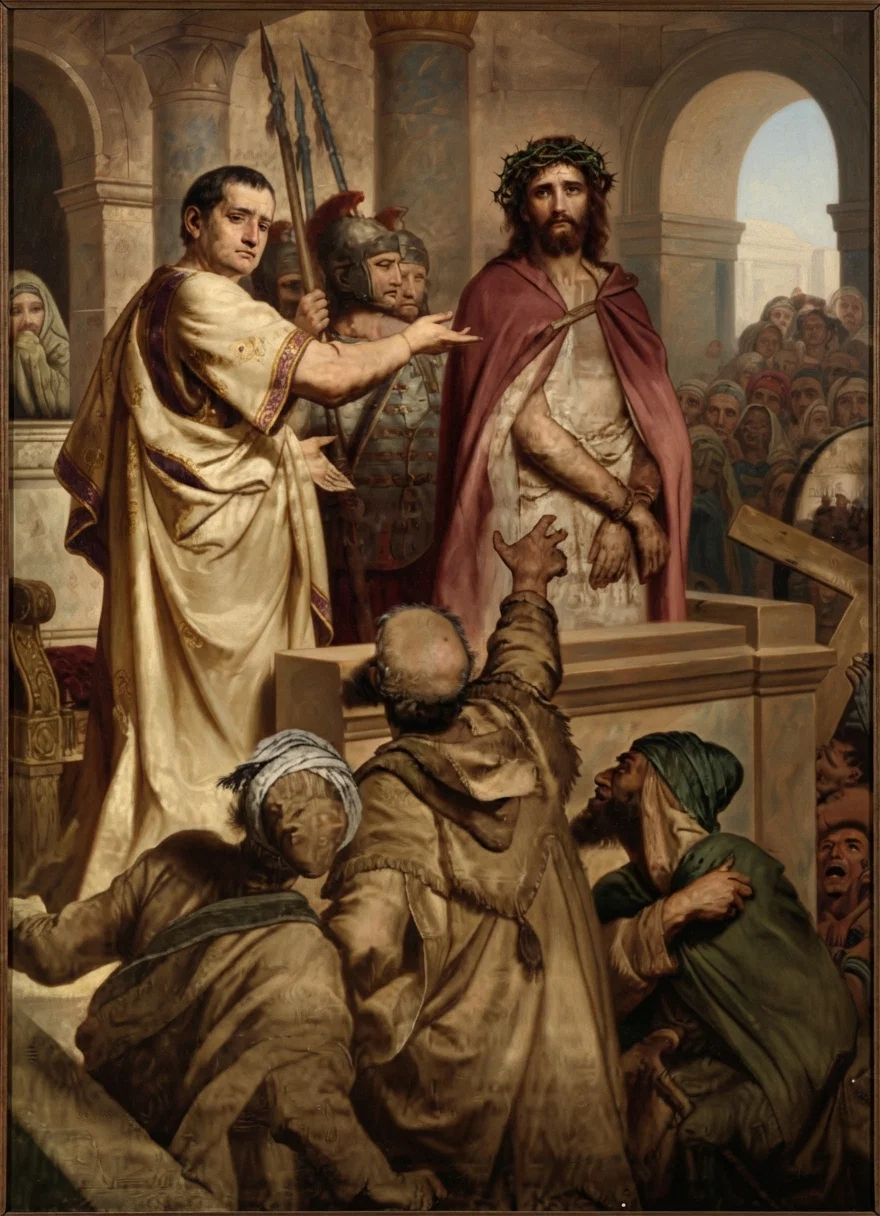
CHRIST BEFORE PILATE
AND there were certain Greeks among them that came up to worship at the feast: the same came therefore to Philip, which was of Bethsaida of Galilee, and desired him, saying, Sir, we would see Jesus. Philip cometh and telleth Andrew: and again Andrew and Philip tell Jesus." At this time Christ's work bore the appearance of cruel defeat, and to His disciples the case seemed hopeless. But Christ was approaching the consummation of His work. An event which concerned not only the Jewish nation, but the whole world, was about to take place. When Christ heard the eager, hungering cry, "We would see Jesus," His countenance lighted up, and He said, "The hour is come, that the Son of Man should be glorified." He went out to the court of the temple where the multitude was assembled; for at the time when the disciples came to Him, He was in that part of the temple from which all but the Jews were excluded. He met the Greeks, and had a personal interview with them.
These men, coming from the West at the close of Christ's life on earth, represent what the wise men from the East represented at the beginning of Christ's life. At the time of Christ's birth the Jewish people were not studying the prophecies regarding the momentous events about to take place. So engrossed were they in their own ambitious plans, that they knew not the time of the Messiah's advent. Angels found them unprepared to receive the Saviour; and the communication which should have been given to priests and rulers, was given to humble shepherds. These, guided by a bright star, came to the birthplace of Christ, and worshiped Him. The magi, too, came to the manger with gifts, and frankincense, and myrrh.
So these Greeks, representing the nations, tribes, and peoples that would awake to their need of a power out of and above finite power, came to see Jesus. They had heard of Christ's triumphal entry into Jerusalem, and they longed to be instructed as to the hopes of the Jewish nation regarding the Messiah. Some supposed, and had circulated the report, that Christ had driven the priests and rulers from the temple, and that He was to take possession of David's throne, and reign as king of Israel. "We would see Jesus," they said.
The hour of Christ's glorification had come. He was standing in the shadow of the cross, and the inquiry of the Greeks showed Him that the sacrifice He was about to make would bring all who accepted Him into perfect harmony with God. He knew that the Greeks would soon see Him in a position they did not then dream of. They would see Him placed beside a robber and murderer, who would be chosen before the Son of God. They would hear the people, inspired by the priests and rulers, making their choice. As the bellowing of wild beasts their voices would be heard, saying, "Release unto us Barabbas." And to the question of Pilate, "What shall I do then with Jesus which is called Christ?" the answer would be given, "Let Him be crucified."
By making this propitiation for man's sins, Christ knew that His kingdom would be perfected and would extend throughout the world. He would work as the Restorer, and His Spirit would prevail. For a moment He looked into futurity, and heard the voices proclaiming in all parts of the earth, "Behold the Lamb of God, which taketh away the sin of the world." The anticipation of this, the consummation of His hopes, is expressed in the words, "The hour is come, that the Son of Man should be glorified." But the way in which this glorification must take place was never absent fromChrist's mind. Only by His death could the world be saved. As the grain of wheat, the Son of Man must be cast into the ground, and die, and be buried out of sight; but He was to live again.
None of the people, not even the disciples, understood the nature of Christ's kingdom. O, how His patience must have been taxed by the low estimate placed by men upon His mission and character! They seemed unable to believe that He would not sit on David's throne, that He would not take the scepter, and reign as a temporal prince in Jerusalem.
Words true and full of significance when rightly placed are misleading when misapplied. The utterances of the prophet describing the second appearing of Christ were applied by the Jewish teachers to His first advent. The description of Christ's second coming is true; but this truth, the beautiful and grand, could not be made to harmonize with His first coming. The word was true, but it was truth placed in the wrong setting.

They Could Not Understand

Christ had often tried to tell His disciples the truth concerning His work, but they were unable to take it in. He gave them lessons which they could in no wise comprehend. He longed to open everything before them; but He was obliged to say, "I have yet many things to say unto you, but ye can not bear them now." He was laboring to keep back the revelation He desired to make. He knew that if He told them what He desired to, His words would not be appreciated or understood. The impressions made upon their minds by the maxims and traditions with which they had been familiar from their youth, were difficult to efface.
But after Christ's crucifixion, Jew and Greek, barbarian and Scythian, bond and free, would be able to understand His work, and to comprehend the words which upon this occasion He addressed to His disciples. "Verily, verily, I say unto you," He said, "Except a corn of wheat fall into the ground and die, it abideth alone: but if it die, it bringeth forth much fruit." Christ saw that the fallow ground of the heart must be broken up, the soil thoroly worked, the good seed sown and carefully harrowed in. It was not pleasant for the disciples to submit to this. Many opposite influences had been at work, confusing and beclouding their minds. But with what wisdom Christ presents His future, illustrating it by the things of nature, that the disciples might understand that the purpose of His mission was to be fulfilled by His death. "Verily, verily, I say unto you," He said. When Christ said, "Verily, verily," the disciples always understood that something of importance was to follow; and now, as they listened to His words, they saw divinity revealed in humanity. "Verily, verily, I say unto you, Except a corn of wheat fall into the ground and die, it abideth alone: but if it die, it bringeth forth much fruit." When the grain of wheat falls into the ground and dies, it springs up, and bears fruit. So the death of Christ would result in fruit for the kingdom of God. Life was to be the result of His death, in exact accordance with the law of the vegetable kingdom.

Lessons of Nature—Death of Self

Every harvest this lesson is repeated. Those who till the soil have the illustration of the Saviour's words ever before them. Year by year man preserves his grain by apparently throwing away his choicest sample. For a time this must be hidden under the furrow, to be watched over by the Lord. Then appears the blade, then the ear, and then the corn in the ear. But this development can not take place unless the grain is buried out of sight, hidden, and, to all appearances, lost.
The seed buried in the ground produces fruit, and in their turn the seeds of this fruit are planted. Thus the harvest is multiplied. So the death of Christ on the cross of Calvary will bear fruit unto eternal life. The contemplation of this sacrifice will be the glory of those who, as the fruit of it, will live through the eternal ages.
With this lesson Christ connects the self-sacrifice that all should practise. "He that loveth his life shall lose it," He declares; "and he that hateth his life in this world shall keep it unto life eternal. If any man serve Me, let him follow Me; and where I am, there shall also My servant be: if any man serve Me, him will My Father honor."
This is the only honor we should seek. And we should seek it with a determination and an earnestness proportionate to the value of the treasure we have in view,—eternal life in the kingdom of God. Christ claims the complete consecration of man to Himself. This is the condition upon which man is exalted. As he submits his mind, his body, his soul, to God, so he will be honored. Self-renunciation is the great law of self-preservation, and self-preservation is the law of self-destruction.

Sow Here for Eternity

He who lives for self, and devotes his life to self-serving, will lose his life. He may gather much, but he imparts little. All such are as the grain that is eaten. Those who think and plan for self only, who desire everything to minister to their ideas and advance their interests, pursue a course of selfish idolatry. God says of them, "Ephraim is joined to idols: let him alone." Those who love this temporal life so well that they will scheme for themselves, and work upon worldly plans, will find at last that they are bankrupt; for they are without the eternal riches. But those who hate this life, who choose death rather than a life without Christ, win heaven. Those who devote their lives to God's service, who honor Him, and commit the keeping of their souls to Him as unto a faithful Creator, will bring forth fruit unto eternal life. The Lord will keep that which is committed to His trust against that day. He will honor the man who serves Him with the whole heart.
(Concluded next week)

The Promises to Abraham

V—Paradise Restored

It is said that Abraham, "when he was called to go out into a place which he should after receive for an inheritance, obeyed; and he went out, not knowing whither he went. By faith he sojourned in the land of promise, as in a strange country, dwelling in tabernacles [tents] with Isaac and Jacob, the heirs with him of the same promise: for he looked for a city which hath foundations, whose builder and maker is God." Heb. 11: 8-10. In the record of this experience, found in Genesis, nothing is said about a city; but here it is evident that God promised to give Abraham a city with the earth.
This city will be the capital of the kingdom over which Christ will reign. "When the Son of Man shall come in His glory, and all the holy angels with Him, then shall He sit upon the throne of His glory. . . . Then shall the King say unto them on His right hand, Come, ye blessed of My Father, inherit the kingdom prepared for you from the foundation of the world." Matt. 25: 31-34. The city will be the metropolis of the kingdom.

Frequent Mentions of the City

The Scriptures make frequent reference to this city as the home of God's people. In the fourth chapter of Galatians a contrast is drawn between the old Jerusalem and the new. Old Jerusalem is said to be in bondage with her children; "but Jerusalem which is above is free, which is the mother of us all." Gal. 4: 25, 26. She is the mother, the metropolis of the kingdom.
The Saviour alluded to this when He said: "In My Father's house are many mansions: if it were not so, I would have told you. I go to prepare a place for you." John 14: 2. This is that city filled with mansions which God promised Abraham and his seed, and which forms part of their inheritance.
Again we read, "For here have we no continuing city, but we seek one to come." Heb. 13: 14. "But ye are come unto Mount Zion, and unto the city of the living God, the heavenly Jerusalem." Heb. 12: 22. That is the city of peace—for that is the meaning of its name. There the "Prince of Peace" shall reign over those of whom it is written, "Blessed are the peace-makers: for they shall be called the children of God." Matt. 5: 9.
Isaiah exclaims concerning this city, "Look upon Zion, the city of our solemnities: thine eyes shall see Jerusalem a quiet habitation, a tabernacle that shall not be taken down." Isa. 33: 20. That great city is here called a "tabernacle," no doubt to convey the idea that it is a movable city. A tabernacle is a structure that can be moved, therefore a city to be moved might properly be called a tabernacle; for we read, "I will write upon him . . . the name of the city of My God, which is New Jerusalem, which cometh down out of heaven from My God." Rev. 3: 12.

The City Descending to Earth

There was given to the prophet a view of the city as it descends, at the end of the millennial age, when the earth has passed through its desolations. He gives this description: "And I saw a new heaven and a new earth: for the first heaven and the first earth were passed away; and there was no more sea. And I John saw the holy city, New Jerusalem, coming down from God out of heaven, prepared as a bride adorned for her husband. And I heard a great voice out of heaven saying, Behold, the tabernacle of God is with men, and He will dwell with them, and they shall be His people, and God Himself shall be with them, and be their God. And God shall wipe away all tearsfrom their eyes; and there shall be no more death, neither sorrow, nor crying, neither shall there be any more pain: for the former things are passed away." Rev. 21: 1-4.
Again the angel said to the prophet, "Come hither, I will show thee the bride, the Lamb's wife. And he carried me away in the Spirit to a great and high mountain, and showed me that great city, the holy Jerusalem, descending out of heaven from God, having the glory of God: and her light was like unto a stone most precious, even like a jasper stone, clear as crystal." Rev. 21: 9-11.

The City Described

The prophet then tries to describe the city: "And the city was pure gold, like unto clear glass." Verse 18. It "lieth four-square." Verse 16. Its circumference is twelve thousand furlongs, or three hundred and seventy-five miles on each side, inclosing more space than is contained in the States of Illinois, Indiana, Ohio, and Connecticut combined.
Its wall, "great and high," is worthy of special notice. It had twelve foundations of precious stones of wondrous size, and engraved on them the names of the twelve apostles. "And the foundations of the wall of the city were garnished with all manner of precious stones." This must be the city Abraham saw, "which hath foundations, whose builder and maker is God."
Twelve gates of pearl, each gate being one pearl, are found in the walls. "And the gates of it shall not be shut at all by day: for there shall be no night there." "And the street of the city was pure gold, as it were transparent glass." "And the city had no need of the sun, neither of the moon, to shine in it: for the glory of God did lighten it, and the Lamb is the light thereof." Another description states that "then the moon shall be confounded, and the sun ashamed, when the Lord of Hosts shall reign in Mount Zion, and in Jerusalem, and before His ancients gloriously." Isa. 24: 23.

No Curse nor Sorrow There

In this city "there shall be no more curse: but the throne of God and of the Lamb shall be in it." Rev. 22: 3. The Paradise of God, from which man was excluded, will be found in it; for we read, "To him that overcometh will I give to eat of the Tree of Life, which is in the midst of the Paradise of God." Rev. 2: 7. No weeping eyes or breaking hearts will be found there, for God shall wipe away all tears. "And there shall be no more death, neither sorrow, nor crying, neither shall there be any more pain: for the former things are passed away." Rev. 21: 4. "And the inhabitant shall not say, I am sick: the people that dwell therein shall be forgiven their iniquity." Isa. 33: 24.

The Invitation to Be There

It is to this glorious city that God invites all His weeping, wandering exiles to come. The strangers, the sojourners, the pilgrims, are all included in the invitation. The true Israel of God, those who have had a new birth, a new name, and a new character, like Jacob of old, all are invited to come. In the soul-inspiring words of another, we, too, extend the invitation:
Come, if you would inherit mansions where sickness, sorrow, pain, and death can never enter; if you would have a right to the Tree of Life, and pluck its immortal fruit, and eat and live; if you would drink of the water of the River of Life, that flows from the throne of God, clear as crystal. Come, if you would obtain through those glittering gates of pearl an abundant entrance into the eternal city; if you would walk its streets of transparent gold; if you would behold its glowing foundation stones; if you would see the King in His beauty on His azure throne. Come, if you would sing the jubilee song of millions, and share their joy. Come, if you would join the anthems of the redeemed with their melodious harps, and know that your exile is forever over, and this is your eternal home. Come, if you would receive a palm of victory, and know that you are forever free. Come, if you would exchange the furrows of your care-worn brow for a jeweled crown. Come, if you would see the salvation of the ransomed myriads, the glorified throng which no man can number. Come, if you would drink from the pure fountain of celestial bliss, if you would shine as the stars forever in the firmament of glory, if you would share in the unutterable rapture that fills the triumphant hosts as they behold before them unending ages of glory ever brightening and joys ever new.—"Daniel and the Revelation," page 367.
Past the setting of suns stands the city Elysian, Unrevealed save to spirits anointed and free, Which the chosen behold as a glorified vision In splendor unveiled by the crystalline sea,— The clear, azure sea,—the wide-flashing sea,— The wonderful, odorous, music-toned sea,— That flows round the shores of the country of God, Which only the feet of His freemen have trod.
Its walls stand superb in the sunshine eternal; Round its turrets in ether the cloud-billows curl; Not a fair stone is stained by a shadow diurnal; And each massive gate is a portal of pearl,— One lustrous, great pearl,—a bewildering pearl,— A glorious, fathomless, mystical pearl,— That haunts me and taunts me with far-off delight, In visions of day-tide and dreams of the night.
I dream of it often when sickness and sorrow Pass over my spirit and scourge as a rod, And fill me with longings for some glad to-morrow,— Some glimpse of that city whose builder is God,— Whose founder is God,—whose maker is God,— Where the blest reign forever and ever with God; And then how it seems to grow nearer,—so near That the strains of its music break low on my ear!
And then, as its splendors are spread out before me, Enchanting my senses, alluring my soul, What billows of rapture roll o'er me and o'er me, Till earth and its troubles from under me roll;— Beneath me they roll,—far away from me roll,— As distant as east from the west is their roll;— And I seem like a child on the warm, loving breast Of a mother who soothes it, and lulls it to rest.
Shall we see it? Ah, yes! for us it was builded,— For us its foundations were measured of old,— For us were its turrets of ivory gilded, Its battlements burnished with silver and gold,— With virginal gold,—with yellow, bright gold,— And metals more precious than silver and gold,— For us it is waiting, who wearily roam As aliens afar from our country and home.
How often—God help us!—far from it we wander, Our bruised feet marking the way with our blood; Of the joys of this life growing fonder and fonder, As if over yonder no proud city stood,— No bright city stood,—no light city stood,— No royalest, comeliest, white city stood,— While we who are heirs of a kingship divine Are content with the husks and the huts of the swine.
Continue reading: What Shall We Do with the Fourth Commandment?