The completely worthless character of such "evidence" of age as considered last week becomes, if possible, more apparent when we consider that very many of these so-called "extinct" forms are perhaps not really distinct (physiological) species from their living representatives of to-day. For, in spite of all that we have learned about variation, there seems to be little or no allowance ever made for the effects of a certainly greatly changed environment. If the fossil forms are not precisely like the modern in every respect they are always classed as separate species, in utter disregard of the striking anatomical differences between the huge Pleistocene mammals and their dwarfish descendant of to-day, which for a hundred years or so were positively said to be distinct from one another, but are now acknowledged to be identical.
A Strong Assertion Disproved.
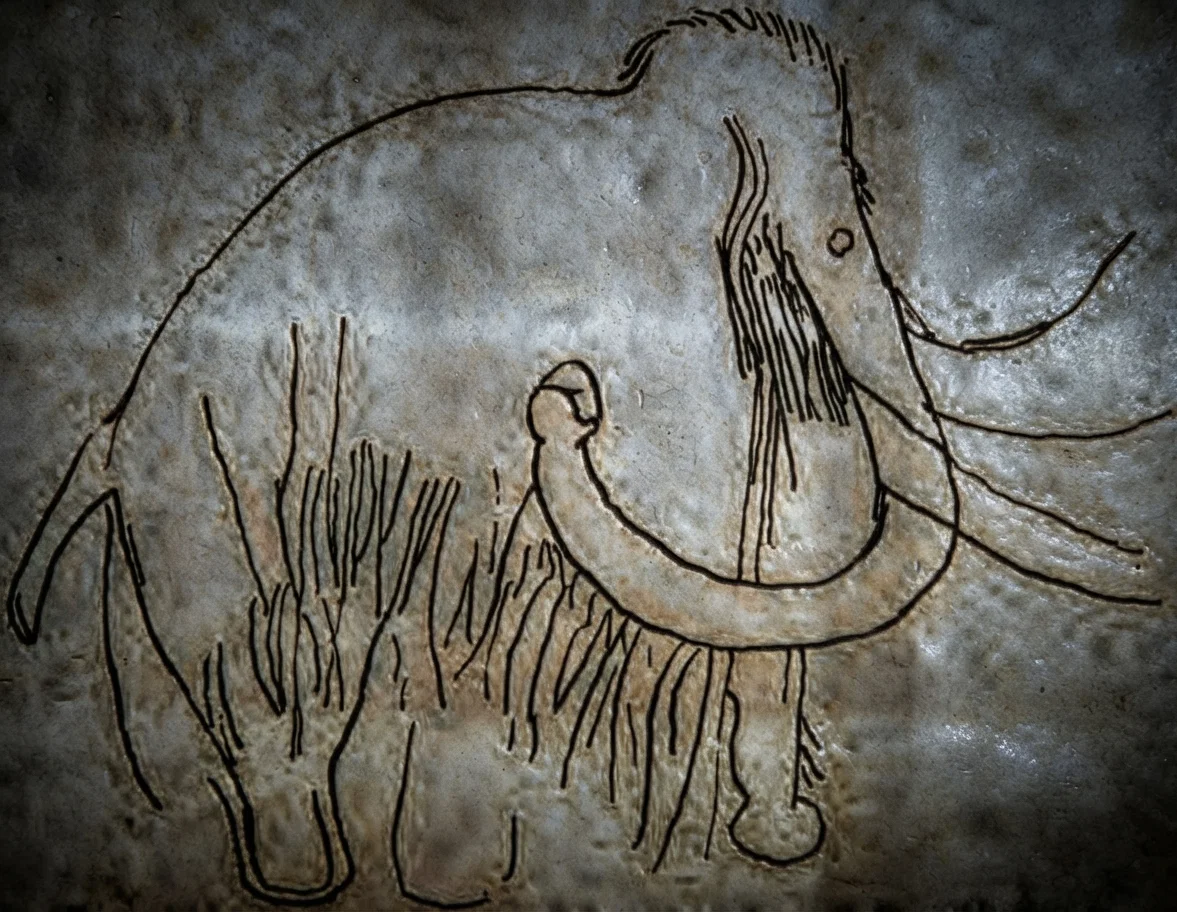
Of course no one denies that the strata teem with forms extinct for thousands of years, forms which we moderns have never seen alive. Other forms do not appear familiar to our modern eyes, because larger or of somewhat different form; but to say that they are actually distinct species from their modern representatives or that no human being has ever seen them alive, are statements utterly incapable of proof. Up to about the year 1860 it was stoutly maintained that man had never seen any of these fossil forms alive. But no one now maintains this view, for human remains have now been found along with undisturbed fossils of the Pleistocene, or even middle Tertiaries, while the drawings and paintings on the cave walls of southern France represent reindeer, mammoths, etc., side by side, and are so wonderfully accurate that no one can doubt that they were copied from life. Hence, the only question now (from a scientific standpoint) is, with how much of that ancient fossil world were these equally fossil men acquainted? If man lived in "Miocene times," when even according to the geological arrangement a luxuriant vegetation spread over all the Arctic regions, what possible evidence is there to show that his companions, the rhinoceros, hippopotamus, mammoth, etc., were not also living then and browsing off just such plants, when the arctic frosts caught them in the grip of death and preserved their "mummies" untainted for our astonishment and scientific information? Things which are equal to the same thing are equal to each other; why should not plants and animals, contemporary with the same creature (man), be acknowledged to be contemporary with one another? If man was positively contemporary with the Miocene vegetation (I am still arguing from the popular scientific standpoint), and the Pleistocene mammals are now acknowledged on all sides to have been contemporary with man, what is there to forbid the idea that the Pleistocene mammals and the Miocene flora were contemporary with one another?
A Possibility That Means Much.
For nearly half a century geologists have never had the courage to face this problem fairly and squarely, with all preconceived prejudices about their Uniformity fetish cast aside. Is it possible that all the Tertiaries and the Pleistocene may be really a unit after all? But the trouble would then be that, with this much conceded, the whole "phylogenic series" would tumble with it, and become only the taxonomic, or classification, series of that ancient world with which those fossil men were acquainted. To appropriate the words of another, I know of nothing against this view save "the almost pathetic devotion of a large school of thinkers to the religion founded by Hutton, whose high priest was Lyell, and which in essence was based on ‘a priori’ arguments like those which dominated medieval scholasticism and made it so barren."—Sir Henry Howorth, "The Glacial Nightmare and the Flood," pp. 20, 21.
Elephas Primigenous—the mammoth, drawn by primitive man on a cave wall, showing man to have been contemporary with the mammoth.
One Scientific Theory Abandoned.
Baron Cuvier’s work in the line of comparative osteology has never been surpassed, perhaps never equaled since, and he is generally admitted to have been the greatest naturalist and comparative anatomist of that, or perhaps of any, time (Professor Le Conte, "Evolution and Religious Thought," pp. 33, 34); and yet he maintained most positively that all, or practically all, those which we now call the Pleistocene mammals were distinct species from the modern ones; and it is only of recent years and with extreme reluctance that many of them have been admitted to be identical with the ones now living. This only came about after man was proved beyond controversy to have been contemporary with them. Hence, is there anything absurd or unfair in suggesting that a fresh discovery of human remains in rocks now classed as Mesozoic or Palaeozoic might lead to a subsequent identification with modern forms of many more species now classed as extinct?
I do not mean by this that they would probably carry the human period back into "Mesozoic" or "Palaeozoic time." O, not at all. The principle of inertia or least resistance would make it much easier to work just the other way. For, according to the very accommodating methods of this "science" the presence of human remains in any set of beds would be considered proof positive that such deposits could not possibly belong to the more "ancient" systems, but must be "Pleistocene," or at the most "late Tertiary." It would be so much easier to find a small percentage of living molluscs in some strata handy by, than to admit that these fossil men were contemporary with the whole fossil world—as the Bible really teaches.
Fossils of Living Species.
But let us proceed. I have already instanced cases where well known species have been for almost a century regarded as extinct which modern research has decided are identical with the modern living species. Such are the cave-lion (Felis spelæa), cave-hyena (Hyena spelæa), and hippopotamus (Hippopotamus Major). The great cave-bear can now be added to the list. The brown bear of the Old World and the grizzly of the Rockies have long been regarded as not specifically distinct from one another, and the most recent explorers of the Belgian caves have concluded that the various fossil varieties are probably "specifically inseparable from U. arctos," or the modern brown bear.—Nature, Nov. 7, 1901, p. 13.
It is well to remember in this connection the reluctance with which such specific distinctions are always surrendered, and that in spite of all that we have learned about the surprising possibilities of variation, little or no allowance for the potent influences of a changed environment seems ever to be made when the fossil forms are being considered. They are not all physiological species that can be separated as morphological species, and the skeleton, often only a fragment of it, is all that we have to depend upon in the case of the fossils. If the numerous varieties of the domestic dog were all extinct and known to us only as fossils, we would doubtless not only have a dozen new specific names invented immediately, but such extreme types as Pug and Greyhound, St. Bernard and Scotch Terrier, might even be erected into distinct genera; and, of course, they would all have to be arranged in single file to show their geological succession in time.
More Species than the Facts Warrant.
In view of these things it would appear from the quotation given below, that with more complete knowledge and a broader view of specific distinctions, the numerous species of fossil elephants, such as E. columbi, americanus, antiquus, etc., may be greatly reduced in number, or that the mammoth (E. primigenous) may be found to be inseparable from some of these and the ancestor of the present9Asiatic elephant (E. indicus). The bones of the skeleton of the mammoth are very like those of the modern species, but the skull differs slightly in being narrower in certain regions, while the tusks were greatly larger and their bony supports proportionately stronger. Besides we know that the mammoth had a good suit of clothing of both hair and wool, while the modern species is nearly naked. But all these changes would be just what we should expect with a greatly changed environment, and are of little weight in disproving genetic relationship, however important they may be from the standpoint of the taxonomist. Indeed it is the dentition that affords the usual guide, and according to the following statement of the highest English authorities the genetic identity of the two seems almost certain:
It is chiefly by the characters of the molar teeth that the various extinct modifications of the elephant type are distinguished. Those of the mammoth differ from the corresponding organs of the allied species in the great breadth of the crown as compared with the length, the narrowness and close approximation of the ridges, the thinness of the enamel and its straightness, parallelism, and absence of 'crimping,' as seen on the worn surface, or in a horizontal section of the tooth.
Besides these variations in the number of ridges or plates of which each tooth is composed, the thickness of the enamel varies so much as to have given rise to a distinction between a 'thick-plated' and a 'thin-plated variety'—the latter being the most prevalent among the specimens from the Arctic regions, and most distinctively characteristic of the species. From the specimens with the thick enamel plates the transition to the other species or varieties mentioned above, including E. indicus is almost imperceptible.—Flower and Lydekker, 'Mammals etc.' pp. 428-29.
The 'other species or varieties' to which our authors allude as having been already mentioned by them are 'E. columbi of America and E. armeniacus of the Old World,' and they say that the modern Asiatic elephant (E. indicus) is very like them, 'if, indeed, it can be specifically distinguished from them.'—Id. p. 428. Hence there is not a shadow of a doubt in my mind that the modern elephant of India, the king of our present land animals, is the lineal, the degenerate, descendant of the mammoth, the monarch of that older and more ideal world. The extreme reluctance with which anything like a confession of this fact leaks out in our modern literature can be readily understood when we try the hopeless task of splicing the environment of the modern with that of the ancient form on any basis of uniformity.
The Biblical Deluge is the only thing to solve the riddle.
(Continued next week.)
"LORD, TEACH US TO PRAY."
By Ellen G. White
BY MRS. E. G. WHITE.
It came to pass, that, as He was praying in a certain place, when He ceased, one of His disciples said unto Him, "Lord, teach us to pray, as John also taught his disciples." And Jesus answered them in the words of the Lord's Prayer.
"When ye pray," He said, "say, Our Father which art in heaven, Hallowed be Thy name. Thy kingdom come. Thy will be done, as in heaven, so in earth. Give us day by day our daily bread. And forgive us our sins; for we also forgive every one that is indebted to us. And lead us not into temptation; but deliver us from evil."
"Our Father which art in heaven." The word "our" expresses a sense of human brotherhood; the word "father" that of childlike trust. In ancient time there was usually associated with the name "father" all the affection and tenderness now centered in the word "mother."
When from the heart we say, "Our Father," we worship God in truth. This petition carries the suppliant away from earth and human beings to the One who is unerring in judgment, compassionate, merciful, pure, and holy.
"Hallowed be Thy name." Thus we give expression to our reverence for the divine One. All true prayer will first recognize the presence of God, whose eye is open to all that His creatures do. The suppliant's first work is to honor God by giving expression to his reverence for Him.
"Thy kingdom come. Thy will be done, as in heaven, so in earth." In heaven the will of God is perfectly carried out. Love to God makes service a joy. On earth there is rebellion and variance. The disobedient and rebellious can not understandingly repeat the Lord's Prayer. Their will has never submitted to discipline, and until they are brought into conformity to the will of God, they can not intelligently pray that His will may be done on earth as it is in heaven. It should be the prayer of every true follower of Christ that God will subordinate everything in this world to His will.
Our temporal necessities also are to be the subject of our petitions. We are to call upon God for food. "Give us day by day our daily bread," Christ said. But we are not to ask God for food, and then sit idly down, doing nothing. In order that our wants may be supplied, our heavenly Father puts work into our hands, that we may co-operate with Him in answering our prayer for food.
"And forgive us our sins; for we also forgive every one that is indebted to us." Few realize the true import of these words. After completing the Lord's Prayer, as given in the sixth chapter of Matthew, Jesus added, "If ye forgive men their trespasses, your heavenly Father will also forgive you. But if ye forgive not men their trespasses, neither will your Father forgive your trespasses." He who is unforgiving cuts off the very channel through which alone he can receive mercy from God. However sorely we may have been wounded, we are not to cherish our grievances, and sympathize with ourselves over our injuries; but as we hope to be pardoned for our offenses against God, we are to pardon all who have done evil to us.
"Lead us not into temptation." God sometimes allows Satan to tempt His children, that they may be proved and tested. If they rely on their own strength, they will fail in the trial; but if they realize their inability to help themselves, and trust wholly in God, He will provide a way of escape. There are times when it is necessary for men to be exposed to danger, and to be placed among corrupting influences, but a sense of their dependence on God will lead them to keep their hearts uplifted to Him in prayer every hour, for strength to resist and grace to overcome. The experience gained in these fierce conflicts fortifies the soul to pass unscathed through more trying ordeals.
Christ prayed to His Father in behalf of His followers, "I pray not that Thou shouldst take them out of the world, but that Thou shouldst keep them from the evil." Sin and pollution abound on every hand, and daily, hourly, the prayer should ascend to heaven, "Deliver us from evil." The offering of this prayer by one who realizes his weakness makes the temptation of the enemy powerless.
Busy People Working for God
When Jesus called His disciples, it is a remarkable circumstance that He never called a single idler or loafer. They were all busy people. It is by these busy classes that everything is done, and it is to them that the world looks for all enterprise and progress. When anything is to be done in the church, no one ever thinks of calling upon the people of leisure. The busiest men and women are the only ones that have time to work for God, and they are the only ones that bear most cheerfully the heat and burden of the day.—Methodist Advance.
Zeal Without Knowledge
ZEAL without knowledge is like haste to a man who is walking in the dark.—John Newton.
CONCERNING BANKERS.
By Walter E. Gillis
BY WALTER E. GILLIS.
HAVE you ever considered the banker? An interesting character, indeed. He is a man of means whose business in life is to receive and pay out money. His place of business has come to be one of the greatest conveniences of modern civilization.
To my mind this interesting individual points a very vital Gospel lesson. In fact, every experience, every fact, connected with physical life has its wealth of wisdom for the spiritual wayfarer.
As you know, the banker receives deposits of money from his patrons, to be paid out on demand by check issued and signed by the depositor; and the style of these checks is mandatory. It is not "please pay," or "will you pay," but it is "PAY to bearer or order." The depositor issues his check knowing that his money is in the bank for its redemption. But should that banker be so foolish as to dishonor the check by refusing to cash it, how long do you suppose the depositor would leave his money in those vaults? Most certainly not longer than it would take to have it removed.
Of this example this is the sum: Our heavenly Father has founded a great system of banks throughout the world and made all His children bankers, depositing with them all the riches of heaven in the person of His dear Son Jesus. And upon these bankers He has issued checks to every needy soul coming in touch with them. These checks are variously worded, but the fund deposited is unlimited and suited to the demands of all.
I will quote a few:
"Go ye into all the world, and preach the Gospel to every creature." Mark 16:15.
"As we have therefore opportunity, let us do good unto all men." Gal. 6:10.
"Thou shalt love thy neighbor as thyself." Gal. 5:14.
"The Spirit of the Lord God is upon me . . . to proclaim liberty to the captives; . . . To proclaim the acceptable year of the Lord." Isa. 61:1, 2. Have we received Christ? Then are we stewards of the wealth of Jehovah and daily these checks are being presented for us to honor. If we do not honor them, how long suppose you shall we be made the channels of so great blessings? Lift the cross and wear the crown.
Mountain View, Cal.
THE SABBATH
By L. A. Phippeny
THE SABBATH BLESSING.
THERE is a special Sabbath blessing. But this blessing can be fully appreciated only through fullest obedience, and by following in the footsteps of the Master, and doing the works that He did.
There is no special blessing to be had by keeping the Sabbath as a matter of form. There must be the fullest obedience from the heart. If there is no soul-rest, the outward form can avail little for the individual. If there is indifference in the heart, such observance and obedience are little short of pollution of the Sabbath, and the urgent need of the individual is humbling of self, and earnest seeking of God, until the heart is made right.
The Secret of the Matter.
Herein lies the secret of the whole matter. The Lord asks us to give Him all that we have and all that we are, or hope to be. Entire consecration and submission to the divine will are necessary, for individuals to realize to the fullest any blessings that the God of heaven has to bestow upon them. And then the blessings will not only bless the recipients themselves, but the Lord will cause these blessings to flow on from them to others. He will use the blessed ones as His agencies, His ministers. Such was God's design for Israel of old, and it is His design for spiritual Israel of to-day. "Ye shall be named the priests of the Lord; men shall call you the ministers of our God." Isa. 61:6. "Ye are a chosen generation, a royal priesthood, a holy nation, a peculiar people; that ye should show forth the praises of Him who hath called you out of darkness into His marvelous light; which in time past were not a people, but are now the people of God; which had not obtained mercy, but now have obtained mercy." 1 Peter 2:9, 10.
When the Lord would lead Israel from bondage into liberty, these great truths were placed before them, and the blessings which were to be theirs, if they would obey Him, were enumerated in detail. They would be blessed in the home and in the field; in flocks and in herds—"thou shalt be blessed above all people." They were to be lenders, and not borrowers; they were to be the head, and not the tail. And all nations should wonder at their wisdom, and through them would learn of the true God, and of His salvation.
The Blessing of Health.
But above all other blessings which count for happiness in this life was the blessing of health and freedom from disease which was promised them. "And the Lord will take away from thee all sickness, and will put none of the evil diseases of Egypt, which thou knowest, upon thee." Deuteronomy 7. At the very beginning of their deliverance was this promise made: "If thou wilt diligently hearken to the voice of the Lord thy God, and wilt do that which is right in His sight, and wilt give ear to His commandments, and keep all His statutes, I will put none of these diseases upon thee, which I have brought upon the Egyptians; for I am the Lord that healeth thee." Ex. 15:26.
"For I am the Lord that healeth thee." These words are fraught with deep significance.
In the deliverance of Israel the Gospel was preached unto them, and it was revealed to them as a Gospel of salvation from both physical and spiritual slavery. It was a healing Gospel, for salvation means healing. It is a healing Gospel forever for every sin-sick and body-sick soul. And when Jesus came in the flesh, He proceeded with the work undertaken for Israel of old when He led them out of Egyptian slavery into liberty. He set the captives free; He healed the sick; He delivered the oppressed; He gave life where there was death. He revealed the character of the God of heaven. What more natural than for the Lord to make His children well, and keep them from every sickness and disease, if they would obey faithfully His commandments and let Him manifest His character in them? This result must follow, for it is a divine law that death can not exist where life is.
Egypt means sin and bondage; to remain in sin means death; and the physical sickness that brings death is the result of sin originally. And so deliverance from Egypt means salvation from slavery, bondage, sin, sickness, and death—the second death, at least. And salvation is redemption, and redemption is nothing short of re-creation—newness of life.
And Here Is Where the Sabbath Comes In
What is the memorial or sign of creation?—The Sabbath. What is the sign of redemption?—The Sabbath. Then what is the sign of deliverance from sin?—The Sabbath. What is the sign that Christ dwells within?—The Sabbath, signifying Christ's rest in us, and our rest in Him. Healing is salvation. What is the sign, therefore, of removal of sickness from the body, as well as from the soul?—The Sabbath. "I am the Lord that healeth thee." How may we know that He is the Lord that heals us?—"Hallow My Sabbaths; and they shall be a sign between Me and you, that ye may know that I am the Lord your God." Is there not a blessed significance in the words, "I am the Lord that healeth thee?" Is there not a blessed significance in the Sabbath?
Then does not the Sabbath hold a special blessing?—Most assuredly, for the man who takes it for all there is in it. Listen to Isaiah, and mark again the significance of his words: "If thou turn away thy foot from the Sabbath, from doing thy pleasure on My holy day; and call the Sabbath a delight, the holy of the Lord, honorable; and shalt honor Him, not doing thine own ways, nor finding thine own pleasure; nor speaking thine own words; then shalt thou delight thyself in the Lord; and I will cause thee to ride upon the high places of the earth, and feed thee with the heritage of Jacob thy father; for the mouth of the Lord hath spoken it." Isa. 58:13, 14.
What was the heritage of Jacob their father?—Canaan, the type of soul-rest and eternal rest; a righteous people, "ministers of our God," delivered and kept from sin and from sickness and evil diseases. "For the Lord's portion is His people; Jacob is the lot of His inheritance." "My heritage Israel." Deut. 32:9; Joel 3:2. "For I am the Lord that healeth thee." And all for the man who delights himself in the Sabbath, because of what the Sabbath means and what it is.
Another Question.
But the question may be asked, Will not these blessed results follow for any truly honest-hearted Christian, who perhaps has not learned of the true Sabbath, but who has kept the first day of the week, or some other day, as the Sabbath, believing that he was obeying the Lord's commands? The answer to this question is also the answer to the question, Does it make any difference which day one keeps, if he is honestly keeping it as unto the Lord? In replying to these questions, basing the reply on the principles involved, it is far from the writer to answer in a dogmatic spirit.
The Lord is good, and righteous, and just. He does not condemn for mistakes of ignorance, nor for failure to do what one ought to do, when the individual knows nothing of what his duty is. The Lord does bestow rich blessings upon every true soul, even tho he err through ignorance. He has such an one in His hands, and will shape his future to lead him into truth, as witnesses the case of Saul, who verily thought he was doing God service in persecuting the church. And the Lord does bless with healing from sickness, through the prayer of faith, many who are honestly observing the Sunday.
But there are degrees of blessings and degrees of experience. And no one can just hold for a moment that the same depth of experience, or the same degree of blessing, can be bestowed upon even honest individuals who are not honoring the Lord's Sabbath, as upon those who are honoring it in harmony with the basic principles noted in this and preceding studies. If there were no distinction, no difference in this matter, full warrant would be given to Sunday observance by the Lord Himself; He would be giving honor to an institution which He has Himself condemned, an institution originated by the enemy, as noted in other studies, and put forward by the adversary for the express purpose of destroying the knowledge and worship of God, and exalting himself in the place of God. This would be unthinkable!
God Recognizes a Difference.
The whole evidence of the Word shows how impossible it would be for the Lord to bestow equal blessings in such a case as we have just been considering. No! He will lead men to Himself, and not to another; to that which bears His name, not to that which bears the name of another. He will lead to life, not to death. He would give them the heritage of His people. He has set His hand the second time to gather His people out of Babylon,—out of every place where they have been scattered by sin, and He will be exceeding careful and jealous for His great name and the honor due Him. Of Israel of old it was said: "The Lord alone did lead him, and there was no strange god with him." This will be said of Israel to-day as they enter into His rest.
Reader, are you one who has not realized the depth of meaning in the Sabbath? one who has been observing another day than the Lord's Sabbath? Have you received blessings of healing through the prayer of faith in the precious promises of the Word? Then do you begin to realize that there are added blessings, a depth of experience which you have not touched, and which shall be yours as you honor Jesus and the Father through the Sabbath? The promised blessing is for obedience to the Lord's law, His commands. But that law is the statement of the positive facts of the everlasting covenant, the new testament written in every heart by faith in Christ.
And the proving of Israel of old as to11whether they would walk in that law, was by means of the Sabbath. See Exodus 16. The Lord is proving the world to-day by the same means. He is proving you. If you have learned of the true way—and I am sure the door is open—do not delay to enter in, not only that you may receive a great blessing, but that you may avoid the unfortunate results that follow neglect of duty.
Reader, are you a Seventh-day Adventist? If so, are you a shining example of the blessings of soul-rest and deliverance from physical sickness that belong to you, and to every one who delights in the Sabbath? If not, why not? Do you know that others are looking at you and asking, Where is the life of your profession? And, in asking this, they are referring to this very matter of freedom from sickness which they know ought to be manifested in Seventh-day Adventists, above all other people, in harmony with their profession. Are you living, or dying? Is the Sabbath a form, or is it a life? Is it a day of idleness and ennui, or is it a day when you follow with joy in the footsteps of Him who was the great exemplar of life and the Sabbath idea, and who went about doing good? Is it a day when the bread of life is dealt out to the hungry, and when the water of life is given to satisfy the thirsty soul?
If so, "Then shall thy light break forth as the morning, and thine health shall spring forth speedily; and thy righteousness shall go before thee; the glory of the Lord shall be thy rereward. Then thou shalt call, and the Lord shall answer; thou shalt cry, and He shall say, Here I am. If thou take away from the midst of thee the yoke, the putting forth of the finger, and speaking vanity; and if thou draw out thy soul to the hungry, and satisfy the afflicted soul; then shall thy light rise in obscurity, and thy darkness be as the noonday; and the Lord shall guide thee continually, and satisfy thy soul in drought, and make fat thy bones; and thou shalt be like a watered garden, and like a spring of water, whose waters fail not. And they that shall be of thee shall build the old waste places; thou shalt raise up the foundations of many generations; and thou shalt be called, The repairer of the breach, The restorer of paths to dwell in."
Then those who are now looking to see, among Seventh-day Adventists, the manifestation of the gifts of healing belonging to the church will see and be glad, and their eyes will be enlightened with a great light. And then they will see in the Sabbath a joy and a delight and a world of meaning not discerned before. Then shall the reproach be taken away, and men shall indeed name you "the priests of the Lord," and shall indeed "call you the ministers of our God."
The promises are all clear. Jesus made them. They are in Him, Yea and Amen. The promised blessings are yours for the taking, whoever you are. Do you realize your exalted privilege and your solemn responsibility? There is only one thing that can possibly stand in the way of realization. For Jesus' sake, let it be taken away, and enter into His rest.
THEY THAT ARE SICK.
By Nelia Snow
BY NELIA SNOW.
"THEY that be whole need not a physician, but they that are sick," said Jesus; and because of this truth He devoted His life to the service of the sick, not alone to those ill in body, but to the sin-weakened souls about Him. Whether it was the proud Nicodemus, honored as teacher and ruler in Israel, or the weeping Mary, outcast of society, despised, forsaken, Jesus' interest, sympathy, and service were as freely given in one case as in the other.
Later, when about to commit His work on earth into the hands of His followers, He said, "As the Father hath sent Me, even so send I you." The mantle of the Great Physician fell upon those who should from henceforth enter His service and bear His name. They were to minister, as they had opportunity, to those sick in body, mind, or spirit.
The earthly physician who goes out to serve those stricken with bodily disease has many forbidding conditions to meet. He finds his patient with coated tongue, rapid pulse, and high fever. He is peevish, incoherent, delirious; these are only symptoms of a diseased body; they neither anger, excite, nor surprise the physician. On the contrary, the more distressing the symptoms, the more earnestly, carefully, and patiently he works. Because the case is a desperate one and the conditions discouraging, he does not, if true to his profession, relax his efforts and turn to easier cases. The greater the need the more decided the effort to bring relief.
Thus has God called those who profess to be Christians (physicians of the soul), to work for others, regardless of the unfavorable symptoms. Had Jesus turned aside from the apparently hopeless case of the maniac of Gadara there would have been, for us, no wonderful record of "him that was possessed with the devil, and had the legion, sitting and clothed, and in his right mind."
"As we have therefore opportunity let us do good unto all men." "The Christian's opportunity determines the measure of his responsibility." He must recognize in every one a spiritual patient. The patient may be either a professed child of God, or an unbelieving neighbor in whom the symptoms of soul sickness are manifest. They both require the utmost skill, love, and wisdom with which Christ has equipped His followers.
This one may be unlikely to respond to the labor bestowed, yet has the opportunity to do him good presented itself? Then we may not turn aside from the one fallen among thieves, whether the thieves be ignorance, poverty, or sin. "Even so send I you," said Jesus; and the "even so" leads the disciple into the same service which claimed the Master's life. "Ye are my friends, if ye do whatsoever I command you."
Blaine, Me.
Truth Purest at the Fountain
"The noblest thoughts, the sweetest truths, are those untranslated virgin impressions received from heaven first handed, unalloyed by language and uncorrupted by a human lip. Truth, like the angel's song at the incarnation, loses much of its heavenly music, poetry, harmony, and beauty by being translated into language. The stream is clearest, purest, sweetest at the fountain."
RIGHTEOUSNESS BY FAITH.
By H. G. Lucas
BY H. G. LUCAS.
TREMBLING, before Thy glorious throne,
O Lord! I bring my heart of stone.
I pray that Thou wilt break and bless,
And plant in me Thy righteousness.
I know that evil dwells within,
And binds me fast to lust and sin.
I know that nothing can atone
But Jesus' blood and that alone.
If men could righteousness attain
By wealth or stealth, by work or pain,
By other than just faith, and love,
They'd surely reach the world above.
So clear and simple is the way,
That rich and poor are led astray
By him who seeks their shame and death,
Because they seek not Christ by faith.
The just shall live by faith divine,
And walk in love in God's design,
Till Jesus come to give him life
And end sin's struggle and earth's strife.
Healdsburg, Cal.
NATURE OF MAN.
1. Who only has inherent incorruptibility and therefore continuance of existence?
“The King of kings, and Lord of Lords; who only hath immortality.” 1 Tim. 6:16, 17.
2. What is man’s nature physically?
“Man that is born of a woman is of few days, and full of trouble.” Job 14:1. “Shall mortal man be more just than God?” Job 4:17. See 2 Chron. 14:11, margin.
NOTE.—“Mortal” means subject to decay, death, extinction. “Immortal” means not subject to death or decay, incorruptible.
3. Why is man subject to death?
“Wherefore, as by one man sin entered into the world, and death by sin; and so death passed upon all men, for that all have sinned.” Rom. 5:12.
NOTE.—Adam could transmit to his posterity no higher nature than he himself possessed.
4. What was man made in the beginning?
“Man became a living soul.” Gen. 2:7.
NOTE.—The Hebrew term (nephesh chayee) simply means a living creature. See Gen. 1:21, 24, 30, margin.
5. What constituted man a living soul, or living creature?
“And the Lord God formed man of the dust of the ground, and breathed into his nostrils the breath of life, and man became a living soul.” Gen. 2:7.
NOTE.—This “breath of life” was not given to man alone; but every living creature shared it; each of course, according to the law of his being. Gen. 7:15, 22. Notice the strength of the marginal Hebrew in the latter verse. “Yea, they [man and beast] have all one breath; so that a man [in this respect] hath no pre-eminence above a beast.” Eccl. 3:19.
6. What test did God place upon man?
“But of the tree of the knowledge of good and evil, thou shalt not eat of it; for in the day that thou eatest thereof thou shalt surely die.” Gen. 2:17.
NOTE.—Man was not therefore immortal; for, if immortal, he could not die. He was not mortal; for to die he must change his course of action. He was a candidate for immortality (the crown of an incorruptible character), possessing eternal life by the gift of God, continued through “the obedience of faith.”
7. When man sinned, what was the assured end?
“Because thou hast . . . eaten of the tree, of which I commanded thee, saying, Thou shalt not eat of it; . . . in the sweat of thy face shalt thou eat bread, till thou return unto the ground; for out of it wast thou taken; for dust thou art, and unto dust shalt thou return.” Gen. 3:17-19.
8. What then occurs at death?
“Then shall the dust return to the earth as it was; and the spirit shall return unto God who gave it.” Eccl. 12:7.
NOTE.—The Hebrew word rendered spirit (ruwach), is translated “breath” in Gen. 7:15; Ps. 104:29; 146:4; Eccl. 3:19, and many other passages. In other words, the life which God gave was not a separate entity; it did not so come from Him; it did not so return to Him. It came from Him as life to quicken the organism He had made. When that was dissolved, the life returned to the great Fountain. In neither man’s creation nor dissolution is there a hint of immortality possessed by him. On the contrary, the very opposite is shown. “His breath goeth forth, he returneth to his earth; in that very day his thoughts perish.”
9. Who only, then, is immortal?
“Now unto the King eternal, immortal, invisible, the only wise God, be honor and glory forever and ever. Amen.” 1 Tim. 1:17.