Your ShelfYour Projects

Signs of the Times, Vol. 33, No. 25.

With Our Inquirers

Signs of the Times

Jun 19, 1907

Pacific Press Publishing Company · Mountain View, California · Jun 19, 1907

With Our Inquirers

"If ye will inquire, inquire ye."
[All questions to this department will be answered which to the editors will seem to minister to the good of the readers and to the mission of the paper. The same question can not be answered repeatedly in the same volume. The name and address must accompany question, not for publication, but as an evidence of good faith, and that answer may be made by letter if deemed advisable. It is well always to enclose a stamp for reply.]

2122.—"Written and Engraven in Stone." "Done Away." 2 Corinthians 3.

Kindly explain 2 Cor. 3:6-15. Does it mean that the Old Testament was entirely done away, including the Ten Commandments? S. S. B.
1. Secure of your tract society, if you can, the tract, "From Glory to Glory," which gives full explanation of that chapter. Our stock was burned, and has not been reprinted. If you will read the context carefully you will see, first, that what the apostle is speaking of is not certain laws or testimonies, but ministration—service.
2. There is a service of the letter and a service of the Spirit.
3. He declares that God had given him a service of the New Testament, which is a service of the Spirit, that the letter killeth, but the Spirit giveth life. That is true of the Gospel, of the law, of every living truth of God; the mere letter, the mere form, kills, while the Spirit, which is always God's life, gives life. In the service of the letter men have the law of God outwardly; it is to them on tables of stone; it ministers death. Those who accept of God's plan and receive of the Spirit have that law written in the tables of their heart. The law becomes to them a law of righteousness. Rom. 8:2.
4. The children of Israel received the law of God in the letter. It was to them the ministration of death, written and engraven in stone. Moses received that law in the Spirit. It was to him life, so that he could stay in the presence of God forty days and nights, twice over, without food and not suffer; and when he came down from the mount his face was shining with the glory of God, a glory that the children of Israel could not bear. The ministration of the Spirit, as illustrated in Moses and in Paul, came with great glory, and outshone the glory of condemnation, as righteousness is more glorious than condemnation.
5. God designed that when the children of Israel saw the law and were condemned that they would still yield to Him and receive the righteousness which Moses did, so that the glory of condemnation would be done away or fade away in the greater glory of righteousness. But that was not the case. They could not even look upon Moses, so he had to put a veil upon his face. And that veil illustrates unbelief, and where there is unbelief, men serve only in the letter and not in the Spirit; so that among the unbelieving Jews or the unbelieving men of any nation who accept God's word, and do not yield to Him, the veil is upon the heart. The unbelief is there. Whenever they will turn to the Lord, unbelief will be taken away. The passage has absolutely nothing to do with the doing away of the Old Testament or one single truth of God's word. What the Lord longs shall be done away is the condemnation in the hearts of His children.

2124.—Marriage and Divorce.

In question No. 2074, regarding divorce and marriage, you state that the innocent party has the Scriptural right to marry again. If the Saviour permitted the innocent party to marry again according to Matt. 5:32, how is it that no such permission is granted in Mark 10:11, 12, Luke 16:18; 1 Cor. 7:10, 11, 39? ANXIOUS ONE.
The Lord does not generally give all of His conditions in any one place. For instance, He tells us in Matt. 7:7 to "ask and it shall be given." He lays down there no other condition whatever. Elsewhere we are told, "If ye shall ask anything in My name, it shall be given you." No other conditions are stated there. Elsewhere we are told, "If ye ask according to His will," and elsewhere still there are other conditions. The mere fact that the condition is not mentioned in some of these Scriptures does not preclude the condition at all. There are several statements in the New Testament regarding divorce. Matt. 5:32, it seems to us, covers the ground fully, "Every one that putteth away his wife, saving for the cause of fornication, maketh her an adulteress; and whosoever shall marry her when she is put away committeth adultery." It seems to us that it is implied that if there be no fornication, there is no right to put away or divorce; if there is fornication, there certainly is the permission to divorce. The innocent party does then have the right to marry, but not the guilty one. Matt. 19:9 states the same principles. Mark 10:11, 12 does not note the exceptions, but does condemn the matter of putting away for trivial causes, as was common with the Jews at that time, and is common in this country at the present time. This is also true of Luke 16:18. Rom. 7:2, 3 is simply a possible side of the marriage relation used to illustrate the soul's relation to God. 1 Cor. 7:10, 11 is instruction to the Christian wife of the unbelieving husband, and so also verse 39. We see no reason to answer otherwise than what has already been said in this department, that there is but one Scriptural cause for divorce and that is fornication; and when divorce is obtained for that reason, it seems to us to give the innocent party the right to marry again.

2120.—Powerless to Do. Rom. 7: 15.

What did Paul refer to when he declared, "To will is present with me; but how to perform that which is good I find not"?
First read "The Gospel and Its Purpose," in the SIGNS of June 12. The apostle Paul in the seventh chapter of Romans is speaking of the experience of the convicted sinner, one to whom the law of God has come, has touched his heart, has reproved him for his sin, but who finds himself without strength to do right. He sees what he ought to do because he is convicted by the law (verses 13, 14), but he has no power to do it of himself. He finds this power, however, as he tells us in the twenty-fifth verse, in Jesus Christ. His thorn in the flesh was not sin, but evidently his defective eyesight, which he besought the Lord thrice to take away; but the Lord declared that His grace was sufficient for him, notwithstanding his infirmity.

2121.—The Virgin Mary.

Is there any history of the life of the Virgin Mary except that which we find in the Bible?
There is no authentic history. There are all sorts of traditions, but none of these are founded on any kind of authority at all. The only authentic account we have of the Virgin Mary is found in the word of God.

2123.—What Is Duty?

A works for C, who is a farmer. Has C any right to ask A, who observes the Sabbath, to do chores and other work on the Sabbath? C says he takes care of the cattle on Sunday. L. L.
It seems to us that this would depend on whether the man is hired by the day or by the month. If he is hired by the day he would help only on those days in which he was employed, the six days. If he were working by the month on the premises of the man, it would be proper to do necessary chores. By this we do not mean what humanity might call necessary but what would be actually necessary for the life and welfare of the people and stock. Cows have to be fed and milked, horses have to be fed and watered, chickens and fowls of various kinds the same. Such chores as these, reduced always of course to a practical, merciful minimum, must be performed on the Sabbath the same as on any day. So the prophet Amos, the herdsman, must have cared for his flocks, so must also David, Abraham, and Jacob.

2125.—Galatians. Chapters 4, 5, 6.

Would you please explain Galatians 4, 5, and 6? We are needing it explained here very much.
This department is altogether too brief to give any such explanation. In order to at all fully explain it three or four good articles could be written. We simply say this, that the subject is the Gospel of Jesus Christ as manifest in the promises of Abraham and fulfilled in Christ Jesus. The law is brought in to show that it condemns all, and hence reveals the need of the Gospel. It also reveals that all are under the law by nature, condemned by it, but that very condemnation will bring them to Christ Jesus, where they may be justified by faith; and those who do accept Christ, whether Jew or Greek, bond or free, are all one in Christ Jesus. The apostle is very explicit in these chapters in laying down the foundation principles of the Gospel, because false teachers had come in to pervert the Gospel and lead away converts. Leading them away from the Gospel was turning them back to the worship of false gods, chapter 4:8-10, showing how the origin of pagan days came into the church. He also shows that those who endeavor to justify themselves by their own works are in bondage as was Hagar, while those who believe in the Lord Jesus Christ for justification are the children of the free woman, and therefore we are to stand fast in that liberty, trusting in Christ for justification, and yet in Christ bearing the fruits of the Spirit, which are in harmony with His holy law. The rest of the book is filled with practical instruction in Christian life.

2126.—The Four Gospels.

Is it true, as I have heard it stated, that the four Gospels were selected by Catholic bishops from a large number of Gospels?
Catholic bishops may have selected them, but they did not come to us because they were selected by Catholic bishops. The New Testament has come to us before Rome was in the condition in which we find it now and in which it has been for ages. Before we had any such thing as the Catholic Church with its central authority in Rome, the four Gospels were received as authoritative by the church, by all the various early churches. Very early indeed in the history of the Christian church the New Testament as we now have it was regarded as sacred. There were a great many spurious Gospels, spurious writings of all sorts, written by various fanatics, but these were rejected and the four we have were retained. The authority for these is God's gracious providence and the reception of these things by His own people. Catholic councils may have passed upon them, even as they have our present New Testament and the Apocrypha, but that does not make the books authoritative. They are not so because the Roman Catholic Church says so, but because they bear the stamp of divinity, and so have they been accepted by the church of God.

Christ or the Father in Revelation

2127.—Is It the Son or the Father? Rev. 1: 8.
Does the word Lord refer to Christ or to the Father? A. L. M.
It seems to us very clear that it refers to the Father. "I am the Alpha and the Omega, saith the Lord God, who is and who was and who is to come, the Almighty." See also the fourth verse, where the same language is used, referring to the Father in contradistinction to Christ, who is mentioned in the fifth verse. Jesus is referred to as the Alpha and Omega, however, in the thirteenth verse of the last chapter.

2128.—"Four Beasts." Rev. 4: 6.

What or who are these four beasts?
See No. 2 of the Special SIGNS, article, "The Seven-Sealed Book," page 6. A better translation is four "living creatures."

The Meaning of Type and Symbol

THE types and symbols among God's ancient people were not given merely as images to be revered, or as possessing spiritual virtue in themselves. Speaking especially of the tabernacle and its service, the apostle says, in Heb. 9:8-12, that it was "a figure for the time then present, in which
were offered both gifts and sacrifices, that could not make him that did the service perfect, as pertaining to the conscience; . . . but Christ being come an high priest of good things to come, by a greater and more perfect tabernacle, not made with hands, that is to say, not of this building; neither by the blood of goats and calves, but by His own blood He entered in once into the holy place, having obtained eternal redemption for us." From this scripture it is evident that the whole typical system prefigured the actual
work of our great High Priest, "who is set on the right hand of the throne of the Majesty in the heavens, a minister of the sanctuary, and of the true tabernacle, which the Lord pitched and not man." Heb. 8:1, 2.
Without attempting to enter into the details showing the strict conformity of type to antitype, we will briefly consider a few of the wondrous provisions of divine grace foreshown in the symbolism of the sanctuary.

A Continual Reminder.

The sinner needed some continual reminder, not only of his lost condition, but especially of the eternal redemption thru Him who came "to seek and to save that which is lost."
The typical sanctuary was pitched in the midst of the camp of Israel. Even so the Saviour tabernacled in the midst of men by taking human nature upon Him, and meeting and overcoming, under the same conditions and environments, all the temptations to which men are subjected. The court of the typical sanctuary was open to the whole congregation; the holy place was for the priesthood only; but into the most holy place only the high priest could enter. So our lives are divided, as it were, into three circles: the outer circle is open to all, the inner circle is limited, as it were, to the priesthood of our own families; but into the inmost circle—the secret sanctuary of the soul—none may enter but our great High Priest. He alone is able fully to furnish the sympathy and succor for which the heartbeat of humanity is throbbing. Inside of the ark of the covenant, written on tables of stone, were the Ten Commandments. Sowhen we are willing to let the Saviour in, He will write the same law "not in tables of stone, but in fleshy tables of the heart."

The Visible Manifestation of God’s Presence.

Directly above the tables of the law hovered the visible manifestation of God’s presence in the shekinah. The mercy-seat was the cover of the ark, in the center of which the shekinah glory rested. So the propitiatory office of Christ is the mercy-seat, where God dispenses mercy and at the same time upholds the majesty of His law. On either end of the mercy-seat in the typical sanctuary were two cherubim with their faces turned attentively toward the center of the mercy-seat where God’s glory rested. So the mediatorial work of Christ thru which it is possible for God to "be just and the justifier of him which believeth in Jesus" constitutes the center of attraction toward which all the angels turn their faces with ever increasing interest and attention.
O, it is wonderful! "God so loved the world, that He gave His only-begotten Son," so that poor, weary sinners may believe in Him, and have His perfect, sinless life credited to their accounts, just as all our sinful lives were charged to His account. He paid the full price charged against Him for our transgressions, and offers us the full value of His obedience free except for the believing, "which things the angels desire to look into."

Shadows of Heavenly Things.

In Heb. 8:5, we are told that the earthly sanctuary and its service were a "shadow of heavenly things." If we should see the shadow of a building on the ground, we would know that the building itself existed somewhere, and that it must correspond in general outline with the shadow cast on the ground. So we know there is a sanctuary in heaven corresponding with the shadow-temple of God’s ancient people. In the shadow, God’s presence in the shekinah rested just above His law; in the temple on high the law of Jehovah constitutes the basis of His throne. In Ps. 99:1, David says that the Lord "sitteth between the cherubim," just as God’s presence in the shadow was between the cherubim. In Rev. 11:19, we read: "The temple of God was opened in heaven, and there was seen in His temple the ark of His testament." In the temple of heaven, God’s law and His presence on the mercy-seat are related to each other just as they were in the earthly shadow.

Dispensing Mercy.

The dispensing of mercy from above the law in such a way as to satisfy the law’s demands is the crowning feature of the Gospel, just as the visible manifestation of God’s presence on the mercy-seat was the crowning feature of the shadow.
Let us look for a moment at the wonderful administration of justice crowned with mercy. The law of Jehovah, which constitutes the very basis of His throne, is violated; the penalty is death; the majesty of the law must be upheld before the beholding universe. It might have been upheld by the summary execution of all violators, and justice would have been satisfied; but justice must be crowned with mercy; so, instead of beholding the violators of the law executed, the universe beholds the divine Son of God, upon whom the law has no just claim, voluntarily taking upon Himself human nature, and suffering the extreme penalty of humanity’s lawlessness, so that the violators, by accepting His sacrifice, may go free, and justice still be satisfied.
How could the law of God be set on higher ground before the universe than by this sublime spectacle of the Law-giver freely suffering the penalty due to the violators of His law, so that the law might be vindicated and its violators saved? O, how our hearts ought to swell with gratitude to such a Saviour! It pleased God to foreshadow the work of our great High Priest in type and symbol, so that in whatever direction we look we may see Jesus Christ and Him crucified.
"As Moses lifted up the serpent in the wilderness, even so must the Son of Man be lifted up." If we could have stood in the camp of Israel when the brazen serpent was lifted up high in the midst of the camp, it seems to me that we would have been impressed most of all by its conspicuousness. As it glistened in the sunshine it would have been hard to avoid seeing it without deliberately closing the eyes or averting the gaze. Even so the wonderful saving power of the Gospel of Christ is lifted up so high thru type and symbol, converging and culminating in the great climax of Calvary, that the only way we can escape its remedial power is to deliberately close our eyes or avert our gaze. All of the shadow, symbolism, and prophetic imagery of the whole Bible is intended to assist us more clearly to "behold the Lamb of God, which taketh away the sin of the world."
2276 Market Street, Oakland, Cal.

The Orthodoxy of Those Days.

THE “orthodox” view concerning the law of God, and the reverence in which it was held by the church people of a hundred years ago, is quite clearly set forth in the paragraph that follows, quoted from Dr. Adam Clarke’s comments on Rom. 7:7:
“It is not likely that a dark, corrupt, human heart can discern the will of God. His law is His will: it recommends what is just, and right, and good, and forbids what is improper, unjust, and injurious. If God had not revealed Himself by this law, we should have done precisely what many nations of the earth have done, who have not had this revelation; put darkness for light, and sin for acts of holiness. While the human heart is its own measure, it will rate its workings according to its own propensities; for itself is its highest rule. But when God gives a true insight of His own perfections, to be applied as a rule, both of passion and practise, then sin is discovered; and discovered, too, to be exceedingly sinful. So, strong propensities, because they appear to be inherent in our nature, would have passed for natural and necessary operations; and their sinfulness would not have been discovered if the law had not said, Thou shalt not covet, and thus determined that the propensity itself, as well as its outward operations, is sinful. The law is the straight edge which determines the quantum of obliquity in the crooked line to which it is applied.”
Such views as the foregoing concerning the law of God, held by the stalwart Christians of Doctor Clarke’s time, gave England her great stability of government, implanted strength and stability in Holland and Germany, and the sons and daughters of those sturdy supporters of the highest law migrated to this country and established one of the greatest and most desirable nations that has ever blessed the face of this earth. Men do not respect the law of God so highly nor teach it so strongly as they once did, and the lawlessness and corruption of the time is the result. When the supreme law, the law of Jehovah, is lightly esteemed, the sure result of the disregard for human law must follow.

God’s Word and Plan.

O, how unlike the complex works of man, Heaven’s easy, artless, unencumbered plan. No meretricious graces to beguile, No clustering ornaments to clog the pile; From ostentation as from weakness free, It stands like the cerulean arch we see, Majestic in its own simplicity. Inscribed above the portal, from afar, Conspicuous as the brightness of a star, Legible only by the light they give, Stand the soul-quickening words—Believe and Live.
—Cowper.

Character Is a Fact

CHARACTER is a fact, and that is much in a world of pretense and concession.

A Place of Safety.

THRUOUT many of the states of the South and Southwest, in our own land, almost every home is provided with a cyclone cellar. These are generally supplied with bedding and other necessities; many times with food, so that in case of storm those who seek their shelter may be comfortable. Often the storm comes suddenly, and the people have but time to reach the place of safety before the fury of the whirling, twisting, death-dealing tornado swoops down with irresistible force. Sad indeed is it when one is caught too far from the cellar to reach it before the storm sweeps over him, and he is crushed in its toils. But happy are those who do reach safety, and find there a resting-place and food. Tho the winds roar above them, they are safe; tho death and destruction may be all about them, they have no fear, for they are out of the way of the storm.
The world is filled with far greater dangers than tornadoes; all about every one are turmoil and strife and sin, wickedness that is overwhelming, as irresistible as the dreaded cyclone. Not one can say there is no danger; not one can foretell when the storm may burst in fury. Then happy are they who know a place of refuge, a place where rest and comfort are already provided; and happy are they who are ever near that place of refuge, where, on a moment’s notice, they may enter in and be safe. That place, “the shadow of the Almighty,” is a “refuge from the storm, . . . when the blast of the terrible ones is as a storm against the walls.”
MAX HILL.

The Sanctuary and Its Service

By M. H. Brown
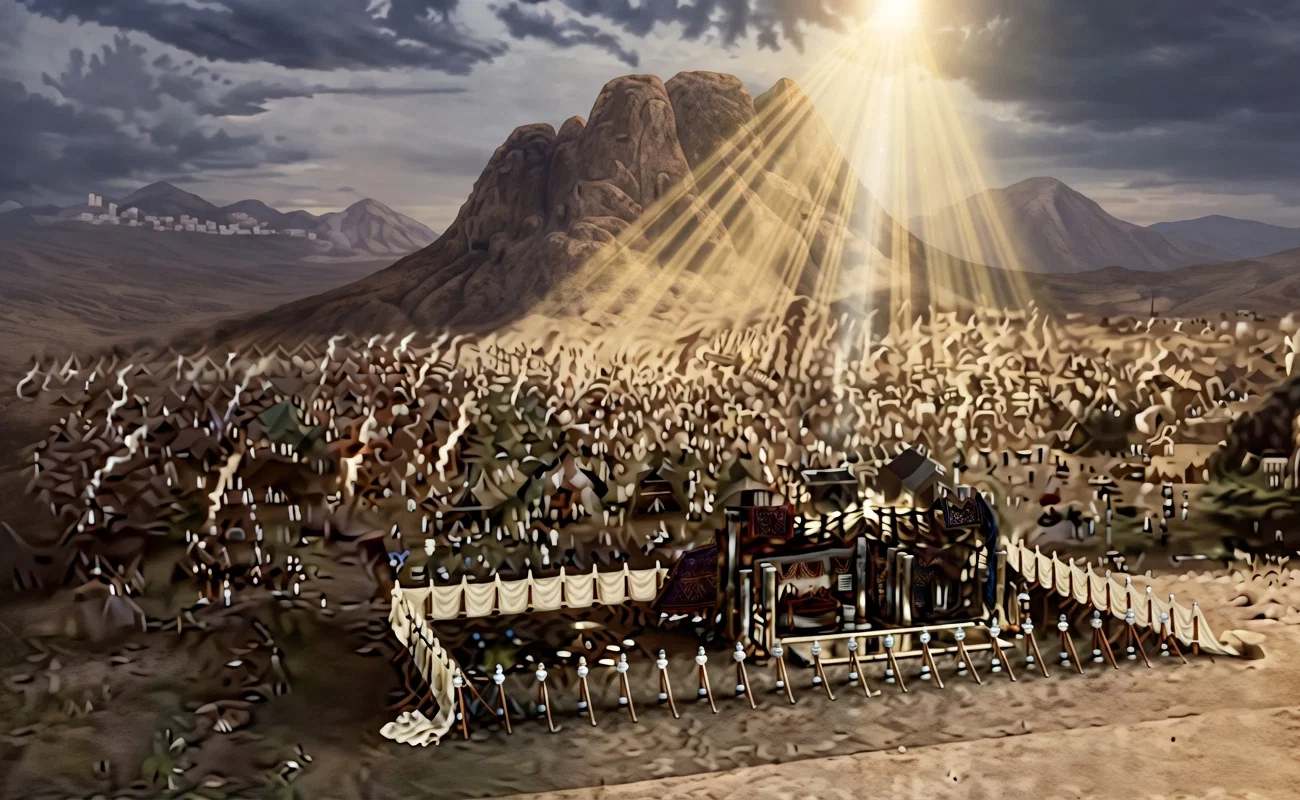
BY divine appointment the worship of the true God has centered in the sanctuary ever since the days of Moses. He commanded Moses to make Him a sanctuary that He might dwell among them. Ex. 25:8. The sanctuary was to be His dwelling-place. His presence was manifested in it. Hence His "way" is declared to be "in the sanctuary." Ps. 77:13. By studying God's "way" in the sanctuary, David received divine enlightenment concerning His dealings with men, and was saved from the despair of unbelief. Ps. 73:1-17. In God's sanctuary he saw His power and glory. Ps. 63:2.
A subject which reveals God's "way," His "power," and His "glory," must be worthy of careful and prayerful study. In the book of Exodus, chapters 25, 26, 27, and 30, we find the instructions that the Lord gave Moses for building the sanctuary. Chapters 36 to 39 record the making, and chapter 40 the erection of it. In Leviticus, chapters 1 to 7, 16 and 23, the main features of the service of the sanctuary are described. We may be sure that these scriptures, altho they may seem to us unimportant and unprofitable, were not written in vain, or without a purpose. They are a part of the "Scripture" that Paul declares is "profitable for doctrine, for reproof, for correction, for instruction in righteousness; that the man of God may be perfect." 2 Tim. 3:16. He also declares that "whatsoever things were written aforetime were written for our learning, that we thru patience and comfort of the Scriptures might have hope." Rom. 15:4. This certainly includes the sanctuary and its service.
The New Testament also speaks particularly concerning this important theme, and declares that Christ is our High Priest, and is a Minister of the sanctuary in heaven (Heb. 8:1, 2); that the earthly sanctuary was a pattern and its service a shadow, or type, of the heavenly (Heb. 8:5; 9:8, 9, 23, 24). In the eighth and ninth chapters of Hebrews we have a brief summary of the whole subject, showing that the earthly sanctuary and its service were an impressive object-lesson to teach us concerning the temple of God in heaven, and Christ's priestly service therein. Therefore a study of the former will enable us to understand the latter, and give us clearer views of our Saviour and of His work in our behalf.

The Sanctuary Built by Moses.

This structure was built of materials furnished by the people, and it was very beautiful and rich in appearance, because it was a pattern of the heavenly sanctuary, or true tabernacle which the Lord pitched and not man. Heb. 8:1-5; 9:11, 23, 24. We are not to understand from this that the sanctuary built by Moses and its service were a perfect representation—the very image—of the heavenly sanctuary and its service, because earthly things can not fully represent heavenly things. Heb. 10:1. The leading features, all in fact that is vital and necessary to teach us God's "way" in the sanctuary, is found in the type as presented in the Scriptures.
The earthly sanctuary had two apartments. The first was called the holy place, and the tent of the congregation, having the table of showbread, the golden candlestick, and the altar of incense. The second apartment was called the holy of holies, the holiest, also the holiest of all, and the most holy place. It was half as large as the first apartment, and contained the ark of God's covenant. This ark was also called the ark of God, because it contained His law, the Ten Commandments, written upon tables of stone. The cover of the ark was made of fine gold, so beaten as to form not only the cover, but two cherubim, one on each end. This cover was called the "mercy-seat," because mercy and pardon were granted to the repentant sinner when the blood of the offering was sprinkled before and upon it, thus honoring and satisfying the claims of the divine law, beneath the mercy-seat, that had been transgressed.
A curtain called the "veil" was hung before the first apartment of the sanctuary, and another curtain sometimes called the "veil," and the "second veil," separated the two apartments. The sides of the sanctuary were made of wood overlaid with gold, and covered over the top with four curtains. The first one was made of fine twined linen, blue, purple, and scarlet, beautifully embroidered with cherubim, representing the angels that minister in the heavenly sanctuary. The second was made of goat's hair, the third of ram's skins, and the fourth, or top curtain, was made of badger's skins.

The Service of the Sanctuary.

There was a ministration in both apartments of the sanctuary, a complete round of service being accomplished each year, closing with the tenth day of the seventh month, called the day of atonement. The service in the first apartment was carried on daily through the year. Offerings were brought to the door of the tabernacle. The sinner would confess his sin, placing his hand upon the head of the offering, and thus transfer his sin to the offering. He would then kill the offering, thus acknowledging that his sins—
Tabernacle and Court Open.
his transgressions of the divine law—made him worthy of death, because "sin is the transgression of the law" (1 John 3:4), and "the wages of sin is death" (Rom. 6:23). The sin was then transferred to the sanctuary by the priest, either by his eating the flesh of the offering in the holy place, or by his bringing some of the blood of the offering there. Lev. 6:25-30.
Thus the sins of God's people were transferred to the sanctuary by the daily ministration throughout the year. This made it necessary to have a removal of the sin from the sanctuary. This was called the cleansing of the sanctuary, and was a service performed each year on the tenth day of the seventh month. This was known as the day of atonement. This service is fully described in Leviticus 16 and 23. The high priest took two goats and cast lots upon them, one lot for the Lord and one lot for the scapegoat. The one upon which the Lord's lot fell was killed as a sin-offering for the people, and the high priest took of the blood and sprinkled it before and upon the mercy-seat, and upon the horns of the altar. This was the divinely appointed service for making the atonement and cleansing the sanctuary. Lev. 16:15, 16, 19, 20. Then the sins were borne by the priest from the sanctuary, and, by a simple service, were laid upon the head of the goat upon which the lot fell to be the scapegoat. The goat was then sent away into the wilderness by the hand of a fit man. Verses 20-22. Thus the sins of the people that were lodged in the sanctuary by the daily service thru the year, were borne away by the scapegoat into the wilderness at the close of the yearly service on the great day of atonement, the tenth day of the seventh month. See Lev. 16:29-34; 23:26-29. In this way there was a final riddance of sin from the people and the sanctuary every year. It perished with the scapegoat in the wilderness.
Truly, God's "way" of life and salvation is revealed in the sanctuary, and also His "power" and "glory." There we also are enabled to understand the end of those who obey not the Gospel of God. 1 Peter 4:17; Ps. 73:17.

Choosing God’s Will

Robert Greene writes: "I know my God commands, whose power no power resists." And this is literally true; for God "worketh all things after the counsel of His own will." Why not then choose His will?
Continue reading: Jesus, Antitype of Sacrifice and Priest