WONDERFULLY beautiful to him who hungers and thirsts for the knowledge of God is the story of the Christ, as told in the types and symbols of the earthly sanctuary. In the record of the shadowy service of the long ago, the seeker after truth finds a vivid pen-picture of both the person and work of the Lord Jesus—of Jesus the Sin-bearer, of Jesus our great High Priest.
Evidently the writer of the epistle to the Hebrews so regarded the matter; for, after reviewing the work of the past, he said: “Now of the things which we have spoken this is the sum: We have such an High Priest, who is set on the right hand of the throne of the Majesty in the heavens; a Minister of the sanctuary, and of the true tabernacle, which the Lord pitched and not man. For every high priest is ordained to offer both gifts and sacrifices; wherefore it is of necessity that this Man have somewhat also to offer.” Heb. 8:1-3.
God’s word is sure. “The Scriptures can not be broken.” Just so truly as on earth there were typical offerings for sin, and priests to minister, so truly in heaven there are both offering and priest for the sons of men.
Jesus Our Sacrifice.
From the day that sin first entered this fair world of ours until now, our heavenly Father has been striving to lead men to look upon Jesus as their sacrificial Substitute. “Blessed be the Lord God of Israel; for He hath visited and redeemed His people, and hath raised up an horn of salvation for us in the house of His servant David, as He spake by the mouth of His holy prophets, which have been since the world began.” Luke 1:68-70. Jesus is the “Lamb slain from the foundation of the world.” Rev. 13:8. In the ecstasy of divine assurance, John the Baptist cried out, “Behold the Lamb of God, which taketh away the sin of the world.” John 1:29.
The story of Jesus, our Sacrifice, is so blessedly simple that even a child can understand. In that terrible day when sin first intruded itself into man’s life, the Son of God looked down from His holy habitation and saw that “there was none to help,” and “wondered that there was no intercessor; therefore His arm brought salvation unto him.” Isa. 63:5; 59:16. That day He gave Himself up in man’s behalf; the iniquity of all was laid upon Him (Isa. 53:6), and all Heaven’s agencies were at once set in operation for the accomplishment of His will.
By patriarch, priest, and prophet, man was instructed concerning the Lamb that was to come; and “when the fulness of time was come, God sent forth His Son, made of a woman, made under the law, to redeem them that were under the law.” Gal. 4:4, 5.
Calvary came. In harmony with that which was “determined before to be done” (Acts 4:28); namely, that He, by the grace of God “should taste death for every man” (Heb. 2:9), Jesus was there “brought as a lamb to the slaughter.” Isa. 53:7. “Him who knew no sin” (2 Cor. 5:21), the “lamb without blemish and without spot” (1 Peter 1:19), there “offered up Himself.” Heb. 7:27.
But Why Must He Die?
Ah, it was that God “might be just,” and yet “the Justifier of him which believeth.” Rom. 3:26. All had sinned (Rom. 3:23); “sin is the transgression of the law” (1 John 3:4); and “the wages of sin is death” (Rom. 6:23). That God’s holy law might be satisfied and upheld, and still sinful man be saved, Jesus, the Author of the law, threw Himself into the breach. He put Himself into man’s place, taking all that man deserved, that the man might have all Christ deserved. He took man’s death that man might have His life. “Who His own self bare our sins in His own body on the tree, that we . . . should live unto righteousness.” 1 Peter 2:24. “He hath made Him to be sin . . . that we might be made the righteousness of God.” 2 Cor. 5:21.
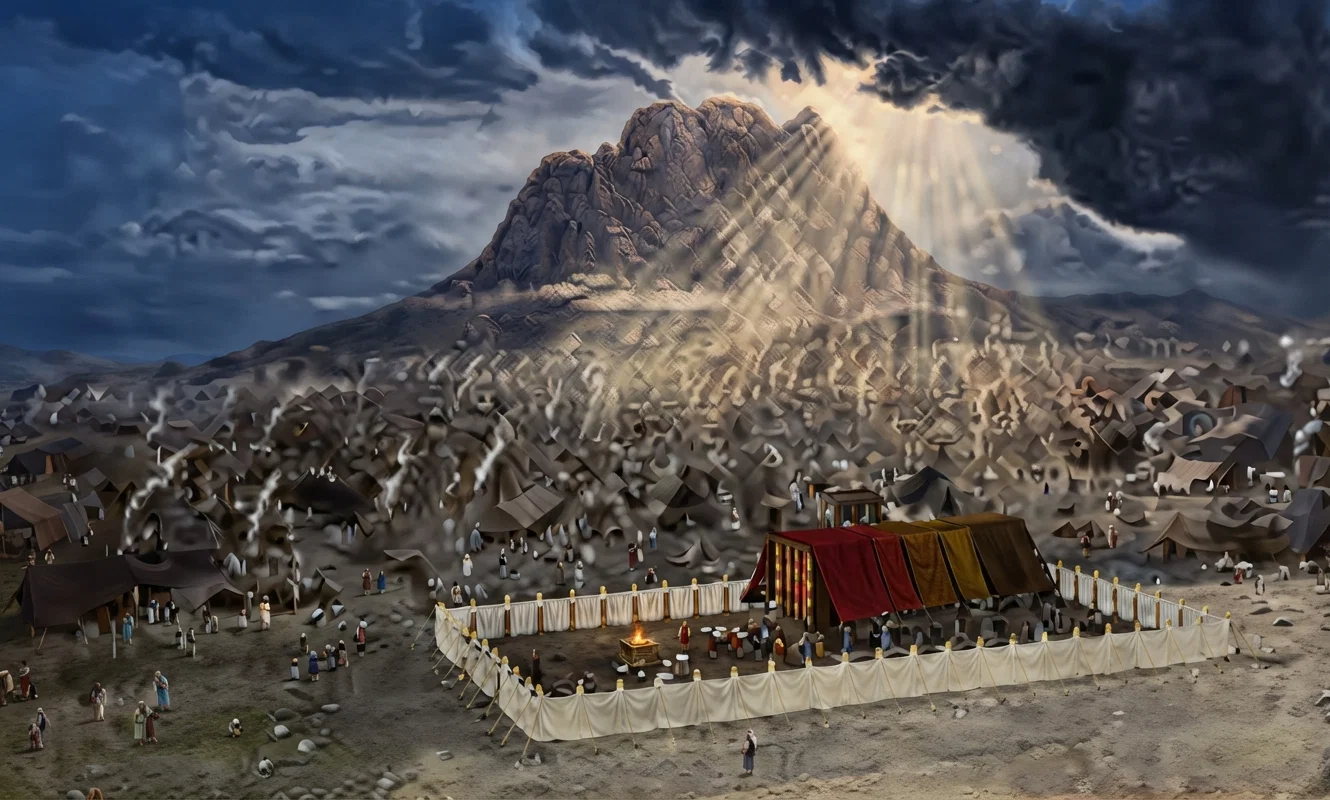
Tabernacle and Court.
By His death the Son of God made possible reconciliation between God and man. Rom. 5:10. He “abolished in His flesh the enmity . . . to make in Himself of twain one new man.” Eph. 2:15. By the gift of Himself, He broke down the wall of sin which shut man away from heaven.
But this is not all. The Scripture says (Heb. 9:22), “Without shedding of blood there is no remission.” As in the type, so here, the blood is the medium by which sin is transferred to the sanctuary on high, the channel thru which, by prayer, man can find access to Jehovah’s throne. Heb. 10:19. The blood of the cross makes peace. Col. 1:20. And blessed indeed is the glorious truth that “the God of peace . . . thru the blood of the everlasting covenant,” makes man “perfect in every good work to do His will.” Heb. 13:21, 22.
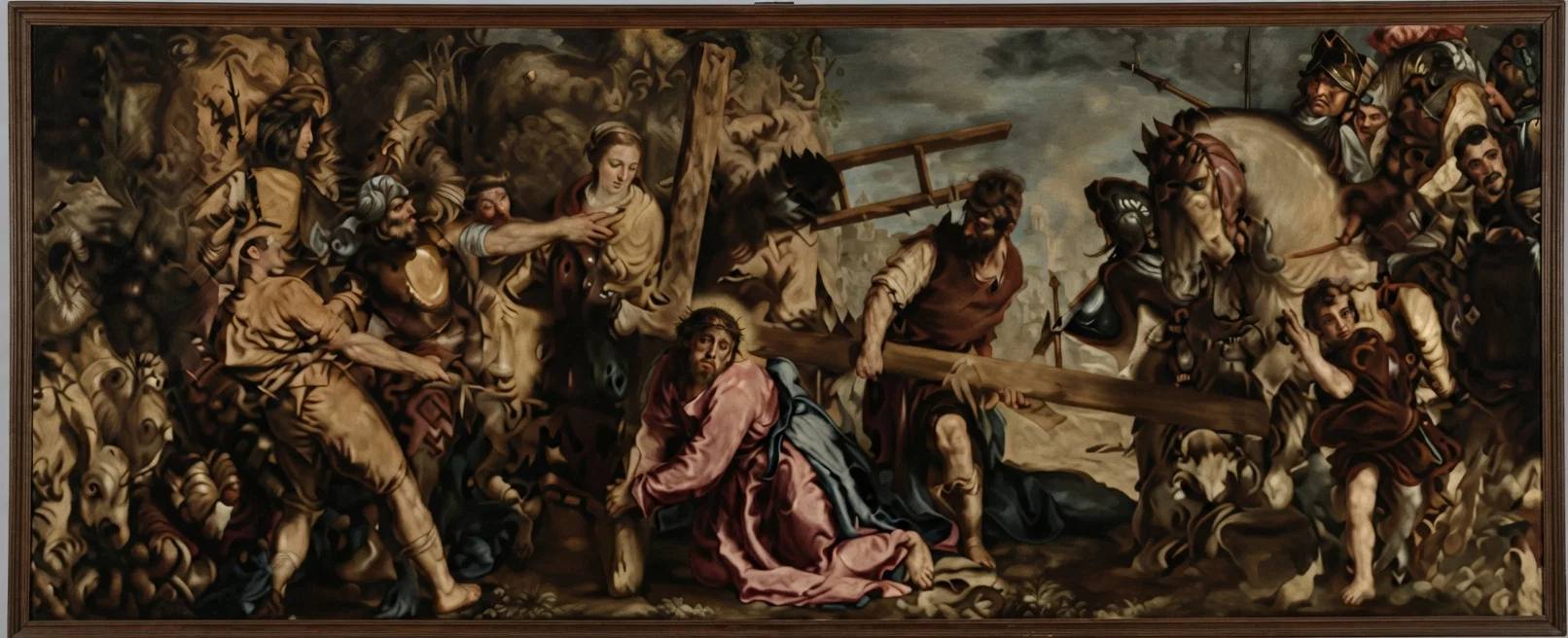
Veronese. Christ Bearing the Cross.
Jesus Our High Priest.
“Seeing, then, that we have a great High Priest, that is passed into the heavens, Jesus the Son of God, let us hold fast our profession.” Heb. 4:14. Having completed His earthly ministrations, our Lord took His departure to the courts above, there to “appear in the presence of God for us.” Heb. 9:24. He is there as our Advocate (1 John 2:1), seated with the eternal Father upon the throne of mercy and grace. Heb. 4:15, 16. Surrounded and assisted by those who ascended with Him to heaven (Matt. 28:52, 53; Rev. 5:6), He there, by a specific and a well-defined service, completes what Calvary had begun.
And let all remember that our High Priest in the heavenly temple must “have somewhat . . . to offer” for sin, even as did the priests on earth. Heb. 8:1-4. Of the earthly service the Scripture says, “For if the blood of bulls and of goats, and the ashes of an heifer sprinkling the unclean, sanctifieth to the purifying of the flesh; how much more shall the blood of Christ . . . purge your conscience from dead works to serve the living God?” Heb. 9:13, 14. And this makes the story plain. To-day Jesus Christ pleads His own “precious blood.” In behalf of His lost ones on earth, He stretches forth His hand to the Father and asks that for His own blood’s sake the Father have mercy upon those who by the broken law are condemned to death. His constant word is, “Father, remember the blood, remember the blood!” And as the prayers and confessions of His believing children come up before God, He mingles with them the fragrant incense of His righteousness (Rev. 8:3, 4), the merits of His own blood. This is a glorious truth and thus the Master graciously reminds us that, “Having an High Priest over the house of God; let us draw near with a true heart in full assurance of faith, having our hearts sprinkled from an evil conscience.” Heb. 10:21, 22.
“The sprinkled blood is speaking.” Does it speak for you and for me?—It does, if we have chosen that it shall. The work of the atoning sacrifice can be wrought out in us only by our cooperation. Man must yield7
his will in order that God may work. Man’s part is to make the offering of Jesus Christ His own personal offering. Says the Lord, “Thou shalt make His soul an offering for [thy] sin.” Isa. 53:10.
Jesus is our Priest forever (Heb. 5:10); His priesthood changes not (Heb. 7:24); and because of this “He is able also to save them to the uttermost that come unto God by Him, seeing He ever liveth to make intercession for them.” Verse 25. Blessed hope! And this hope “we have as an anchor of the soul, both sure and steadfast, and which entereth into that within the veil; whither the Forerunner is for us entered, even Jesus, made an High Priest forever after the order of Melchizedek.” Heb. 6:19, 20.
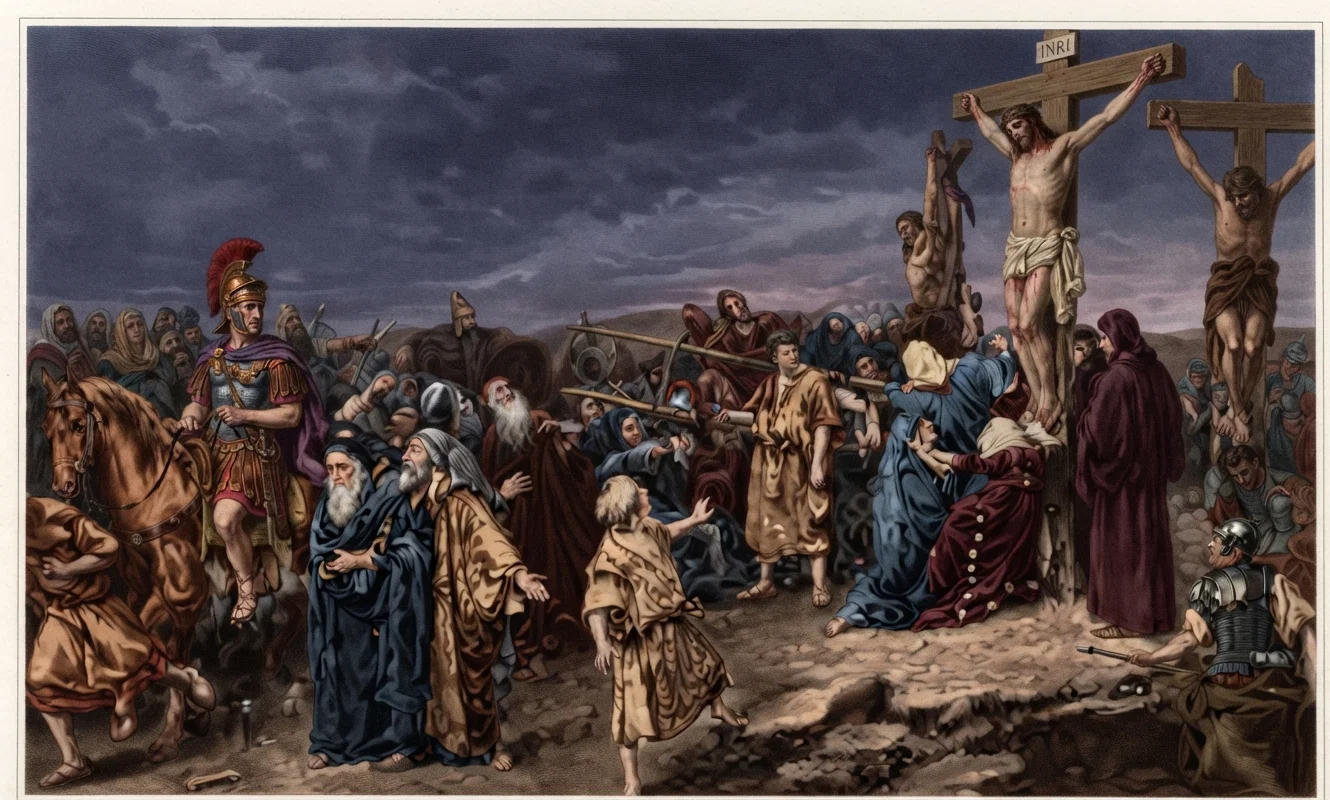
The Crucifixion.
Search the Scriptures
By F. D. Starr
By F. D. Starr
Jude.
THIS epistle, tho brief, is a startling judgment message. It was written in A.D. 66, about the time of the appearance of the Second Epistle of Peter, which book it much resembles.
It is evident from the statements of Jude that the pure doctrines of the Gospel were already being corrupted by men who were teaching perverse things to draw away disciples after them, as predicted by Paul in Acts 20: 29, 30. From that time forward it would be more necessary to contend earnestly for the faith once delivered to the saints. While superstition has so extensively taken the place of true faith, and tradition has taken the place of the Decalogue, yet it is comforting to know that even from the last generation of men there will be those who can testify as did the apostles: "I have kept the faith." Of them it is said in Rev. 14:12, "Here are they that keep the commandments of God, and the faith of Jesus."
Jude tells us that "the Lord, having saved the people out of the land of Egypt, afterward destroyed them that believed not." It is plain from this that there is such a thing as being saved and yet afterward lost. Doubtless there is frequently too much confidence placed upon past experience so that the individual becomes careless and is lost at last. The following words from "Christ's Object Lessons," page 155, clearly express this point: "Those who accept Christ, and in their first confidence say, I am saved, are in danger of trusting to themselves. They lose sight of their own weakness and their constant need of divine strength." "Wherefore let him that thinketh he standeth take heed lest he fall." 1 Cor. 10: 12.
It is not always those who are most forward in proclaiming, "I am saved," that are in the most safe position.
It is interesting to note how many ancient men of Bible history are mentioned in this short epistle—Adam, Cain, Enoch, Moses, Korah, and Balaam. The record concerning these characters is thus endorsed, as in all portions of the New Testament.
"Michael the Archangel" is also mentioned. This is the same being to whom reference is made in Dan. 10: 13, 21; 12: 1, and can be none other than Christ the Prince of Life, as shown by 1 Thess. 4: 16, which reads: "For the Lord Himself shall descend from heaven with a shout, with the voice of the Archangel, and with the trump of God; and the dead in Christ shall rise first." As it is the voice of the Son of God that wakes the dead, the Archangel (Michael) whose voice is here mentioned, must of necessity be the Son of God.
The dispute about the body of Moses, to which allusion is made in Jude 9, shows very clearly that Moses must have been raised from the dead, else there could not have been any contention concerning his body. This fact explains the query so often propounded in reference to the appearance of Moses and Elijah on the Mount of Transfiguration (Matt. 17:3). Elijah, the type of those who will never die, had been translated without seeing death; and Moses, the type of those who fall asleep in Jesus, had been raised from the dead. Thus we have in miniature the coming kingdom of God.
It is interesting to notice that this second coming of the Lord was preached by Enoch, the great-grandfather of Noah (Jude 14). Tho in prophetic vision Enoch saw the on-coming Flood, the first advent of the Messiah, yet his mind seemed to leap over these important events to the great judgment scene at the second coming of our Lord. A doctrine preached in the patriarchal age can not be said to be an innovation.
Enoch had translation faith, a faith in the second coming of Christ, so strong that the Lord permitted him to experience this change from mortality to immortality thousands of years in advance of those who "are alive and remain unto the coming of the Lord." This will be the faith of the remnant, also.
The discretion that should be exercised by those who labor for souls is mentioned in verses 22, 23. Some are to be, as it were, pulled out of the fire. No doubt God in His providence works in this manner to rescue souls from perdition. Thus they become brands plucked out of the fire. Zech. 3:2. The flesh may be destroyed "that the spirit may be saved in the day of the Lord Jesus." 1 Cor. 5:5. Let us not complain at the severe manner in which earthly ties may be severed and heavenly cords strengthened.
"Now unto Him that is able to keep you from falling." Verse 24. How consoling the knowledge that there is One able to keep us. But does this release us from any responsibility in this matter?--No, indeed. While we get so much comfort from verse 24, let us not overlook verse 21: "Keep yourselves in the love of God, looking for the mercy of our Lord Jesus Christ unto eternal life." While we pray God to keep us, and rejoice in the assurance that He will do so, we do not want to forget that we are workers together with God, and He has said to us, "Keep yourselves in the love of God."
The letter closes with this doxology: "To the only wise God our Saviour, be glory and majesty, dominion and power, both now and ever. Amen." The Revised Version reads: "To the only God our Saviour, thru Jesus Christ our Lord, be glory, majesty, dominion and power, before all time, and now, and forevermore. Amen." This latter translation is in harmony with the original Greek.
"Praise God from whom all blessings flow,
Praise Him, all creatures here below;
Praise Him above, ye heavenly host.
Praise Father, Son, and Holy Ghost."
Why Not Be Saved?
It is the goodness of God that redeems man. Man can not buy or earn or merit pardon or salvation. He can only choose and by faith accept that which Christ has purchased for him, and which he freely gives to all who will accept it. We know that it is hard for proud man to accept this, but the humble hears thereof, and is glad. God waits to be gracious to all. His blessings are in reach of all, for all may be humble, all may by faith reach Christ Jesus, who stooped to redeem "every man." Then why not be saved?
Answered Prayer.
By Max Hill
A LITTLE child comes to its father and asks for a valued book containing many beautiful pictures. The father desires above all things to please his child, yet knows that the little hands are soiled, and unskilled in handling so large a book. He knows, too, that the little one could not read the book, nor even understand the pictures. The child pleads for the privilege, but still the father holds it back. At the same time he offers in the place of it another volume, simple and plain, tho beautiful, one that the child can readily understand and appreciate.
If he is well trained the child is content with the father's choice, and his request is granted. Not that he receives the exact thing he asked for, the very book; but back of the desire for the book was the desire to be happy, and the father, knowing what is best, grants the request. He gives that which will make the obedient child happy, and that which will train it to enjoy and understand the more beautiful book when it can understand and know how to use it.
So we come to our heavenly Father, and O, we want such great things, such fine things! We could not understand them, nor could we use them. It would not be safe at all for us to have them, and yet we plead and plead for the impossible. The Father grants that which would make us happy if we were content with His choice. He gives us that which will train us for the greater and more beautiful. Then shall we not accept what He gives as answer to our prayers? Our Father knows, and if it is the "Father's good pleasure to give you the kingdom," will He not give us "richly all things to enjoy?" MAX HILL.
The Sanctuary, or the Temple, of God.
THE word "sanctuary" in the Scripture means a place set apart to a holy or sacred purpose, consecrated to the worship of God. The word "temple" is used in the same way, as a special place to worship God, where sacrifices are offered and priests minister. They have various applications in the Scriptures:
1. The individual Christian is said to be the temple of God. "Know ye not that your body is a temple [sanctuary] of the Holy Spirit which is in you, which ye have from God? and ye are not your own; for ye were bought with a price: glorify God therefore in your body." 1 Cor. 6:19, 20. God desires to dwell in each of His children, write His law in their hearts, and control every member of the body. He dwells in our "hearts thru faith," in order to establish us in love. Eph. 3:17. Without faith we are "separate from Christ" and "without God in the world." Eph. 2:12. By faith we have His life, and He is Christ in us "the hope of glory." Col. 1:27.
2. The church is also His sanctuary, or temple. Paul writes to the Corinthian church: "Know ye not that ye are a temple of God, and that the Spirit of God dwelleth in you?" 1 Cor. 3:16. "In whom [Christ] each several building, fitly framed together, groweth into a holy temple [sanctuary] in the Lord; in whom ye also are builded together for a habitation of God in the Spirit." Eph. 2:21, 22. In this temple it was God's design that His law should be supreme, His word paramount, His Spirit the motive power. Then His presence and power would have remained thruout the ages if the church herself had not set Him aside and permitted iniquity and error to reign. "The man of sin" would never have been developed, "the mystery of iniquity" would never have generated the Dark Ages if the church had held fast by faith to Christ and the word. His mighty presence, cherished in the heart and life would have forever restrained the man of sin. 2 Thess. 2:6, 7.
3. But the word "sanctuary" is generally used of the building, the inner tabernacle, erected by Israel at the command of God in the wilderness, the story of which is told in Exodus, chapters 25 to 40. When Solomon built the temple, that took the place of the portable tabernacle. In both of these buildings the worship of God upon the earth centered. All the earthly worship and service revolved around the holy of holies where rested the law of God over which was the mercy-seat.
When this earthly center was repudiated by God as no longer sacred, and the invisible hand at the Crucifixion rent the veil dividing the holy and most holy places, the center of God's worship was transferred to the heavenly courts where Christ our Lord ministers His own blood on behalf of sinners. This latter sanctuary and its teaching is developed, as far as space will permit, in this issue of our paper and the next. It is a study of transcendent importance, a key to the understanding of the Scriptures. It reveals God's ineffable holiness, His sublime majesty, His boundless mercy, His nearness as Father and Friend.
Man's Mightiest Argument with God.
GOD is love. He loves His only-begotten Son. This is self-evident. He loves the good, the pure, the lovely. They are in harmony with His nature. But God loves the sinner, not because the sinner is lovely or lovable, but God loves in order that He may make the sinner lovable. God loves everything capable of being transformed by love.
Man was not made to be a sinner. He was made to glorify God, to reveal in his own life some of the many excellencies of God's goodness, to be a prism thru which the pure white light of God should be refracted in varied beauty. But man sinned. The design of God was marred. The prism became opaque. The beauty of character was lost. The luster of holiness vanished.
Yet God sees within the wreck the possibilities of restoration. He looks upon the longing heart and restless mind, and pities with infinite pity. He sees that selfishness has perverted every good in man, and He longs to set him right. God loves. God pities. God longs to save the poor sinner from himself.
The desire of God to help is measured by the infinite Gift He has bestowed. "For God so loved the world, that He gave His only-begotten Son, that whosoever believeth in Him should not perish, but have everlasting life." John 3:16. "For when we were yet without strength, in due time Christ died for the ungodly. For scarcely for a righteous man will one die; . . . but God commendeth His love toward us, in that, while we were yet sinners, Christ died for us." Rom. 5:6-8.
No Hope in Himself.
Such man was, such he is—"without strength." He has no power to lift himself above himself. Restless as the sea, ambitious as Lucifer, aspiring to the highest, if not the worthiest, man has no power to lift himself up. Never did a nation elevate its standard of itself. Never did man of himself improve motive and morals. Some power from without must undertake the work, or take hold of the soul. Invariably it has been the influence and power of religion which has improved the man or the people. On the other hand, there are numerous examples of men and nations drifting to degradation and ruin while trusting in themselves.
Yet the consciousness of sin and weakness on the part of man has also brought the conviction that something must be done to save him, some mighty effort put forth, some great sacrifice made. Out of this has grown all the awful sacrifices of heathen worship. Women have given themselves to deified depravity worse than death, men have imposed upon themselves in the name of the thing they worshiped all sorts of torments—wearing of hair shirts, fastings, scourgings, burning, broiling, torturing in a hundred ways in the hope of appeasing deity and silencing an accusing conscience. The first-born son has been offered a victim to horrible deaths, and nations have offered multitudes of humans to appease the gods.
A Sacrifice Demanded.
The conviction is true. Sin demands a Sacrifice or Substitute. It demands, first, the death of the sinner, not as arbitrary payment, but as existing potentially in the sin itself, as the fruit in the seed. "Sin when it is full-grown, bringeth forth death." "The soul that sinneth, it shall die." "The wages of sin is death." And the payment of the wages leaves the soul in death. It has no claim upon the life beyond. Human conduct can no more than fill the present moment; it can by no manner of means lay up a stock of righteousness for the future. Hence the human, erroneous effort to do extraordinary things, to make extraordinary sacrifices. But the more men have multiplied their vain means and cruel devices to buy God's favor the worse they have grown. Yet sin still demands the life; and, if saved from the sin, the sinner must have the Substitute.
God's Love.
The Substitute has been provided in the love of God. It was no forced substitution. God "gave His only-begotten Son." His Son "gave Himself." The Substitute became the Sacrifice—freely offered for all, and all who break partnership with sin, and place themselves upon the side of God and righteousness and love, shall know of God's power to save.
Choose—Taste.
Men may criticize the plan of God. They may belie His wisdom. They may scoff at His power to save, and go down to eternal death. God will not argue with them. He lays down man's mighty need. He tells of His infinite fulness to meet the need. He declares: "If any man willeth to do His will, he shall know." And He invites: "O taste and see that the Lord is good." His love for you compelled His substitution and sacrifice; but in His love He will not, can not, compel you to accept His free grace. If you are determined to drift on to death, He must let you go. If you will to do His will, His grace abounding over sin is freely bestowed. And all the types and sacrifices of lambs and goats and bullocks described in His word are but the remembrancers, the index fingers, of faith pointing to the Lamb of God who taketh away the sin of the world, who is able to save to the uttermost all those who come to God by Him.
There is one mighty twofold argument we may use—the argument which moved the heart of the infinite God in our behalf—our need, and His fulness of love and power.
Resisted unto Blood.
By T.
In exhorting us to the perfection of the example of Christ, the apostle Paul says, "Ye have not yet resisted unto blood, striving against sin." In this scripture sentence the conflict that the Master waged in the Garden of Gethsemane is brought vividly to mind.
The Lord Jesus entered into the sufferings of men, and made Himself a partaker in the conflict that we are called upon to wage against sin by taking upon Himself the sinful flesh of humanity. Upon this point read the following soul-helpful scripture:
"Since then the children are sharers in flesh and blood, He also Himself in like manner partook of the same; that thru death He might bring to naught him that had the power of death, that is, the devil; and might deliver all them who thru fear of death were all their lifetime subject to bondage. For verily not to angels doth He give help, but He giveth help to the seed of Abraham. Wherefore it behooved Him in all things to be made like unto His brethren, that He might become a merciful and faithful High Priest in things pertaining to God, to make propitiation for the sins of the people. For in that He Himself hath suffered being tempted, He is able to succor them that are tempted." Heb. 2: 14-18.
"The children are sharers in flesh and blood," says the apostle, and then he adds that the Master "Himself in like manner partook of the same." He "partook of the same;" and He partook of the same "in like manner." Then we may be encouraged in our conflict with the flesh against sin since the Master took upon Himself this same flesh that we find so much difficulty in bringing into subjection to the right. Our encouragement is heightened and deepened by the further knowledge that the Master assumed the same flesh and blood with us so "that He might become a merciful and faithful High Priest." "For in that He Himself hath suffered being tempted, He is able to succor them that are tempted."
The only way that we mortals can be enabled to fully enter into sympathetic touch with one that is in deep grief or distress is to have passed thru the same thing, and in the same way. But having had the same suffering ourselves, we can come to the afflicted one and say, "I know just how you feel; I have passed thru it all." And when the suffering, distressed one is thus met by a person that has had actual experience in the things that he is now suffering, he can feel the "touch" of sympathy, even tho no other word is uttered aside from the statement, "I have passed thru the same thing."
Such is the law of sympathy and helpfulness among men. And the Master recognized that, even tho He were the Son of God Himself, yet He could not be a perfect sympathizer with humanity unless He actually tasted in His own person of the conflicts, the griefs, and the woes that are suffered by the sinful race. Thus does the Son of Man take infinite pains to give to the subjects of His salvation the strongest and at the same time the most delicate touches of sympathy.
He partook of the same flesh with humanity, and with the same handicap that enthralls sinful man, the Master fought the battle of overcoming sin completely. He met every temptation that we have to meet. For doth not the Scripture say:
"Having then a great High Priest, who hath passed thru the heavens, Jesus the Son of God, let us hold fast our confession. For we have not a high priest that can not be touched with the feeling of our infirmities; but One that hath been in all points tempted like as we are, yet without sin. Let us therefore draw near with boldness unto the throne of grace, that we may receive mercy, and may find grace to help us in time of need." Heb. 4: 14-16.
He has fought the battle clear thru. He has met sin at every turn. He "hath been in all points tempted like as we are." And He was successful in every conflict, for He came out of the battle "without sin."
His whole life from the manger to Gethsemane and Calvary was a part of the plan to fit Him to "touch" humanity with His heart of infinite sympathy. His life was the very life that He is seeking to lift us into. His whole life was lived to show how to link humanity with divinity so as to actually conquer sin and to live the real life of the righteous.
And, O, how bravely and unswervingly and unyieldingly He fought. He gave sin no quarter, and He allowed it no place anywhere in His life. It came surging against Him with its great temptations until in the supreme conflict of Gethsemane it forced from His agonized and agonizing person the death agony and blood sweat. But still He could not be forced to yield. O masterful Conqueror! O Hero of heroes! Thou hast not called us to resist sin in the fires of such indescribable agonies, but we humbly pray Thee to strengthen us to resist in the same spirit of unconquerable courage.
What an uplifting help it is to mankind when we are made aware of the fact that we have such a sympathetic, such a courageous, such an unconquerable High Priest in the heavenly sanctuary for our Mediator and Redeemer! T.
Teaching Piety by Irreverence!
By T.
To attempt to teach piety in connection with irreverent remarks or "puns" on the word of God is to attempt an impossibility. But just such an inconsistent thing is attempted by a religious weekly that comes to us regularly, and that also tries regularly to teach that the great need in the world to-day is more power of God's Spirit in the pulpit. The pulpit is constantly admonished to seek for greater power in order that it may win souls.
But, after presenting in the first part of the paper many good things that the editors design to stir the minds of the people to piety and devotion, they insert a column or more of items that they head, "Comic and Curious." A curious feature of these "comic and curious" paragraphs is that one of the most conspicuous of them is an irreverential story concerning Noah in the ark.
The statements of the Bible are straightforward utterances of divine truth, designed to help the children of men in the way of salvation. The power of the Scriptures as a positive statement of definite truth is the one thing that makes it possible for these sacred words to lay hold of the minds of men and women and lift them out of the debasing ways of sin into the realm of a life of right doing and power. And for an individual, be he minister or layman, or a paper, no matter how sincerely religious an attitude may be assumed, to teach the plan of salvation one moment and turn the next to telling some funny story that makes light of Bible narrative is but to invite failure.
"Thou hast magnified Thy word above all Thy name," is the language of the sacred Book. Ps. 138: 2. One of the commands of the Decalogue reads, "Thou shalt not take the name of Jehovah thy God in vain; for Jehovah will not hold him guiltless that taketh His name in vain." Ex. 20: 7. And there is the statement from the psalm that the Lord has magnified His word above all His name. Then since it is wrong to take Jehovah's NAME in vain, it is even worse to make slighting and ridiculous remarks about His WORD. For He Himself HAS MAGNIFIED HIS WORD ABOVE HIS NAME, and has told us so; and it is in His word that both His name and His person are revealed to us.
Jesting about the Scripture as a whole is a thing that no conscientious and intelligent Christian would think of doing. He would shrink from such a thought with the same horror that he would have if confronted with the suggestion of blasphemy of God's name. It can do only harm to take any of the statements or stories of the word of God and make light jests concerning them. Such jesting can appear as "comic and curious" to none except the superficial or the insincere, or the very poorly instructed Christian.
In this age of irreverence and disrespect for the word of God, professing Christians should not advance the evil work by speaking lightly of the word of God or of any of its portions. When jests are made in our presence concerning the Bible or any of its parts we should steadfastly fail to "see the point," and place our frown on the evil practise by refusing to laugh at the irreverent punsters.
T.
San Francisco and Other Cities.
By Editor
Many of the newspapers of the Eastern States are having a good deal to say about the lawlessness and corruption of San Francisco. It is a favorite theme just now for reporter, cartoonist, and editorial writer. The editors of this paper were born and raised in the East. They are very familiar with the customs and conditions in the society of the Eastern States. Representatives from this office have occasion to spend more or less time each year in the East. And we know from personal observation and personal contact with conditions throughout the country that things are no worse in San Francisco than in the average seaport city, and the Western metropolis compares very favorably with most of the inland cities of the republic. In times of strikes in San Francisco, like the present, there is lawlessness and violence in abundance; but the same is true of Chicago, Louisville, New York, St. Louis, or any other place. San Francisco has a horde of grafters and municipal corrupters, and labor tyrants; but New York, St. Louis, Philadelphia, Pittsburg, Minneapolis, Portland, Seattle, Chicago, and many other large cities, it is creditably reported, have a university course in which those who are determined on going the downward road may take a master's degree in the arts of iniquity. It is not a question of location; we are living in the time when prophecy has foretold that "evil men and seducers shall wax worse and worse, deceiving, and being deceived." And thus it will continue till wickedness meets its destruction at the second coming of Christ.
Episcopal Residences and Christian Work
By Editor
A recent letter from Pope Pius X to the United States hierarchy expresses his gratification "that the residence which the episcopal delegate in Washington will henceforth occupy is nearing completion;" and he expresses his gratification that "the faithful in America saw that our delegate's present dwelling did not fully befit his position as our personal representative among you." But if the Church of Rome, or any other church for that matter, were doing the Lord's work and acting as His representative, high episcopal residences at national capitals would not be known.