Your ShelfYour Projects

Signs of the Times, Vol. 30, No. 20.

THE CONSISTENT LIFE
Earlier text: CHRISTIAN SOCIALISM

MYSTERIOUS TIBET.

TIBET, one of the possessions of China, comprising a great division of the Chinese Empire, is a country of which very little is definitely known. Surrounded by high mountains, it has been to a great degree isolated from the rest of the world. Tibet is a corruption of the Chinese name; the people themselves call it the "land of Bod." The Kwanlun Mountains bound it on the north; on the east are the Chinese provinces of Szchuen and Yunnan; Assam, Buhtan, Nipal, and Gurhwal separate it from Burma and India on the south; while on the west its boundaries are not sharply defined from the territory of Kokonor. Little Tibet does not properly belong to Tibet, tho it is claimed by Chinese geographers. The greater part of the surface consists of high tableland (elevation 11,510 ft.), divided into three parts by mountain ranges; the valley of the Indus on the west, between the Hindu Kush and Himalaya Mountains; the high desert land, almost uninhabitable, and wholly unknown, lying between the Kwanlun and Himalaya Mountains; and the basin of the Yaru-tsangbu on the east, consisting of high ridges, and deep gorges, mountains and valleys. Numerous peaks of perpetually snow-capped mountains are to be found, of which Mt. Kailasa (26,000 ft.) is the highest.
The principal river, the Yaru-tsangbu, drains the whole of southern Tibet between the first and second ranges of the Himalayas, and is supposed to empty into the Brahmaputra, tho explorations have not yet been extensive enough to decide the truth. All the large rivers of southern and eastern Asia find their source in Tibet. In the central part are numerous lakes. The climate is varied, but in general the air is pure and excessively dry. Snow and ice last for most of the year, but in the middle of summer the valleys, even between the snowy mountains, are excessively hot. In the southern part moisture and vegetation are found, and sheep, goats, and yak are raised.

The Government

is conducted by two high commissions appointed at Peking, but these confer with, and are guided by, the two grand officers of the Tibetan hierarchy, the Dalai-Lama, and the Teshu-Lama; the former is known generally as the Grand Lama. The power is practically in the hands of the priests or lamas, so numerous as to give Tibet the name of the "kingdom of priests." The southern frontier is strongly fortified, and communication with the states intervening between Tibet and India is forbidden. On the Chinese frontier the same strictness is exercised, for the policy of exclusion is fostered alike by the Lamas and the Chinese—the one because they wish to preserve their religious supremacy and fat offices, the other because they wish to retain their political power, faint tho it be. Lhasa, the capital, has only once been visited by an Englishman,—Mr. Manning, in 1811,—and its location has but recently been agreed upon to be approximately in lat. 29° 39' 17" N., and long. 91° 05' E. It stands in a fertile plain, at an altitude of 11,700 feet, encircled by mountains. It is noted for the number of its monasteries, bonzes and lamas, filthy streets and mean buildings. The population is estimated at from 40,000 to 80,000, and the population of the whole of Tibet is estimated by Russian authorities at 6,000,000.
The people belong to the Mongol race. They are not so highly civilized as the Chinese, but are more so than the Mongols. Physically they are somewhat of slender build, with brown hair, slightly oblique eyes, swarthy and beardless. They are a mild-tempered, genial, kind, and friendly people, and intensely religious. In no other country is so much deference paid to the priests; the proportion of believers in the religion is also greater than in most countries. Their religion consists of two kinds; the old original religion called the "Bod," of which little or nothing definite is known; and that form of Buddhism called Lamaism. The social customs of the people differ greatly from those of their neighbors on the east and south, particularly in the position which women hold. Here polyandry is the custom instead of polygamy, the wife being usually espoused by brothers. In general, education is restricted to the priests, but the women, who conduct most of the traffic, learn writing and arithmetic. In some of the northern provinces the chieftainship is held by the women.
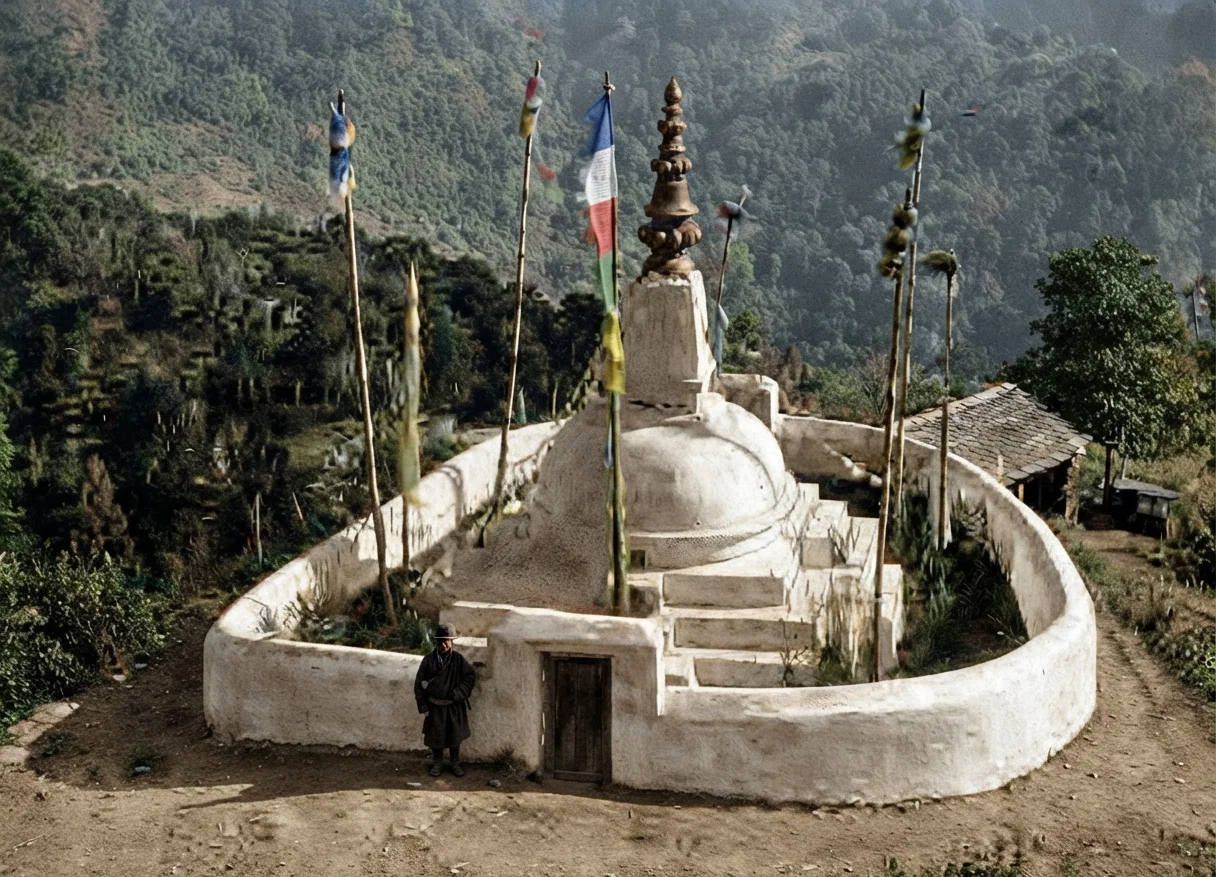
A Tibetan Tomb at Darjeeling.
The language of Tibet is derived from the Sanskrit. It is alphabetical, and reads from left to right. Thirty consonants are recognized, with four additional vowel signs. Their literature, as well as many of their customs, has been influenced to a great degree by China.

Missions

are not permitted in Tibet. In former times the Roman Catholic Church made noble efforts to enter the forbidden land, and was for a time successful. In 1330 the apostle of Tartary, Odoric Forojuliensis, traveled in Tibet, and found missionaries already in the city of Lhasa, who had gone there, it is supposed, early in the preceding century. In the 17th century a mission was commenced from India, and the reigning prince was favorable to the new religion; but his apostasy was made the pretext of his overthrow. Various attempts at evangelization have been made since that time. The most noteworthy one was in 1845, when Fathers Gabet and Huc penetrated to Lhasa after a journey of eighteen months, only to be arrested by the Chinese officials, who sent them prisoners to Canton. From that time the Société des Etrangères has made numerous attempts, both by way of India and China, to enter the kingdom; but after suffering persecution, and the massacre of their priests, they have given up the effort, and occupy now only the confines of Tibet, where they work among the Chinese and such Tibetans as are there found.
The Moravian Brethren occupy three stations in Little Tibet (see Leh, Poo, and Kyelang), where they are waiting for opportunity to enter Tibet. One or two attempts have been made at great risk, but have proved ineffectual. They have studied the Tibetan language, and there are now several works which will aid the future missionaries to Tibet when the country is opened. A Tibetan-English grammar, a Tibetan grammar, and a New Testament in Tibetan have all been published. The missionaries of the C. I. M. in Szchuen and Yunnan are also waiting to possess the land.—Encyclopedia of Missions.

Priest-ridden.

Tibet, now of special interest on account of the British expedition in that mysterious land, possesses so many lamas that it is practically priest-ridden. At the head of the hierarchy are the grand lamas, who all claim to be Buddha reincarnate. Every lamasary has such a priest-god, and there is one called Chang Kia Foo, who lives at Peking. Beneath these high priests there are hundreds of lamas who profess to be the reincarnated spirits of Buddhist saints. Then there are lamas in whom are supposedto dwell the founders of monasteries, and lamas in whom good men live their lives over again. The priests constitute such a large portion of the population that many of them are compelled to go about the country begging from door to door.
There are many features about lamaism which strongly resemble the doctrines of the Roman Catholic Church. The ceremonial of worship, the burning of incense, the chanting of hymns, are so closely similar to these services in the Roman Catholic Church, that Father Huc, who succeeded in visiting Lhasa in 1839, reached the conclusion, in his "Souvenirs," that the wandering lama from whom Tsong Kapa drew his inspiration, was in reality a Jesuit missionary. Other travelers, however, declare that the lamas are wofully corrupt; that, while professing celibacy, they are very immoral; that they eat the flesh of the dead, and have a passionate thirst for blood. Many, he says, use a hypnotic power over their parishioners, and obtain wealth by various modes of extortion.
Unlike some professing Christians, who expect their Sunday piety to last through the week, the Tibetans pray most of the time. Whether they are at work or at pleasure, whether squatting on the floor of their houses, or on a journey, they continue their supplications. In order that religion will not prove too inconvenient, these pious people have prayer flags, and prayer wheels, by which orisons are rendered automatically. A prayer wheel, for example, is a sort of spool, covered with cabalistic inscriptions, which a lama has written and sold, and should the faithful be walking along the street, or conversing with a boon companion, he can keep saying his prayers by constantly turning the wheel. Prayer flags are likewise covered with supplications, which are believed to prove efficacious when waved in the air.—Protestant Observer.

ANXIETY.

FAINT hearts, who toil and pray, but doubt If God will grant! Theirs is the harvest who in trust Do sow and plant, Nor ponder whether it will be Or full or scant.
If once it fail, with diligence They sow again. Another year will surely bring The needed rain, The needed sun, to fill the fields With fuller grain!
The Lord of love may hear as tho He heard us not; But never yet the prayer of faith Hath He forgot; Some day His word will fruitful make Each waiting spot.
We rise betimes, as if our zeal That word could speed; We eat the bread of carefulness, That can not feed; Delaying rest, we only add Sore need to need.
O, happy they who quietly Anticipate The blessing He will shower down Or soon or late! They toil, they pray, aright; their faith His will can wait. —Harriet McEwen Kimball.

MARY JONES AND HER BIBLE.

THE origin of the British and Foreign Bible Society, which celebrated its centennial March 7, 1904, is one of the most romantic and interesting incidents in the history of the Christian Church. In the eighteenth century, although the art of printing had been discovered, the expense of printing the whole Bible was so great, and the poverty of the people so general, that copies of the whole Bible were very rare, and could be obtained by but few families. The Welsh have always been a people noted for their deep religious feeling and piety. About the year 1794, Rev. Thomas Charles, of Bala, in Wales, opened a school in Abergynolwyn, with which a Sunday-school was connected. One of the earliest pupils in this school was Mary Jones, who lived two miles away, but was always punctual in her attendance, and showed an unusual interest in the study of the Bible. She did not have a Bible of her own, but one was owned by a family who lived two miles from her home, and to this house she went every week to read and study the Bible, and store up its precious truths in her memory. For six years she attended this school, and studied the Bible which belonged to this family, walking the four miles twice a week, so much did she love the Word of God. Her parents were poor, and could not buy her a Bible, but she began to save every penny that she could earn, with the hope of sometime having for herself a copy of God's precious Word.
At last she thought she had enough to buy a Bible. The only place where she could get one was at Bala, of the Rev. Mr. Charles; but Bala was about thirty miles away, and she had no means of conveyance. She determined, however, to walk and find Mr. Charles, and buy a Bible, if one could be had for her money.
It was springtime, and the snow was still on the ground in places when Mary set out for her long journey on foot to Bala. This was in the year 1800. She borrowed from a neighbor a little bag in which to bring back her long-hoped-for treasure. Over the hills and through the ravines she traveled in her bare feet, stopping occasionally to rest, and eating a little of the coarse bread she had brought, and drinking from the cool and sparkling brooks which ran down the mountain-sides.
She reached Bala in the evening, too late to see Mr. Charles, but found a stopping-place at the home of a minister, Rev. David Edwards, who became much interested in her errand. In the early morning, before light, Mr. Edwards called her, and together they went to the house of Mr. Charles, who was up, and in his study, as appeared from a light shining in the window.
The long-looked-for moment was near when Mary hoped to receive the fruition of her labors, her prayers, and her desires. Mr. Edwards told her story to Mr. Charles, who became greatly interested, but to his great sorrow he was compelled to say that all the Bibles he had received from London had been sold, and that he had only a few left which had been promised to friends. The disappointment was too much for the heart of poor Mary; she burst into tears, and cried and wept so that her distress was heard all over the house. Her long-deferred hope was dashed to the ground; the disappointment was more than she could bear.
Her anguish was too much for the heart of the good minister, and at last he said, "Well, my dear girl, I find you must have a Bible, however difficult it is for me to give you one without disappointing other friends; it is impossible for me to refuse you," and so he gave her a Bible. She handed him the money which she had been saving for six long years, and her tears flowed again, not tears of distress, but tears of joy, and the good ministers wept with her.
Mary's walk over the long thirty miles back to her home in Llanfihangel-y-Pennant was an easier journey than when she came. Her heart was light. Had not God given her the desire which had so long been growing in her soul?
The good man, Rev. Thomas Charles, of Bala, was deeply moved by this incident, and it confirmed in his mind a resolution which had been forming, that there ought to be a Bible Society to give the Bible to the people of Wales. At the annual meeting of the Religious Tract Society of London, a few years later, he related this touching incident, and urged the formation of a Bible Society to give the Bible to the people of Wales. The secretary of this society was Rev. Joseph Hughes, a Baptist minister, and he said, "It certainly would be well to form a society, but if a society for Wales, why not a society for the empire and the world?" The suggestion was at once adopted, and so a Baptist minister became the founder of the great British and Foreign Bible Society.
Mary Jones lived for many years after this, and was a deeply devoted Christian. Her Bible was her treasure all her life. She became deeply versed in the Scriptures, and could repeat large portions from memory, and her religious influence was deeply and widely felt in all the neighborhood of her home. So as in the days of Christ, in the formation of this, the first Bible society of the world, and the parent and example of many others, the words of Scripture were found true, "A little child shall lead them."—The Watchman.

OUR WORK AND WORKERS.

AT Oklahoma City, April 9, two candidates were baptized by Brother A. E. Field.
AT a canvassers' institute recently held at Meno, O. T., three candidates were baptized.
SO FAR the present year seven members have been added to the church at New Home, N. D.
THE Southwestern Union Record reports the baptism of eleven candidates at Shattuck, O. T.
THE brethren at Eagle River, Wis., are preparing to build a house of worship the present year.
IN the Wisconsin Reporter, Brother J. B. Scott notes the baptism of two young people at Milwaukee.
THE teacher of the Pine Glen, New York, church school reports that five of her pupils desire baptism.
A CHURCH of eight members was organized at Rowsburg, Ohio, April 9, by Brother M. C. Kirdendall.
ON March 30 a Sabbath-school of eighteen members was organized at Wales, N. D., by Brother John G. Walker.
AT Crandon, Wis., recently, Brother Wm. Covert spoke and conducted a social meeting in the Methodist church.
A REPORT in the New York Indicator from Brother and Sister Wightman says that six persons have accepted the faith during their meetings at Avon. They were still enjoying a good interest.
AT the East Side Indianapolis church on a recent Sunday evening, after a discourse on the Sabbath question by Brother A. W. Bartlett, two persons accepted the message and have united with the church.
THE North Dakota Conference and general camp-meeting is to be held at Harvey, June 15-27. Harvey is the place where the new conference school building is being erected. A local camp-meeting will be held at Hamkinson, June 29 to July 4.
SISTER E. G. WHITE arrived in Washington, D. C., April 24, having endured the journey from California remarkably well. Her courage was good, and she was pleased with the prospect for the work there. The many friends who were praying that she might have a safe and prosperous journey will rejoice that the Lord hearkened and answered.
A LETTER from Brother L. N. Muck, editor of the Christian Record, our journal for the blind, states that the publication office of that paper has been removed from Battle Creek, Mich., to College View, Neb. All communications should now be addressed, Office of Christian Record, College View, Neb.
FROM Conon, Scotland, Brother James McKay writes to the North Dakota Gleaner that in the past year he has placed 243 copies of "Great Controversy" and 250 "His Glorious Appearing" in the north of Scotland, besides many other smaller witnesses for the truth. His orders for "Great Controversy," at the time of writing, amounted to 341.
THE contractor for the new buildings of the Pacific Press Publishing Company, at Mountain View, Cal., reports excellent progress in the work. Already we are beginning to feel the sensation of proposed changes in the old establishment. The counter check-book department, which has been sold to an outside company, has been moved to another part of Oakland, which materially reduces the working force. Most of the laborers in that department go with that work, and as the principal workers are Sabbath-keepers, the new establishment will continue to observe the Sabbath for a time, at least until others can be found who can carry on the business and operate the factory.

CALIFORNIA CONFERENCE AND CAMP-MEETING.

The thirty-third annual session of the California Conference of Seventh-day Adventists will be held in connection with the camp-meeting at Bushrod Park, Oakland, Cal., June 1 to 12, 1904. The first meeting of the conference will be called June 1, at 9 A.M. It is planned to devote the first three days of the meeting wholly to the conference business with the exception of the evening, at which time public services will be held. Delegates are requested to be present at the first meetings of the conference. Delegates' credentials will be sent to the churches. Each church will be entitled to one delegate and an additional delegate to every twenty members. The matter of selecting delegates for the churches should be attended to as early as possible, and the credentials should be forwarded to the conference office.
Tents will be furnished at the following prices:— 12x17, $3.50 Carpet (burlap), $0.75 Fly, $0.75 10x12, 2.50 " 50 " 50
Special rates for transportation over the various railroad lines will probably be secured at the usual one and one-third fare. Particulars will be given in the next issue of this paper.
An old-time workers' meeting will precede the camp-meeting, dated May 17-31. Able-bodied men and women who can come to help fix up the grounds will please correspond early with the secretary. To all who can be utilized board and tent rent will be free. Daily Bible study will be a part of the program.
A. S. KELLOGG, Vice-president. J. D. RICE, Secretary.

ANNUAL MEETINGS.

The eighth annual session of the California Conference Association of the Seventh-day Adventists, a corporation, will be held in conjunction with the regular meeting of the California Conference of Seventh-day Adventists, beginning, at Bushrod Park, Oakland, Cal., at 9 A.M., June 1, 1904, for the purpose of electing a board of seven directors, and transacting such other business as may properly come before the meeting.
C. H. JONES, President.
M. H. BROWN, Secretary.

NOTICE OF ANNUAL MEETING.

THE seventh Annual Meeting of the California Medical Missionary and Benevolent Association, for the purpose of electing four or more members of the board of directors, and such other business as may properly come before the meeting, will be held at Sanitarium, Napa County, Cal., Wednesday, June 15, 1904, at the hour of 12 o'clock M.
California Medical Missionary and Benevolent Association. T. J. EVANS, President.
E. E. PARLIN, Secretary.

Copying for Blind

Copying for Blind.—Any readers having blind friends who desire to have text-books copied for study at home or in the church schools, can have copying done by arranging with H. A. Dike, College View, Neb.
INTERNATIONAL SERIES THE SUNDAY SCHOOL

LESSON 9.—MAY 29.—THE PASSOVER.

Lesson Scripture, Matt. 26:17-30, A. R. V.
(17) "Now on the first day of unleavened bread the disciples came to Jesus, saying, Where wilt Thou that we make ready for Thee to eat the passover? (18) And He said, Go into the city to such a man, and say unto him, The Teacher saith, My time is at hand; I keep the passover at thy house with My disciples. (19) And the disciples did as Jesus appointed them; and they made ready the passover.
(20) "Now when even was come, He was sitting at meat with the twelve disciples; (21) and as they were eating, He said, Verily I say unto you, that one of you shall betray Me. (22) And they were exceeding sorrowful, and began to say unto Him every one, Is it I, Lord? (23) And He answered and said, He that dipped his hand with Me in the dish, the same shall betray Me. (24) The Son of Man goeth, even as it is written of him; but woe unto that man through whom the Son of Man is betrayed! good were it for that man if he had not been born. (25) And Judas, who betrayed Him, answered and said, Is it I, Rabbi? He saith unto him, Thou hast said.
(26) "And as they were eating, Jesus took bread, and blessed, and brake it; and He gave to the disciples, and said, Take, eat; this is My body. (27) And He took a cup, and gave thanks, and gave to them, saying, Drink ye all of it; (28) for this is My blood of the covenant, which is poured out for many unto remission of sins. (29) But I say unto you, I shall not drink henceforth of this fruit of the vine, until that day when I drink it new with you in My Father's kingdom.
(30) "And when they had sung a hymn, they went out into the Mount of Olives."
Golden Text.—"For even Christ our Passover is sacrificed for us." 1 Cor. 5:7.

SUGGESTIVE QUESTIONS.

(1) What Jewish festival is under consideration in this lesson? What question did the disciples of Jesus ask on the first day of the feast? Verse 17. Note 1. (2) In reply to this question, what directions did Jesus give? Verse 18. Note 2. (3) What then did the disciples do? Verse 19. (4) What occurred when evening was come? Verse 20. Note 3. (5) As they were eating, what startling announcement did Jesus make? Verse 21. (6) How did this announcement affect the disciples? What did they begin to say? Verse 22. (7) How did Jesus answer this query? Verse 23. (8) What further statement did He make as to what should be done to Him? What comment did He make concerning His betrayer? Verse 24. (9) What then did Judas say? How did Jesus reply to this question? Verse 25. Note 4. (10) Then what new ceremonial was introduced? What did this bread represent? Verse 26. Note 5. (11) What was added to complete this ordinance? Verse 27. Note 6. (12) What explanation did Jesus make of the "cup"? Verse 28. Note 7. (13) What did Jesus say of His own participation in this memorial? Verse 29. (14) How did they close the exercises? Then where did they go? Verse 30. Note 8.

NOTES.

1. "The first day of unleavened bread" was the first day of the Passover festival, during which only unleavened bread was eaten. The first day of the Passover week began at sunset on the evening of the fourteenth day of the first month. Ex. 12:18. It was necessary to procure a room furnished with the necessary table, couches, and other fixtures. There must also be the unleavened bread, bitter herbs, wine, and a paschal lamb. The lamb had to be slain in the temple court between 3 and 5 o'clock, and cooked in a private house.
2. Mark 14:12-16 and Luke 22:7-13 give more detail of the directions to the disciples. There we are told how the disciples were to recognize the man of the house where they were to prepare for the feast. They were to see a man bearing a pitcher of water, and he would show them the place. For some reason Jesus did not want all the disciples to know the place beforehand. Judas had already agreed with the chief priests to betray Him, and sought opportunity to do so. Luke 22:3-6. Had he known the place where they would eat the supper, he might have given notice to the enemies of the Master, and the supper, with all the sacred associations and instruction, could have been disturbed. Luke says that Peter and John were the disciples sent to prepare for the occasion. Verse 8.
3. The strife as to which of them should be greatest, mentioned in Luke 22:24, would naturally be manifested while being seated at the table. The position at table was and is a matter of much importance among Orientals. As Jesus said of the scribes (Matt. 23:6), they loved the chief place at feasts, and an instructive parable was spoken on the same characteristic of the people. Luke 14:7-11. This spirit of jealousy had been manifested by the disciples before, and had been rebuked by the Master. Mark 9:33-37; 10:35-45. A position by the side of the host was deemed the post of honor, and it was, no doubt, their anxiety to be thus seated—manifested in some way—that was the direct cause of His rising from the table to wash their feet, and to permanently establish the ordinance. See John 13:2-20.
4. Judas seems to have been compelled to ask the question, "Is it I?" lest his silence would emphasize his exposure. According to John's account, Jesus answered the other disciples, "He it is, for whom I shall dip the sop, and give it him. So when He had dipped the sop, He taketh and giveth it to Judas." John 13:26. The reply, "Thou hast said," is a direct affirmative answer. Judas then knew that his purpose was known to the Master. The Lord had done everything possible to convince the traitorous disciple of the error of his covetous design, and now all ties between them were severed. Judas had fully quenched the Spirit that had been so long striving with him. And this is the danger that confronts every one who defers a full surrender.
5. The Lord's Supper was instituted just at the close of the Passover supper. Therefore, the bread used was "unleavened." Nothing leavened was permitted to be in any Jewish house during the Passover week. "This is My body."-It was not His literal body, but represented it, just as the paschal lamb represented His body. No one would claim that the lamb was literally Christ, or could be so transmogrified.
6. "Drink ye all."-They were all to partake of it, not any one for all the rest. The infinite sacrifice which is here commemorated is for every individual, and each is to partake of the emblems in recognition of this fact. The communion is an occasion of individual as well as collective thanksgiving.
7. "This is My blood."-The "cup," or wine, represents Christ's blood; that is, His life (Lev. 17:14), which was poured out "for many." For the same reason that unleavened bread was used, unfermented wine was used as an emblem at the communion. No ingredient that is the result of decay, or that would produce intoxication, could fittingly represent the pure and holy life of Christ. "Blood of the covenant."-By the blood of Christ the new, or everlasting, covenant was confirmed, as the old covenant was dedicated by the blood of typical animals. Compare Heb. 9:16-22.
8. The usual Passover song was Psalm 118. They went out to the Garden of Gethsemane, which was at the foot of the Mount of Olives. Between the institution of the Lord's Supper and the arrival at Gethsemane, the instruction in John 14 to 16 was given, followed by the prayer recorded in chapter 17.

LESSON IX.—THE SEVEN TRUMPETS—THE BREAKING UP OF THE EMPIRE OF ROME—FALL OF THE WESTERN EMPIRE.

(Study for Sabbath, May 28.)

QUESTIONS.

1. WHAT scene was presented to the prophet, following the vision of the seven seals? Rev. 8:2.
2. Of what is the trumpet a symbol? Jer. 4:19; 1 Cor. 14:8. Note 1.
3. Before opening to the prophet's vision the desolation of war, what view was presented? Do our prayers actually reach heaven? With what are they mingled? Rev. 8:3, 4. Note 2.
4. What followed the sounding of the first trumpet? Where did the desolating effect fall? What was the result? Verses 6, 7. Note 3.
5. What was seen when the second trumpet sounded? Where was this burning mountain cast? What was the effect? Verses 8, 9. Note 4.
6. What was seen, following the sounding of the third trumpet? Where did this star fall? What was the name of the star? What was its effect upon the waters? Verses 10, 11. Note 5.
7. What scenes transpired as the fourth trumpet sounded? Verse 12. Note 6.
8. What more ancient prophecy was fulfilled in the history of these times? Dan. 7:23, 24.
9. After the three kings had been plucked up, what work by the little horn power was to follow? Dan. 7:21, 22.
10. Do papal principles still oppose the truth? Do the kingdoms of divided Rome still exist in our day? For what may we look next? Dan. 2:44.
11. What assurance for the times of conflict before us have we in the word of prophecy, showing God's overruling hand in history? Isa. 45:9-11; 40:9, 22, 23, 29-31.

NOTES.

1. The seven trumpets deal with the wars of nations; the first four with the downfall of the western division of the Roman Empire. The division of Rome, as prophesied by Daniel, was to be brought about amidst war and tumult. The four attacks that really shattered the Western Empire are here covered.
2. As tho to reassure the saints who were to witness the coming calamities of war, the Lord shows how surely the prayers of the saints on earth come up before His throne. "The incense, ascending with the prayers of Israel, represents the merits and intercession of Christ."—Patriarchs and Prophets, p. 353. This picture must ever comfort believers who will pass through the last struggle of the nations, when war and tumult is to fill the earth. Verse 3 seems to pass to the close of the heavenly ministry and the final desolation of the earth.
3. "Hail and fire mingled with blood" suggests war from the north, with fire and sword. The Goths fell upon Rome from the icy north like a hailstorm, A.D. 395-419, particularly under Alaric. Compare these significant phrases from the historian Gibbon's account with the language of the prophet: "They [the Goths] deserted their farms at the first sound of the trumpet." "Armies . . . issuing from the frozen regions of the north." "The consuming flames of war spread from the banks of the Rhine over the greater part of seventeen provinces of Gaul." "His [the poet Claudian] trees, his old contemporary trees, must blaze in the conflagration of the whole country." The text says, "The third part of trees." The phrase, "the third part," often repeated in this series, evidently has reference to the division of the empire into three parts, effected in Constantine's day, the eastern, with Constantinople the capital; the western, including Britain, Gaul (France) and Spain; and the central division, having the city of Rome as capital.
4. The next crushing attack was from the burning regions of the south, by the Vandals, A.D. 428-476. The sea is the scene of conflict. Under Genseric, "Monarch of the sea," naval attacks were made upon the empire, aptly described in the symbol of the burning mountain cast into the sea. Twice he burned the entire Roman fleet. Carthage, in northern Africa, was his capital. "He beheld," says Gibbon, "the final extinction of the Empire of the West."
5. Invasion of the Huns under Atilla, whose forces struck most heavily in the regions in which the main river systems of the empire have their fountain head. His career in Western Rome was brief, as a blazing meteor, A.D. 451-453. Atilla gloried in the titles, "The Scourge of God," "The Terror of the World," and bitter as wormwood was the cup of affliction pressed to the lips of the inhabitants of the desolated regions.
6. "In the political firmament of the ancient world, while under the reign of Imperial Rome, the emperorship, the consulate, and the senate shone like the sun, the moon, and the stars."—Keith. After the conquest of Italy (A.D. 476), Odoacer, king of the Heruli, abolished the office and title of emperor in Western Rome, and in the course of history soon following, the consulship (in 541) and senate (542) were also set aside, "till Rome was without an emperor, a consul, or a senate." The original Roman Empire had been divided. The ancient seat of empire, the city of Rome, was henceforth to enthrone a pope instead of a Caesar. In coming up he had schemed the overthrow of three of the ten new nations, the Heruli, Vandals, and Ostrogoths, and in A.D. 538 the political supremacy of the Papacy was established, with seven nations in the territory of Western Rome, represented in the present-day nations of Western Europe. Constantinople was the sole imperial city. And in the events of the next two trumpets the scene is transferred to the East.
THE SABBATH SCHOOL INTERNATIONAL SERIES

To Prevent Loss of Hair

Shampoo the hair once a week with Glenn's Sulphur Soap. The sulphur is absorbed by the hair and revives the hair roots.
Glenn's Sulphur Soap is a specific for parasitic scalp and skin diseases and cures dandruff. Refuse all substitutes for

Glenn's Sulphur Soap

25c. a cake, all drug stores, or mailed for 30c. by The Chas. N. Crittenton Co., 115 Fulton Street, New York.

TOURIST CARS EAST

VIA

S. P. LINES

Personally Conducted Quickest Time Cheapest Rates
Your choice of a dozen routes
Through cars to—
Portland, Omaha, St. Paul, St. Louis, Memphis, Houston, Atlanta, Los Angeles, Denver, Minneapolis, El Paso, New Orleans, Salt Lake City, Kansas City, Chicago, Cincinnati, San Antonio, Montgomery, Washington, D. C.
Remember these cars run through to above named cities without a change from Oakland or San Francisco. Our fast limited trains in connection with the above mentioned service.

G. T. FORSYTH

Div. Pass. Agent
12 San Pablo Ave., Oakland, Cal.
PHONE MAIN 543

CAN THE SOUL DIE?

Some startling statements and scriptural conclusions on this subject will be found in the little work entitled, "Scripture References." It is well worth a careful examination. . . . . . . . . . . . .
Price 2 cents each. $1.40 per hundred
ADDRESS PUBLISHERS OF THIS PAPER.
Continue reading: The New Cook Book