Your ShelfYour Projects

Signs of the Times, Vol. 30, No. 20.

THE CONSISTENT LIFE

Signs of the Times

May 18, 1904

Pacific Press Publishing Company · Oakland, California · May 18, 1904

THE CONSISTENT LIFE.
BY MRS. E. G. WHITE.
THERE is an eloquence far more powerful than the eloquence of words in the quiet, consistent life of a pure, true Christian. What a man is has more influence than what he says. A godly life is a living epistle, known and read of all men.
Character is not something shaped from without, or put on; it is something radiating from within. If true goodness, purity, meekness, and equity are dwelling in the heart, this will be manifest in the character; and such a character is full of power.
The officers who were sent to take Jesus came back with the report that never man spoke as He spoke. But the reason for this was that never man lived as He lived. Had His life been other than it was, He could not have spoken as He did. His words bore with them a convincing power, because they came from a heart pure and holy, full of love and sympathy, benevolence and truth.
True religion consists in doing the words of Christ; not doing them to earn God's favor, but because, all undeserving, we have received the gift of His love. Christ places the salvation of men, not upon profession merely, but upon faith that is made manifest in works of righteousness. Doing, not saying merely, is expected of the followers of Christ. It is through action that character is built. "As many as are led by the Spirit of God, they are the sons of God." Not those whose hearts are touched by the Spirit, not those who now and then yield to its power, but those who are led by the Spirit, are the sons of God.
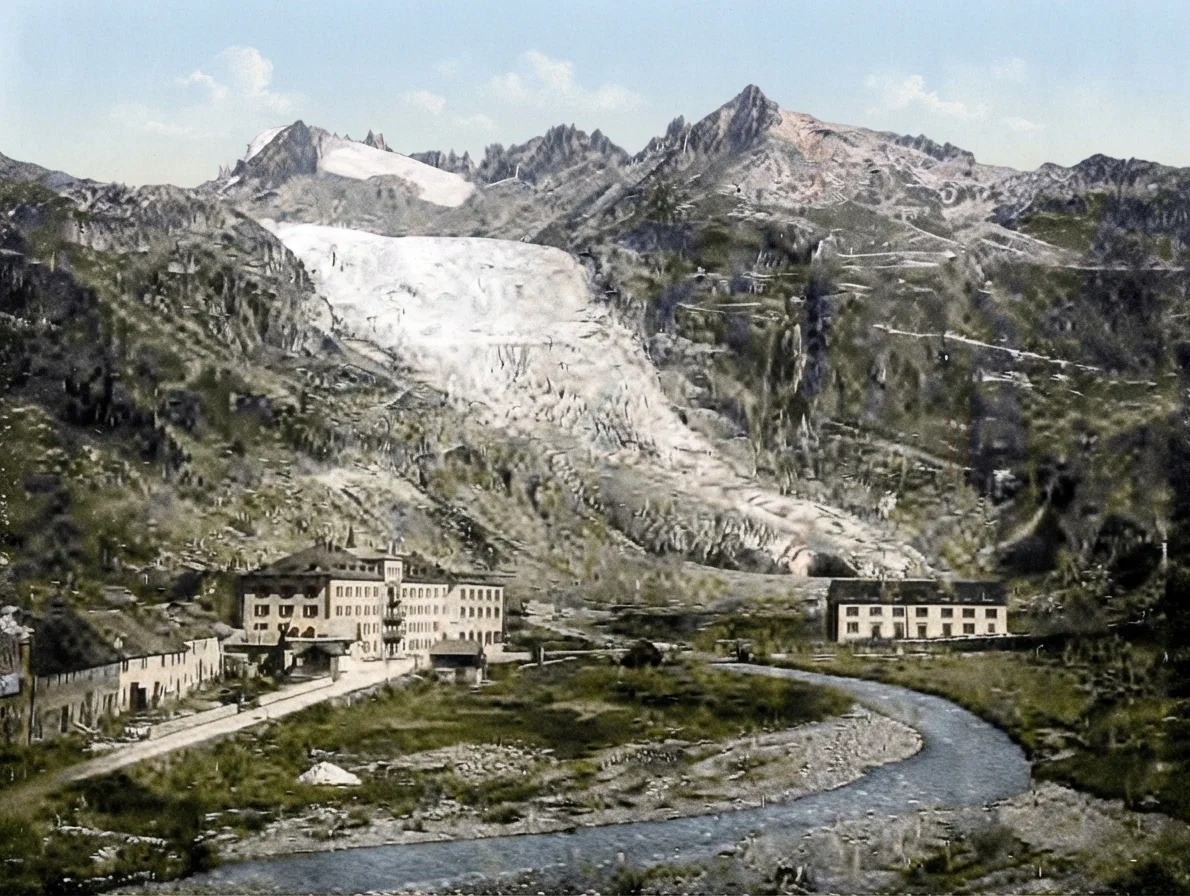
The Great Rhone Glacier in the Swiss Alps.
By the quiet, unconscious influence of a holy life, true Christians reveal Christ. The fragrance of the life, the loveliness of the character, show to the world that they are children of God. Men take knowledge of them that they have been with Jesus.
To those who have named His name Christ says, "You have given yourselves to Me, and I have given you to the world as My representatives." As the Father had sent Him into the world, so, He declares, "have I also sent them into the world." As Christ is the divine channel for the revelation of the Father, so we are the channel for the revelation of Christ. While our Saviour is the great source of illumination, forget not, O Christian, that He is revealed through humanity. Every individual disciple is Heaven's appointed channel for the revelation of God to man. Angels of glory wait to communicate through you heaven's light and power to souls that are ready to perish. Shall the human agent fail of accomplishing his appointed work? O, then to that degree is the world robbed of the promisedinfluence of the Holy Spirit.
When Christ would define the advancement possible for us, He said, "Be ye therefore perfect, even as your Father which is in heaven is perfect." This advancement is not gained without effort. The Christian life is a battle and a march. But the victory to be gained is not won by human power. The field of conflict is the domain of the heart. The battle which we have to fight—the greatest battle that was ever fought by man—is the surrender of self to the will of God, the yielding of the heart to the sovereignty of love. The old nature, born of blood and of the will of the flesh, can not inherit the kingdom of God. The hereditary tendencies, the formed habits, must be given up.
He who determines to enter the spiritual kingdom will find that all the powers and passions of an unregenerate nature, backed by the forces of the kingdom of darkness, are arrayed against him. Selfishness and pride will make a stand against anything that would show them to be sinful. We can not, of ourselves, conquer the evil desires and habits that struggle for the mastery. We can not overcome the mighty foe who holds us in his thrall. God alone can give us the victory. He desires us to have the mastery over ourselves, our own will and ways. But He can not work in us without our consent and co-operation. The divine Spirit works through the faculties and powers given to man. Our energies are required to co-operate with God.
The victory is not won without much earnest prayer, without the humbling of self at every step. Our will is not to be forced into co-operation with divine agencies, but it must be voluntarily submitted. Were it possible to force upon you with a hundredfold greater intensity the influence of the Spirit of God, it would not make you a Christian, a fit subject for heaven. The stronghold of Satan would not be broken. The will must be placed on the side of God's will. You are not able, of yourself, to bring your purposes and desires and inclinations into submission to the will of God; but if you are "willing to be made willing," God will accomplish the work for you, even "casting down imaginations, and every high thing that exalteth itself against the knowledge of God, and bringing into captivity every thought to the obedience of Christ." Then you will "work out your own salvation with fear and trembling. For it is God which worketh in you both to will and to do of His good pleasure."

THE LIBERTIES OF LIFE.

THAT beautiful motto of Jesus, called the "Golden Rule," "Whatsoever ye would that men should do to you, do ye even so to them" (Matt. 7:12) is the comprehensive rule of life. It gracefully puts the doer of a deed in the receiver's place. Properly observed, this rule would maintain a happy moral poise for the whole family of earth.
The Lord intended humanity to enjoy a unit interest in life. The living of each individual was primarily intended for the helpfulness of all. Every departure from this principle is narrow and selfish, and therefore sin. All selfishness is sin. Take selfishness away, and sin is destroyed.
Taking the forbidden fruit was man's first act of selfishness. This set the evil mill going, and nothing but the infinite power of God's love can stop it. Because of selfishness, the commandments are put in the negative form; still their purpose is to promote true liberty. Transgression disturbed the happy equilibrium, and brought "thou shalt not" into the moral code.
But all the commandments are positive in their summary, which tells man to love his neighbor as himself. The soul that possesses this principle, walks at liberty, and is always found in the way of the Lord's commandments. The life that is hardened by selfishness can not be free. The influence of sin upon the heart of man acts like the winter's frost upon a pond of water. The mill-wheels are blocked while the water is frozen, so the work must wait till the water is set free. The warm rays of the sun must act upon the hardened mass. The melted current starts the good mill going, and thence flows on till it mingles with the blue waters of earth's mighty reservoir.
How like the winter-bound stream is the heart calloused by sin. The warm glow from the Sun of Righteousness must shine upon it, and dissolve the hardness. Then will start a stream which, by receiving rivulets, increases in volume until it bears many souls into the great ocean of God's love.
A free-born soul knows what the liberties of life mean. Released from the frosts of sin, life is employed in doing a thousand deeds of kindness, without losing its sweetness. It is softened and flexible, fitting anywhere this service is demanded. "If the Son therefore shall make you free, ye shall be free indeed." "Freely ye have received, freely give."
The liberated water that turned the mill, is free to operate the next wheel in its course. Being versatile, it can be placed in a thousand positions, and yet enjoy its freedom. It may tumble over the cataract, swiftly speed with the current, silently rest in the lake, or be tossed in ocean's waves, and still be free.
A true life desires association. To be alone is bondage. When Adam was brought from the dust, the Lord said, "It is not good that man should be alone; I will make him an helpmeet for him." Gen. 2:18. When Eve was introduced to him, "Adam said, This is now bone of my bone, and flesh of my flesh; . . . and they shall be one flesh." "And Adam called his wife's name Eve; because she was the mother of all living." By special illumination, he comprehended the great truth that mankind constitute one brotherhood. The parentage of the human family being "one flesh," it follows that all are brothers and sisters, and hence the rights of every one are equal to those of every other.Adam was made happier by the creation of Eve, because association freed him from the bondage of self. The earth was too large for one alone, but admirably adapted for a multitude.
The narrow-minded and stingy are much like the poor hedgehog, who rolls himself up in his own quills to keep from being approached. Everything that touches the little bundle of selfishness must be pricked by its barbs. The creature is imprisoned by its own embattlements, and seems to live for the purpose of supporting its thorns.

The Largest Life.

Life yields its richest fruit for the one who conforms most closely to its true purpose. The happiest man shares his gladness with the greatest number of people. His joys are multiplied according to the number of lives he blesses. The person who brings joy to a thousand has a thousand shares in the joy.
The apostle said: "Tho I was free from all men, I brought myself under bondage to all, that I might gain the more. . . . To the weak I became weak, that I might gain the weak; I am made all things to all men, that I may by all means save some. And I do all things for the Gospel's sake, that I may be a joint partaker thereof." 1 Cor. 9:19, 22, 23, R. V.
The hope of being a joint partaker in salvation with every soul who accepted Christ through his ministry, was indeed a pleasing prospect. And the sharing of the apostle in all their joy would only increase the joy of all. A thing so good as redemption from sin, must be given to others in order to be kept. He that would have salvation alone, can not have it at all.
In explanation of how he had been made free, the apostle said, "Am I not free? . . . Who planteth a vineyard, and eateth not of the fruit? Who feedeth a flock, and eateth not of the milk? He that ploweth should plow in hope, and he that thresheth in hope, should be a partaker of his hope." Even the affliction borne, the apostle says, "worketh for us a far more exceeding and eternal weight of glory."
The sowing of an evangelistic life, in the Gospel field, may be compared to the sowing of a grain of wheat, and then gathering and sowing again the whole product from year to year, until all garners are filled with the increase. The life of the first grain planted would thus be multiplied into countless millions. So with the fruit of a life like that of Paul. The increase brought into the kingdom is great beyond computation.

All-Comprehending.

That "life is the light of men." That life is the source and the way, the power and the glory. That life, tho the source of all things, was sown as a seed in the soil, and the prophet says it grew up a "tender plant."
It was sown in men's wounds, and healed over in their bruises. It gave life, and then received and swallowed up and destroyed death. It imparted righteousness, and yet was accounted as transgression. "In all their afflictions He was afflicted." "He bare them and carried them all the days of old." Even the iniquity of all was laid upon Him. He received within himself the accumulated sins of men. He exchanged justified life for inexorable death.
In giving this great price, Christ bought all men. All were lost but those in Him. All go into oblivion save those who live through Him. He lives in all, and all live in Him.

OPENING TO THE ENEMY.

THOSE who indulge fretful feelings, either of anxiety or irritation, know not what an opening they thereby give to the devil in their hearts. "Fret not thyself," says the psalmist, "else shalt thou be moved to do evil." And in entire harmony with this warning of the elder Scriptures is the precept of St. Paul against undue indulgence of anger: "Let not the sun go down upon your wrath, neither give place to the devil." Peace is the sentinel of the soul, which keeps the heart and the mind of the Christian through Christ Jesus. So long as this sentinel is on guard and doing his duty, the castle of the soul is kept secure. But let the sentinel be removed, and the way is opened immediately for an attack upon the fortress.—Bishop Huntington.

PEACE, BE STILL.

BY LLEWELLYN A. MORRISON.
WILDLY the tempest, o'er Galilee sweeping, Brake in its boisterous din, Low, in a fisherman's boat, He lay sleeping— Peace and contentment within; Weary was He as He pressed the rough pillow, The toil of the day had been long; O, it was sweet to be sooth'd by the billow— Hushed into rest by the song.
They are His own: all the forces, uniting, Serve at His will or His word— Sonorous angels in service delighting, Praising the name of the Lord. Deep in the mountain, the forest and ocean, Music, indwelling, hath birth— Infinite anthems of praise and devotion Thrilling the resonant earth.
Nature hath moods for the soul and is cheerful, Could we see under the veil; Hearts that are venal and sordid are fearful— Shrink from the gloom and the gale. Hearts that are whole hear the chorus ascending Clear as the hymn of the stream; Hearts that are pure see the glory attending, Follow the luminous gleam.
"Peace!" to the winds, and "Be still!" to the waters,— Quickly His voice they obey; Breathless, obedient, Jehovah's fair daughters, They come to "Attention" at play. Calm and complacent the blue sky they mirror,— Sunset gilds silver and sod. "Why do ye fear?"—there is nothing in error— These are the angels of God.
Master, speak "peace" to the turbulent forces Lording the realms of my soul! Guide and direct all my being's resources, Keep them within Thy control; So shall I pass o'er the tumults of passion, Tho my barque toss on their foam; So shall I perfect my measure and mission, Coming, at eventime, home. Toronto, Ont.

THOSE SCARS.

A BATTLE-SCARRED veteran was a candidate for office, and a compatriot had been vigorously opposing his election. But when election time came round, and the bitter opponent was about to cast his vote, the scarred face of the old hero confronted him. Then the tears suddenly came to his eyes, and he loudly declared that he could not resist those scars, and cast his vote for the one he had been opposing. As we read of this incident we wondered why such an argument does not make more disciples for the crucified Hero who "tasted death for every man," and that too "while we were yet sinners," while yet at enmity against Him and against His law. If scars marking faithful service in behalf of some temporal cause of limited extent be worthy of grateful remembrance, how much more those scars received in the loving service of procuring undeserved favor for condemned sinners. Reader, if you have yet any sentiment of gratitude for noble service rendered in which your welfare is concerned, think of those scars that tell of the sufferings on Calvary's cross.
If the judgment books shall reveal that your faith is firmly fixed in Him who gave His life a ransom for your life, if the record of the deeds done in the body shall show a hope anchored within the heavenly veil, the scars in that head and side, in those hands and feet, will attest the fact that your sins have been washed away in the precious blood of the Son of God.
"Were the whole realm of nature mine, That were a tribute far too small; Love so amazing, so divine, Demands my life, my soul, my all."

The Russo-Eastern Question Prophetically and Historically Considered

THE RUSSO-EASTERN QUESTION PROPHETICALLY AND HISTORICALLY CONSIDERED. NO. 3.

(Concluded.)
[This present exposition of the thirty-eighth and thirty-ninth chapters of Ezekiel is presented for the study of our readers. The writer feels the profound conviction that the views as set forth in these articles are truth. For these views the editors are not responsible. The prophecy is an open one, one about which various opinions exist, and much uncertainty; therefore we give these articles space. Let the prophecy be carefully, prayerfully considered. If there are decided objections, let us hear from you. —ED. S. OF T.]
THE final scenes of Gog's (Russia's) career are graphically given by the prophet in chapter 39:1-22. The line of events here described begins prior to those delineated in verses 15-23 of the foregoing chapter, and is end farther down the stream of time. Verse 1 leaves no doubt as to who is the object of the Lord's displeasure, and in verse 2 we are again told of the restraints that are put upon him just before the final acts leading to his ruin and the end of the world.
The reason for these restraints is given in Rev. 7:1-3. It is notable, as indicative of the nearness of the closing scenes of earth's history about to be enacted, that the six great world powers, the United States, England, Germany, France, Italy, and Austria, are making most strenuous efforts to maintain the peace of the world. Their efforts, however, seem to have been in vain, for at the present time a "state of war" exists between Japan and Russia.
Keen diplomats and astute statesmen have long foreseen inevitable world-wide war growing out of the Eastern Question. Their deductions are the result of worldly reasoning alone. Indeed, it scarcely requires prescient wisdom to forecast such a result from the Russo-Japanese contention, as it involves vital interests of every nation on earth—of some their very existence. If so be these nations are to be instruments in God's hand to restrain this conflict by "hooks" in Russia's "jaw," it will only be temporary; for God's word is stronger than the gossamer thread of diplomacy that seeks to cool the ebullition of international jealousy. Dan. 2:43. The very act of restraining Russia will involve the other powers, because some will fear an advantage in which they do not share.
The "mountains of Israel" are the strongholds of power, or governments of nations, in which God's people dwell, being vouchsafed some degree of legal protection in religious liberty by so-called Christian nations. Verse 3 fitly illustrates the futility of any attempt of this Gogian power to carry out any purpose that militates against God's people. Verses 4, 5, 17-20, all refer to the same matters and agree with other scriptures, to wit, Rev. 19:17-19; Zeph. 1:7, 8, 14, 15; Joel 3:2, 9-12.
These scriptures just given point to the beginning of the final scenes, and Mal. 4:1-3 and Zech. 14:1-3 describe the after-scenes when the former work has been accomplished.
Verse 6: "And I will send a fire on Magog [Russia], and among them that dwell carelessly [margin, "confidently"] in the isles; and they shall know that I am the Lord." Here fire means the destructive and consuming processes of war. Jer. 48:45. Those that "dwell confidently in the isles" are thought by some to be the people of "coast lands," or "maritime countries;" but, as all nations have more or less "coast lands" and maritime features, we do not see that such application should be unqualifiedly made in this connection; but it seems more reasonable to conclude that the prophet is speaking of those countries most interested in the doings of Magog (Russia), whose distinctive geographical features might be designated by the word "isles;" and England is preeminently an island kingdom, and, admittedly, the greatest maritime power in the world. Japan is also called the "Island Empire," and in the last few years has attained an enviable maritime position among the other nations. Of all the nations of earth none have interests of such magnitude at stake in the Russo-Eastern Question as do those two, England and Japan. Therefore we conclude that war is inevitable between Russia and Japan and England, and also that it is imminent. During these fearful scenes that are now coming upon the earth, just before man's probation—time to accept salvation—closes, and the last plagues are ushered in, God's people will make known the true message for these times, warning all people of the judgments foretold in prophecy, which are now at the very threshold of fulfilment.
Verse 10 describes another incident of the closing, or rather final judgments; and the expression, "And they shall burn them with fire seven years," shows the completeness of the cleansing work, which is more vividly presented in Rev. 20:8, 9; 2 Peter 3:10; Mal. 4:1-3; Ps. 11:6.
Verses 11-16 tell us how Gog and all his bands (armies), and all the "many peoples with him" (his allies), and "all his multitude" (the warring nations gathered against him), all come under the unmixed wrath of God in that day. Rev. 14:9, 10.
In verses 12-14 the term "seven months" denotes that the burial and cleansing is thorough and complete, that it is for "all time" and eternity. The "passengers," "those who remain on the face of the earth," are the "whole house of Israel," who have passed through the cleansing fires, and upon whom the second death had no power.
At this time Jerusalem is holy, "and there shall no strangers pass through her any more." Joel 3:17. There is an absolute literalism about these prophecies that can not be set aside, notwithstanding the similes and symbols so largely drawn from the experiences of ancient Israel. They are actual scenes, enacting and to be enacted here upon the earth, and the culmination "hasteth greatly." This is Ham-ongog—Gog and Hamona, the valley of eternal death, and the city of the eternal dead; for Gog and all his mighty host have found their final doom on the farther side of the second resurrection. They met and were conquered by the second death, because they were not Christ's at His coming. We need look no farther; "Gog and Magog" ended HERE.Russo-American Eastern Question, and Russia's International Policy.
The one dominant, overpowering purpose and desire of Russia is to be mistress of the world. Beginning 4,000 years ago with the Magogian tribes, and it seems with an inborn propensity for "Japhetic enlargement," she joined to herself one-half of the Japhetic family in the Ethnic persons of Meschech, Tubal, and a part of Gomer. Thus the Cushite tribes of Dedan and Sheba, together with the commingled Semitic and Hamitic races, were finally merged into the great Slavonic race. We remember about half a century ago Russia was classed in the geographies as "half civilized." Her peasantry are low in morals, and are kept in degrading ignorance. Her official class is venal as well as corrupt, profligate, and given to inveterate cruelty, ruthlessness being a modern, as well as ancient, characteristic. Herein is the foundation of the peculiar variety of diplomacy that amazes the world; artful, deft, unique, and untiring; subtle and unscrupulous. It is hard to express or describe the true inwardness of her statecraft; but with an atom of truth in a gulf of sophistry, Russian monumental assurance has stupefied the other nations, till they are apparently oblivious to the manifest danger that is at once threatening and imminent,—a Slav mistress of the world. Will she attempt this feat?—Yes; for it is the dream of her life. Will this dream reach fulfilment?—No; for when she goes forth to accomplish this "evil thought" she will find the grave the prophet foresaw.
This is not all; there are some other things of equally fateful import that she will accomplish. She will have a war with Japan and England. Again the "hooks" will be put in her "jaws," and she will be "turned back" again for a brief period; but she will be the ultimate gainer by the contest. She gains time, also, which, in the present state of her unaccomplished plans, is extremely desirable, as it will give her assured opportunities to finish the Trans-Siberian Railway and other much-needed transportation facilities—a commercial highway through the last bit of buffer territory lying between her and India (now almost completed). Her intention is to pauperize England by monopolizing the trade of India; to drive the Turk out of Europe; to absorb Asia (here is where the Turk comes to his end with none to help him. Dan. 11:45); to trade portions of it out to some other nations for which they become her allies by treaty compact, thereby securing a Russian highway to the world's great waters.
And then, not discerning that the end is come, she makes an assault on the United States for real or fancied injuries, with a view to "getting even." "Remnant" Israel is in the throes of the last persecutions, precipitated and aggravated by Russian successes and intolerance. Then will be the final gathering of the nations to their last conflict. Then will this great diplomatic craftsman of the world, unable to overcome that "more sure word of prophecy" with her accustomed adroitness, "fall upon the open field; for I have spoken it, saith the Lord God." Eze. 39:5.

The Industrial Conflict in the Light of Revelation.

By G. W. Rine.

WORK—ITS SACRED MISSION.

IN one of his New England speeches, delivered in the summer of 1902, President Roosevelt affirmed that the workingmen had many grievances to be redressed, but that they deserved no sympathy or commiseration on the ground of their being obliged to work. All right-thinking persons will assent to the President’s averment. For no person can live a sane, normal life without devoting himself to regular, honest, intelligent work. It is only by being one of God’s working men that a man can be one of God’s noblemen. Before returning to His Father, the Master “gave to every man his work.” This He did because He knew that no man is really and truly a man unless he be a workingman—working with hands and head and heart.
“Next to faith in God is faith in labor,” wrote one of the old English divines. This thought needs restatement. Faith in God implies faith in labor. God is life, and life means work. Hence, devotion to God necessarily carries with it devotion to work—devotion expressed in service. Life means service and service means work. To be nothing is to do nothing. To do something worth doing is to be something worth being. “There is always hope for a man,” wrote Carlyle, “who actually and honestly works. In idleness alone is there perpetual despair.” Blessed is the man who has found his work, and does it—blessed because he is fulfilling the supreme mission of life, and is thus conforming to the supreme law of life. This is the normal life, because it is the life of God. “My Father worketh hitherto, and I work,” declared the greatest Worker the world ever knew. To bear the cross is to follow Jesus; but the cross means service, and service means work.
Labor in itself is not a curse, but is distinctively and essentially a blessing—a blessing given to man before he fell. Gen. 2:15. Too many peoples are still the victims of the delusion that work is a disagreeable necessity of life, something hopelessly hostile to the very notion of blessedness. Yet there is nothing more evident in all this world than the fact that there can be no genuine, lasting happiness in this life, apart from earnest work. These poor souls are the unconscious disciples of the old philosopher who wished that the earth might be transmuted into a bun and the sea into lemonade, in order that the world might be happy without effort. It was the heathen world that regarded manual work as servile, and, therefore, at variance with the dignity of a true gentleman, or a noblewoman. They thought such work unworthy of a free man, and fit only for slaves. This viciously false conception of common work was born of heathenism, and heathenism is demonism.

Work a Moral Necessity.

Idleness and goodness simply can not live together in the same person. They are mutually repellent. In short, idleness is in itself a species of sin; work, if not righteousness in itself, is the unvarying and eternal accompaniment of unrighteousness. This ethical necessity of honest labor is just as essential on the part of the rich as of the poor. In the day of supreme and final reckoning every man shall be rewarded “according to his works.” A tree is known by its fruits, by the results of its activities. Jesus, the Author of righteousness, sanctified common toil and hallowed the faithful performance of the humblest duties by His example as well as by His teachings. By His toil as a carpenter, and, subsequently, as a teacher and missionary, He lifted common duty and common labor to a plane of sacred dignity and nobleness.
It has been said that the unemployed classes at both ends of the social scale are the vicious, the dangerous classes. A great Christian thinker once declared that “If you are idle you are on the way to ruin, and there are few stopping places upon it.” He clearly saw that idleness is the sepulcher of virtue, and that to do nothing is the readiest road to do that which is worse than nothing. All human experiences, as well as revelation, attest the great fact that life can not be kept sweet and true apart from the filling up of time with useful labor. Idleness invariably ends in ennui, disgust, and moral laxness. In Ruskin’s apt phrase: “There is a working class, strong and happy, among both rich and poor; there is an idle class, weak, wicked, and miserable, among both rich and poor.” By nature’s law, immutable and just, goodness ever ends where indolence begins. The Spaniards have a saying that the busy man is troubled by one demon; the idle man by a thousand. Of essentially the same import is this Turkish maxim: “The devil tempts all men, but the idle man tempts the devil.”
If he be idle, even a Christian can not long maintain moral integrity. We remember with what severity Paul rebuked the Thessalonians when he learned that some of them, in the ardor of their religious feelings, had forsaken their ordinary occupations. Their motives were good, but their judgment was in error. Their purpose in abandoning their occupations was that in quietness and peace they might cultivate a spirit of prayerfulness and an inner devotion or spiritual meditation.
But the very means defeated itself and made the end impossible. Instead of growing in grace and spiritual devotion, they became busybodies, flighty, and a nuisance to their quiet, hard-working neighbors. Knowing that all sorts of moral disorders would arise from this unhappy state of affairs, Paul sent them this spirited rebuke: “When we were with you, this we commanded you, that if any would not work, neither should he eat. For we hear that there are some which walk among you disorderly, working not at all, but are busybodies. Now them that are such we command and exhort by our Lord Jesus Christ, that with quietness they work, and eat their own bread.” It is evident from these words that any one who can work and has a chance to work, can not eat the bread earned in the sweat of another’s face, and still be guiltless.
No one, however, should work simply to get the wherewithal to live, but from a conviction that working is the truest, highest, and happiest kind of living. Many persons work hard and long to acquire a competence, with the hope thatthen they shall be able to devote themselves to something higher. There can be no greater delusion. There is nothing higher than honest, intelligent work. There is nothing baser or more execrable than voluntary idleness. Honest, earnest service is the only badge of true nobleness, of genuine manliness, of intrinsic worth. He who conscientiously serves is ever God's nobleman.

The Motive and the Fruit.

The disciplinary and ennobling power of work is largely determined by its spirit and motive. Merely selfish labor, designed solely to get and to keep, tho better than indolence, is yet nothing more than ugly, barren drudgery. But let it glow with the sheen and warmth of love, and work rises to the dignity and glory of a God-given mission, of a divinely inspired joy. In the last analysis it is only love that takes all the grossness, and all the sting out of work, and lifts it above bare, soulless drudgery. All true work is service, and service is the issue and fruit of love.
Such work is the very salt of life, giving it tone and flavor. Apart from love-inspired work there can be no self-respect, and hence no peace, no lasting happiness. Nothing else can yield a joy so pure, and keen, and wholesome as the consciousness of duty done, of honest work well performed. Emerson once pithily wrote: “The reward of a thing well done is to have done it.” The sweetest of all pleasures is the fruit derived from consecrated toil. God intends that we, like the bee, shall make our daily work our chief joy and amusement. What a paradise this would soon be if every worker should fall in love with his work, become infatuated with it, not for its own sake, but for the sake of Him who in love has given “every man his work.”
In my reading my eye recently caught this epigram: “One of the great lessons of life is not to do what one likes, but to like what one does.” This each one can do if he will receive into his heart the divine spirit of labor, which is nothing less than the spirit of consecrated service.
Most earnestly would I urge upon the young people the absolute necessity that in the appointed and demanded work of their life they should find the supreme pleasure and joy of their life. Do not do your work simply because you must; do not do it slavishly, and then, having got it done as speedily as possible, look somewhere else for the enjoyment that every normal heart craves. How dreary such a life must be! I have a conviction that if every man could say with Jesus, “My meat [delight] is to do the will [work] of Him that sent Me, to finish His work,” the saloons, the theaters, the race-tracks, etc., would soon all disappear for want of patronage. Ay, even strikes, lockouts, boycotts, and all forms of industrial strife would perish from sheer anemia. Every one would do his work so well, so joyously, that a just compensation would follow as certainly as the night the day.
If young people would study the principles of their work, let their interest dwell on its details; appreciate the help they are rendering others through their work, and the education and discipline that their own minds and hearts are getting out of it; they would soon find their appointed work to be the center and source of their highest and holiest joys. Then they would not be running everywhere else to find other pleasures to compensate them for their self-sacrificing toil. One can never do well what one does not do gladly. No one who hates his work will linger over it lovingly, and thus give it those extra touches, and that exquisite finish that love alone can give. It is the heart that gives insight and penetration to the head, and deftness to the hand. The slave, conscious of his slavery, is a bungling workman; but God's free man, consecrated to his work, is the incarnation of skill.
The man who has caught a vision of the sacred dignity of honest work, sees vastly more in his labors than his daily income, or the employment of his time, or even the mere benefiting of his fellows. To him work is the incarnation of the unseen principles of character. He sees clearly that in the loom of his daily work, honesty, integrity, accuracy, thoroughness, conscientiousness, and truthfulness are being woven into the fabric of character. To him the varied forms of work are so many conductors through which messages of grace and truth find their way into the heart. His workshop is not only a place for making things, but for making men; the office is not only a place for balancing ledgers, but for making character; the mart is not only a place for making money, but it is first of all, a place for fitting the virtues into one's life, for turning out true, cultured God-fearing men. A school should not be so much a place for making scholars as for making righteous men and women.
What we are growing to be, is very largely determined by our doing. He who is doing careless, slipshod, slovenly work is making for himself a careless, slipshod character. Truthfulness in work is as imperative as truthfulness in speech. To put deceit into one's work is the most effectual way to put deceit into one's character. Shoddy work is, however, not only a sin against the worker, but an offense against society, as well as a sin against brotherly love. Somebody suffers for it, is defrauded by it. Speaking plainly, then, dishonest work is at once to cheat, to lie, and to commit a grave offense against one's own soul.
The true worker, then, is the true nobleman. He accepts his work as God-given, assigned to him as a sphere wherein he can serve humanity and glorify God. Such a view of one's work transfigures petty drudgery, and glorifies the narrow corner. It adds a new and sacred sanction to the universal necessity, the universal law, of work. True work is applied worship—religion fulfilling its normal mission.

THE FATAL STEP.

A FATHER took his little child out into the field one day, and it being a hot day, he lay down under a tree and at last fell asleep. While he was sleeping the little child wandered away. When he awoke, his first thought was, Where is my child? He looked all around, but could not see it. He shouted at the top of his voice, but all he heard was the echo. Running to a little hill, he looked around, and shouted again; but no response. Then going to a precipice at some distance, he looked down, and there upon the rocks and briers, he saw the mangled form of his loved child. While he was sleeping the child had wandered over the precipice.
What a picture of the church of God! How many fathers and mothers are sleeping now while their children wander over the terrible precipice right into the bottomless pit! Fathers and mothers, where are your children to-day? —Selected.

Ask, Seek, and Knock

LET praying fathers and mothers never grow faint of heart. Let despondent churches, long unvisited by revival blessings, only close up their ranks more compactly about the mercy-seat, and besiege heaven with new importunity. For above the dark cloud of their discouragement is written, He that “asketh receiveth; and he that seeketh findeth; and to him that knocketh it shall be opened.”—T. L. Cuyler.
Continue reading: How They Became Convinced