In his teachings Christ interpreted the spiritual character of the law, showing that to hate was to commit murder, to think impurely was to commit adultery, to covet was to be an idolater; and his life was so completely in harmony with the sacred precepts as interpreted by him, that he could challenge those who were constantly seeking something against him with the inquiry, “Which of you convinceth me of sin?” And he “who did no sin” wrought out this life of perfect righteousness, not for himself, but for us, that the image of God might be again revealed in our lives. The law was within the heart of Christ, and he came to do the will of God, in order that the same law might be written in our hearts, that we might be restored to the blessedness of doing God’s will, and that the form might become the reality in us. This is accomplished for each individual by his acceptance, through faith in the word of God, of the work of Christ for him. He thus opens the door of his heart to Christ, that Christ may become the very life of his life, that so he may be “saved by His life.” This is righteousness by faith. This is being “found7in him, not having mine own righteousness, which is of the law, but that which is through the faith of Christ, the righteousness which is of God by faith.”
Thus we see that the law first gives knowledge of sin. It sets up a perfect standard of righteousness, and so defines the righteousness required; but it can not confer that righteousness. It does not make one a sinner; it simply reveals the fact that he is a sinner. It can not give righteousness; it simply shows the need of righteousness. But God, who requires the righteousness of the law in our characters, has made provision that this righteousness shall be brought to us in Christ, who is the center of the Gospel. The standard of character which is defined by the law is represented to us in Christ, in the Gospel. So we read: “But now the righteousness of God without the law is manifested, being witnessed by the law and the prophets; even the righteousness of God which is by faith of Jesus Christ unto all and upon all them that believe; for there is no difference; for all have sinned, and come short of the glory [character] of God; being justified freely by his grace through the redemption that is in Christ Jesus; whom God hath set forth to be a propitiation through faith in his blood, to declare his righteousness for the remission of sins that are past, through the forbearance of God; to declare, I say, at this time his righteousness; that he might be just, and the justifier of him which believeth in Jesus.” By the law, sin is revealed; in the Gospel, righteousness is revealed. By the law, the disease is made known; in the Gospel of Christ, the cure is found. This is the first step in the relation between the law and the Gospel.
Form versus Life—Establishing the Law.
But after we have come to Christ and are “justified by faith without the deeds of the law,” after we have become “the children of God by faith in Christ Jesus,” having received him who is righteousness and the living law, what, then, is our relation to the law? This will perhaps best appear by considering the results of genuine faith in Christ. To believe on Christ is to receive Christ; not to assent to a creed, but to accept a life; not to strive for the maintenance of certain outward forms, but to become “partakers of the divine nature.” Creeds and forms can not save people from their sins. Terrible is the catalog of the sins of those “having a form of godliness, but denying the power thereof.”
A new life must be imparted before man can “live unto God.” “Except a man be born anew, he can not see the kingdom of God.” “For neither is circumcision anything, nor uncircumcision, but a new creature.” This experience depends upon the faith which each one exercises for himself, and “it is of faith, that it might be by grace.”
To all who sincerely pray the prayer, “Create in me a clean heart,” the reply comes, “Believe ye that I am able to do this? . . . According to your faith be it unto you.” “And this is the victory that overcometh the world, even our faith,” but faith for victory is the “faith which worketh by love.” “Do we then make void the law through faith? God forbid; yea, we establish the law.” “This is the victory which overcometh the world, even our faith”—Christ made present with all his glorious power—but this is the Christ in whose heart is the law of God, who said of himself, “I have kept my Father’s commandments,” who was and is the law of God in life, so that when the prayer is answered, “that Christ may dwell in your hearts by faith,” the law in Christ is “written not with ink, but with the Spirit of the living God; not in tables of stone, but in fleshly tables of the heart.” And thus do we establish the law.
“Where there is not only belief in God’s word, but a submission of the will to him, where the heart is yielded to him, the affections fixed upon him, there is faith,—faith that works by love and purifies the soul. Through this faith the heart is renewed in the image of God. And the heart that in its renewed state is not subject to the law of God, neither indeed can be, now delights in its holy precepts.” “God is love;” his law is an expression of his love; and Christ is that law of love expressed in life; so when we receive Christ into our hearts, then love, the fruit of the Spirit, is received into our hearts; and “when the principle of love is implanted in the heart, . . . the new covenant promise is fulfilled. ‘I will put my laws into their mind, and write them in their hearts;’” for “love is the fulfilling of the law.” And thus do “we establish the law” by faith.
A Divine Witness.
But after the law is thus by faith established in the heart by abiding in Christ, and having him, who is the living law, abide in us, then the fruit of such a union with Christ will appear in the life. “He that abideth in me, and I in him, the same bringeth forth much fruit,” and thus are we “filled with the fruits of righteousness.” And now the law, which revealed sin, but could not confer righteousness, witnesses to the character of the righteousness which we have received through faith in Christ. “But now the righteousness of God without the law is manifested, being witnessed by the law and the prophets.” The law reveals sin by defining righteousness, by showing us the character of God. The Gospel reveals righteousness. “Therein is the righteousness of God revealed.” We receive this righteousness as the free gift of God, in receiving Jesus Christ. The law can not give us what we need. It urges us to Christ, where we receive what it demands but can not bestow. Then we return to the same law, and it bears witness to the fact that the righteousness we have received in Jesus Christ is the very righteousness which it demands but can not impart. This was God’s plan for those who would believe in Christ. “God offered them in his Son the perfect righteousness of the law. If they would open their hearts fully to receive Christ, then the very life of God, his love, would dwell in them, transforming them into his own image; and thus through God’s free gift they would possess the righteousness which the law requires.”
What Did Christ Abolish?
The words “abolish,” “take away,” “destroy,” and “change,” have been so persistently connected with the law by some public teachers, that there exists in the minds of many people the honest conviction that all which is expressed by these words was done to the law by Christ. It is true that he came to “abolish” something, and to “take away” something, and to “destroy” something, and to “change” something; but it is important that we should know just what it was that he abolished, and what it was that he took away, and what it was that he destroyed, and what it was that he intended to change by his work in behalf of man. This we can easily learn from the Scripture. It is said of our Saviour, Jesus Christ, that he “hath abolished death, and brought life and immortality to light through the Gospel.” Death is the result of sin. “Sin, when it is finished, bringeth forth death.” But “sin is the transgression of the law.” Christ came to abolish that which is the result of being out of harmony with the law, and he440did it, not by abolishing the law, but by bringing us into harmony with the law.
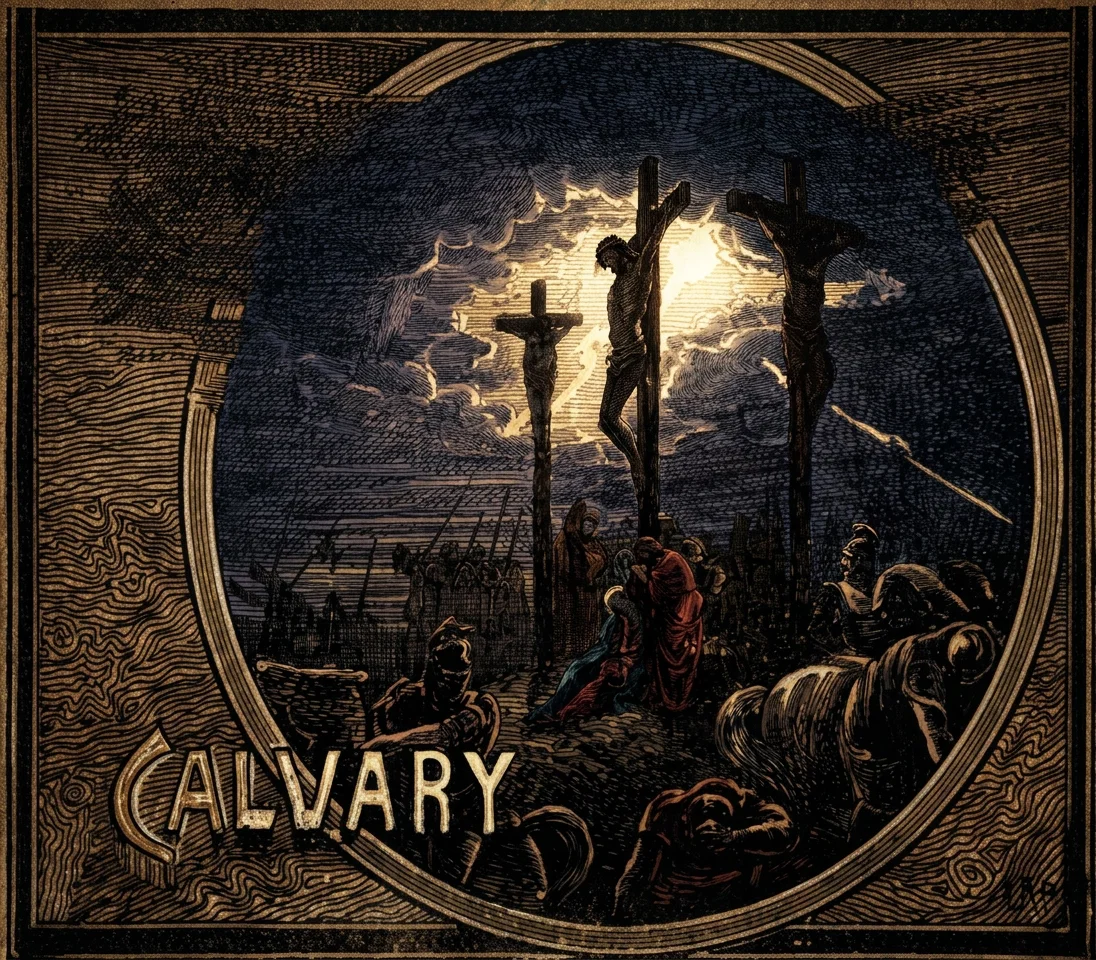
We read that Christ “was manifested to take away our sins.” He is the sin bearer, “who his own self carried up our sins in his body to the tree, that we, having died unto sins, might live unto righteousness.” Sin is lawlessness, and Christ was manifested to take away, not the law, but lawlessness.
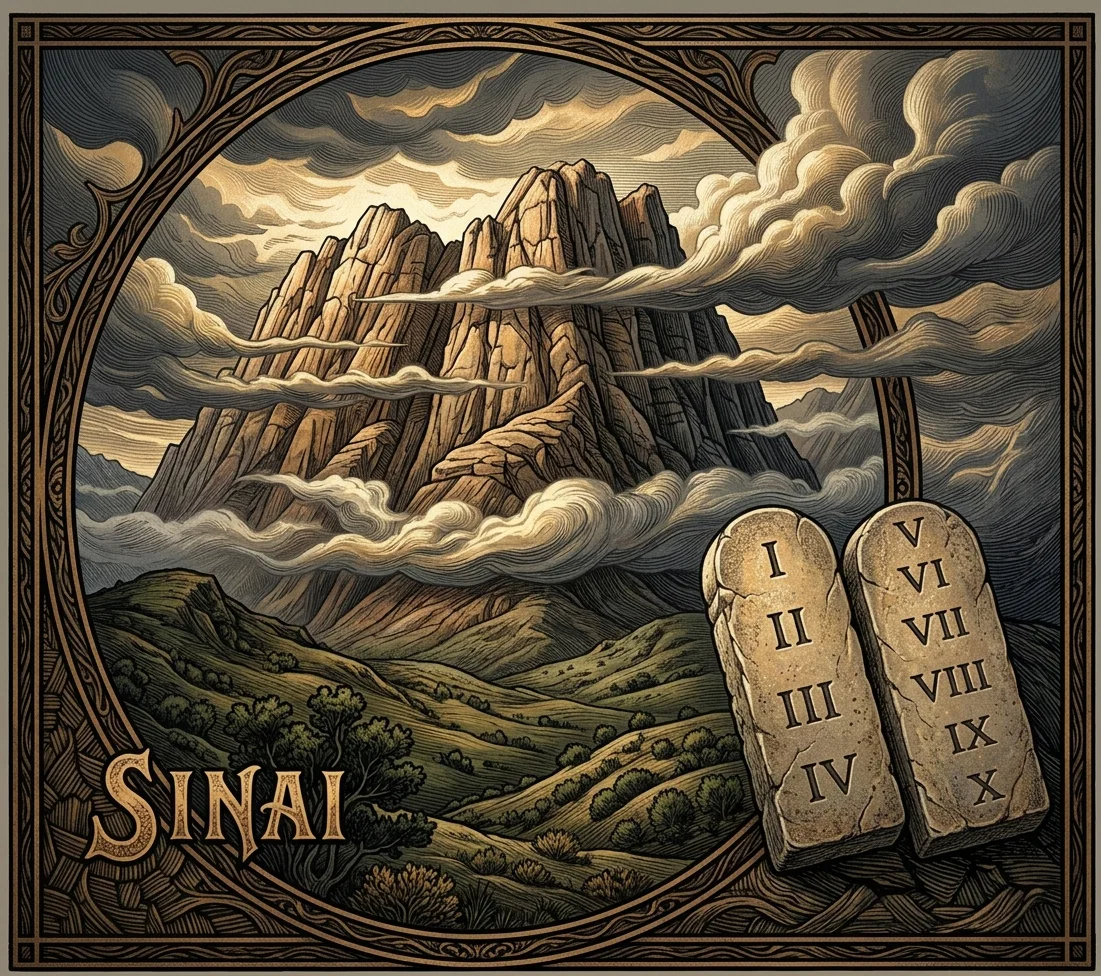
The attitude of Christ toward the law is set forth in the prophecy which says, “He will magnify the law, and make it honorable.” In his sermon on the mount, which is itself but the interpretation of the principles contained in the words spoken from Mount Sinai, Christ said, “Think not that I am come to destroy the law, or the prophets; I am not come to destroy, but to fulfil.” He “came to explain the relation of the law of God to man, and to illustrate its precepts by his own example of obedience.” But we are taught that “for this purpose the Son of God was manifested, that he might destroy the works of the devil.” The works of the devil are those which are contrary to God’s law. “The devil sinneth from the beginning,” and in every case “sin is the transgression of the law.” Furthermore, Christ came to destroy the devil himself. Satan had introduced into this world rebellion against God and his law, and Christ’s mission and work were to put an end to that rebellion and the instigator of it. In order to do that, he took our flesh, “that through death he might destroy him that had the power of death, that is, the devil.”
What Did Christ Change?
It is a blessed thing to know what a change was wrought by Christ in giving himself for man. There was certainly need that a change should be made. Men were far from righteousness, “being alienated from the life of God through the ignorance that is in them,” “having no hope, and without God in the world.” “But God, who is rich in mercy, . . . hath quickened us together with Christ, . . . and hath raised us up together, and made us sit together in heavenly places in Christ Jesus.” And thus “we all . . . are changed into the same image from glory to glory.” But more even than a change of character has been provided for us, for “we look for the Saviour, the Lord Jesus Christ; who shall change our vile body, that it may be fashioned like unto his glorious body.” “We shall not all sleep, but we shall all be changed, in a moment, in the twinkling of an eye, at the last trump.” Glorious change! A renewed character and a renewed body! This is the fulness of the salvation provided for us in Jesus Christ.
It thus becomes evident from the teaching of the Scriptures that Christ came to abolish, not the law, but death; to take away, not the law, but our sins; to destroy, not the law, but the devil and his works; to change, not the law, but us. He did all this “by the sacrifice of himself.” If the law could have been changed or abolished, Christ need not have died.
In different ways God teaches that sin is transient, while the law is eternal. While Jesus was teaching on one occasion, “the scribes and Pharisees brought unto him a woman taken in adultery,” and asked what should be done in such a case, not because they desired to be instructed, but “tempting him, that they might have to accuse him.” After her accusers had made their charge, “Jesus stooped down, and with his finger wrote on the ground.” “Although doing this without apparent design, Jesus was tracing on the ground, in legible characters, the particular sins of which the woman’s accusers were guilty.” Thus Jesus wrote the record of sins in the sand. How easily could this record be obliterated! A gust of wind or a dash of water, and it is gone! But God wrote his law with his finger upon tables of stone,—an unchangeable and imperishable record of his own character. This same law he writes in the heart of the believer, there to remain to all eternity; for “he that doeth the will of God abideth forever.” Sin, and death, the result of sin, may be taken away; for “the blood of Jesus Christ his Son cleanseth us from all sin,” and “death is swallowed up in victory;” but “all thy commandments are righteousness,” and “thy righteousness is an everlasting righteousness.” “Hearken unto me, ye that know righteousness, the people in whose heart is my law;” “my salvation shall be forever, and my righteousness shall not be abolished.” “Jesus Christ is the same yesterday and to-day, yea and forever.”
The very charge made against God by Satan was that his plan of government was defective, and his law imperfect; and the whole controversy between Christ and Satan has been waged over this point: Shall God’s rule be acknowledged and his law respected in this world, or shall the rebellion succeed and the kingdom of Satan be established here? Is it not clear, therefore, that every one who to-day takes the position that God’s law has been changed or abolished is really putting himself on the side of the “god of this world” and in opposition to “the God and Father of our Lord Jesus Christ”? But God will show to the satisfaction of the universe, even in the very face of Satan’s work, that his law is perfect, and his government just. “Who shall not fear thee, O Lord, and glorify thy name? for thou only art holy; for all nations shall come and worship before thee; for thy judgments are made manifest.”
“Because he hath appointed a day, in the which he will judge the world in righteousness by that man whom he hath ordained.” Acts 17:31. Webster’s definition of the word “appoint,” is “to fix; to establish; to constitute, prescribe, allot, assign.” God has therefore fixed upon a day or time; it is established; the day is prescribed, and according to Dan. 8:14 it is at the end of the 2,300 days, or years.
We now call for the inspired writers of the Bible to bear their testimony upon this important subject. Jude will be the first to speak: “And the angels which kept not their first estate, but left their own habitation, he hath reserved in everlasting chains under darkness unto the judgment of the great day.” Jude 6.
The Saviour bears the following testimony: “He that rejecteth me, and receiveth not my words, hath one that judgeth him: the word that I have spoken, the same shall judge him in the last day.” The judgment is in the last day, and not after it.
We now inquire, Does the judgment day begin before the second advent of Christ? The testimony of John is, “Blessed and holy is he that hath part in the first resurrection,” and, “But the rest of the dead lived not again until the thousand years were finished.” Rev. 20:5, 6. There are two resurrections. The dead in Christ are raised at his coming, and the wicked, one thousand years later. It is evident that if the righteous and wicked are to be resurrected at different times, it must be determined, before the resurrection, who are holy and righteous; and to this agree the words of Christ: “But they which shall be accounted worthy to obtain that world, and the resurrection from the dead [literally, “out from among the dead”], neither marry, nor are given in marriage.” Luke 20:35. The accounting worthy of a resurrection, must take place before the resurrection, and, as the second advent of Christ and first resurrection take place at the same time, the accounting worthy is done prior to his coming.
Daniel speaks thus: “I beheld till the thrones were cast down, and the Ancient of Days did sit, whose garment was white as snow, and the hair of his head like the pure wool; his throne was like the fiery flame, and his wheels as burning fire. A fiery stream issued and came forth from before him; thousand thousands ministered unto him, and ten thousand times ten thousand [angels, Rev. 5:11] stood before him; the judgment was set, and the books were opened.” Dan. 7:9, 10. Christ also was brought before the Ancient of Days, or into the holy of holies of the heavenly sanctuary. “I saw in the night visions, and, behold, one like the Son of man came with the clouds of heaven [angels], and came to the Ancient of Days.” Verse 13. After the judgment is set, and the books are opened, Daniel says, “I beheld then, because of the voice of the great words which the horn spake; I beheld even till the beast was slain [after the judgment was set], and his body destroyed, and given to the burning flame.” See also 2 Thess. 1:7, 8. The judgment was set in 1844, the Son of man was brought before the Ancient of Days, and then there were some great words uttered by a power symbolized by the horn, and at last he saw the beast destroyed by the burning flame which will accompany Christ’s second advent.
We give one more text to prove that the judgment takes place before Christ’s second advent: “And I saw another angel fly in the midst of heaven, having the everlasting Gospel to preach unto them that dwell on the earth, and in every nation, and kindred, and tongue, and people, saying with a loud voice, Fear God, and give glory to him; for the hour of his judgment is come; and worship him that made heaven, and earth, and the sea, and the fountains of waters.” Rev. 14:6, 7. We learn from this text that the everlasting Gospel is preached to the inhabitants of the earth by this angel. Who are those who preach the Gospel on the earth?—They are God’s ministers. Therefore, the angel having the Gospel to preach to them that dwell on the earth, must be a symbol of a religious movement given by God’s ministers. The message to be given is the everlasting Gospel. Part of the message is that “the hour of God’s judgment is come.”9As the judgment is in the last day, this message must be a last-day message. Or, if the judgment began in 1844, this message should go at that time. Ministers in all parts of the earth proclaimed the judgment day, in 1844. The theory then prevailed, as it now does, that the judgment day and the second advent were to take place at the same time. The judgment day did begin, but the second advent is still in the future.
John says, “And there followed another angel, saying, Babylon is fallen.” Rev. 14:8. This message announces the downfall of professed religionists. The world, since the fall announced, is almost void of genuine Christianity, such as was in the apostolic church.
There is still one more message to go to the world: “And the third angel followed them, saying with a loud voice, If any man worship the beast and his image, and receive his mark in his forehead, or in his hand, the same shall drink of the wine of the wrath of God.” Verses 9, 10. This warning message is the last that will go to the world. It is now being given. The next event is the coming of Christ, as announced in verse 14: “And I looked, and behold a white cloud, and upon the cloud one sat like unto the Son of man, having on his head a golden crown, and in his hand a sharp sickle.”
Judgment is of two kinds,—investigative and executive. According to the word of God, there are two investigative and two executive judgments. The first investigative judgment and the first executive judgment both pertain to the household of God, or the church. The second investigative and the second executive judgments both pertain to the wicked.
The judgment which began in 1844 was the first investigative judgment, and pertained to the church only. Judgment “begins at the house of God,” and the sins of those who have accepted of the Gospel, and have proved faithful, and have overcome, will all be blotted out, and Christ says to such, “I will come again, and receive you unto myself.” John 14:1–4. When he comes, it will be to execute, or carry out, the decisions made in the first investigative judgment. Jude 14, 15.
The second investigative judgment is an investigation of the cases of the wicked, and is to take place in heaven during the thousand years, or the millennium. Rev. 20:5–7. The church of Christ will participate in this judgment. “And Jesus said unto them, Verily I say unto you, That ye which have followed me, in the regeneration when the Son of man shall sit in the throne of his glory, ye also shall sit upon twelve thrones, judging the twelve tribes of Israel.” Matt. 19:28. “Do ye not know that the saints shall judge the world? and if the world shall be judged by you, are ye unworthy to judge the smallest matters? Know ye not that we shall judge [fallen] angels?” 1 Cor. 6:2, 3. This is the second investigative judgment, and lasts one thousand years. At its close the wicked are raised from the dead, and come forth to suffer the second death, or the penalty for their sins. The punishment of the wicked is the carrying out of the decisions of the second investigative judgment, and is the second executive judgment.
Sometimes as the great day of the Lord, comprised of many events, is spoken of as one, so the judgment of that day is spoken of as one, including all classes. Here is a description of the judgment which began in 1844: “And I saw the dead, small and great, stand before God; and the books were opened; and another book was opened, which is the book of life; and the dead were judged out of those things which were written in the books, according to their works.” Rev. 20:12. A book is spoken of in the text, called the book of life. It is always spoken of in the singular number. The books which contain the record of our deeds, are spoken of in the plural number. The book of life contains names. Rev. 13:8; 21:27. When the judgment was set in 1844, the “books” were opened, and the sins of those who were found faithful, were all blotted out. Acts 3:19. Of those who are not found faithful, the names were blotted out of the book of life (Rev. 3:5), and their sins remain on record in the other books. The book of life contained the names of those who accepted Christ from Adam’s day to our own. In 1844, the first name called was Adam’s; and so they pass down the ages until they reach our day. How soon our names may be called we can not tell, but all is well if we only have Christ as our pleading Lawyer, to plead the merits of his blood before the supreme court of the universe.
“The judgment is set; the books have been opened.
How shall we stand in that great day?”
New Carlisle, Ohio.
LITTLE COURTESIES OF LIFE.
It is a pleasant thing, when one is going about the world, to bestow little courtesies, or do little kindnesses for those with whom we come in contact; but it is not every one who has the faculty of doing these things gracefully.
An incident in a street car the other day illustrates the aptitude of some people in meeting emergencies, and the ease with which they grasp the situation. A lady entered the car holding her dress up to avoid stepping on the trimming, which had broken loose, and was dangling some distance below the edge of the skirt. Adjusting her belongings as best she could, and putting the trimming in proper shape, she began a search for a pin. The belt, the edge of the dress, the collar—every place where a pin might have been found—was examined, but to no purpose.
The threads that held the trimming were then pulled up and tied as snugly as possible, and she gave up in despair, and settled herself to the idea that the trimming must drag until she could get to some place where the needful repairing could be done. A pert youngster across the car grinned and enjoyed her embarrassment. A rather dashing-looking woman transfixed her unfortunate sister with her eyes, and smiled in an insulting fashion. A middle-aged man, evidently a dyspeptic, exchanged glances with his friend; and, all told, the situation was not particularly comfortable.
Just then a man rose from his seat, passed down the aisle of the car, halted just long10enough to offer the lady some pins, touched his hat, and was gone in an instant. There was more genuine good-will in the act than all of those disgruntled spectators could feel in a lifetime. The man was a stranger, and the lady scarcely caught sight of his face, but she knew without any further evidence that he was a gentleman.—New York Ledger.
CHEERFULNESS AND COURAGE.
How much these two words mean to the child of God! A few days since we met a man who, altho he had gone through many trials and tribulations, yet was bubbling over with so much cheerfulness and courage that it was inspiring and contagious. While he has seemingly more difficulties to surmount than any ten men would have ordinarily, yet he is invariably cheerful and courageous, and God has given him such a spirit of good cheer throughout that not only is he able to bear the burdens laid upon him, but is wonderfully helpful to every one he meets.
Trouble and tribulation are so apt to make us long-faced, sad-faced, that it is well for us to remember that a Christian life, altho beset by cares and sorrows, should be a life of cheerfulness and courage.
Jesus was cheerful; Jesus was courageous. Do not let us fail to remember this; for others will be hindered or helped in proportion as we are either cheerful or downcast in our deportment.
“Be careful for nothing; but in everything by prayer and supplication with thanksgiving let your requests be made known unto God. And the peace of God, which passeth all understanding, shall keep your hearts and minds through Christ Jesus.” Phil. 4:6, 7.—Union Gospel News.
The Setting of a Great Hope
The setting of a great hope is like the setting of the sun. The brightness of our life is gone, shadows of the evening fall around us, and the world seems but a dim reflection itself—a broader shadow. We look forward into the coming lonely night; the soul withdraws itself. Then stars arise, the night is holy.—Longfellow.
Christ, the Light of Life
“If in faithfulness we love and serve Him who is ‘the way, the truth, and the life,’ whatever clouds may gather above us, they will finally break away and be cleared. ‘I am the Light of the world,’ says Christ; ‘he that followeth me shall not walk in darkness, but shall have the light of life.’”
WHAT MAKES A WOMAN?
Not costly dress nor queenly air;
Not jeweled hand, complexion fair;
Not graceful form nor lofty tread;
Nor paint, nor curls, nor splendid head;
Not pearly teeth nor sparkling eyes;
Not voice that nightingale outvies:
Not breath as sweet as eglantine;
Not gaudy gems nor fabric fine;
Not all the stores of fashion's mart,
Nor yet the blandishments of art;
Not one, nor all of these combined,
Can make one woman true, refined.
'Tis not the casket that we prize,
But that which in the casket lies.
These outward charms that please the sight
Are naught unless the heart be right.
She, to fill her destined end,
Must with her beauty goodness blend,
Must make it her incessant care
To deck herself with jewels rare,
Of priceless gems must be possessed,
In robes of richest beauty dressed;
Yet these must clothe the inward mind
In purity the most refined.
She who doth all these goods combine
Can man's rough nature well refine;
Hath all she needs in this frail life
To fit for mother, sister, wife.
Contentment dwells within her mind,
And peace doth here a lodgment find.
He who possesses such a friend
Should cherish well till death doth end.
Woman, in fine, the mate should be,
To sail with man o'er life's rough sea;
And, when the stormy cruise is o'er,
Attend him to fair Canaan's shore.
—Selected.
THE CAT IN SEVERAL LANGUAGES.
THE cat is called a kat in Danish and Dutch, katt in Swedish, chat in France and the most of its dependencies, katti or katze in German, catus in Latin, gatto in Italian, gato in Portuguese and Spanish, kot in Polish, kots in Russian, keti in Turkish, cath in Welsh, kathl in Cornish, catua in Basque and gaz or katz in Armenia. Mr. Harrison, the great English authority on cats, says that there are not a dozen languages or dialects known that spell the word cat without beginning with the letter c, k, or g. The native Australians and those of Mexico had no words for the name of domestic felines.—St. Louis Republic.
What's in the Well?
By John Harvey Kellogg
WHAT'S IN THE WELL?
BY J. H. KELLOGG, M.D.
Water, to be sure, but there may be something more. Perhaps, like a silver mine in Nevada, it has “millions in it”—millions of filth, of germs, of suffering, and possibly death. It will be well worth while to look into the well and see what there is in it that should not be there.
Every one ought to know that the “old oaken bucket,” or the most improved modern means of hoisting water, may bring from the cool depths of the well the invisible but deadly causes of fatal illness; and that the same draught which brings refreshment to the thirsty laborer and cools his parched tongue, may introduce into his system seeds of disease and death. But how do these dangerous things get into the well? Let us see.
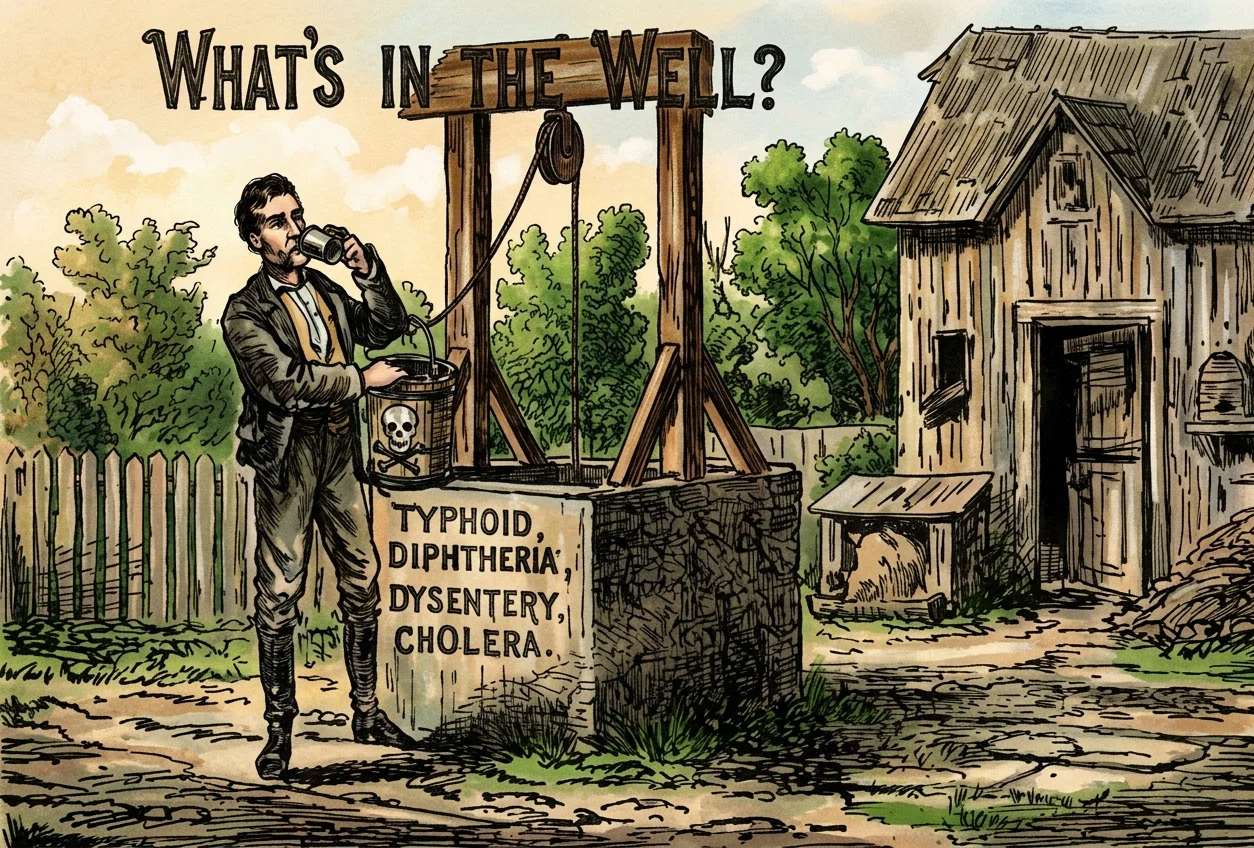
The well, for convenience, is located in the back yard, perhaps a rod away from the house, or it may be even nearer by. There are some other things beside the well which for convenience are grouped close about the back door. Here is a cesspool at a little distance, perhaps only a few feet from the well; and there is a vault, a filthy institution which is an open disgrace to civilization. A little farther away is the garbage heap. In other locations are the chicken coop, the pig-pen, and stable, with their accumulations of decomposing filth. It may be that in a remote corner a dead animal has been buried to save the trouble of conveying it to a distance. A damp and reeking spot near the back door marks the place where the house slops have been deposited since the drain to the cesspool became stopped up with the accumulated filth of a half dozen years.
Each one of the sources of filth mentioned, is a contributor to the well. What becomes of the slops which are deposited upon the ground?—A portion evaporates, but the greater part soaks into the ground. Many persons imagine that what goes into the ground is destroyed. Certainly this is a mistake. The filth which has disappeared from the surface is out of sight, but not out of existence. It is present in the soil, and even more active for evil than if it were still upon the surface. The water which we derive from our wells comes from the soil. If the soil is filled with filth, the water will necessarily be contaminated. Whatever filth is deposited upon the surface in the vicinity of a well, may sooner or later find its way into the well. Every rain washes it a little deeper down, until it reaches the well itself or the underground veins of water by which it is fed.
Scientific investigations have shown that typhoid fever, cholera, diphtheria, and possibly malaria and a number of other diseases, may make their entrance into the system in this way. Indeed, as regards the two first-named maladies, it is known that drinking water is almost the sole means of communication. So it is perfectly safe to say that if one will take care to see that his drinking water is always pure, he will escape death from either typhoid fever or cholera. And it is also evident that if one suffers from either of the diseases named, it is because he or some other person has been guilty of neglecting to protect his drinking water from contamination. The late Dr. Parkes, of England, once remarked, “When a man dies of typhoid fever, some one ought to be hanged.” Certainly some one ought to be educated, and to do this is the object of this tract.
Cesspools, vaults, and other sources of filth, have no business within many rods of a well; but the probability of something of this sort being placed near to any well is so strong that it is much the safer way to make the well in such a manner that it will be practically safe from contamination from sources of this kind under any circumstances. This may be accomplished by making what is commonly termed a bored or driven well. An iron pipe is driven into the ground until water is reached. This will prevent the surface water from getting into the well, and if the pipe is carried down until the “second water” is reached, so that it penetrates some distance of dense rock or clay, the protection may be considered as practically perfect.
Every housekeeper should know how to tell bad water from good, which is not always very easy to do, at least not unless one has some instructions in methods. The following rules for the examination of water are so simple that they may be followed by any person of intelligence, and they will be found to be sufficiently reliable to answer a very useful purpose:—
How to Examine Water.—Only a skilful chemist can make a perfectly accurate and reliable examination of water; but the following suggestions will enable any intelligent person to make such an examination of drinking water as will greatly diminish the chances of injury from this potent source of disease:—
1. Notice the color of the water. Pure water has no color, is free from sediment, and does not contain suspended or floating specks or particles.
2. Observe the odor. Pure water is absolutely free from odor. Water which has a distinct odor is to be suspected.
3. Notice also the taste. Pure water is free from flavor.
Remember good water is colorless, odorless, tasteless.
If you wish to test the water further—and it is necessary to do so to be even reasonably sure that it is pure, as some waters which are free from color, taste, or odor, are still very impure—take a few ounces of the water, place it in a clean bottle, add a small lump of white sugar, and put it in a warm place for a few days. If the slightest turbidity appears within a week or two, the water is unsafe to use.
Here is another test: Get at a drug store a solution consisting of three grains of permanganate of potash, twelve grains of caustic potash, and an ounce of distilled water. This is a test solution by means of which organic impurities may be detected. Put some of the water to be tested in a clean glass. Add a drop of the purple test solution to the glassful of water. It will produce a faint pinkish tinge. If the water is pure, the pink color will remain; if the water is impure, the color will disappear. If the color disappears within half an hour, the water is unfit to drink. The more impure the water is, the sooner the color will disappear.
The danger of using water which is suspected of being impure, is greatly lessened by boiling. Filters may be relied upon for removing suspended particles and for removing the unpleasant flavor of rain waters; but a really dangerous water is not rendered safe by filtering in the ordinary manner.