Every one knows that the body can be made to float by a competent swimmer, but not so many are aware of the fact that the human body will float by itself without assistance, if properly managed. The body is lighter than its own bulk of water, but only slightly lighter. If, then, it be allowed to sink as far as it will, some portion will remain above the surface. If all but the face be submerged, the nose and mouth will protrude. But if the arms be raised and flung about, the head will naturally sink. To properly balance the body in floating, the swimmer should lie on his back in the water, with his hands extended above his head in the line of the body; this serves to balance the feet, which would otherwise sink and bring the body into an upright attitude, making it necessary for the head to be thrown back in an excessively uncomfortable position in order to keep the mouth and nose above the surface.
But if any small floating article can be gotten, floating is without difficulty. What country boy ever learns how to swim without a board? A little board, three or four inches wide and two or three feet long, under his chest, was ample to enable him to float as he paddled around and unconsciously acquired confidence in his own power and an acquaintance with the maneuvers of the swimmer. Anything that will float may be of advantage. The life preserver is the elaboration of the swimming board, nothing more. When a person falls into the water, he is ordinarily sure to rise again, and when he rises, he invariably grasps at anything within reach—“Drowning men catch at straws” is an old proverb that is always true. So, any available floating material, such as boxes, boards, oars, sticks of wood, etc., should be thrown into the water near where the drowning person has fallen. On shipboard the traditional conduct is to throw over a chicken coop.
If the drowning person can be reached, the bystanders should extend to him an oar, a fish pole, a bough from a tree, or throw him a bit of rope or something of the kind. Professor Esmarch says that an old sea captain told him that he had saved many lives by pulling off his coat and holding it by one sleeve, throwing the other or the coat tails to the drowning person. If the accident is due to the breaking of thin ice, it is often possible to slide out to the sufferer something that will distribute his weight over the ice, such as a board or a ladder. In passing over thin ice it should be remembered that when the body lies flat on the frozen surface, it is much less liable to break through than when the weight is concentrated, as in standing erect.—Christian Advocate.
Faith and the Love of Money
“THERE are people in every church who stop believing the Bible the minute they look at a dollar.”
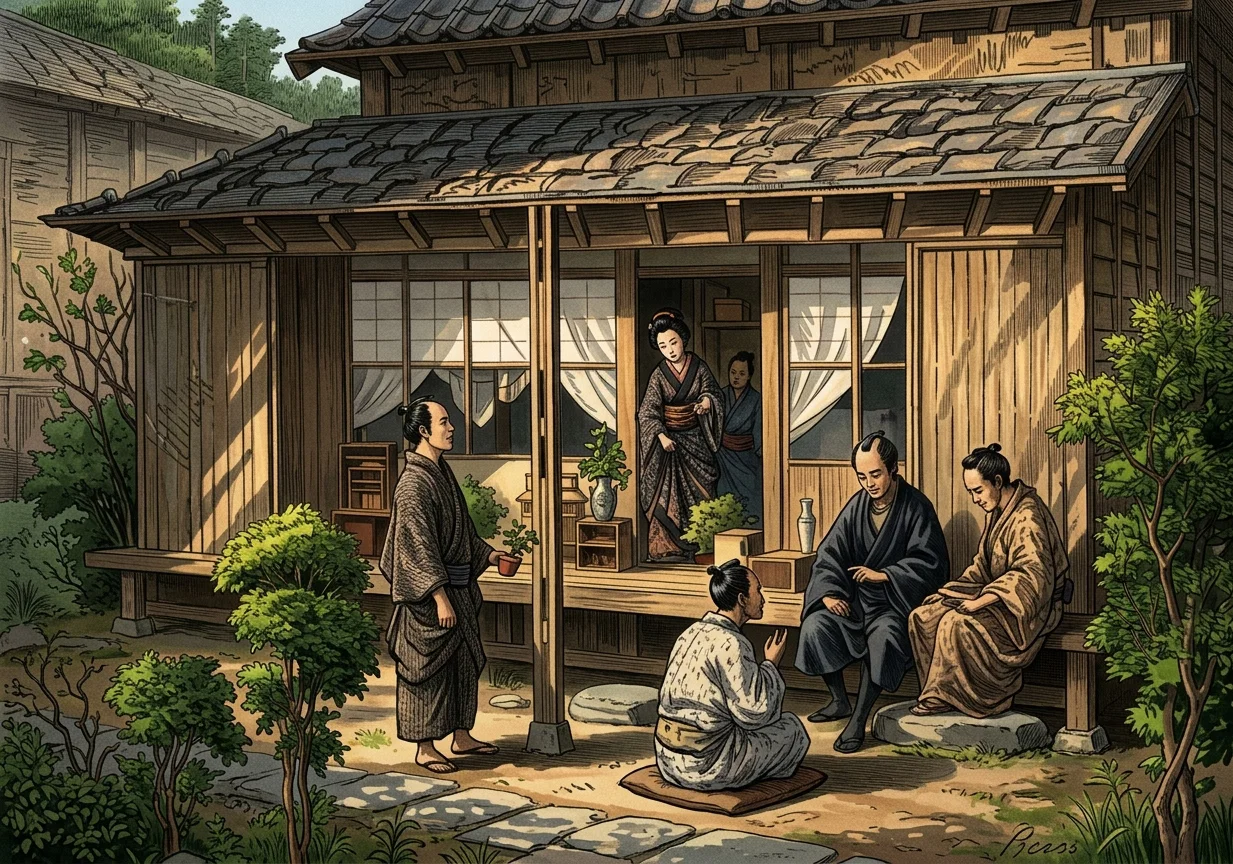
A JAPANESE HOME.
JAPANESE CHARACTERISTICS.
By Henry Hartshorne
BY HENRY HARTSHORNE, M.D., LL.D., TOKYO, JAPAN.
Whom do the Japanese resemble, of other races? Popular ideas in the west associate them with the Chinese, but they are certainly a totally different race; if akin to them at all, they must have been separated stocks for at least a thousand years. Physically, they are, like the Chinese, yellow, or yellowish brown, in complexion, even in this having less of the jaundiced hue, and varying more in the shade or depth of color among themselves. Common opinion classes them as Mongolian, a name also given by some ethnologists to the American Indians. Probably the correct account is that the Japanese are Mongolian, and the Chinese race are outside of that stock. But if any population can be described as absolutely peculiar, in bodily and mental characteristics, it is that of Japan.
It is not easy, even with much study of this population, to discern three distinct types, which are spoken of by Rein and a few other observers. Hardly a dozen men or women, less than sixty years old, have come under my notice, whom I could not recognize as Japanese, in any costume, or in any part of the world. If one type differs from the rest, it is that of the lowest coolies, rustic laborers, and town scavengers, the remainder, probably, of the Eta caste, in feudal times outcast, like the Pariahs of Hindustan, now capable of citizenship under the reformed political system.
A typical Japanese may be thus described: Short in stature, a man 5 feet and 3 to 5 inches, a woman about 5 feet, or even less; weight, a man, 115 to 130 pounds, a woman, from 90 to 110 pounds; figure, that of the men only discernible when in foreign clothes, as, for example, soldiers and policemen; the shape of the women, concealed by their style of dress, well proportioned. Some years ago the men wore little or no clothing in warm weather; foreign influence has modified this, especially in the cities. Face round; the cheek-bones full, but the lower jaws about equally broad; chin small; lips never negroid, often somewhat full, upper lip rather short, its curve high; nose mostly convex (Roman), seldom aquiline, only thick and slightly upturned in the lowest class; bony brow prominent, hairy eyebrows, wide apart, smooth, not bushy, high and arched. The Japanese' eyes are their most peculiar features. In many, but not nearly all, there is some slope, rather backward than upward, never with the degree of obliquity common in the Chinese; the upper eyelid is heavy, the opening between the lids, often narrow (slit eyes), generally shaped like a fish, with the head towards the nose, and the tail, or outer angle, long and tapering to a point. The dark part of the eye is very dark, and the white very white, looking more so because of the short and inconspicuous eyelashes, and the absence, or nearly so, of the little red spot (caruncle) present in the eyes of other races—our own, for instance. What other race, or fraction of a race, combines such characteristics? Foreigners resident or visiting here, and wearing Japanese clothes, as the Salvation Army men and women now here do, are always easily known as such, from whatever part of the world they have come.
Of the mental and emotional traits of the Japanese, Professor Ladd, of Yale, gave the best account a year ago in Scribner's Magazine. They are sensitive, impulsive, mutable in feeling, enthusiasm, and pursuits; subject to waves of action and reaction; intelligent, not often superior in logical reasoning or abstract philosophy, but quick to learn, yet not inclined to depth or thoroughness; extremely skilful in imitation and improvement of the inventions of others, but deficient in inventive power themselves. Their chief superiority has been, for several centuries, in decorative art. They are, as some one has said, small in great things, and great in small things. Professor Ladd sums up much in saying that theirs is the sentimental temperament. The sentiment which controls them is that of the Confucian teaching, personal loyalty,—allegiance and subordination, for life or death, to the emperor first of all; in each family, of the wife to her husband, or, after his death, to her eldest son; of children to their father, and after him, to the eldest son, the head of the family. The story of the forty-seven Ronin, who, in the seventeenth century, planned and effected the death of the slayer of their daimio, knowing that every one of them would suffer death as a consequence, is a historical example of the force of this sentiment. Much later, in 1859, a band of Samurai murdered Ii Kamon, prime minister of the Shogun then in power, and then sent a letter to another member of his cabinet, giving patriotic reasons for their act, concluding with a request that the punishment of death might be, as it soon after was, inflicted upon them. Where else in all the world could such things happen?
We are not, by observation of these marked peculiarities, brought much nearer to an answer to the question of the origin of the Japanese people. We may, however, be thereby strongly impressed with the likelihood that only conjectural answers to that question can be now obtained. Another step in the inquiry will make the discrimination clearer, when we bring into view another race, the Ainu, who were inhabitants of Japan before the present dominant race came, and were driven, as the North American Indians have been, by colonizing Europeans, to remain as a subjugated remnant in a remote fraction of their ancient domain.—S. S. Times.
FROM INDIA.
Inasmuch as India is the great field to which the missionary contributions are sent this quarter, it will be of double interest to read the following, from a letter by Sister Georgia Burrus, to a friend in California. Sister Burrus was a former member of the Oakland church.
You probably are aware that some time ago we opened a school for Hindu girls in our house. We just closed to-day (May 1) for the midsummer holidays. We have had an attendance of from twenty-five to thirty-five as bright little girls as you ever saw. One can not help but love them. We have had a native young lady to teach the common branches. Mrs. Robinson has taught sewing, and I have given Bible lessons. It has been my first attempt to teach in Bengali, and I can assure you it has not been fluently done; but I trust that through the blessing of God, some seeds of truth may have been planted in their hearts that will brighten their lives and bear fruit in the kingdom. We expect to reopen the school about the middle of June, the beginning of the rainy season.
We are now in the hot season. The thermometer varies from 100 to 110 in the shade. But by keeping doors and windows closed we can stop out much of the heat. For my part I do not mind it, as I do not suffer from it at all. . . . One of the most disagreeable features of life during the hot season is prickly heat, which, as its name implies, is a sort of rash that breaks out all over the body, accompanied by the most intense itching and prickly sensation. For some reason, however, I am entirely free from this distressing accompaniment of Indian life. Last summer, while living at the Y. W. C. A. Home, I attributed my immunity from it, while other Europeans living there were suffering, to the fact12that I did not partake of the meat and highly-spiced food which made up their diet. But I have had to abandon that theory, as all of our family here are strict vegetarians, and yet are nearly all distressed by the prickly heat, while I go free.
We are having a dreadful epidemic of cholera here. A few weeks ago the death rate from cholera alone in the city of Calcutta was 325 in a week. Only a short time ago word was sent us that one of our schoolgirls had cholera, and wanted to see her teachers before she died. The native teacher and myself went to the house, and the sight I witnessed I can never forget. In a little room about eight by ten were two children lying on the same bed, apparently dying—our little girl and her brother. Crowded into the room were about a half dozen women, crying and sobbing. The air was hot and foul, and the children were pleading for water, but the doctor had said they must not drink water. In another room of the same house lay an oil man, the grandfather, in the very last stage of the disease, and they pointed us to two other rooms, where three others of the family had just died, and this was simply in one house. Whole families are often swept away. O, for consecrated physicians and nurses at such a time as this! There is a slight abatement in the epidemic now, and we trust when the rains come, that it will die out. Last summer there was just such an epidemic of smallpox.
. . . Bananas are cheap and plentiful, but I think we have had them every meal since we have been here, and we are getting tired of them. Canned fruit is very high. Occasionally, as a luxury, we indulge in a tin of California peaches, but it does not happen often, I assure you.
GUIDE THOU ME.
By A. R. Wilcox
BY A. R. WILCOX.
I would not always stay
In this dark world;
On life's wild sea I'm cast
With sails unfurled.
Dear Saviour, pilot me
On stormy main;
O, still the wave and make
It calm again!
But when the port is reached,
The breakers passed,
O, let me anchor safe
In heaven at last!
And while the ages roll,
In mansions blest
Let me with Christ, my all,
Forever rest.
OUR WORK AND WORKERS.
On the 13th ult. Elder D. A. Ball baptized six persons in the Hudson River, at Bath-on-Hudson, N. Y.
Elder A. E. Place, president of New York conference, whose severe illness was noted a few weeks ago, has so far recovered as to be able to visit his parents at Mt. Vernon, Ohio.
Meetings are now being held in Yreka, Siskiyou County, Cal., by Elders H. F. Courter and George A. Snyder. Siskiyou is one of the extreme northern counties of the state, and it is encouraging to know that the advent message is being proclaimed “from Dan to Beer-sheba” in California.
The Advance (Congregational) of June 18 has this reference to our medical missionary work in Chicago: “Dr. J. H. Kellogg, superintendent of the Battle Creek Sanitarium, Michigan, who has for some time maintained a free medical dispensary (with free baths and free laundry) for workingmen, at 40 Custom House Place, Chicago, at a cost to him of $6,000 per year, has recently secured the old brick church at 42 Custom House Place, Chicago, and has had it thoroughly renovated and fitted for a workingman’s home and medical mission, where will be maintained free reading-room, free baths, free medical dispensary, with a skilful physician in attendance to treat the sick poor. A daily Gospel meeting will also be maintained. Dr. Kellogg will be assisted by a corps of forty medical students, who are studying for missionary work. Dr. Kellogg has also started a ‘Settlement’ work at 744 West 47th Street, Chicago, where is maintained, for the better classes of the poor, lectures on health, cooking, and sewing schools, mothers’ meetings, kindergartens, kitchen-gardens, and other work. Several visiting nurses spend their time looking up the very needy and rendering to them all the aid possible.”
The importance of letting the light shine is illustrated in the report of a laborer at Exeter, England. A business man, with whom he had some conversation, asked if he had ever heard of a people called Seventh-day Adventists. The brother told him that he knew such a people. The gentleman then said he had met one of them on shipboard on the way to South Africa six years ago, and he is now interested to learn more of their doctrine. The same laborer relates another instance, which shows that the preaching of the truth often makes impression unknown to the preacher. He says: “I met a local preacher who was acquainted with the truth, having, with others still interested, attended the meetings held in the city by Elders Durland, Wilcox, and Lane about ten years ago. He gave me an order for ‘Patriarchs and Prophets,’ and the address of a gentleman carrying on a large business, also a local preacher. I found the latter in harmony with us on all points of truth, . . . and he informed me that he has preached the message quite extensively.” We are destined to find many surprises in discovering that the Lord has agencies in the work of which we had not been aware. We may also know by these things that if we prove recreant to the trust reposed in us, the Master can readily supply our places in the work.
1 Now there was a man of the Pharisees, named Nicodemus, 2 a ruler of the Jews; the same came unto him by night, and said to him, Rabbi, we know that thou art a teacher come from God; for no man can do these signs that thou doest, 3 except God be with him. Jesus answered and said unto him, Verily, verily, I say unto thee, Except a man be born 4 anew, he can not see the kingdom of God. Nicodemus saith unto him, How can a man be born when he is old? can he enter a second time into his mother's womb, and 5 be born? Jesus answered, Verily, verily, I say unto thee, Except a man be born of water and the Spirit, he can not 6 enter into the kingdom of God. That which is born of the flesh is flesh; and that which is born of the Spirit is spirit. 7 Marvel not that I said unto thee, Ye must be born anew. 8 The wind bloweth where it listeth, and thou hearest the voice thereof, but knowest not whence it cometh, and whither it goeth; so is every one that is born of the Spirit. 9 Nicodemus answered and said unto him, How can these 10 things be? Jesus answered and said unto him, Art thou the teacher of Israel, and understandest not these things? 11 Verily, verily, I say unto thee, We speak that we do know, and bear witness of that we have seen; and ye receive 12 not our witness. If I told you earthly things, and ye believe not, how shall ye believe, if I tell you heavenly things? 13 And no man hath ascended into heaven, but he that descended out of heaven, even the Son of man, which is 14 in heaven. And as Moses lifted up the serpent in the 15 wilderness, even so must the Son of man be lifted up; that whosoever believeth may in him have eternal life.
QUESTIONS.
Who was Nicodemus?
To whom did he come? When? How did he begin his talk with Jesus?
What apparently irrelevant reply did Jesus make?
By what inquiries did Nicodemus show his pretended misapprehension of the statement of Jesus?
What explanation was given to him?
What great law of heredity was then declared?
What exhortation was given?
What illustration is introduced?
What inquiry revealed Nicodemus’ ignorance of spiritual things?
What reproof did Jesus administer?
With what certainty did Jesus say that he spoke? Was his testimony received?
What inquiry did Jesus then make?
Who has ascended up to heaven?
What was lifted up by Moses? Of what was this a type?
Why is the Son of man lifted up?
NOTES.
1. “THE mind is an invisible agent of God to produce tangible results. Its influence is powerful, and governs the actions of men. If purified from all evil, it is the motive power of good. The regenerating Spirit of God, taking possession of the mind, transforms the life; wicked thoughts are put away, evil deeds are renounced, love, peace, and humility take the place of anger, envy, and strife. That power which no human eye can see, has created a new being in the image of God. . . . The power of the Holy Spirit transforms the entire man. This change constitutes the new birth. . . . Human nature is vile, and man’s character must be changed before it can harmonize with the pure and holy in God’s immortal kingdom. This transformation is the new birth.” “Not even a respectable life, and a respectable religiousness besides,—this is not to be reborn; this is but to be mended, patched.” There must be “the communication of life by the Spirit of God.”
2. The “must” of verse 7 finds its complement in the “must” of verse 14. God “must” make provision for whatever “must” be done in us.
3. “You have resolved to give yourself to God. Now go to him, and ask that he will wash away your sins, and give you a new heart. Then believe that he does this, because he has promised. Through this simple act of believing God, the Holy Spirit has begotten a new life in your heart. You are as a child born into the family of God, and he loves you as he loves his Son.”—Steps to Christ, pp. 51, 54.
4. Position does not necessarily imply a fitness for the work. One may be “the teacher of Israel” (R. V.), and yet not know “these things.”
Suggestions for Further Study.
Nicodemus said, “We know,” but Christ said, “I say unto thee.” What is the force of this change from the plural to the singular?
Two teachers are mentioned,—“a Teacher come from God,” and “the teacher of Israel” (R. V.). Note the difference between them.
The “life” of chapter 1:4 is now spoken of as “eternal life.” This is one of the key-words of this Gospel. We shall have occasion to study it carefully.
INTERNATIONAL SUNDAY SCHOOL LESSON
“Take heed unto thyself; and unto the doctrine;” “that thy profiting may appear to all.”
1. And David said, Is there yet any that is left of the house of Saul, that I may show him kindness for Jonathan’s sake? 2. And there was of the house of Saul a servant whose name was Ziba. And when they had called him unto David, the king said unto him, Art thou Ziba? And he said, Thy servant is he. 3. And the king said, Is there not yet any of the house of Saul, that I may show the kindness of God unto him? And Ziba said unto the king, Jonathan hath yet a son, which is lame on his feet. 4. And the king said unto him, Where is he? And Ziba said unto the king, Behold, he is in the house of Machir, the son of Ammiel, in Lo-debar. 5. Then King David sent, and fetched him out of the house of Machir, the son of Ammiel, from Lo-debar. 6. Now when Mephibosheth, the son of Jonathan, the son of Saul, was come unto David, he fell on his face, and did reverence. And David said, Mephibosheth. And he answered, Behold thy servant! 7. And David said unto him, Fear not; for I will surely show thee kindness for Jonathan thy father’s sake, and will restore thee all the land of Saul thy father; and thou shalt eat bread at my table continually. 8. And he bowed himself, and said, What is thy servant, that thou shouldest look upon such a dead dog as I am? 9. Then the king called to Ziba, Saul’s servant, and said unto him, I have given unto thy master’s son all that pertained to Saul and to all his house. 10. Thou therefore, and thy sons, and thy servants, shall till the land for him, and thou shalt bring in the fruits, that thy master’s son may have food to eat; but Mephibosheth thy master’s son shall eat bread alway at my table. Now Ziba had fifteen sons and twenty servants. 11. Then said Ziba unto the king, According to all that my lord the king hath commanded his servant, so shall thy servant do. As for Mephibosheth, said the king, he shall eat at my table, as one of the king’s sons. 12. And Mephibosheth had a young son, whose name was Micha. And all that dwelt in the house of Ziba were servants unto Mephibosheth. 13. So Mephibosheth dwelt in Jerusalem; for he did eat continually at the king’s table; and was lame on both his feet.
Golden Text: “Be kindly affectioned one to another with brotherly love.” Rom. 12:10.
NOTE.—The covenant of friendship between David and Jonathan resulted in the “kindness” shown by David in this lesson, and this kindness resulted in the kindness which David himself received from the hand of Mephibosheth’s friend in the hour of his sore distress. Thus we see how it is that good deeds follow one another down through the years, as the tree follows the seed and the seed the tree. David had been actively engaged in subduing his enemies and establishing government in the various nations which he had made tributary to Israel, and yet in the midst of it all he finds time to show a kindness to the remnant of the13house of his erstwhile enemy, Saul. One of the most beautiful incidents in the records of ancient times is this friendship of David and Jonathan.
SUGGESTIVE QUESTIONS.
(1) What question did King David ask concerning the house of Saul? Verse 1. (2) What prompted the inquiry? Ib. See note above. (3) Who appeared in the king’s presence in answer to David’s question? Verse 2. (4) What question did David ask of Ziba? Verse 3. Note 1. (5) In answering the king, what physical weakness of Mephibosheth did Ziba mention? and why? Ib. Note 2. (6) What did the king do when he found out where the young man lived? Verse 5. Note 3. (7) How did Mephibosheth conduct himself when he was brought into the king’s presence? Verse 6. (8) What did he acknowledge himself to be? Ib. (9) What did David cause him to be? Last clause of verse 11. (10) What did David say he would do for Jonathan’s sake? Verse 7. (11) How did Mephibosheth receive the words of the king? Verse 8. (12) How much was included in what David placed in the hands of Mephibosheth? Verses 9, 10. Note 4. (13) What special honor was bestowed upon him? Second clause of verse 10. Note 5. (14) What did Ziba say he would do? Verse 11. (15) How long did this arrangement of affairs continue? Verses 12 and 13. Note 6.
NOTES.
1. Kindness of God.—That is, such kindness as God shows, free and forgiving. Many times during David’s reign he had occasion to experience the kindness of God. It is not to be supposed, however, that David considered Mephibosheth his enemy, altho he was of the house of Saul; for it was understood between David and Jonathan that their covenant of friendship included their children. Saul had many times sought the life of David, and if David had followed the custom of ancient nations, the entire family of Saul would have been put to death to atone for his misdeeds.
2. Lame on his feet.—Mephibosheth, son of David’s friend, had been living in Israel for twenty years. It had been fifteen years since Jonathan and Saul had fallen on Mount Gilboa and David began his reign; yet during all this time David had not known that there was still living a son of his old-time friend. It was doubtless thought that David would consider him a rival and seek his life. Thus when Ziba answers the king, he is careful to specify his physical condition, both as an assurance of his incapacity for seeking the throne, and also as an appeal to the king’s sympathy. This is also shown in David’s assurance as recorded in the first clause of verse 7.
3. In Lo-debar.—This was a town on the east side of the Jordan, and was situated near Mahanaim, where Ish-bosheth, son of Saul, brother of Jonathan, held his court for seven years while ruling all Israel, except Judah. In choosing this locality, it is quite evident that Mephibosheth feared Saul’s enmity toward David had inspired in David a similar spirit toward all of Saul’s posterity.
4. Thou . . . shall till the land for him.—It is probable that Ziba had been tilling the land for himself, or possibly for David, in right of his wife, Saul’s daughter. The entire property of Saul’s house was really forfeited to the crown by Ish-bosheth’s rebellion, but it is not known whether David had taken formal possession of this estate previous to turning it over to Mephibosheth.
5. And bring in the fruits.—While Mephibosheth was to eat at the king’s own table, this provision was made for his family and household, in order that he might maintain an establishment suitable to his rank.
6. Shall eat bread alway at my table.—Thus was bestowed upon Mephibosheth, in loving remembrance of Jonathan, the greatest honor King David had to bestow; and in thus honoring the crippled grandson of his avowed enemy, King David shows another of those characteristics which make the better side of his life exceeding beautiful.