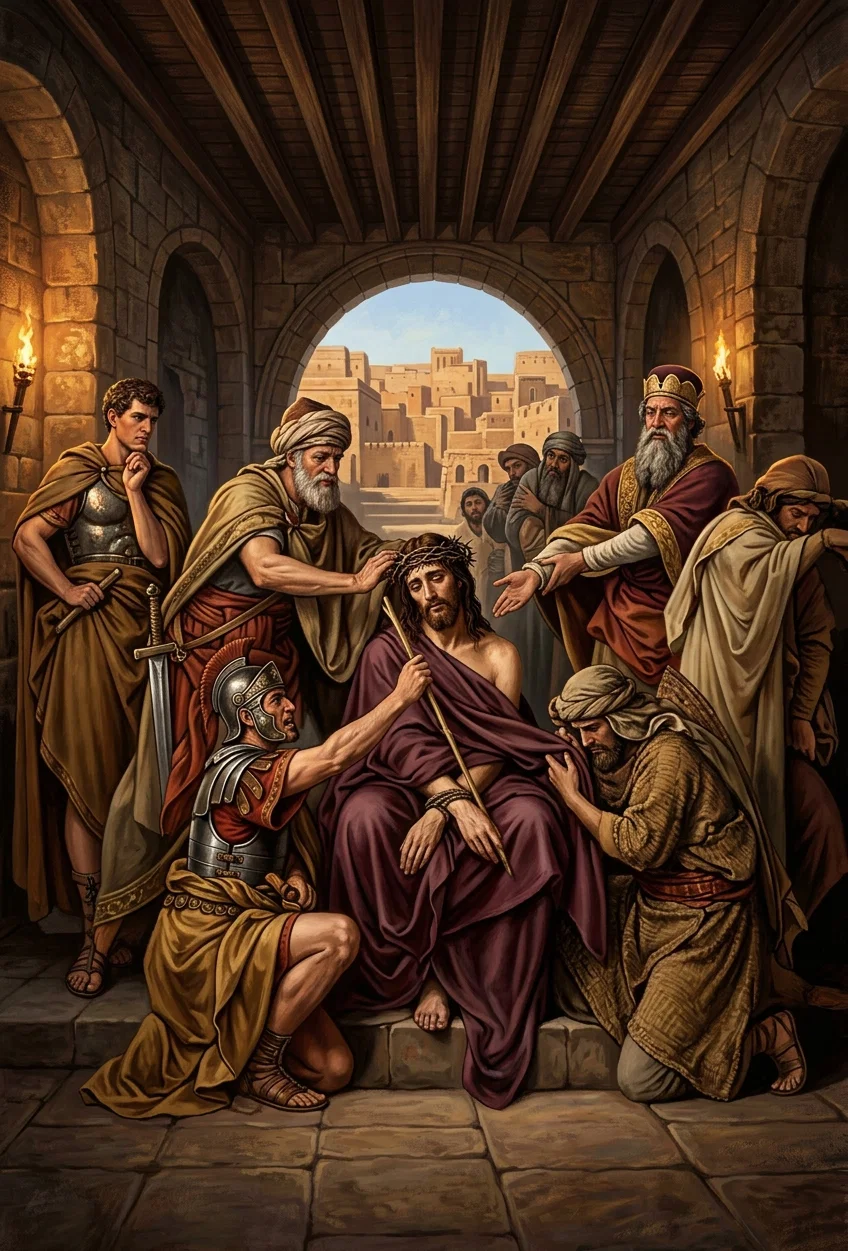
God had signally blessed the Jews, and they had been unfaithful to their trust; tho professing to be the people of God, they would have no place in the kingdom of heaven. They had been made the depository of sacred truth; they had had light far in advance of any other nation on the face of the earth, and yet by misappropriating the great gifts lent to them in trust, by dishonoring and misrepresenting God, by becoming self-righteous and self-important, they had lost the precious graces of the Spirit of God, and were wholly unfit for the heavenly courts. They had not honored God, therefore God could not honor them. They had counted other people as unworthy to associate with them. They had despised them, and fully believed that they themselves would go into heaven before others. But those whom they despised, who made a more faithful use of their privileges, would be accepted of God, and would enter heaven, to sit down with distinguished men who did not reject the world's Redeemer, or cast contempt upon the law of Jehovah.
The words that Christ spoke to John and James, recorded in Matt. 20: 21, 22, contain a deep, unchangeable truth. Tho they did not understand its full significance when it was spoken to them, they afterward appreciated its meaning; for the Holy Spirit enlightened their minds. These words are written for our instruction as well as theirs. We are in the same danger as were those who supposed that they were the very favorites of heaven, who supposed that Christ had come to exalt the Jews as a nation, and to break the yoke of bondage under which they groaned with such a sense of humiliation. They excluded the gentiles from any participation in the kingdom of God; but Jesus distinctly told them that many who were called heathen would be saved, while those who had neglected to improve their rich opportunities, and who did not appreciate the treasures of truth, would be cast into outer darkness.
If we would be children of God in deed and in truth, we must seek first the kingdom of God and his righteousness, and decide that we will be doers of the words of Christ, that we will obey God rather than men. We are to honor human agencies in whom we see the loveliness of Christ's character, but we are not to dishonor God, and him who was the Sent of God, by giving to men flattering titles. The greatest Teacher the world ever knew left no example of this character for us to follow. He did not call any fallible, sinful man by a title that belongs alone to God. No human being heard the title of reverend or right reverend from his lips as applied to man. Our highest honor is our humility. Christ, who was the most exalted among men and angels, bids us to learn of Him who is meek and lowly of heart. Those who took high titles to themselves, were rebuked by Christ as hypocrites. He said that they would not enter into the kingdom of heaven themselves nor permit others to do so. They made great pretensions, and presented themselves before the people as those who had superior knowledge of the Scriptures, but Christ said of them that they were ignorant both of the Scriptures and of the power of God. He said, “In vain do they worship me, teaching for doctrines the commandments of men.”
The Pharisees sought in every way to destroy the force of the truth, and to eclipse the light of God from the view of the people. Professing to be representatives of God, under the garb of religion, they committed the grossest transgressions. Christ came to represent the Father, and therefore they were stirred with enmity against him, and were determined to put him out of the way. Christ placed the principles of the Gospel before the minds of his disciples and the people in order that they might see how great was the contrast between the spirit of true religion and that of the religion professed by the Pharisees.
John and James, who made the request that they might sit, one on the right hand and the other on the left hand of Christ in his kingdom, did not make this request in the spirit that many have thought they did. They both loved Christ, and desired to be as close as possible to his person. It was customary for John to take his position next to the Saviour at every possible opportunity. James also longed to be honored with as close a connection with Christ as John desired. But when the ten heard of the request that had been made, “they were moved with indignation against the two brethren.” Jesus called his disciples to him, and said: “Ye know that the princes of the gentiles5exercise dominion over them, and they that are great exercise authority upon them. But it shall not be so among you, but whosoever will be great among you, let him be your minister; and whosoever will be chief among you, let him be your servant.” This means that those who would be great in the church of God must act as true shepherds in his church. They are to follow the example that Christ has given. “And whosoever will be chief among you, let him be your servant; even as the Son of man came not to be ministered unto, but to minister, and to give his life a ransom for many.”
The Mind of Christ.
Jesus did not come to earth with outward pomp and display. His works of divine love and mercy were to testify to his divine origin and character. Those who would not receive him because of his outward humility, would be of no value to the Saviour, no blessing to humanity. He clothed his divinity with humanity, and yet he did not require that any one should minister unto him. He came to labor for others. He ever strove to do men good; he provided for their necessities. Among his disciples he was in every sense a care-taker, a burden-bearer. He shared their poverty. He practiced self-denial on their account. He went before them to smooth the more difficult places, and now he was nearing the time when he would consummate his work for men on earth by laying down his life. He paid his life as the price for our redemption.
“He Humbled Himself.”
The lessons given to the disciples of Christ, are full of significance, and present most profitable instruction for us who believe. We are not to act after the manner, precept, or example of men who are in authority in earthly positions, but to minister to others, to be servants to all, “even as the Son of man came not to be ministered unto, but to minister, and to give his life a ransom for many.” The kingdom of God is established on different principles than are the kingdoms of this world. There is to be no rank among the servants of Christ. Christ says, “All ye are brethren.” The rich, the poor, the learned, the unlearned, the bond, and the free are equally God's heritage, and he who is most exalted in the sight of God is he who has most genuine humility, the deepest sense of his unworthiness, the greatest realization of his dependence upon God. Those who truly love God, truly love their fellow-men. They constantly seek to do good to all those who are connected with them. They are laborers together with God.
Christ did not reprove John and James and their mother for offering this request to sit upon his right hand and upon his left hand in the kingdom. In presenting the principles of love that should actuate them in their dealings one with another, he presents to the indignant disciples the instruction that he would have them practice in their daily lives. They were to take his life as an example, and follow in his steps. The apostle presents this matter before us also in its true light, and says: “Let nothing be done through strife or vainglory; but in lowliness of mind let each esteem other better than themselves. Look not every man on his own things, but every man also on the things of others. Let this mind be in you, which was also in Christ Jesus; who, being in the form of God, thought it not robbery to be equal with God; but made himself of no reputation, and took upon him the form of a servant, and was made in the likeness of men; and being found in fashion as a man, he humbled himself, and became obedient unto death, even the death of the cross. Wherefore God also hath highly exalted him, and given him a name which is above every name.”
Christ lived the law. He copied no human model, he drew no lessons from the maxims that guided the world. He was the brightness of his Father's glory, the express image of his person. He thought it not a thing to be grasped to be equal with God, and yet there was not one act of oppression in his whole life. He bore patiently with Judas. Judas condemned himself in betrayal his Lord, gave himself up to the enemy, passed sentence upon himself, and put himself to death. How tenderly Jesus dealt with Peter; tho he denied him three times, yet he looked upon Peter with sorrowful regret, with pardoning love! It was that look that broke the heart of the disciple. Let us look upon the spotless life of Christ, appreciate his unstained purity of character, and pray earnestly, “Be thou my pattern.”
Christ was ever touched with human woe. He healed the sick. He worked miracles. He condescended to go to those who could not come to him. He raised the dead. And yet he bore with meekness and patience the charge that he cast out devils through the prince of devils. He denounced every abomination in the land. His own spotless, untainted purity put to shame every evil practice. It was this character that showed up in contrast the character of those who were deceiving the people and lording it over God's heritage. His lips were free from all guile; zeal for God's honor was unceasingly apparent in his life, and yet the most inveterate hatred was aroused against the only-begotten Son of God, who hated sin alone, yet loved the sinner. Satan could find nothing in Christ by which to lead him from the path of rectitude. Judas declared, “I have betrayed innocent blood.” Pilate, who condemned him, said, “I find no fault in him.” But, tho spotless, tho blameless, he was delivered to be crucified. Shall we who have been purchased by the blood of Christ complain of hardships? Shall we for whom Christ has died oppress one another? Shall we who are mortal, erring men, heap reproach upon those who are mortal, erring men like ourselves? Shall we think it too great a disgrace to suffer reproach for the name of Christ?—God forbid. Let us go without the camp, and, if required, bear reproach cheerfully, gladly, for Christ's sake. If we have found Christ precious to our souls, then we owe it to Jesus to tell others of his preciousness, to lead them to understand what they shall do to inherit eternal life. We have received much of heaven; we are to impart much of heaven. We are to make known the ways of Christ upon earth.
BE MY GUIDE.
By Cora Bigelow
BY CORA BIGELOW.
Heavenly Father, true and loving,
Take my trembling hand in thine.
Lead me, guide me, ever proving,
'Tis thy way, O Lord, not mine!
Oft do doubts and fears assail me.
Oft my faith most weak I find.
Well know I how much doth grieve thee.
Be my Guide, dear Lord divine.
Let me never from thee wander,
I would ever in thee hide.
To thee I my all surrender,
Draw me closer to thy side.
Holy Parent, thou hast taught me,
In the Book that thou didst send,
If I gave myself unto thee,
Thou wouldst be my constant Friend.
Here am I. O, take me, Jesus,
Bid all sin and sorrow flee!
Thou wilt bear all griefs and burdens,
Now I rest secure in thee.
Now I feel thy love most holy,
Lead me, leaning on thy breast
In a manner meek and lowly,
'Till I with thee am at rest.
In the mansions thou hast for me
Gone from this earth to prepare,
Soon, O Lord, may I be with thee
In that heavenly land so fair!
Then with all the saints in glory,
Then with all the pure and free,
With thee, Saviour, I shall ever
Dwell throughout eternity.
Newcastle, Ind.
THE SIMPLE FACTS.
ACCORDING to the Christian Statesman, the United States Government employs 150,000 persons to “break the sabbath,” i. e., to do business on Sunday in the mail service. It runs 15,000 mail trains every Sunday; “100,000 freight and passenger trains are every sabbath grinding God’s laws under their wheels,” etc. What is that compared with the fact that the Statesman and its associates, in the name of the God whom they disobey, trample on his holy day continually, teach irreligious men to do so, and then complain because the United States Government treats Sunday with the same disregard which they, Christian men, give the Sabbath? If God were not more patient than these “National Reformers” are, they would be smitten with destruction for their wicked effrontery.—Sabbath Advocate.
ALL IN CHRIST.
By Alice M. Smith
A STORY is told of a famous sculptor, who, after having worked several years upon a bust of the Christ, was asked to make a statue of the goddess of Venus.
“Nay!” cried he, in answer to the invitation. “After spending seven years in gazing at the face of my Lord and Master, do you think I would turn from him to a heathen goddess?”
So it will be with us. If we have learned to look upon Christ as our model, we will not turn away to seek human examples, but will be satisfied with nothing less than the perfect Pattern.—Alice M. Smith.
Front and Back Seats at Prayer Meeting
“THE fact that you take a front seat at the prayer-meeting may not, of itself, prove that you are an earnest worshiper, but the fact that you choose a back seat will be taken by many as a proof that you are not.”
Reverence for Religion and Scripture
“No MAN ought to have the less reverence for the principles of religion, or for the Holy Scriptures, because idle and profane wits can break jests upon them.”
CALIFORNIA CHRISTIAN ENDEAVOR AND THE SABBATH.
By W. N. Glenn
BY W. N. GLENN.
There is no time when otherwise sensible men become so utterly “at sea” as when they undertake to make of none effect the plain word of God. This fact is, perhaps, more than in any other regard, conspicuously demonstrated in the widespread effort to break the force of the fourth commandment in its declaration that the “seventh day is the Sabbath of the Lord.” The determined effort to compel men by civil law to acknowledge another sabbath than that commanded by the Lord, is only equaled by the persistent manner in which men of learning will pervert the word of God in order to lead the masses away from its plain declaration. The attempt to explain away the word of God, and thus betray the confidence of the people, is infinitely more baneful in its result than to openly deny it. When a man, however learned, squarely denies the word, the commonest mind can understand his meaning and choose between infidelity and the truth. It is then a mere matter of faith. But when one in whom the people have confidence as a professed teacher of the Scriptures ingeniously endeavors to show that they mean something entirely different from what they say, then the people are deceived. And the longer such a teacher has labored to bring himself into such delusion as to really believe his incongruities, the greater is his influence in leading the people astray.
At the late Christian Endeavor convention at San Jose, Cal., a Baptist minister of advanced age and long experience delivered an address on the Sabbath question. Taken as a whole, it would be hard to find its equal in confusion of speech since the confusion of tongues at the tower of Babel. If he himself should see the like from any one else—on any other subject—sprinkling for baptism, for instance—he would surely ridicule it. We notice a few characteristic propositions:—
“If I had time I would be glad to tell you of the creation Sabbath; to show you that just as the six days of creation were indefinite periods of time, so the seventh day, God’s Sabbath, has already lasted about six thousand years.”
The reader will notice and remember that he here admits that the “seventh day” is “God’s Sabbath.” To this he adds that “God’s great rest day of Sabbath and redemption work is not yet completed.” But the record places the sanctification of the seventh day after the resting on it. If that day “is not yet completed,” then the record is false; for it records as having been done even before the fall an act which could not be done until the day was “completed.” The record says that “God blessed the seventh day, and sanctified it; because that in it he had rested from all his work which God created and made.” Gen. 2:3. Again the learned speaker says:—
“Adam kept not God’s Sabbath—he did not live long enough. That reminds me of a young lady who was asked if she had ever read ‘Æsop’s Fables.’ She replied, ‘O yes, when they first came out!’ I wondered if she would like to confess her age, if that were true.”
It is no wonder that such an absurd proposition should “remind” him of something ludicrous. But the ludicrous nature of the proposition did not lead him to abandon it; so he continued:—
“Adam was not old enough to keep God’s Sabbath, but please bear this in mind: Adam’s sabbath was on the first day of the week. The first day Adam ever saw was a sabbath. God did not make Adam and Eve until Saturday, along toward night, so Adam’s week began with a sabbath. If I had time I would try and show you how creation sabbath on the first day of Adam’s week is exactly the same as the Christian sabbath on the first day of Adam’s week. The first day of Adam’s week synchronizes with the first day of the Christian week.”
Ordinarily it would seem that the bare reading of such assertions would be enough to show any one their utter futility; but the fact that a large convention listened to its delivery with manifest approval, shows that in these days almost anything that may be said in support of Sunday observance passes for wisdom. So we ask the reader to take a second look at it. Note again the assertion, “Adam’s sabbath was on the first day of the week.” Adam was created on the sixth day, and as God’s Sabbath was the seventh day, Adam’s first-day sabbath could not come until after God’s seventh day was past. But the author of this wonderful address says that God’s rest day “is not yet completed.” According to this logic, we have not yet come to Adam’s first-day sabbath.
As to the statement that “the first day Adam ever saw was a sabbath,” it is falsified by the Scriptures, which show that Adam was created on the sixth day, the day before the Lord rested. The Sabbath had not yet been set apart, and that sixth day seems to have been a very busy one. Adam was created; the animals came before him and he named them; and afterward Eve was created and presented to him for a wife. Dominion was given him over everything that had been created in the earth, and instruction was given in regard to food for man and beast. But according to the logic of this address, the sixth day was a sabbath, and the sixth day was the first day of the week. The Scripture record of the sixth day’s work also falsifies the statement that “God did not make Adam and Eve until Saturday, along toward night.” There was no such day known then as “Saturday;” but as it is everywhere understood that Saturday stands for the seventh day, so we take it for granted that he means the seventh day, especially so as he calls it a Sabbath day. And here again we are confronted with the dilemma that “the seventh day, God’s Sabbath,” has lasted about six thousand years, and “is not yet completed;” therefore Adam’s first-day sabbath has not yet arrived.
All the talk about “Adam’s week” is only calculated to deceive and bewilder the mind that endeavors to follow such perversion of the Scripture. God established the week by the six days of creation and the seventh day rest, and there is no record of any change of that arrangement. No change of month or year could work any change in the week. If Adam had an individual week, distinguished as beginning on the day of his birth, then why not every man reckon his week and his Sabbath in the same way? Altho the foregoing quotations show the general character of the address, we give one more:—
“I believe that for twenty-five hundred years the patriarchs kept the first day of the week precisely as Adam did. I would be glad to show you also that the children of Israel in the land of Egypt kept the first day of the week. The sun-worshipers to-day all over the world observe the first day of the week. Surely this is not without authority.”
Authority, forsooth! Authority! Behold the authority for Sunday keeping: (1) “I believe;” (2) what the Israelites did in the darkness of Egyptian bondage; (3) what the sun-worshipers do all over the world. But we like to agree with people when we can, so in the main we agree with the statements of the last-quoted paragraph, altho perhaps not in the same sense in which the author does. We believe that “the patriarchs kept the first day of the week precisely as Adam did,”—that they kept it by working on it and resting the seventh day, as the Lord did in creation, and as he ordained that man should do when he set apart the seventh day. See Gen. 2:1-3; Mark 2:27, 28. We believe also that many of the Israelites fell into Egyptian idolatry during the long, dark night of their bondage; for as soon as they were escaped from bondage, they were reminded of the true Sabbath of the Lord—even before they came to Sinai. See Ex. 16:5, 22-29. And we know that “sun-worshipers to-day all over the world observe the first day of the week,” and that from this custom in ancient times the day has its name. But instead of taking these things as authority for the religious observance of the day, we deem them very good reasons for not doing so. There is but one legitimate authority for Sabbath observance, and that is the plain commandment of God, the language of which no Protestant has yet dared to change, notwithstanding the many claims that God has authorized the change.
Inasmuch as the address herein alluded to has been sent forth by the California Christian Endeavor Society as the beginning of a scheme to “agitate” and “educate” the people with a view to working up a sentiment favorable to a state Sunday law, we may take occasion to notice some more of its vagaries. The speaker announced that he had “fourteen lines of argument” on the subject of a Christian sabbath, and the convention manifested a very eager desire for some ground upon which to base state legislation on the subject. However, I can assure my readers that none of the fourteen arguments are any better than those here quoted. In fact, these are given precedence in the order of presentation.