On January 27, at the Waldorf-Astoria Hotel in New York, 966 persons, mostly millionaires, participated in the third annual banquet of the National Association of Manufacturers. The gentlemen present represented a thousand million dollars of wealth. The dinner is said to have cost $15,000. The hotel in which the banquet was held is one of the most magnificently finished, decorated, and furnished structures in the world. The cost of this luxurious building was $10,000,000—a fitting banquet-hall indeed for the possessors of such vast wealth.
It is a striking coincidence that the same New York papers which reported this splendid banquet, should also report the poverty that is occasioning the strikes among the cotton mills in New England. The report states that on investigation one man was found to be earning only $3.72 a week. Another could earn $4.20 a week. Two others, one of whom was married, earned only $3.00 each a week. A father of four children was working for $4.40 a week. His wife also was working and earned $3.79 a week. Such wages are certainly low enough to cause the question to be honestly asked, How can people live on such small amounts? And yet it was proposed to make a cut on this already meager pay.
Representatives from the owners of these cotton mills must have been among the banqueters in New York. And who can conceive of a more striking contrast between wanton luxury on the one hand and almost hopeless destitution on the other? And how well it would be for the enormously wealthy, if, instead of planning to add to their millions that they now have, they would stop to consider and profit by a most remarkable Scripture admonition before it is too late! The scripture reads:—
“Go to now, ye rich men, weep and howl for your miseries that shall come upon you. Your riches are corrupted, and your garments are moth-eaten. Your gold and silver is cankered; and the rust of them shall be a witness against you, and shall eat your flesh as it were fire. Ye have heaped treasure together for [R. V., in] the last days. Behold, the hire of the laborers who have reaped down your fields, which is of you kept back by fraud, crieth; and the cries of them which have reaped are entered into the ears of the Lord of Sabaoth. Ye have lived in pleasure on the earth, and been wanton; ye have nourished your hearts, as in a day of slaughter. Ye have condemned and killed the just; and he doth not resist you.” James 5: 1–6.
Observe the clearness of this scripture. The fact is plainly stated, “Ye have heaped treasure together for the last days.” How forcible! Not merely an ordinary amount of wealth is acquired, but “treasure” is “heaped” together. And the text also says that it is “for the last days.” The Revised Version translates it, “in the last days.” And by what means is this “treasure” thus “heaped together”? Let Him before whose tribunal all the world is soon to be summoned make the answer: “Behold, the hire of the laborers who have reaped down your fields, which is of you kept back by fraud, crieth; and the cries of them which have reaped are entered into the ears of the Lord of Sabaoth.”
This text tells in no uncertain language to any one who will listen to it just what “this widening breach between capital and labor” means. It is one of the unmistakable tokens that we are in the “last days.” And if any one feels that he is under the crushing heel of wealth, instead of resorting to forceful measures for relief, let him be consoled by the promise that already his “cries” “are entered into the ears of the Lord of hosts.” And ever should we pray for the oppressing rich that they may turn from their evil before it is necessary for the divine decree to be pronounced, “Go to now, ye rich men, weep and howl for your miseries that shall come upon you.”
T.
HOLDING THE WINDS OF WAR.
By T.
There are very few days as they pass in which the newspaper despatches are not discussing the probabilities of war in some quarter of the globe. One day it is the United States and Spain that are going to fight. Another, it is Germany and China. Another, it is England and Russia, and so we might continue.
In connection with this subject there is no more noticeable feature than the sudden and unexpected manner in which these international difficulties are hushed. Why do not the nations go to war, since they find so many things to quarrel about? Why are these great war clouds so soon blown away?
Some are of the opinion that the “great Christian nations” are becoming too magnanimous and humane to resort to arms in settling their disputes. But while listening to the angry clamors of these nations, a person wonders what foundation there is for such a notion. Others are persuaded that the fully civilized and enlightened greatness of the diplomacy of our time is that which chains the dogs of war. But he who knows how little pity is in the hearts of the men who are willing to see untold thousands slain if only their bonds and stock or mercantile interest can be advanced thereby, will hardly be convinced that this solution is correct. Then there are those who quiet their fears by the hope that the modern implements of war are so terrible that the nations are afraid to meet each other on the battlefield. But there is much evidence to show the fallacy of such a delusive hope.
None of these solutions of the problem being satisfactory, it is a consolation to turn to the Word of God and find a definite reason why the nations, tho “angry” and continually quarreling, do not go to war. The Word says: “And after these things I saw four angels standing on the four corners of the earth, holding the four winds of the earth, that the wind should not blow on the earth, nor on the sea, nor on any tree. And I saw another angel ascending from the east, having the seal of the living God; and he cried with a loud voice to the four angels, to whom it was given to hurt the earth and the sea, saying, Hurt not the earth, neither the sea, nor the trees, till we have sealed the servants of our God in their foreheads.” Rev. 7: 1-3.
This scripture explicitly states that “four angels standing on the four corners of the earth,” and thus assuredly reaching every quarter of the globe, are “holding the four winds of the earth.” In these “winds of the earth” must be contained all the strife to be found among the nations in the last days, as foretold by prophecy. Then it is the angels of God that are “holding” the nations, in spite of themselves, from a universal and destructive war. And how true it is that it requires “holding” to keep back hostilities! For, according to all human observations, it would seem much of the time that war could not be averted. But an unseen power chains the demons of war, and, altho it would often seem that they were about to precipitate a general clash of arms, yet they are “held.”
And they are held to allow God’s ambassadors to proclaim to every creature the glad tidings of the soon-coming Saviour. All who will accept the Gospel message are “sealed” as “the servants of our God.” And when that work is done, those who have disregarded the Word of God will be dismayed to find that this talked-of peace can never be realized, and instead the nations will be plunged into “the battle of that great day of God Almighty.”
T.
LATTER-DAY PATRIOTISM.
By W. N. G.
The enemy of souls is not averse to good things, provided he can pervert them to the advancement of his unholy cause. He is quite willing to acknowledge and even to urge the authority of the Scriptures, if he can but create a wrong impression concerning their teaching. This was illustrated in his temptation of Christ in the wilderness. To-day one of his favorite channels of operation is patriotism, and he is leading many zealous people to believe that patriotism means the enforced observance of religious rites, in order to save the nation. First there came the flag-on-the-schoolhouse fad. Of course no lover of his country would find any fault with this of itself; but there follows the flag salutes, in many cases connected with more or less nonsensical sentiment, which is palmed off on the children as patriotism. Aside from the false education involved, there comes in the worse element of compulsion. When teachers imbibe false notions of patriotism, the error will surely be imparted to the children. As a specimen of the growing tendency of this so-called patriotic innovation, we hear of a school in Pennsylvania whose teacher inculcates patriotism not only by the flag salute, but with the addition of a little song said to be introduced by Christian Endeavorers, in which occur the following lines:—
“We are temperance children,
Growing for the cause;
We will vote down alcohol,
And enforce the Sunday laws.”
Children brought up with this idea of patriotism instilled into their minds as part of their daily education, will be prepared to conduct a government on the most intolerant lines. And no one knows this better than the archenemy of civil and religious liberty. Of course all this is the outgrowth of the popular Christian-citizenship theory of salvation through politics. W. N. G.
CHINESE AFFAIRS AGAIN.
By T.
It is only a few weeks since the world was astir over the possibilities of a general war among all the great nations over Chinese questions. But it is indeed remarkable how suddenly the matter was hushed. Some thought that the question was settled, and consequently the “triumphs of diplomacy” were again applauded. But the mind may be disabused on the settling of this difficulty, and the actual condition of things seen by reference to the despatches received from that quarter during the last few days.
It is now stated on good authority that Russia has read her ultimatum to Great Britain, and threatens to invade England’s India Empire if the Russian wishes concerning certain Chinese ports are not conceded. Those who have been following the matter are well aware of the fact that “diplomacy” is hardly the correct word to use in speaking of the wrangle over Chinese territory that has been going on for a number of weeks. If the word “diplomacy” is used in this connection, it should be explained as being restricted to that questionable form of the statesman’s art that has no higher aim than a scramble for money interests. The simple facts, told in common English, are that some great capitalists who already have more money than they know what to do with, are seeking for new territory for trade and investment. And China’s good—neither any other good—is being considered. The whole matter is confined to the cold-blooded question of who shall hold the trade of that supine, and “poor, benighted, heathen kingdom.” And so the “Christian nations,” some of which are honored with the distinguishing title of “defenders of the faith,” are ready to tear China in pieces and destroy hundreds of their own subjects as well, in order to protect the mercantile interests of a class already too wealthy. And those who are anxious to have their interests thus protected and extended may not want to enter the ranks to suffer the hardships of a poor soldier, but possibly can be prevailed upon to furnish the “sinews of war” at a “fair rate of interest.”
There are wonderful object lessons, from more standpoints than one, in these international quarrels, if pains is taken to look at the facts just as they are.
T.
WHEN I GO HOME.
By Eugene Field
It comes to me often in silence,
When the firelight sputters low,
When the black, uncertain shadows
See wraiths of the long ago;
Always with a throb of heartache
That thrills each pulsing vein,
Comes the old, unquiet longing
For the peace of home again.
I’m sick of the roar of cities,
And of faces cold and strange;
I know there’s warmth of welcome,
And my yearning fancies range
Back to the dear old homestead,
With an aching sense of pain;
But there’ll be joy in the coming
When I go home again.
When I go home again! There’s music
That may never die away,
And it seems that the band of angels
On mystic harps at play,
Have touched with a yearning sadness
On a beautiful, broken strain,
To which is my fond heart wording—
When I go home again.
Outside of my darkening window
Is the great world’s crash and din,
And slowly the autumn’s shadows
Come drifting, drifting in.
Sobbing, the night wind murmurs
To the plash of the autumn’s rain;
But I dream of the glorious greeting
When I go home again.
—Eugene Field.
THEODORE LANCASTER.
By Priscilla Ann Baker
(Concluded.)
Poor Abbie Lancaster! She went home an' saw them lay her precious baby in the grave, as she stood alone as droopin' as the willer that grew near by, an' then returned to their desolate home. It had been lonely for her an' her little one without the lovin' protection of her husband, but now the silent, neglected place seemed frightful to her as the days dragged by. She would cook, but couldn't eat alone. She slept little, an' then only to dream of prison bars an' baby cries, an' start awake with empty arms. Theodore wrote a pitiful letter to their home folks, an' so her mother went down to comfort her what she could; but my! it didn't do a bit of good towards savin' her. She just dwindled down weaker an' sadder till she couldn't walk. She tried to eat an' sleep, but when she forced down food, it didn't do her no sort of good, an' 'peared like there was no sleep fur her.
They'd called a doctor, an' her mother would tell her about things back here to Indiany, an' try every way to cheer her up, an' she'd listen an' smile, but whenever she'd leave the room, Mis Lancaster said her mother'd hear her moan and cry, “O God, my baby, my husband!” After a few weeks the sweet, broken-hearted young wife found rest in the grave; brain fever, the doctor called it. God is merciful, an' so He give “His beloved sleep.”
All this time she had ben slippin' away frum him, they still kept her husband in jail, an' only let him out in time to meet them takin' her to the cemetery.
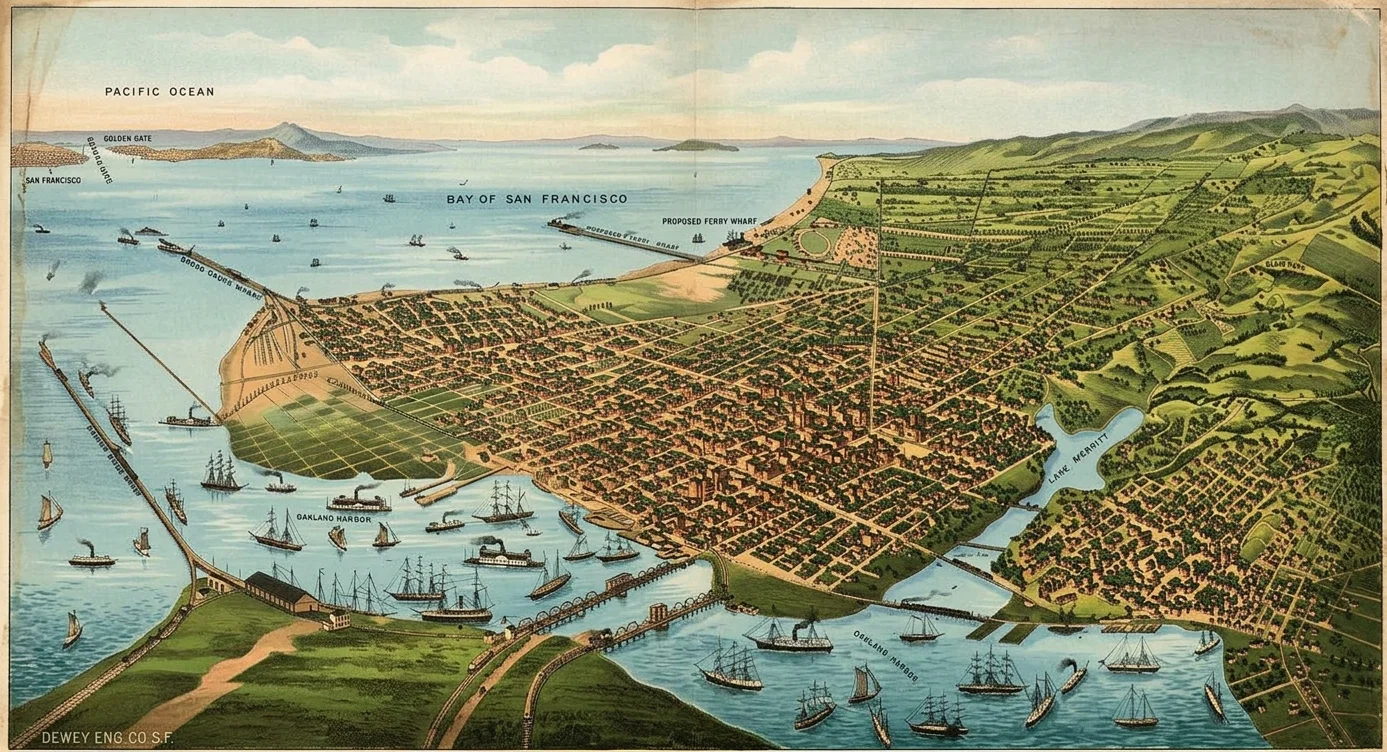
CALIFORNIA SCENERY, No. 6.—The above bird's-eye view is an illustration of the home city of the “Signs of the Times.” On the left of the picture and west of the city is a corner of San Francisco, and the “Golden Gate,” leading out from the harbor to the broad Pacific Ocean. Oakland is much more thickly populated on the north and extends farther on the east than is shown by the illustration. The office of the “Signs of the Times” is situate at a point one and seven-eighths inches from the bottom of the picture and three and nine-sixteenths from the right.
Well, the poor man sold his stock an' crop fur next to nothin', an' come back with his wife's mother, an' all his an' her folks is a tryin' to git him to not grieve himself clear down like she did.
After he'd come away, that very senator that had got him to go down there (an' if you'll believe it he's kin of Davy Crockett's, Mis Lancaster says), he saw how mean and unprincipled human natur is if it's got any chanct to overbear, downtread, an' act the tyrant. When they wus legislatin', he tole about Theodore bein' jailed an' lots of other seventh-day folks, too, fur paintin', an' diggin' a mess of pertaters an' sich, that wouldn't disturb nobody that wus busy tendin' to their own Sunday-keepin'. He showed 'em how they wus egactly like the persecutors of Eurip, an' like the Puritans to the Baptists an' Quakers, a-burnin' an' torturin' 'em fur their religion. I read his speech that Mis Lancaster had along, cut out of a Arkansas paper. It wus downright solid sense the whole way through, an' the most of them ones that makes the laws had wit enough to see it, so they put it onto their books agin that seventh-day folks wus free to worship when they liked an' to work on Sundays too.
Me an' Baker, we went to work an' treated that young man jist as well as we knowed how, an' kept them frum goin' three or four days, an' livened him up as much as we could, which wusn't a gray deal—an' then they went on to their relations in Bloomfield fur a spell.
The very next week after they wus here Parson Jones had a man to preach in our meetin'-house one night on “Sabbath Observin'.” He wus right in fur havin' the name of God put into the Constitution an' the strictest kind of Sunday laws made, so that no work would be done Sunday an' everybody could go to church. He said the poor workin'-men didn't hev no time to see their families nur keep the commandments; an' tole how people go picknickin' Sunday, play baseball, read Sunday papers, an' ride on the cars; an' how the preachers couldn't git their members out to church fur readin' the papers theirselves, but he said, too, that a man that wouldn't work a-Sunday wus shore of a stiddy job, fur they knowed he had a conscience.
An' then he rolled up his sleeves, as it were, an' paced up an' down that pulpit fur nearly half a hour tellin' about seventh-day folks workin' agin' the National Deformers that he belongs to. He called 'em monymanyacs, proselyters, an' fanatics—stuff that anybody had orter know shouldn't be spit out into no meetin'-house anyways. But my! I can't begin to tell all he said, nor don't want to, but while he wus yellin' an' prancin' I thought of Theodore Lancaster an' them other men in Arkansas, an' I see right away that the devil wus leadin' that man to think he knowed it all, an' to feel it wus his juty to make everybody else do jist as he thought they had orto whether they thought 'twus right or wrong.
He's in fur settin' the Ten Commandments right up fur the law of the land, and layin' the penalties onto anybody that don't keep 'em jist as they think they'd orto—whatever religion or no religion.
Well, now, look here, they ain't nobody in this hull United States that wouldn't ruther see every man, woman, an' child that lives under the flag a-keepin' every one of them commandments right along, not anybody. But say, you know 'swell's me, that is if you're a10Christian, that it hain't a-goin' to do no good nur be acceptable obejance to God fur you an' me to make 'em purtend to keep 'em. We've got to make people leave one another an' their property alone, that's what the government's fur, an' it's all right to 'tend to murderers, polygamists, thieves, an' sich that comes between feller-bein's and feller-bein's, but that ain't because it's in God's law, fur if we wus carryin' out His way of lookin' at things, we'd have to know as much as Him, or be guided by Him direct, as Israel wus, an' be so we could tell when a man hated his brother an' hang him, fur God says he's a murderer; an' when folks broke the seventh commandment in vile thoughts an' punish them an' when enybody—yes eny'bod'y, Parson Jones or who not—coveted the least thing of somebody else to put 'em smack through fur it. But we hain't got quite so knowin' as that, an' so we can't set ourselves up to makin' people do thus an' so because we believe they had orto. We can persuade 'em, an' show 'em, an' teach 'em the way we think's right, an' if they believe it, an' do it, all right, an' if they don't, all right, an' them an' God fur it in the jedgment.
They hain't nobody in this country but what kin keep Sunday if they want to, fur our laws don't allow nobody to disturb 'em onto their own premises, an' no lawful meetin' kin be broke up Sunday nur no other day. If their business calls them to work a Sunday, they kin drop it an' do somethin' else. They's lots of good land in this country needin' work. Another thing I thought when that National Deformer wus goin' on an' urgin' laws of how we're told in the Bible that man looketh on the outward appearance but the Lord on the heart; an' you know as well as me that lots of the folks that purtend to be Christians now, hain't, an' it would be pure tomfoolery to git a lot more of 'em at it. That's jist what they'll do if they let the preachers git to runnin' this country. Frum the man that wants office to the sneak that wants to steal, they'll all purtend to be mighty pious if it's a-goin' to pay.
As fur as church-members readin' newspapers an' preachers ridin' on cars on Sunday is concerned, they probable wouldn't do it if they didn't want to, an' if they do an' at the same time purtend to keep the day, their own churches an' not the police kin manage 'em if they see fit. An' if people hain't got no conscience to keep the day right, an' want to go on a picnic an' play baseball, it won't hurt 'em half as much as settin' back of the blinds readin' novels, or sneakin' into a saloon or barn to gamble an' drink, as they likely would.
An' there's another thing; if they set the commandments up fur our government law, what they goin' to do about the one that's about the Sabbath, a-sayin' that it's the seventh day of the week, an' the reason of keepin' it because God rested after He'd made the world? They've got queer idees fur sure. 'Spect they'd be tryin' to change it.
Fur my part an' Baker's we're a-goin' to do all we kin to convict people of their wrongdoin's an' show 'em where they're sinnin', an' help 'em to do right. We kin do this by talkin' to our neighbors, an' brethren, an' sisters, an' by savin' all we kin frum the farm to put right into the missionary box. My chickens an' turkeys an' blackberries brings in right smart, besides the money I'm gittin' to the creamery every week right along now, an' I hain't a-goin' to say nothin' to Baker about that plush cheer an' hangin' lamp I want powerful bad fur the parlor, fur I know I'd jist put 'em in there an' not havin' much company they'd not be doin' half the good that that money would to the cause of Christ.
This talkin' about Theodore Lancaster has set me to thinkin', an' me an' Baker's both a-readin' the Testament through frum end to end to find out all we kin about the Sabbath, fur—would you believe it?—Mis Lancaster says that Christ never changed the day to Sunday nur tol' the apostles to, but that 'twas done later by the Catholics, an' we're a-goin' to find out all about it fur ourselves straight frum the Bible, me an' Baker is, an' if what she says is so, that men, little, puny specks in God's universe, has ben a-tryin' to tamper with His law that He wrote with His own finger, we'll obey Him rather than them, or I'm powerful mistaken on what principles we're a-standin', me an' Baker.
PRISCILLA ANN BAKER.
MISSIONS IN TURKEY.
By H. P. H.
Few fields have been the object of so much missionary effort on the part of America as Turkey. About the time that the Spirit of the Lord was preparing heralds of the first angel’s message, pioneer missionaries were sent to Turkey by the American Board of Missions, chiefly sustained by the Congregationalists; and while America received new spiritual life from the preaching of the first angel’s message, a spirit of revival attended the efforts of missionaries in Turkey, and a notable work was accomplished. This was doubtless largely due to the outpouring of the Spirit which attended the first message.
But those days of revival in Turkey are far in the past. A notable change has taken place. This is generally felt by the people; and is doubtless due to the fact that missionary effort here has not been connected with the advancing light of the message. This being the case, it might be expected that the preaching of the third angel’s message would be attended with greater power than that of the ordinary missionary; and that is precisely so. Whenever the message is preached, new life is manifested. Said a missionary to me in speaking of a visit of one of our workers to his town, “Your worker did at least one good thing for our people, he stirred them all up to study the Bible as they had not done before.” And as the people examine the Word, they are quickened by it.
The chief effort of missionaries in Turkey is in the line of education; and as much of the instruction is in English, a large number of the students learn this language, which may be termed the mother tongue of the message. This is a factor of no small importance in connection with our work. There are now 170 American missionaries in Turkey. As a result of some 75 years’ work, there are now 125 churches, with a membership of 12,000. In the various schools, there are over 20,000 pupils.
While the Congregationalists confine their efforts largely to Asia Minor, and Turkey in Europe, the Presbyterians occupy Syria and Palestine as their field, with headquarters at Beirût. This city, the chief port and commercial center of Syria, is situated on an elevated peninsula several miles in length, about the middle of the Lebanon range, north and south, and has a population of 100,000, consisting of Moslems and Christians of almost every creed11and shade of creed. This city is pre-eminently an educational center, there being here 103 schools, with 561 teachers and 15,473 pupils. Deducting the 24 Mohammedan and 6 Jewish schools, the remaining 73 represent 12 shades of Christian belief.
Connected with the American mission in Syria are 39 American workers, 16 men and 23 women, who operate from five centers, Beirût, Tripoli, Abeih, Zahleh, and Sidon. The result of 70 years’ work is 28 churches, with 2,247 members. The population being about 2,000,000, there is but one Protestant to a thousand of the population. Besides the work of Presbyterians, there are other smaller agencies in the field, such as Reformed Presbyterians, Irish Presbyterians, Scotch Free Church, etc.
The language of this field is Arabic. This language is spoken almost wholly from the throat, and reminds one of the bleating of a sheep. The missionaries complain that Sunday is not kept as it should be, as it is difficult to convince the people of the sacredness of the day; for the name for Saturday in the Arabic is Sabbath, the same word as is used in the fourth commandment, and are not clear as to what Sunday has to do with it. The message will without difficulty clear up their minds on this subject. There is no place in the world where there is more confusion in regard to a day of worship than in Syria. The Druzes worship on Thursday, the Mohammedans on Friday, the Jews on Sabbath, and the Christians on Sunday. None of them keep a rest day as they should; and nothing but the third angel’s message will set them right.
SIDON (modern name “Saida,” Hebrew, “Zidon,” meaning a fishery) is one of the most ancient cities of the world. See Gen. 10:15. It is situated on the west coast of Syria, between Lebanon and the sea, 123 miles northwest of Jerusalem. In Joshua’s time it was “Great Zidon,” probably the metropolis of Phenicia. Joshua 19:28. From here came those who helped to build the temple (1 Kings 5:6), and hence came the abominations of sun-worship to corrupt Israel (1 Kings 11:5, 33). It was probably visited by our Lord. Matt. 15:21; Luke 6:17. The ancient city was several times destroyed. Its population is about 10,000, of which 7,000 are Moslem. The city is but a shadow of its former greatness in wealth, manufactures, and commerce. The American Presbyterian Board has there a flourishing mission.
The truth has entered northern Syria, having passed what the ancient warriors called the Gate of Syria, and may it now speedily spread over the whole country, that once more the mountains of Lebanon may resound with the everlasting Gospel! H. P. H.
Beirût, Syria, January 2.
CURIOSITIES OF BOMBARDING.
At Plevna it took a Russian battery a whole day's firing for each Turk killed. At Gibraltar, in 1781, 260,000 shot and shell were thrown, and the total killed and wounded was only 1,340. It took 200 shots to hit one man, according to the figures of the Franco-German War. Even more surprising, into Verdun, 33,000 shells were thrown, and only 7 persons were killed. Phalzburg had a similar number of fatalities for the 8,000 shells received there. Eight deaths in Bitche were caused by 25,000 shells, or 3,000 shells for each man killed. In Mézières 300 were killed, but it required 193,000 shells to do it. Then there was Thionville, into which 30,000 shells were thrown, with the result that 2 were killed, and finally Longwy, which received during the siege 30,000 shells without losing a single man. At Murfreesborough it took 27 cannon-shot and 130 rifle-bullets to hit one man; while one of the maxims of war, since the campaign of 1870, is that it takes a ton of iron to kill a man.—London Correspondence of N. Y. Sun.
FACTS OF SCIENCE.
Fecundity of Germs.—Cohn, a celebrated Prussian bacteriologist, declares that a single germ could, under favorable conditions, multiply in three days to 4,772,000,000,000, and make a mass weighing 7,500 tons. It is a merciful provision of nature that “favorable conditions” never exist.
THE light of a kerosene lamp is said to be considerably increased by placing in the oil reservoir a fused mixture of two parts of pure, hard, white paraffine with one part of pure, hard spermaceti. About 0.3 gm. to 1-2℔ of oil will last about four days. This addition also is claimed to prevent the bad odor of certain kerosenes. (This is an English patent.)
A STOMACH bucket of the size of a small peanut with an open, incurved rim is used by Dr. Max Einhorn for obtaining a sample of the contents of the stomach. The patient swallows it readily, and after five minutes it is withdrawn by the silk thread to which it is attached, and the contents submitted to examination. It is not so objectionable to patients as the stomach tube.
EXPOSURE to sunlight is one of the best disinfectants for clothing known. The light passing through glass will not do it.
A FLY-WHEEL in Germany is made of steel wire. The wheel is 25 feet in diameter, and 250 miles of wire were used in its construction.
Trusting in God’s Unchanging Love
By Charles D. Wells
Who trusts in God’s
Unchanging love,
Builds on a rock
That naught can move.
CHARLES D. WELLS.
WORK FOR THE NEW YEAR.
By Emma I. Pardon
Seeking for help from the Saviour,
Humbly in reverent prayer,
That by His grace He may aid us
Every burden to bear;
Earnestly searching the Scriptures,
As for some hid treasure rare,—
Then will God’s Spirit enlighten
Each with a glory most fair.
Helping the poor and afflicted,
Seeking the lost every day,
Cheering the faint and down-trodden,
With blessed hope’s glorious ray;
Tenderly pointing the fallen
Unto the heavenly way,—
Thus let us work for the Master;
He will our labor repay.
EMMA I. PARDON.
Albany, N. Y.
OUR WORK AND WORKERS.
FIVE members were added to the church in Alameda, Cal., on the 29th ult.
BROTHER J. F. BALLENGER notes the recent addition of nine members to the church at London, Ont.
THE librarian of the church at Uncompahgre, Colo., reports an addition of three to the membership.
AT Eleva, Wis., five persons recently accepted the truth as presented by Brother Swin Swinson, and a Sabbath-school was organized.
THE Iowa Bulletin notes three new houses of worship in that State,—one at Liberty, one at Onawa, and a portable tabernacle at Davenport.
DURING six months ending in January, thirty-two members were added to the church at Artichoke, Minn., under the labors of Brother A. J. Stone.
A CHURCH of sixteen members was organized at Fond du Lac, Wis., January 16, by Brethren Wm. Covert, president of the Conference, and George M. Brown.
BROTHER C. B. RULE, a West Virginia laborer, reports as follows to the Monitor: “I thought a line from the work in this city would give you courage. We have prayed for the Lord to guide us, and openings have been made for four cottage prayer meetings, and others want us to come.” It would have added to the interest of this good report if the Monitor had mentioned what city is thus receiving the truth; but practically it makes no difference, as12in every city and to every creature must this Gospel of the kingdom be preached for a witness, and then will the end come. So says the Master.
OUR HELPING HAND MISSION.
By C. H. Jones
We had hoped that ere this paper went to press we could announce the opening of our Helping Hand Mission, at 641 Commercial Street, San Francisco, but in this we are disappointed. However, we can assure our readers that we have not been idle. The buildings were found to be in a very dilapidated condition, and it was needful that they be thoroughly renovated from top to bottom. The walls have been scraped, the woodwork cleaned, and now plasterers, calciminers, paper-hangers, painters, etc., are busy at work putting on the finishing touches. Then will come the plumbing, fitting up the restaurant, furnishing the sleeping apartments, etc. It will take at least a week or ten days longer to finish the work, but when it is done, the buildings will be neat and clean, and the Mission complete in all its appointments.
A cement floor has been laid in the basement of one of the buildings, and here will be located the bath-rooms, laundry, drying-room, etc., all of which will be free to those who wish to make use of them. The other basement will be used for work-rooms and storage.
The chapel will occupy the first floor of the east building, and here Gospel meetings will be held every night of the year. The first floor of the west building will be used for a restaurant, where good meals will be served for five cents, and free to those who are not able to pay.
The two upper floors of both buildings will be used for a dormitory and treatment-rooms, and will accommodate about two hundred persons.
So far the work has been nearly all done by volunteer service, which is greatly appreciated; but from this time on it will be necessary to employ more skilled labor.
The ladies of the Oakland and San Francisco churches are actively at work making up bedding and assisting in various ways.
An order has already been placed for fifty double-deck iron bedsteads, and these will be added to from time to time, as necessity requires.
Our call for money, bedding, clothing, provisions, etc., is meeting with a hearty response; all the way from Maine to California, but still there is room. The expense of fitting up these buildings is going to be very heavy—more than we at first anticipated; but we know that there are thousands who will want a share in the good work.
Here is a letter just received from a brother which will show what one church is doing:—
Jan. 28, 1898.
SIGNS OF THE TIMES HELPING HAND MISSION, 641 Commercial Street, San Francisco, Cal.—Dear Brethren: I ship to-day nine boxes of fruit, honey, clothing, bedding, etc., and prepay the freight on same. It is donated by the brethren of the —— church and friends of the cause. We have many other things in preparation.
We are going to try to district the entire vicinity and canvass for supplies and everything needful for the Mission. Please write us at once, and let us know the most pressing needs of the institution, and we will do our best to assist you. I mean give us a list of the most needed articles.
I am chairman of the Christian Help Work Band here, and will place the needs before our brethren.
Your brother in the work.
And here is another of like import:—
Jan. 28, 1898.
B. F. RICHARDS—Dear Brother: Shipped by to-day's, January 20, freight, one box of clothing to the Helping Hand Mission, 641 Commercial Street, San Francisco. The box contains bedclothing sufficient to dress one of the 200 beds, 10 pounds of raisins, also a number of articles of clothing. It is the request of the Hanford Missionary Society that the bed be called the “Hanford bed.”
HANFORD MISSIONARY SOCIETY.
Such letters as these are a source of great encouragement, and many more of like import might be given.
Now are there not others who would esteem it a privilege to “endow a bed,” or help in some other way? Remember, it is all for the poor and the needy, and the Master has said, “He that hath pity upon the poor lendeth unto the Lord, and that which he hath given will He pay him again.” Prov. 19:17. Here is God’s promissory note. Who will invest? Cash donations, and anything in the shape of bedding, clothing, provisions, etc., will be thankfully received and duly acknowledged. All donations of money or supplies will be used strictly for mission work, and should there be more than enough for this Mission, it will be used in other places as the Lord may direct.
Send all moneys to Helping Hand Mission, care SIGNS OF THE TIMES, Twelfth and Castro Streets, Oakland, Cal., and all provisions, clothing, blankets, etc., to Helping Hand Mission, 641 Commercial Street, San Francisco, Cal. C. H. JONES.