THE publishing house at Battle Creek, Mich., reports the receipt of a letter from Mankato, Minn., stating that a canvasser there had sold thirty-seven copies of one of our large books in twenty-six hours.
DR. J. E. CALDWELL, our medical missionary at Rarotonga, Cook Islands, finds both branches of his work growing on his hands. He is much in need of both men and means for extending the work. But while he finds hard work, he reports the daily blessing of God in his efforts.
HELPING HAND MISSION.
By S. N. Curtiss
Treasurer's Report.
SINCE our report last week, most encouraging letters have come in from all parts of the United States, and donations ranging from 50 cents to $25 have been received.
A county judge in a southern state sends a cash contribution, and says, “May the Lord help and bless you abundantly in this work.”
A brother and sister in South Dakota write: “We have read in your paper about the Helping Hand Mission you are going to establish in San Francisco, so thought we would send you $25 to help start the mission, and may the dear Lord bless you and prosper you in your good work.”
Another brother says, “I have not much to give, yet I freely give my little mite,” and a money order for $10 accompanied the letter.
Contributions of bedding, clothing, dishes, chairs, table ware, dried fruit, honey, etc., are also coming in, as noted elsewhere in this paper.
The following is the report of cash received up to Feb. 2:—
Reported last week . . . . . . . $318.15
Cash received this week . . . . . . 156.75
Total . . . . . $474.90
S. N. CURTISS,
Secretary and Treasurer.
GOOD NEW TRACTS
Ready February 12.
Apples of Gold Library No. 48 is entitled “Try the Spirits,” and is written by L. A. Phippeny. 8 pages; price, ½ cent.
“Beloved, believe not every spirit, but try the spirits whether they are of God,” is the groundwork of this study. That these “spirits” are real personalities, possessing more than human power and intelligence, that they are ever “round about” us, intently engaged in the battle of good and evil, that we as human beings constitute their field of battle, are all clearly demonstrated. New and valuable thoughts are advanced—thoughts deserving careful consideration.
Bible Students’ Library No. 151, “Christian” Demand for War. A striking object lesson. By Dr. E. J. Waggoner, illustrated. 16 pages; 1 cent.
“In God’s name let us raise an army and . . . sweep the old murderer and all his tribe into the sea,” says one correspondent in a leading religious journal, referring to the Turks. Dr. Waggoner quotes such utterances because they indicate the “Christian” sentiment which is really consecrating the spirit of war. He asks those holding such sentiments, “When the name of Christ, the Prince of peace, is used as a war cry, where shall we look for peace on the earth?” It contains some of the most powerful arguments against the use of force by Christians that we have ever read, and if widely distributed will awaken people to the iniquity of the principle involved. One of the illustrations is found on the cover page, and shows the mosque of Omar, where thousands of the Saracens met death at the hands of the “Christian” crusaders.
Bible Students’ Library No. 152, “The Alarm of War.” By Elder A. O. Tait. Fully illustrated. 32 pages; price, 2 cents.
“The alarm of war” is continuously sounding from some part of the world. Every few days the papers tell of new inventions or improvements in the weapons of war. Already the powerful cannon and torpedoes, the rapid-fire and machine guns, along with all the other modern devices for killing men by the wholesale, are causing the questions to be anxiously asked, What are we coming to, anyway? Will the nations rush into war armed with these terribly destructive implements? What does it all mean?
These preparations are shown to be one of the signs of the end, and a fulfilment of prophecy. A series of vivid illustrations is an attractive feature and will gain the tract many readers. Every one is interested in, and will read on, this subject. Let us give them a chance.
PACIFIC PRESS PUBLISHING CO., Oakland, Cal.39 Bond St., New York City.18 West 5th St., Kansas City, Mo.
Mission Work in Colorado, Iowa, and Milwaukee
On the 22d ult., four members were received into the church at Denver, Colo., and five others were baptized., then at the close of the meeting still another candidate applied for baptism.
BROTHER J. M. REES, president of Colorado Conference, gives this report of the Denver Mission for the first two months of its existence: “November and December—No. of free lodgings, 384; paid lodgings, 64; No. of treatments, 300; treatments given outside of the mission, 40; No. of articles of clothing given to the poor, 75; penny meals served, 2,000.”
THE new mission at Clinton, Iowa, is now under headway, and is in charge of Brother and Sister A. J. Stone. They sell a bowl of good soup and three slices of bread for a penny, and many poor people patronize the place. A report of the work says, “The other evening a little girl about 11 years old lingered and asked that we pray for her, as she wanted to be a Christian.”
THE Reporter gives an itemized report of the work of the Helping Hand Mission in Milwaukee, in which we note that in two and a half months there were held 75 inside and 73 open-air meetings; 59 professed conversion; No. of beds paid for, 691; beds free, 406; baths, 375; lunches paid for, 5,485; lunches free, 1,912. Of the meetings, the report says: “They can not well be described. Among those who attend are the poor, lonely, and discouraged ones; the hopeless and those hardened by crime and drunkenness, also many of the working class who feel themselves too poorly dressed to attend the city churches. Women as well as men attend these meetings. These people find friends here who are interested both in their temporal and spiritual welfare.”
PERIODICALS WANTED.
By George J. Lloyd
I COULD use five hundred Signs, Instructors, and Little Friends each week in missionary work if sent post-paid to 122 S. Warren Street, Trenton, N. J.
GEORGE J. LLOYD.
OUR GENERAL AGENTS.
General Eastern Agency.—Pacific Press Pub. Co., 39 Bond St., N. Y. City, N. Y.
General Central Agency.—Pacific Press Pub. Co., 14-18 W. 5th St., Kansas City, Mo.
Argentine—Señor N. Z. Town, Casilla del Correa, 481 Buenos Ayres, Argentine Republic, S. A.
Arkansas Tract Society—Fayetteville, Ark.
Atlantic Tract Society—39 Bond St., New York City, N. Y.
Australia—Echo Publishing House, North Fitzroy, Victoria.
Australian Tract Society—251 St. George's Road, North Fitzroy, Australia.
California Tract Society—1059 Castro St., Oakland, Cal.
Texas Tract Society—626 and 628 Elm St., Dallas, Tex.
Upper Columbia Tract Society—College Place, Wash.
Utah Tract Society—Box 1058, Salt Lake City, Utah.
Vancouver Island—B. Robb, 231 Pandora St., Victoria, B. C.
Vermont Tract Society—190 N. Winooski Ave., Burlington, Vt.
Virginia Tract Society—2504 E. Clay St., Richmond, Va.
West Virginia Tract Society—Newburg, W. Va.
Wisconsin Tract Society—Milton Junction, Wis.
The Great Threefold Message
The Great Threefold Message is an illustrated sixteen-page tract. Its price is $1.00 per 100, and it is now in its 25th thousand.
It considers the subject of “God’s remedy for the ills of Christendom. “All the world knows that Christendom is indeed ill; and many would gladly know the remedy. The subject is so treated in this tract that this class will read, and to read is to know that remedy for themselves.
PACIFIC PRESS PUB. CO., Oakland, Cal.
New York, N. Y. Kansas City, Mo.
FRANCIS HOPE.
Stereopticon Slide Artist.
I HAVE a large stock of illuminated texts, charts, symbols, and pictures bearing on the prophecies, Sabbath, nature of man, temperance, etc. Beautifully colored. From 25 cents up. Send stamp for list. Slides made from any engraving, negative or kodak film at less than half-trade prices.
Address,
PACIFIC PRESS PUBLISHING CO.
Oakland, Cal.
LITERARY NOTICES.
“Students’ Edition of a Standard Dictionary of the English Language.”—Designed to give the Orthography, Pronunciation, Meaning, and Etymology of over 60,000 Words and Phrases in the Speech and Literature of the English-speaking peoples, with Synonyms and Antonyms: containing also an Appendix of Proper Names, Foreign Phrases, Faulty Diction, Disputed Pronunciations, Abbreviations, etc., etc.; 1,225 Pictorial Illustrations; Abridged from the Funk & Wagnalls Standard Dictionary of the English Language, by James C. Fernald, Editor; Francis A. March, L.L.D., Consulting Editor; Associate Editors—John W. Palmer, M.D., Francis A. March, Jr., Ph.D., William R. Cochrane, Emma Fiske Roberts, M.A., Frank H. Vizetelly. Large 8vo, cloth sides, leather back, including Introduction, 924 pp. Price, $2.00 net. Bound in tan sheep, $3.50 net. New York and London: Funk & Wagnalls Company.
We have received the above long-promised dictionary, and are not disappointed. It is more than the peer of any other students’ dictionary; it is far superior to any other. It of course is not unabridged; and we would advise first of all the purchase of the unabridged, “The Standard,” as the one English lexicon par excellence. But if one can not afford that, let him purchase the “Students’ Standard.” It is unequaled, a marvel of condensation and clearness. Printed from good, clear type, on fine paper, and abounding in illustrations; it will be prized by the student and busy man.
“The Eastern Question in the Light of God’s Promises to Israel, Prophetic and Historic,” by H. E. Robinson, Review and Herald Publishing Company, Battle Creek, Michigan.
The object of the writer has been to illuminate the much-agitated “Eastern question” by shedding upon it the light of prophecy. We can in no better way indicate the contents of the book than to quote a number of its seventeen chapter headings: The Israel of God, The Hebrew Nation, The Gentile Nations, Universal Restoration, Another Gospel, The Promised Land, The Sanctuary, The Kingdom of Christ, The Doom of Turkey, Turkey and Russia, The Day of the Lord, The Four Winds, The Second Exodus. The book is well written, well printed, and neatly bound in cloth. Price, $1.00; in paper covers, 50 cents.
A bound volume of The Converted Catholic for 1897 comes to our table. James A. O’Connor, editor and publisher, 142 West 21st Street, New York. This magazine (monthly) is especially designed for the conversion of Roman Catholics to evangelical Christianity; and one of its special features is therefore testimonies from recent converts, witnesses of the facts of the Gospel. Four thousand have already been published. Its warfare is against Romanism not Romanists; and it clearly portrays the dangers which menace this country from the influence of Catholicism. Sample copies on application. May the Lord bless the editor in his work of saving souls. The price of the magazine is $1.00 a year.
The Cosmopolitan for February presents for thoughtful readers the following articles of interest: “The Last of the Valois,” “How the Banana Is Grown,” “The Personnel of the Supreme Court,” with portraits of all the justices, save the last appointed; “The Utilization of City Garbage.” These and other papers are well and fully illustrated. For sale by all news-dealers. Price, ten cents.
Among the interesting papers in McClure’s Magazine for February are Dr. Nansen’s “Future North Polar Expeditions,” illustrated by photographic reproductions and drawings from life; “The Last Days of George Washington, from the Manuscript Diary of His Private Secretary, Colonel Tobias Lear;” and “Reminiscences of Men and Events of the Civil War,” by the late Charles A. Dana. Price, 10 cents, by all news-dealers.
Birds for December gives a sketch of the Ornithological Congress, and beautiful illustrations and descriptions of the Mountain Bluebird, Allen’s Humming-bird, the Green Winged Teal, the Black Grouse, the Flamingo, the Verdin, one of the tiny birds, and four others of equal interest. An excellent magazine for children. Price, $1.50 a year; single numbers, 15 cents.
PILGRIM’S PROGRESS
By John Bunyan
BY JOHN BUNYAN
A new, clear-type edition of convenient size. Neatly bound in cloth, cover design in colors, 240 pages, size 5×7½ inches.
Price, 50 Cents
Address . . .
PACIFIC PRESS PUB. CO., Oakland, Cal. 43 Bond St., New York. 18 W. 5th St., Kansas City, Mo.
Lesson IX.—Sunday, February 27, 1898.
WARNING AND INVITATION.
Note.—This lesson section includes Matthew 11, verses 2 to 30. In connection with the study of the lesson read Luke 19:41–48. The record now goes back a little to bring in a new element or new method in the teachings of Jesus. Following close upon the heels of the proclamation of the kingdom and the call to repentance, comes this note of warning and of judgment. “From this time onward these warnings grow more and more terrible to the close of His ministry. See Luke 11:39–54; 13:1–5; 16:15, and their strongest and most terrible expression in Matthew chapter 23.”—Abbott. Read also the warnings of the most important event in this world’s history as contained in the fourteenth chapter of Matthew. The teacher should make plain that these warnings are not given for the purpose of condemning men, but that men, through them, may seek the kingdom of God and His righteousness.
20 “Then began He to upbraid the cities wherein most of His 21 mighty works were done, because they repented not. Wo unto thee, Chorazin! wo unto thee, Bethsaida! for if the mighty works had been done in Tyre and Sidon which were done in you, they would have repented long ago in sackcloth and ashes. 22 Howbeit I say unto you, it shall be more tolerable for Tyre and Sidon in the day of judgment, than for you. 23 And thou, Capernaum, shalt thou be exalted unto heaven? thou shalt go down unto Hades; for if the mighty works had been done in Sodom which were done in thee, it would have remained until this day. 24 Howbeit I say unto you, that it shall be more tolerable for the land of Sodom in the day of judgment, than for thee. 25 “At that season Jesus answered and said, I thank thee, O Father, Lord of heaven and earth, that thou didst hide these things from the wise and understanding, and didst reveal them unto babes: yea, Father, for so it was well-pleasing in thy sight. 26 All things have been delivered unto Me of My Father, and no one knoweth the Son, save the Father; neither doth any know the Father, save the Son, and he to whomsoever the Son willeth to reveal him. 28 Come unto Me, all ye that labor and are heavy laden, and I will give you rest. 29 Take My yoke upon you, and learn of Me; for I am meek and lowly in heart; and ye shall find rest unto your souls. 30 For My yoke is easy, and My burden is light.
Golden Text: “Come unto Me, all ye that labor and are heavy laden, and I will give you rest.” Matt. 11:28.
SUGGESTIVE QUESTIONS.
(1) After speaking of the attitude of the people toward Himself and John, what did the Saviour begin to do? Verse 20. (2) Why did He do this? Same verse. (3) Upon what two cities did He pronounce wo? Verse 21. (4) What comparison did He make between them and two Gentile cities? Same verse. Note 1. (5) What did He say of the condition of these cities in the day of judgment? Verse 22. (6) What did the Saviour say of the city of Capernaum? Verse 23. (7) With what city did He compare it? Same verse. (8) What contrast would these two cities show? Same verse. Note 2. (9) What would be the comparative conditions of these two places in the judgment? Verse 24. (10) For what did the Saviour at this time thank the Father? Verse 25. Note 3. (11) Why was the Saviour thankful that such was the case? Verse 26. (12) With what had the Father intrusted Him? Verse 27. (13) What does Christ say of man’s knowledge of Him? Same verse. (14) Who only know the Father? Same verse. Note 4. (15) What universal invitation does the Saviour then extend? Verse 28. (16) What does He ask them to do? Verse 29. (17) What reason does Christ give why men should take His yoke and learn of Him? Same verse. (18) What blessed experience will those have who accept this invitation? Same verse. (19) What is the nature of the yoke and burden which Christ lays upon His followers? Verse 30. Note 5.
NOTES.
1. Wo unto thee.—This was not a wishing of wo upon these cities, neither was the wo to come in consequence of this declaration. Christ simply stated what would be the actual consequence of the course which they were taking. It is not known just where Chorazin was situated, but it is believed to be not far from the Sea of Galilee. Bethsaida was located on both sides of the mouth of the Jordan. Tyre and Sidon were cities of Phoenicia on the coast of the Mediterranean Sea. In the time of Christ Tyre was an important commercial center, being probably next to Jerusalem in size. The Saviour’s words in respect to these four cities show that the most hopeless cases are not among those who have fallen low in sin and are regarded as outcasts.
2. It would have remained.—While this shows on the14one hand the power of Christ to check sin and to save from sin, it shows on the other hand the extent and intensity of Christ’s work for the inhabitants of the unrepentant city of Capernaum. It would seem from the reading of the Revised Version that the inhabitants of Capernaum had an exalted idea of their own influence and importance. Such an idea, whether entertained by an individual or a multitude, is the certain precursor of disaster, and if persisted in, eternal death.
3. Thou didst hide these things.—The things which Christ was teaching to the world at that time and to us now,—the truths of His Gospel. They are not hidden, and will not be hidden, from those who in humility of heart seek for them with due appreciation of their worth. They are hidden, and will remain hidden, from those who have exalted ideas of their own wisdom and prudence, who depend upon their own great learning or philosophy for an understanding of the spiritual things of God. God does not hide them for the purpose of keeping them hidden, but that men should not have in them an occasion for their own glorification. In accordance with this are the words of Paul in 1 Cor. 1:26–29: “For ye see your calling, brethren, how that not many wise men after the flesh, not many mighty, not many noble, are called; but God hath chosen the foolish things of the world to confound the wise; . . . that no flesh should glory in His presence.”
4. He to whomsoever the Son willeth to reveal Him.—Christ’s purpose in coming to the earth was to reveal the Father in His own life, that through God’s great love men might be drawn to Him. Christ says (John 17:3): “And this is life eternal, that they might know Thee, the only true God, and Jesus Christ, whom Thou hast sent.” And He came that we “might have life,” and that we might have it “more abundantly:” therefore the revealing of the Father was necessary. Christ “willeth” to reveal the Father to every one who realizes his need of Him; to every one who truly accepts the invitation to come to Him; but only through Christ does that revelation take place.
5. My yoke is easy.—It is easy because Christ Himself is in the yoke. Christ’s burden does not crush us. It is like the string to the kite, without which the kite could not rise. It is not one grievous to be borne; but he who has the largest has the lightest heart.
24 “Now a certain Jew named Apollos, an Alexandrian by race, a learned man, came to Ephesus; and he was mighty in the Scriptures. 25 This man had been instructed in the way of the Lord; and being fervent in spirit, he spake and taught carefully the things concerning Jesus, knowing only the baptism of John; and he began to speak boldly in the synagogue. 26 But when Priscilla and Aquila heard him, they took him unto them, and expounded unto him the way of God more carefully. 27 And when he was minded to pass over into Achaia, the brethren encouraged him, and wrote to the disciples to receive him; and when he was come, he helped them much which had believed through grace; for he powerfully confuted the Jews, and that publicly, showing by the Scriptures that Jesus was the Christ.”
1 “And it came to pass, that, while Apollos was at Corinth, Paul having passed through the upper country came to Ephesus, and found certain disciples; and he said unto them, Did ye receive the Holy Ghost when ye believed? And they said unto him, Nay, we did not so much as hear whether the Holy Ghost was given. And he said, Into what then were ye baptized? 4 And they said, Into John’s baptism. And Paul said, John baptized with the baptism of repentance, saying unto the people, that they should believe on Him which should come after him, that is, on Jesus. 5 And when they heard this they were baptized into the name of the Lord Jesus. 6 And when Paul had laid his hands upon them, the Holy Ghost came on them; and they spake with tongues, and prophesied. 7 And they were in all about twelve men. 8 “And he entered into the synagogue, and spake boldly for the space of three months, reasoning and persuading as to the things concerning the kingdom of God. 9 But when some were hardened and disobedient, speaking evil of the Way before the multitude, he departed from them, and separated the disciples, reasoning daily in the school of Tyrannus. 10 And this continued for the space of two years; so that all they which dwelt in Asia heard the Word of the Lord, both Jews and Greeks. 11 And God wrought special miracles by the hands of Paul; 12 insomuch that unto the sick were carried away from his body handkerchiefs or aprons, and the diseases departed from them, and the evil spirits went out. 13 But certain also of the strolling Jews, exorcists, took upon them to name over them which had the evil spirits the name of the Lord Jesus, saying, 14 I adjure you by Jesus whom Paul preacheth. And there were seven sons of one Sceva, a Jew, a chief priest, which did this. 15 And the evil spirit answered and said unto them, Jesus I know, and Paul I know; but who are ye? 16 And the man in whom the evil spirit was leaped on them, and mastered both of them, and prevailed against them, so that they fled out of that house naked and wounded. 17 And this became known to all, both Jews and Greeks, that dwelt at Ephesus; and fear fell upon them all, and the name of the Lord Jesus was magnified. 18 Many also of them that had believed came, confessing, and declaring their deeds. 19 And not a few of them that practised curious arts brought their books together, and burned them in the sight of all; and they counted the price of them, and found it fifty thousand pieces of silver. 20 So mightily grew the Word of the Lord and prevailed.
QUESTIONS.
1. What eminent man is introduced in the scripture before us? What was his birthplace? and what natural and acquired talents had he? To what place did he come? Acts 18:24.
2. In what was he instructed? What is said of his zeal? What did he do? To what was his knowledge of the things of the Lord limited? Verse 25.
3. How was his knowledge perfected? Verse 26.
4. Where did he afterward go? How was the way prepared for his reception? On his arrival, what good did he accomplish? Verse 27.
5. How did he accomplish this? Verse 28.
6. While Apollos was laboring in Corinth, to what place did Paul come? Chapter 19:1.
7. What question did he put to certain disciples whom he found there? What was their reply? V. 2.
8. What did they say about their baptism? V. 3.
9. What did Paul then tell them about the baptism of John? Verse 4.
10. When they heard this, what did they do? V. 5.
11. What followed their baptism? What did they then do? Verse 6.
12. How many men were there who had this experience? Verse 7.
13. What work did Paul then engage in? For how long? Verse 8.
14. What effect did his preaching have on some? What did Paul therefore do? Verse 9.
15. How long did he continue this work? With what result? Verse 10.
16. What wonderful power did God manifest through Paul? Verses 11, 12.
17. Who tried to imitate this work? How many of them were there? Verses 13, 14.
18. How did they proceed? What was the result of their effort? Verses 13, 16.
19. How far did the news of this spread? What gain resulted to the truth? Verse 17.
20. What were many believers led to do? Verse 18.
21. To what had they been addicted? How real was their renunciation of magic? What was the value of the books thus destroyed? Verse 19.
22. What power was it that effected this wonderful change? What is said of the Word of God? Verse 20.
NOTES AND QUESTIONS.
“We have not so much as heard whether there be any Holy Ghost.” What had John proclaimed in his preaching? Matt. 3:11. Could these twelve men, then, ever have seen or heard John the Baptist? Could they have been at all acquainted with John’s teaching? Had they, judging from Acts 19:4, 5, even heard anything about Christ? In whom, then, had they been blindly believing?
“Have ye received the Holy Ghost since ye believed?” The two verbs are in the aorist tense, and therefore denote instantaneous acts. The Authorized Version therefore gives an entirely wrong idea, as there is no question about what happened after believing; but the question relates to what occurred when they believed. Hence (Revised Version), rightly, Did ye receive the Holy Ghost when ye believed? “We have not heard.” Also the aorist. We did not hear, referring back to the time of their beginning. “Whether there be any Holy Ghost.” But, as Bengel observes, “They could not have followed either Moses or John the Baptist without having heard of the Holy Ghost.” The words, therefore, are to be explained, not of their being unaware of the existence of the Holy Ghost, but of His presence and baptism on earth. The word estin, there be, is to be taken in the sense of be present, or be given, as in John 7:39, where it is said, ‘The Holy Ghost was not yet (οὐπώ ἦν),’ and where the translators rightly render, ‘was not yet given.’”—Vincent.
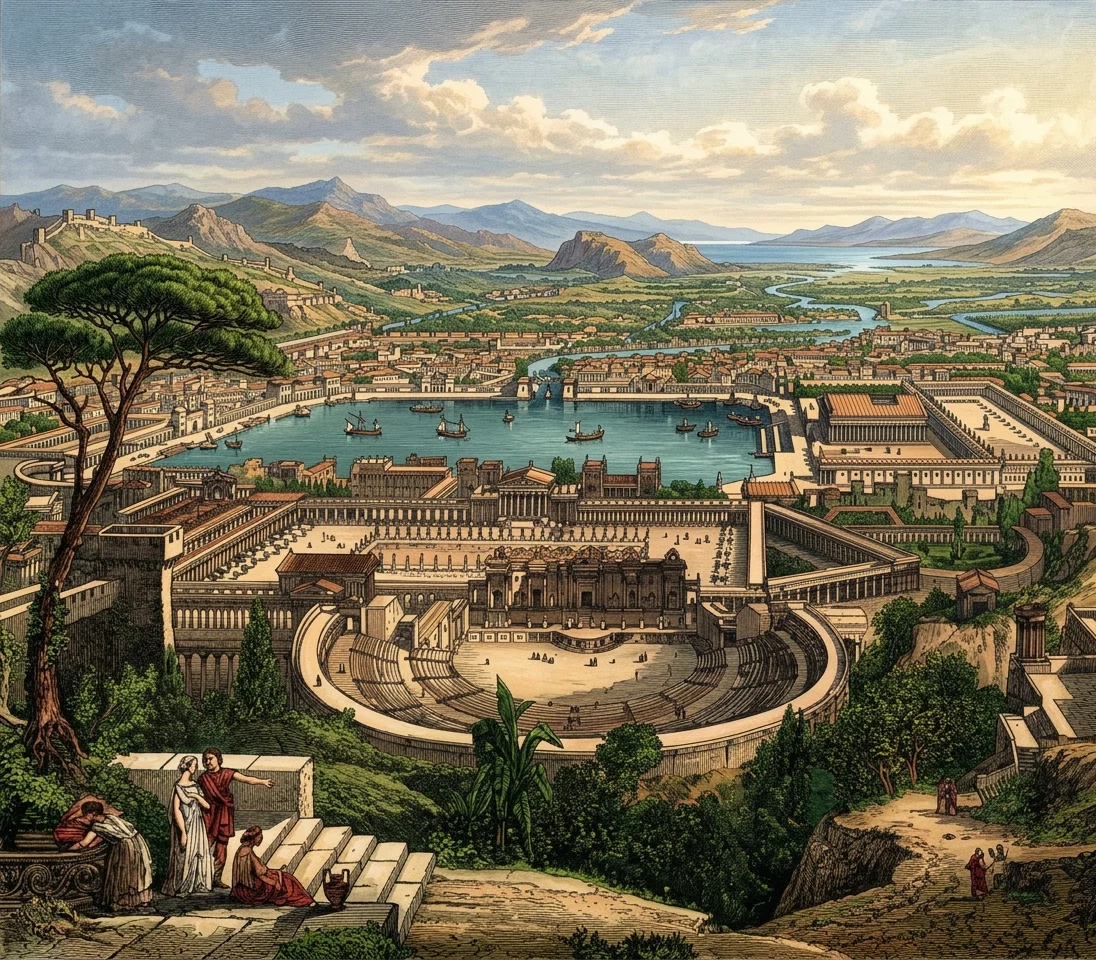
EPHESUS was the most important city of Asia Minor, noted in the apostles’ time for three remarkable buildings: (1) Temple of Diana, one of the seven wonders of the world, 425 feet long, 220 wide, of purest marble; 127 Parian marble columns, 60 feet high supported the roof. (2) The theater (Acts 19:29), capable of seating 50,000. (3) The Stadium, or circus, an arena 685 feet by 200, where fighting, wrestling, racing, etc., were carried on. All that is now left beside its magnificent ruins is a little village called Ayasalouk.