“In the third year of the reign of King Belshazzar a vision appeared unto me, even unto me Daniel, after that which appeared unto me at the first.” Dan. 8:1.
This vision was given two years later than the vision described in the seventh chapter. The second verse says that the prophet was at Shushan, “in the palace.” Shushan was one of the capitals of Babylon, being “in the province of Elam.” In the vision the prophet seemed to be “by the river of Ulai,” and he tells what he saw, in the following language:—
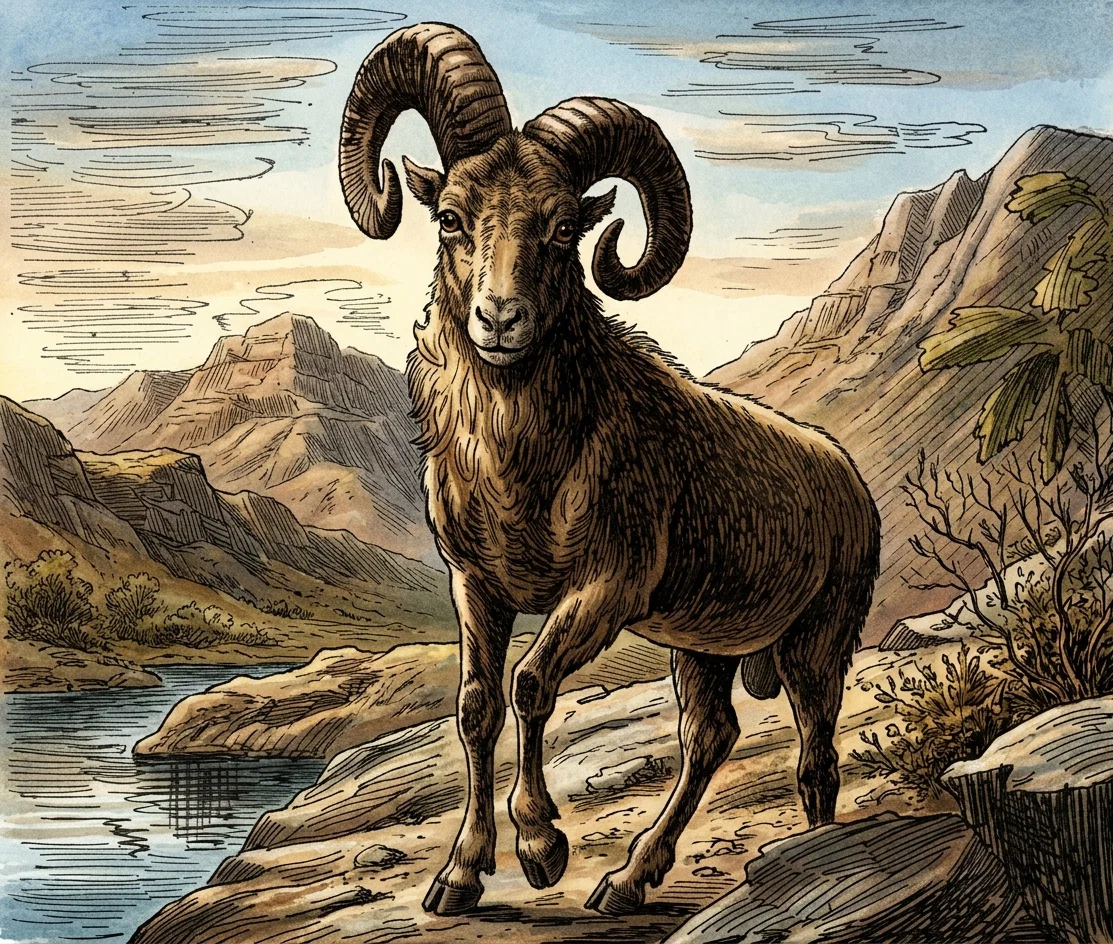
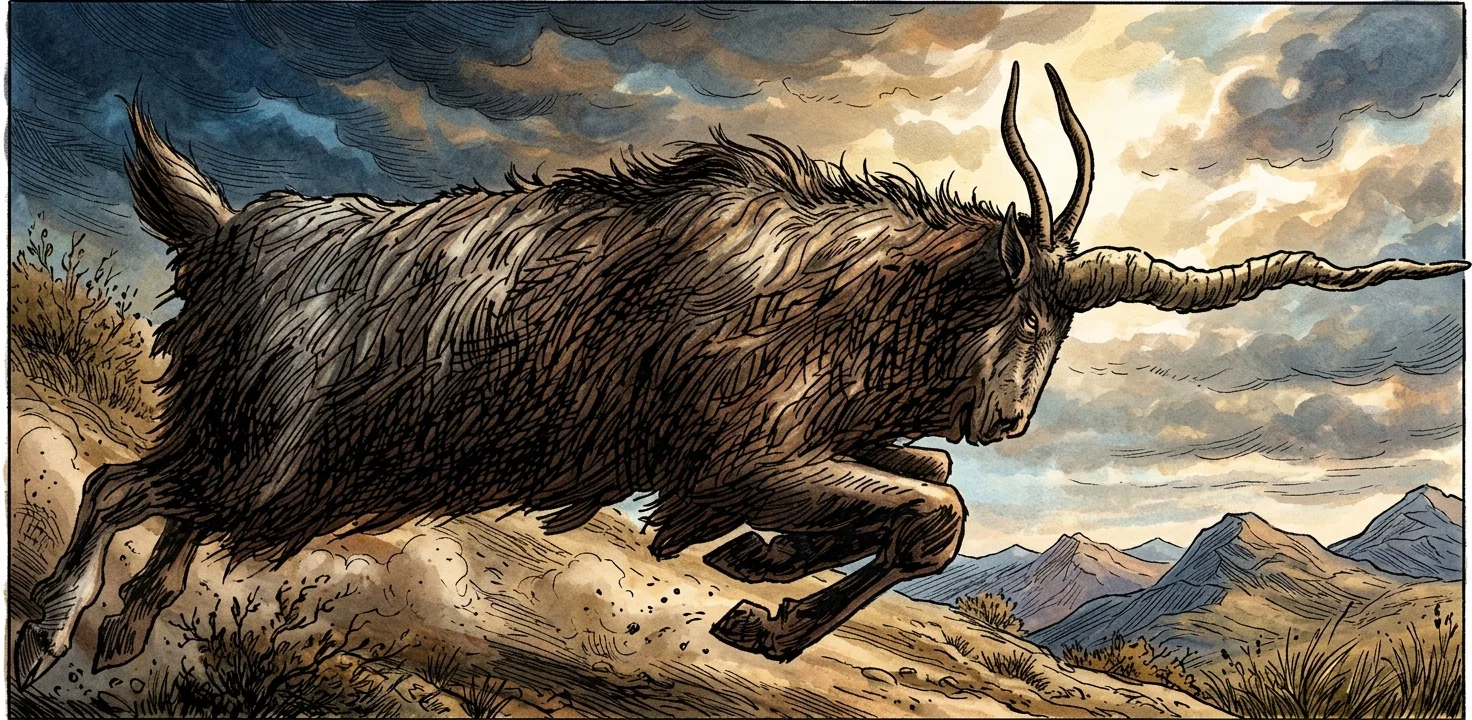
“Then I lifted up mine eyes, and saw, and, behold, there stood before the river a ram which had two horns; and the two horns were high; but one was higher than the other, and the higher came up last. I saw the ram pushing westward, and northward,5and southward; so that no beasts might stand before him, neither was there any that could deliver out of his hand; but he did according to his will, and became great. And as I was considering, behold, an he goat came from the west on the face of the whole earth, and touched not the ground; and the goat had a notable horn between his eyes. And he came to the ram that had two horns, which I had seen standing before the river, and ran unto him in the fury of his power. And I saw him come close unto the ram, and he was moved with choler against him, and smote the ram, and brake his two horns; and there was no power in the ram to stand before him, but he cast him down to the ground, and stamped upon him; and there was none that could deliver the ram out of his hand. Therefore the he goat waxed very great; and when he was strong, the great horn was broken; and for it came up four notable ones toward the four winds of heaven. And out of one of them came forth a little horn, which waxed exceeding great, toward the south, and toward the east, and toward the pleasant land. And it waxed great, even to the host of heaven; and it cast down some of the host and of the stars to the ground, and stamped upon them. Yea, he magnified himself even to the prince of the host, and by him the daily sacrifice was taken away, and the place of his sanctuary was cast down. And an host was given him against the daily sacrifice by reason of transgression, and it cast down the truth to the ground; and it practised, and prospered.” Verses 3-12.
As the beasts of the previous vision stood for kingdoms, it would be but natural to suppose that the beasts of this chapter have a like import. But we are not shut up to conjecture, or even to the facts of history, in discovering the meaning of the ram and goat. Daniel was plainly told that—
“The ram which thou sawest having two horns are the kings of Media and Persia. And the rough goat is the king of Grecia; and the great horn that is between his eyes is the first king.” Verses 20, 21.
But why is not Babylon mentioned in the vision, as in the vision of the seventh chapter and in the dream of chapter 2?—Because this last vision was given to Daniel in the last year of the reign of the last king of Babylon. It was about to drop into the past, therefore could not well be the subject of a vision concerning the future. The prophecy began with the new kingdom just coming on the scene of action. The two horns of the ram, one higher than the other, the higher coming up last, have the same significance as the bear of the seventh chapter, which lifted itself on one side; thus was indicated, what history afterward verified, that the Persian element in the kingdom became predominant.
The notable horn of the goat was Alexander the Great, the “first king” of the Grecian Empire. The breaking off of this horn was fulfilled in the death of Alexander, and the four horns which arose in its place were the counterpart of the four heads of the leopard of the seventh chapter. The kingdom, tho still reckoned as a unit, was (after a brief pretension on the part of Alexander’s brother and two sons) governed by four generals of the army. Seleucus ruled over Syria and Babylon in the east; Lysimachus, in Asia Minor and the north; Ptolemy, in Egypt on the south, and Cassander, in the European or western part of the kingdom.
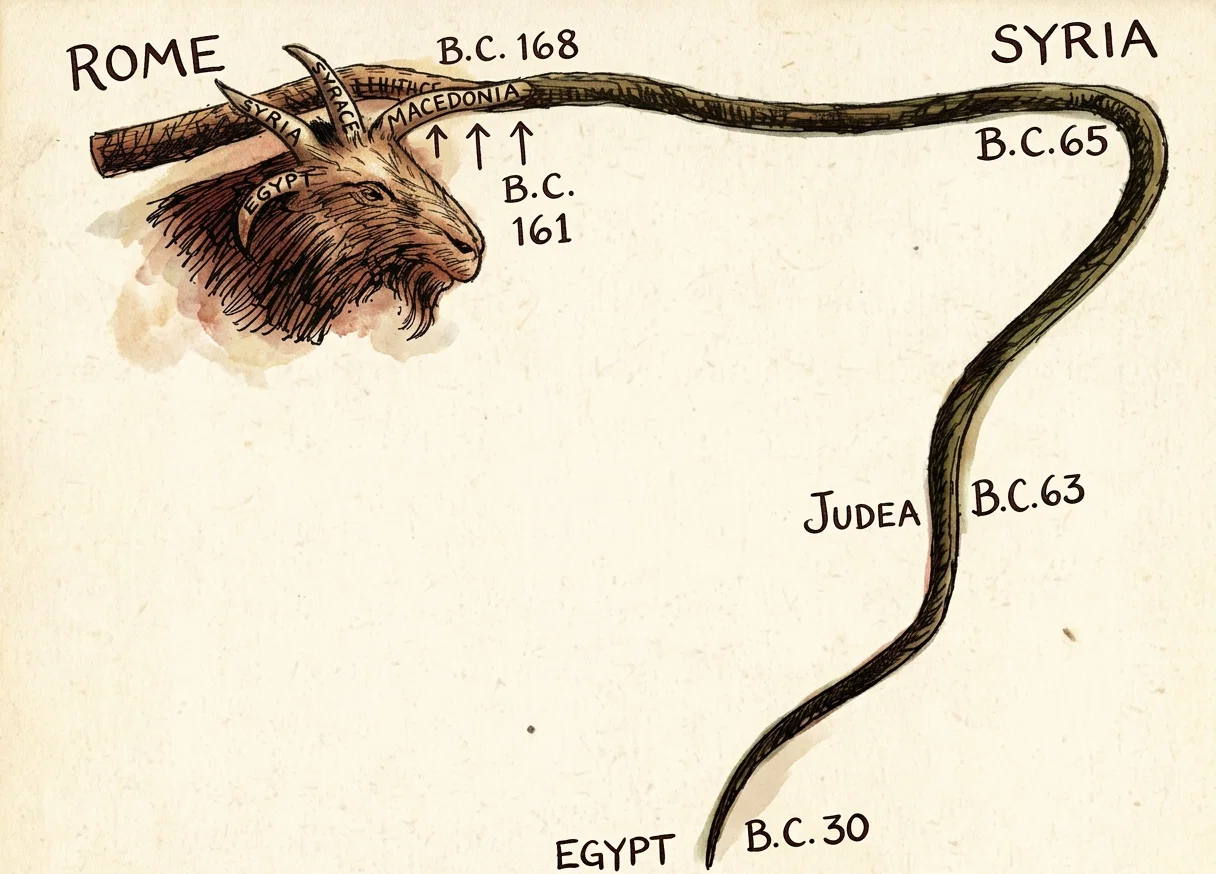
Out of one of the horns there “came forth a little horn, which waxed exceeding great.” It is said of the ram (Medo-Persia), that he “became great;” of the goat (Grecia), that he “waxed very great,” and of this little horn, that it “waxed exceeding great.” Inasmuch as it waxed exceeding great in all parts of the then dominant kingdom, we conclude that it conquered that kingdom. What power did so with Grecia? As with the iron kingdom in Nebuchadnezzar’s dream-image, and the “fourth beast” in Daniel’s former vision, there is no power but Rome whose history meets the prophecy. Rome attacked the goat (Grecia) in its European or western “horn,” and continued its conquests until it was victorious everywhere.
This “little horn” is not identical with the “little horn” of the seventh chapter. It includes the work of that “little horn,” but it is the same as the entire “fourth beast” of chapter 7, with its “little horn” and all. It is Rome in both its pagan and papal phases. This point should be noted particularly: In the seventh chapter Rome is treated as two powers, civil and ecclesiastical, the “little horn” being exclusively ecclesiastical; but in the eighth chapter Rome is treated as a unit; whatever is done, whether of a secular or religious nature, is done by that power as a whole.
With this light before us, it is not difficult to understand the meaning of the work ascribed to this power. “It waxed great, even to [margin, ‘against’] the host of heaven [the people of God]; and it cast down some of the host and of the stars [prophets and apostles] to the ground, and stamped upon them.” It put them to death, and tried to stamp out their influence. “Yea, he magnified himself even to the Prince of the host.” Jesus Christ is the “Prince of the host,” the “Lord of hosts,” and He was crucified by the authority of the Roman Government. No other power on earth at that time had authority to execute the death penalty. All this was done while Rome was yet pagan in religion.
“By him [margin, ‘from him’] the daily sacrifice was taken away, and the place of his sanctuary was cast down.” It was the pagan religion and its services that were practically taken away when Rome, by imperial decree, became (nominally) Christian. How was the place of his sanctuary cast down? “An host was given him against the daily sacrifice [paganism] by reason of transgression, and it cast down the truth to the ground; and it practised, and prospered.” All the way through the recital of this vision the pronouns “it” and “he” are used interchangeably when referring to the same power. Moreover, we have the same power warring against itself. The host that was given him is not the “host of heaven,” previously mentioned. The host that politically defeated and seized portions of the empire, dividing it into different kingdoms, were hosts of barbarians. But these were brought under the influence of the church and used against the pagan religion. Through the intrigues of the bishops of Rome, the church gained power, while the political power of the empire waned.
Whatever was done by either the church or the State was done by the “little horn” power, for it stands for both. It not only took away the daily (or continual) desolations of paganism, but, having done so, it did worse under the guise of Christianity than paganism had done; it “cast down the truth to the ground; and it practised, and prospered.” It was the Church of Rome that did this; it was the ecclesiastical feature of this little horn power—the feature which corresponds to the little horn of chapter 7—that “prospered,” while the political phase of the empire lost power.
The angel Gabriel said to Daniel, “I will make thee know what shall be in the last end of the indignation; for at the time appointed the end shall be.” Verse 19. Then follows the explanation of the symbols of the ram and the goat, as before noted, and then a repetition of what should come after the goat, or Grecian Kingdom: “And in the latter time of their kingdom, when the transgressors are come to the full, a king of fierce countenance, and understanding dark sentences, shall stand up.” Verse 23. God in His long-suffering mercy does not overthrow nations or peoples until their iniquity is full—till there is no more hope of good from them. See Gen. 15:16; Dan. 5:17–28; Matt. 23:29–39; 1 Thess. 2:14–16; 2 Peter 3:9, 10. Grecia was no exception to the rule.
The description, “a king of fierce countenance,” agrees well with that of the “fourth beast” of the seventh chapter, which was “dreadful and terrible, and strong exceedingly.” A power “understanding dark sentences” is well exemplified in Rome. This part of the book of Daniel was written in Hebrew, primarily for the Hebrew people, to whom the Latin language was then unknown; much of the Roman Church services are unintelligible to the people, and ambiguity is a characteristic of much of her literature. Continuing, the angel said, “And his power shall be mighty, but not by his own power.” Verse 24. “There is no power but of God.” Rom. 13:1. “The Most High ruleth in the kingdom of men, and giveth it to whomsoever He will, and setteth up over it the basest of men.” Dan. 4:17. “He removeth kings, and setteth up kings.” Chap. 2:21.
“And he shall destroy wonderfully, and shall prosper, and practise, and shall destroy the mighty and the holy people.” Verse 24. Of this power, as symbolized by the “exceeding dreadful” beast in chapter 7, it is said that he should “devour the whole earth,” and should “tread it down, and break it in pieces.” This of course would include the “mighty” as well as the “holy people.” Rome did tread down all opposing armies, and it did destroy the people of God, both Jews and Christians, as no other power ever did.
“And through his policy also he shall cause craft to prosper in his hand; and he shall magnify himself in his heart, and by peace [margin, “prosperity”] shall destroy many; he shall also stand up against the Prince of princes [Christ and His law]; but he shall be broken without hand.” Verse 25. All these specifications apply to Rome, and are consonant with other scriptures, especially with chapter 7:25, 26; 2:34, and 2 Thess. 2:7, 8. That this prophecy dealt with matters far in the future, is further shown by verse 26: “And the vision of the evening and the morning which was told is true; wherefore shut thou up the vision; for it shall be for many days.” W. N. G.
“My child, give Me thy grief.
In patience long I’ve waited
For thee to ask relief.
I know thou long hast borne it;
O, why the burden bear?
I’ve promised all to carry;
I will thy sorrow share.
“I gave Myself a ransom
And died upon the tree;
O blood-bought, guilty sinner,
What hast thou done for Me?
I’ve searched all o’er the mountains,
I’ve called My sheep by name;
I’ve borne them in My bosom
When they were weak and lame.
“And still I’m calling, calling,
O’er mountain, vale, and hill,
‘Come unto Me, ye thirsty,
And whosoever will.’
The fount of life is flowing,
Its waters still are free;
’Twill give thee full salvation;
O stoop and drink and see!
“Let go of self, poor sinner,
And clasp thy hand in Mine;
Now be ye My disciple,
Abiding in the Vine.
In love the Father purgeth,
That ye more fruit may bear;
The branches are His planting,
The tender fruit His care.
“The pruning seemeth grievous,
But afterward there’s rest.”
I know we’re prone to wander—
I know God’s way is best.
He pardons my transgressions;
O, wond’rous love to tell!
I’ll praise Him for His goodness,
For truly all is well.
HATTIE C. KELLEY.
Crystal Valley, Mich.
Who Is Your Advocate?
All on earth are judgment-bound sinners; and in the majority of cases this is an instinctive feeling. All must appear at the last great Assize, before the Court of Last Resort, from which there can be no appeal. In appearing before courts men need an advocate. In this life, the advocate is oftentimes a failure, and if he wins one suit, his expenses are greater than a loss without him would have been. Who is your advocate before the court of Last Resort? If you have none in whom you have perfect confidence, let us recommend One who will not, can not fail. He knows all about every case, knows all about the law we have all transgressed, and knows how to help us. “If any man sin, we have an advocate with the Father, Jesus Christ the righteous.” He never lost a case placed implicitly in His hands. He will not lose yours if you will give it to Him. Is He your Advocate?
“TAKE HEED THAT NO MAN DECEIVE YOU.”
By T.
The Saviour’s words, “Take heed that no man deceive you,” while applicable for all time, were given as a special admonition for the last days. This fact any one will readily perceive who gives careful study to the twenty-fourth chapter of Matthew, from which these words are quoted. The Master adds, “For there shall arise false Christs, and false prophets, and shall show great signs and wonders; insomuch that, if it were possible, they shall deceive the very elect.” Matt. 24:24.
“False Christs and false prophets” will surely arise, and great deceptions will appear on every hand. There can be no doubt of this important truth, for the Lord’s Word clearly reveals it to us. But how good it is that it is impossible for them, as they show their “great signs and wonders,” to deceive “the very elect”! The elect of God are shielded from these last-day deceptions, because they reverently believe and give heed to this Word, which exposes every snare laid for their feet. They know from a personal knowledge of the blessed Book of all books that in very truth “Thy Word is a lamp unto my feet, and a light unto my path.” Ps. 119:105. And he whose feet are in the path lighted by that divine lamp, can not be deceived. He who would deceive us, avoids coming into the open light; he comes surreptitiously under the cover of falsehood. And so when we stand in that path so brilliantly lighted by the Word of God, it is not “possible” to deceive us. How comforting this truth is! How full of assurance can he move forward, and what firmness is there in his tread, when he sees lying before him, not in dim outlines, but in the clearest light, this bright path so graciously provided by our Master!
But simply to tell us that there are dangers of deception in these last days is not enough; we must be told what these delusions are if we would see and avoid them. One of these, we are told, is that “there shall come in the last days scoffers, walking after their own lusts, and saying, Where is the promise of His coming? for since the fathers fell asleep, all things continue as they were from the beginning of the creation.” 2 Peter 3:3, 4. This scripture incidentally shows what other texts more plainly reveal, and that is that it is a part of God’s plan when the time of the great event is near, to have the doctrine of the soon coming of Christ preached. But as the prophecies are unfolded, and the signs which are revealed all about us are clearly pointed out as unmistakable evidence that the day of the Lord is near, some are heard to say, “Where is the promise of His coming?” In derision they tell us that “since the fathers fell asleep, all things continue as they were from the beginning of the creation.”
Yet we know that marvelous differences betwixt our time and the days of the “fathers” do exist. Storm and earthquake, political strife, warlike preparations, crime increasing on every hand, the amassing of wealth by the few, and the poverty and consequent suffering of so many, are among the things that are causing men’s hearts to fail them to-day. God in His Word has mentioned that these social, political, and physical disturbances will be combined in such awful proportions at the close of time as to stand out as unmistakable signs that the “last days” are reached, and that we may confidently look for the coming of our Saviour at an early hour.
Notwithstanding this evidence that the Master has so graciously given, we hear the sneering question, “Where is the promise of His coming?” Well, if the scoffer could only realize it, he himself is one of the clearest proofs that the day of “His coming” is right at hand; for the doctrine of the soon coming of Christ is being preached with sufficient power and clearness to disturb his mind. And, to avert the force of this evidence that is rolling in upon him as an overwhelming tide from the heart of a loving heavenly Father, the question is raised, “Where is the promise of His coming?” The question is asked faintly, perhaps, at first, for the evidence is so clear and God is so desirous of saving that He sends home the conviction with a power that seems irresistible. But when a truth is seen and resisted, when conscience is stifled, and honest convictions are trampled underfoot, the vital and clinging force of truth finds no place to anchor within us, and, without realizing it, we are soon drifting amid the storm.
But wherein, you will ask, can this derisive sneering at the doctrine of the soon coming of Christ be found to be a fatal deception of the last days? This is an important question; study it closely. Every other deception is involved in it. Has not the Lord given us the most precious promises of His coming? Why, the very last book of the Bible that was given, closes with that sublime benediction, “He which testifieth these things saith, Surely I come quickly.” Jesus is indeed the “Desire of all nations.” He is truly the “One altogether lovely.” He is the “Friend of sinners.” He is the “gentle Shepherd.” He is the great “Redeemer.” And why should all not want Him to come? Why should any one raise a sneering question as to the “promise of His coming”? And what a delusion it is for men to get into that frame of mind where they can rudely scoff at the comforting hope of the return of our blessed Lord!
Yet any one knows that nothing is made the subject of ridicule more than that most glorious of all doctrines, the second coming of Christ. Men who see and teach that His coming is near are by many classed at once as fanatics, and so the mind is turned away from carefully examining the evidence which shows that our Lord will soon come. What a fatal delusion of the enemy this is! And how completely by this prejudice can he close the mind against the evidences so plainly to be seen everywhere, showing that the coming of the Lord, that time to be desired above all others, is almost here!
And will it not be a fatal delusion to you if you allow the sneering at the pleasurable thought of the soon coming of Christ to keep you from a knowledge of this most glorious truth? For the promise is only “unto them7that look for Him shall He appear the second time without sin unto salvation.” Heb. 9:28.
But you say, “Christ’s soon coming is not a pleasurable anticipation to me.” O, if this is true it is because you do not know Jesus! He is your personal Friend, if you could but realize it; and if you do not love the thought of His coming, it is because you are holding to some sin or cherished idol. And you know that the Master can not approve any evil. Then let Him have the sin to destroy it, so that He may save you at the day of His appearing. For if you hold back, you will surely join with those who scoff at His coming, and thus lose your soul.
It may take heavenly courage to stand up against this “scoffing” in these “last days.” But our Lord has told us that we would meet it, so that we may go to Him for strength to overcome. The power of ridicule is one of the very worst things to conquer that any one has to meet. But how good it is that our Master was willing to suffer for us the worst ridicule that ever a man was called to meet! And so when the world jeers at our hope of His soon coming, He strengthens us by His words, “Be of good cheer; I have overcome the world.”
T.
“AS WHITE AS SNOW.”
“COME now, and let us reason together, saith the Lord; tho your sins be as scarlet, they shall be as white as snow; tho they be red like crimson, they shall be as wool. If ye be willing and obedient, ye shall eat the good of the land.” Isa. 1:18, 19. This is God’s message to all now, and the promise will be fulfilled now to all who will receive the message.
How condescending the Lord is; the High and Lofty One who inhabits eternity, stoops to reason with the lowest sinner, in order that He may induce that sinner to be saved! What holy respect for the sinner’s individuality!
What a revelation of His love! The self-righteous of earth often despise the sinner. “This Man [for God became man] receiveth sinners;” nay, more, He invites them to come to the Royal Presence. What wonderful, condescending love!
And what a revelation of power is this text! “Tho your sins be as scarlet, . . . like crimson”—why does He not say “black as sackcloth”? The most evil thing in this world is sin. The worst blot to eradicate, the worst poison to eliminate, in all this earth is sin. And He uses the firmest dyes, scarlet and crimson, to illustrate the nature of sin. It is almost impossible to bleach perfectly white the scarlet-dyed cloth. It is absolutely impossible for the sinner to cleanse himself. But God, in His mighty, merciful love, makes as white as snow sin’s crimson stain.
How pure that cleansing will be! When Jesus was transfigured and His disciples saw Him as He was, His raiment was “shining, exceeding white as snow; so as no fuller on earth can white them.” Mark 9:3. That, sinner, is the cleansing He will give you, a cleansing all through and through, for He uses the raiment as the symbol of the heart within.
O sinner, are you not sick of sin? Do you not want the crimson stains washed away? Never mind if you do not understand the process; go to the Lord; pray the prayer in simple faith that He has taught: “Wash me, and I shall be whiter than snow,” and He will by His own divine alchemy cleanse you. Will you not do it? All He asks is, “If ye be willing and obedient.” O, come to Him! Leave the curse of sin, and bear away the song of blessing.
Does the above scripture teach that the Sabbath was changed? A minister so stated.
The text teaches nothing of the kind. The claim that it does is most ridiculous. The prophet is giving directions concerning the purifying of the altar. “Seven days shall they purge the altar and purify it. . . . And when these days are expired, it shall be, that upon the eighth day, and so forward, the priests shall make your burnt-offerings,” etc. “The eighth day, and so forward,” means every day after the seven days of purification. Yet we saw one tract which quoted the text, “It shall be that on the eighth day of the week.” Such work speaks for itself, but not with the text.
Please explain 1 Tim. 4:1-4. Does not this scripture disagree with the teachings of Seventh-day Adventists, and with other scriptures which teach that there are clean and unclean animals? A READER.
No; there is no contradiction so far as we know. That there is a difference between beasts and fowls the Lord expressly tells us in Leviticus 11 and in Deuteronomy 14. It is implied in Gen. 7:8, and elsewhere. This is true in the very nature of the beasts themselves. It is recognized by physicians from a purely physiological standpoint in their prohibitions of certain flesh foods from the dietary of the sick and feeble. But what 1 Tim. 4:1-4 refers to is not particularly flesh, but foods; for that is all that is implied by the word “meats,” even as we apply it to the kernels of nuts at the present time. There will be those who depart from the faith, who will give heed to seducing spirits, who will forbid marriage, who will prohibit foods created of God to be eaten. If you know of such a class, do not follow them. These creatures of God are modified, to our mind, by the expression, “sanctified by the Word of God and prayer.” All foods that God has sanctified, or set apart, may be eaten, if you can in faithful prayer and thanksgiving receive them.
Please explain Eccl. 3:21, “Who knoweth the spirit of man that goeth upward, and the spirit of the beast that goeth downward to the earth?” E. T.
The Revised Version probably gives the better idea, “Who knoweth the spirit of man whether it goeth upward, and the spirit of the beast whether it goeth downward?” There were those in Solomon’s day evidently who taught the immortality and conscious, separate existence of the spirit. But he asks, “Who knoweth?” Read verse 21, in the light of verse 19, remembering that “breath” in verse 19 comes from the same original word as “spirit” in verse 21. In both cases the word simply means life. When any living thing yields up its life, that life goes back to God, the Fountain of life. Eccl. 12:7.
Verses 40 and 41 give an illustration of the separation which will take place between the wicked and the righteous when the great day of the Lord comes. Verses 42 and 43 show the necessity of watching. He who does not watch will be overtaken, even as the sleeping man when the thief comes.
THE INSPIRATION OF THE WORD.
A CORRESPONDENT writes us as follows:—
I am in receipt of your paper of Jan. 6, 1898, and find therein much interesting reading along Bible lines in which all are or should be deeply interested. In the Bible Reading, item 6, I read: “The New Testament writings were inspired by the same Spirit.” While this doctrine or statement is believed by most all denominations, I am unable to believe it as much as I would be glad to do so. To be inspired of God, or by the Holy Spirit, as I take it, means that the speakers or writers are fully under the control of God as much as if He spoke the words by their mouths and guided their pen or hand. Do you so believe? If speaker and writer are so guided, ought they not to agree the same as tho only one speaker spoke or only one writer wrote? If not, why not?
We have no disposition to dogmatize as regards the inspiration of the Word of God either as a whole or as respects its different parts. We prefer to let the Word speak. To him who has faith, the speaking of that Word will be sufficient. To him who has not faith, any amount of argument will be of little avail. A few observations, however, may be helpful.
In the first place, “The Old Testament” and “The New Testament” as indicating division of the Bible are not of Biblical but human origin. There was the old covenant and the new covenant, sometimes called testament, but the Scriptures before Christ as truly teach the new covenant as do the Scriptures since that time.
2. The Scriptures in the days of Christ and His apostles were what we now call the Old Testament. These were called “the Law of Moses, and the Prophets, and the Psalms,” “the Law and the Prophets,” “the Scriptures,” “the Word,” etc. To them was constant appeal made as ultimate evidence of the truth of the Gospel.
3. These Scriptures are said to be inspired. The apostle Paul, referring to them as “the Holy Scriptures,” which Timothy had known from a child, declares that “all Scripture is given by inspiration of God [God breathed], and is profitable for doctrine, for reproof, for correction, for instruction in righteousness; that the man of God may be perfect, thoroughly furnished unto all good works.” 2 Tim. 3: 16, 17.
Mark that it is not the man that is inspired, but the Scriptures, the writing. It is nowhere said in the Word of God that the Bible writers were “inspired men.” These Scriptures, known to us as the “Old Testament,” thoroughly furnish the man of God unto all good works; thus revealing their perfection.
Other evidences from the New Testament confirm the above. Peter tells us that “the prophecy came not in old time by the will of man; but holy men of God spake as they were moved by the Holy Ghost.” 2 Peter 1:21. In 1 Peter 1:11 we are told that it was “the Spirit of Christ which was in them” that “testified beforehand the sufferings of Christ, and the glory that should follow.” Referring to the Psalms it is written, “As the Holy Ghost saith” (Heb. 3:7; Acts 1:16), and our Lord, basing an argument upon a word of the Psalms, declares, “The Scripture can not be broken” (John 10:35). David says, “The Spirit of the Lord spake by me, and His word was in my tongue.” 2 Sam. 23:2.
4. There are expressions in the New Testament which convey the same idea in the promises of our Lord to His apostles (John 15:26, 27; Acts 1:8; Heb. 3:3, 4); in the testimony of Peter classing the writings of Paul with “the other scriptures” (2 Peter 3:16); in the testimony of Paul, “Which things also we speak, not in the words which man’s wisdom teacheth, but which the Holy Ghost teacheth” (1 Cor. 2:13).
5. Another evidence of that Word is its power manifest in molding, changing, regenerating, and re-creating the hearts of men. Thousands of lives have borne witness to this all through the ages. How many times is a soul converted and helped by some text of Scripture in which thousands of others could see nothing! The secret is disclosed to faith. Man shall live by every word of God, and faith receives it as such. Compare Deut. 8:3; 1 Thess. 2:13; Isa. 55:10, 11.
6. The fulfilment of the prophecies of God’s Word is a mighty evidence that the Word is what it is said to be, the Word of God.
7. The teaching and example of our Lord. Never in all His teaching did He even question a single word of the Scriptures. They were to Him ultimate authority. When Satan came with his strongest and subtlest temptation, the temptation was thrice met by, “It is written,” and each time the weapon was taken from a fortress, an armory, against which the “higher criticism” has for years leveled its batteries in vain. See Matt. 4:1–10; and the quotations in Deuteronomy. Jesus read the Scriptures, taught them, quoted them, opened them to His disciples, but never questioned or criticised a single part.
8. In what respects do we know that Bible writers disagree? Of course there may be some minor mistakes in copying and translating the original; but these are insignificant as compared with the great, grand truth of salvation. Many times on a first glance two passages seem to conflict where, if we knew all the circumstances which called them forth, we should see agreement where now we see difference. Two men give each an independent account of an event. They seem to be in conflict, where, if we could have been present, we would have seen perfect agreement.
To the untrained ear the same music played on a dozen different instruments may seem to produce a discord; but to the master, all is harmony. Each has its own particular tone and quality, and can reveal in the music that which none other instrument can. Each expresses its own individuality, but one and all express the power and skill of the master. When our ears are perfectly attuned to the harmony of heaven, we will hear harmony where now we hear discord. In this, as in all things, let us have the mind of Christ.
New Methods of Recruiting Bible Classes.
THERE may be a little tinge of sarcasm in the following editorial from the New York Sun, but perhaps not more than is admissible under the circumstances:—
“It seems that the dancing-masters of Jersey City are protesting against the innovation of a dancing-school which has been introduced into an Episcopal Church of that town, contending that by ‘cutting under’ in rates it is injurious to their business. The church school’s price is $1.00 for eight dancing lessons, or only twelve and a half cents each.
“The rector retorts by saying that the formal sanction which the church gives to dancing will tend to increase the outside demand for instruction in the art, and thus benefit the secular dancing-masters.
“Which side is right can only be demonstrated by experience. But if the churches are to enter into the field of amusement, entertainment, and polite accomplishments, may they not eventually monopolize the business? If a church can properly be used as a dancing-school, why should it not also be turned into a ballroom? Why should it not make provision for card parties, ‘smoking concerts,’ and convivial entertainments of all kinds? Why might it not be turned into a theater on week days, used as a training-school for bicyclists, tennis players, wrestling matches, sparring matches, and all athletic contests which can be carried on indoors?
“The Rev. Mr. Stoddard has introduced dancing lessons into his church in order to attract young people to his Bible class, but the other exercises we have suggested would be not less alluring. Nor can it be said that any of these amusements are more incongruous with a church than is the dancing-school of the Rev. Mr. Stoddard.”