Your ShelfYour Projects

Signs of the Times, Vol. 24, No. 6.

IMPORTANT LESSONS FOR TO-DAY

Signs of the Times

Feb 10, 1898

Pacific Press Publishing Company · Oakland, California · Feb 10, 1898

IMPORTANT LESSONS FOR TO-DAY.
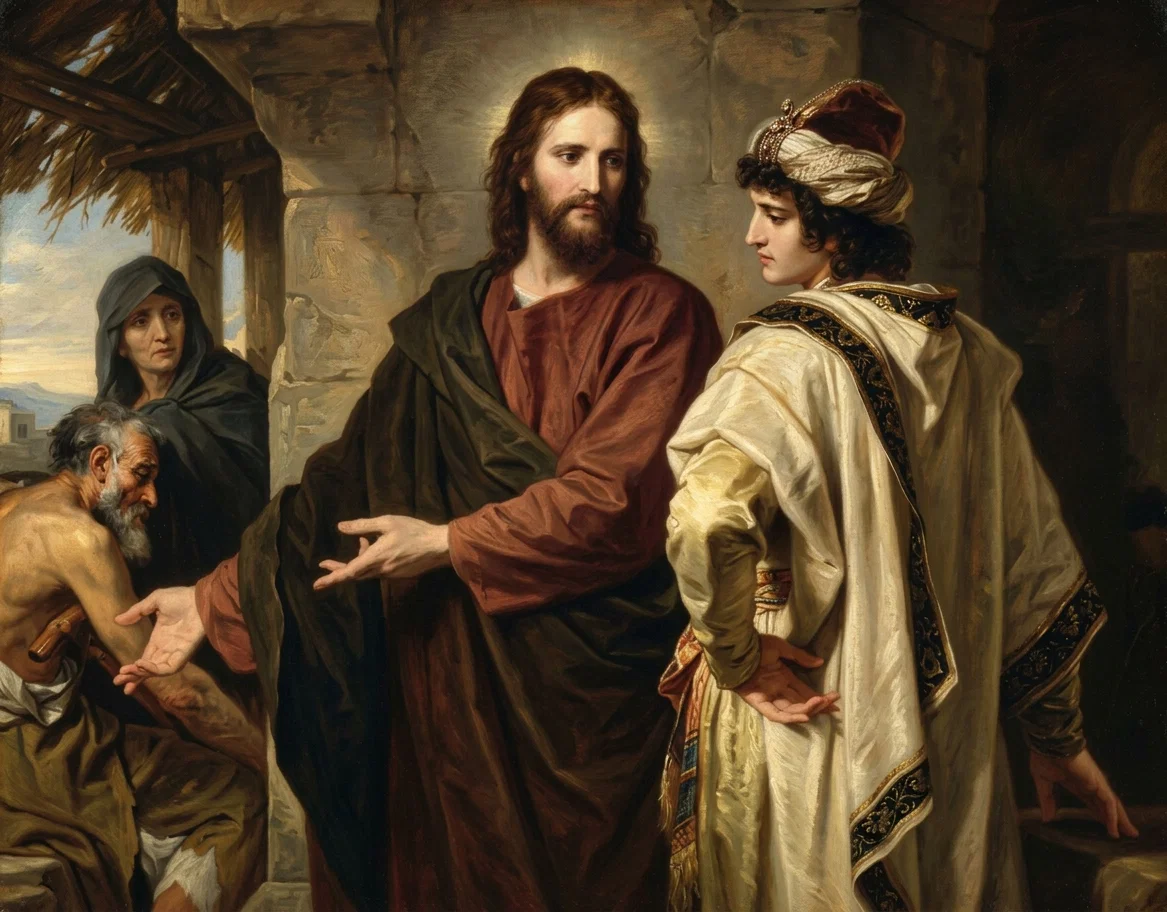
There is found in Matt. 19:16–22, in Mark 10:17–22, in Luke 18:18–23, a brief record of an incident in our Lord’s earth-life which contains practical lessons for every age, but lessons of especial importance for these days of peril. The actor in the scene is representative of the respectable wealth-loving of every age and land. The words of our Lord present eternal truth.
“Go and sell that thou hast, and give to the poor, and thou shalt have treasure in heaven; and come and follow Me.” Matt. 19:21.
Our quotation combines the account in the three Gospels:—
“And when He was gone forth into the way, there came a certain ruler, and kneeled to Him, and asked Him, Good Master, what good thing shall I do, that I may have eternal life? And Jesus said unto Him, Why callest thou Me good? there is none good but One, that is, God; but if thou wilt enter into life, keep the commandments. He saith unto Him, Which? Jesus said, Thou knowest the commandments, Thou shalt do no murder, Thou shalt not commit adultery, Thou shalt not steal, Thou shalt not bear false witness, Honor thy father and thy mother, and, Thou shalt love thy neighbor as thyself. The young man saith unto Him, All these have I kept from my youth up; what lack I yet? And Jesus, beholding him, loved him, and said unto him, If thou wilt be perfect, go and sell that thou hast and give to the poor, and thou shalt have treasure in heaven, and come, follow Me. And he was sad at that saying, and went away grieved; for he had great possessions.”
The Question.—Self-righteous and deceived tho the young ruler was, yet he was sincere in his question. He recognized in our Lord a great teacher; he evidently was impressed by the Spirit of God with a lack in his own heart, which did not assure eternal life, and he longed to live forever. “Good Master, what good thing shall I do?” His character had been wrought out on true Pharisaic principles. It must be a good work, that was true; but he must do the good work.
The Revealing Reply.—Jesus desired to show the young ruler himself and the true source of all goodness. “Why callest thou Me good? there is none good but One, that is, God.” Jesus did not say that He Himself was not good; but He did say that God only was good, inherently and essentially good. Therefore, if Jesus was good, He was God, as assuredly He was, “God with us.” Did the young man really believe this? Jesus does not ask a reply; He wishes the young man to think of the far-reaching import of His searching words. He wished him to learn what He wishes every soul to learn, that all goodness is in God, and that if we are good at all, it must be in God’s goodness. “In Thy borrowed goodness good.” “All have sinned and come short of the glory of God.” The very psalms which the young man had chanted in his service had declared the truth, “There is none that doeth good, no, not one.” Psalms 14 and 53. If he were good, the goodness was not of him, but of God. Had the young man known this, he would have better realized how he owed all to God.
The Conditions of Life.—Jesus sought toreach his heart by another way: “In the way of righteousness is life” (Prov. 12:28), was a scripture often read in the synagogs. Over and over again God had told the Hebrews that the way of His commandments was the way of life. “Which if a man do, he shall live in them.” Lev. 18:5; Deut. 30:15–19. He merely stated the great truth in other words, “If thou wilt enter into life, keep the commandments.” God’s life is given through His law. Both are eternal and harmonious. The law of man’s continued existence is the law of God’s commandments, the law and life which were in Jesus Christ. The transgression of these commandments is sin; and “sin, when it is finished, bringeth forth death.” James 1:15; Eze. 18:4. The young man by his own question admitted that he did not have eternal life; he was therefore transgressor of God’s eternal law.
The Revealing Reply.—“Which?” As tho he would say: “What commandments have I not kept? Master, you do not know how righteous I am.” Jesus calmly repeats five commandments of the last part of the Decalog, and then sums them all up, including the last precept, in the injunction, “Thou shalt love thy neighbor as thyself.” And the poor, deceived man replied, “All these have I kept from my youth up;” and outwardly, he probably had. He had kept the outward form. No one could bring a charge against him on account of one single overt transgression. “Master, I have kept all these, what more do I lack?” the young man replies. He thought he told the truth. He did not know how deceived he was. He did not know that only those persons keep God’s commandments who love God with all the heart, mind, soul, and strength; that only by God’s Spirit or life could he keep God’s law; and that he could only do this by yielding all by faith to God. Jesus knew all this, and He brings home to the heart of the young man the last searching lesson, a lesson which would try the sincerity and faith of the words, “Good Master,” which would show the young man how much more he loved his riches than God, how little he comprehended the exceeding breadth of God’s commandments, and how little he prized the Saviour’s promise of a better treasure and eternal life.
His Test of Obedience.—“If thou wilt be perfect,” if thou wilt have the perfect life, “go, sell that thou hast, and give to the poor, and thou shalt have treasure in heaven; and come, follow Me.” Jesus was still pressing home the Scriptures in which the young man had been instructed from youth: “He that hath pity upon the poor lendeth unto the Lord; and that which he hath given will He pay him again.” Prov. 19:17. It was God’s own promise repeated in even more precious words. The young man thought that he had kept the commandments; he did not realize that his riches were his idol, that he coveted them and his reputation more than he did to do God’s will. He had kept none of the commandments; all his deeds were wrought in self. The Lord’s test of obedience revealed the selfishness and idolatry of the man; he felt grieved, and went away sorrowful. “How hardly shall they that have riches enter into the kingdom of God.”
Jesus Loved Him.—He saw in him the possibilities of a noble, useful character. He loved and loves every other one whom that young man typified and whose heart is set on money. Because He loved him He wanted to save him, even as He loves and longs to save every soul situated as was that young man. He loves you, dear soul, to whom is intrusted wealth of any sort. He loves you, and therefore He does not want your heart set on earthly riches, which will soon scatter and perish. Rich as a Rothschild tho you may be in this world’s possessions, you can keep it only till you die. Naked you came into the world, naked you go out. You leave all at last, even tho you cling to it with the covetous clutch of the miser while you live. And even before you die, the banks may break, your gilt-edged investments prove worthless, your stocks go down, your speculations prove disastrous; fires may burn your wealth, floods destroy it. And that is all you have. Christ loves you, and would give you a better treasure. He would give it in the best way. He would unite you with Himself in a holy partnership of helpfulness. “Mi-sery is mis-ery.” Holding all, you die and lose it all. Giving all, you place it in the bank of God, which can never fail, and you get it all again for all eternity, and glorified, multiplied a myriad-fold. Your buildings here will decay with age and crumble under the earthquake shock; there they will be the mansions that last forever, that are garnished with the gems of God. Here your land will succeed to another at your death, or will be taken by creditor or enemy while you live; there “the kingdom shall not be left to other people,” for you shall live forever. The glitter of your hoarded gold here will tarnish; there it will shine in immortal eyes to all eternity. Sell, and give to the poor. They are God’s representatives in need, in order to draw out the sympathies of your heart and test your loyalty to God. Christ identifies Himself with every one of them; whatever you do for each and to each is done for Him. O, do you not see Him and hear Him in the maimed, the halt, the blind, the crippled, the hungry, the homeless, the houseless, the “ragged, bestial beggars” which throng the cities? Some of them seem not human, but give to them for Christ’s sake. He can recreate them. He knocks at your door in need. Turn Him not away empty-handed. Many are working almost despairingly to help the multitudes in our great cities; sell, and give, and co-operate with Christ. Join partnership with a firm that never failed. Place your treasure in heaven, in a bank that can never break. O, work with Christ, and share His eternal joy! Heb. 12:2; Matt. 25:34–40.

Christ and the Pharisees.

“And when He was come into the temple, the chief priests and the elders of the people came unto Him as He was teaching, and said, By what authority doest Thou these things? and who gave Thee this authority?” This took place soon after Christ had driven from the temple those that were defiling it by unholy traffic. At that time divinity had flashed through humanity. Christ had said, “Take these things hence.” “It is written, My house shall be called the house of prayer; but ye have made it a den of thieves;” and the priests and rulers fled as if pursued by an armed band of soldiers, or by the presence of an offended God.
After fleeing thus, they saw no marks of divine judgment upon them, and they felt ashamed of their hasty retreat at the command of a humble Galilean. What could they answer to those who would inquire why they had fled? We will return, they said, and resume our position in the temple. We will challenge this Man as to His authority. But the very fact that they had fled from Him was sufficient evidence of His divinity.
Now they came to Christ with the question, “By what authority doest Thou these things? and who gave Thee this authority?” They hoped that He would say something that they could construe for the advancement of their evil work. But Christ made His reply conditionally on their answering a question He put to them. “The baptism of John, whence was it?” He asked, “from heaven, or of men?”
The priests saw that they were in a dilemma from which no sophistry could extricate them. If they said that John’s baptism was from heaven, their inconsistency would be made apparent. Christ would say, Why then have you not believed on John? After the baptism of Christ, John had seen the glory of God, like a dove of burnished gold, resting upon Him, while the voice of the Infinite One proclaimed, “This is My beloved Son, in whom I am well pleased.” And John had testified of Christ, “Behold the Lamb of God, which taketh away the sin of the world.” Why, then, if the Pharisees believed on John, did they deny the Messiahship of Christ?
If the Pharisees stated their true belief, and affirmed John’s baptism to have been of men, the wrath of the people would be turned against them, instead of against Christ; for they believed John to be a prophet.
With intense interest the multitude waited to hear the decision of the Pharisees. Hypocritically professing ignorance, they said, “We can not tell.” “Neither tell I you,” said Christ, “by what authority I do these things.”
The Pharisees were silenced. Baffled and disappointed, they stood with lowering brows, not daring to press further questions upon Christ, while the people stood by, amused to see these proud, self-righteous men defeated.
Christ’s purpose was not to humiliate His opponents. He did not wish to give the impression that He was glad to see them in a hard place. He had an important lesson to teach. He had mortified His enemies by allowing them to become entangled in the net they had spread for Him. Their acknowledged ignorance in regard to the character of John’s baptism gave Him an opportunity to speak, and He improved the opportunity by presenting before them their true position, adding another warning to the many already given. It was His custom to let circumstances furnish opportunity for His lessons.
“What think ye?” He said. “A certain man had two sons; and he came to the first, and said, Son, go work to-day in my vineyard. He answered and said, I will not; but afterward he repented, and went. And he came to the second, and said likewise. And he answered and said, I go, sir; and went not. Whether of them twain did the will of his father? They say unto him, The first. Jesus saith unto them, Verily I say unto you, That the publicans and the harlots go into the kingdom of God before you.”
The priests and rulers could not but give a correct answer to Christ’s questions; and thus He obtained their opinion in favor of the first son. This son represented the publicans, those who were despised and hated by the Pharisees, who held no intercourse with them. The publicans were grossly immoral. They were indeed transgressors of the law of God, showing in their lives an absolute resistance to His requirements. They were unthankful and unholy, and when told to go and work in the Lord’s vineyard, they gave a contemptuous refusal. But appearances are deceiving. Christ did not judge from appearances, but from the fruit borne. When John came, preaching repentance and baptism, the publicans received His message and were baptized.
The second son represented the leading men of the Jewish nation. Some of the Pharisees had repented and received the baptism of John,but the leaders among them would not acknowledge that He came from God. His warning and denunciation did not lead them to make amendment. They “rejected the counsel of God against themselves, being not baptized of Him.” They treated His message with disdain. Like the second son, who, when called, said, “I go, sir,” but went not, the Pharisees professed obedience, but acted disobedience.
The priests and elders made great professions of piety. They claimed to be looking eagerly for the promised Messiah, and apparently they were waiting with anxious expectancy for the call to the great supper, when they would immediately go in. They were proclaiming everywhere the great events that were to take place when the King of the Jews should come. They boasted constantly of how He was to conquer their enemies, and set up His own kingdom. But they applied to His first advent the prophecies relating to His second coming, and when He did come, they knew Him not.
They claimed to be obeying the law of God, but they were so exacting in their requirements that they made it impossible for any one to keep it. They themselves were constantly disobeying it. The law is holy, just, and good, but the Jewish leaders only rendered it a false obedience.
Before the Pharisees, Christ, who knew their hearts, held up their religious pretensions as God viewed them. He stripped from them their robe of apparent righteousness, laying bare their hypocrisy. The very people they despised and ignored believed in John. His preaching sent conviction to their hearts, and showed them the sinfulness of sin. And, altho at first they refused to obey the call, “Go, work to-day in My vineyard,” yet when John’s words fell upon their ears, calling them to repentance, they received his message. They had before made no profession of obedience, but after they heard his words, they saw their error, repented of their neglect, and obeyed. They were denounced and cursed by the Pharisees as infidels, but they showed by their faith and works that they were going into the kingdom of heaven before the self-righteous Pharisees, who had been given great light, but whose works did not correspond to their profession.
MRS. E. G. WHITE.

SCRIPTURAL LESSONS FROM THE STARS.

WHEN “God said, Let there be lights in the firmament of the heaven to divide the day from the night,” He also said, “Let them be for signs, and for seasons, and for days, and years.” These lights include the sun, the moon, and the stars. Not only does the mariner make use of these heavenly bodies in directing his course across the trackless deep, but they are God’s great timepiece for all men, and they are also for signs. Four thousand years later, when Christ would definitely mark the last generation that would live on this earth, He said, “There shall be signs in the sun, and in the moon, and in the stars.” Other scriptures state definitely what appearance they would assume that would constitute them signs. They all were to be darkened. Joel 3:15. The moon would be turned into blood. Chapter 2:31. This darkening of the sun was to occur immediately after the great papal persecution (Matt. 24:29), but in the 1,260 years measured off by the Lord for that power (Mark 13:24).
The days of papal persecution began in A.D. 538 and ended in 1798. The persecution closed about 1776. The darkening of the sun and moon occurred May 19, 1780. A great earthquake would also precede the darkening of the sun. This occurred in November, 1755, when nearly the whole earth felt the shock. The city of Lisbon was terribly shaken, and the ruins are seen unto this day. Rev. 6:12, 13. The manner of the falling of the stars is so vividly described that many living witnesses who saw the falling of the meteors of Nov. 13, 1833, have the event so fixed upon their memory that time can never efface it. Thus we have entered the period of which the Saviour said: “Verily I say unto you, This generation shall not pass away, till all be fulfilled. Heaven and earth shall pass away; but My words shall not pass away.” Luke 21:32, 33.
The wise men also at the first advent of Christ, who had not the written Word, were studying the Gospel from the heavens, when a peculiar star appeared. It led them, instructed by the Spirit of God, to follow its guiding ray to the stable of Bethlehem, where Christ was born. They paid Him homage and made Him presents, while the proud Pharisees were as blind to the fulfilment of the prophecies as are the Pharisees of the nineteenth century. They professed to believe the Bible, but were not simple enough to believe that God meant what He said, and were too indolent to study for their own salvation.
Of Himself, Christ said: “I Jesus have sent Mine angel to testify unto you these things in the churches. I am the root and the offspring of David, and the bright and Morning Star.” Rev. 22:16.
Many other equally interesting lessons are also taught by the stars. Over 2,000 years after the creation, we have the next recorded instance of God making mention of the stars. He gave Abram a lesson in the stars which, if David had heeded, would have saved him and his people the terrible experience recorded in 2 Samuel 24. God gave it after Abram had questioned as to the manner of the fulfilment of the promise that he should have a son. “And Abram said, Lord God, what wilt Thou give me, seeing I go childless, and the steward of my house is this Eliezer of Damascus? And Abram said, Behold, to me Thou hast given no seed; and, lo, one born in my house is mine heir. And, behold, the word of the Lord came untohim, saying, This shall not be thine heir; but he that shall come forth out of thine own bowels shall be thine heir. And He brought him forth abroad, and said, Look now toward heaven, and tell the stars, if thou be able to number them; and He said unto him, So shall thy seed be. And he believed in the Lord; and He counted it to him for righteousness.” Gen. 15:2-6.
To be impressed as Abram was, and get an idea of the lesson the Lord presented before Abram, and the one that has come down to us, it would be necessary to go out some clear, starry night, fix the eye upon some one point in the heavens, and begin to count the stars. After counting awhile, you will begin to question whether you counted that one or not. And in a moment or two you will find it is entirely useless to attempt to count them. First, the number is too great to count. Second, it would be impossible to tell whether you had counted particular ones or not. So shall thy seed be. Who can now or ever could tell who God’s people are? God alone reads the hearts, and He alone can number the faithful.
Another very impressive lesson is found in Dan. 12:3: “And they who have instructed wisely shall shine as the resplendence of the firmament, and they who have made many righteous like the stars forever and ever.” (Spurrell’s translation.) To correctly understand this let us imagine God’s people are a missionary people (which they are), and are scattered among every nation, kindred, tongue, and people. You would see dotted over the entire world here and there one or more representatives of Christ; gathering around him or them, a few darkened souls that are learning of Jesus. Among these companies are some who shine almost like suns, revealing to darkened ones around them the light of God. Others are like planets, reflecting the light of the Son of God; while others are wandering, irresponsible, like meteors. And so the little centers, some larger than others, are gathering around themselves groups or companies, and these groups gather into conferences or larger groups, and these groups making still larger groups, according to organization of churches, conferences, and finally the entire world of groups, revolve around one grand Center, the Lord Jesus Christ. It is thus with the heavenly bodies. “For one star differeth from another star in glory.”
Around our sun is a family of planets, some shining brighter than others. So this family helps constitute a larger family, and so on until the entire heavenly firmament revolves around one grand center. May not this be where God resides? Has not the spiritual world a firmament also? There will not be a single individual in the kingdom of God but will belong to some family, made so not by natural ties, but by the grace of our Lord and Saviour Jesus Christ. “God setteth the solitary in families” [or “God seateth the beloved at home,” “but the rebellious shall abide in the weary land,” Spurrell]. Ps. 68:5, 6. See also Ps. 113:7-9; 128:1-6. And is there not one great family of which God is the father and to which when this speck of a world is redeemed, all will be united? Eph. 3:14, 15; 1:9, 10.
S. N. HASKELL.

WHICH DAY IS THE SABBATH?

To the question, Which day is the Sabbath? the Bible gives definite answer,—“The seventh day is the Sabbath of the Lord thy God.” Ex. 20:10. This is certainly plain enough; but plain as it is, some minds are not satisfied with it, and ask again, What seventh day?
To this latter question the Bible also gives explicit reply; it is the seventh day of the week.
In the account of the crucifixion and burial of our Lord, given by Luke, we read:—
“And that day was the preparation, and the Sabbath drew on. And the women also, which came with Him from Galilee, followed after, and beheld the sepulcher, and how His body was laid. And they returned, and prepared spices and ointments; and rested the Sabbath day according to the commandment.” Luke 23:54–56.
“Now upon the first day of the week, very early in the morning, they came unto the sepulcher, bringing the spices which they had prepared, and certain others with them.” Luke 24:1.
Now it is just as plain as anything can possibly be that Christ was crucified and buried on the day before the Sabbath; that the day following the day of the crucifixion was the Sabbath, which we are told the women observed “according to the commandment.” The commandment, it will be remembered, plainly specifies “the seventh day;” and the next day we are told was “the first day of the week.” Here is the weekly cycle of seven days plainly brought to view, and the last day of that cycle is the Sabbath “according to the commandment.” It follows necessarily that the commandment requires the observance of the seventh day of the week.
But it may be asked how we know that we have the same weekly cycle as in the days of our Lord’s earthly ministry. We know it by the concurrent testimony of all history upon the subject. The world has had, within historic periods, but one weekly cycle. The “Encyclopedia Britannica,” art. “Calendar,” places the weekly cycle among the most ancient divisions of time known, and states that it has been “employed from time immemorial in almost all eastern countries,” remarks that “those who reject the Mosaic recital will be at a loss, as Delambre remarks, to assign to it [the week] an origin having much semblance of probability.”
It is needless for us in this examination to go back of the Crucifixion to inquire whether or not somewhere between creation and the cross the original week may have been lost. Inspiration says that the day observed by the holy women who followed Christ from Galilee was “the Sabbath day according to the commandment.” This proves conclusively that amid the shifting scenes of human life, amid the rise and fall of empires, amid the wreck of nations, through all the centuries that had passed since first God blessed and sanctified the Sabbath, His providence had preserved a knowledge of that sacred day. Men had forgotten God, they had turned to the worship of images, they had served the creature rather than the Creator; but they had not entirely forgotten His Sabbath. The most ancient languages bear witness to this fact by giving to the seventh day of the weekly cycle names equivalent to Sabbath or rest. One of these is the Babylonian, which was a written language 3,800 years before Christ.
No student of history will for a moment entertain the thought that by any possibility could the weekly cycle have been lost or changed since the women who were last at the cross and first at the sepulcher “rested the Sabbath day according to the commandment.” Rome was then at the height of its power. Learning was not as common as it is to-day, but the world enjoyed a high state of civilization. Within forty years of the cross the Jews were scattered among all nations, and have been so scattered ever since, but Rabbi Wise declares that history records no disagreement among them at any time as to the day of the Sabbath, nor between them and other people. This perfect harmony between the dispersed Jews and between Jew and Gentile would not have been possible had there been any change in the weekly cycle. And to these facts all authorities bear witness to-day. Everywhere Sunday is the first day of the week and Saturday the seventh. Look at the tables between the Old and New Testaments in the old family Bible and there you will find a table giving the days of the week as follows:—
1st, Sunday. 2d, Monday. 3d, Tuesday. 4th, Wednesday. 5th, Thursday. 6th, Friday. 7th, Saturday, or Sabbath.
This table is not Inspiration, but it is unimpeachable evidence that the seventh day of the fourth commandment is not an illusive thing that can not be located, but that God by His providence has identified it so clearly as to leave all without excuse who refuse to obey the commandment which says:— “Remember the Sabbath day, to keep it holy. Six days shalt thou labor, and do all thy work; but the seventh day is the Sabbath of the Lord thy God.” Ex. 20:8–10.
C. P. B.

WHOM DOES THIS HIT?

I ONCE heard a conversation between a church-member and an infidel. After arguments had been urged at some length on both sides, the infidel observed to his friend that they might as well drop the subject of conversation; “for,” said he, “I do not believe a single word you say, and, more than this, I am satisfied that you do not really believe it yourself; for to my certain knowledge, you have not given for the last twenty years as much for the spread of Christianity—such as the building of churches, foreign and domestic missions—as your last Durham cow cost. Why, sir, if I believed the one-half what you say you believe, I would make the church my rule for giving, and my farm the exception.”—Selecta.

A LITERAL COMING.

WHEN the second coming of Christ is presented, some persons will say: “Does not this coming mean our acceptance of Him at conversion, and the witness of the Spirit? Or may it not mean His reign over the church? Or may it not mean death?”
I feel free to say that it is impossible that any one of these should be meant. Think a moment. Do you condemn the Jews for rejecting the Messiah, when He came in such literal fulfilment of prophecy? and yet will you reject the same literalness about His second coming? “And, behold, thou shalt conceive in thy womb, and bring forth a Son, and shalt call His name Jesus.” Do you believe these words to be literally true? If so, why not believe what follows to be as literal? Luke 1:31-33.
We have a literal Christ, the Mediator of the new covenant. Heb. 12:24. We believe that the “Jerusalem which is above,” of which Sarah is typical, is the New Jerusalem which comes down out of heaven from God, and that it is a literal, tangible, real city. How, then, are we authorized to do away with the literal sense of a multitude of passages which predict a literal coming of Christ to set up a literal kingdom? Such “spiritualizing” of scriptures subverts the authority and power of the Word of God. What is the purpose of language, if not to convey definite ideas? It was no trouble for the Holy Spirit to choose words to convey correct thoughts. A little child gave the substance of the whole thing when it said, “If Jesus didn’t mean what He said, why didn’t He say what He meant?” But He did mean what He said, and His words will “not pass away.” Matt. 24:35.
His first advent did not mean death to the Jews, and they did not so understand it; neither does His second coming mean death to Christians, nor should they so understand it. Our Saviour made a clear distinction between death and His coming in John 21. He tells Peter how he (Peter) should die, and then, by contrast, He speaks of John, saying, “If I will that he tarry till I come, what is that to thee?” That is, that John might not die, but live till Jesus should come again. The disciples so understood it, and reported that “that disciple should not die.”
There are many passages that clearly teach that death can not be synonymous with the second coming of Christ. Death is an enemy (1 Cor. 15:26), and at Christ’s coming we are raised from the dead, and shout victory over death and the grave. “O death, where is thy sting? O Hades, where is thy victory?” If faithful unto death (tho faithfulness cost us our lives), we are promised a crown of life (Rev. 2:10); but we do not receive it until Jesus comes (2 Tim. 4:8).
We would that every Christian might realize “the grace that is to be brought unto” us (not at death but) “at the revelation of Jesus Christ.” Nowhere in the sacred Word are we taught to watch for or prepare for death. But we are commanded to watch and prepare for the coming of our blessed Lord. Let us, therefore, not be deceived by the thought that our great “enemy,” death, is the precious coming of Jesus.
Reader, does not this subject interest you? You may say, “I know but little about it, and can not understand it.” But do you want to understand it? If so, God has given you His Word, and it is open to you. The Holy Spirit is promised as your Teacher. John 14:26. Will you study it? Will you search the Scriptures for yourself and see if these things are so? Jesus is soon coming, and you may not be ready to meet Him if you delay investigating this subject longer. It will bring joy to your soul. One who opposed the subject of the personal second coming, said, after spending an evening in investigating the Scriptures, “I have spent the happiest night of my life, for last evening I saw the truth concerning the second coming of Christ.” It filled him with joy. Reader, search the Scriptures, and ask the Holy Spirit to open your eyes to these important truths.
J. H. DURLAND.
Battle Creek, Mich.
Continue reading: THE PROPHETIC SYMBOLS OF DANIEL 8