Your ShelfYour Projects

Signs of the Times, Vol. 39, No. 43.

The Somewhere Land

Signs of the Times

Nov 5, 1912

Pacific Press Publishing Association · Mountain View, California · Nov 5, 1912

The Somewhere Land

By M. C. Wilcox
[In a meeting where the immortality and intangibility of the soul and its shadowy home were set over against conditional immortality and a new heaven and earth, an old man said, "I want to be somebody, and go somewhere, and be somebody when I get somewhere, instead of being nobody, and going nowhere, and being nobody when I get nowhere." God has something better.]
O, there lies not far the Somewhere Land, Beyond earth's cares and tears. By the bow of God are its mountains spanned; By the mind of God are its ages planned; Millenniums are its years.
The flowers fade not in the Somewhere Land; The leaves fade not, nor fall; There is no bent form nor palsied hand, Nor crape on the door, nor mourning band, But life possesses all.
I long for a home in the Somewhere Land, Where love shall hearts imbue; To be somebody in that holy band; To reach that somewhere, and with them stand, With Christ my Lord; don't you?
I am longing to be in that Somewhere Land, More than unmeaning shade; To be more real from my Maker's hand, In that home by the bow of promise spanned, Than ever human made.
O, there's joy, glad joy in the Somewhere Land When all its sons come home— Come home to the home by the Father planned, Whose law is love, from whose glory grand They nevermore shall roam.

Question Corner

"IF YE WILL INQUIRE, INQUIRE YE."
This Inquirers' Department is conducted for the purpose of helping those who are studying the Bible. The answers are oftentimes only suggestive. They are never to be considered infallible, only as they agree with the infallible Word. The writer who may answer them does not consider that his opinion is infallible. He will simply give the best that he has, and plead with the inquirer to search the Word. Such questions only will be answered as, to the editors, seem to minister to the good of the readers and to the mission of the paper. We can not answer repeatedly in the same volume questions upon the same scripture. The name and address must accompany question, not for publication, but as an evidence of good faith, and that answer may be made by letter if deemed advisable. No letters are answered which do not contain the name of the writer. It is well always to enclose stamp for reply.

3903 — Their Worm Shall Not Die

Do Isa. 66:24; Mark 9:44, 46, 48; and Rev. 14:11, mean that the wicked are to be tormented forever and ever? What are we to understand by "their worm shall not die"? Isa. 34:10 reads, "The smoke thereof shall go up forever." Does the Bible in any other place give a clearer interpretation? W. S. H.
The word rendered "hell" in the last part of Mark 9 is "Gehenna," and the Greek word "Gehenna" comes from the Hebrew words "the Valley of Hinnom." All authorities agree as regards this. The Valley of Hinnom was a valley just outside of Jerusalem, where was thrown the offal of the city, the dead bodies of malefactors, and other refuse. Upon these dead bodies and filth of the city, worms preyed. They were there constantly, to devour utterly all that was cast there; and what the worms could not devour, constant fires were kept burning to destroy, in order to avert pestilence. And thus "the Valley of Hinnom" became a synonymous term with "utter destruction." One can see how this is. All this refuse from the city was cast there to be destroyed, the constant worm preying upon it to destroy it, and the constant fires kept burning to devour it, or consume it. And that is the figure which our Lord uses to show the destruction of the incorrigibly wicked; they will be cast into Gehenna, where the worm shall not die, and the fire shall not be quenched, until it has done its work; and hence we read of the wicked in the Thirty-seventh Psalm, "Evil-doers shall be cut off." Verse 9. "They that are cursed of Him shall be cut off." Verse 22. "The enemies of Jehovah shall be as the fat of lambs: they shall consume; in smoke shall they consume away." Verse 20. We read in Mal. 4:1, "For, behold, the day cometh, it burneth as a furnace; and all the proud, and all that work wickedness, shall be stubble; and the day that cometh shall burn them up, saith Jehovah of hosts, that it shall leave them neither root nor branch." And of Satan, under the figure of the king of Tyre, it is said, speaking of his destruction: "Therefore have I brought forth a fire from the midst of thee; it hath devoured thee, and I have turned thee to ashes upon the earth in the sight of all them that behold thee. . . . Thou art become a terror, and thou shalt nevermore have any being." In Matthew, the third chapter, in the words of John the Baptist concerning Christ, "whose fan is in His hand, and He will thoroly cleanse His threshing-floor; and He will gather His wheat into the garner, but the chaff He will burn up with unquenchable fire." That is, that fire will not be quenched until it has consumed the chaff.
As a comment upon this, turn to Jeremiah, the seventeenth chapter, the twenty-seventh verse, in which we read of God's judgment upon Jerusalem, if they would not observe His Sabbath, "Then will I kindle a fire in the gates thereof, and it shall devour the palaces of Jerusalem, and it shall not be quenched." Jerusalem was to be burned up with unquenchable fire. Read in 2 Chron. 36: 19-21 as to just what this unquenchable fire did: "And they burnt the house of God, and brake down the wall of Jerusalem, and burnt all the palaces thereof with fire, and destroyed all the goodly vessels thereof. . . . to fulfil the word of Jehovah by the mouth of Jeremiah, until the land had enjoyed its sabbaths." This shows that the unquenchable fire simply means an instrument of destruction that would do its work of destroying. We have the same thought concerning the worm that should not die. For a comment upon this, turn to Isaiah, the fifty-first chapter, seventh and eighth verses: "Fear ye not the reproach of men, neither be ye dismayed at their revilings. For the moth shall eat them up like a garment, and the worm shall eat them like wool; but My righteousness shall be forever, and My salvation unto all generations." Note again that the worm destroys, and this is the very figure of the sixty-sixth chapter and the twenty-fourth verse, for observe that it is not upon the living that the worm preys, but it is upon the dead. Thus the Revised Version reads, "And they shall go forth, and look upon the dead bodies of the men that have transgressed against Me: for their worm shall not die, neither shall their fire be quenched; and they shall be an abhorring unto all flesh." That is, they shall be utterly destroyed, and as Mark puts it, turned into ashes on the face of the earth.
The expression "torment . . . forever and ever," in Rev. 14:11, is a wrong use of the meaning of the Greek term "basanismos," the primary meaning of which is "testing;" so God's children shall be tested forever and ever. They will be tested by fire, for "the fire shall try every man's work of what sort it is." 1 Cor. 3:13. That fire will be kindled by the presence of God, for "our God is a consuming fire." Heb. 12:29. When God shall be revealed with all His overpowering presence of burning glory, His own children will be changed from mortality to immortality. They will simply take upon themselves new glory, for God's glory only consumes sin; but that burning glory will set on fire the very foundations of the earth, when the wicked are judged, and sin and all that is identified with sin will be destroyed, and the last testing will take place, and the smoke of that testing will go up forever. That was the thought of the burnt offering. The burnt offering stood for the consecration of the man who offered it. In that was represented all of himself, all his sin was confessed. That burnt offering represented himself, and the smoke went up forever. That is not that it was constantly and forever ascending, but that the fire had consumed, and the smoke was gone forever. It was a finality. And so the tormenting, or testing, forever and ever is a final testing. "The wicked shall go away into everlasting punishment"—not punish-ing, but a punishment which shall be final. See the "Bible Students' Library," No. 111, "Tormented Forever and Ever," the price of which by mail is two cents.

3904 — The Seventh Trumpet

When did the time of the seventh trumpet begin, 1840, 1844, or has it to come yet? Is there a difference between the "time" and the sounding of the trumpet? M. H. W.
It is generally understood and clearly shown, it seems to us, that the sixth trumpet ended in 1840. That was the second wo trumpet. "The second wo is past: behold, the third wo cometh quickly." Rev. 11:14. And then comes the sounding of the seventh trumpet, and immediately on its sounding it is said, "The seventh angel sounded; and there followed great voices in heaven, and they said, The kingdom of the world is become the kingdom of our Lord, and of His Christ: and He shall reign forever and ever."
Referring to the 10th chapter, the 7th verse, "But in the days of the voice of the seventh angel, when he is about to sound, then is finished the mystery of God, according to the good tidings which He declared to His servants the prophets," according to good Greek scholars, like Alford, the original is expressed by "when he is about to sound," not, "when he shall begin to sound."
From 1844 on are the days of the seventh trumpet. They belong to the seventh trumpet. They are the time when that trumpet is about to sound, and God is holding that final sounding until the mystery of God, or the gospel work, shall be finished. That is the waiting time. That is the "little season" when God is waiting for His children to get ready, to warn the world concerning the last great catastrophe which shall meet it, and to gather out a people to glorify His name. And when the trumpet sounds, then Christ the Lord will come, and will begin His glorious, eternal reign as King of Kings and Lord of Lords.
We offer this as a suggestion to our querist. There is not space in this department to develop it more fully.

3901 — Tell No Man

In Jesus' healing, what was His reason for nearly always telling them to tell no man?
He did this in order that there might be no excuse on the part of the people, or of His critics at that time, of saying that He was seeking popularity. That is what the Pharisees did. They prayed on the street corner. They gave their alms with great ostentation. They wore garments that would say to others around them, See how holy I am. Jesus did nothing of this sort. The very fact that they themselves posed before the people as righteous would necessarily lead Him to take an opposite course. He was not posing for popularity, and therefore He charged them that they should tell no man. Of course they did tell. Their countenances and their voices and their praises to God told, but at the same time there would be borne with it His own testimony that this was not to draw attention to Himself. He was not seeking to be popular.

3902 — Who Baptized John?

I heard a person ask not long ago, "Who baptized John?" I have not found anything on this in "Questions and Answers." —S. C.
No, there is nothing in "Questions and Answers" regarding this. We do not know who baptized John. The Bible tells us nothing about it. We do not know whether he was baptized or not. We do know this,—God called him from before the time that he was born. God Himself fitted him for his mission, and God Himself sent him. The Lord does not satisfy our curiosity in any way regarding the fitting of His servants, or the choosing of them. Everything that was necessary to do on John's part, or in John's attitude toward the Lord, was evidently met, and we can leave all that with the Lord.

3905 — The Offerings of Solomon

Solomon offered 122,000 animals as burnt offerings. Explain how this was possible. 1 Kings 8:63.
According to our versions, 1 Kings 8:63 gives us 142,000 offerings. These offerings were the sum of all that were offered during the two weeks' feast, it seems without question. These would be 142,000 in fourteen days, or about 10,143 a day. If each day consisted of twelve hours — and that would probably be the case — or even longer than that, with the morning and evening offerings, then it would be but 845 an hour; and with the many priests, and the great altar, and probably many temporary altars, this would certainly not be a surprising thing, many of them being offered at one time.

3906 — By the Catholic Bible

Can you prove the Seventh-day Adventist faith from the Catholic Bible? Inquirer.
Yes, it is not difficult. There are a few expressions that are translated wrongly in the Douay Version. For instance, instead of "repent" they have it "do penance;" but these things are sufficiently guarded, perhaps, in other passages, so that it would not be a difficult thing to prove all the truth of God in these days, even from the Catholic version. The trouble is not with the Catholic Bible so much as it is with the Catholic tradition which sets aside the Bible.
Schedule for the Week Ending November 16, 1912

Schedule for the Week Ending November 16, 1912

Schedule for the Week Ending November 16, 1912
Sunday November 10 Romans 9
Monday " 11 " 10
Tuesday " 12 " 11
Wednesday " 13 " 12, 13
Thursday " 14 " 14
Friday " 15 " 15, 16
Sabbath " 16 1 Thessalonians 1, 2; Psalm 113

Readings in Romans and Thessalonians

The first six days of the week cover the remainder of the book of Romans. After the argument concerning justification and Christian experience, the apostle takes up other things, among which is the relation of the Jewish people to God's plan as worked out in them, the doctrine of election, instruction concerning spiritual gifts, and our relation to the state, with various other matters which need not here be mentioned. The last day of the week concludes with two chapters of 1 Thessalonians, the first of Paul's epistles, written probably in the year 52. Both the epistles to the Thessalonians were probably written at Corinth, one following the other by a few months. The first epistle is remarkable in this, that every chapter has something to say on the second coming of Christ. The apostle commends the brethren because of their work of faith, and labor of love, and patience of hope.
Psalm 113 is supplementary to the last day's reading,—an excellent song of praise to God for deliverance.

EDITORIAL

The Time Is Fulfilled

Now after John was delivered up, Jesus came into Galilee, preaching the gospel of God, and saying, The time is fulfilled, and the kingdom of God is at hand: repent ye, and believe in the gospel." Thus reads the record in Mark 1: 14, 15. Jesus' ministry began about six months before this. It ran parallel with that of John a few months, and then His forerunner was cast into the prison of Machærus by the wicked Herod, urged on by his wretched paramour, Herodias. John's work was ended; that of Jesus was just fairly begun, and the brief record of Mark epitomizes the instruction of our Lord.
"THE time is fulfilled." What time? — The time foretold by prophets, preeminently the prophet Daniel in chapters 8 and 9. In chapter 8:14 is given the period of 2,300 prophetic days or years. In chapter 9 is clearly intimated that seventy weeks of these years, or 490 years, were cut off from the 2,300, upon the Jewish people. It is also clearly declared that this period began when the commandment went forth to restore and rebuild Jerusalem. This event occurred in the seventh year of Artaxerxes Longimanus, as recorded in Ezra 7; but the records of history show that the seventh year of Artaxerxes fell in B.C. 457, and the Jews themselves were cut off from being a special people of God 490 years later, in A.D. 34. According to Daniel, 483 years, or 69 weeks, from that commandment would reach to Messiah the Prince. The word "Messiah" means "anointed." Jesus was anointed at His baptism, as stated in Acts, the tenth chapter, and thirty-eighth verse: "How God anointed Jesus of Nazareth with the Holy Ghost and with power: who went about doing good, and healing all that were oppressed of the devil; for God was with Him." And our Lord Himself states the same thing shortly after His baptism: "The Spirit of the Lord is upon Me, because He hath anointed Me to preach the gospel to the poor; He hath sent Me to heal the broken-hearted, to preach deliverance to
the captives, and recovering of sight to the blind, to set at liberty them that are bruised, to preach the acceptable year of the Lord." Luke 4:18, 19. And He immediately declared, "This day is this scripture fulfilled in your ears." We have therefore the fulfilment of Isa. 61: 1, which our Lord quoted, and that of the time given in Daniel 8 and 9, fulfilled in our Lord's ministry. "The time is fulfilled." The word of God given from six to five centuries before had met its complement in the work of our Lord. And men knew it. Souls who had been longing for the light, grasped the light. Devout men and women who had been studying the Word, saw it fulfilled in Jesus Christ. And "the people which sat in darkness" in the land of Zebulun and Naphtali, "by the way of the sea, beyond Jordan, Galilee of the Gentiles," turned from the shadow of death to the light of life in Christ Jesus.
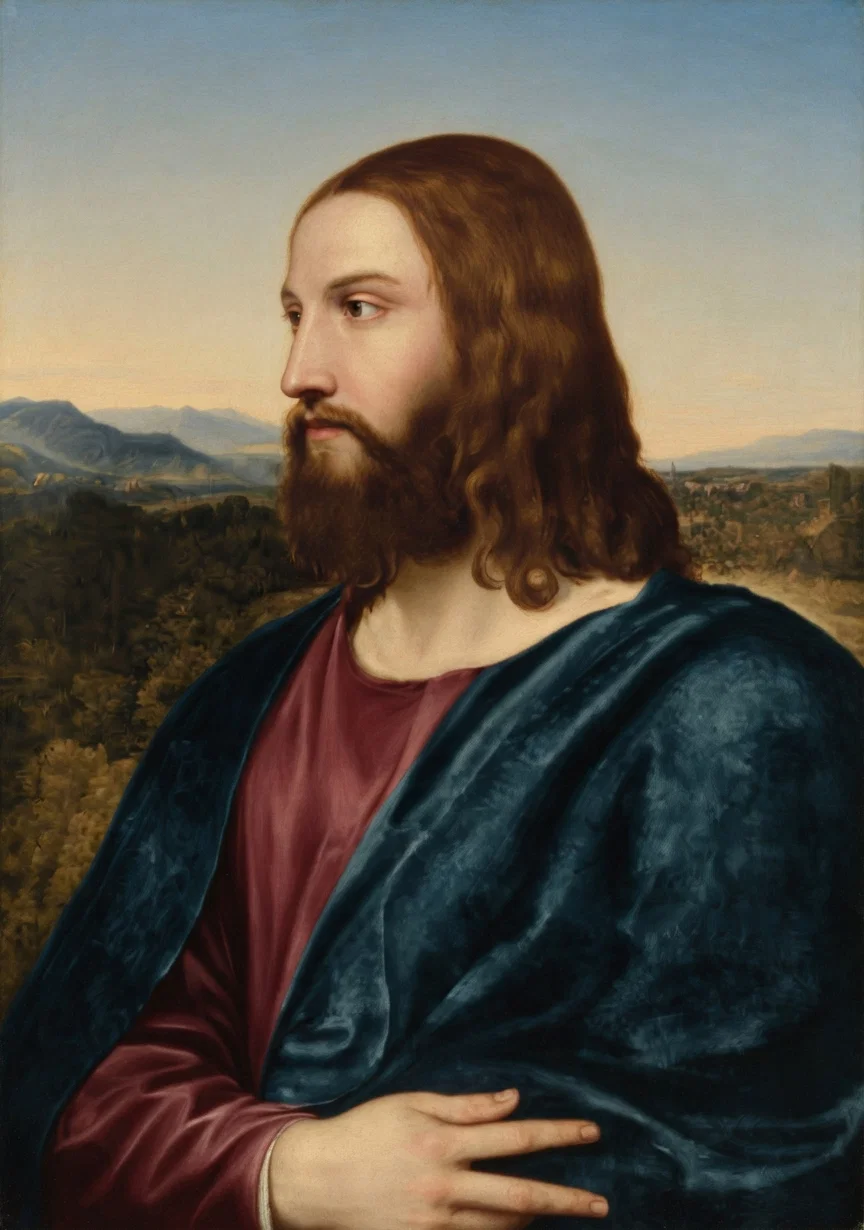
TITIAN'S CONCEPTION OF OUR BLESSED LORD
"THE kingdom of God is at hand." Jesus the King stood among them. They might have then received Him, they might have welcomed Him. The whole temple could have been thrown open to His glorious presence. God would have used that people for the evangelization of the world, but "He came unto His own, and His own received Him not." The nation as a nation rejected Him. They declared, "We have no king but Cæsar," and they were left to the pitiful destruction which the Cæsars of the world brought upon them. They were not willing to meet the conditions.
"REPENT" — that is the first condition stated by our Lord. Repentance is defined as "sorrow for sin." There are two kinds of repentance. These are clearly stated in 2 Corinthians, the seventh chapter, verses 9, 10. Paul rejoiced over the Corinthians because they sorrowed to repentance. They were "made sorry after a godly manner," "for godly sorrow worketh repentance to salvation not to be repented of: but the sorrow of the world worketh death." If a man is sorry for his sin because the sin is known, he is not sorry because of the wrong in committing the sin; his sorrow is because of the disgrace that accompanies it. The horse thief is sorry when he is apprehended, but he is not sorry because of the intrinsic wrong in the stealing of the horse; he is sorry because he is found out. There is much of such sorrow as that in the world. It works no reformation of life. It works only death. It hardens the heart, benumbs the conscience. It does not reach the root of the matter. But the "godly sorrow" is sorrow for sin. It pays little heed to the penalty, it gives little consideration to the temporary disgrace to the individual. The real sorrow is because the soul
has yielded a slave to the enemy, has brought itself under the bondage of death, has denied its blessed Lord. Such a sorrow as that, leads to clean, clear, ample confession of deeds. It leads to restoration of the things that can be restored. It leads, as it led in the repentant ones in Corinth, to a carefulness of life, to a clearing of themselves by confession, to indignation against sin, to fear lest they should offend God, to vehement desire to put away the sin and correct the life, to zeal and earnestness in God's service. That is the kind of repentance thatour Lord calls for, and upon such a foundation as that may be built the next condition.
BELIEVE the gospel. Believe the good tidings. Not merely assent that they are true, but receive them with all the heart, for the gospel is good tidings. It brings the diagnosis of the law with it, and the diagnosis is not pleasant to the natural heart. It is not pleasing to tell the self-satisfied, self-righteous, worldly-wise soul that he is a sinner, that he is afflicted with leprosy, that he is so unclean that he has no right to stand among God's children, that he will be utterly condemned in the judgment, as even the law now condemns him. And yet that is the diagnosis that God brings to every son and daughter of Adam who is not regenerated through Christ. But it is a part of the "Good Tidings." God does not deceive His children. He does not temporize with sin. He deals with them fully, frankly, strongly. He would have them see the "exceeding sinfulness of sin." But then the good tidings declares, Thy sins shall be taken away. "If we confess our sins, He is faithful and just to forgive us our sins, and to cleanse us from all unrighteousness." "Come now, and let us reason together . . . . Tho your sins be as scarlet, they shall be as white as snow; tho they be red like crimson, they shall be as wool." These are God's messages to the truly repentant sinner; and however deep the sin may be, however its crimson stains may have dyed the soul, the laboratory of God's grace furnishes the means of washing it white. That is the good tidings, soul; that is what God asks you to receive.
JESUS did not preach some political scheme for reforming mankind. He did not organize a Christian citizenship association for the conversion of men. He makes no appeal to civil law to reform the heart. He had no social plans to propagate. His appeal was personal. He would have every soul come direct to Him, every soul make personal acquaintance with his Lord, every soul have life connection with the Fountain of life. And therefore all are to be brought to the personal Christ, and find in Him not alone the Physician who can rightly diagnose the spiritual sickness, but the Physician who is able to cure all ills, and wash away all sin. Soul, it is the same message to-day, only intensified by the very times in which we live. It is the same sinful human heart with which Christ the Lord has to deal. It is the same blessed Saviour who is able to change from sin to righteousness, and translate us from the kingdom of darkness into the kingdom of the Son of His love. And faith makes connection with that power, and reaps the cleansing, the fruitage that Christ has Himself purchased for us. "Repent ye, and believe the gospel."

The Bible Sabbath in the Christian Era

IN previous articles, we have seen that there is no authority whatever for the statement often made that "the Sabbath was changed by Christ and the apostles." It would be something more like the truth to say that an attempt was made to change the Sabbath, without Christ, by the early apostasy. The apostasy, and not the apostles, is responsible.
It should be considered first that practically all of the early apostolic church were converts from the Jewish nation. They were literal Israelites, as well as converts to Christianity. Christ Himself, according to the flesh, was of the tribe of Judah, and was therefore a Jew of the Jews. The apostles were Jews. The three thousand converted on the Day of Pentecost, as well as the five thousand who were converted at the preaching of Peter when the lame man was healed, were citizens of the Israelitish nation. It was not till after the conversion of the apostle Paul that the early church learned, by revelation and by the study of the Scriptures, that it was God's plan to have the gospel preached to every nation. The "middle wall of partition" was to give way, and all the world was to have the benefits of salvation. This had ever been the Lord's plan, but the Jews had perverted it, and had come to believe, as churches have believed and taught since, that they were the only "elect of God."
The facts, then, show that the Christian church was established among the Jews, by those who had been converted to Christ from Judaism. The first three years of its most ardent and warm-hearted work was within the Jewish nation and for the Jewish nation. Christianity made a great split in the Jewish church, and the controversy ran strong and high. The apostles and this early church went forward fearlessly to proclaim the gospel of Christ. They had power in their work, and the earnestness of devout minds and a living experience led them to urge the gospel upon all they met. This stirred the Jews to do all in their power to combat the Christians. They were watching for every little thing that they could bring forward to create prejudice against the followers of Christ. On a certain occasion, they employed the orator Tertullus to accuse Paul and his fellow Christians before the Roman governor Felix. All that this shrewd and eloquent lawyer could find to bring against Paul is stated in the following language:
"We have found this man a pestilent fellow, and a mover of sedition among all the Jews throughout the world, and a ringleader of the sect of the Nazarenes: who also hath gone about to profane the temple: whom we took, and would have judged according to our law. But the chief captain Lysias came upon us, and with great violence took him away out of our hands, commanding his accusers to come unto thee: by examining of whom thyself mayest take knowledge of all these things, whereof we accuse him. And the Jews also assented, saying that these things were so." Acts 24: 5-9.
There is no charge, in this scripture, that Paul had been openly setting at defiance one of the Ten Commandments. And the Jews in that time, as the record in the Gospels abundantly attests, had hedged the Sabbath commandment about with numerous restrictions, so that if there had been any disrespect shown to the day, it would have raised a great clamor among those Jews who were so anxious to find something against the early church. But we have positive testimony from Paul himself that there was no difficulty over the observance of the law which contained the Sabbath commandment, for in his reply to the orator Tertullus he said:
"They neither found me in the temple disputing with any man, neither raising up the people, neither in the synagogs, nor in the city: neither can they prove the things whereof they now accuse me. But this I confess unto thee, that after the way which they call heresy, so worship I the God of my fathers, believing all things which are written in the law and in the prophets: and have hope toward God, which they themselves also allow, that there shall be a resurrection of the dead, both of the just and unjust. And herein do I exercise myself, to have always a conscience void of offense toward God, and toward men." Acts 24:12-16.
Paul believed all things written in the law and in the prophets. And of the things written the discussion arose over the resurrection, and not over the Sabbath. If the Jews in that time, who were such sticklers for the outward observance of the Sabbath, could have found some of the early Christians teaching that the institution had been done away or changed, there would have been no end to the persecutions that would have been inflicted because of that thing. The same Paul who made the foregoing speech before Felix, said on another occasion:
"But as God hath distributed to every man, as the Lord hath called every one, so let him walk. And so ordain I in all churches. Is any man called being circumcised? let him not become uncircumcised. Is any called in uncircumcision? let him not be circumcised. Circumcision is nothing, and uncircumcision is nothing, but the keeping of the commandments of God." 1 Cor. 7:17-19.
The Twentieth Century New Testament renders verse 19 of the above: "Circumcision is nothing; the want of it is nothing; but to keep the commandments of God is everything."
Circumcision was one of the established rites of the Old Testament dispensation, and we find plenty of controversy over that question in the early church. The first general conference of Christians was called to consider the rites that had served their purpose in the old dispensation, and that were not to be brought over into the new. The fifteenth chapter of Acts makes it clear that circumcision was prominent among the things they met to consider. Now if there had been any hint that the Sabbath was to have been changed or done away, there would have been plenty of evidence of the controversy. These are facts that should be conclusive and convincing.
But we have shown, in previous articles, that the prophecies foretold that a power would arise that would think himself able to change the times and the laws of the Most High. And Paul, in his instruction to the elders of Ephesus, makes it clear where this power should arise. He says:
"Take heed therefore unto yourselves, and to all the flock, over the which the Holy Ghost hath made you overseers, to feed the church of God, which He hath purchased with His own blood. For I know this, that after my departing shall grievous wolves enter in among you, not sparing the flock. Also of your own selves shall men arise, speaking perverse things, to draw away disciples after them." Acts 20:28-30.
An apostasy was to arise within the church itself. Of your own selves shall men arise, who shall speak perverse things, to draw disciples to themselves. Such is the teaching of the great missionary apostle to the Gentile world. And this apostasy was already beginning to manifest itself while Paul was still living; for we read from his pen:
"Let no man deceive you by any means: for that day shall not come, except there come a falling away first, and that man of sin be revealed, the son of perdition; who opposeth and exalteth himself above all that is called God, or that is worshiped; so that he as God sitteth in the temple of God, showing himself that he is God. Remember ye not, that, when I was yet with you, I told you these things? And now ye know what withholdeth that he might be revealed in his time. For the mystery of iniquity doth already work: only He who now letteth will let, until He be taken out of the way." 2 Thess. 2:3-7.
In Paul's day, this mystery of iniquity, this man of sin, was already working right in the church itself. And as we follow the history of the church, we find that the apostles who were taught by Christ in person had scarcely passed from their active labors, until ambitious bishops arose in many of the churches located in the leading cities of the gospel world, who departed from the pure teaching of Christ, and began to set up standards and doctrines of their own. This teaching soon split the young church into various discordant sects. The Nazarenes held to the pure teaching of the Word of God. Other sects, prominent among which was the Gnostics, taught that they had a purer doctrine than that of the apostles; and when these Gnostic doctrines were shown to be in contradiction to the plain word of the Bible, they conveniently set the Bible aside by saying that there was a "spiritual meaning" that they must take, and not what the words themselves said.
The Jews soon became a very much hated and despised people because they had crucified Christ. And this hatred was finally carried to the point of discarding the Sabbath of Jehovah because the Jews observed that day. Instead of Jehovah's Sabbath, they instituted the observance of the first day of the week, without any warrant whatever, and in open disregard of the plain law of Jehovah.
The two institutions were observed side by side for centuries, the custom in different parts of the world being different upon the subject. Around this observance of the Sabbath, discussions and persecutions raged for centuries. There were ever those who believed the plain teaching of the Word of God, and who adhered to the observance of the true Sabbath of Jehovah. But the connected history of these observers of the Bible Sabbath must be gathered largely from the writings of those who were fighting them, and of this class of matter there is an abundance.
God has not been without stanch defenders of His Sabbath day as the memorial of His creative power. And the arguments, all through the centuries, that have been used against its observance, have been practically the same as the arguments that are used to-day. The defenders of Sunday and the opponents of the Bible Sabbath have had to admit in every century that they have no Bible text to support their claim. All that they have is tradition, and the notion that they have a right to improve on God's plan as expressed in His law. They have ever been compelled to admit that so far as the Bible is concerned, it speaks of no weekly Sabbath aside from the seventh day of the week.
God gave a Sabbath, and gave a reason for giving it. He has never changed it nor abolished it. The Bible is so clear upon the subject, that men in all ages have seen it from the teaching of the Word alone. And while there has been a strong controversy over the question in the past, the greatest controversy over the subject remains for the immediate future. Some will say that we ought not to make such a fuss over the mere observance of a day. But the question involves our loyalty to God.

God’s Love for His Children

LET not unworthiness scare the children of God. Parents love their children and do them good, not because they see that they are more worthy than others, but because they are their own.—Leighton.

Knowing When to Forego an Advantage

“NEXT to knowing when to seize an opportunity, the most important thing in life is to know when to forego an advantage.”
Continue reading: The Invisible Things of God