Your ShelfYour Projects

Signs of the Times, Vol. 23, No. 6.

Based on Humility

Signs of the Times

Feb 11, 1897

Pacific Press Publishing Company · Oakland, California · Feb 11, 1897

Based on Humility

Editorial

Meekness
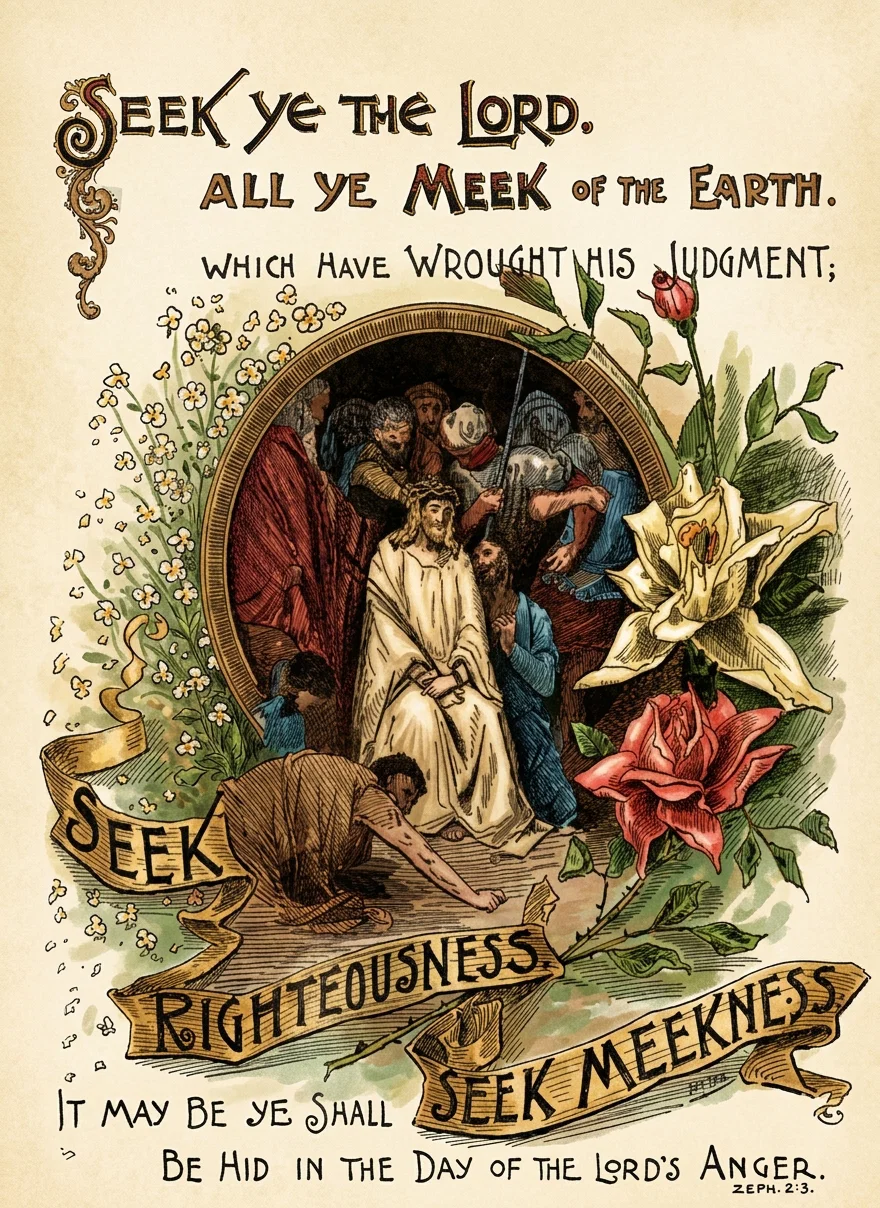
“The fruit of the Spirit is . . . meekness.” The original meaning of the Greek term translated meekness meant, among the heathen, mildness, gentleness, self-control, forbearance, equanimity. It was used almost wholly to express outward conduct of man or beast toward their fellows. In the Christian life it denotes an inward quality not natural to the man, but an outgrowth of the Spirit of God.

Based on Humility

True meekness in the Christian vocabulary is based on humility, and is especially manifest in the Christian’s relation to God. It indicates that the possessor has looked upon God, has seen his greatness, his majesty, and his infinite purity, and, in that ineffable light, has seen his own abject weakness, nothingness, and sinfulness. And yet meekness is not akin to hopelessness. It does not dwell with despair. It is a fruit from the same root which bears love, joy, peace, gentleness, goodness, faith, temperance. But it is humble, submissive.

Not Vacillating

But meekness does not mean a vacillating disposition. It does not mean a weak spirit, one ready to yield to the force of public opinion, or expediency. It does not mean timidity in doing right. It is consistent with the greatest strength of character. It is, therefore, a misuse of the word to refer to a weak, timid, vacillating man as meek. There is a reason why the meek man, the humble, the one who has looked upon God, should not fear. To him who has seen the Majesty of Heaven, what is man that he should be feared? To the humble Elijah of the desert, what were King Ahab and the prophets of Baal? To the meek and humble forerunner of Christ, what was Herod that the prophet should quail before him?

Meekness Is Teachableness

It seems to us there is no better scriptural definition implied than this: “The meek will He guide in judgment; and the meek will He teach His way.” Ps. 25:9. The meek, then, is one who is willing to be taught and guided of God. Knowing God, and knowing himself in the light of God, he also knows his need of divine counsel and direction. Like the prophet of old he will cry, “O Lord, I know that the way of man is not in himself; it is not in man that walketh to direct his steps” (Jer. 10:23); and realizing this he will plead with David: “Show me thy ways, O Lord; teach me thy paths. Lead me in thy truth, and teach me; for thou art the God of my salvation; on thee do I wait all the day.” Ps. 25:4, 5. But meekness will not seek to quench its thirst for knowledge at the broken cisterns of earth, at the stagnant pools of tradition, at the reservoirs of church creeds or councils, at the little buckets of men. It seeks for the knowledge of the Infinite. It would drink from the cool flowing waters of Life’s Lebanon. It would partake of the fruits of the heavenly Paradise. But none of these things are sought by meekness selfishly or exclusively; they are sought unselfishly, humbly, lovingly, sincerely, at the only right Source of seeking. Men may help on the way, but the wisdom given through men is a help to the object sought, but not the object itself.

The Mightiness of Meekness

A wonderful illustration of this lowly yet wondrously divine grace we have in Moses, “the man of God,” and in Him whom Moses typified. Altho the former was “learned in all the wisdom of the Egyptians,” a mighty warrior and statesman (Acts 7:22), he humbly enters the school of Christ for forty years, tending and leading and bearing in his arms under the stars of God the sheep and lambs of the flock. That was his higher university course, preparatory to his great life-work. None but a meek man would have taken it, and none but a meek man would have learned the precious lessons of the deserts of Midian. That finished, God sends him to Egypt to deliver his people. He is to go before earth’s mightiest monarch and proudest court and demand freedom for his enslaved people. But what is man to him who has met God? He bears his message. He is threatened, but quails not. By the power of Jehovah, manifest through his simple shepherd’s crook, he works a succession of the mightiest miracles the earth has ever known. He bears the murmuring, the complaining, the rebellion, the treachery of his kindred, with prayers for their forgiveness. While taught of God, he humbly takes suggestions from the godly shepherd-priest of Midian. When his friends feel that he is slighted because others are prophesying, he is wishing that all God’s people were prophets, and that the Lord would put his Spirit upon every one. When Israel have proved false to God, false to his leadership, he is pleading with an agony of soul among the human second only to that of Gethsemane, “Yet now, if Thou wilt forgive their sin;—and if not, blot me, I pray Thee, out of Thy book which Thou hast written.”It is not discouragement that wrings from his heart the plea, it is the man of God pleading, in sublimest self-effacement. What meekness, what strength of character! In the very meekness was the strength. Among the very mightiest of all God’s human agents and co-workers, and yet the Word tells us that “the man Moses was very meek, above all the men which were upon the face of the earth.” Num. 12:3. It was because of his meekness that God could talk with him face to face even as a man speaketh to his friend.
But the great example of the power of meekness is Jesus Christ the Son of God. Preëminently, altho the Son of the Highest, he was the meek and lowly of heart. Teachable?—Yes. Hear him: “I can of mine own self do nothing; as I hear, I judge; and my judgment is just; because I seek not mine own will, but the will of the Father which hath sent me.” “I do nothing of myself; but as my Father hath taught me, I speak these things.” He was made in all things like unto his brethren. He bore their weaknesses, their sins, their infirmities. In all points as they were tempted, he was tempted. Hence his prayers to God, his strong crying and tears, his complete emptying of self and laying hold of God. This was meekness; and because of this God gave him of his Spirit without measure, filled him with all the fulness of the Godhead, made all fulness to dwell in him, and through him wrought the salvation of the universe. But all the power was the might of meekness, might which only the meek can know.

“A CIVIL SABBATH LAW.”

Let California Be Free.

THE Marysville (Cal.) Democrat says:— The question of a Sunday law is being considered again in certain quarters and undoubtedly will not down until a reasonably just law has been placed upon the statute books. There are many people who do not approve of a sabbath law, yet there has not, to our knowledge, been a tenable argument presented against a law that will cause the people in general to show greater respect for the day. From birth to manhood we were taught by a good mother to not only respect the day, but to honor it as a blessing. In nearly all the older states there is in force a civil sabbath law, and under such provisions of restraint the day is observed by mercantile firms and nearly all branches of business.
There is a text in the paragraph above for many sermons, and we notice it because it presents the views of many; but we will perforce have to content ourselves with a few brief comments.
1. “Civil sabbath law.” There never was such a thing as pertaining to a religious day; there never will be such a thing. The Sunday law is in the interest of the religious day, pushed by the religious people. As a purely civil day, what preeminence has Sunday over Monday or Tuesday, or any of the other six working days? Logically every one will answer, “There is no difference.” If a civil Sunday law, then, why not a Monday law and Tuesday law, etc.? Of course this would make nonsense. Well, the civil Sunday law is just as much nonsense as a law regulating Monday observance would be.
2. “Reasonably just law.” There can be no such thing as a “reasonably just” sabbath law. If such a law is right and just and good, it should apply to all persons alike. To make exceptions condemns it at once as class legislation. California is the one great State of the Union that can boast that all classes are religiously equal before the law. It is a proud position and worthy of all honor. Orthodox Jews, Seventh-day Christians, First-day Christians, no-day Christians, unbelievers, and idolaters are equal before the law so far as the religion goes. Each can practise his own mode of worship (or he can refuse to worship) so long as he does not infringe the equal rights of his fellows as individuals. Every man can work every day if he chooses; and as a free man, he can refuse to work any day he chooses. The Orthodox Jew and Seventh-day Christian can observe the seventh day and follow legitimate employment on Sunday. The First-day keeper may observe Sunday as holily as he can and work on Saturday when it comes. There is absolute justice, and every man is left with God-given freedom to choose, unhampered by intolerant law.
Now for the State to pass a law that the Sunday-keeper should, after observing Sunday for conscience’ sake, observe Saturday for the sake of the conscience of somebody else, would be injustice. His resting on Sunday is to the Sunday-keeper a religious duty, and his right so to do is guaranteed by the Constitution of the State. As a matter of conscience he must observe it. Now for the State to demand that he shall observe another day, or refrain from labor on another day, out of deference to the wishes of his Seventh-day brethren, would be to deprive him of one-sixth of his income, or to place upon him a tax of sixteen and two-thirds per cent., which it did not place upon his Seventh-day neighbor. Propose such a law, pass such a law, and a cry of injustice, intolerance, and persecution would resound from every Sunday pulpit and paper and throat from Siskiyou to San Diego, and from the Sierras to the Pacific Ocean. Nay, more; from the Atlantic to the Pacific in inhabited America would be heard the cry. More than this, every true lover of liberty among no-day observers, and Seventh-day observers, including the SIGNS OF THE TIMES, would protest by tongue and pen against such injustice. The Sunday-keeper shall not be taxed to the extent of sixteen and two-thirds per cent. of his income to honor an institution held (rightly or wrongly) as sacred by his Seventh-day brother, whether the Sunday-keeper be 900 in 1,000 or 1 in 1,000,000. Such a law would be monstrously, unreasonably unjust.
And, reader, and you, neighbor Democrat, would it not be as unjust to turn the case around and tax the Seventh-day man sixteen and two-thirds per cent. for the sake of the conscience of the First-day man? Or has the Seventh-day-keeper and the no-day man no rights that Sunday people are bound to respect? Make the thing personal. Bring it home. Test it by the Golden Rule: “Whatsoever ye would that men should do to you, do ye even so to them.” To tax a man even to any extent on account of his religion, to demand by law that he shall pay deference, or reverence, to any religious dogma in which he does not believe, is unreasonably unjust, and degrades the dogma in his eyes rather than exalts it.
3. “Greater respect.” Outward deference may be compelled, but true respect never. Law may make weak men hypocrites, and free men haters of the thing deference to which is compelled by law, but to arouse respect and honor for such a thing never. There is but one law which will awaken, quicken, and demand respect and obedience concerning the Sabbath day, and that is the law of the Most High pressed home by the Spirit of God. But it is not at the behest of human legislation. Let the adherents of the various sabbaths appeal to this law, if it will apply; if not, let them choose the day to which it does apply. The very fact that men appeal to human law to support, uphold, or protect a religious institution, shows that they have no faith in God or his Gospel.
4. Men Not Institutions.—It is the duty of civil government to protect men, not institutions. Wherever religious institutions which do not apply equally to all persons are bolstered up by law, there is always injustice done somewhere. But laws equally applying to all persons protect the weak against the encroachments of the strong, and leave each religion to its own intrinsic worth and the voluntary zeal of its adherents. It permits the Chinese to worship his Joss, the Catholic to adore “the Host” and anathematize the heretic, the ultra Protestant to condemn Roman Catholicism as idolatry, and worship with simpler ceremony, the unbeliever to not worship at all or to worship self, the Sunday-keeper to keep Sunday, and the Sabbath-keeper to keep Sabbath—each in his own way, providing he does not interfere with the equal rights of his neighbor. Let the law be for the man, not the dogma or institution. For protecting man civil government is ordained of God. For protecting religious dogma or institution or creed under cover of sanitary regulation, civil law, or otherwise, civil government is perverted by the devil.
“He’s true to God who’s true to man; wherever wrong is done, To the humblest and the weakest, ’neath the all- beholding sun, That wrong is also done to us; and they are slaves most base Whose love of right is for themselves, and not for all their race.”
California is still the glad land of freedom. Religion is as free so far as State law is concerned as the wild waves of ocean that break on her rocks or wash the sands of her coast; as free as the breezes that blow over her snow-capped mountains, her fertile valleys, or her sun-kissed orange groves. Here Sundayis kept as well as in the creed-bound States of the Old World, or in those fettered with colonial laws in our east. Let California remain free!

Are You among the Meek Ones?

Are You among the Meek Ones? Great and precious are the promises to such. The meek will God guide and teach. “The meek shall inherit the earth.” Or are you proud and self-sufficient?—Certain failure is yours. Would you possess the precious grace of meekness? Ask God for his Spirit, which he is waiting to give (Luke 11:9–13); and that Spirit will bear meekness in your life. Jesus, the mighty One, says: “Come unto me, all ye that labor and are heavy laden, and I will give you rest. Take my yoke upon you, and learn of me; for I am meek and lowly in heart; and ye shall find rest unto your souls.” “Seek meekness.”

Question Corner

“Enquire, and make search, and ask diligently.”
Let it be understood; it is an invariable rule. We answer no unsigned communications. We do not ask the name for publication; but we wish the privilege of replying by letter if deemed necessary. If the name of the writer is not signed to the letter accompanying the question, the question finds its way to the wastebasket.

No. 481. Shall Never Die.

KINDLY explain John 11:26: “And whosoever liveth and believeth in me shall never die.” H. R. S.
The question was over the resurrection. Jesus said, “Thy brother shall rise again.” Martha answered, “I know that he shall rise again in the resurrection at the last day.” Jesus wished to make clear the great truth that the resurrection then, as well as at the last day, rested in him. “I am the resurrection, and the life; he that believeth in me [who has placed his faith in me], tho he were dead [even tho he lie in the grave as does Lazarus], yet shall he live; and whosoever liveth and believeth in me [in that day when the dead are raised] shall never die.” Those who sleep in Jesus will be raised from the dead as was Lazarus; and those then living and believing in Jesus shall never die.

No. 482. The Son of Man.

WHY is Christ called the “Son of man,” as in Matt. 18:11, when he was the Son of God? J. M.
Because he was the Son of man, “born of a woman,” Gal. 4:4, R. V.; Matt. 1:25. While he was truly the Son of God, he became truly the Son of man, “in all things” “made like unto his brethren, that he might be a merciful and faithful high priest.” See Heb. 2:14–17.

No. 483. “Absent from the Body,” etc.

WILL you kindly explain 2 Cor. 5:8 and Phil. 1:23. They were used in Sunday school to prove that one went to heaven at death. J. M.
These two scriptures may be explained together.
Notice particularly that 2 Cor. 5:1–9 presents three states or conditions. (1) “Earthly house of this tabernacle” (verses 1 and 4), “in this” (verse 2), “mortality” (verse 4), “at home in the body” (verse 6). These expressions represent this present mortal life, in which the apostle groaned and was burdened. (2) The middle state, “found naked” (verse 3), “unclothed” (verse 4). This has reference to death. (3) The third state, “building of God,” “house not made with hands” (verse 1), “clothed upon,” etc., “swallowed up of life” (verse 4), “present with the Lord” (verse 8). This represents the future immortal state, when the saints will be with Christ. The same three conditions are set forth in Phil. 1:21–23 as “to live” here, “to die,” “and to be with Christ.” The whole thing turns on when the saints are to be with Christ, and when mortality is swallowed up of life. This is clearly declared to be when Christ comes, at the last trump (Matt. 16:27; 1 Cor. 15:51–54); then it is that man shall be rewarded, and the mortal shall put on immortality. It was that which Paul longed for. It was not to live here, altho that would further the cause of Christ; it was not to die that he wished, altho it might bring gain to Christ; he did not wish to be unclothed; but he did wish to be translated, to go where Jesus was. Of living or dying he did not know which to choose; but the third thing—to be with Christ by translation—was far better. See also Rom. 8:23, where he refers to the same groaning, and tells of his desire, “the adoption, to wit, the redemption of our body.” It was Christ’s glorious coming, the resurrection out from among the dead, and the dwelling with Christ in an immortal state, that were the crowning joys of Paul’s wish and labor. There is nothing in the scriptures in question which suggest an immortal soul or conscious state of the dead.

No. 484. Cain’s Wife.

WHERE did Cain get his wife? A. H.
She was doubtless a daughter of Adam and Eve. Many years—even hundreds—may be covered by Gen. 4:16, 17. When the Sacred History begins the account of Cain, it carries it to the end, or till his posterity take his place. Before Cain possessed a wife, sons and daughters were born unto Adam. See Gen. 5:4. All such questions would be easily answered did we know a few more facts; but God’s Word is not given to minister to mere curiosity. What pertains to our salvation, God has clearly declared. If there are some statements of Sacred History which do not seem to accord with facts, it is, in all probability, because of our partial understanding of the subject. Knowing the will and way of the Lord, we can afford to wait his time to solve the problems of mere curiosity.

No. 485. Pot of Manna and Aaron’s Rod.

WERE the golden pot and Aaron’s rod put in the ark with the testimony or tables of the covenant? See Heb. 9:4. 1 Kings 8:9 says there was nothing in the ark save the two tables of stone. A. A.
The two passages may have reference to different times: Heb. 9:4 to the time when the sanctuary was builded, and 1 Kings 8:9 to a later period, when the pot of manna and the rod had been removed. Or the word “wherein” in Heb. 9:4 may refer to the “Holiest of all” of verse 3.

No. 486. Socialists.

WHAT do you think of the Socialist organization, whose headquarters are at Ruskin, Tennessee, and should Adventists join them? A. D.
We know nothing about the Socialist organization referred to; it may be a worthy worldly association or otherwise. But we do know that the church of Jesus Christ is large enough, its gifts ample, the scope of its mission sufficiently extensive, and its platform broad and strong enough to use every power for good which every Christian possesses. Having all this, what do we want more? What organization could be better than the church, “which is His body, the fulness of Him that filleth all in all”? However good, then, any earthly organization may be, why should Adventists, if they are Christians, wish to join them? Lead the world to Christ.

No. 487. Beauty and Bands.

PLEASE explain Zech. 11:10, and as much of the chapter as you have time and space. J. M.
The chapter seems to be a prophecy of Jerusalem and the Jews as God’s people down to the Crucifixion. The first part of the chapter shows God’s mercy in restoring his people who had been oppressed by the powers of earth, Babylon, Medo-Persia, Grecia, and other powers. By his staff Beauty, or Grace, he would again show them favor, and gather them and forgive them, and by Bands he would bind them together again. “Three shepherds,” the powers that rose against them, he overthrew. And yet God’s people turned against him, notwithstanding his goodness. They even betrayed the One who came to save them. Verses 12, 13. God, therefore, broke his covenant with them, because they would not hear him, and he refused to bind them together; for they would not choose his way.

“I SAID, YE ARE GODS.”

When the Jews accused the Saviour of blasphemy because he said he was the Son of God, he silenced them with these words: “Is it not written in your law, I said, Ye are gods? If he called them gods, unto whom the Word of God came, and the Scripture can not be broken; say ye of him, whom the Father hath sanctified, and sent into the world, Thou blasphemest; because I said, I am the Son of God?” John 10: 34-36.
There was a wealth of meaning in these words far beyond the comprehension of the unbelieving Jews; and perhaps even now, under the full light of the glorious Gospel of Christ, it is impossible for finite beings to fully fathom the depth of divine grace expressed in the scripture quoted; but to suggest some thoughts in this connection which have been helpful to the writer, and which may be encouraging also to others, is the purpose of this article.
It will be observed in reading Ps. 82: 6, from which our Saviour quotes, that the expression, “Ye are gods,” is applied, not to all men, indiscriminately, but to those who are “children of the Most High.” It is true that in one sense all men are children of God; all are his children by creation; but, as will appear presently, the reference in this place is to those who are “children of the Most High,” not simply by original creation, but by adoption, and by the new birth, or by re-creation.
The names which God gives are invariably descriptive of character, and are given because they are indicative of the moral quality of those to whom they are given. Therefore when God calls men gods, it is because they have been made partakers of his own moral nature. That the scripture under consideration has reference to this fact, may be seen very clearly in the light of even a few of the many texts bearing upon the subject.
In Rom. 8: 15-17 the apostle says: “Ye have not received the spirit of bondage again to fear; but ye have received the Spirit of adoption, whereby we cry, Abba, Father. The Spirit itself beareth witness with our spirit, that we are the children of God; and if children, then heirs; heirs of God, and joint-heirs with Christ.” To be a “joint-heir” is to inherit jointly, that is, on equal terms with another. It follows that whatever Christ inherits from the Father, the adopted children of God likewise inherit with him. It is impossible therefore to escape the conclusion that a part of this joint inheritance is the “more excellent name,” mentioned in Heb. 1: 4.
Even among men, an adopted child takes the family name; only the natural children, however,are partakers of the father's nature. But when God adopts, he brings to the new birth, so that those who receive the Spirit of adoption, receive with that Spirit, or by that Spirit, rather, “power to become the sons of God;” are “born again” (John 3: 3-8), and thus by inheritance are made “partakers of the divine nature” (2 Peter 1: 4); which nature, wherever found, is properly described by the Father's name. “This is the Lord's doing, and is marvelous in our eyes.”
The new birth is not merely a change of sentiment, a change of mind wrought by evidence; it is the beginning of a new life, the death of the carnal mind, the reception of the spiritual mind. And this change is the work of the divine Spirit: “That which is born of the flesh is flesh; and that which is born of the Spirit is Spirit.” “God, who commanded the light to shine out of darkness, hath shined in our hearts,” says the apostle, “to give the light of the knowledge of the glory of God in the face of Jesus Christ.” 2 Cor. 4: 6. “And this treasure we have in earthen vessels, that the excellency of the power may be of God, and not of us.”
The Saviour himself did not attempt to explain the new birth, further than to say that it was the work of the divine Spirit; nor can it be explained by any man. But this much we know, that it is wrought by the same power that in the beginning spoke the worlds into existence, that out of darkness made light, and that to-day holds in their places the circling spheres that age after age revolve around the myriad suns with which the Creator has adorned the universe. Man is as helpless to change his own nature as is the leopard his spots or the Ethiopian his skin, but the same Word that in the beginning said, “Let there be light,” and light was, says the same to-day in every heart open to the divine influence. “Everything depends on the right action of the will. The power of choice God has given to men; it is theirs to exercise.” The sinner can not change his heart; he can not of himself give to God its affections; but he can will to serve him. And the will-power, the citadel of the soul, once surrendered to God, he works in the heart of the penitent “both to will and to do of his good-pleasure.” The divine injunction is, “Let this mind be in you which was also in Christ Jesus;” and, like every other command of God, there is in this one an implied promise of strength to obey. The poor man with the withered hand had no ability to move it, but, grasping by faith the power there was in the divine command, “Stretch forth thy hand,” he stretched it forth, “and it was restored whole as the other.”
To every soul the Saviour says, “Behold, I stand at the door, and knock; if any man hear my voice, and open the door, I will come in to him, and will sup with him, and he with me;” and partaking of the rich viands which he provides, we “drink into the same Spirit,” the “Spirit of adoption,” and are thus “made partakers of the divine nature,” Christ is “formed within” (Gal. 2: 20), and the experience of the soul is aptly described by the words of the apostle: “I am crucified with Christ; nevertheless I live; yet not I, but Christ liveth in me.” Gal. 2: 20. He who has Christ has all things. Says the apostle, “Ye are complete in him,” “for in him dwelleth all the fulness of the God-head bodily.” Col. 2: 9, 10. “O the depth of the riches both of the wisdom and knowledge of God! how unsearchable are his judgments, and his ways past finding out!”
C. P. BOLLMAN.

Live by Faith

Live by Faith.—That man who will triumph with Christ in these days of peril, will be he who breaks through all feelings of apathy and indifference, and seeks God by living faith, because he needs God. Thousands will wait for some special feeling, some wave of enthusiasm, the testimony or influence of some great man, some outward manifestation of power, no one of which may ever come to them, and if it did might not be perceived. Thus waiting they will be swept into the great flood of sin and infidelity. Faith is not feeling. “Faith is ours to exercise, but feeling is God’s to give.” Faith will cleave to God whether feeling is present or not. Have faith in God; “have it to thyself before God.” His coming will vindicate it all.

GOLDEN DAYS.

O THESE are precious golden days for work, They are with rapid footsteps going by! This mortal life at best is only short, Soon comes the end, when man lies down to rest.
Then work while light is shining, work to-day; To-morrow’s shadowed in uncertainty. When He shall ask, what will your answer be, “Hast thou improved those priceless hours I gave Thee best to please My just and holy name?”
’Tis truly said: Our life a service is; But oft they better serve who only wait,— Yes, wait until the Master calls for some To do a greater work, and be content With service small if so He wills for thee.
Athens, Vt. A. R. WILCOX.

THOUGHTS FROM THE SEPTUAGINT.

Some Suggestive Readings.

A Spiritual Diagnosis.

In Deut. 8:2 is found this instruction: “And thou shalt remember all the way which the Lord thy God led thee these forty years in the wilderness, to humble thee, and to prove thee, to know what was in thine heart, whether thou wouldest keep his commandments, or no.” In the LXX. the phrase “to know what was in thine heart,” is rendered “to diagnose (διαγνωσθῇ) what was in thine heart.”
We are familiar with the terms “diagnose” and “diagnosis,” used in a medical sense. The physician examines the patient and then decides what is the trouble with him. If the malady be a difficulty in the heart, he tells the nature and seriousness of that difficulty. Startling revelations of physical weakness are thus oftentimes made known to the surprised and saddened invalid and his friends. The spiritual maladies of man are fully as insidious and surprising as are those of the body. But no one except the skilful Physician of the soul can give a correct diagnosis of the case. In describing in general terms our condition he has said: “The whole head is sick, and the whole heart faint. From the sole of the foot even unto the head there is no soundness in it; but wounds, and bruises, and putrifying sores; they have not been closed, neither bound up, neither mollified with ointment.” Isa. 1:5, 6. “The heart is deceitful above all things, and desperately wicked [“sick,” R. V.]; who can know it?” Jer. 17:9.
To get at the particular difficulties, specifically, in each individual case, it is necessary to seek unto Him who knows the hearts of all men, to read and study His Word and the testimonies of His Spirit; also, as in the case of Israel of old, temptations and trials will be necessary in order to a complete diagnosis of our spiritual condition.

Rebellious against the Lord.

The words of Moses are given in Deut. 9:24 as follows: “Ye have been rebellious against the Lord from the day that I knew you.” The rendering of the Greek version is: “Ye have been disobedient toward the Lord from the day in which he became known unto you.” While either of these renderings would be correct, yet apparently the latter one is the more forcible and impressive. It was not the connection of Moses with that people that ought to make the strongest impression upon their minds, but their connection with God. The fact is that Moses was one of the Israelitish people himself, and had known something of their history from childhood. The Lord had always known all about them, of course. But there was a time when the Lord became known unto the house of Israel; that was particularly the time when he descended upon Mount Sinai and spoke the Ten Commandments in grandeur and solemnity, and the people heard his voice, and he was thus made known unto them. Immediately after that they rebelled against him and made the golden calf and worshiped it, and their subsequent history was marked by acts of disobedience. Their responsibility in this matter was much greater after the Lord had made himself known to them than it was previous to that grand display before their eyes. This seems to be the force of the reproof of Moses in the text in question.

The Year of Forgiveness.

“At the end of every seven years thou shalt make a forgiveness.” That is, the word here rendered release is the same as that used by our Lord in such instructions as that found in Matt. 6:12, there rendered forgive, “And forgive us our debts, as we forgive our debtors;” or Matt. 9:6, “The Son of man hath power on earth to forgive sins,” etc. The word is also rendered “remission” in such passages as Matt. 26:28; Mark 1:4; Acts 2:38, “remission” and “forgiveness” being translated from the same word. “And that repentance and remission [or forgiveness] of sins should be preached in his name among all nations.” Luke 24:47. The same fact is true in reference to the word used in the Greek of Deut. 31:10. We there read again of the year of forgiveness: “At the end of every seven years, in the solemnity of the year of forgiveness, in the feast of tabernacles,” etc. What a grand occasion that must have been—the year of forgiveness! Well could the devout Israelite pray the prayer taught by the Master so many centuries later: “And forgive us our debts, as we forgive our debtors.” Is there not beauty in the way in which the heavenly Teacher states it? Had the pious Hebrew left the exaction of every debt owed him by his fellow-citizen? Then could he expect God would forgive him, but not otherwise. Another thing that made that season particularly interesting was the fact that it occurred at the time of the Feast of Tabernacles, which feast was only a few days, less than a week, after the great day of atonement, when all were to be so deeply interested in having their own sins forgiven. Ah, the sweet “solemnity of the year of forgiveness”! What a good time to study the law, when knowing the forgiveness of the Gospel! See Deut. 31:10–13. F. D. STARR.

“CHRISTIAN CITIZENSHIP DAY.”

The proposition to make Washington’s birthday (February 22) do duty as “Christian Citizenship day” is being agitated by certain enthusiasts of the Christian Citizenship movement. This movement has for its object the enforcement of nominal Christianity by civil law, the placing in office of men who believe in compelling the minority to at least outwardly adhere to the religious tenets of the majority—that is, after the Christian Citizenship advocates shall have become a recognized majority. Of course they would not want such a doctrine enforced while they are in the minority; that would not be Christian citizenship of the order that is now being popularly agitated as a religio-political measure.
But one of the most illogical features of this movement is the attempt to drag the name of George Washington into it, as tho that great patriot ever countenanced in any way such an unchristian, un-American idea. Washington emphatically avowed the doctrine that “every man who conducts himself as a good citizen is accountable alone to God for his religious faith, and should be protected in worshiping God according to the dictates of his own conscience.” Again, Washington, as President of the United States, signed a treaty with Tripoli, in which was the plain declaration that “the government of the United States is not in any sense founded upon the Christian religion.”
The claim that this is a “Christian nation” is a radical departure from the design of its illustrious founders; yet under no government has Christianity found a more congenial atmosphere, until within the past decade efforts have been made to limit its free exercise by religious legislation. And consonant to the attempt to change the original character of the governmentto that of a religious autocracy, is this proposition to force upon the record of George Washington the imputation that he stood for any such scheme as the present Christian Citizenship movement. It is as far from Washington as the east is from the west. Every patriot should protest against this aspersion of the name and political character of Washington. Every Christian should protest against this misrepresentation of practical Christianity, this going back to the bondage of Church and State union, from which Washington and his compatriots set the country free.
“But now, after that ye have known God, or rather are known of God, how turn ye again to the weak and beggarly elements, whereunto ye desire again to be in bondage? Ye observe days, and months, and times, and years. I am afraid of you, lest I have bestowed upon you labor in vain.” Gal. 4:9-11.
W. N. G.
Continue reading: THE OBEDIENT AND THE DISOBEDIENT