Signs of the Times, Vol. 26, No. 40.

A ROYAL PRIESTHOOD

Signs of the Times

Oct 3, 1900

Pacific Press Publishing Company · Oakland, California · Oct 3, 1900

A ROYAL PRIESTHOOD.
BEGINNING with Adam, the head of each family was its priest. And the plan was continued till the flood, and in the family of Noah after the flood.
THE order and the plan were ordained of God, a part of the great symbolic system of sacrifices and offerings for sin, pointing down the ages to the Redeemer to come. Afterward, when one family became a nation, and God led them out of bondage, the order of the priesthood was transferred to one tribe, the priests for the whole people.
IN the glory of his first estate, with the unclouded and majestic intellect of a man made in the image of God, Adam's keenest joy and most absorbing theme were contemplation of his Creator and His wondrous works. God was the All-in-all. This was religion in its first elements. It was an integral part of man's nature. And sin did not efface this principle of worship, but corrupted it, and perverted it, and distorted the system of sacrifices for sin, and changed their signification. It was worship still, but of what a nature!
ALWAYS sin and evil systems have been patterned after the true and the good. This is Satan's plan to deceive. And invariably, also, they are overdone, departing from the simplicity and completeness of the original, and becoming ponderous and burdensome. And so the services of the worship of all nations had and have their forms and ceremonies and sacrifices, and in most instances a vast army of priests and attendants. Here, using as instruments those set apart to conserve the highest interests of mankind, it would seem that sin has wrought out its most skilful product, the refined essence of evil. "Like priest, like people," is a phrase of vast import, when thoughtfully considered.
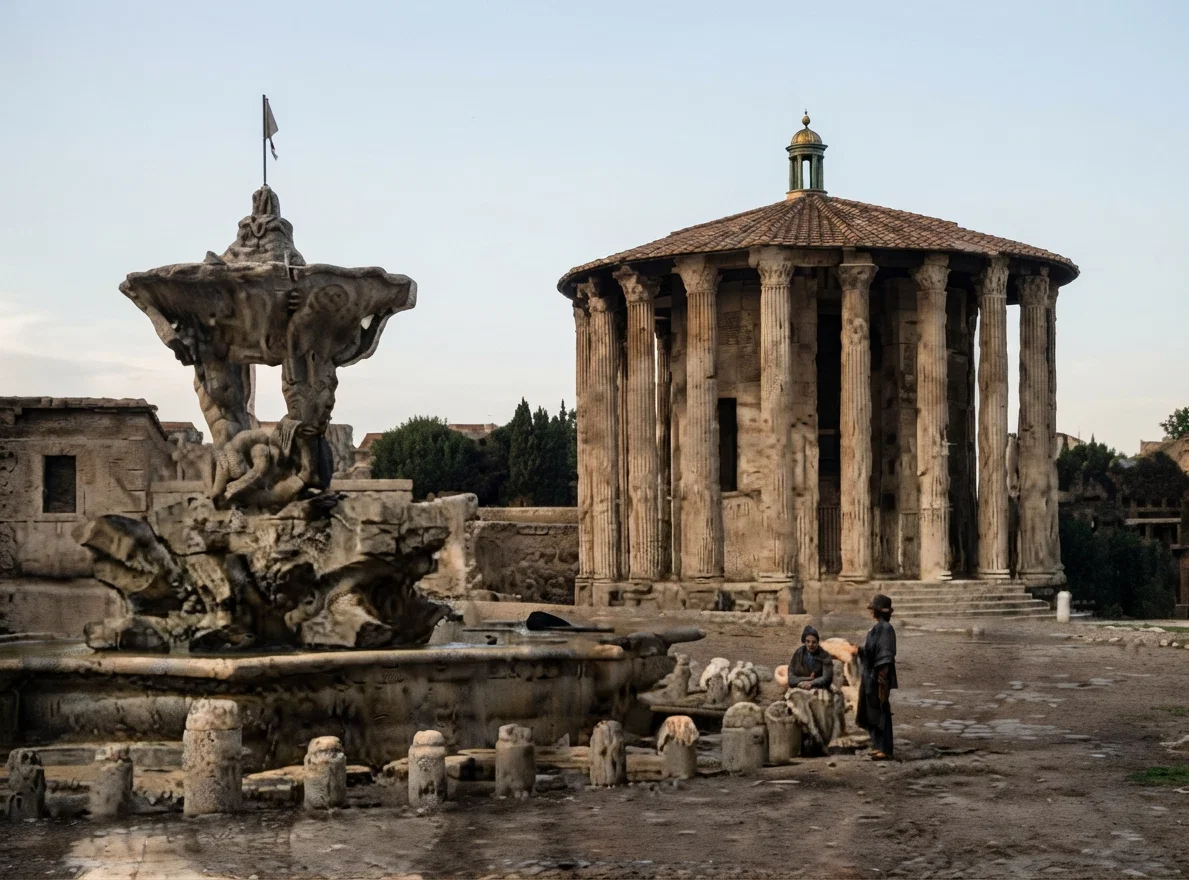
Temple or shrine of Vesta, close by the Forum, Rome, with fountain of Egeria (probably). According to tradition, the original shrine was built by the Emperor Numa (715-673 B.C.). It was four times destroyed before being rebuilt the last time by Severus. Vesta was the Roman goddess of the hearth,—the Greek Hestia,—and identified in various ways with Venus, with the Phoenician Astarte and the Egyptian Athor,—"queen of heaven,"—and the Babylonian Rhea,—woman deified,—the "mother of knowledge." To guard the sacred fire (symbolizing the life of the Roman people), and keep it continually burning, and to have charge of the shrine and its services, four virgins—afterward six—were chosen by the emperor. These priestesses were called vestal virgins, and their term of service was thirty years each—ten years of learning, ten service, ten teaching. The fires of the shrine were finally extinguished, the revenues—which were enormous—confiscated, and the service (almost dead) brought to an end by Gratian, emperor from A.D. 359-383.
BUT there came a time when the offering of the blood of bulls and goats ceased as possessing any efficacy. Type met antitype; an offering for sin was made once for all, and Jesus, the High Priest forever after a better and eternal order, entered into the heavens, there to appear before the throne for us. Through the centuries and the ages, in the darkness of sin and chaos, a light had been shining, and faithful ones all along had looked up, and had seen the light, and followed it. God was choosing a people for Himself, and numbering them as members, servants, children, of an everlasting kingdom, spiritual now, spiritual forever, but due in the end of the world of sin, in a gloriously real, physical sense, also.
THE center of all was Christ, the crucified and the glorified. And He is still the center, and is to be forever. And He is our Brother. He was not ashamed to call us His brethren,—the human race. Into His kingdom He calls us to come, with an appealing cry that echoes over all time, and, by the grace of God, the fellowship of flesh and blood is made infinitely closer and more sacred in each sinner who accepts that grace, even the invisible but enduring spiritual brotherhood of the sons of God.
HE is the Head of the better priesthood; and who are His associates?—His brethren of the everlasting kingdom. Wonderful, overwhelming thought! But it is even so. "But ye are a chosen generation, a royal priesthood, an holy nation, a peculiar people." 1 Peter 2:9. The whole "nation," the whole "chosen generation," is a royal priesthood, called and chosen for holy service in the work of God,—"holy brethren, partakers of the heavenly calling." Heb. 3:1. They are not called out of the world, but, while remaining in it, are not to be of the world.
BUT what is the office work of each member of this royal priesthood?—"That ye should show forth the praises [virtues] of Him who hath called you out of darkness into His marvelous light." Sacred and glorious service! Therein the faithful on earth are co-laborers with their High Priest in heaven and with the "multitude of captives" led on high for service in the heavenly sanctuary. Matt. 27:52, 53; Eph. 4:8; Rev. 5. Not to the "ministry" alone is committed the great work of God on earth. While the church militant is organized after divine instruction for the facilitation of various lines, yet the exalted privilege of the spiritual priesthood, with its solemn responsibilities, restsupon each member, for this is what membership, fellowship, brotherhood, in the eternal kingdom means.
IT is not a matter of passing moment. In the midst of worldly attractions and ambitions, in the presence of worldly and man-made systems and humanly-devised priesthoods, the God of heaven has a kingdom of right royal priests, whose faithful service here will finally be transmuted, translated, into the eternal service of the temple above. For in some form, subserving some eternal purpose, the great temple on Mount Zion in the earth made new will endure in endless ages. And, indeed, God's people, wherever they may be, however then the service may be arranged, will be one vast spiritual temple, in and through and by means of which will be unfolded and revealed to the universe the measureless depths of the plan of salvation. "Him that overcometh will I make a pillar in the temple of my God, and he shall go no more out." Rev. 3:12.
"AND he shall go no more out." Amen. And it may be so even now. Blessed promise! Let it be reality. "But know that the Lord hath set apart him that is godly for Himself." Ps. 4:3. This is the requirement, truly, for setting apart for this holy service. With man it is not possible, but with God all things are possible. And yet without man's will it is impossible. The willing is yours, sinner, professor, saint. The power for transformation is the Lord Almighty's, and it is not far from each one of us. It is to be had for the sincere asking. Ask, and receive.

THE BREAD OF LIFE.

THE Bible contains the science of salvation. "All Scripture is given by inspiration of God, and is profitable for doctrine, for reproof, for correction, for instruction in righteousness; that the man of God may be perfect, thoroughly furnished unto all good works."
He who breathed into man the breath of life and made him a living soul, has breathed into the Scriptures a vital, life-giving power. "The Word of God is quick, and powerful, and sharper than any two-edged sword, piercing even to the dividing asunder of soul and spirit, and of the joints and marrow, and is a discerner of the thoughts and intents of the heart. Neither is there any creature that is not manifest in His sight; but all things are naked and opened unto the eyes of Him with whom we have to do."
We need to study the Word of God far more than we do. Thus we shall see ourselves as we are. Let us take God's holy Word as our counselor. Let us study it with a heart open to receive its instruction.
Those who study the Bible with a true purpose will become wise unto salvation. Christ speaks of this as eating the flesh and drinking the blood of the Son of man. "I am the living bread which came down from heaven," he said; "if any man eat of this bread, he shall live forever; and the bread that I will give is My flesh, which I will give for the life of the world."
"The Jews therefore strove among themselves, saying, How can this Man give us His flesh to eat? Then Jesus said unto them, Verily, verily, I say unto you, Except ye eat the flesh of the Son of man, and drink His blood, ye have no life in you. Whoso eateth My flesh, and drinketh My blood, hath eternal life; and I will raise him up at the last day. For My flesh is meat indeed, and My blood is drink indeed. . . . It is the Spirit that quickeneth; the flesh profiteth nothing; the words that I speak unto you, they are spirit, and they are life."
By offering Himself on the cross of Calvary, Christ gave His flesh and blood for the salvation of the world. Those who believe in Him as a personal Saviour, those who work His works, receiving His words and practising His principles, are eating the bread of life. Christ's lessons are their food and drink. They constantly seek to do Christ's will. Under all circumstances they strive to do as He would do. They look to Him who is the Author and Finisher of their faith, inquiring earnestly, What would Jesus do? What words would He speak? If I speak words that He would not speak were He in my place, I am not abiding in Him, or He in me.
Christ's Word is the bread of life and the water of salvation. Trust in its fulness comes to us through constant communion with God. By it we gain spiritual strength. Christ supplies the life-blood of the heart, and the Holy Spirit gives nerve power. Begotten again unto a lively hope, imbued with the quickening power of a new nature, the soul is enabled to rise higher and still higher. Paul's prayer for the Ephesians was "that He would grant you, according to the riches of His glory, to be strengthened with might by His Spirit in the inner man; that Christ may dwell in your hearts by faith; that ye, being rooted and grounded in love, may be able to comprehend with all saints what is the breadth, and length, and depth, and height; and to know the love of Christ, which passeth knowledge, that ye might be filled with all the fulness of God."
As our natural life is sustained by physical food, so our spiritual life is to be sustained by spiritual food, even the words of Christ. The Gospel, believed and lived, means eternal life. It gives spiritual health and vigor. It enables us to show in the daily life the fruits of the Spirit.
The disciples of Christ are to bring the perfection of His character into their characters. He has given them His Word as their spiritual food. As they eat His Word, they will grow like Him, manifesting unselfishness, integrity, kindness, and love. In all they do, Christ-likeness will be revealed. Thus they will show that they are eating the bread of heaven and drawing living water from the wells of salvation.
In Christ, "God was manifest in the flesh, justified in the Spirit, seen of angels, preached unto the Gentiles, believed on in the world, received up into glory." These words are not merely to be read as a lesson. They are to be understood, believed, and lived. They will give us spiritual life. Christ's teachings are to be brought into the daily experience. We have redemption through His blood, even the forgiveness of our sins.
It is by the Word of life that the Christian is to live. From it we are to receive a continually increasing knowledge of truth. From it we are to gain light, purity, goodness, and a faith which works by love and purifies the soul. It is given to us that we may be cleansed from all defilement, and presented faultless before the throne of divine glory. Wondrous victory, gained by Christ in our behalf!
Oneness with Christ depends on the renewing of the mind by the Holy Spirit. Thus we are strengthened to walk in newness of life, receiving from Christ forgiveness for our sins. He who has this experience is a cleansed vessel, sanctified and meet for the Master's use. Self is dead. His words are, "I live, yet not I, but Christ liveth in me." There is a daily reception of the Holy Spirit, and this brings eternal life to the soul.
Those who eat the flesh and drink the blood of the Son of God have a vital, saving union with Him. They are partakers of the divine nature. Christ dwells in the human tenement. True Christians are one with Christ as Christ is one with God. The quickening of the Holy Spirit brings life to the soul. When this is believed, understood, and known by experience, the character of God is revealed in the human agent. Christ abides in the heart.
All disunion, all selfish thoughts, words, and actions, are the fruit of the working of an unholy spirit upon the mind. Under the influence of this spirit, words are spoken which do not reveal the Saviour. Christ is not formed within, the hope of glory. Those who live thus are sinners, tho they may be counted as saints. They are without faith. They do not practise the principles of Christ. Many who claim to be Christians commit grievous sins because they do not eat the bread that came down from heaven.
Those who receive Christ are meek and lowly. Christ opens within their hearts a fountain of living water, which springs up unto eternal life, refreshing the souls of others. The lives of those who eat the bread of life are purified by the grace of God. They claim and receive all that the giving of Christ's flesh and blood signifies. Vivified by the Holy Spirit, they are enabled to work the works of Christ.
The Word of God should be our counselor in all difficulties, our guide in all the relations of life. In the heart, the home, the place of business, the living oracles of God should reign supreme. When alone, when no human eye sees, no human ear hears, the truth is to be our companion. Ever the soul is to be subject to its control. Upon thought, word, and deed it is to stamp its divine impress. To those who obey, the Word of God is the tree of life. It possesses the elements necessary for the formation of a perfect character, and on the effect which its teaching produces in us depends our destiny for eternity.

A LESSON FROM MY FOUNTAIN PEN.

ONCE my religion was of the dipping kind. You know you motion downward, not upward, when you dip. So I would dip into this source of pleasure and into that little poorly-filled well of encouragement but to find the result sometimes excessive and often excessively meager, only to return again to find that the contents had seemed to be evaporated. At best, it was in the long run disappointing and tantalizing. Now I have learned a better way. It is this: Fill from the top. My fountain pen illustrated the way to me. When I had it well filled it just wrote away until I had scribbled all over the pages for many hours—and never a dip. The ink awaited as if on tiptoe every sway and jolt I might give—and just flowed. And when I placed my pen aside awaiting its next needed use, it remained always ready, so that at the very next sway or jolt it would flow. How many a life like mine formerly goes along dipping, dipping! Now, child of promise, let me tell you something—if you want to live a joyous, peaceful, Christly life, moment by moment, give up the dipping, and just in simple but absolute faith claim your Father's promise to fill you with the Holy Spirit, and your full life will flow through every channel of duty. No more dipping, surely, since "he that believeth on Me, as the scripture hath said, out of his inmost self shall flow rivers of living water."—Evangelist Henry Ostrom.

LESSONS FROM MATTHEW 24

"THE END OF THE WORLD."

"THE end of the world!" How often it is spoken of in the Bible! How often it is spoken of by the people,—so often that the expression is almost a proverb! And how few people really believe in any such thing!
Indeed, if it were left for the people of the world to say whether there should be any end of the world, it is certain that there never would be any, because no generation of people would ever have the world end in their own day. Besides, if it were left for the people to say whether there should be any end of the world, there never would be any; because of themselves the people of the world never can certainly know of the beginning of the world; and how could they know of any end?
Knowledge of either the beginning or the end of the world is altogether a matter of revelation. Therefore it is that only "through faith we understand that the worlds were formed." The worlds were formed, made, created. It was done by the word of God. "By the word of the Lord were the heavens made; and all the host of them by the breath of His mouth." "For He spake, and it was." Ps. 33:6, 9. And so entirely were the worlds formed by the word of God "that things which are seen were not made of things which do appear." Heb. 11:3.
The world having been created, it is only from the Creator that the purpose and course of its existence can be known, and whether there shall be any end. The world having been produced by the word of God, it is only by the word of God that it can ever be known that there shall be any end of the world. And when the word of God is spoken on that subject, as well as on any other, whatsoever in that word is said, that is final, and must be accepted, because that is the sole source of knowledge, and He is the sole authority qualified to speak on the subject.
What, then, says the Word as to the end of the world? Twice in the parable of the tares, Jesus used definitely the expression "the end of the world." "The field is the world; the good seed are the children of the kingdom; but the tares are the children of the wicked one; the enemy that sowed them is the devil; the harvest is the end of the world; and the reapers are the angels. As therefore the tares are gathered and burned in the fire; so shall it be in the end of this world. The Son of man shall send forth His angels, and they shall gather out of His kingdom all things that offend, and them which do iniquity; and shall cast them into a furnace of fire; there shall be wailing and gnashing of teeth. Then shall the righteous shine forth as the sun in the kingdom of their Father. Who hath ears to hear, let him hear." Matt. 13:38-43.
Again, in the parable of the net which was cast into the sea, and gathered of every kind, Jesus says: "When it was full, they drew to shore, and sat down, and gathered the good into vessels, but cast the bad away. So shall it be at the end of the world; the angels shall come forth, and sever the wicked from among the just, and shall cast them into the furnace of fire; there shall be wailing and gnashing of teeth." Verses 48-50.
Again, when Jesus commissioned His disciples to preach the Gospel, He said, "Lo, I am with you alway, even unto the end of the world." Matt. 28:20.
Therefore, so certainly as Jesus has spoken, there is to be the end of the world. This is so certain because "the world was made by Him" (John 1:10), and because it is at His coming that the end of the world is to be.
From the words already quoted it is evident that the end of the world comes in fire—in the judgment and destruction of wicked men. This is further shown in another place: "By the word of God the heavens were of old, and the earth standing out of the water and in the water; whereby [by the word of God] the world that then was, being overflowed with water, perished; but the heavens and the earth, which are now, by the same word are kept in store, reserved unto fire against the day of judgment and perdition of ungodly men." 2 Peter 3:5-7.
Thus by the word of God, which made the world, it is certain that the world will end; for "the day of the Lord will come as a thief in the night; in the which the heavens shall pass away with a great noise, and the elements shall melt with fervent heat, the earth also and the works that are therein shall be burned up." "The heavens being on fire shall be dissolved, and the elements shall melt with fervent heat." Verses 10, 12.
The heavens shall depart as a scroll when it is rolled together, and every mountain and island shall be moved out of their places. And the kings of the earth, and the great men, and the rich men, and the chief captains, and the mighty men, and every bondman, and every freeman will hide themselves in the dens and rocks of the mountains, and will cry to the mountains and rocks, "Fall on us, and hide us from the face of Him that sitteth on the throne, and from the wrath of the Lamb; for the great day of His wrath is come; and who shall be able to stand?" Rev. 6:14-17.
"In that day a man shall cast his idols of silver, and his idols of gold, which they made each one for himself to worship, to the moles and to the bats; to go into the clefts of the rocks, and into the tops of the ragged rocks, for fear of the Lord, and for the glory of His majesty, when He ariseth to shake terribly the earth." "The lofty looks of man shall be humbled, and the haughtiness of men shall be bowed down, and the Lord alone shall be exalted in that day." Isa. 2:20, 21, 11.
When Jesus spoke repeatedly of "the end of the world," He uttered no new saying; for all the prophets had spoken of it, and He was only speaking of a thing the mention of which was familiar to all who were acquainted with the Scriptures. Besides this, it is His own coming that brings the end of the world; and all the prophets from "Enoch also, the seventh from Adam, prophesied of these" two simultaneous things. Enoch had said, "Behold, the Lord cometh with ten thousands of His saints, to execute judgment upon all;" and all the other prophets had followed with the same announcement and warning, so that time and space would fail to recall the words of all.
That the second coming of the Lord and the end of the world are simultaneous events was so well understood by the disciples from the Scriptures, that when they asked Jesus concerning the end of the world, their question was, "What shall be the sign of Thy coming, and of the end of the world?" The sign of either is the sign of the other; the same sign betokens both.
From the day that sin entered the world, it has been settled by God, and has been spoken to men in the Word of God, that there shall be an end to this world. For God "hath appointed a day, in the which He will judge the world in righteousness by that Man whom He hath ordained; whereof He hath given assurance unto all men, in that He hath raised Him from the dead." Acts 17:31.
The resurrection of Christ itself is assurance to all men that there shall be an end of the world. For the resurrection of Christ is assurance to all men that they shall all be judged; and it is assurance of this, in that His resurrection is the assurance of the resurrection of every man, from "the first man Adam" unto the last man that shall ever live on the earth. And the resurrection of the dead is at the second coming of the Lord; and the second coming of the Lord brings the end of the world. "For as in Adam all die, even so in Christ shall all be made alive. But every man in his own order; Christ the first-fruits; afterward they that are Christ's at His coming. Then cometh the end." 1 Cor. 15:22-24.
Seeing, then, that there is certainly to be "the end of the world," and such an end, seeing "that all these things shall be dissolved; what manner of persons ought ye to be in all holy conversation and godliness, looking for and hasting unto the coming of the day of God?" 2 Peter 3:11, 12.
What, then, of the time? When shall these things be? What says the Creator and Preserver of the world as to the time when properly the end of the world shall be really looked for and expected? Next week we shall begin a series of six studies of the Lord's answer to the direct question as to the sign of His "coming and the end of the world."
Who can there be who should not study the Lord's answer to that question?
ALONZO T. JONES.

THE SABBATH ACCORDING TO THE COMMANDMENT.

"They returned, and prepared spices and ointments; and rested the Sabbath day according to the commandment." Luke 23:56.
THIS text plainly shows that the Sabbath of the New Testament is the seventh day of the week; for the commandment referred to says, "The seventh day is the Sabbath of the Lord thy God." While the foregoing is true, yet it must be remembered that at the time our Saviour was crucified there was no controversy as to which day of the week was the Sabbath, for the only day that was recognized as the Sabbath at that time was the seventh day. So there must have been another reason why inspiration says that those holy women kept the Sabbath "according to the commandment." There were two Sabbaths, viz., the Sabbath of the Lord and the traditional one; but they both came on the seventh day of the week. The Pharisees, in their unrighteous condition, could not keep the Sabbath "according to the commandment;" for the commandments are holy and spiritual; hence, to keep the Sabbath according to the commandment one must be holy and spiritual.
The Pharisees, being devoid of the Spirit and holiness, heaped upon the Sabbath, it is said, some four hundred nonsensical restrictions, thus making it by their practise a traditional sabbath.
Christ, however, did not cater to their traditions, but took occasion at every opportunity to sweep them away by His teaching and practise; for which He was persecuted by the Pharisees (see Mark 3:1-6; John 5:16), and finally crucified because of His loyalty to the Sabbath—Christ kept the Sabbath "according to the commandment." With this view of the text it can be seen why the Holy Spirit recorded the fact that those holy women kept the Sabbath "according to the commandment," for only the day previous their Lord had been crucified because He kept the Sabbath "according to the commandment."
The Pharisees, knowing full well that the Roman Government would not condemn Him on this account, sought false witnesses. Matt. 26:59, 60.
But, right in the face of this, they proceeded to make preparations to keep the Sabbath; and the next day they dared to keep the Sabbath "according to the commandment," for which their Lord, only a few hours previous, had been put to death.
May all seek holiness and the Holy Spirit, that they may as fearlessly observe the Sabbath as Christ and the holy women, in the face of opposition. K. C. RUSSELL.

OUR HEAVENLY FATHER.

No other privilege granted to mortals equals the privilege of calling God "our Father." Sometimes the privilege of calling some elderly persons father and mother is greatly esteemed by a homeless child, even tho nothing more is involved than the mere use of the dear names. But it is not simply that we may call Him our Father; He is our Father. God is a Father even to those who know Him not. He is such a Father as no earthly parent can be. But while God is more to His children than earthly parents can be to theirs, He is a model to parents. It is fitting that we should in this respect, as well as others, study the divine Pattern, and imitate it in our capacity as parents. What God is to His children, all earthly parents should seek to be to theirs.
The Fatherhood of God is beautifully illustrated in Psalm 139. The first four verses say: "O Lord, Thou hast searched me, and known me. Thou knowest my downsitting and mine uprising, Thou understandest my thought afar off. Thou compassest my path and my lying down, and art acquainted with all my ways. For there is not a word in my tongue, but, lo, O Lord, Thou knowest it altogether." From this text we learn how closely our heavenly Father scrutinizes our lives. He searches us and knows us thoroughly, far better than we know ourselves. He observes even when we sit or stand; He accompanies us on the street or about our work; He attends us when we sleep; we can go nowhere but God's watchful eye is upon us. He knows the thoughts—every thought that passes through our minds, and not a word we utter escapes His notice. This is true, not only of me, but of you, and of every living soul, old or young, of the 1,500,000,000 people living on the earth. No wonder the psalmist should exclaim, "Such knowledge is too wonderful for me; it is high, I can not attain unto it."
But here is a great example set before all parents. Too often fathers and mothers are almost wholly unacquainted with their children. They know them by name, and could pick them out of a crowd, perhaps. But as for searching their lives and hearts to discover their thoughts and purposes, they have never thought of doing so. The children are allowed to go where they please and come when they choose, only so they do not make themselves too troublesome. Most fathers would prefer an hour's snooze, and most mothers would choose an hour's gossip over the garden fence, or an hour with a book, to an hour spent in getting on intimate terms with the son or daughter.
Under these circumstances children are left to look up their associates elsewhere, and it is not often that Satan allows the opportunity to put one of his agents into the place, to slip by unimproved. It is a calamity to father, mother, and child when the first place in a child's heart is usurped by some one other than father and mother.
Some mothers with a large family excuse themselves from giving personal care to each child because there are so many of them. Let such think of God, with His fifteen hundred millions of children on this little world; and how many more worlds' full He has we know not. Parents have no right to bring into the world children for whom they can not care. Such children are bred for Satan, and we can not afford that. In a numerous family the mother should be provided with helps, so that she will not need to spend her whole time at drudgery. She should have time to teach and study the children, each one separately. In the end it will yield great returns for good if father and mother will faithfully perform their duties toward their children after the example of our heavenly Father.
G. C. TENNEY. Rockhampton, Queensland.

HOW THINGS WERE MADE.

THE so-called wise men of the earth have indulged in much vain philosophy concerning the way the earth, and all that it contains, was made. They have speculated and reasoned; and while their deductions in nowise agree, each is confident that his conclusions are correct.
The cause of all this jargon is stated in Matt. 22:29, in the rebuke administered by the Saviour to the self-righteous Pharisees. He said, “Ye do err, not knowing the Scriptures, nor the power of God.” These two things—the Scriptures and the power of God—were unknown to the professed Biblical expositors of those days. They therefore reasoned themselves into erroneous conclusions. “Lo, they have rejected the Word of the Lord; and what wisdom is in them?” Jer. 8:9.
So it is now. Error fills the earth. We are taught it from childhood. The Biblical account of creation is everywhere discredited. A few days ago I took up a text-book on physiology which was written for, and used in, the public schools. In the first line of the introduction I found the statement that “the human body is the abode of an immortal spirit” (an unscriptural statement); and in a note at the end of the first chapter I read this: “Fossil bones deposited in the ground long before the appearance of man upon the earth, have been found by Cuvier, exhibiting a considerable portion of cartilage.” How cruel thus to deceive the youth! Any one who knows anything about the Bible knows that prior to the sin of Adam there was no death in this earth, and that therefore there could not by any possibility be in the earth “long before” this time any fossilized bones, the remnants of animals once living.
And we are taught this same heresy by the “higher critics” of the land. We hear it from the pulpits. Scientists in their research claim to have discovered that the account the Lord gave Moses of the way the earth was created is not correct. The Mosaic account of creation is represented as unreasonable. Instead of things being created as stated in Genesis, we are told that they evolved through long geological ages of pollywogs and ancestral apes up to man, who governs and controls all things about him. To be sure they must have something with which to begin a “germ,” they call it; yet we are never favored with an explanation as to where this “germ” came from. The egg, they tell us, was before the hen, for all things came from a germ; but where the egg originated they are not quite certain. How their theory helps matters, the writer does not see. Personally, it is as easy for me to believe that a hen existed without an egg as that an egg came into existence without a hen. One would be as great a wonder as the other, and would take as much power to produce.
How much better than all this confused mixture of human speculations is the clear statement of Him who created all things for His glory! How much better to believe that we have a God, possessing all power, even to create worlds, and that having done so, He tells us how it was done! It is true we may not, with our finite minds, be able fully to comprehend creation, any more than we can fully understand Him who created. But “by faith we understand.” He did not need the lapse of ages for things to “evolve,” or “grow,” or “form,” but “He spake, and it was done; He commanded, and it stood fast.” Ps. 33:9. “By the word of the Lord were the heavens made; and all the host of them by the breath of His mouth.” Verse 6. The words He spoke were words of power, the thunderings of the almighty Architect. He spoke, and “the breath of His mouth” was formative. Worlds came into existence at His command; He simply spoke, and they were. What power is this! Reader, behold the earth at your feet, and then scan the heavens by the most powerful telescope, and realize that all things, from the most tiny grain of sand to the suns which glimmer on the furthest outposts of telescopic vision, have been made by the word of God. And this same word is preached by the Gospel unto us for our salvation. In these things we see the word of God working to create worlds and uphold them, while in the Gospel we see the same word working to save men and women from the terrible consequences of sin.
See how this is illustrated in the first chapter of Genesis. When God wanted a firmament, He said, “Let there be a firmament,” and we are told “it was so.” Likewise, on the third day, when vegetation was wanted, “God said, Let the earth bring forth grass, the herb yielding seed, and the fruit tree yielding fruit after his kind, whose seed is in itself, upon the earth; and it was so.” God spoke, and these things existed. His words have life, and have produced the life which is in all vegetation even to the present hour. It was the same when He peopled the sea with the finny tribes. He simply spoke, and they came into being. It was thus that all things came into being. How great a God is our God, who can speak with such mighty and such lasting results! Who spoke will be considered next.G. B. THOMPSON.

COMMON BLESSINGS.

I SAID in the mountain path, I say it on the mountain stairs,— The best things any mortal hath Are those that every mortal shares. The grass is softer to my tread For rest it yields unnumbered feet; Sweeter to me the wild rose red, Because it makes the whole world sweet. —Lucy Larcom

IN RETROSPECT.

If I were a girl again, I do not think I would be quite so set as I was on my own intellectual development. "You think so much of whether people are clever or not," as a friend of mine said to me, when I was a little over twenty, "and so little of anything else." Well, time has its revenges; and I can honestly say that I am inclined to think of "anything else" a good deal more than of cleverness in the men and women that I meet. I think far more of cheerfulness and honesty and truthfulness and amiability than I did in those days, and I would rather that some of my young friends were a little less concerned about being clever and much more concerned about being good.—Mary Lowe Dickinson.

HOW ALUMINUM IS PRODUCED.

ALUMINUM is the electrician's metal. It was discovered, or rather first isolated from the minerals of which it is a component, seventy-two years ago, by Wohler, in Germany. As lately as ten years ago it was so rare that it was justly classed as a precious metal. Then the electrical processes for its manufacture came into use, and to-day it is cheaper than any of the other metals excepting only iron, lead, and zinc. The method of its production is as simple as it is interesting. Two minerals, cryolite and bauxite, are used in the process, both of them compounds of aluminum. The former is found only in Greenland. Curiously enough it is green, a roughly crystalline substance which melts easily at a low red heat. It is, chemically speaking, aluminum fluoride. Bauxite, which is named after the town of Baux, in France, near which large beds of it have been found, is a white or yellowish clayey substance, consisting almost wholly of alumina, or aluminum oxide. In the modern process the cryolite is first melted in cast-iron tanks about the size and shape of an ordinary bath-tub, gas fires being used to supply the heat. Into the molten mass is stirred the bauxite, which has previously been cleaned and pulverized. At each end of each tank is an electrode consisting of a heavy carbon plate, and between these a very powerful current of electricity is passed. The current is sufficient to keep the contents of the tank heated to the melting point, and in a few minutes the metallic aluminum begins to collect at one of the carbon plates. The temperature of the bath being high enough to keep the metal melted, it collects in drops and flows to the bottom of the tank, from which it is drawn from time to time by removing a plug from a conveniently-situated hole. The metal is rapidly taking the place of brass and copper in many industries, notably as a conductor of electricity. For long-distance power-transmission lines it has many advantages. While it is more costly, pound for pound, than copper, yet it is so much lighter and comparatively so good a conductor of electricity, that a line built for it, for the same effective current-carrying power, weighs only half as much and costs ten per cent. less.—Selected.

Wanted

Wanted.—Agents everywhere for luminous name-plates, signs, numbers. Readable darkest nights. Profits large. Sample case loaned. Right Supp'y Co., Englewood, Ill.

"None to speak of"

"How many potatoes did you raise this year?" asks one farmer of another. 'None to speak of,' is the reply. He does not speak of his potato crop because he has none to speak of. And this is the reason why many do not speak of their experience; they have no experience to speak of.
"Reader, if you do not have an experience to speak of, get one. If you already have an experience worth speaking of, then speak of it. 'Ye are My witnesses saith the Lord.' Speak of it first in thine own house, and then to your neighbors. God wants to use your testimony to save them; your testimony will reach sinners when the Bible will not."
Such are a few sentences from the book by A. F. Ballenger entitled
Continue reading: Power for Witnessing