"FOR Thou, Lord, art good, and ready to forgive; and plenteous in mercy unto all them that call upon Thee." Ps. 86 : 5. The Lord is ever ready to forgive the penitent sinner. He is plenteous in mercy, and ever delights to dispense that mercy to those in need. What a pity that we are not all just as ready to repent when we have sinned. And when we have accepted the service of Christ our Saviour, how often we are found both unwilling and unready to do the Master's bidding.
Jesus kindly excused His disciples from watching with Him in the garden, by saying, "The spirit truly is ready, but the flesh is weak." But the trouble with these disciples was not wholly a physical one. On the same night Jesus said to Simon, "Behold, Satan hath desired to have you, that he may sift you as wheat. But I have prayed for thee, that thy faith fail not. And when thou art converted, strengthen thy brethren. And he said unto Him, Lord, I am ready to go with Thee, both into prison, and to death." Luke 22 : 31-33.
From this we learn that religious profession, or religious zeal are not enough to give a readiness to do and to suffer for Christ, but a thorough conversion. Peter verily purposed, in himself, to stand with Christ, suffer, or die. But in a few short hours, we hear him denying Christ with an oath. But when his conversion was perfected in Gethsemane, and he was endowed with the Holy Spirit on Pentecost, he was enabled to say, Come life of reproach, and suffering, or ignominious death, I am ready, as his life fully demonstrated.
Take the case of Paul, the great apostle to the Gentiles, as another illustrious example of a man who could ever say, I am ready for anything and everything that may come across my path as I follow my divine Master. To the saints in Rome he wrote, "So, as much as in me is, I am ready to preach the Gospel to you that are at Rome also." Rom. 1 : 15. And this he was enabled to do, altho a prisoner.
Again, when returning to Jerusalem from a successful missionary tour, he tarried several days at Cæsarea, with Philip the evangelist. While there he was told by a true prophet that bonds awaited him at Jerusalem. His companions, and brethren of that place, all besought him with tears not to go up to Jerusalem. Then Paul answered, "What mean ye to weep and to break mine heart? for I am ready not to be bound only, but also to die at Jerusalem for the name of the Lord Jesus." Acts 21 : 12, 13. This was not a vain and empty boast on the part of the apostle, for he well knew wherein his strength lay, which enabled him to say with perfect assurance, "I am ready," without regard to whether he knew, or did not know, what awaited him.
The last recorded instance of Paul's use of these significant words, "I am ready," an expression of entire consecration, is found in his last letter to his beloved Timothy. "I am now ready to be offered, and the time of my departure is at hand. I have fought a good fight, I have finished my course, I have kept the faith; henceforth there is laid up for me a crown of righteousness, which the Lord, the righteous Judge, shall give me at that day; and not to me only, but unto all them also that love His appearing." 2 Tim. 4 : 6-8.
"I am now ready to be offered." Thus he spoke deliberately, calmly, trustingly, yea, more hopefully, in plain view of immediate death at the hands of his enemies. He had no bitter or cruel things to say about his persecutors, but with strong faith, and bright hope, he looked above and beyond this life of conflict, to the crowning day. In that day, when Jesus comes in glory, with all the overcomers; he would receive a crown of glory, righteousness, and immortality. And that blessed hope ever sustained him, and enabled him to say, I am ready to preach, to labor, to be bound, or to die; to be accounted anything or nothing for Jesus' sake. Can we always say, I am ready?
SPIRITUALISM.
By R. C. Porter
BY R. C. PORTER.
WE are living in an age of startling developments. Leading churchmen are becoming skeptical on the authorship of the Ten Commandments and the Bible. They are also becoming skeptical on the work of creation and the atonement.
The announcement by Dr. Savage of his acceptance of spiritualism is but another wave of the popular tide of apostasy that has set in. He is reported as follows:
Rev. Dr. J. Savage, one of the best known clergymen in America, and one of the leaders on the subject of psychic phenomena and investigation, is out with an explanation of his belief in spirit visits. In an interview, he says he has seen "manifestations" that can not be accounted for in any other way than as supernatural phenomena, and so strongly is he convinced of this that he says he would be willing to pay $1,000 to any magician who will duplicate them.
Ever since the death, five years ago, of his son, who at the time was employed in the Boston public library, Dr. Savage has sought for communication from the spirit land, and he now claims to have succeeded in his search. Dr. R. Heber Newton has also recently announced himself a spiritualist. This is but the logical result of believing the unscriptural doctrine of the immortality of the soul.
An Interesting Experience.
While the writer was pastor of the church in St. Louis, a gentleman, who was a church member, seeing my announcement to speak on the subject of Spiritualism too late to reach the appointment, wrote me requesting an early interview. I called at his office the next morning. In the course of our conversation he said he believed he had fallen into the hands of the spirits of devils, and they were determined to destroy him. He said he was powerless to release himself from their grasp, and unless he could soon make his escape, he would become a nervous wreck and lose his reason. He had recently lost his wife with whom he had lived very happily for many years. In his bereavement he was overwhelmed with grief, and was seeking for comfort and consolation, when a friend pointed him to a spirit medium. He visited the medium and was assured on returning home that night his wife would meet him. What appeared to be his wife came according to the prediction of the medium. He felt her gentle touch as natural as life. The visits were repeated every night for two weeks. He was so disturbed by the caresses of this spirit that he could not sleep. In his desperation he visited the medium again. She promised to rebuke that spirit, and permit it to disturb him no more.
On retiring that night in place of one spirit coming, he said, there came about a dozen demons which patted him all over, night after night, for seven nights. Convinced that he had fallen under a deception, knowing his wife would not thus torment him, he sought release from these spirits. He agreed with me that it was not the spirit of his wife. He earnestly requested prayer for deliverance. I told him I knew of but one remedy; faith in God's Word was his only hope. Together we read the following Scriptures:
"For the living know that they shall die; but the dead know not anything, neither have they any more a reward; for the memory of them is forgotten. Also their love, and their hatred, and their envy, is now perished; neither have they any more a portion forever in anything that is done under the sun." Eccl. 9:5, 6.
"Thou prevailest forever against him, and he passeth; thou changest his countenance, and sendest him away. His sons come to honor, and he knoweth it not; and they are brought low, but he perceiveth it not of them." Job 14:20, 21.
"Put not your trust in princes, nor in the son of man, in whom there is no help. His breath goeth forth, he returneth to his earth; in that very day his thoughts perish." Ps. 146:3, 4.
"But I would not have you to be ignorant, brethren, concerning them which are asleep, that ye sorrow not, even as others which have no hope. For if we believe that Jesus died and rose again, even so them also which sleep in Jesus will God bring with Him. For this we say unto you by the word of the Lord, that we which are alive and remain unto the coming of the Lord shall not prevent them which are asleep. For the Lord Himself shall descend from heaven with a shout, with the voice of the archangel, and with the trump of God; and the dead in Christ shall rise first; then we which are alive and remain shall be caught up together with them in the clouds, to meet the Lord in the air, and so shall we ever be with the Lord. Wherefore comfort one another with these words." 1 Thess. 4:13-18.
When Christ comes, He finds His people in their graves and calls them forth. "Marvel not at this; for the hour is coming, in the which all that are in the graves shall hear His voice, and shall come forth; they that have done good, unto the resurrection of life; and they that have done evil, unto the resurrection of damnation." John 5:28, 29.
It is at Christ's second coming that this mortal puts on immortality, this corruptible puts on incorruption, and the dead shout the victory over death and the grave. "Behold, I show you a mystery; we shall not all sleep, but we shall all be changed, in a moment, in the twinkling of an eye, at the last trump; for the trumpet shall sound, and the dead shall be raised incorruptible, and we shall be changed. For this corruptible must put on incorruption, and this mortal must put on immortality. So when this corruptible shall have put on incorruption, and this mortal shall have put on immortality, then shall be brought to pass the saying that is written, Death is swallowed up in victory. O death, where is thy sting? O grave, where is thy victory?" 1 Cor. 15:51-55.
We have a parallel case of the spirit of friends being called up, back in the days of Saul and the witch of Endor (1 Samuel 28); it is quite remarkable, however, that it was after the Lord had departed from Saul and refused to communicate with him by Urim and Thummim, by prophets or by dreams, that he seeks a witch to call back his dead friend Samuel. Did God then co-operate with the witch of Endor, whom He so abhorred that He had commanded that all such should be put to death, and, through her, bring back the spirit of Samuel? - Assuredly He did not. The whole thing was a deception of the devil, and the11work of the spirits of devils. It is the same thing spoken of in Rev. 16:13, 14: "And I saw three unclean spirits like frogs come out of the mouth of the dragon, and out of the mouth of the beast, and out of the mouth of the false prophet. For they are the spirits of devils, working miracles, which go forth unto the kings of the earth and of the whole world, to gather them to the battle of that great day of God Almighty." Notice, they are unclean spirits, the spirits of devils working miracles, performing real wonders. They give no pure and holy joy, no sweet and perfect peace.
Christ only is the Prince of Peace. He does not torment His people, but "He giveth His beloved sleep."
All this I told him, and asked, Will you take these words of God and believe them? He replied, I have always believed that the spirit of the dead goes away and is conscious and cognizant of our actions after death. I inquired, If that is true, why can they not return? What does God's Word say in these plain texts of Scripture? Does it not say plainly that the dead neither love, hate, nor know anything of what is done under the sun, and have no portion in the doing of it? He replied, It certainly does. I believe God's Word.
We prayed, claiming the promise, "All things are possible to him that believeth." Drawing nigh to God, resisting the devil in the name of the Lord, the spirits of devils departed, and sweet and peaceful sleep came. "Earth hath no sorrow that heaven can not heal."
A Great Work of Deception.
We should extend our sympathy and help to those who lose their way in the midst of earth's sorrows. Let us not chide them, but point them to the Comforter, and snatch them from the deceptive snare, so cunningly laid to entrap souls in the hour of sorrow. "For there shall arise false christs, and false prophets, and shall show great signs and wonders; insomuch that, if it were possible, they shall deceive the very elect." Matt. 24:24. Why can not Satan deceive the elect?—Anchored in Christ and His Word, He is with them alway, even to the end of the world. "Thou wilt keep him in perfect peace, whose mind is stayed on Thee; because he trusteth in Thee." Isa. 26:3. "The angel of the Lord encampeth round about them that fear Him, and delivereth them." Ps. 34:7.
We are yet to see more marked demonstrations of power and signs and lying wonders. Satan will be transformed into an angel of light in his last-day deceptions. "For such are false apostles, deceitful workers, transforming themselves into the apostles of Christ. And no marvel; for Satan himself is transformed into an angel of light. Therefore it is no great thing if his ministers also be transformed as the ministers of righteousness; whose end shall be according to their works." 2 Cor. 11:13-15.
Spiritualism is to connect with the present enforced Sunday-rest movement; and, as apparent evidence that enforced Sunday legislation meets with divine approval, will counterfeit Elijah's test of bringing down fire from heaven in confirmation. "And he doeth great wonders, so that he maketh fire come down from heaven on the earth in the sight of men. And deceiveth them that dwell on the earth by the means of those miracles which he had power to do in the sight of the beast; saying to them that dwell on the earth, that they should make an image to the beast, which had the wound by the sword, and did live." Rev. 13:13, 14.
Already we begin to read of the "Boy Wonder," "Modern Miracles," "Cures performed last night that rival those of 1,800 years ago." And the word passes from one to the other in surprise, "Wonderful;" "Astonishing;" "Marvelous;" "The work of God;" "How could he do it?"
Miracles No Evidence of Truth.
Because great power is manifested, and miracles are performed, is no evidence that God is performing the work. It may be the works of Satan through the deceptive agency of Spiritualism. The second coming of Christ is to be preceded by just such miracle-working manifestations. "Even him, whose coming is after the working of Satan with all power and signs and lying wonders, and with all deceitableness of unrighteousness in them that perish; because they received not the love of the truth, that they might be saved. And for this cause God shall send them strong delusion, that they should believe a lie; that they all might be damned who believed not the truth, but had pleasure in unrighteousness." 2 Thess. 2:9-12.
It is true there will also come the outpouring of the Spirit of God in the last days. Signs and wonders will be wrought by its power. "And it shall come to pass afterward, that I will pour out My Spirit upon all flesh; and your sons and your daughters shall prophesy, your old men shall dream dreams, your young men shall see visions; and also upon the servants and upon the handmaids in those days will I pour out My Spirit. And I will show wonders in the heavens and in the earth, blood, fire, and pillars of smoke. The sun shall be turned into darkness, and the moon into blood, before the great and terrible day of the Lord come." Joel 2:28-31. How can we tell when we see manifestations of supernatural power, whether it is of Satan or of God? Two texts will suffice to make our pathway plain. "Beloved, believe not every spirit, but try the spirits whether they are of God; because many false prophets are gone out into the world. Hereby know ye the Spirit of God; every spirit that confesseth that Jesus Christ is come in the flesh is of God." 1 John 4:1, 2. Christ come in the flesh, embraces "Christ in you, the hope of glory." Coupled with this, as the final test which will forever fortify the honest seeker after truth against the devil's delusions, is Isa. 8:20. "To the law and to the testimony; if they speak not according to this word, it is because there is no light in them."
We are entering upon the closing struggles of the conflict of the ages. It will be marked by the most marvelous manifestations of miracle-working power, yet, for those who heed the Word, it will be as easy to distinguish between the side of Christ and that of Satan as between light and darkness.
THE "LATTER RAIN."
1. TO ANCIENT Israel, while yet in the wilderness, the Lord made this promise: "And it shall come to pass, if ye shall harken diligently unto My commandments which I command you this day, to love the Lord your God, and to serve Him with all your heart and with all your soul, that I will give you the rain of your land in his due season, the first rain and the latter rain, that thou mayest gather in thy corn, and thy wine, and thine oil." Deut. 11:13, 14.
2. About six hundred and fifty years later, this promise was given by the prophet Joel: "Be glad then, ye children of Zion, and rejoice in the Lord your God; for He hath given you the former rain moderately, and He will cause to come down for you the rain, the former rain, and the latter rain in the first month." Joel 2:23.
3. That the "rain" here mentioned is figurative is shown by the fact that reference is made to the time just preceding the coming of the Lord (verse 1). Therefore the promise is to the spiritual Israel, to whom, at that time, it can be said, "He hath given you the former rain."
4. That "rain" is used here to illustrate a spiritual lesson, is further shown by James: "Be patient therefore, brethren, unto the coming of the Lord. Behold, the husbandman waiteth for the precious fruit of the earth, and hath long patience for it, until he receive the early and latter rain. Be ye also patient; stablish your hearts; for the coming of the Lord draweth nigh." James 5:7, 8.
5. Joel's prophecy, before quoted, is otherwise expressed in these words: "It shall come to pass afterward, that I will pour out My Spirit upon all flesh; and your sons and your daughters shall prophesy, your old men shall dream dreams, your young men shall see visions; and also upon the servants and upon the handmaids in those days will I pour out My Spirit." Joel 2:28, 29.
6. This prophecy began to be fulfilled on the day of Pentecost, when the Holy Spirit came down with great power upon the disciples of Christ. Peter then said to the people, "This is that which was spoken by the prophet Joel," and added the scripture above cited. Acts 2:16-18. That was the "early rain." The "latter rain" is due just before the harvest, which is "the end of the world." Matt. 13:39.
7. The Spirit of Christ is His representative in the earth until He come again. "The Comforter, which is the Holy Ghost, whom the Father will send in My name, He shall teach you all things, and bring all things to your remembrance, whatsoever I have said unto you." John 14:26; see, also, Rom. 8:9-11; 1 Tim. 1:14. And in this way He will be with us "unto the end of the world." Matt. 28:19, 20.
8. As the "latter rain" is essential to an abundant harvest, so the special outpouring of the Spirit is indispensable in the last days. (a) Because it will be a time of apostasy on the part of professed Christians, and an especial awakening will be desirable. 1 Tim. 4:1, 2; 2 Tim. 3:1-5; Rev. 3:14-22. (b) Because it will be a time of great delusion and deception. Matt. 7:22, 23; 24:23-27; 2 Peter 2:1, 2; Rev. 13:11-17. (c) Because of the fierceness of Satanic wrath against the truth. "Wo to the inhabitants of the earth and of the sea! for the devil is come down unto you, having great wrath, because he knoweth that he hath but a short time." Rev. 12:12.
9. In connection with the work of the last days' revival of the Spirit—which is to be a world-wide work—the Lord gives us this injunction: "Bring ye all the tithes into the storehouse, that there may be meat in Mine house, and prove Me now herewith, saith the Lord of hosts, if I will not open you the windows of heaven, and pour you out a blessing, that there shall not be room enough to receive it." Mal. 3:10.
10. Can any one afford to lose the blessing of the "latter rain," and be without fruit when the great harvest time comes? Can you? Would you not rather have it said to you, "Well done, thou good and faithful servant; . . . enter thou into the joy of thy Lord"? Matt. 25:21.
Christian Faith Like Fragrant Flowers
By Henry Ward Beecher
As FLOWERS never put on their best clothes for Sunday, but wear their spotless raiment and exhale their odor every day, so let your Christian faith, free from stain, ever give forth the fragrance of the love of God.—Beecher.
An Atmosphere of Promise
By Charles Spurgeon
No ONE ever wanders where a promise does not follow him. An atmosphere of promise surrounds believers as the air surrounds the globe.—Spurgeon.
TWO CHILD MARTYRS.
Mrs. Simcox, a missionary's wife who was murdered in China, wrote, in one of her last letters, about two little boys whose friends and relatives the Boxers had put to death before their eyes, in the hope that they would deny their faith in Christ. The little boys were told to say they "did not believe in13God." But the brave children said, "We do believe in God." Then came the cruel rejoinder, "We are going to kill you this instant, if you don't deny Him." With a loyalty unsurpassed, instantly came back the answer, "Even if you kill us, we will still believe." In a few moments the little childish voices were stilled forever on earth, for they had joined the host who have witnessed for their Maker with their lives.—Selected.
THE REVIVAL OF BUDDHISM IN CEYLON.
On every hand we see evidences that real Gospel work is being hindered by a lack of energy in carrying it to the darker regions of the earth. The enemy of souls knows that the "coming of the Lord draweth nigh," and that the "Gospel of the kingdom" is due to "every nation, and kindred, and tongue, and people." Therefore he is alert to stir up interest in every form of religion that can antagonize or hinder the progress of the Christian religion. This, more than anything else, accounts for such awakenings as that of Buddhism in Ceylon, as told in the Evangelisches Missions-Magazin, published in Basel, Switzerland. The following is part of a translation by Louis Meyer:
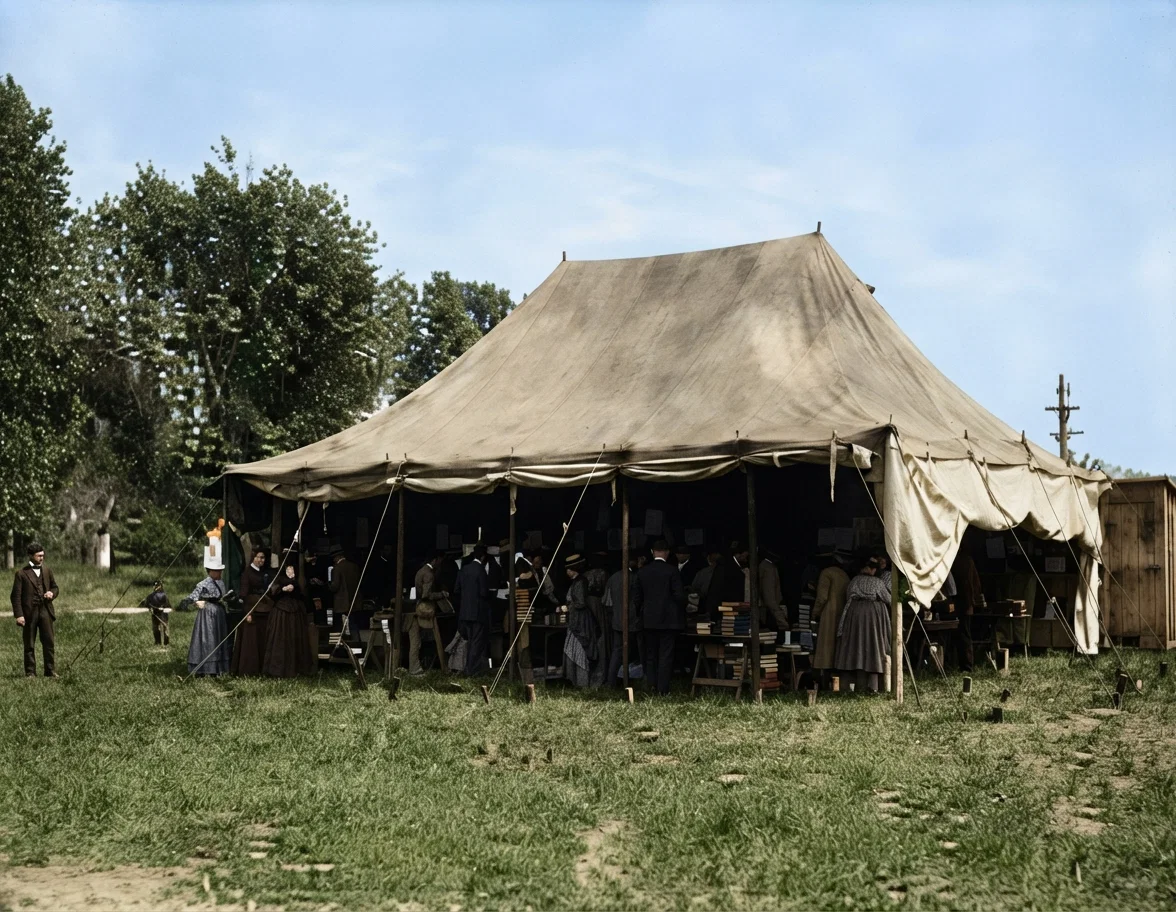
Book Tent at Cloverdale (Cal.) Camp-meeting.
"The recent strengthening of Buddhism, the ancient religion of the Singhalese, in almost every part of the Island of Ceylon, is one of the strangest but well-established phenomena of the present day. The missionaries have to pay more attention to it than to anything else, and we might well speak of 'the present-day revival of Buddhism in Ceylon.' Twenty-five years ago Buddhism in Ceylon was neither aggressive nor defensive. The ancient temples were standing, the priests studied their sacred books, and on holy days crowds thronged the sanctuaries; but no efforts were being made to deepen the religious life of the people, or to hinder the Singhalese from accepting Christianity. Christian schools were flourishing, and heathen children, having received Christian instruction, were baptized. In the villages only Buddhism was still a strong power, but it showed no life whatever in the cities.
"Now a remarkable change has come. Buddhism has founded schools everywhere, high schools in the larger cities, and common schools in smaller cities and in villages. In all these schools the tenets of Buddhism are taught most zealously, and thus an effort is made to counteract Christian influence. Even a few orphanages have been founded to keep poor and deserted children from seeking admission to Christian institutions. Buddhism is making use of the printing-press to spread its teachings. Textbooks, leaflets, and tracts have been published, and there is an effort to give the priests a better secular and religious education. In Colombo a hall has been opened, where public lectures on religious subjects are given in English and Singhalese. Feasts and pilgrimages are multiplied, and better attended than ever before. Societies for the promotion of Buddhist interests have been founded, and the followers of Buddhism have become strengthened in their belief.
Branch Office of Pacific Press Publishing Company, Portland, Oregon.
"But the most remarkable fact is that this revival of Buddhism has come about through the efforts of laymen, and not through the priests. Laymen are spending time, strength, and money for the founding of schools and the support of priests and temples in such a large-hearted manner that even the opponents of Buddhism must admire their consecration. They are trying to awaken, from lethargy and indolence, the priests, who continue, as heretofore, to spend their time in introspection, holy (?) meditation, study of sacred writings, and the collection of alms for their own support, appearing rarely in public for the encouragement of this forward movement.
"What results have this revival of Buddhism in Ceylon already attained? The follower of Buddhism, standing in the midst of the movement, would naturally claim greater results than the Christian spectator. However, some effects are apparent to all. Buddhism has become more highly respected among its followers, who no longer are ashamed of their religion. There was a time when witnesses in the courts of justice sought to excuse themselves for being followers of Buddha, but now they proudly own the fact. Again, Christianity is being opposed, not only as a religion, but as an occidental influence inimical to everything oriental. Again, a surprising spirit of consecration and liberality has been awakened among Buddhist laymen. Children, heretofore almost neglected and forgotten, are now cared for, and are taught the Buddhist catechism. Religious instruction has been introduced into the day-schools, and even Buddhist Sunday-schools have been organized. Special processions of children are formed on holy days, and led to the temples. Thus Buddhism is trying to gain respect and authority."
A BABY MISSIONARY IN KOREA.
By Mattie Wilcox Noble
As HE, on his mother's lap, rode along in the four-man chair, through the interior of Korea to visit some of the churches, all the passers-by stopped to gaze at him, and when, near some town or village, the bearers, for a brief rest, lowered the chair, a crowd soon gathered, and remarks about the baby would be heard.
"How his hair has faded; it is gray like an old man's," they would say. It was the first time many of them had seen a foreign child, and also the first time some of them had seen blond or golden hair.
"He must be five or six years of age," they would say. Some one asked him, "How old are you?" He answered, Soy wasso, which means anywhere from one and a half to three years, or that the child had lived in parts of three years. He is two and a half years old.
The people were amazed, not only that such a big, talkative, playful child could be only two and a half, but that he could talk to them, for he would salute them in their fashion, saying, "Are you in peace?" and, in departing, say, "Abide in peace."
The three-year-old children of the Koreans are always carried on their mother's backs, and are small and shy.
When the party stopped for any length of time to teach, the baby's mother, to attract the attention, and to win the hearts, of the people, would ask him to sing for them. He would sing a part of "Let a Little Sunshine In." That gave his mother a good opportunity to teach the sight-seeing crowd.
After interpreting the meaning of the song the child had sung to them, she would urge upon them the beauty and necessity of opening their hearts to let in God's light and love. The people would then be quite responsive, and, looking lovingly at the baby, call him, Chagun Moksa, or "little pastor."
While his mother held meetings with the women, the baby would remain in his tiny room with the amah; then, at the close of the services, he would be brought out for the women to see.
They didn't always wait, however, for him to come out, but all day, and during the evenings, people would come to the paper doors and windows, press a wet finger against the paper, and soon have eyeholes all around. To these the baby would go, and gaze into the curious eyes, and sometimes, to the great amusement of the sightseers, he would step into their straw shoes at the door, and walk around in them.—Mattie Wilcox Noble.
A Corner of the Cloverdale Camp-ground.
THE WAY TO OVERCOME.
By Will Wood
BY WILL WOOD.
WHEN first from slumber waking,
No matter what the hour,
If you will say, "Dear Jesus,
Come, fill me with Thy power,"
You'll find that every trouble
And every care and sin
Will vanish, surely, fully,
Because Christ enters in.
It may be late in morning,
Or in the dark before,
When first you hear His knocking;
But open wide the door,
And say to Him, "Dear Jesus,
Come in and take the throne,
Lest Satan with his angels
Should claim it for his own."
For we are weak and sinful,
"Led captive at his will."
But Thou canst "bind the strong man,"
Our heart with sweetness fill.
So would we have "Thy presence"
From our first waking hour;
All through the swift day's moments,
Dwell Thou with us in power.