The conquest of Canaan under Joshua occupied seven years, and during the whole of that time there is but one record of defeat and the loss of men in battle. The story of this defeat is told with great minuteness in the seventh chapter of Joshua, because it contained lessons of the greatest moment to Israel and of incalculable value to the people of God to-day.
Two things were responsible for the defeat at Ai,—the undetected presence of sin in the camp, and the self-confidence of the men of Israel in recommending that only a few men go up to take the city. After their humiliating experience, and the turning of their backs before their enemies, they carefully investigated the cause of their defeat, and traced it back to “Achan, the son of Carmi, the son of Zabdi, the son of Zerah, of the tribe of Judah;” and he and his house were taken to the valley of Achor and utterly destroyed. The record is (Hosea 2:15) that the valley of Achor became a door of hope. The basis for hope was a cleansed and purified camp.
There is no doubt that God would have revealed the presence of sin in the camp just as certainly before the march on Ai as afterward, had Joshua and the leaders been living in that abiding fellowship of God’s Holy Spirit that would have given them the spiritual discernment to detect sin and put it away. See “Patriarchs and Prophets,” page 493.
It was so in a similar case in the experiences of the apostles. As Achan was to Israel, so were Ananias and his wife to the early church. Instead of the fifth chapter of Acts recording a great revival, as it does, with multitudes of men and women being added to the Lord, possibly it would have had to record a great defeat, such as came to Israel at Ai, had it not been for the manifest presence of the Holy Ghost, and Peter’s spiritual insight and discernment, which enabled him to detect sin, and put it away before undertaking a great work for God.
“Now all these things happened unto them for ensamples: and they are written for our admonition, upon whom the ends of the world are come.” Whenever there has been failure in our life or labor, we may be sure that some cherished sin, hidden in the heart, is responsible for it. We may wonder why God does not deal as definitely and severely with sin to-day as in the past; but the answer is that these great object-lessons of his abhorrence of sin, recorded in both the Old and the New Testament, are sufficient for all time. Great victories for God invariably follow great reformations of heart and life.
The putting away of sin is what brought Christ to this world to die. All else he could have done for us, and remained in heaven. Let the church once more return to apostolic purity and power, and by diligent searching put away the accursed thing, and again we may count on the manifest workings of God, and multitudes both of men and women coming into the light.
New York City.
A New Republic
By C. E. Rentfro
C. E. RENTFRO
In the rise and fall and overturning of the nations we see the hand of God, who rules upon earth, though his throne is in heaven. In Revelation 17 the prophecy tells us that at some time in history the nations represented by the ten horns are to turn against the Papacy. The Suevic horn must sooner or later do its part. Certainly Portugal, the country of the Suevi, has just given the Papacy a blow.
A long series of occurrences denoted the gathering of forces for a crisis. Finally, when the hands pointed to the hour, the clock struck. On Monday evening,7just as we were preparing to open our meeting, a newspaper boy came by, crying, “Assassination of Dr. Miguel Bombardo!” I said to myself and to others, “This is the beginning of the revolution.”
This man was the director of the institute for the insane, recently elected deputy of parliament, and a popular freethinker, opposed to clericalism. Although preparations had been made for an armed revolt, his death caused the outbreak perhaps sooner than it was expected. To-day, October 6, the banner of the republic floats over all public buildings, forts, and soldiers’ quarters in and near Lisbon, and in many cities and villages throughout Portugal.
Tuesday morning, Oct. 4, 1910, about 1 A. M., the first attempt began by an assault on the barracks of the 16th infantry, which in a body opened the doors, letting in the populace, to whom were delivered the arms. The colonel was killed, and the soldiers went out commanded by noncommissioned officers. The signal given was three cannon shots from war-ships in the river Fagus.
Other regiments joined the revolution, and the conflict was on. The battle raged until Wednesday morning, when the republican banner was raised on the barracks and over the city council chambers.
All day on Tuesday I was trying to get to Lisbon, to see how the brethren were faring, but no one could pass. On Wednesday morning I was trying to find a way to enter when salutes for the new banner, and the proclamation of the republic, were fired.
Returning to a station outside the city, I boarded the first train entering Lisbon after this. What rejoicing! Such enthusiasm I never saw. Those who do not know this people might expect terrible things; but those who were directing affairs had confidence in their friends, and the city was thrown open to all. Every one breathed a sigh of relief.
I visited most of the brethren, who had much to recount. No one slept during the two or three nights of the combat and suspense. The bursting of shells and the booming of cannon were all that one would expect in a revolution. If we, at about seven or eight miles’ distance, heard the cannon, they, when the shells burst above the buildings, were shaken and badly frightened. God mercifully protected them from harm.
Our transference from the kingdom of Portugal to the Portuguese republic was accomplished in less than forty-eight hours.
Life is protected; liberty is granted; no one is to be molested for motive of religion. We ask the prayers of God’s people in behalf of this new field of labor, that we may know how to make use of the blessing of freedom from priestly domination that has come to this people.
Lisbon.
Restitution of All Things
By W. S. Cruzan
W. S. CRUZAN
One of the themes that has ever engaged the minds of the prophets has been that of the final “restitution of all things,” when “the mystery of God should be finished, as he hath declared to his servants the prophets.” Rev. 10:7. The work of the gospel, “the mystery of God,” is to gather from the nations of the earth a people made “meet to be partakers of the inheritance of the saints in light,” by having the eternal purpose of God wrought in their lives and character through Jesus Christ our Lord. And so he “hath chosen us in him before the foundation of the world.” We are chosen in him “in whom we have redemption through his blood, the forgiveness of sins, according to the riches of his grace.” We are redeemed from sin, redeemed from the transgression of the Father’s law, and its righteous principles are fulfilled in us who are being led by his Spirit (Rom. 8:4), “that in the ages to come he might show the exceeding riches of his grace . . . toward us through Christ Jesus.” The prophets of God through the different ages have received glimpses of his eternal purpose, even of that purpose “which he hath purposed in himself: that in the dispensation of the fulness of times he might gather together in one all things in Christ, both which are in heaven, and which are on earth; even in him.” This is “the purpose of him who worketh all things after the counsel of his own will,” that the whole family in heaven and earth, named after the eternal Son, might be reunited again in one family. Eph. 1:9-11; 3:15.
The breach that sin has made in the family of God will be repaired, and healed by the “bruises” of his own beloved Son (Isa. 53:5, margin), “who was delivered for our offenses, and was raised again for our justification.” This is the work of the “restitution of all things,” which has been undertaken by Christ Jesus our Lord. We are persuaded that since all power is given unto him in heaven and in earth, therefore he is fully able to carry on to a glorious completion this great work of restoring all things again to meet the mind of the eternal Father, who has declared that “the earth shall be full of the knowledge of the Lord, as the waters cover the sea;” and that sin, the affliction of his people, “shall not rise up the second time.” Isa. 11:9; Nahum 1:9.
And this glorious dominion, “even the first dominion,” “shall come to the daughter of Jerusalem,” to the “tower of the flock, the stronghold of the daughter of Zion,” which is Christ our Lord. It is the mind of the Father soon to send this Jesus again, “whom the heaven must receive until the times of restitution of all things, which God hath spoken by the mouth of all his holy prophets since the world began.” Acts 3:20, 21. When he returns, “he will send his angels with a great sound of a trumpet, and they will gather together his elect.” These angels will also “gather out of his kingdom all things that offend, and them which do iniquity” (Matt. 24:31; 13:41); for he will receive from his Father a kingdom (Luke 1:32; 22:29; Dan. 7:14; Rev. 11:15), and will renovate it, and burn out the dross, which is sin, and have a clean kingdom, whose subjects will be found doing the will of the eternal Father through Jesus Christ. Ps. 37:20; 2 Peter 3:10-13; Matt. 13:43.
Semmes, Ala.
Wise Use of the Sabbath
God is never content with less than the best for man. To this end he gave him authority over the material creation, that it might be subject to him, and minister to him; for this he established the family, that together men might be perfected through the joys and duties of domestic and social relationships; for this he ordained work, that life might never be blighted with the curse of idleness; for this he instituted the Sabbath, that rest might contribute its helpful solace and comfort, to repair the waste of life, and renew man for the struggle of life.
Some have interpreted the Sabbath as a day set apart for God, that he might exact for himself a fraction of man's time. Nothing could be more mistaken. The Sabbath was made for man. It was made for him in recognition of the fact that man was made in the image of God, and that it would be an instrument of power in achieving godlikeness.
The Sabbath as a day of rest recognizes the discipline of work. A man made in the image of God must resemble God in a life of active and purposeful usefulness and benevolence. But it also recognizes that a man must occasionally, and if he would work at his best and longest, periodically rest.
Two extreme views of the Sabbath are current. One is the Pharisaic view that the day is to be observed with an exacting and wearisome round of religious services, which even the saintliest find anything but a means of grace, and never cease to reproach themselves because they can not feel otherwise. The other is the secular view, which makes it an occasion of frivolous idleness, if not of more vicious dissipation. If one of the two had to be chosen, there can be no doubt of the immense superiority even of the Pharisaic Sabbath to that of the secular.
The best use of the Sabbath is that which makes it best for the manifold man — regarding his body, his mind, his heart. A wholesomely religious Sabbath is our salvation; religion is the only efficient sanction for morals, the only power which can make us better men and better women, the only offset to the eternal grind of material interests, the only efficient discipline of character, by which man is able to reach and maintain “the measure of the stature of the fulness of Christ.”—Northwestern Christian Advocate.
Tired Mothers
By Eugene Worrell
A LITTLE elbow leans upon your knee,
Your tired knee, that has so much to bear;
A child's dear eyes are looking lovingly
From underneath a thatch of tangled hair.
Perhaps you do not heed the velvet touch
Of warm, moist fingers folding yours so tight;
You're weary with the worries of the day,
You are almost too tired to pray to-night.
But it is blessedness! A year ago
I did not see it as I do to-day;
We are so dull and thankless, and too slow
To catch the sunshine till it slips away;
And now it seems surpassing strange to me
That while I bore the badge of motherhood,
I did not kiss more oft and tenderly
The little child that brought me only good.
And if some night when you sat down to rest,
You missed the pressing elbow from your knee,
The restless little head from off your breast,
The lisping tongue that chatters constantly,—
If from your own the dimpled hands had slipped,
And ne'er would nestle in your palm again;
If the dear feet into the grave had tripped,—
I would not blame you for your heartache then.
I wonder so that mothers ever fret
At little children clinging to their gown;
Or that the footprints, when the days are wet,
Are ever black enough to make them frown.
If I could find a little muddy boot,
Or cap, or jacket, on my chamber floor;
If I could kiss a rosy, restless foot,
And hear it patter in the house once more;
If I could mend a broken cart to-day,
To-morrow make a kite to reach the sky,—
There is no woman in God's world could say
She was more blissfully content than I.
But ah! the dainty pillow next my own
Is never rumpled by a shining head;
My singing birdling from its nest is flown;
The little boy I used to kiss is — dead.
— Eugene Worrell.
The Cold Bath a Tonic
By H. C. Menkel, M. D.
H. C. MENKEL, M. D.
A cold application to the skin is one of the best general physiological tonics. The cold first causes the blood-vessels to contract; this is followed by a vigorous reaction, and the skin becomes red, due to an exhilarated blood circulation. This increased circulation is not limited to the skin only, but is shared by every organ and structure. An increased active circulation means increased nutrition, and increased resistive power against disease and disease germs. This is illustrated by the following experience:
Surgeon McGregor, formerly superintendent surgeon of the English army in Egypt, makes a very interesting observation concerning the value of the cold full bath. While he was in charge of the “Blues,” a famous old regiment, then located at Canterbury, an epidemic of typhus fever, generally complicated with pneumonia, broke out. The disease developed so rapidly that in a short time one fifth of his regiment were on the sick-list, and there were thirty-three cases of fever, with daily accessions to the number. At this juncture it occurred to McGregor, a disciple of Currie, who was familiar with the use of the bath in the treatment of cases of fever, that the cold bath might be used for prophylactic as well as curative purposes. Accordingly, to use his own words, “about the twelfth, at my earnest recommendation, all the regiment out of the hospital were marched three times a day to the riverside, and every man was made to bathe. The good effects of this were speedily manifest; the number of new fever cases decreased daily, and those that did appear wore a milder aspect. Many, indeed, yielded to the common treatment; in some cases an emetic, and in others the cold bath, at once cut short the disease. We lost no cases in October. Indeed, it was evident to all that after the general bathing of the regiment, the contagion was stopped; the few cases that occurred after this were stripped of all the alarming and dangerous symptoms with which the disease broke out. In all, there were sixty cases of fever, occurring from July to October 21, on which day the last case appeared. We lost six of this number.”
The immunity evidently conferred by the tri-daily bath was certainly more than a coincidence. It would seem eminently reasonable to suppose that if the cold bath aids recovery by stimulating the vital forces and increasing the vital resistance, and to such a degree that the patient already thoroughly infected with the disease is brought to a safe recovery, the application of the same measures before the contraction of the disease ought so to fortify the system as to enable it successfully to withstand the influence of the infectious element to which the malady owes its origin. The principles involved in this suggestion are worthy of thoughtful consideration. If the principle holds in relation to a single malady, it is equally sound in relation to all others which depend upon either infection or any other external cause — excepting, of course, accidents.
India.
Influence of Pictures in the Home
By Margaret Shepherd
MRS. MARGARET SHEPHERD
That we become changed by beholding, is a truth taught in the Word of God, and it is generally acknowledged that what we see constantly before us must exert a great influence either for good or for evil. The pictures, therefore, that are always before us act an important part in the formation of the characters of the inmates of our homes.
This being so, what kind of pictures should we allow to appear upon our walls? All will agree that they should be only those that depict beauty and inspire pure thought.
Let us divide them into three classes for consideration,—wall decorations, books, and periodicals.
Concerning the first we shall not, as a rule, have much difficulty; paintings, crayons, portraits, sketches, etc., usually portray good subjects. Select those which give you distinct pleasure each time your eyes rest upon them—the landscape that makes you wish to take a walk in the place portrayed, the animals that seem almost alive, fruit that looks good enough to eat, and flowers that remind us of the real handiwork of the Creator, richer than Solomon's robe.
Few can possess the rare works of art, but we can have the reproductions of them almost in perfection through the wonderful color work that is done in this age.
An artist once invited a friend into his studio to show him a new picture. After allowing him to look at it, he said:—
“Well, what do you see?”
“I see,” replied the friend, “only a portion of a rustic lane, but it seems to me I hear the nightingale singing.”
“I am glad to hear your opinion,” said the artist; “for I have tried to paint the song of the nightingale.”
Pictures make a quicker and deeper impression than words, and until the child has reached maturity, and learned how quickly to banish evil things from the mind, he is likely to be indelibly impressed by obscene, evil pictures.
Encourage the liking for good pictures as for good books. If we allow only the best books in our homes, we need hardly fear the illustrations they contain; but if the trashy novel or paper9is admitted, there will be spread out scenes of violence and crime, such as help to send many boys and girls to prison in after-years.
There is one kind of illustration in some books of history that is especially hard on the nervous systems of delicate children, such as the burning and slaughtering of white persons by Indians. I recall an ancient work describing the tortures committed during the time of the great papal persecution, such as quartering, stretching, and the use of the stocks. My mother had put it out of sight in the attic, but occasionally we came across it, and dared to glance at the horrifying details of torture shown there, though we knew it would harrow our minds for hours.
In newspapers and magazines we come to a vast range of pictures, good, bad, and indifferent. Magazines contain much that is good in halftone cuts, so excellent that one almost feels that he has seen the people, places, inventions, and happenings portrayed. Here, also, lies a source of danger to many young people in the romantic age, who are charmed by the fame suggested by the pictures of actors and actresses.
Pictures of fashions also distract the mind from better things, and turn many a foolish head. They need be consulted only often enough to insure being neatly, tastefully, and sensibly dressed.
Little eyes, and I fear sometimes older ones, are attracted by that which to them is queer and curious; hence the baleful influence of the so-called “funny sheet,” which has come to be a really dreadful thing. The editor of the Ladies' Home Journal, Edward Bok, has written an excellent article on this subject, showing that this “funny page” teaches disrespect of parents, of teachers, of friends, and of God, and shows all sorts of ill tricks that we would not wish to have our children copy.
Pictures may suggest any phase of emotion,—peace, repose, anger, activity, joy, sorrow, the works of Satan, or the works of God. Which will be of the greatest good to you and your family? Which will you choose to have before you?
College View, Neb.
CHILE, SOUTH AMERICA.
By Frank H. Westphal
The Chilean Conference sends greetings to the brethren who are praying for the completion of the work of God in the earth. We long for the coming of our blessed Saviour, when we shall meet those who have given of their means for the extension and support of the work in Chile. The Chilean Conference voted thanks to the brethren who have helped to plant the banner of truth here, and for the promise of a part of the $300,000 Fund. Our school in Pua is to share in this institutional fund. Eight Mapuche Indian young people are attending our training-school. A brother whom none of us have yet met has sent in two hundred dollars in tithes and offerings. The Lord is calling out his own. F. H. WESTPHAL.
E. HOWSE
By E. HOWSE
Samoa
E. HOWSE
Samoa’s dusky sons and daughters call for help,—a people warm-hearted and care-free, possessing little and needing less,—a people who are clean, intelligent, and religious, and well satisfied as regards both this life and their expectations concerning the hereafter.
Practically all of them, numbering10about thirty-nine thousand, belong to one or another of the Christian sects at work here; but few, indeed, practise what they profess. They need a gospel that will help them to put away their old habits, which have been handed down from heathenism, and which cause so much disease among them. The message must be given to these people. They constitute a part of the nations, tongues, and peoples to whom the message is to go in this last generation of men.
Our work was started here a number of years ago, but with all the changes that have come, we have yet to establish our first company. The workers have returned to the home land through failing health, and one has laid down her life for the truth.
We have tracts in the Samoan language, dealing with six phases of our truth. These are read with interest; but when the people see the truth, and admit that they should obey, they step back, and their old associations hold them. What shall we do to help these people? The very fact that they do not know their need is a call to us to help them. Shall we withhold that which is life-giving from those who are ready to die? The islands of the sea, by their great need, are calling for help. And we are called upon by God to supply their need by the very fact that he has given us a knowledge of his truth.
Apia.
“Grandmother” Wang
The organ of Methodist missions reports the death, at eighty-six, of “Grandmother” Wang, of wheelbarrow fame. Long ago her son wheeled his mother four hundred miles, from Anking to Peking, that she might learn to read the Bible for herself. Of late years her strength had been unequal to much travel among the villages, so oftentimes she sat in the gate of the Woman’s Foreign Missionary Society compound at Tai-anfu, preaching Jesus to the passers-by. As she herself wrote, two years ago: “I do not know whether or not the Lord will still give me so much strength; but if I can do nothing else, here is the earth gate, with many passers-by. I’ll just sit in it, and speak a word when I can.”
“No Money”
By Minnie L. Haskins
No money! yet brothers and sisters are
dying.
No money! yet millions in darkness are
lying.
No money! to teach them that Jesus
waits pleading.
No money! to send them the joy they
are needing.
No money! yet teachers and preachers
are waiting,
Impatient with standing, while men are
debating.
O daughters of Zion! the Father is
calling;
He needeth your help; for your sisters
are falling.
Must we call back the men from the
vineyard of God?
Shall we fail to trace footsteps the
martyrs have trod?
Shall we rest in our luxury, heedless of
cries
From agonized heathen—of heart-
broken sighs?
Must we cry the word “Halt!” to the
soldiers awaiting?
Must we tell them to stop, in measured
tones stating
That money is wanting, that heathen
must die,
That still in their misery our brothers
must lie?
— Minnie L. Haskins.
Words of Cheer
By M. C. Sturdevant
BULAWAYO, RHODESIA.—We do most surely send greetings. Never was the work so prosperous here at Solusi (our first African mission station). God is at work. There are one hundred student boarders in the home, with eight out-schools doing splendid work, and more to follow. We praise God and take courage. M. C. STURDEVANT.
F. W. FIELD
By F. W. Field
TOKYO, JAPAN.—The work is moving forward in the Island Empire, and souls are accepting the truth in various places. A church has been organized in Hiroshima since our effort there this summer. For the winter we are planning a longer, stronger effort than ever for the training of our young people. We need and ask the continued interest and prayers of our brethren and sisters.
F. W. FIELD
Samoa
By E. Howse; T. Howse
SAMOA.—At this time of prayer we ask that you remember the islands of Samoa. Pray that the Lord of the harvest will send forth laborers; for truly the harvest is great, and the laborers are few. The enemy has contended every inch of ground here; but the cause will conquer, we know; for has not the Lord said that among the saved there will be representatives from every nation, and kindred, and tongue, and people? There are honest hearts here; but what are two workers among all these islands? E. Howse, T. Howse.
The Western India Mission
By Geo. F. Enoch
BOMBAY SIDE, INDIA.—In the Western India Mission we have half the population of the United States, minus the greater per cent of its schools, its Bibles, and its Christianity. Three persons pass into eternity every minute, or one and one-half millions every year, within our borders. The situation calls for consecrated men and women to form the solid square of educational, publishing, medical, and evangelistic workers, to train the army of native laborers necessary to warn these millions. We have barely made a beginning in the study of one of the languages of West India. Since this field also must be warned ere the work is finished, we must have the prayers of God's people, the unction from on high to make the labor effective, and men and means. “When I heard these words, I sat down and wept, and mourned certain days, and fasted, and prayed before the God of heaven.” Neh. 1:5. GEO. F. ENOCH.
The Council at Mokanshan, China
By I. H. Evans
I. H. EVANS
LEAVING Seoul, Korea, the morning of August 23, I reached Shanghai, September 27, and was glad to greet the brethren who had come to the boat to meet me. The following week we started for Mokanshan, a day's ride from Shanghai. The journey is made partly by rail, partly by rowboat, and partly by carriers. Altogether, it is a hard trip, at the best.
CHINESE UNION’ MISSION COMMITTEE
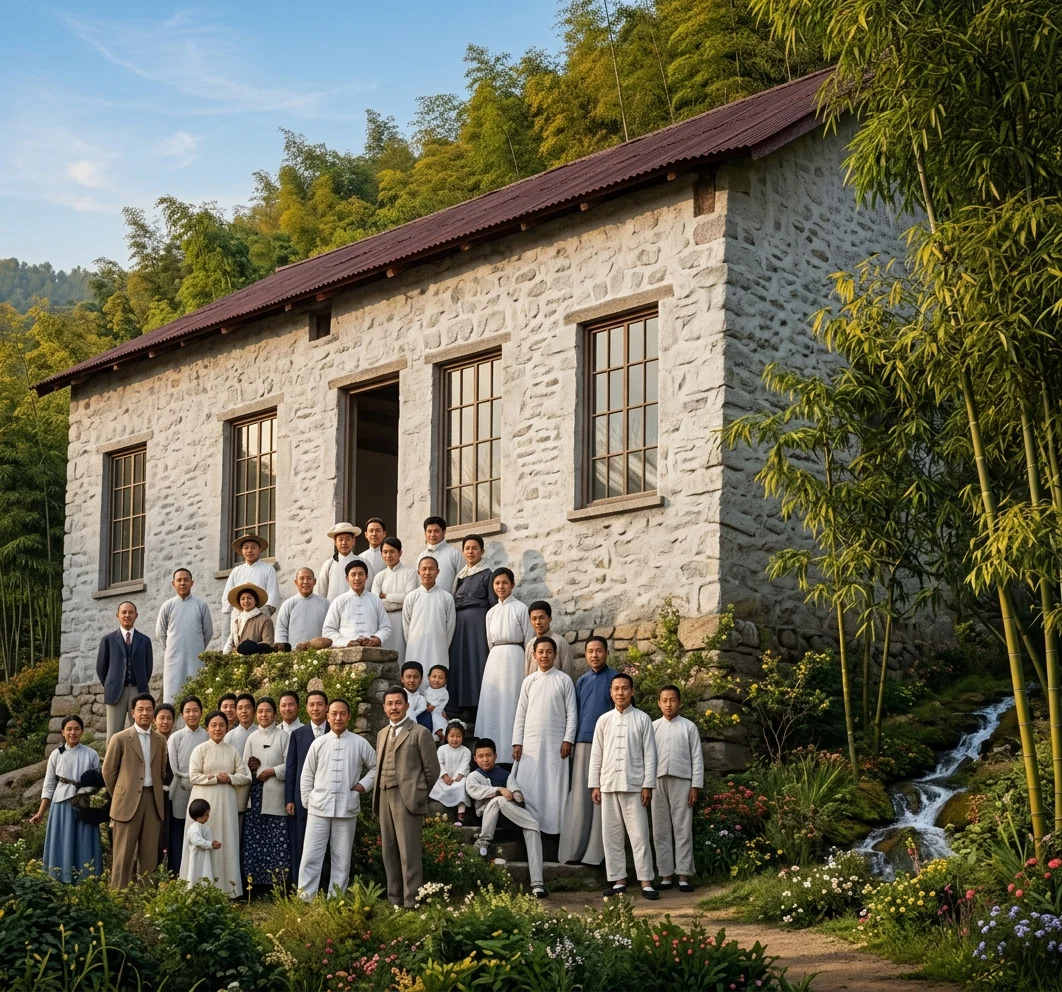
Mokanshan is a low mountain, the highest point reaching some twenty-four hundred feet above sea-level. It is covered with a thick growth of bamboo, which adds greatly to its beauty. Our location is at an elevation of about fifteen hundred feet, and has some pretty views looking down steep gulches into the valley below. A small stream dashes down the mountain, passing through the mission property. This water has been piped into the treatment-rooms, giving all the fresh, cool water we can ever use, and affording a pressure for the treatment-rooms of some forty-seven pounds to the square inch.
The treatment-rooms building is a plain stone structure, with walls two feet thick. It is two stories high, and about 24 x 36 feet. It has a cement floor, a corrugated iron roof, is well lighted, is piped with hot and cold water, has good sprays, and was erected for eleven hundred dollars, gold. However, some things are still needed to make the place what it should be. For about two hundred dollars, gold, it can be equipped with two full baths, and two electric batteries for giving electricity. When this is done, the rooms will be all that can be desired, and we shall be able to give treatments to all who come, at reasonable rates.
CHAPEL AND DISPENSARY AT MOKANSHAN
The total investment will not exceed thirteen hundred dollars, gold.
About one hundred families of missionaries spend from six weeks to three months on this mountain each year. Many of these are very glad for the prospect of good treatment-rooms, where they can come another year.
A small chapel has been erected, in one end of which a modest dispensary work is carried on for the Chinese. To this dispensary many come daily for medicine and treatment, which they greatly need. The chapel seats about fifty persons. The Seventh-day Baptists usually meet with us in worship on the Sabbath. The Chinese have their meetings in the forenoon, and the foreigners have theirs in the afternoon.
It was in this little chapel that we held our ten days' council for China. Most of the Chinese Union Committee were present, and the work for the whole field was carefully considered. Many recommendations were adopted, some of the most important of which follow: That seven men be asked to come to China, and take the oversight of the distribution of our literature in the seven occupied mission fields; that a study of the books of Daniel and the Revelation be printed soon; that a new press be purchased as quickly as possible, to help in printing the much-needed literature for China; that two hundred dollars be appropriated to further equip the treatment-rooms in Mokanshan; that a story of the rise and progress of our work be prepared, and printed at an early date; that the Central Chinese Mission be divided, the provinces of Honan and Hupeh being known as the North Central Chinese Mission, and Hunan and Kiangsi as the South Chinese Mission; that Elder J. J. Westrup and family be granted a year's furlough; that Elder F. A. Allum take the superintendency of the North Central Chinese Mission; that Elder R. F. Cottrell take the superintendency of the South Central Chinese Mission; that Dr. A. C. Selmon take the superintendency of the East Chinese Mission; that Dr. H. W. Miller take the superintendency of the North Chinese Mission; and that a school for Mandarin-speaking Chinese be opened this fall at Cheo Chia K'o, the same to be in the charge of Dr. Miller.
Many other important matters pertaining to the work in its various divisions were discussed and decided at this meeting. At its close we returned to Shanghai, to complete some work that had to be attended to there.
When I came to see the location of the printing plant, and the meager facilities with which they are compelled to work, I could not but say, “How long, O Lord? how long?” Dr. Selmon showed me the editorial room, which is a sample of what these workers have. They are located up-stairs in a Chinese house with low walls, and with windows on one side. The rear is boarded up with unmatched lumber, leaving cracks from an eighth to a quarter of an inch wide. This is all the protection they have against the penetrating cold of a Shanghai winter. I asked the doctor how it was possible for them to endure the heat and the cold. He replied: “It is often so cold that only by standing up and rubbing ourselves can we keep working at all. Our fingers often become11so numb we can not hold a pen. And the heat in summer is just as intense as the cold in winter.”
When I left Shanghai to take the boat, where I am now writing, I came down the narrow lane through which most of our workers in the press have to pass in going to and from their homes. In this street, not more than six feet wide, were six deformed beggars, asking alms, three of whom were lepers, almost dead with the loathsome disease. One of them was so nearly dead that his eyes were glazed, and he lay with his head in the dust, asking for help. Another poor soul had just lost two toes, and he held his swollen, bleeding foot toward the passers-by, beckoning to them to see his misery. Another had lost his hands, and could not walk, but lay there, thrusting himself toward me, begging an alms. We were compelled to pass within four feet of these poor, helpless souls, being eaten alive with this incurable malady. And the workers in our press must daily pass these poor unfortunates, exposing their very lives to the most loathsome of all human ailments. Perhaps you ask, “Why not move elsewhere?” The answer is a simple one,—to get into decent quarters costs more rent than it is possible for our men to pay, on their meager salaries. These workers have been hoping for two years that means would be forthcoming for building a plant outside the city, where the lives of the helpers can be conserved. The question is, How long shall they be compelled to wait?