“INNOMINATO,” in the New York Sun of February 14, tells us quite a good deal about the plans of the Vatican for the purpose of restoring the civil power of Italy to the Papacy. Among other things, he quotes from a recent article by Father Brandi, entitled “The Way of Just Reparations.” Brandi “proposes to Catholics as a watchword and a manifesto, ‘the federal republic.’”
Concerning this article of Brandi, “Innominato” says: “After analyzing the holy father’s last speech on the independence of the Papacy; after showing that Italy has established mathematical unity, with Rome for the capital, instead of copying the federalist model of the United States, of Switzerland and of Germany; after demonstrating finally that there is no inconsistency or contradiction in supporting the republic in France and opposing the monarchy in Italy, Father Brandi, the author, uses these words: ‘The people have above all things a feeling for realities; they understand the venerable pontiff when he says: “Italians, my children, I, too, am an Italian and I love our great country. But I love my country for its own self; I love the soul of the fatherland, which never dies, and which is neither sectarian, nor liberal, nor dynastic, but Catholic. I warn you paternally, nevertheless, to think first of all of reconciling Italy with Catholicism by suppressing the dissensions between her heart and her head, a dissension that can only bring ruin. Remember that organisms, constitutions, forms of government, may be changed; the republic may succeed the monarchy, confederation may succeed the unity of the Constitution, but when all has been changed, there always remains immutable Italy; there always remains the Italian people and the nation, to which you owe above all your devotion and your services. In putting aside what is transitory, do not condemn to failure what should be permanent. Enter upon the path of just reparations, and, even tho you should be obliged to sacrifice something, you will have the glory of having saved the fatherland.’”’”
Forms of government are of no consequence, provided only that the Papacy may rule. In one nation it can support a monarchy; in another it overthrows the monarchy in favor of a republic, but it is all that the Papacy may govern.
And such desires of ruling are by no means confined to the Papacy. Protestant supremacy has manifested itself in just as despotic decrees, dogmas, and acts, as were ever shown in the Papacy. But all the world should know that both have gone wrong before they manifest themselves in any of these dictatorial or persecuting methods. Catholics and Protestants alike should all learn to be true Christians in every respect. And then, like their divine Master, they will say, “My kingdom is not of this world.” John 18:36. Political intrigue so as to change forms of government will constitute no part of their work. Their whole mind and heart will be absorbed in seeking to win people for the eternal kingdom to come, and not in wrangling with them over the forms of government that are now. T.
Degeneration
By James J. Baxter
DEGENERATION.—There is something simply awful in the growing tendency of the modern individual to take in hand the precious gift of life and fling it back in the face of his Creator.—Rev. James J. Baxter, Catholic, Boston, Mass.
Hypocrisy
HYPOCRISY.—A man may grow rich robbing widows’ houses, and the church elects him to an office if he will give a tithe of his ill-gotten gains to found a chair in a denominational college.—Rev. N. M. Waters, Methodist, Chicago.
THE DEMORALIZATION OF DEBT.
By Talmage
DEBT! There is no worse demoralizer of character. The sad records of defaulting, embezzling, and dishonest failure which we meet with so constantly in the daily press are often, indeed most frequently, the result of the demoralization10of debt, and consequent desperate efforts at extrication. The financial props have given way. The little debt which at first was as small as a grain of mustard seed, like the rolling snowball, has gathered weight and multiplied itself a hundred-fold. And still it grows, and, like the fabulous hydra which Hercules was sent to kill, you no sooner strike off one head than two shoot up in its place. The struggle is severe, but the end is decisive; either confession is made of hopeless bankruptcy, which might and should have been avoided, or integrity is sacrificed to the temptation of the moment. Debt ruins as many households and destroys as many fine characters as rum; it is the devil’s mortgage on the soul, and he is always ready to foreclose. Pay all your bills. Look every man in the face, conscious that you owe the world no more than it owes you. Be indebted for nothing but love, and even that be sure you pay in kind, and that payments are frequent.—Talmage.
THE PRIZE.
One morning before starting to school, when Katie came in, as was her custom, to her mother for her good-by kiss, her eyes shone brighter than usual, and her cheeks glowed with excitement.
“Are you not glad, mama,” she asked, “very glad for me?”
“Certainly, my child,” was the reply, “I should rejoice with all my heart if you should win the prize.”
“If I should win!” cried Katie in astonishment; “who else could receive it?”
“Do not build too much on it, Katie; for disappointment is very hard to bear.”
“But, mama, Anna Schulter is the only one that can compare with me; and every one says that my work is better than hers.”
“Perhaps ‘every one’ has told Anna Schulter that her work is better than yours.”
“O mama, what a funny idea!” laughed Katie; “but you shall see my return crowned with the prize.”
Scarcely an hour had passed when the street bell sounded, and the mother listened with beating heart. But the heavy, tired step did not resemble the usual light tread of her little daughter. The door opened, and Katie, with pale, troubled face, entered. She paused a moment as if gaining composure, and then, rushing to her mother’s arms, she sobbed as if her heart would break. There was no need to tell that not she, but Anna Schulter, had gained the prize from the art school; and the mother’s first care was to soothe her disappointed child.
CALIFORNIA SCENERY. NO. 9.—It may be of interest to our readers to see, in this time of gold excitement, a picture of the place where J. W. Marshall, an employee of Gen. John A. Sutter, discovered the precious metal in California, Jan. 24, 1848, in Sutter’s mill-race. It is a circumstance worthy of note that both of these men died poor. So will many others who are now setting their hearts on the mines of earth.
“Restrain yourself, my dear,” she said; “this is not the worst grief that could befall you.”
“Not the worst?” sobbed Katie; “why, mama, you can’t imagine how terrible it was to see all those scornful faces, and to stand there like an outcast.”
“Are you not exaggerating, dear?”
“No, indeed, mama; every one left me and crowded around Anna, who, I am sure, did not deserve the prize.”
“Do you not think the art critics have better judgment than you?”
“But Anna received help.”
“Katie,” said her mother sternly, “if you have worked faithfully, there is no disgrace in losing the prize; but it grieves me to see my little girl so governed by envy. How do you know that Anna received help?”
A painful pause followed, during which Katie did not dare raise her eyes to her mother’s. She began to see how foolishly she had acted.
“But,” she thought, “could any one bear such humiliation quietly?”
“Forgive me, mama,” she whispered softly; “I shall try to drive away these wicked thoughts; but I am so disappointed!”
Her mother kissed her tenderly and said, “Think, Katie, if you had won the prize, could you be happy when you knew some one was very miserable over losing it?”
“But Anna did not know how grieved I was. She was the center of a great crowd, praised by all, while I stood at one side alone. No one seemed to notice me; so I hurried home to you.”
The next morning Katie appeared with eyes much inflamed by weeping; but she had thought of a remedy for her sorrows, and chatted pleasantly with her mother all during breakfast.
“Mama,” said Katie, when the meal was over, “I see that it was very wrong in me to act as I did yesterday. I shall cherish no more ill-will toward Anna, and shall try to rejoice in her happiness; but please promise me that I may give up my studies in the art school.”
“That would be foolish, indeed,” replied her mother.
“Dear mama, I can not endure to go again where I have suffered such humiliation.”
“My child, you must conquer this envious spirit, and be earnest in your determination to do right.”
Katie was silent for a moment; but she wondered why her usually indulgent mama would subject her to such a severe trial. Her mother remained firm, altho Katie pleaded hard for permission to abandon her art studies. And when the new term began, it was with ill concealed displeasure that she entered the school. She was late as possible, in order to avoid all intercourse with other pupils; and soon after her arrival the instruction began. As Katie took her seat and bent over her work, every eye seemed to turn toward her, either in pity or scorn, and she scarcely dared to raise her head to nod to Anna, who gave her a friendly smile in return. Katie blushed deeply and looked down. She heard some whispers near, and thought they certainly were concerning her and her disappointment. Her cheeks burned hotly, and she wondered if the hour would ever end.
At last the time came to go home. She had determined to say a few words to Anna, but was so cordially met by her that the dreaded task proved an easy one.
“I must tell you, Katie,” said Anna, “how sorry I am that you did not win the prize. I could not enjoy it at all until mama said that you were such a sensible girl that you would try harder and win next time.”
Katie was deeply mortified. But she took up her work with new zeal, resolving that she would deserve the title of “sensible girl.”
That evening, as she sat by her mother’s side, she whispered, “Mama, I have conquered now, and I shall do the best I can without thinking of the prize.”
One day after Katie had been working diligently for several months, she was sent to a desk for some drawing materials, and there saw the model she had prepared for the last art exhibition. Her now practised eye readily detected many faults, and she blushed to think how blind her conceit had made her. She determined never again to elevate herself above others, and to let honest work and untiring diligence take the place of supposed natural skill.
At the next exhibition Katie won, and deservedly received the prize.—Anonymous.
“BEAR YE ONE ANOTHER’S BURDENS.”
IF any little word of ours
Can make a life the brighter,
If any little song of ours
Can make one heart the lighter,
God help us speak that little word
And take our bit of singing,
And drop it in some lonely vale
To set the echoes ringing.
If any little love of ours
May make a life the sweeter,
If any little care of ours
May make another’s fleeter
If any little help may ease
The burden of another,
God give us love, and care, and strength,
To help along each other.
—Anon.
WHY HE NO LONGER USES LIQUOR AS A MEDICINE.
AMONG the many pleas made for alcohol is its use as a medicine; but it is good to know that not a few able physicians have seen and are seeing that its medical use results in more harm than good. Here is the testimony of one worthy to be heard, Dr. H. D. Didama, dean of the Medical College of Syracuse University, N. Y. He thus writes to the New York Voice, of Jan. 15, 1897:—
“In answer to your request for ‘a somewhat extended statement’ of my views concerning the use of alcohol in medical practise and the observations which led me to adopt them, I refer you to an article in No. 3 of the new Philadelphia Medical Journal, published last week, entitled ‘Experientia Fallax.’ This is, as you will see, entirely impersonal, but it gives an intimation of my own habits and medical practise.
“For many years after my graduation at Albany, in 1846, I prescribed alcohol, and for twenty years, while occupying the chair of professor of the science and art of medicine in the College of Medicine of Syracuse University, I followed in my lectures—often reluctantly and usually afar off, but still I followed—the almost unanimous teaching of authors, ancient and modern, and the professors in the medical schools.
“Convinced that a great number of the diseases I was called to treat owed their existence or aggravation to the use, in alleged moderation of alcoholic beverages, and that not in a few instances this use was commenced and even continued by the advice of the medical attendants; convinced also by the published experiments of many acute observers at home and abroad, and by my own observations, that almost all diseases could be managed as well if not better by the non-use of alcohol, and satisfied from the communications of some brother practitioners that the fatality in certain specified diseases was not delayed, to say the least, by the employment of increasing and enormous doses of wine, whisky, and brandy; and influenced also, I must admit—overwhelmed, indeed—by what I know and what I read daily of the pauperism, domestic wretchedness, crime, insanity, and incurable maladies transmitted to innocent offspring, I abandoned entirely, more than three years ago, the use of alcoholic remedies.
“I have endeavored by personal example and earnest counsel to dissuade my patients from the use of intoxicating beverages and medicines.
“The outcome of this practise, medically and morally, has been satisfactory to myself, and, I have reason to believe, to my patients also.
“Whatever regrets I may feel for my former teaching and practise, I have no apology to offer for my inconsistency except that once given by Gerrit Smith: ‘I know more to-day than I did yesterday; the only persons who never change their minds are God and a fool.’
“Permit me to add that while there may be an honest difference of opinion regarding the efficacy of legislative enactments in overcoming or restraining the drink habit, there should be little doubt that a whole-hearted, persistent, precept-and-example effort of the medical profession exerted as individuals on their patients and the families of their patients, and as associations on the community at large, would do immeasurable good.
“And the newspapers might aid materially in this beneficent work if, while they continue to spread before our households every day the details of the brawls and fights of drunken men and the horrible murders which they commit, they would discontinue advertising, without warning or dissent, side by side with the atrocities, the ‘innocuous beers,’ the pure malt whiskies, the genuine brandies, guaranteed to prevent and cure all manner of diseases.
‘H. D. DIDAMA.
“Syracuse, N. Y., Jan. 15, 1898.”
THE FIRST CHURCH IN KLONDIKE.
New York, January 21.—Two missionaries were last August sent to the Klondike by two New York women under the auspices of the Presbyterian Board of Home Missions. The names of the women are kept a secret by the board. A letter has just been received by D. J. McMillan, corresponding secretary of the board, from these missionaries—the Rev. Hall Young and Dr. W. A. McEwen. The letter is from Dawson City, and is dated December 1. It was carried from Dawson City to the nearest outpost of civilization by Jimmy Jackson, an Indian, who has a record for going where no other man can go. The letter announces the establishment of the first church in Klondike, and says there is food enough there to last till spring. If provisions reach the miners by April 1, the danger of absolute want will be entirely past.
Mr. Young writes that he and his companions are the only missionaries who reached Klondike City, two miles from Dawson City, their destination, before the winter set in. Since then, of course, nobody has arrived there. They started at once to provide a place of worship for the miners. On this point, Mr. Young writes:—
I found a newly-erected two-story house belonging to a saloon-keeper, which he offered to let us have on the following terms: The large room on the first floor one month for $100 in advance; or the whole house (there are six 8 by 10 rooms in the upper story) until May 15, seven months, for $800, giving five days to raise the money. Well, I prayed and called on several friends. I got the $100 which secured the room for the next Sunday. I advertised and had a nice meeting, attendance fifty, collection $40. Then I arranged to sub-let the upper-stairs rooms at $20 per month each. They are little, rough, cold, unfurnished boxes, but were eagerly snapped the first day. I got the renters to advance all they could and borrowed the rest from the gold commissioner, Mr. Fawcett. At the expiration of five days I paid the other $750 and got the lease of the building.
But there were troubles ahead. On the 21st of November one of the lodgers came home filled with whisky. Altho candles were worth $1.50 each, he lighted one and then kicked it over. The building was burned to the ground. The pluck of the missionaries had aroused the enthusiasm of the miners, however, and gold was forthcoming in paying quantities. Mr. Young argued for and won the observance of Sunday in the camp, and the “opera-house,” which had been used for other purposes, on that day is now the church.
Somebody stole two bags of flour from the missionaries, but the thief has been forgiven. The missionaries have started a Young People’s11Society of Christian Endeavor, and a branch of the Y. M. C. A. The letter closes:—
I walked over twenty miles on Tuesday, with the thermometer at 37 degrees below zero, made eleven calls, and found about thirty church people who will attend the meetings.
Flour is $1.50 per pound; candles, $1.50 apiece; meats, $1.25 per pound, and other food in proportion. Flour can hardly be had at any price, and groceries can scarcely be bought at the stores. On the other hand, some of the mines are pouring forth constant streams of gold, and there is no difficulty in paying obligations.
DEVELOPMENTS IN STEAMSHIPS.
THE announcement that Liverpool has adopted a supplemental dock program involving an expenditure of $20,000,000, and that docks are to be built capable of accommodating steamships of 900 feet and over, says the New York Christian Advocate, implies that the limit of length in ocean steamship construction has not yet been reached. Since the Savannah made her trip across in 1819, to the present, the length of the ocean steamship has increased about fivefold. The Savannah was 145 feet long, and the Oceanic, now building, is 705 feet long. Twenty years ago the longest steamer in the transatlantic service was the City of Berlin, 520 feet; the City of Rome, which came out in 1881, was 600 feet long, and her length was not surpassed until the Campania came out in 1893, and brought the record up to 620 feet. Then came the Kaiser Wilhelm der Grosse last year with her 649 feet, and the Oceanic brings up the list with her length of 705 feet. At this rate of increase it is not unlikely that the 900-foot ship will be berthed in the new docks of Liverpool within the next ten years.
The development in length has been coincident with that of speed. It took the Savannah twenty-nine days and eleven hours to make the run from Savannah to Liverpool in 1819, altho it must be remembered that steam was used only a small part of that time. But it took the Great Western fifteen days to make the run from Bristol to New York in 1838, her average speed being 8.2 knots per hour. The records of the Kaiser Wilhelm der Grosse are astonishing compared to these. But the marvelous performances of the latter ship, with her hourly average of twenty-three knots, is sure to be surpassed when the turbine principle of propulsion has been adopted in the construction of marine engines. It is claimed that a speed of from thirty-five to forty miles an hour will be developed.
What People Think He Does
“It is not so much what a man does that he is condemned for, but what people think he does.”
Condense
“CONDENSE.—There is more power in a compound blowpipe than a prairie on fire.”
LIFTERS AND LEANERS.
By Ella Wheeler Wilcox
No; THE two kinds of people on earth I mean,
Are the people who lift, and the people who lean.
Wherever you go, you will find the world's masses
Are always divided in just these two classes.
And, oddly enough, you will find, too, I ween,
There is only one lifter to twenty who lean.
In which class are you? Are you easing the load
Of overtaxed lifters who toil down the road?
Or are you a leaner, who lets others bear
Your portion of labor and worry and care?
—Ella Wheeler Wilcox.
IF I CAN ONLY HAVE SOMETHING TO EAT.
By T.
A FEW days since the superintendent of our Helping Hand Mission was showing me through its building. When we reached the basement, which former tenants had left in a none too tidy condition, a man followed us in from the street. He had the unmistakable evidence of intelligence in his face, and, while his clothing was much the worse for wear, yet it was plain that he did his best to keep neat and clean.
He said to us, “Don’t you want some one to whitewash and clean up this basement?” And, observing some breaks in the walls, he added, “I can fix that up too, as I am a plasterer.” The superintendent told him that friends of the mission were volunteering their services, and that but very little help was being hired. Well, he says, “I’ll help too, if I can only have something to eat.”
So he was set to work. In conversing with him and watching how willingly, earnestly, energetically, and intelligently he took up the work, one could not avoid the conviction that by only a little help such men might be lifted up and made very useful members of society. But the poor fellows get down, their clothes get badly soiled, and the cold world can see nothing in them but a “tramp” that every one should kick. Don’t spurn these poor souls; let us join in trying to help them. When a man is willing to work, he ought to have a chance to thus be helped to something to eat.
True, many whom we thus seek to help will fail to be benefited by the work we do for them. But on a certain occasion the Master healed ten lepers and only one “returned to give God glory.” Yet our Lord did not cease His benevolent work. He kept right on, healing, helping, and cheering all who came. When just one man is saved, what a wonderful work it is! “What is a man advantaged if he gain the whole world, and lose himself, or be cast away?” And while we are seeking so intently to gain this world’s goods, if we not only are lost ourselves, but fail to use our God-given powers to rescue others, what a redoubled calamity it is! T.
THE DRESS OF THE WOMEN OF INDIA.
By Ella Bartlett Simmons
BY MRS. ELLA BARTLETT SIMMONS.
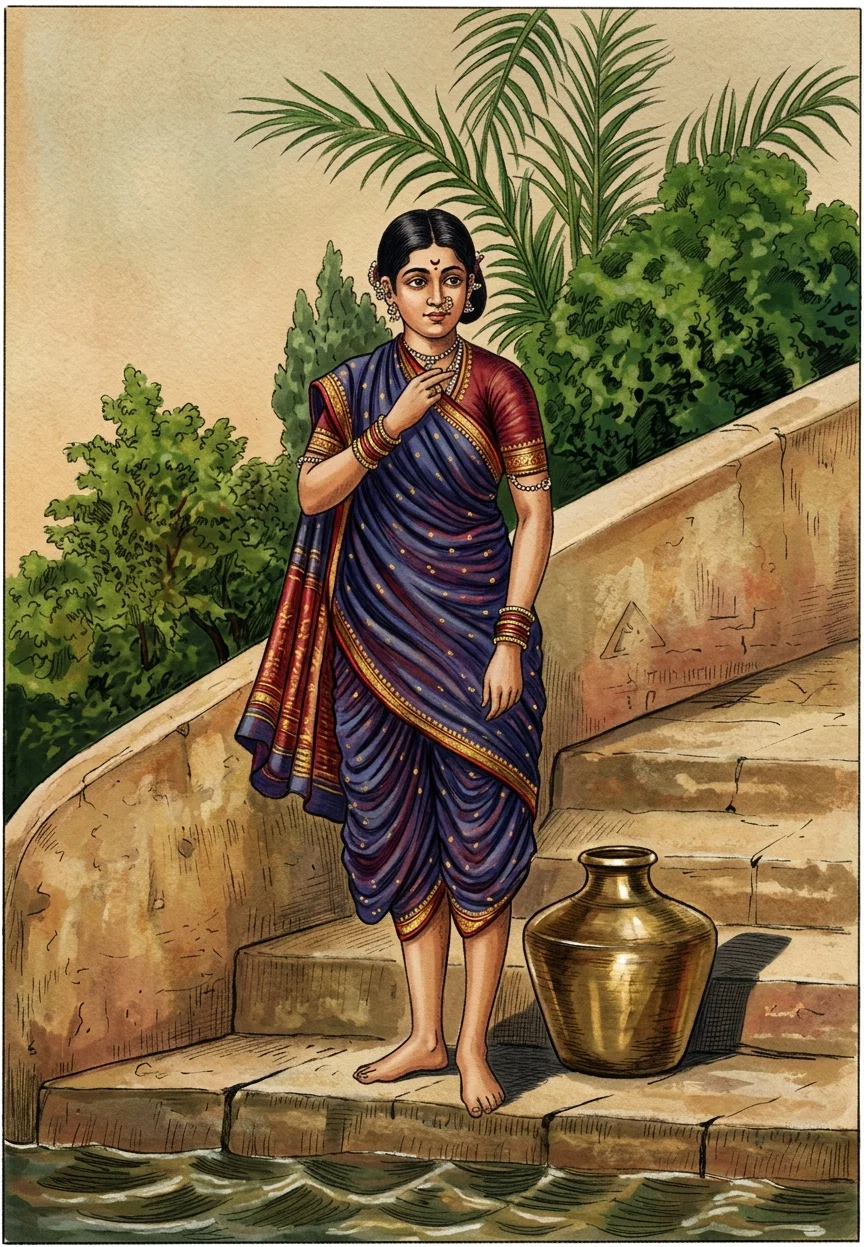
THE most conspicuous feature in the costume of the women of Hindustan is their jewelry. One great reason why girl babies are not welcomed at birth as are the boys is that the father knows that upon the occasion of the girl’s marriage he will be compelled to give her a dowry of jewels, and many a poor man wonders where the money to meet this expense is coming from.
These women of India wear bracelets, armlets, anklets, finger rings, toe rings, and earrings. Several rings are in each ear, and some of the lower rings are so low that they rest upon the shoulder, and sometimes they are so heavy as to break through the tender flesh.
Nose rings are seen, six or eight inches in diameter, tied to the right ear to keep them out of the way of the food.
Bands are worn on the forehead, from which heavy pendants hang; and it is not unusual for necklaces to extend from the neck to the waist line.
Beautiful chains are sometimes worn around the waist in lieu of a belt, and from three to ten bracelets on the ankles.
The low-caste women who daily go forth to their arduous tasks, wear heavy anklets and other jewelry made of pewter or clay, “to be in style.”
These people have learned the art of making jewelry out of very cheap material. Shellac is much used. Gold is not worn on the feet by even the highest in rank, but most dainty gold and silver breastpins and earrings are used by those who can afford them.
There are time-honored distinctions of dress, also, by which the different classes are readily distinguishable.
The highest-caste woman, or Brahmani, is invariably robed in a white sari. This is a strip of cloth five yards long and one and one-half wide, so arranged as to completely and not ungracefully cover the entire person, even the face when necessary.
The lower castes wear a bright-colored skirt, made scant in the back but very full in front, above which a small jacket is discerned. Then over head and shoulders the chaddar is gracefully draped. It may be of any color or material, but is often edged with gold or silver tinsel braid.
The women of the low castes need not keep their faces covered.
In addition to the sari, the Parsi ladies wear a very fancy head-dress, which would be very becoming if they were not compelled to wear it so low over their foreheads as to entirely conceal their jet black hair.
This fact was forcibly impressed on my mind during one of my visits to a Parsi family in India. The youngest and prettiest of the girls had pushed her head-dress back, showing a broad, high forehead and some of her hair, for which she was severely reprimanded, being reminded in very forcible terms that it was the mark of greatest disrespect for a young girl to allow even a particle of her hair to be uncovered in the presence of her elders. Poutingly she drew down her head-dress, knowing full well it was not so becoming.
The most wealthy Parsis dress very richly, and when they ride out unveiled, as they often do with their husbands, they present a charming picture.
The Mohammedan costume is neither pretty nor graceful. Trousers are worn awkwardly made, and substituted for the skirt. The poorer classes have theirs made very tight about the ankle, but full around the waist, while those belonging to the higher class have theirs fashioned to fit closely about the hip, then sloping out at the bottom. Sometimes they are so very full and long that it is necessary to tuck them into the belt, forming huge folds in front, but producing a very unartistic effect in the back.
A WOMAN OF ONE OF THE HIGHER CASTES.
(By a Native Artist.)
The jacket is a tiny little “play affair” made of a sort of flimsy material which barely serves as a foundation for the embroidery and trimming.
The arms are left bare, that they may be covered with bracelets. I have counted eighteen below the elbow and twenty above on one arm.
The chaddar is usually made of very thin material and often heavily trimmed.
The Mohammedan women are very fond of bright colors, and the high classes always wear them, especially red, while the low caste, in contradistinction to the Hindus, always wear white, or at least it shows that it was once that color. They wear a dress reaching to the ground and kept in place by a girdle.—Gospel in All Lands.
Our Work and Workers.
Our school at Keene, Texas, has an enrolment of 115 students. Of these, fifty-five live at the Academy Home.
Meetings are being held amongst the Swedes in five different places in Muskegon, Mich., by Brethren J. M. Eriksson and P. L. Hoen. A good interest is reported.
Brother W. S. Hyatt, formerly president of Kansas Conference, now of Battle Creek, Mich., will shortly go to South Africa to connect with the work in that field.
At the annual meeting of the Florida Conference held in January, L. H. Crisler was elected president, and Josephine Grannis, secretary. The executive committee is composed of L. H. Crisler, M. G. Huffman, J. D. Heacock, A. M. Morrill, and Irving Keck.
A good report comes to the Review concerning the work in Brazil. Brethren H. F. Graf and A. B. Stauffer recently made a journey into the state of Rio Grande do Sul. They stopped first at Porto Alegre, where six persons received baptism. At Ijuhy, where a small company had been calling some time for help, they held meetings for three weeks, which resulted in the organization of a church of forty-two members. The report says: “The power of God was present, and manifested itself especially during the ordination of officers, relieving12the elder of a bodily infirmity and converting sinners, so that immediately afterward six persons were baptized.”
HELPING HAND MISSION.
By S. N. Curtiss
Some liberal donations have come in during the last week, and the first thousand-dollar mark has been passed. Several contributions of food, clothing, and bedding have also come in, and these are greatly appreciated. Still there is need for much more in this line. Can not the members of some of our churches in California unite and send in a quantity of dried fruit, beans, etc.? We shall require large quantities of white beans, and shall be pleased to hear from those who can assist in this direction.
The following is the report of cash contributions for the week ending Feb. 22, 1898:—
Reported last week . . . . . . . . $895 60
Cash received this week . . . . . . 303 00
Total . . . . . . . . $1,198 60