Note.—This event occurred in the third year of the ministry of Jesus, who was then at Galilee with his disciples. John had been imprisoned one year, and was martyred at the age of 33, in a fortress named Machærus on the borders of Arabia, in which Herod’s birthday feast was being held. This rash vow of Herod, like the vow of Jephthah (Judges 11: 30–40), is a standing example of the folly of making rash vows or promises. In addition to the main subject of the lesson, the martyrdom of John, the lesson section contains a striking temperance lesson. Herod had, without doubt, been partaking freely of intoxicating wine. The section includes the lesson scripture, the parallels, and other references to John the Baptist. The parallels are Mark 6: 14–29 and Luke 9: 7–9. References to the birth of John the Baptist will be found in Luke 1: 5–25, 57, 80, and to his ministry in Matt. 3: 1–12; John 1: 19–28. Jesus’ testimony to John and his work will be found in Matt. 11: 7–19; 17: 12, 13; 21: 32.
¹ “At that season Herod the tetrarch heard the report concerning Jesus, and said unto his servants: This is John the Baptist; he is risen from the dead; and therefore do these powers work in him. ³ For Herod had laid hold on John, and bound him, and put him in prison for the sake of Herodias, his brother Philip’s wife. ⁴ For John said unto him, It is not lawful for thee to have her. And when he would have put him to death, he feared the multitude, because they counted him as a prophet. ⁶ But when Herod’s birthday came, the daughter of Herodias danced in the midst, and pleased Herod. ⁷ Whereupon he promised with an oath to give her whatsoever she should ask. ⁸ And she, being put forward by her mother, saith, Give me here in a charger the head of John the Baptist. ⁹ And the king was grieved; but for the sake of his oaths, and of them which sat at meat with him, he commanded it to be given; and he sent, and beheaded John in the prison. ¹⁰ And his head was brought in a charger, and given to the damsel; and she brought it to her mother. ¹² And his disciples came, and took up the corpse, and buried him; and they went and told Jesus.”
Golden Text: “Keep thy heart with all diligence; for out of it are the issues of life.”Prov. 4: 23.
SUGGESTIVE QUESTIONS.
(1) What unwelcome news came to the ears of Herod the tetrarch? Verse 1. Note 1. (2) What did a guilty conscience lead him to conclude in regard to the identity of Jesus? Verse 2. (3) What did he think John the Baptist had done? Same verse. (4) What would this explain to Herod’s mind? Same verse. Note 2. (5) What had Herod first done to John? Verse 3. (6) What was the occasion for this act on the part of Herod? Same verse and verse 4. Note 3. (7) What desire did Herod have in his heart concerning John? Verse 5. (8) Why did he not carry out his desire? Same verse. (9) How did the multitude regard John? Same verse. (10) What feast was being kept at this time? Verse 6. (11) What feature of the feast seems to have been most pleasing to Herod? Same verse. (12) What rash vow did this lead Herod to make? Verse 7. Note 4. (13) What shows that the wife of Herod was plotting in this for the life of John? Verse 8. (14) Being instructed by her mother, what request did Herodias’ daughter make? Same verse. (15) How was the tetrarch affected by this request? Verse 9. (16) Notwithstanding his feelings, what did he do? Same verse. (17) What followed the giving of the command? Verse 10. (18) What was done with the head of the martyred forerunner of the Saviour? Verse 11. Note 5. (19) What did John’s disciples do when they heard what Herod had done? Verse 12. (20) Whom did they inform of the sad end of their teacher? Same verse.
NOTES.
1. Herod the tetrarch.—Herod Antipas, son of Herod the great, who had slain the babes of Bethlehem. He was heir of one-fourth of the kingdom over which his father reigned, the word “tetrarch” signifying a ruler of one-fourth.
2. Therefore do these powers work in him.—The fame of John the Baptist and the work which he did were well known to Herod, and the theory that John was raised from the dead would account to him for the greater works which Christ was doing, as the reports which had come to him of the work of Christ proved to him that they were greater works than man could do. Of course, one raised from the dead would be expected to do what one subject to death could not do. Superstition and a guilty conscience added weight to the theory which was giving Herod so much uneasiness.
3. For the sake of Herodias.—John had said to Herod, “It is not lawful for thee to have thy brother’s wife.” “Therefore Herodias had a quarrel against him [John].” Mark 6: 18, 19. “Herod had put away13his lawful wife, the daughter of Aretas, an Arabian king, for the purpose of marrying Herodias.”—Peloubet. He had also, while a guest at his brother Philip’s house, won the affections of his brother’s wife, and married her, in spite of all law. In so doing, he had broken the law of the Lord recorded in Lev. 18: 16. Herodias was Herod’s niece as well as his sister-in-law, and such a union was unlawful even if not prohibited for other reasons. It was probably the law by which the Jewish nation was governed in these things that John was impressing upon Herod. We see in this rebuke of one high in authority that the greatest as well as the lowliest are alike accountable to God for their course.
4. Promised . . . to give her whatsoever she should ask.—Here is recorded a striking example of the folly of rash, thoughtless vows. Herodias had long been conspiring for the death of John; and it was the custom for dancing girls to receive valuable presents from those whom they were entertaining. The feast gave her an opportunity to carry out her design, and the result of the dancing fulfilled her plans and expectations. Herod was anxious to bestow a princely gift; and, to make it more highly prized by the recipient, he gave her the right to say what it should be. This was Herodias’ opportunity, and she made the most of it. Thus the custom and the opportunity combined to make her deep-laid scheme a success.
5. His head was brought in a charger.—Compare the work of the martyr and that of the one who accomplished his martyrdom. John’s life and mission were a glorious success, and he will finally be crowned with eternal life. “Herodias’ success was brief as well as troubled. In A.D. 38, ten years after the death of John, Herodias stirred up her husband to go to Rome and obtain from the emperor the title of king. But, being followed by complaints of the oppressed Galileans, the result was that he was deposed even from his tetrarchy. Then he was banished to Lyons, in France, and afterwards to Spain, Herodias accompanying him in his exile, where they died in banishment.”—Peloubet.
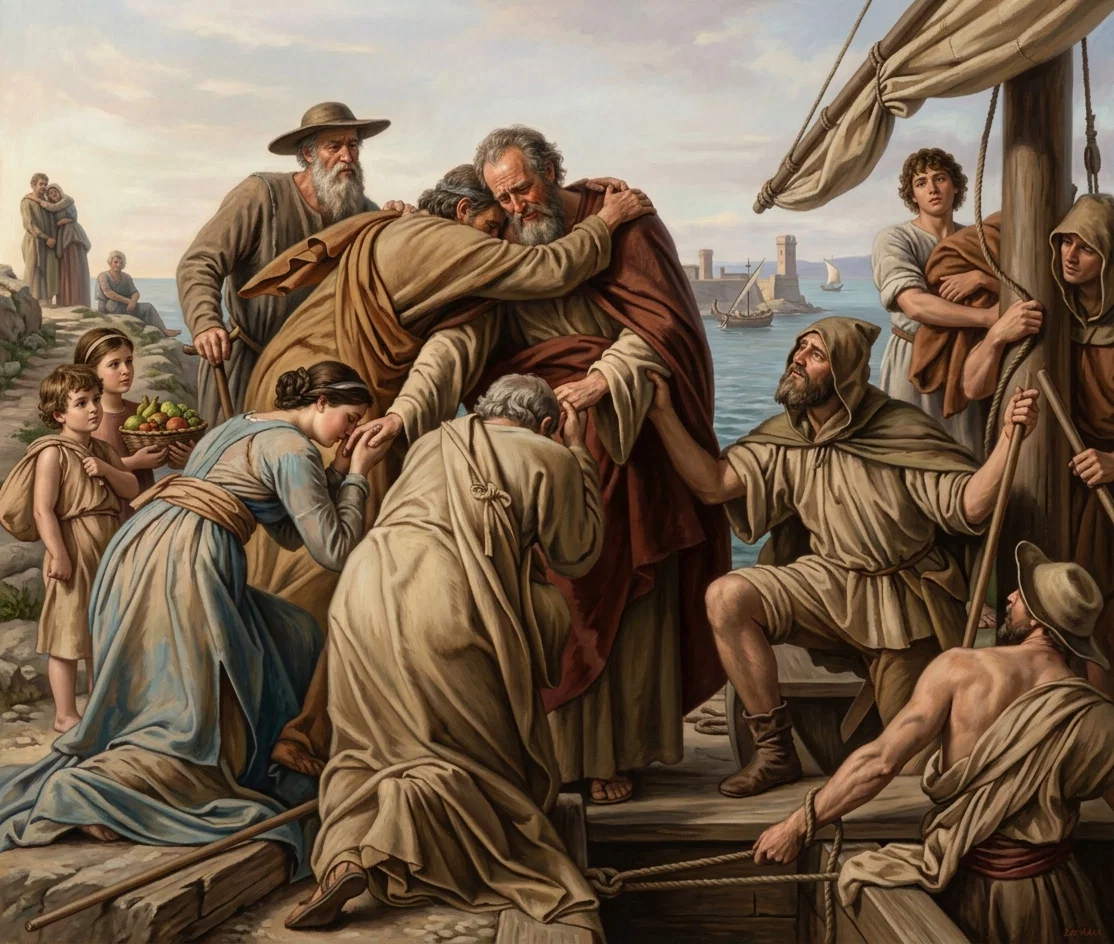
PAUL'S FAREWELL TO THE ELDERS OF EPHESUS.
Evangelistic Work in Montana and Cleveland
DURING the month of January Brethren C. M. Martin and W. J. Stone held a week's meetings in each of the following Montana cities: Helena, Great Falls, Missoula, and Bozeman. The visible result of the meetings was that twenty-three persons were baptized, and twenty yearly subscriptions were taken for our periodicals. The churches were greatly revived, and missionary work received a marked impetus.
BROTHER D. E. LINDSEY reports as follows to the Welcome Visitor: “At the Cleveland Mission Saturday night, February 5, the workers divided their forces, some holding a street service, others visiting the saloons, while others remained to talk with a room full of destitute men who had gathered for service and lodging. The street meeting was held amidst the booming of cannon and firing of rockets, and a general time of confusion incident to a great celebration. Yet many stopped to hear the singing, and, listening to the tender appeal from the Gospel workers, were led to the meeting at the Helping Hand Mission.”
PERIODICALS WANTED.
CLEAN copies of Our Little Friend and Youth’s Instructor are wanted for missionary work in the south. Please send post-paid to F. W. Halladay, Yazoo City, Miss.
MRS. S. L. WALRATH, Santa Cruz, Cal., solicits late clean copies of the SIGNS OF THE TIMES, Review and Herald, and American Sentinel, for missionary work. Please prepay postage.
OUR GENERAL AGENTS.
General Eastern Agency.—Pacific Press Pub. Co., 39 Bond St., N. Y. City, N. Y.
General Central Agency.—Pacific Press Pub. Co., 14-18 W. 5th St., Kansas City, Mo.
Argentine—Señor N. Z. Town, Casilla del Correa, 481 Buenos Ayres, Argentine Republic, S. A.
Arkansas Tract Society—Fayetteville, Ark.
Atlantic Tract Society—39 Bond St., New York City, N. Y.
Australia—Echo Publishing House, North Fitzroy, Victoria.
Australian Tract Society—251 St. George’s Road, North Fitzroy, Australia.
California Tract Society—1059 Castro St., Oakland, Cal.
Texas Tract Society—626 and 628 Elm St., Dallas, Tex.
Upper Columbia Tract Society—College Place, Wash.
Utah Tract Society—Box 1058, Salt Lake City, Utah.
Vancouver Island—B. Robb, 231 Pandora St., Victoria, B. C.
Vermont Tract Society—190 N. Winooski Ave. Burlington, Vt.
Virginia Tract Society—2504 E. Clay St., Richmond, Va.
West Virginia Tract Society—Newburg, W. Va.
Wisconsin Tract Society—Milton Junction, Wis.
DESTRUCTIVE WEAPONS.
“It is scarcely possible to conceive the destructive power pent up in one of the great cannon of to-day.
“The highest military authority states that ‘the impetus of a modern projectile weighing one thousand pounds, as it leaves the mouth of a twelve-inch gun, is equal to that of a sixty-ton locomotive with a train of eight cars, moving at the rate of fifty miles an hour.’ Is it any wonder, then, that a two-thousand-pound missile hurled from the big sixteen-and-one-fourth-inch gun with all the explosive force of half a ton of powder, should crash through nearly forty feet of steel, iron, and solid masonry, as shown in the illustration on page 12?”
The above is taken from our new tract, “The Alarm of War.”
BAPTISM: Its Significance, Its Nature, and the Necessity for It.
By E. J. Waggoner. Bible Students’ Library, No. 79. Pacific Press Pub. Co., Oakland, Cal. 16 pp.; 2 cents.
THE MISSIONARY MAGAZINE
Organ of the Seventh-day Adventist Foreign Mission Board, a journal alive with missionary information, especially with that which pertains to the work and movements of the missionaries of the denomination.
Published monthly at 25 cents per year, 50 cents to foreign countries.
Send subscriptions to the publishers, 1730 North Fifteenth Street, Philadelphia, Pa., or to your tract societies.
Advertisements at usual rates solicited.
“Christian” Demand for War
Bible Students’ Library No. 151, “Christian” Demand for War.
A striking object lesson. By Dr. E. J. Waggoner, illustrated. 16 pages; 1 cent.
“In God’s name let us raise an army and . . . sweep the old murderer and all his tribe into the sea,” says one correspondent in a leading religious journal, referring to the Turks. Dr. Waggoner quotes such utterances because they indicate the “Christian” sentiment which is really consecrating the spirit of war. He asks those holding such sentiments, “When the name of Christ, the Prince of peace, is used as a war cry, where shall we look for peace on the earth?” It contains some of the most powerful arguments against the use of force by Christians that we have ever read, and if widely distributed will awaken people to the iniquity of the principle involved. One of the illustrations is found on the cover page, and shows the mosque of Omar, where thousands of the Saracens met death at the hands of the “Christian” crusaders.
PACIFIC PRESS PUBLISHING CO., Oakland, Cal
Bible Students’ Library No. 152, “The Alarm of War.” By Elder A. O. Tait.
Fully illustrated. 32 pages; price, 2 cents.
“The alarm of war” is continuously sounding from some part of the world. Every few days the papers tell of new inventions or improvements in the weapons of war. Already the powerful cannon and torpedoes, the rapid-fire and machine guns, along with all the other modern devices for killing men by the wholesale, are causing the questions to be anxiously asked, What are we coming to, anyway? Will the nations rush into war armed with these terribly destructive implements? What does it all mean?
These preparations are shown to be one of the signs of the end, and a fulfilment of prophecy. A series of vivid illustrations is an attractive feature and will gain the tract many readers. Every one is interested in, and will read on, this subject. Let us give them a chance.
PACIFIC PRESS PUBLISHING CO., Oakland, Cal
39 Bond St., New York City. 18 West 5th St., Kansas City, Mo.
A GOOD TRACT FOR USE.
By Clarence Santee
“THE Great Threefold Message” is just out as No. 47 of Apples of Gold Library series. It ought to be read by every Seventh-day Adventist, put in every reading-rack, and in the hands of every person who will read. Sometimes I fear that we are passing by the great foundation-stones of the message in our haste after something new. This tract is presented in such a way that people will read. Let the tract societies send in large orders for this tract and follow other publications that have been put out, with this tract, that you will find second to none. It has three illustrations, and contains sixteen pages. Price, one cent. Thousands of these ought to be used in Iowa before the evenings become short. Send them by letter, and in every way. I think the first general effort for 1898 may well be made with this tract.—Clarence Santee, in Workers’ Bulletin.
A BARGAIN.
By William Ward Simpson
I HAVE on hand a limited number of the old edition of “Thoughts on Daniel,” by Uriah Smith. This book sold for one dollar and twenty-five cents ($1.25). As long as they last I will send the same post-paid for fifty cents per copy. This will make a cheap and acceptable present for a friend. Send in your order soon, as they will not last long. Address, William Ward Simpson, Battle Creek, Mich.
News and Notes
Foreign.
—Spain is said to be seeking allies among the Spanish American republics to aid her in case she should go to war with the United States.
—It is proposed by the Agrarian element in Germany to make the exclusion of American importations one of the planks in the coming elections.
—Rev. W. H. Emberly, formerly of the Wesleyan Chinese mission, while selling books in Chefoo, was so seriously assaulted on January 15, that he had to be escorted by soldiers to Chi-Ming.
—A terrible explosion of fire-damp occurred in the colliery at Hammerly, Prussia, on February 17, and it is believed that fifty persons perished, while many others are seriously if not fatally injured.
—On February 17 a large tract of ice on the coast of the Gulf of Finland broke adrift and carried 200 men and a number of horses out to sea. After an exciting experience the men were rescued.
—There are now in Japan 197 kindergartens, with 390 teachers. Forty of these schools are in the city of Osaka alone. Japan has now 600 newspapers and periodicals where two decades ago she had none.
—Russia has begun the transportation of troops by water to her fortifications at Vladivostok, 2,000 soldiers with sixteen cannon having passed through the Bosporous bound for that station on February 16.
—The French are mobilizing troops in Tonquin, to co-operate with the squadron on the arrival of reinforcements; but whether the point of attack will be the island of Hai-Nan or the border villages of Siam, is not known.
—It is stated in Madrid on the highest authority that Spain will never consider any other concessions in Cuba than those embraced in the scheme of autonomy which is now being tried. This is said to be the final decision of the government.
—The Chilian ship Alacama, bound from Australia for San Diego, was abandoned at sea about February 9. Three of her crew were picked up by a tug, but the remainder are supposed to be either adrift in the boats or at the bottom of the ocean.
—The transatlantic steamer Flachat, bound from Marseilles for Colon, was wrecked on Anaga Point, Canary Islands, on February 16, and forty of her passengers and crew went down with the vessel. A portion of the passengers were rescued.
—Señor Paolo y Bernabe, the new Spanish minister to the United States, who takes the place left vacant by De Lome’s resignation, was given a farewell audience with the queen regent on February 20, preparatory to his departure for Washington.
—Russia, France, and England, with Germany’s assent are now proposing Prince George for the governorship of Crete, with the proviso that he renounce all allegiance to the throne of Greece. It is thought this arrangement may be acceptable to the sultan.
—It is reported from London that the Chinese loan of $80,000,000 has been arranged for with the Hongkong and Shanghai Bank of London and the German Asiatic Bank, and that the loan would not have been concluded had not Germany insisted, to prevent Russia obtaining it.
—Oom Paul Kruger, president of the Transvaal Government, is imbibing the spirit of preparation for war, and, according to a Cape Town correspondent of the Daily Mail, “is mounting guns at Johannesburg, and conveying Maxims, shells, rifles, and cartridges to that point in an offensive and ostentatious manner.”14
—Continual rumors of approaching conflict come from the frontiers now in dispute between England and France in West Africa. The latest advices from that vicinity are to the effect that the French have established a military post on British possessions. Both countries are laying claim to rich territory, and the outlook is declared to be serious.
—The Japanese Government has refused the requests of China for an extension of time on the payment of her war indemnity, and the Japanese Times, the organ of the Japanese Government, states that if the indemnity is not paid on time, the result will be the inaugural of an epoch in the eastern crisis, more important than anything which has yet occurred.
—A London Times correspondent writing from Pekin, states that the Chinese Government has decided to open all her inland waters to navigation, under regulations to be framed subsequently. The agreement is to come into operation within four months, and promises a wide expansion of trade. It will no doubt be of material help to the missionaries in opening work in new fields.
—Japan, distrusting Russia’s activity at Port Arthur, recently pressed China for assurances that Russia would evacuate the port in the spring. The Chinese minister at St. Petersburg, in attempting to secure this assistance from the Russian Government, evoked the statement from Russia that the Russian vessels would remain at Port Arthur longer than originally designed. This is regarded as an intimation that Russia intends to retain the port permanently.
—It is reported that renewed activity is now manifest among the Cuban insurgents in the field, as a result of the disaster to the battle-ship Maine and the belief that war would follow. The conditions in the camps where reconcentrados are herded are said to be growing worse and worse. In the city of Matanzas 14,000 are absolutely without food or shelter. Clara Barton, who is now working among the sick and starving Cubans, is said to be fairly overcome with the scenes of horror and desolation in the stricken island.
—M. Emile Zola, the famous French novelist, has been sentenced to pay a fine of 3,000 francs and serve one year in jail for the part which he has taken in advocating the innocence of Dreyfus and the guilt of those who were instrumental in convicting him. This sentence deprives him of his citizenship and brands him as a felon. When sentence was pronounced upon him, the crowded court-room became a veritable pandemonium of jeers and curses for the prisoner, and shouts of approbation for the army. Outside of France the conviction is most general that Dreyfus is innocent and a great injustice has been done the one who championed his cause.
—The report submitted to the Porte concerning the outrages perpetrated by the sultan’s subjects upon the Bulgarians, rehearses the most shocking brutalities. Villages were surrounded, arrests made, and the prisoners were tortured by hot irons thrust into their mouths; their legs were broken; splinters were driven under their nails; their naked feet were placed on hot stoves; they were hung up by the hands or feet over fires; some were tied to horses’ tails, while others were beaten to death. The special victims of the Turks were the schoolmasters. Bulgaria’s sharp demands upon Turkey have checked the outrage for the time being, and investigations are still proceeding.