[From time to time we will reply under this head, if deemed advisable, to such candid inquiries as may be sent us. Correspondents wishing a reply to their questions must give their full name and address, not for publication unless they wish, but as an evidence of good faith on their part, and to give us opportunity to reply by letter if deemed best. It is always well to inclose stamp. Let the questions be short and pointed, and such as may be answered in limited space. The questions will be numbered continuously.]
No. 394. He Came to His Own.
In John 1:11, “He came unto His own, and His own received Him not;” what is referred to as “His own”? J. M.
It means that Christ came to his own world that he had created, his own people that he had redeemed, his own nation to which he had given special light and privilege, to his own tribe, that of Judah, but his own did not receive him. Rotherham renders, “Unto his own possessions he came, and his own people did not receive him home.”
No. 395. Questions in Revelation.
(1) What does the word “him” in Rev. 16:8, last clause, signify? Please explain the verse. (2) Please explain Rev. 20:8. What do Gog and Magog refer to? (3) Explain Rev. 20:14, first clause. (4) Are those who die in the faith under the third angel’s message (see Rev. 14:8-14) numbered with the 144,000?
W. H. F.
1. The word “him” of Rev. 16:8 refers to the sun. It is by many translated “it.” The verse means just what it says, and applies to a period of time just after probation closes.
2. Gog and Magog seem to refer to the wicked nations of earth, who will be deceived by Satan after the second resurrection, at the close of the thousand years.
3. “And death and hell [hades, the grave] were cast into the lake of fire.” It simply means that death and the grave shall be forever destroyed. They will no more mar the enjoyment of the people of God.
4. We do not know. Some of them may be. All will probably stand with the 144,000, but only those who have had the experience of the 144,000 will be numbered with them.
For fuller explanation of these passages see “Thoughts on Daniel and the Revelation.”
No. 396. Shall See Heaven Open.
In John 1:51 Jesus says to Nathanael that he “shall see heaven open, and the angels of God ascending and descending upon the Son of man.” Did Nathanael realize that statement? If so, when? A. W.
In our Lord’s words there is evident allusion to the ladder seen by Jacob. See Gen. 28:12. That ladder typified Christ. The seeing doubtless had reference not to literal physical vision, but to a deeper spiritual sense, which Nathanael realized by believing in Christ. Heaven was thus opened, and Christ was seen as the antitypical ladder. Just when Nathanael thus saw, or where, we do not know. That he should see, Jesus plainly declares, and of that there can be no question. When Christ5comes again, all who have seen in him by faith the antitypical ladder, will see him in glory with all the holy angels.
No. 397. Third Day from What.
John, chapters 1 and 2, speaks of the first, second, and third day of Jesus being among them, but Matthew and Mark and Luke tell us that when he was baptized he was tempted of the devil forty days, and this immediately after his baptism. Please explain how Jesus could be among them a number of days, and yet be immediately driven in the wilderness.
A. W.
As our querist apprehends, John does not mention the temptation at all. What John records in chapter 1:29 and onward was after the temptation, not before. Jesus after his temptation returned to where John was baptizing, and to him John bore witness. Verse 29. Then the next day after this (the first day) John again pointed him out, and the work of Jesus began in the calling of the disciples. The day following (the second day) Jesus started for Galilee. Verse 43. The “third day” after John bore witness to Jesus the second time, came the marriage at Cana.
No. 398. Everlasting Punishment.
How will we harmonize Matt. 25:46 and Mark 9:43-48 with other passages where it is declared that the wicked shall be burned up?
T. W. K.
Simply understand the passages for what they mean. Matt. 25:46 says “everlasting punishment,” not everlasting punishing. It is punishment completed to all eternity. What that punishment is, is shown by 2 Thess. 1:9, “everlasting destruction.” It is a punishment which will be for all eternity, which will never be repeated, a burning up “root and branch.”
So also in Mark 9:43-48. The fire and the worm are symbols of absolute and utter destruction. The worm shall not die till it has consumed all that it can consume, nor the fire quenched till it has burned all that is to be burned. See Isa. 51:6, 8, and 66:24, where it is said that the moth shall eat them up, and the worm shall feed, not on immortal men, but on the carcasses, the dead bodies, of the wicked. See also Jer. 17:27, where the fire that “is all not be quenched” meant should not be quenched till it had “burned all the palaces thereof with fire.” See 2 Chron. 36:19, 21. The word “hell” in Mark 9:43 comes from Gehenna, the valley of Hinnom, a place just outside of Jerusalem, where the bodies of malefactors and the offal of the city were cast. Here worms preyed on the carcasses, and constant fires were kept burning, to consume all impurities. It meant complete and utter destruction to all cast into it, and for this reason it was used by our Lord as a symbol of the utter destruction of the wicked.
No. 399. “The Worm Dieth Not.”
Please explain Mark 9:44, “Where their worm dieth not, and the fire is not quenched.”
E. B.
See answer to question 398. The expression “fire is not quenched” should be “unquenchable fire” (see R. V.), that with which “the chaff,” the wicked, will be utterly burned up. Matt. 3:12.
No. 400. The Lord’s Day.
What day of the week is meant by “the Lord’s day” of Rev. 1:10?
Z. Y.
What authority does our correspondent want? If he is satisfied with the word of God, which thoroughly furnishes the man of God to every good work (2 Tim. 3:16), we can answer the question both briefly and clearly. The text—Rev. 1:10—does not tell us which day is meant, but simply shows us that when the Revelation was written, about A.D. 96, there was a day called the Lord’s day. What day is this? In Mark 2:28 Jesus says of himself, “The Son of man is Lord also of the Sabbath day;” in Isa. 58:13 the Lord by the prophet calls the Sabbath “my holy day;” in Ex. 20:10 we read, “The seventh day is the Sabbath of the Lord thy God;” and in Matt. 28:1 and Mark 16:1, 2 we learn that the Sabbath comes just the day before “the first day of the week.” Therefore, according to the Bible, “the Lord’s day” of Rev. 1:10 is the Sabbath of the Lord, the seventh day of the week.
THE POWER OF THE GOSPEL.
By S. N. H.
BY S. N. H.
There are but few who appreciate the privileges contained in the Gospel of Jesus Christ. Said the apostle, “I am not ashamed of the Gospel of Christ; for it is the power of God unto salvation to every one that believeth.” This is creative power. It is revealed in the creation of the world, in nature, in the word of God, also by the life of our Lord and Saviour Jesus Christ. It embraces all the power of the universe. “For by him were all things created, that are in heaven, and that are in earth, visible and invisible, whether they be thrones, or dominions, or principalities, or powers.” “But my God shall supply all your need according to his riches in glory by Jesus Christ.” It is not according to his riches in this world, only, but his “riches in glory.” This embraces the universe. It is “according as his divine power hath given unto us all things that pertain unto life and godliness, through the knowledge of Him that hath called us to glory and virtue.”
The infinite power of God is pledged by the creation of the universe, and in the Gospel of Christ it is made available to us by faith. And even faith is a gift of God which all possess. It requires cultivation, by contemplation and exercise. Whether it be recognized in nature, in the inspired word, or in the life of Christ, it is all the same. Said Christ, “Though ye believe not me, believe the works; that ye may know, and believe, that the Father is in me, and I in him.” “By beholding we become changed.”
Faith is more than a mere belief in the theory of the Gospel. A man may believe that such a power exists, and yet it do him no good. “The devils also believe and tremble.” The Jews believed that Christ raised Lazarus from the dead, and because of this many of them went away and believed on him, “but the chief priests consulted that they might put Lazarus also to death.” This kind of belief exercised by the priests, brings only condemnation.
There is a great difference between man speaking the truth, and God bearing the same testimony. The truthfulness of man is based on circumstances to make it true, while, on the other hand, God is infinite and creates the circumstances that make it true. To illustrate, we say, “To-day or to-morrow we will go in such a city and continue there a year, and buy and sell and get gain.” All this would depend upon circumstances; for we know not what will be on the morrow. But were the Lord to say we were to go into a city and continue there a year, and buy and sell and get gain, it would be so, even though we should die, before going to the city; for he could raise us from the dead, because he is the Author of life. Said Abraham to his young men, “Abide ye here with the ass; and I and the lad will go yonder and worship, and come again to you.” He believed that Isaac would return with him from the mount, altho he was to offer him for a burnt-offering. He looked beyond the circumstances, and faith grasped the promises of God, “accounting that God was able to raise him up, even from the dead; from whence also he received him in a figure;” for faith “calleth those things which be not as tho they were.”
Many have been troubled with the words found in Joshua 10:12-14: “And he said in the sight of Israel, Sun, stand thou still upon Gibeon; and thou, Moon, in the valley of Ajalon. And the sun stood still, and the moon stayed, till the people had avenged themselves upon their enemies. . . . So the sun stood still in the midst of heaven, and hasted not to go down about a whole day. And there was no day like that before it or after it, that the Lord hearkened unto the voice of a man; for the Lord fought for Israel.” It is needless to say there has been much speculation over these words. The objector says this would have disarranged the whole planetary system, as no one planet could change its motion without seriously affecting others. If the supposition that it would affect the revolution of this earth for the Scripture to be fulfilled, were true, then the very word itself would have created a condition of things so that it would have been necessary for this earth to have been affected in order for the harmony to have continued. God is greater than any law of nature or any cause he ever originated. Causes produce results. God is greater than them all. This is the God of the Bible, the Author of the Gospel.
The laws natural illustrate the laws spiritual, and there is nothing more wonderful than the forgiveness of sin, the creating of a new creature in Christ Jesus. The sinner who is all polluted with moral corruption, like the leper half consumed with his disease, comes to Christ realizing his own condition, and seeing nothing but the Saviour’s healing power. Like the leper of old, he exclaims, “Lord, if thou wilt, thou canst make me clean.” Immediately he receives the cleansing power. The leper’s disease was the result of his own wickedness. His sin had brought its results; God was greater than the sin and the result of sin.
All that is necessary is repentance, and simple faith to accept the Gospel as a free6gift, and we become cleansed from sin, and new desires and aspirations are formed in the heart. The creative power of God was experienced in both soul and body of the leper, and he became a living monument of the power of the Gospel. This wonderful power that can deliver soul and body from the power of Satan, disease, and death, is the Gospel of our Lord and Saviour Jesus Christ. It is our individual privilege to believe and experience it, both mentally, physically, and spiritually.
TELL TO THE WORLD THE STORY.
Awake, O church of God! arise!
Put on thy garments white,—
The garments of his righteousness,
And Christ shall give thee light;
He'll “purely purge away the dross
And take away the tin.”
Why linger in the valleys
When we the heights may win?
Tell to the world the story,
Altho 'tis written plain,
That Christ, the Prince of glory,
Is coming soon again;
The signs that mark his coming
In thunder tones declare;
The western sun is sinking,
The day of God is near.
The story of his love repeat;
O, tell it yet once more
To sinners who have heard it
Many, many times before!
It may be that some gem of light
From out the casket fair
Will shine into a darkened mind,
And find a welcome there.
—Selected.
The Works That God Enjoins upon Man
By D. T. Bourdeau
SAVING FAITH, OR THE FAITH THAT WORKS. NO. 2.
BY D. T. BOURDEAU.
The Works That God Enjoins upon Man.
THE works that God enjoins upon man in his word are, (1) those that are primary, and (2) those that are remedial. By primary works I mean those works which were good before the fall of man, that are good now, and that will be good eternally. These works are, in the highest sense, reflective of God's moral character, and are enjoined by the law termed moral, by the law of Ten Commandments.
It is disregarding these works, or doing works that are contrary to them, that constitutes sin, which is by Inspiration declared to be “the transgression of the law.” 1 John 3:4. It was because these works had been disregarded that the plan of salvation was devised; and one great object of faith, which occupies so prominent a place in the plan of salvation, is to enable man to do these works, which still have the sanction of Heaven.
By remedial works we mean those works which grow out of the fact that divine love and divine wisdom have appointed Jesus as a remedy against sin. Prominent among these are prayer, baptism, the Lord's supper, etc. We call these works remedial, not because we think that there is virtue in them, separately considered, to remove sin, or to heal the wounds that sin has made, but because they grow out of, and relate to, the precious truth that heaven has provided us a Saviour.
These works were not known before man sinned. They never would have been known or enjoined if man had not sinned. They are conspicuous in the plan of salvation, and will cease to be obligatory upon man when the object of that plan shall have been met. But then, and during the endless cycles of eternity, shall primeval works—the works of righteousness wrought by those who will have accepted and conformed to the plan of salvation—be a sure and blessed indication of holiness of character, and a tribute of love and gratitude to God and to his divine Son.
Primary works are the same in every age. But not so with some of the remedial works. For instance, works by which it was formerly shown that a Saviour was to come (as the offering of sacrifices, etc.), have been replaced by works by which it is shown that a Saviour has come (as the celebration of the Lord's death by partaking of the Lord's supper, Matt. 26:17–29; 1 Cor. 11:23–26).
All the works that God enjoins upon us are embraced in these two kinds of works, and are clearly pointed out and defined in the Holy Scriptures, of which Paul says, “All Scripture is given by inspiration of God, and is profitable for doctrine, for reproof, for correction, for instruction in righteousness; that the man of God may be perfect, THOROUGHLY FURNISHED UNTO ALL GOOD WORKS.” 2 Tim. 3:16, 17.
If the man of God is thoroughly furnished unto all good works by the Holy Scriptures, is it not clearly evident that those works which the Holy Scriptures do not prescribe are not good works? And if they are not good works, what are they?
Man's Inability to Merit Pardon, Justification, and Salvation by His Works.
“Whatsoever is not of faith is sin,” and “without faith it is impossible to please God.” These are positive declarations of Holy Writ. See Rom. 14:23; Heb. 11:6. Imperfection and sin are stamped upon every work of ours that is not wrought through faith. In order that works may be agreeable to God, they must be accomplished through love for God and love for man; but this can not be done without that faith which works through love. Gal. 5:6. Our works—works that are not wrought by the help that comes through faith—must necessarily savor of self. They are marked by selfishness, which is a most heinous sin in the eyes of God and of all holy beings.
How, then, can we think of meriting pardon, justification, and salvation by our own works, which are “as filthy rags”? Isa. 64:6. How can we even harbor the thought that it is possible for us to merit these inestimable blessings by faith as a mental action, or by works wrought through faith? To see the futility of such a thought, let us place ourselves at conversion and answer the following questions: Can we by a mental action of one moment, or of a few moments, involving the recognition of guilt, of grievous sins committed, merit the pardon of sins against God and man that we have been years in committing? Can we by such a brief act merit to be pronounced as righteous by the Lord as we would have been had we always done the works of righteousness? Can we by this brief mental act merit to be saved from sin and its sad effects? And can we, in truth, be said to merit any blessing that God may bestow upon us, by works of faith, by works wrought through God's grace, or unmerited favor? It is Jesus, the ever blessed Jesus, who has merited for us these blessings of priceless value, and he has merited them for us because we could not merit them for ourselves.
How inconsistent, then, it would be to cherish the thought that sinful mortals can earn their pardon, justification, and salvation by their prayers, by being baptized, by celebrating the Lord's supper, or by doing (or trying to do) any other work that God enjoins upon us, whether it be moral or remedial in its character! And if we can not earn these blessings by performing works that God has ordained, how can we expect to earn them by doing works that God has never ordained, and which may be safely pronounced sinful, because they owe their origin to that wisdom which exalts itself above God's wisdom?
But this is the great error into which most of our race have fallen. The hundreds of millions that compose the heathen world think that they can appease the wrath of an offended God, atone for their sins, and merit salvation, by making long pilgrimages, repeating long and meaningless prayers, and by torturing themselves before their idols. The Mohammedans make pilgrimages to Mecca, and do other works that God has never commanded them to do, and they, too, connect with what they do the idea that they can merit God's favor.
And who can say that among the millions of Christians of to-day, there are none who think that they can atone or partly atone for their sins, and merit or partly merit their salvation by their works? The only remedy for all who have fallen into this serious error is to abhor and humble themselves in dust and ashes in view of their unworthiness, their moral weakness, and the multitude and enormity of their sins, and to exercise living, saving faith in Jesus Christ, who has merited for them pardon, justification, and salvation, because he knows that they could not merit them for themselves.
Man Can Not Justify Himself.
Justification means the act of pronouncing just or righteous, and the moral law is the rule by which to determine whether a man is just or not. If man had never sinned, or transgressed the law (1 John 3:4), he would stand to-day unperverted, well balanced, and in his primeval strength, uprightness, and glory, and could merit justification by the works of the law. But man having sinned, the case is altered. His faculties are so perverted and unbalanced, and he is so destitute of moral strength, that he can not meet the demands of the law, or do works of righteousness that are pleasing to God. And as the law of God is a perfect rule of justice or righteousness, it is utterly impossible for those who have sinned to produce, even by the grace of God, works of righteousness that exceed the demands of the law for the present, and that can cancel his sins and replace his unrighteousness, so that he can be said to be righteous. This has ever been true since the fall.
And if man has never since the fall been able to merit his justification by attempting to do the works of the moral law, was it possible for man before Christ to merit his justification by doing the works of the typical or ceremonial law? And is it possible for man since Christ to merit justification by doing the works that replace the works of the ceremonial law? It were the height of inconsistency to think that so rich a boon could be merited by works of such a character, or by any of the works we have termed remedial.
Let us take as an illustration the offering of sacrifices formerly enjoined by the typical law, and partaking of the Lord's supper, and going forward in the ordinance of baptism, now required under the Gospel. Those who offered sacrifices after God's plan under former dispensations, did so for various objects, prominent among which were the following: (1) To help them humbly to repent of their sins or transgressions of the law. (2) To help them exercise faith in the Saviour to come for the remission of sins, for justification, for strength to keep God's law, and for salvation. Was there any merit in these works?—None at all. Those who performed these works properly declared themselves unworthy, unworthy, unworthy, and in perishing need of pardon, justification, of divine aid to do the will of God, and of final salvation. The same is now true of those who commemorate the Saviour's death by partaking of the Lord's supper, and who commemorate his burial and resurrection by baptism (Luke 22:15–20; 1 Cor. 11:23–26; Rom. 6:3–5; Col. 2:12), and offer prayers to God in harmony with the plan of salvation.7
We will suppose that you, reader, are the head of a family. A beggar comes to your door. He has never merited any favor from you. On the contrary, he has dishonored you by disregarding the rules of your house, by doing his utmost to lead your children to do the same, and even by insulting you to your face on various occasions. But now he falls on his knees before you, asks you to overlook his offenses, and to give him food, clothing, and some means. Your heart is touched, and you grant him his request. He then turns around and boasts that he has merited all you have given him. A thousand times more inconsistent would it be for us, poor, sinful, fallen, and perverted mortals, to pretend that we can, by our works, merit pardon, justification, and salvation.
(To be continued.)*
HOW PARENTS SHOULD DISCIPLINE THEIR CHILDREN.
By Ellen G. White
BY MRS. E. G. WHITE.
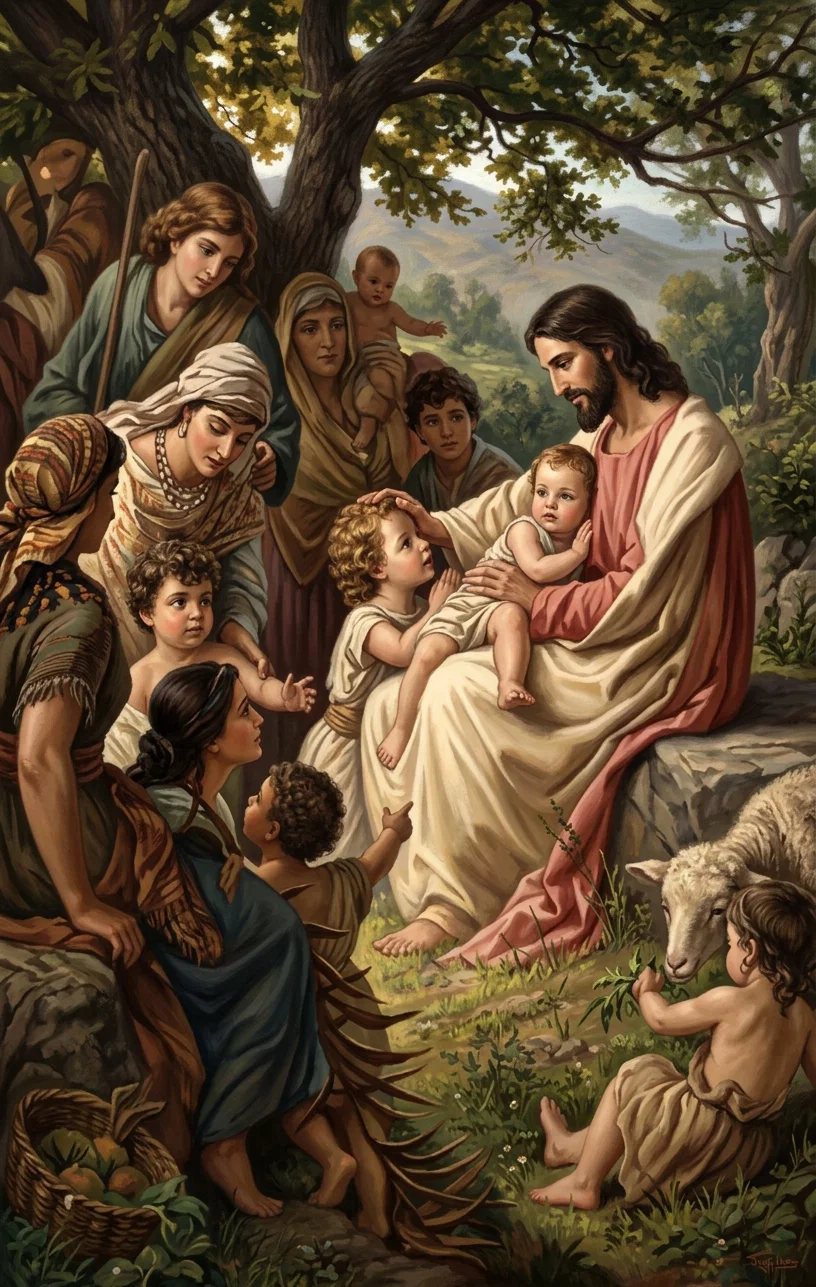
It is the duty of parents to educate and discipline their children from their earliest years. They should seek to kindly and tenderly lead them to Jesus, and impress upon the children the fact that they are anxious to secure the blessing of God upon their little ones. Parents should feel the necessity of this as much as did the mothers who brought their children to Jesus to receive his blessing. The disciples of Christ could not see why these mothers should be so anxious to bring their children into the presence of Christ. They sought to convince the mothers that this was a very improper thing to do; but Jesus reproved his overzealous disciples, and encouraged the mothers to bring their children into his presence. He said to his disciples, “Suffer the little children to come unto me, and forbid them not; for of such is the kingdom of heaven.” These precious words are to be cherished, not only by every mother, but by every father as well. These words are an encouragement to parents to press their children into his notice, to ask in the name of Christ that the Father may let his blessing rest upon their entire family. Not only are the best beloved to receive particular attention, but also the restless, wayward children, who need careful training and tender guidance.
Parents need not feel that it is necessary to repress the activity of their children, but they are to understand that it is essential to guide and train them in right direction. Give their hands and minds something to do that will advance them in physical and mental attainments.
The Lord has promised blessing to the children. He loves to purify and impress their minds, and to lead them in the way of righteousness. Children and youth may be trained in such a way as to become workers in the Master's vineyard. The Lord desires them in his service, and looks to parents to train them in such a way as to make them missionaries at home and abroad. They should be so educated that it will be their pleasure to relieve the cares of their toil-worn fathers and mothers. If parents had not neglected the fulfilling of their responsibilities in doing their parental duties to their children, there would not be so few children and youth enlisted as young soldiers in Christ's army. With proper instruction children will be gained to Christ, and may become channels of blessing to other children and youth. Their influence may be widespread, and methods should be devised so that their active temperaments may find plenty to do in blessing others. When parents thoroughly act their part, giving them line upon line, and precept upon precept, making their lessons short and interesting, and teaching them not only by precept but by example, the Lord will work with their efforts, and make them efficient teachers.
O, that the youth and children would give their hearts to Christ! What an army might then be raised up, to win others to righteousness! But parents should not leave this work for the church to do alone. If parents would search the Scriptures so that they might learn what their duty is from the word of God, they would be awakened to their duty. They would find that the world is converting the church, and that they themselves are offering the same trivial excuses for non-performance of duty as the world offers for not heeding the word of God. Let parents comply with the conditions stated in the word of God, repent of their sins, and be converted. Children have heard the Scriptures misinterpreted, and have thought the misinterpretation must be the truth. When the light of truth is presented, many of these very children are convinced that God has spoken to them. How responsible is the position of parents when their children discern truth, and they use the arguments they have heard in the pulpits to prevent their children from following in the path of righteousness, and teach for doctrines the commandments of men! Parents must educate their children tenderly and kindly, and be representatives themselves of the faith that works by love and purifies the soul. There is greater need of this kind of education now than ever before; for the world is in the church, moulding and fashioning it after a worldly standard.
Education means more than the mere studying of books. It is necessary that both the physical and mental powers be exercised in order to have a proper education. When in counsel with the Father before the world was, it was designed that the Lord God should plant a garden for Adam and Eve in Eden, and give them the task of caring for the fruit trees, and cultivating and training the vegetation. Useful labor was to be their safeguard, and it was to be perpetuated through all generations to the close of earth's history. To have a whole-sided education, it is necessary to combine science with practical labor. From infancy children should be trained to do those things that are appropriate for their age and ability. Parents should now encourage their children to become more independent. Serious troubles are soon to be seen upon the earth, and children should be trained in such a way as to be able to meet them. Many parents give a great deal of time and attention to amusing their children, encouraging them to bring all their troubles to them; but children should be trained to amuse themselves, to exercise their minds in devising plans for their own satisfaction, doing the simple things that are natural for them to do.
Children of two to four years of age should not be encouraged to think that they must have everything that they ask for. Parents should teach them lessons of self-denial, and never treat them in such a way as to make them think they are the center, and that everything revolves about them. Many children have inherited selfishness from their parents, but parents should seek to uproot every fiber of this evil tendency from their natures.8Christ gave many reproofs to those who were covetous and selfish. Parents should seek, on the first exhibition of selfish traits of character, whether in their presence, or when in association with other children, to restrain and uproot these traits from the character of their children. Do not let the child receive the impression that, because he is your child, he must therefore be deferred to, and permitted to choose and direct his own way. He should not be permitted to choose articles of food that are not good for him, simply because he likes them. The experience of parents should have a controlling power in the life of the child.
How carefully should parents manage their children in order to counteract every inclination to selfishness! They should continually suggest ways by which their children may become thoughtful for others, and learn to do things for their fathers and mothers, who are doing everything for them. But if parents are not careful, they will treat their children in such a way as will lead the children to demand attention and privileges that will call for the parents to deprive themselves in order to indulge their little ones. The children will call upon the parents to do things for them, to gratify their wishes, and the parents will concede to their wishes, regardless of the fact that it is inculcating selfishness in their children. But in doing this work parents are wronging their children, and will find out afterwards how difficult a thing it is to counteract the influence of the education of the first few years in a child's life. Children need to learn early that they can not be gratified when selfishness prompts their wishes.
Fathers should train their sons to engage with them in their trades and employments. Farmers should not think that agriculture is a business that is not elevated enough for their sons. Agriculture should be advanced by scientific knowledge. Farming has been pronounced unprofitable. People say that the soil does not pay for the labor expended upon it, and they bemoan the hard fate of those who till the soil. In this country (Australia) many have given up the idea that the land will pay for working it, and thousands of acres lie unimproved. But should persons of proper ability take hold of this line of employment, and make a study of the soil, and learn how to plant, to cultivate, and to gather in the harvest, more encouraging results might be seen. Many say, “We have tried agriculture, and know what its results are,” and yet these very ones need to know how to cultivate the soil, and to bring science into their work. Their plowshares should cut deeper, broader furrows, and they need to learn that in tilling the soil they need not become common and coarse in their natures. Let them learn to bring religion into their work. Let them learn to put in the seed in its season, to give attention to vegetation, and to follow the plan that God has devised.
The farmer and his sons have the open book of nature before them, and they should learn that farming is a noble occupation, when the work is done in a proper manner. The opinion that prevails that farming degrades the man, is erroneous. The earth is God's own creation, and he calls it very good. The hands may become hard and rough, but this hardness need not extend to the soul. The heart need not become careless, nor the soul defiled. The effeminate paleness may be tanned from the countenance, but the testimony of health is seen in the red and brown of the complexion. Christlikeness may be preserved in the farmer's life. Men may learn, in cultivating the soil, precious lessons about the cultivation of the Spirit.