Your ShelfYour Projects

Signs of the Times, Vol. 25, No. 15.

GUARDIAN ANGELS

Signs of the Times

Apr 12, 1899

Pacific Press Publishing Company · Oakland, California · Apr 12, 1899

GUARDIAN ANGELS.

ONE of the most precious assurances the child of God has is that he is under the constant watchcare of his heavenly Father. Not for one moment, day nor night, is he left alone, or does the Father allow the needs of His children to pass from His mind. "All my ways are before Thee," says David (Ps. 119:168); and, "The Lord thinketh upon me," because "I am poor and needy" (Ps. 40:17), is the rightful claim of every soul upon earth.
In an evil world, wrestling not against flesh and blood, the apparent antagonists, but against wicked angels that inspire the unkind words and evil deeds, the afflicted soul might well despair were it not for the assurance that God has power at hand to enable him to withstand these mighty, unseen foes. "This poor man cried, and the Lord heard him, and saved him out of all his troubles" (Ps. 34:6), is the promise—the fulfilled promise—to every one that calls for help. "The Lord is nigh unto all them that call upon Him, to all that call upon Him in truth. He will fulfil the desire of them that fear Him; He also will hear their cry, and will save them." Ps. 145:18, 19. "He delivereth them out of all their troubles." Ps. 34:17.
THE GUARDIAN ANGEL.
THE GUARDIAN ANGEL.
And He tells us the means He uses to do the mighty work: "The angel of the Lord encampeth round about them that fear Him, and delivereth them." Ps. 34:7. His angels "excel in strength," and "do His commandments, hearkening unto the voice of His word" (Ps. 103:20), and are abundantly able to protect from every assault or device of the enemy. The Lord has left on record numerous instances of the deliverance of His people by the heavenly messengers, and these records are for our encouragement day by day, moment by moment. To a few of them we will refer for comfort now.
Very early in the morning, after Daniel had been cast into the lions' den, the remorseful king came to the mouth of the den, and cried with a lamentable voice: "O Daniel, servant of the living God, is thy God, whom thou servest continually, able to deliver thee from the lions? Then said Daniel unto the king, O king, live forever. My God hath sent His angel, and hath shut the lions' mouths, that they have not hurt me." Dan. 6:19-22. Behind the wicked edict that had placed Daniel in this dangerous place was Satan, with his evil angels. But the power sent of God prevailed.
In the early message, Satan inspired Herod to cast Peter into prison. Four quaternions of soldiers were detailed to keep guard over him, and at night he slept between two soldiers, bound by a chain to each. Strong and as sure as man could keep him, truly. But in the night, "behold, the angel of the Lord came upon him, and a light shined in the prison; and he smote Peter on the side, and raised him up, saying, Arise up quickly. And his chains fell off from his hands." And they went out, leaving the soldiers sleeping, past the keepers before the door of the prison, past the first and the second wards, to the great iron gate, which was opened by unseen hands, through one street to another, away from the prison, "and forthwith the angel departed from him. And when Peter was come to himself, he said, Now I know of a surety, that the Lord hath sent His angel, and hath delivered me out of the hand of Herod, and from all the expectation of the people." Acts 12:3-11.
Great assurance and peace have they who fear God and trust in Him. When the king of Syria compassed Dothan about with a great host, with horses and chariots, to take Elisha, the servant of the man of God was filled with consternation at what the morning revealed. But Elisha said: "Fear not; for they that be with us are more than they that be with them. And Elisha prayed, and said, Lord, I pray thee, open his eyes, that he may see. And the Lord opened the eyes of the young man; and he saw; and, behold, the mountain was full of horses and chariots of fire round about Elisha." 2 Kings 6:13-17.
What a wonderful and comforting truth is here revealed! We may seem to be alone;the situation may appear hopeless from a human standpoint, because of the numbers against us. With them we know are hosts of evil angels urging them on to annoy or to destroy. But, praise the Lord, "fear not; for they that be with us are more than they that be with them." "The chariots of God are twenty thousand, even thousands of angels." Ps. 68:17. "Be strong and courageous, be not afraid nor dismayed for the king of Assyria, nor for all the multitude that is with him; for there be more with us than with him; with him is an arm of flesh; but with us is the Lord our God to help us, and to fight our battles." 2 Chron. 32:7, 8.
And if we truly appreciate this help, and realize that the thing is true, it will do for us what it did for the people then. "And the people rested themselves ["leaned themselves," margin] upon the words of Hezekiah king of Judah." They were not troubled in mind, because they believed that with them were mighty angels of God, more than there were helpers with the king of Assyria. In his perplexity David said: "As for me, I will call upon God; and the Lord shall save me. Evening, and morning, and at noon, will I pray, and cry aloud; and He shall hear my voice." And the Lord did hear, for the psalmist's next words are, "He hath delivered my soul in peace from the battle that was against me; for there were many with me." Ps. 55:16-18. Let us realize it.
What a comfort to know that with every child of God are mighty tho unseen companions, ever present to help and to guide aright! From dangers seen and unseen they protect those that fear the Lord, and even the wicked are often protected, in order that they may learn of God's goodness, and turn to Him. "He shall give His angels charge over thee, to keep thee in all thy ways" (Ps. 91:11), is the promise to every one that fears God. "I say unto you, That in heaven their angels do always behold the face of My Father." Matt. 18:10. "Are they not all ministering spirits, sent forth to minister for them who shall be heirs of salvation?" Heb. 1:14.
"Our fathers trusted in Thee; they trusted, and Thou didst deliver them. They cried unto Thee, and were delivered; they trusted in thee, and were not confounded" (Ps. 22:4, 5); "Yea, tho I walk through the valley of the shadow of death, I will fear no evil; for Thou art with me; Thy rod and Thy staff they comfort me" (Ps. 23:4); "Fear not, thou worm Jacob;" "for I the Lord thy God will hold thy right hand, saying unto thee, Fear not; I will help thee" (Isa. 41:14, 13); "The angel of the Lord encampeth round about them that fear Him, and delivereth them."

LIQUID AIR.

What It Is and What It Does.

IT has been left for the closing years of the nineteenth century to see the discovery and application of one of the greatest, the simplest, and most abundant forces that the storehouse of this world has ever yet unlocked to us. It is a hitherto unsuspected and untamed power of the air. Its discovery is recent, and the taming and harnessing process is going rapidly and successfully on. I refer to the latent power of liquid air.
A kettle containing liquid air at 312° below zero, boiling on a block of ice. The temperature of ice is 32° above zero. There is therefore a difference in temperature of 344°.
The world, which is supposed to be extremely wide-awake at the present time, is just now really waking up to the immense possibilities in the application of this marvelous force. Had it been discovered a century ago, the world could scarcely have made any use of it whatever. No machinery was at that time in use, or in process of construction, in which it could be used. It would have been a case of a great power entirely inert on account of the deficiency of mechanism. The taming and utilizing of the power of steam and of electricity have caused that marvelous advancement in the field of mechanics which has made this century the peer of all others, and given to liquid air the opportunity required to make manifest its power and its possibilities.
Among the interesting things science has revealed within the last five years in regard to our atmosphere are the number of gases it contains; its mechanical utility when under high pressure, and the fact that it can be transformed into a liquid with marvelous inherent power. It was only a few years ago that the air was supposed to contain but two gases, oxygen and nitrogen, with the occasional accidental presence of carbonic acid gas. Chemists have since discovered that it contains the gases known as argon, helium, krypton, metargon, and neon, and a trace of other gases. Twenty-five years ago scientists taught that air was a gas and could be made nothing but a gas. They had subjected it to enormous pressure, but they could not transform it into either a solid or a liquid. In 1877 Raoul Pictet, after many experiments, succeeded in obtaining a few drops of liquid oxygen. In 1892 Olzewski, a Polander, succeeded in liquefying nitrogen, the other principal element of air, but only in very small quantity. Prof. James Dewar, of England, succeeded about the same time in reducing both these gases to a liquid form, the first that he produced costing about $3,000 per ounce. Its manufacture at this time, however, was only a costly experiment, so costly, indeed, that it could be of no commercial use—the experiments simply proving that air could be liquefied.
For a number of years past, air under pressure has been a serviceable agent in the operation of certain machinery in workshops and elsewhere, also for the propulsion of vehicles to a limited extent. In machine shops compressed air operates steel drills, lifts heavy castings and cumbrous rolled sheets of steel and iron, runs calking machines, and heads heated rivets; but for this purpose it has to be compressed by powerful engines, sent through strong tubes to the machine it operates, and must be entirely dependent upon the compressor of the steam engine.
But air is destined to be of more independent utility to man; and this comes about through its transformation into liquid form, which was not possible, except at great expense, until within the past year. Chas. E. Tripler, of New York, who has been studying and experimenting along this line for the past eight years, has so perfected his liquefying apparatus as to be able to produce, from a single machine, liquid air at the rate of five gallons per hour. When it is understood that it requires eight hundred cubic feet of ordinary air to produce one cubic foot of liquid air, one can realize something of the problem involved in its manufacture. In other words, the atmospheric contents of a room ten feet square and eight feet high are cooled, compressed, and condensed into one single cubic foot, and that is liquid air.
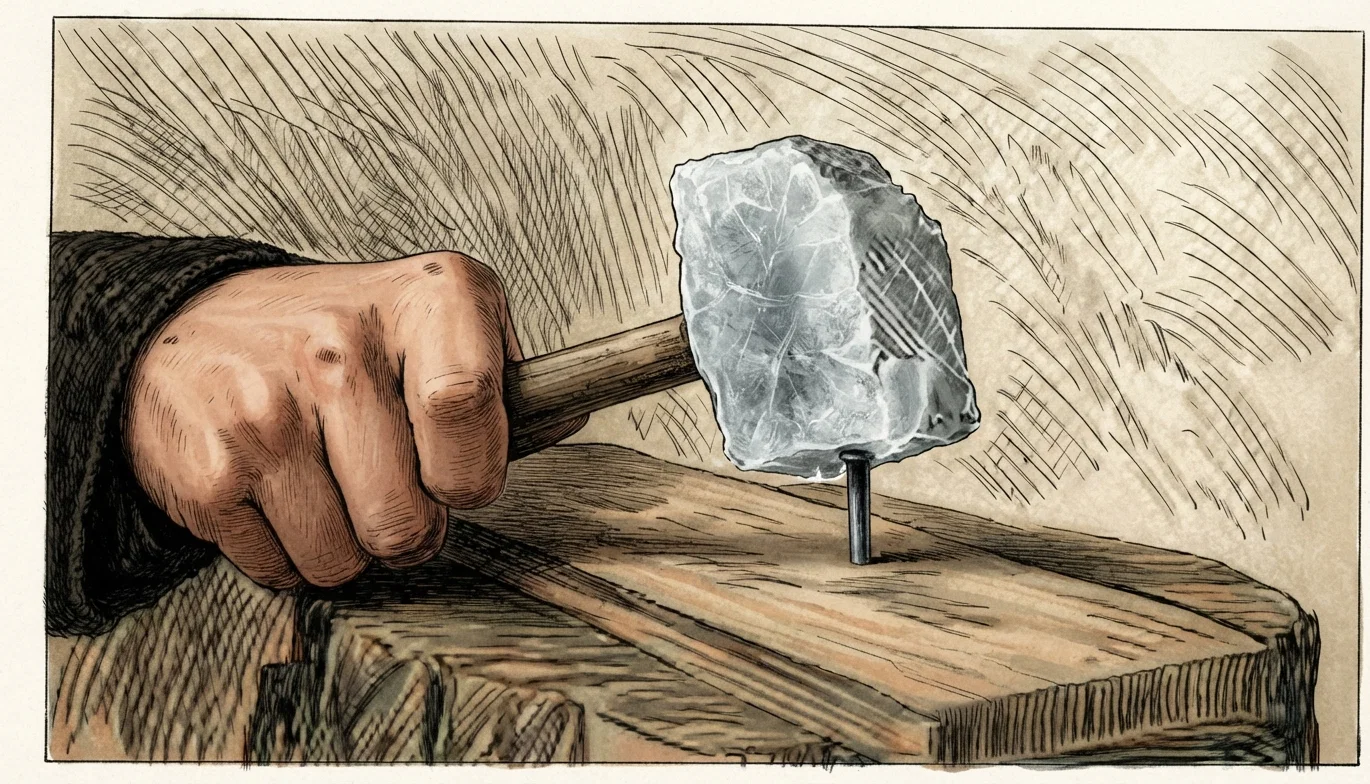
The temperature of air when thus transformed is 312° below zero, or 344° colder than a block of ice. One is not able to comprehend the intensity of such cold. Mercury, which freezes at only 40° below zero, becomes as hard as iron after being immersed for a few seconds in liquid air. Mr. Tripler has fitted a handle into a block of mercury thus frozen, and driven nails with it. Alcohol, which freezes at 212° below zero, becomes solid ice when poured into a tumbler of liquid air. It is so cold that it will even freeze iron, and make it as brittle as glass. Gold and silver, after immersion in this liquid, become soft and pliable in the fingers.
Driving a nail with a hammer made of mercury frozen in a dish of liquid air. Mercury freezes at 40° below zero.
It is difficult to think of ice as being hot, and yet in comparison with liquid air, ice is as hot as a glowing furnace. A kettle containing liquid air is placed upon a block of ice, and thekettle sends forth a jet of 'steam-air' with as much force as real steam is ejected from the spout of a teakettle placed over a blazing fire. The temperature of the ice is so much higher than the liquid air that the ice actually compels the liquid air to boil.
Liquid air can not be confined. Its expansive force is so great that it must have vent as it is gradually boiled away by the heat in the surrounding air. Herein lies the secret of its utility in operating machinery. Its gradual transformation back into gas (or ordinary air) is to-day driving successfully the piston of a ten horse-power engine, and at the same time operating machinery to produce more liquid air. Three gallons of liquid air will operate an engine a sufficient length of time to produce ten gallons, thus leaving a surplus of seven gallons from each three gallons used.
The power of liquid air as an explosive has not yet been definitely determined, but enough has been learned about it in this line to show that its force is tremendous. It can be seen that this must be so from the fact that as a gas it occupies eight hundred times the space it did as a liquid. Ordinary felt or wool saturated with liquid air and ignited explodes with the force of guncotton.
An icicle of alcohol frozen in a cup of liquid air. Alcohol freezes at 212° below zero.
All these experiments and findings are interesting from the standpoint of curiosity; but the progressive man of this practical age asks, 'Of what service is it?'
The inventor of the liquid air engine asserts that what it has accomplished on a small scale in operating his ten horse-power engine it will do on a larger scale with engines of the greatest horse-power; and there seems no real ground for denying his assertion. It is within the realm of the most apparent possibilities to anticipate that erelong it will be driving the propellors of ocean liners, the pistons of locomotives, factory engines, and pumping plants, and turning the wheels of street-cars and other forms of horseless vehicles. The inventor's claims may yet be realized in the matter of being able to supply war ships with plants for making their own liquid air to propel themselves from port to port, to use it in the place of powder for firing their guns, and in the place of dynamite, guncotton, or powder in the shells themselves, which would explode with terrible force against the sides of an opposing war ship. In addition to this service it would be used for cooling the guns in action, which would be one of its most important features in connection with the business of war.
Its use is not restricted to the field of mechanics and explosives. The intensity of its cold makes it exceedingly valuable as a refrigerating agent, and it is being used for that purpose. It will freeze a slice of beef so solid that it will ring like metal when struck with a hammer, and can be ground up into a fine dust. As liquid air is absolutely pure, physicians will use it extensively for cooling and purifying the air of sick-rooms and hospitals. No germs will be able to live in its freezing temperature. Surgeons are already making use of it in cauterizing sores and wounds, for which work it is much better than ordinary cauterizing fluids, as its action can be more easily controlled. It will eat out diseased flesh quickly and safely.
It seems evident from the progress thus far made that liquid air is to be the power of the future; and the simplicity of the apparatus required for its manufacture will make it almost an inexpensive power. Imagine the saving of expense in the production of power when neither coal nor wood are used
Steel rod burning in a cup of liquid air. Steel burns at 3,500° above zero. This great temperature is obtained by having a lighted match attached to the steel rod when it is immersed in the liquid air.
—liquid air producing liquid air, and that in turn furnishing power to drive all our machinery, propel our vessels, drive our carriages, cool our rooms, furnish our electric lights, freeze our food, and fire cannon. Verily, Roentgen rays, wireless telegraphy, and liquid air have crowned the brow of this miracle-working century, and are fast fulfilling the prophecy of God's written Word that at 'the time of the end many shall run to and fro, and knowledge shall be increased.'
C. M. SNOW.

FAITHFUL AND JUST TO FORGIVE.

"If we confess our sins, He is faithful and just to forgive us our sins, and to cleanse us from all unrighteousness." 1 John 1:9.
Every one has run up a fearful account of sin against God, and is therefore under bondage unto death. But the sinner has a friend in Jesus, who paid every farthing of that debt long ago. He, however, entered into an arrangement with God, the Father, that should the guilty one confess his iniquity, and ask forgiveness, he should be set at liberty, and the death penalty be canceled; otherwise it should not be averted.
God is declared to be faithful. It means that He will do just as He has agreed to. He will keep faith with the repentant sinner. This fact must be fully accepted by the sinner as the first condition of acceptance. But God is also just in forgiving the sinner, for the reason that Jesus paid the debt in full, and all the conditions on the part of the Saviour of sinners are complied with.
The terms of salvation are so plain that a child can understand them. Reader, will you accept them?
"All the fitness He requireth Is to feel your need of Him."
Do you feel your need of Him now?
"Come unto Me," says Jesus, "and I will give you rest." Matt. 11:28.
"Ask, and it shall be given you; seek, and ye shall find." Matt. 7:7. A. SMITH.

WE WHICH ARE ALIVE SHALL NOT PREVENT THEM WHICH ARE ASLEEP.

THE thought which used to trouble the people of God concerning those of them who died, or fell asleep, was that they might never live again. This was true of the church at Thessalonica. The apostle Paul had so vividly presented the coming of Christ that they entertained the hope that they should live to see Him come in His power. So when some of their beloved number fell asleep in Jesus, they were troubled. Word reached the servant of the Lord, and he wrote them, saying: "But I would not have you to be ignorant, brethren, concerning them which are asleep, that ye sorrow not, even as others which have no hope. For if we believe that Jesus died and rose again, even so them also which sleep in Jesus will God bring with Him." 1 Thess. 4:13, 14.
All this is turned around now. Instead of the fear that the living would reach heaven first, or enter upon the glorious reward first, leaving the sleeping ones behind, the belief is prevalent that those who die enter upon their reward first, leaving the living behind to struggle with temptation and sin. But neither of these views is correct. God forgets none of His saints. He does not love them more after they die than before. His plan is a just one, which provides for all whose names are found in the Lamb's book of life when probation ends, to enter upon their eternal joys together. "For this we say unto you by the word of the Lord, that we which are alive and remain unto the coming of the Lord shall not prevent them which are asleep. For the Lord Himself [Jesus of Nazareth] shall descend from heaven with a shout, with the voice of the archangel, and with the trump of God; and the dead in Christ shall rise first; then we which are alive and remain shall be caught up together with them in the clouds, to meet the Lord in the air; and so shall we ever be with the Lord." Verses 15-17. We shall ever be together with the Lord from that moment on throughout all eternity. Death can never have any more power over that celestial company; for they have conquered death and the grave, having by faith conquered sin, which is the sting that brings death.
But let us not forget that the sleeping ones have not gone on before. They are not called down from the skies to join the living company at Christ's coming. When Christ was asleep, He was in Joseph's new tomb. He was not sleeping in the heavens, but was locked up in Satan's prison-house—the tomb. Those who sleep in Jesus, likewise sleep in the tomb. When the mighty voice of Jesus calls them, He calls for them to arise from the dust. "Thy dead men shall live, together with my dead body shall they arise. Awake and sing, ye that dwell in the dust; for thy dew is as the dew of herbs, and the earth [not heaven] shall cast out the dead." Isa. 26:19.
Job, in regretting his birth, expressed the thought of rest, had he been laid in the grave. "For now should I have lain still and been quiet, I should have slept; then had I been at rest." "There the wicked cease from troubling; and there the weary be at rest. There the prisoners [of the grave] rest together; they hear not the voice of the oppressor." He is speaking of the grave for this rest, for He continues, "Which rejoice exceedingly, and are glad, when they can find the grave." They are not alive and active in heaven, but their ears and hearts are silent in the grave.
Blessed morning when again every ear shall hear! The Lifegiver comes at two different times, and gives life to all. All shall again hear His voice, but some awake to enter upon everlasting life, and some only awake to hear the doom of their own life-work of wickedness pronounced upon them. "And many of them that sleep in the dust of the earth shall awake, some to everlasting life, and some to shame and everlasting contempt." Dan. 12:2.
Dear reader, it is yours to decide now in which class you will be in that solemn day. In one or the other we all must stand. If you hear Christ's voice calling you to repentance to-day, harden not your heart, but turn to your loving Saviour and Redeemer, who is waiting to receive you and seal you as His. "Come unto Me, all ye that labor and are heavy-laden, and I will give you rest," is His sweet invitation to you. T. E. BOWEN.

The Need for a Model

PEOPLE seldom improve when they have no model but themselves to copy after.—Goldsmith.

Truth in Simplicity

TRUTH always comes as Christ came, in the garb of absolute simplicity.—R. Le Gallienne.

Faith Behind Faithful Work

At all turns a man who will do faithfully needs to believe firmly.—Carlyle.

Cain, the First Sulky Fellow

CAIN, the first of evil-doers, was also the first sulky fellow.—Rambach.
Continue reading: FAITH WHICH WORKS BY LOVE