Your ShelfYour Projects

Signs of the Times, Vol. 39, No. 48.

To the Eternal Victor

Signs of the Times

Dec 10, 1912

Pacific Press Publishing Association · Mountain View, California · Dec 10, 1912

To the Eternal Victor

Psalm 76, Spurrell's Translation
GOD is known in Judah, His name is great in Israel, Yea, His tabernacle is in Jerusalem, And His abiding-place in Zion.
There He shivereth the flying arrows of the bow, The shield, and the sword, with the instruments of warfare. Thou art more gloriously resplendent Than the war trophy upon the mountains of prey. The stout-hearted are spoiled, they have sunk into their sleep: Neither have any of the mighty men recovered power. At Thy rebuke, O God of Jacob, They were overcome with sleep, Together with the chariot and the horse. Thou art terrible, even Thou, And who can stand before Thee in time of Thy wrath? Out of heaven Thou didst cause judgment to be pronounced. The earth was afraid, and was silent, When God arose to judgment, To save all the oppressed of the earth. Surely the wrath of man shall praise Thee, The remainder of wrath Thou wilt restrain. Vow ye, and pay unto Jehovah your God: Let all who are about Him bring forth offerings To Him who ought to be reverenced. He will restrain the spirit of princes; He will be reverenced by the kings of the earth.

Signs of the Times

"IF YE WILL INQUIRE, INQUIRE YE."

This Inquirers' Department is conducted for the purpose of helping those who are studying the Bible. The answers are oftentimes only suggestive. They are never to be considered infallible, only as they agree with the infallible Word. The writer who may answer them does not consider that his opinion is infallible. He will simply give the best that he has, and plead with the inquirer to search the Word. Such questions only will be answered as, to the editors, seem to minister to the good of the readers and to the mission of the paper. We can not answer repeatedly in the same volume questions upon the same scripture. The name and address must accompany question, not for publication, but as an evidence of good faith, and that answer may be made by letter if deemed advisable. No letters are answered which do not contain the name of the writer. It is well always to enclose stamp for reply.

3933 — Spirits in Prison

Please explain 1 Peter 3:19. T.
This is one of the difficult and obscure texts that Mormons use, and others, to try to make people believe that when Jesus died upon the cross He went down to limbo, or a sort of purgatory, and preached to disembodied souls who were there shut up, and had been since the days of Noah. We do not believe the text teaches anything of the kind. The plain declaration of the Scriptures is that "the dead know not anything;" that "his breath goeth forth, he returneth to his earth; in that very day his thoughts perish;" and therefore we can not believe that there ever did exist, or does still exist, any place in God's universe where there are disembodied souls in torment, or torture, or suffering of any kind. Let us paraphrase the text: "Because Christ also suffered for sins once, the righteous for the unrighteous, that He might bring us to God, being put to death in the flesh, but made alive in the Spirit," that is, at the time of His resurrection. See Rom. 8:11. Then we are told that it was in that Spirit also He went and preached to the spirits in prison. That is what He came for. Read Luke 4:18; Isa. 61:1. Christ manifested in His flesh just what His Spirit had been doing through all past ages. He preached to the antediluvians also, but He preached to them through Noah, a preacher of righteousness. 2 Peter 2:5; Heb. 11:7. And He preached to them when they were aforetime disobedient, "when the long-suffering of God waited in the days of Noah, while the ark was a preparing." That was the time that Christ through His Spirit preached through Noah to the souls that were shut up in the prison of sin. He did it when the long-suffering of God waited. He did it while the ark was preparing.

3936 — Christ and His Coming Kingdom

Please explain Heb. 10:12, 13. J. F.
The text is quite plain of itself. It simply states that when our Lord had offered one sacrifice for sins forever, He sat down on the right hand of God. That is, He then became kingly Priest, there waiting, expecting, until that time when the work should be done, when all who would accept the grace of God had accepted it, and all others, who would not do it, but who wholly identified themselves with sin, would be brought into subjection and destroyed. This, in brief, is the meaning of the text. It is stated a little more fully, perhaps, in 1 Cor. 15:24-28: "Then cometh the end [that is, the end of Christ's ministry], when He [Christ] shall deliver up the kingdom [His reign as priest] to God, even the Father; when He [the Father] shall have abolished all rule and all authority and power. For He [Christ] must reign [as priest at the right hand of God], till He [the Father] hath put all His enemies under His [Christ's] feet. The last enemy that shall be abolished is death. For, He [the Father] put all things in subjection under His [Christ's] feet. But when He saith, All things are put in subjection, it is evident that He [the Father] is excepted who did subject all things unto Him. And when all things have been subjected unto Him [Christ], then shall the Son also Himself be subjected to Him [the Father] that did subject all things unto Him [Christ], that God may be all in all." When the work of Christ's priesthood shall be over, then He will take His own throne, and reign forever, in a kingdom in which there shall be no enemies. Rev. 3:21.
The question upon Acts 10:28-30 has been answered recently.

3931 — Not Praying for Others

How can Jer. 7:16 be applied to-day in the ranks of those who are looking for the Lord's coming? S.
We would not apply it. If the Lord told Jeremiah that he should not pray for this people, "neither lift up cry nor prayer for them, neither make intercession to Me; for I will not hear thee," we would suppose of course that Jeremiah would carry out that instruction; but we would have no right to use that, by our judgment, as applied to any one else. It is God's Spirit that gives souls a burden to pray for others. When that burden is taken away, when the Spirit of God does not lay that burden upon devoted hearts, that would certainly show that it was not God's time to work. When God does lay a burden of soul upon the heart of any one of His children, He will work with that one who is burdened in the effort to save the soul. He does not work by halves. When we in our human judgment say that this one is beyond hope, or that one is beyond hope, we are putting ourselves in a perilous place, are assuming divine judgment, are taking a fearful responsibility upon ourselves. All those things may be left with God. If our heart is burdened to pray for a soul, truly burdened, God by His Spirit will help us. When He Himself lays that burden upon our hearts, let us pray. But if He takes the burden from our heart, so that we have no desire to pray for a soul, that of itself does not indicate that the soul is without hope. We may not be the one that God can use in that way, and upon some one else He may have laid the burden. The apostle John intimates in his first epistle, the 5th chapter and the 16th verse, that there may be sins unto death, but even these he does not say that we should not pray for. There are certain sins that we should pray for, without question, but he does not prohibit our praying for any one. No text of Scripture should be used in that way. Leave these things to God, and if we ourselves do not have a burden, let us not feel that God has left that soul for whom we do not feel burden. He may have laid it upon some one else.

3932 — Gifts of God

Please explain Rom. 11:29., J. F.
The meaning of this text is simply this, that when God gives, and when God calls, He does not repent of it, even tho the gift may be despised and the calling rejected. That is the meaning of the text. He loved Israel for the fathers' sake, and He does not repent of His love. He gave them great things for the fathers' sake; He does not repent of the gifts. They may trample them underfoot, but some day, somehow, in His own time, all will be vindicated. It is so that His children ought to feel. If we have bestowed upon others out of a pure heart, and they utterly despise us, let us not regret our gift. No truly given gift will ever fail of its destined end so far as the giver is concerned. God sends His rain upon the just and upon the unjust, His sun shines upon all characters alike. In some, the goodness of God may lead to repentance; in others, it may harden their hearts against His goodness. But He is not sorry that He bestowed His goodness upon them.

3934 — The Day and the Hour

I have been reading your paper, in regard to the second coming of Christ. You said we could not know the day or the hour. How may we harmonize this with 1 Thess. 5:4? E. A.
It is Jesus Himself who tells us, "But of that day and hour knoweth no one, not even the angels of heaven, neither the Son, but the Father only." Matt. 24: 36. 1 Thess. 5:4 is a general statement: "But ye, brethren, are not in darkness, that that day should overtake you as a thief." That would not necessarily mean that we would know the day or the hour when the great day of God's judgment begins. But we will know the seasons, we will know the time; and God's children at that time will be watching and waiting. And the very fact that they are to watch and to wait would show that they do not know the exact day. A man who knows the time of the train does not watch for days or hours before it is time for the train to come. So God's children, not knowing the day or the hour, will be watching and waiting; but they will know the seasons, and then know that the time is near, even at the doors.

3935 — Baptism for the Dead

Please explain 1 Cor. 15:29.
This is another obscure text which Mormons use to show that one can be baptized for another after that one is dead. It has with it a sort of doctrine of purgatory, that it is possible for the righteousness of one sinful person to be substituted for the unrighteousness of another sinful person. That is not the thought of the apostle. If one will read that whole chapter, take into consideration the teaching of the whole chapter, and especially verses 1 to the text in question, he will see that the whole argument of the apostle is, our only hope is in Christ Jesus. Christ Jesus died for our sins, according to the Scripture. He was the only one through whom we have any hope. All who had died hoping in Him are without hope unless He was raised from the dead. If His death did not avail for our sins, and His resurrection for our life, all are hopeless. They that have fallen asleep in Christ Jesus are perished. Whoever, then, was baptized by faith in Christ, was baptized into His death. They were baptized with the fact that He Himself died in their behalf, and that they themselves were accounted dead because of their sins, only because Christ rose from the dead. That, in a brief way, is the meaning of the text. Those who were baptized for the dead, were baptized with faith in Christ, who died for all, and with hope in the resurrection wrought through Him.

3937 — Man in Christ

Could you tell me who the person is that is spoken of in 2 Cor. 12:1-4?
The apostle is here speaking of himself. The question is, Should he glory? If he did, why, he had had abundant visions and revelations of the Lord. So he refers to an experience that he had fourteen years before. Whether at that time he was actually caught up to heaven in the body, or outside of the body, he did not know, but the visions were just as real as if he saw them with his natural eyes. Such a one was caught up into the third heaven, where God dwells, caught up into Paradise, and there heard unspeakable words, which it is not lawful for a man to utter. The 5th verse declares that he could glory because of that, but when he thought of himself and of his own unworthiness, he would not glory in himself. In fact, he would only glory in his weaknesses, because Christ had glorified Himself in letting His power rest upon him, so that he was lifted above even his infirmities. Simply the apostle considers himself in the twofold sense, as one to whom God had given great revelations, as one who was continually humbled and weakened by his physical infirmities.
Schedule for the Week Ending December 21, 1912

This Week’s Bible Reading

Our week's reading includes First and Second Peter, and Psalms 127-135, 137, 138. First Peter was written about the year 60, and Second Peter supposedly about the year 66. Both of them are doubtless the epistles of Simon Peter the apostle. There is a striking similarity between Second Peter and Jude. Both of them are very practical. Both of them look forward to the glorious triumph of the Christian at the second coming of Christ. The twelve psalms in this week's readings are both instructive and inspiring, filled with the spirit of true worship. Psalm 137 is another song which grew out of the exile, while Psalm 138 is another psalm of David that was evidently written, or collected, after the first seventy-two were brought together. The last day brings us to the wonderful book of Revelation, the first two chapters, written by John the apostle in the Isle of Patmos, near the close of the century. And our reading concludes with Psalm 46, of the triumph of God's people over all things earthly.

Weekly Reading Schedule

Sunday | December 15 | 1 Peter 1; Ps. 127, 128 Monday | " 16 | " 2; Ps. 129, 130 Tuesday | " 17 | " 3; Ps. 131, 132 Wednesday | " 18 | " 4, 5; Ps. 133, 134 Thursday | " 19 | 2 Peter 1, 2; Ps. 135 Friday | " 20 | " 3; Ps. 137, 138 Sabbath | " 21 | Revelation 1, 2; Ps. 46

Signs of the Times

"Even as we have been approved of God to be entrusted with the Gospel, so we speak; not as pleasing men, but God, who proveth our hearts."

"The Water That I Shall Give Him"

By Emma Hildreth Adams
READER, take seat for a short time, and let us think over the meaning of these words, for they suggest something extremely important.
Water is a world-wide acquaintance, a universal friend, an indispensable servant of mankind. We look into the crystal fluid daily; we drink it for refreshment when weary, when thirsty; we use it prodigally in a hundred ways; we throw it away—waste it—constantly; we listen to its pleasing music in the foaming sea waves, in the falling rain, in the gurgling springs, in the swift-flowing rivers.
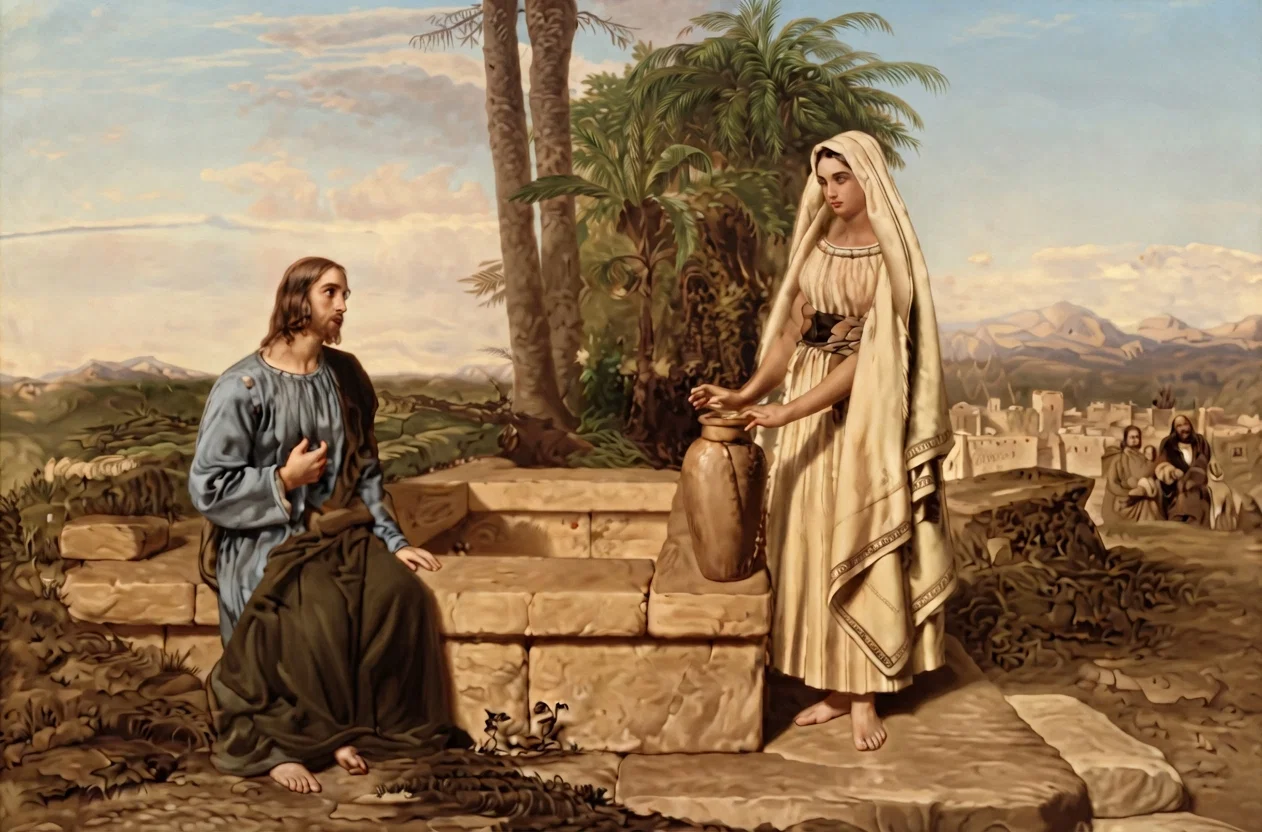
JESUS AND THE WOMAN OF SAMARIA
Send now a quick glance around the world. Observe how vast a portion of its surface shimmers with water—water framed into rolling, tossing, flashing oceans; water rimmed into sheltering, protecting bays, gulfs, and lakes; water curbed into mighty rivers pushing their proud way down steep mountainsides, grinding massive rocks into dust, beautifying arid valleys, transporting hither, thither, every year, thousands of the human race, distributing widely the million fruits of man's toil, the marvelous results of man's inventions; water leaping, gushing, from the hidden fountains of the earth, and driving the wheels of a thousand great industries; and water at the very zenith of its mechanical uses—the furnishing power to generate electrical energy, that mightiest, most subtle, most spirit-like of nature's known forces.
Partly cataloged, this is water as we know it, as we work with it, a medium of boundless utility to man, an element of gracious service to all animals, fishes, birds, bees, butterflies, and even reptiles, those gruesome, repellent creatures which speed our thoughts back to Eden, and remind us of an immutable law transgressed and of centuries of bitter consequences.
But, most fortunately, in this gospel age, during nineteen centuries of "good news" to the human race, water has served a purpose far higher, has symbolized a service far more beneficent, than any mentioned above.
Shortly preceding His signal suffering in behalf of man, Christ, the benevolent Creator of the world-wide liquid, exalted it far above all its common uses and associations, by making it a symbol of the cleansing, purifying power of truth,—truth unchangeable, truth as it exists in God, as it is revealed in Christ, truth in its power to supplant sin, to implant righteousness, to clarify character, when instilled, made effective, by the mighty and beatific influence of the Holy Spirit.
I will quote the text from which the seven words forming the heading of this article are taken, John 4:14:
"But whosoever drinketh of the water that I shall give him shall never thirst; but the water that I shall give him shall be in him a well of water springing up into everlasting life."
That Christ had reference here to the abounding and benign effects and fruits of the gracious yet mighty truths He taught, when instilled and made effective by the beatific influences of the divine Spirit, is evident from similar sayings of the Saviour on other occasions.
John 7:37, 38 recalls an occasion when, as the Jews were contending with Christ, according to their custom, He declared with fearless directness: "If any man thirst, let him come unto Me and drink. He that believeth on Me, as the Scripture hath said,from within him shall flow rivers of living water."
John explains immediately and distinctly the tenor of the Master's words: "But this spake He of the Spirit, which they that believe on Him should receive."
In John 14:16, 17 Christ affirms this assertion when He declares: "I will pray the Father, and He shall give you another Comforter, that He may abide with you forever; even the Spirit of TRUTH; whom the world"—the worldly-minded—"can not receive." But "He dwelleth with you, and shall be in you."
Elsewhere, with even greater emphasis, the Lord makes clear to His disciples the relation of the Spirit to the great, eternal truths He Himself taught them, and also points out to them the distinct service of both marvelous and mighty agencies. John 14:26; 15:26:
"But the Comforter, which is the Holy Ghost, whom the Father will send in My name, He shall teach you all things, and bring all things to your remembrance, whatsoever I have said unto you." "But when the Comforter is come, whom I will send unto you from the Father, even the Spirit of TRUTH, which proceedeth from the Father, He shall testify of Me."
Also, "When He, the Spirit of TRUTH, is come, He will guide you into all TRUTH: for He shall not speak of Himself; but whatsoever He shall hear, that shall He speak: and He will show you things to come."
Now Christ Himself is the great fountain and source of truth. "I am the way, the TRUTH, and the life: no man cometh unto the Father, but by Me." "If ye continue in My word, . . . ye shall know the truth, and the truth shall make you free."
Not only was Christ the way, the truth, and the life, but He was also the true, the reliable WORD. Notice: "In the beginning was the Word, and the Word was with God, and the Word was God. . . . All things were made by Him; and without Him was not anything made."
Then He who told the woman at the well in Sychar, "Whosoever drinketh of the water that I shall give him shall never thirst; but the water that I shall give him shall be in him a WELL of water springing up into everlasting life," must have possessed not only the great power but also the full will to establish that statement, to confirm that pledge.
That was an amazing assertion, a startling utterance. A WELL of water abounding with life, within man! Springing up not for a day, not for a year, but for eternity! What could have been the meaning of that humble Wayfarer? What instrumentality would He use to accomplish a purpose everlasting, a result to endure through the ages?
Let us read: "He that BELIEVETH on Me, as the Scripture hath said, from within him shall flow rivers of living water."
Then man himself has some part in this unique, unequaled transaction. He must take the initial step. He must BELIEVE in the mighty, compassionate WORD, in His power to cause—through the reception of exalted, eternal truth, instilled by the divine Spirit—streams of noble impulse, of pure affections, of lofty purposes, of merciful deeds, to flow out to all humankind, whether friend or foe.
So long as this water of life, of love, of pity, shall be used for gracious ends, for Christlike service to others, so long will the Spirit of God minister an affluent supply, to every follower of Christ, of the potent, efficacious TRUTH symbolized by rivers and wells of water.

God's Message of To-Day

Its Rejection and the Result

IN this series of articles on the great message of to-day, have been set before us God's great oneness, and the unity that He requires among His children—nay, more, not only that which He requires, that they shall all speak the same things, and be perfectly joined together in the same mind and in the same judgment, but it was the preeminent burden of the greatest prayer of our Lord that has been left on record, 'That they all may be one; as Thou, Father, art in Me, and I in Thee, that they also may be one in Us: that the world may believe that Thou hast sent Me.'
This condition was to a great degree realized in the apostolic church; and yet, shortly after that, divisions came in. Men tried man's way in developing, compelling, and maintaining unity; and as the result, we had the Papacy. But the way of force, or anathema, is not God's way—that must be the way of love. As a result of men's following their own ways, we have the condition of Christendom as it is to-day, and as it has been for centuries. It is in a divided condition, and this divided condition in detail has been set before us; not only divided in doctrine, but in ways, in purposes, and in methods, and among the great Protestant denominations men are drifting away from the Word of God, and are coming to that place where they no longer believe it as the Word of God. This division of sentiment, division of doctrine, of methods of belief, God denominates, in His prophetic Word, 'Babylon,' simply because of the confusion that exists in the great religious world. He does not present it as a name of rejection. The thought of His heart was, 'We would have healed Babylon;' and the great, everlasting gospel message, 'Fear God, and give glory to Him; for the hour of His judgment is come: and worship Him that made heaven, and earth, and the sea, and the fountains of waters,' was designed, and is designed, to bring healing, not only to the individual's sinful heart, but to the people of God.
That message has been going to the world for the last half century. Wherever it has been allowed to have its way, it has brought union of heart. It has laid the glory of man in the dust, and has exalted the Word of God, and Christ Jesus as Lord. But it is also clearly evident that if God's message is rejected, the evil must persist. If a physician comes and truly diagnoses a fatal disease, a disease which will surely terminate fatally if allowed to run its course, and the wise physician presents the only remedy which will cure, and that remedy is rejected, the patient must go on to dissolution—death must certainly ensue. And so the great, last, healing message of God has been rejected by Christendom as a whole. The churches have turned from the everlasting gospel as God's great means of healing her ills and woes.
God deals with individuals. The church is endeavoring to achieve her triumphs by the mass.
God presents His Word, 'It is written,' as the necessary element of conversion. The church not only fails to present that Word, but has taken from it its power in the current 'higher criticism' of to-day, and the glory of man is put in the place of the glory of God.
It is God's plan to heal the soul by regeneration and re-creation. But for that the doctors in the church have substituted evolution, what they call 'divine immanence,' within the man; and the world is growing worse, and that which was designed to be the salt of the earth has lost its savor.
These things were bound to follow the rejection, passive or active, of the great message which God has given for the healing of the world's ills. Necessarily there must follow first a moral fall, moral deterioration in the church. This we need not take time to argue. It is felt by all the spiritual leaders in the great Protestant churches of to-day that there has been a tremendous lowering of standards, moral standards; that expediency has taken the place of principle; that church-members are received who know nothing of regeneration, or change of heart; that men are countenanced in the church, and held within the church, who are immoral in life and character, who are dishonest according to gospel standards, in their dealing with their fellow men. We have developed before us to-day the picture which the apostle Paul draws of the last days among those who have a form of godliness, but deny its power. Read the description in 2 Tim. 3:1-5:
'But know this, that in the last days grievous times shall come. For men shall be lovers of self, lovers of money, boastful, haughty, railers, disobedient to parents, unthankful, unholy, without natural affection, implacable, slanderers, without self-control, fierce, no lovers of good, traitors, headstrong, puffed up, lovers of pleasure rather than lovers of God; holding a form of godliness, but having denied the power thereof: from these also turn away.'

Making the Beast

But more than this, whenever the church of God has been reproved of her sins, and she has rejected that reproof, she has sought for some substitute to make good. There are strong, able men who are longing for better conditions in the religious life of to-day, and also in the political life of to-day, made up, as it is, to a large extent, of religious influences. They see the tremendous cataclysm to which the nations are marching; but instead of humbling their hearts before God and seeking Him, they are seeking for the power of civil law to enforce religious decrees, to bend men to their moral and ecclesiastical standards. But the union of church and state is what made the beast power, set forth so vividly and strongly in the prophecies of the Revelation. The beast power is not the Roman CatholicChurch as such, it is not the ecclesiastical body; it is the church connected with civil power, and the civil power thus dominated by the church becomes the beast of prophecy, passing through all its various phases, indicated by the seven heads.
That beast power is the one which has been dominant in the Old World. In the New World we have men endeavoring to make an image to that beast. We have the whole power of the Federal Council of Protestant Churches uniting for the purpose of controlling not simply religious matters, but civil matters. And the one thought, or object, around which all these efforts are centering, is the Sunday-sabbath—a sabbath which men have the right to observe if they desire, as between man and man, but which man has no right to enforce upon his fellows; and when he does enforce it upon his fellows through civil law, it then and there becomes the mark of the beast. Remember, we are not saying that those who observe Sunday have the mark of the beast. There are many, and we know not how many, who are observing the day because they believe it to be a holy day, and that they are honoring God in so doing. But when that time comes that Sunday is made the slogan for patriotism, and the shibboleth of loyalty to God, and is enforced by a union of church and state, or religion and the state, it becomes at that very time a mark of the beast; and it is to this that the rejection of the simple, mighty, everlasting gospel has led the churches of to-day. Against this, God warns the world:
“If any man worshipeth the beast and his image, and receiveth a mark on his forehead, or upon his hand, he also shall drink of the wine of the wrath of God, which is prepared unmixed in the cup of His anger; and he shall be tormented with fire and brimstone in the presence of the holy angels, and in the presence of the Lamb; and the smoke of their torment goeth up forever and ever; and they have no rest day and night, they that worship the beast and his image, and whose receiveth the mark of his name.” Rev. 14:9-11.
This, to you, reader, may seem nonsense; but we plead with you to study the prophecy, and study religious conditions in the world in the light of that prophecy. Consider the healing message which God has given us in verses 6 and 7 of that prophecy of Revelation 14. Think of what it would do if it were received by the churches of to-day, how it would break down all barriers which exist between the denominations, how it would turn from sin of every form and kind, and would lead men back to glorify their Creator and Redeemer. But its rejection has led to the moral fall, more and more manifest, of the churches themselves, and to the demand for a union of church and state, or of religion and the state, and the elevation of the Sunday-sabbath, which has no ground of authority at all in the Word of God, in the place of that Sabbath day which is the memorial of creative power, and the sign of redeeming power. Ex. 20:8-11; Eze. 20:12.
But God has given us a practical demonstration of what that message will do. It has gone to nearly every nation on the face of the earth. It is doing its work in Protestant and Roman Catholic lands; it has stretched out into the great heathen nations of the world. And wherever it goes, it brings men to the Word of God as the sole standard,
and develops a class of whom the Scriptures themselves speak, “Here are they that keep the commandments of God, and the faith of Jesus.” Certainly it is not doing an evil work. It does not rest in merely protesting against sin and error; it develops positive characters, those who are willing through loss of reputation, or property, or opportunity, to stand for God, obedient to all the commands of God, as did the Lord Jesus Christ, in the power and strength which implicit faith in Him brings. This third angel’s message is the protest which God is making to the world to-day.
We plead with our readers to turn from the thing against which Inspiration does protest, and turn to the great, positive, gospel message which is able to save to the uttermost.
Continue reading: God’s Word Our Assurance