Your ShelfYour Projects

Review and Herald, Vol. 86, No. 1.

The Messina Earthquake Disaster

Review and Herald

Jan 7, 1909

Review and Herald Publishing Association · Takoma Park Station, Washington, D. C. · Jan 7, 1909

The Messina Earthquake Disaster
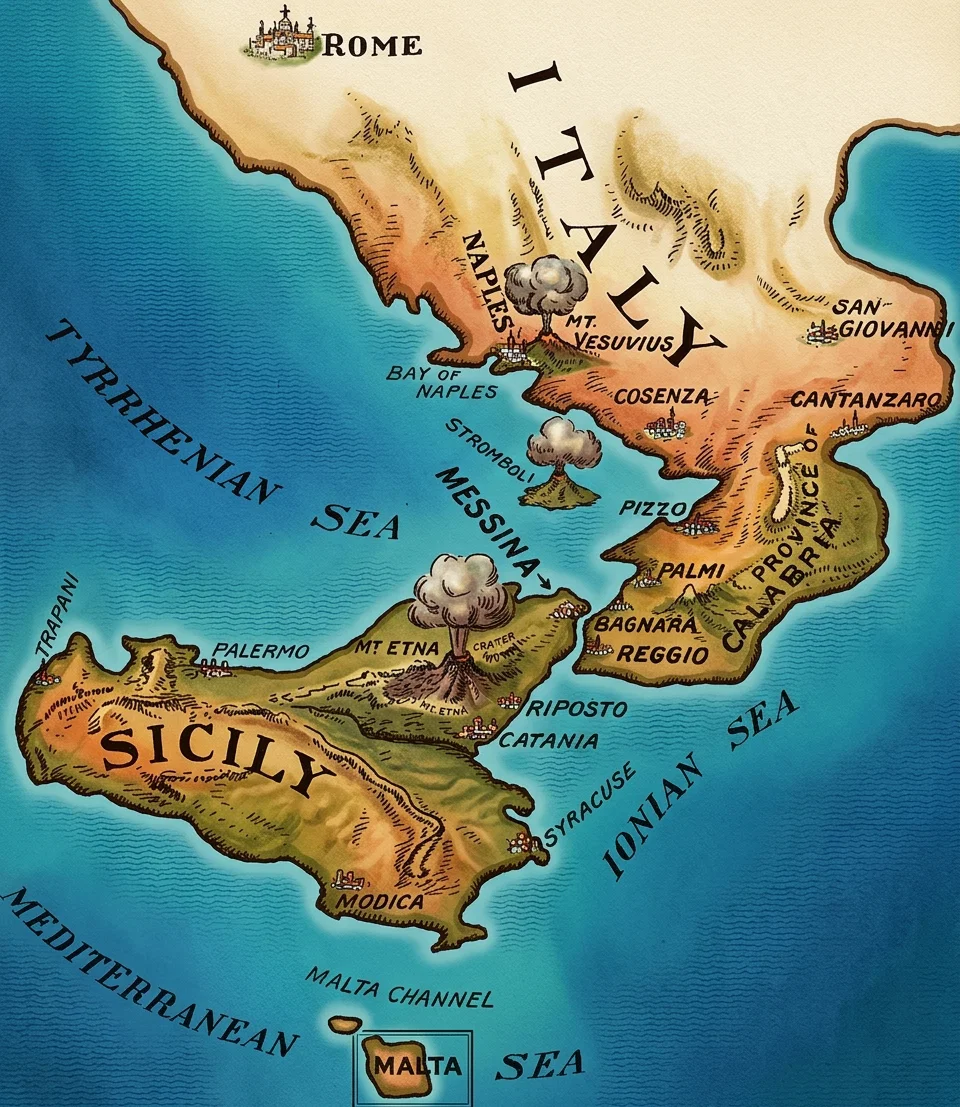
AN OUTLINE MAP OF SOUTHERN ITALY AND OF SICILY
This map includes the whole territory disturbed by the great earthquake which was felt throughout the island of Sicily and as far to the northeast as the town of San Giovanni. The center of disturbance was in and around the Strait of Messina, the narrow channel dividing Italy from Sicily. Here are located the cities of Messina and Reggio, which according to authentic reports have been practically wiped out of existence. The city of Naples is made a base of supplies for the district now threatened with famine, and also serves as a place of refuge for many who have fled from the devastated territory. Article on last page.

NOW READY

The Practical Guide to Health

By F. M. ROSSITER, M. D.
A Thorough Treatise on Anatomy, Physiology, and Hygiene, With a Scientific Description of Diseases, Their Causes and Treatment
DESIGNED for the home and for the instruction of nurses. Profusely illustrated with drawings made especially for the book. This medical work has been prepared by a successful practising physician, with an honest purpose of making it just what its title implies,—

A Practical Guide to Health

It outlines in a clear, comprehensive manner the construction of the human system, with illustrations showing the anatomy of the various parts of the body and their relation to each other.
It gives a minute description of the nature and causes of diseases, and hygienic prescriptions for their cure.
It covers practically all the common diseases, and deals with them in such a way that the information given can be applied in the home.
It will be found of great practical value in every home. Over 600 pages, substantially and tastefully bound in the three following popular styles:—
Cloth, marbled edges . . . . . . . . . . . . . . . . . . . . . . . . . . . . . . . . . . . . . . . . . . . . . . . . . . . . . . . . . . . . . . . . . . . . . . . . . . . . . . . . . . . . . . . . $3.00
Full law sheep . . . . . . . . . . . . . . . . . . . . . . . . . . . . . . . . . . . . . . . . . . . . . . . . . . . . . . . . . . . . . . . . . . . . . . . . . . . . . . . . . . . . . . . . 4.00
Full Persian morocco . . . . . . . . . . . . . . . . . . . . . . . . . . . . . . . . . . . . . . . . . . . . . . . . . . . . . . . . . . . . . . . . . . . . . . . . . . . . . . . . . . . . . . . . . . . . . 5.00
Agents wanted

Important Tracts on Health Topics

Life and Health Leaflets, a series of tracts, envelope size, devoted to timely health topics. On account of their moderate price, they can be used in large quantities for public distribution.
Send for a supply to use in your correspondence.
1. Alcohol and Disease . . . . . . . . . . . . . . . . . . . . . . . . . . . . . . . . . . . . . . . . . . . . . . . . . . . . . . . . . . . . . . . . . . . . . . . . . . . . . . . . . . . . . . . . ½c
2. Liquor and Poverty . . . . . . . . . . . . . . . . . . . . . . . . . . . . . . . . . . . . . . . . . . . . . . . . . . . . . . . . . . . . . . . . . . . . . . . . . . . . . . . . . . . . . . . . ½c
3. Counting the Cost of Alcohol . . . . . . . . . . . . . . . . . . . . . . . . . . . . . . . . . . . . . . . . . . . . . . . . . . . . . . . . . . . . . . . . . . . . . . . . . . . . . . . . . . . . . . . . . . . . . . ½c
4. Is Alcohol a Food? . . . . . . . . . . . . . . . . . . . . . . . . . . . . . . . . . . . . . . . . . . . . . . . . . . . . . . . . . . . . . . . . . . . . . . . . . . . . . . . . . . . . . . . . ½c
5. The Cure for National Intemperance . . . . . . . . . . . . . . . . . . . . . . . . . . . . . . . . . . . . . . . . . . . . . . . . . . . . . . . . . . . . . . . . . . . . . . . . . . . . . . . . . . . . . . . . . . . . . . ½c
6. Patent Medicines . . . . . . . . . . . . . . . . . . . . . . . . . . . . . . . . . . . . . . . . . . . . . . . . . . . . . . . . . . . . . . . . . . . . . . . . . . . . . . . . . . . . . . . . ¾c
7. Simple Treatments for a Cold . . . . . . . . . . . . . . . . . . . . . . . . . . . . . . . . . . . . . . . . . . . . . . . . . . . . . . . . . . . . . . . . . . . . . . . . . . . . . . . . . . . . . . . . ½c
8. Some Effects of Tobacco Using . . . . . . . . . . . . . . . . . . . . . . . . . . . . . . . . . . . . . . . . . . . . . . . . . . . . . . . . . . . . . . . . . . . . . . . . . . . . . . . . . . . . . . . . ½c
9. Pointed Facts About Tobacco . . . . . . . . . . . . . . . . . . . . . . . . . . . . . . . . . . . . . . . . . . . . . . . . . . . . . . . . . . . . . . . . . . . . . . . . . . . . . . . . . . . . . . . . ¼c
10. Pure Air in the Home . . . . . . . . . . . . . . . . . . . . . . . . . . . . . . . . . . . . . . . . . . . . . . . . . . . . . . . . . . . . . . . . . . . . . . . . . . . . . . . . . . . . . . . . ½c
One of each, post-paid, 5 cents.
Life and Health Series deals with the question of the use of alcohol and tobacco most exhaustively, and the arguments against their use are most convincing. The tracts are intended to be used by individuals or societies in health educational campaigns. Each tract has been prepared by a physician who has made a special study of the subject about which he has written. Size, 4⅝ x 7 inches.
1. The Tobacco Habit . . . . . . . . . . . . . . . . . . . . . . . . . . . . . . . . . . . . . . . . . . . . . . . . . . . . . . . . . . . . . . . . . . . . . . . . . . . . . . . . . . . . . . . . 5c
2. Tobacco Using . . . . . . . . . . . . . . . . . . . . . . . . . . . . . . . . . . . . . . . . . . . . . . . . . . . . . . . . . . . . . . . . . . . . . . . . . . . . . . . . . . . . . . . . 1½c
3. Diet and Endurance . . . . . . . . . . . . . . . . . . . . . . . . . . . . . . . . . . . . . . . . . . . . . . . . . . . . . . . . . . . . . . . . . . . . . . . . . . . . . . . . . . . . . . . . 5c
4. Chronic Constipation . . . . . . . . . . . . . . . . . . . . . . . . . . . . . . . . . . . . . . . . . . . . . . . . . . . . . . . . . . . . . . . . . . . . . . . . . . . . . . . . . . . . . . . . 1½c
5. Medical Use of Tobacco . . . . . . . . . . . . . . . . . . . . . . . . . . . . . . . . . . . . . . . . . . . . . . . . . . . . . . . . . . . . . . . . . . . . . . . . . . . . . . . . . . . . . . . . ¾c
One of each, post-paid, 14 cents.
Other numbers will be added to the above from time to time, until every phase of the subject is fully covered.
REVIEW AND HERALD PUBLISHING ASSN.
New York City WASHINGTON, D. C. South Bend, Ind.

The Federal Council of Churches

In order that we may understand more clearly the full significance of the action taken by the council concerning the observance of Sunday, we call attention again to some features of the discussion upon the subject.
In its printed report to the council, the committee on Sunday observance declared: “We have no objection to reading the [fourth] commandment, ‘Remember that you keep holy one day in seven.’”
In the resolutions on this subject reported to the council, it was urged “that a new and stronger emphasis should be given in the pulpit, the Sunday-school, and the home to the Scriptural observance of the first day of the week as the sacred day,” and further, “that all encroachments upon the claims and sanctities of the Lord’s day should be stoutly resisted through the press, the Lord’s Day Associations and Alliances, and by such legislation as may be secured to protect and preserve this bulwark of our American Christianity.”
No one pointed out the contradiction between the interpretation given to the fourth commandment by the committee, “Remember that you keep holy one day in seven,” and the resolutions calling for “the Scriptural observance of the first day of the week as the sacred day,” and for “such legislation as may be secured to protect and preserve this bulwark of our American Christianity;” but it did occur to some one that the proposed action would be likely to work hardship for those who, in following the principle laid down by the committee to “keep holy one day in seven,” should decide to observe the day actually mentioned in the fourth commandment, the seventh day of the week, and therefore the following resolution was proposed:—
Resolved, That it is not our intention that anything shall be done to interfere with the convictions of those brethren represented with us in this council who conscientiously observe the seventh instead of the first day of the week as the day of rest and worship.
Here, then, were three propositions before the council: (1) The obligation of the fourth commandment interpreted to mean, “Remember that you keep holy one day in seven;” (2) the demand for “the Scriptural observance of the first day of the week as the sacred day,” and for legislation in its behalf; (3) the disavowal of any intention to interfere with those who observe the seventh instead of the first day of the week. It was evident that one or more of these proposals must be repudiated by the council. It is evident that it would be impossible to interpret the fourth commandment so that it would simply require the observance of “one day in seven,” and at the same time call for “the Scriptural observance of the first day of the week as the sacred day,” with the express purpose of resisting any desecration of that day by “such legislation as may be secured to protect and preserve this bulwark of our American Christianity,” and at the same time to state that nothing should be done to interfere with the convictions of those who observe the seventh day of the week.
It became apparent at once that if the influence of this great combination was to be used effectively in behalf of any sabbath, and if pressure was to be brought to bear to secure such legislative enactments as would compel at least an outward regard for that sabbath, one particular day must be officially recognized, and the application of the principle of “one day in seven” must be limited to that particular day. That the real situation was clearly understood is evident from the statements made during the discussion of the resolution proposed. One delegate said:—
Some people do not believe in the Lord’s day, but some other day as the Sabbath. If we do not take a stand upon which day we believe we should observe as the day set apart for the worship of God, and for rest, this will give a wrong impression to the people. Is it the Lord’s day or some other day that we are standing for?
The fourth commandment clearly states which day is to be observed as the Sabbath, but the report of the committee set this aside in favor of keeping holy “one day in seven.” Then the same committee reported in favor of “the Scriptural observance of the first day of the week as the sacred day,” and expressed itself in favor of such legislation as might be necessary in order to secure the observance of that day. As between these two contradictory positions, the logic of the situation demanded just what this delegate stated; namely, that the council should select a particular day for the sabbath, and then stand for that day as against any other day.
Another delegate, recognizing the actual situation which was thus presented to the council, put the real issue in these words:—
The question is whether this council will step back and leave that first day of the week without its due recognition from us as a body.
A Methodist bishop emphasized the far-reaching effect of the action of the council, in this statement:—
We must decide on one day as the sabbath, or the whole purpose goes for naught. If we make a formal consent to another day, how can we hope to bring about the proper observance of the first day of the week in our mission fields, and in places where there is little disposition to observe it in our own country?
Thus did these men place themselves on record as perceiving clearly that the practical application of their seventh-part-of-time theory would frustrate all their efforts to require the observance of the first day of the week, and that they must refuse to take any action which would allow that there could be any other Sabbath than the first day of the week, even though such refusal would mean an interference with the conscientious convictions of others.
It remained, however, for one speaker to give expression to other reasons which evidently carried much weight against the adoption of the resolution. To quote his words:—
If we were to accept the resolution, that gives the impression that we acknowledge that there is another day than the first day of the week which is the Lord’s day, the Sabbath, a day of rest and for the worship of God, I say that there are those who will take advantage of any such admission on our part. The Jews will feel a little stronger assurance in their belief. They will say that we acknowledge that there is another day than the first day of the week which is the Lord’s day. The Seventh-day Adventists will take heart in their antagonism to many of the things which we hold sacred, in addition to their assaults upon the first day of the week as a day for rest and worship.
Thus one of the considerations, and without doubt a leading one, which induced the Federal Council of Churches to take such action as would authoritatively declare the first day of the week to be the Sabbath, and to refuse to acknowledge that “there is another day than the first day of the week which is the Lord’s day, the Sabbath,” was their determination to have nothing in common with the Jews, or even any Christians who observe the day specifically mentioned in the fourth commandment. There was thus manifested a determined purpose not only to urge the observance of the first day of the week, but to repudiate the observance of the seventh day of the week; and in taking this action the council preferred to disregard the rights and convictions of one denomination (the Seventh-day Baptists) who had accepted the invitation to form a part of the council, rather than to give any countenance to the practise of the Jews and of those Christians who have a conscientious regard for the claims of the fourth commandment.
From the facts here stated we are warranted in saying that the Federal Council of Churches has decided:—
  1. That the first day of the week, Sunday, is the Lord’s day, the Sabbath.
  2. That the united influence of this great combination shall be used to secure such legislation as may be deemed necessary for the protection of that day, and for the enforcement of at least an outward regard for it.
  3. That there can be no other Sabbath than the first day of the week.
  4. That the observance of the seventh day of the week can not be regarded as the Scriptural observance of the Sabbath.
  5. That it would be injurious to the cause of Christianity to admit that the Jews observe the true Sabbath.
We are now prepared to understand more clearly the results which are likely to follow from this action of the Federal Council of Churches, and in pointing this out it will be necessary to refer to a former period of church history.
In the early part of the fourth century, steps were taken which led to a complete union of church and state, and the full development of the papacy; and the center around which this whole movement revolved was the question of the Sabbath. First came Constantine’s famous Sunday edict, in A. D. 321, in which he declared: ‘On the venerable day of the sun let the magistrates and people residing in cities rest, and let all workshops be closed.’ Next came the decision of the Council of Nice, A. D. 325, requiring that throughout the whole empire Easter should be celebrated on Sunday. In the letter from the council to the church, the decision was communicated in these words:—
We have also gratifying intelligence to communicate to you relative to unity of judgment on the subject of the most holy feast of Easter; for this point also has been happily settled through your prayers; so that all the brethren in the East who have heretofore kept this festival when the Jews did, will henceforth conform to the Romans and to us, and to all who from the earliest time have observed our period of celebrating Easter.
From a letter written by the emperor Constantine to the churches upon this same subject we take the following:—
In the first place, it seemed very suitable in the celebration of this sacred feast that we should follow the custom of the Jews, a people who, having imbued their hands in a most heinous outrage, and thus polluted their souls, are deservedly blind. . . . Let us, then, have nothing in common with this most hostile people, the Jews.
This disposition to exalt Sunday, and to cry out against the observance of the seventh day because it was kept by the Jews, came to a climax in the Council of Laodicea, about 364 A. D., which enacted the following canon:—
Christians shall not Judaize and be idle on Saturday, but shall work on that day; but the Lord’s day they shall especially honor, and, as being Christians, shall, if possible, do no work on that day. If, however, they are found Judaizing, they shall be shut out from Christ.
An appeal was made to the civil power to enforce these decisions of the church, and thus the way was opened for that union of the church with the state which effectively established the papacy.
It hardly needs to be pointed out that the Federal Council of Churches is in effect repeating the history of the fourth century; and it is perfectly clear that in their action on the question of the Sabbath, first, in deciding that the first day of the week and not the seventh is the Sabbath, and second, in demanding the enforcement of the day on the part of the civil power, they are taking the steps which will lead directly to the union of church and state. In view of their refusal to adopt the resolution which would permit the observance of the seventh day without interference, it is also plain that their action, when carried into practical effect, must lead to persecution.
It is true that there has been in years past a demand for the passage of Sunday laws, but never before in the history of this country has a combination claiming to represent more than half the population of the United States formally registered such a demand. From such action as this, by such a body as this, the cause of enforced Sunday observance will without doubt receive a tremendous impetus, and we may expect to see results in the near future.

Editorial

HUMAN wisdom, unaided, would not be able to interpret correctly the meaning of current history. A master mind is planning and plotting against God, and is seeking to divert from him the glory due unto him. The minds of men are being agitated with strange and startling ideas, tending to dishonor God and to exalt themselves. The speculations of philosophy and the conclusions of an infidel science are readily accepted, while the only authoritative revelation is either rejected or so interpreted as to make its teaching of no practical force. Many of those who are nominally set for the defense of the gospel are themselves leading the people in false paths, and few are the voices which are raised in protest against the current perversions of the truth. In such a time as this the gospel message for this generation throws a clear light upon all these misleading teachings, and reveals the right path. The world needs just such a message.

The Rise and Fall of Religious Liberty in America

A Masterful Ally in the Campaign Against the Government

We remember the bid for Catholic support made by those forces which are seeking to unite religion and the state in this country, as pointed out in these articles; and we remember also the encouragement in that direction given them by Catholics. We have seen that in every instance where religion and the state have been united, persecution and the utter disregard of human rights have immediately followed, whether that union consisted of the Catholic religion and the state or of a professed Protestant religion and the state. We have seen that in this country, where church and state are said to be disjoined, men have suffered for conscience’ sake because a single ordinance of the church—the Sunday sabbath—has been put upon the statute-books of the States.
Since such a condition of things has invariably produced such results, and since the National Reform Association and all its allies hitherto named are earnestly seeking to bring about such a condition, it is worth while to inquire into the purpose and plans of its new ally, the Roman Catholic hierarchy. We find, first, that the aims of the two great combinations are similar in one respect. Bothhave declared war upon the Constitution of the United States, as it stands to-day. The National Reformers and their allies would so alter it as to make it a declaration of the nation’s religious belief, thus making it a basis for the government’s interference in the religion of the individual. They propose also, by means of this reconstruction of the Constitution, and other resultant changes, to bring into being the veritable kingdom of righteousness in this world—in short, to usher in the coming of Christ himself; and as whatever opposes righteousness must be iniquity, and whoever opposes the coming of Christ must be an antichrist, they must brand as sinners and antichrists whoever shall dare to oppose their plans of bringing about such a consummation.
When the one religious practise now upon the State statute-books has been so rigorously enforced by pains and penalties, and when those pains and penalties have been inflicted chiefly upon persons who were opposed to the institution upon religious grounds, we are not left to conjecture what the result would be if that organization, by its own power and influence, should succeed in accomplishing the result aimed at. But when we come to consider the power and influence of its new ally, the history of that ally in all parts of the world where its purpose has been dominant,—the pains that have been suffered, the imprisonments that have been endured, the blood that has been shed,—we may know of a surety that when these two great organizations, through their united influence and power, have brought about their mutually desired change in this country’s Constitution and in its attitude toward the individual conscience, the rights of the individual will be ignored, freedom of conscience will no longer exist, religious practises will be enforced by law, church attendance will be compulsory, and finally there will occur what even National Reformers are not ready for now, and will not be anxious for then—the greater organization will absorb the lesser, and the will of the pope will be the supreme law of the land. All this is as sure to follow the reconstruction of the Constitution upon a religious basis, and the amalgamation of the two great organizations for a union of religion and the state, as night is sure to follow day. The preservation of the Constitution as it is, the preservation of the American principles of government as they are, are all that stand between the country as it was founded and the country as Rome would have it to be. That the purpose of the Roman hierarchy has not been misinterpreted in this, will appear as we proceed. The government of the United States is republican in form,—a government “of the people, by the people, and for the people,” deriving its just powers from the consent of the governed. Rome is at enmity with this principle. The people’s right to rule themselves she never will concede. Says Dr. O. A. Brownson, a recognized Catholic authority:—
The people need governing, and must be governed. . . . They must have a master. . . . The first lesson to the child is, obey; the first and last lesson to the people, individually and collectively, is, obey; and there is no obedience where there is no authority to enjoin it. The Roman Catholic religion, then, is necessary to sustain popular liberty, because popular liberty can be sustained only by a religion free from popular control, above the people, speaking from above, and able to command them; and such a religion is the Roman Catholic. . . . In this sense we wish this country to come under the pope of Rome. As the visible head of the church, the spiritual authority which Almighty God has instituted to teach and govern the nations, we assert his supremacy, and tell our countrymen that we would have them submit to him. They may flare up at this as much as they please. . . . They will not move us, or relieve themselves from the obligation Almighty God has placed them under of obeying the authority of the Catholic Church, pope, and all.—“Brownson’s Essays,” pages 380-383.
The people of the United States have considered themselves their own masters, able to govern themselves, and having a right to govern themselves; but the papacy would put over them “a master,” and take from them all right to any part in their own government. In this attitude it is diametrically opposed to the fundamental principles of the nation. Its demand that this country “come under the pope of Rome” is a demand for the complete undoing of all that has made this nation, for the complete revocation of the nation’s most vital principles. The purpose of the papacy to be the “master” which the people of this country need is further set forth by the same writer in these words:—
She [the Catholic Church] is, under God, the supreme judge of both laws [civil and religious], which for her are but one law; and hence she takes cognizance, in her tribunals, of the breaches of the natural law as well as of the revealed, and has the right to take cognizance by nations as well as of its breaches by individuals, by the prince as well as the subject; for it is the supreme law for both. The state is therefore only an inferior court, bound to receive the law from the supreme court [the church], and liable to have its decrees reversed on appeal.—Ibid., pages 283-284.
The bold effrontery of such declarations is almost astounding; but it is in perfect accord with the principles of self-exaltation so peculiarly characteristic of the papacy. It is her purpose to be king of all kings on earth, lord over all lords, sitting in judgment on kings and princes, and calling nations to account, even as nations call their individual subjects to account. It even purposes to release the subjects of these individual nations from allegiance to their rightful rulers when those rulers are not sufficiently submissive to the Holy See. This is plainly indicated in a work entitled “His Holiness Pope Pius IX,” pages 47, 48, in the statement that it is “the general duty of all Catholics, whatever their country may be,” and “of all men, if they did but know it, to protect the rights of the Holy See.” What are these rights for which “the faithful” are to contend in every country, which they are to “protect” even against the laws of their own land?—The right of the pope to make every nation subservient to his will, to override the laws of every country on earth, to alter every national and State constitution that is not in harmony with his will, to make the financial support of Catholic worship and Catholic institutions a part of every national budget, to eradicate freedom of thought, of speech, of the press, and of worship, and to make himself—the pope—the ruler of all rulers, the king of the world. All this is involved in the following declaration of Pope Pius IX:—
Thinking and meditating on all these matters, we are bound anew to enforce and to profess, what we have oftentimes declared, with your unanimous consent, that the civil sovereignty of the Holy See has been given to the Roman pontiff by a singular counsel of divine providence; and that it is of necessity, in order that the Roman pontiff may exercise the supreme power and authority, divinely given to him by the Lord Christ himself, of feeding and ruling the entire flock of the Lord with fullest liberty, and may consult for the greater good of the church and its interests and needs, that he shall never be subject to any prince or civil power.—“Appleton’s Annual Cyclopedia,” 1871, pages 689, 690.
This is further shown in the following words:—
Suppose it be said, “I acknowledge the spiritual authority of the holy father; but why am I, an Englishman [or an American], to come forward in a political way, and use all my exertions to protect the temporal rights of a foreign prince?” My answer at once is plain. The pope is not a foreign prince to any Christian, to any human being.—“His Holiness, Pope Pius IX,” p. 48.
The pope considers himself a domestic prince in every nation, in every state; and Catholics claim for him first duty from every subject of every nation on earth. In the light of this fact, it can readily be seen that no constitution out of harmony with the papal purpose can stand in any country, once the Catholics of that country become powerful enough to change or abolish it. This country’s Constitution is out of harmony with those purposes. How it is viewed by a prominent Catholic journal, the Catholic World, will be seen by the following:—
As it [the United States Constitution] is interpreted by the liberal and sectarian journals, . . . or is interpreted by the Protestant principle, so widely diffused among us, . . . we do not accept it, or hold it to be any government at all, or as capable of performing any of the proper functions of government; and if it continues to be interpreted by the revolutionary principles of Protestantism, it is sure to fail—to lose itself either in the supremacy of the mob or in military despotism. . . . Protestantism, like the heathen barbarisms which Catholicity subdued, lacks the element of order, because it rejects authority [the pope’s authority], and is necessarily incompetent to maintain real liberty or civilized society. Hence it is we so often say that if the American republic is to be sustained and preserved at all, it must be by the rejection of the principle of the Reformation and the acceptance of the Catholic principle by the American people.—The Catholic World, Vol. XIII, page 736.
Plain words are these, and they set forth boldly the unchanging purpose of the papacy toward this country. It is a favorite aphorism of the adherents of Romanism that “when Rome speaks, that ends the matter.” She has spoken concerning this country, its Constitution, and its liberal institutions, and declared herself at enmity with them all as they exist to-day. She has declared that governments, to be legitimate, must be based upon the law of God. The American government is not so based, therefore is not legitimate. She has declared that nations born of revolution are not legitimate. This nation was so born, therefore illegitimate. She has declared that governments ruled by the people instead of by kings, or by kings not submissive to her, are merely governments de facto, and have no legitimate claim upon the allegiance of their people. In her summary of the nations, the United States is a government de facto; and by that definition are her spiritual subjects in this country released from their duty to support the Constitution as it reads. Says Balmes in his work, “Protestantism and Catholicity Compared,” chap. 56, page 336:—
It is allowable to resist illegitimate power by force. The Catholic religion does not enjoin obedience to governments existing merely de facto.
This opens the way for any kind of resistance to the government and institutions of the United States which the Vatican may choose to instigate. It invites, on the part of American Catholics, attacks upon the fundamental laws of this government. It releases American Catholics from moral responsibility for any attitude of opposition they may assume toward the United States government, in short, absolution in advance for any act committed against the nation in its present form. Such is the ally which the Sunday-law advocates have taken into their camp to assist in the overthrow of the Constitution of the United States, and to march with our liberties back into the darkness of the Dark Ages.
The next article will show how the Roman Church relates herself to the movement she has been invited to join, and what part she proposes to play in advancing it. C. M. S.
Continue reading: To the Fields in 1908