WHAT shall be done for the child of the isolated Sabbath-keeper, that he may not be deprived of a Christian education? is a problem that some parents have to solve. Perhaps my experience may be a help to some who are situated as I have been.
We had one adopted girl. With the exception of one year, when we lived near a church-school, she was taught at home. At first, it did not require a great amount of time. But when she had learned to read fairly well, and other studies were required, the difficulty of finding time for the lessons was greater.
I began my school at one o’clock in the afternoon. Sometimes it was difficult to adhere to this hour, but we could usually do so by calling the school to order, and while lessons were being studied, I finished washing my dishes, or did whatever was necessary. I rang a small bell to open the school. Children are great lovers of formality, and our little girl considered the ringing of the bell an important part of the exercise. It gave the school a businesslike start, and assisted in maintaining order.
The family-school teacher does not have so many classes as does the one who teaches a larger school, and she is not constantly busy with the recitations. During those intervals when the lessons were being studied, I did my mending or other hand sewing, wrote letters, etc. I expected to be interrupted by occasional questions, and I could drop my work any time when the lessons were ready to be recited.
For Bible study, we had the Sabbath-school lesson, and a text of Scripture was committed to memory each day. We had a lesson from “Healthful Living,” and the ordinary branches were studied.
We had one short intermission, which was frequently a work-recess, when the wood-box was filled, or other necessary tasks were done.
We had no regular time for closing, but the school was usually in session about three hours. We made it a rule to close the school when all the lessons were learned. This was an incentive to a faithful improvement of the time. I think our pupil learned as much in three hours as she would have learned in the public school in six hours. My methods may not have been the most modern, but I tried to have plenty of old-fashioned thoroughness.
Older children do not need much attention while studying, only some one must see that regular study hours are maintained. An hour or two will be sufficient for a number of recitations, which may take place in the evening if necessary.
This kind of school is not so good as24a church-school, but the plan is worth trying when one is far away from church-school privileges.
MRS. LUELLA B. PRIDDY.
Our Schools
By Frederick Griggs
Education
ARE not Seventh-day Adventists failing to do all that they should to instruct the world concerning the gospel principles of education? If these principles are identical with those of God’s plan of saving men, should not all the world know of them? There is only one answer to these questions—an affirmative one.
The men and women who believe in this great second advent movement should recognize the opportunity offered through the educational channel to save children and youth from the corruption that is in the world. Our schools and our people should be at the head of every work that makes for the symmetrical and thorough development of the whole being. We must let these principles be known.
We have no better way of communicating the educational truths which we hold than by means of the book “Education,” which places this feature of our work in its proper setting, showing its right relation to all other phases of the message. Not only are these truths beautifully expressed, but they are so clearly and strongly presented as to win the approval of thinking teachers and parents. In view of its great value, should not our educational workers, and indeed all our people, make a whole-hearted effort to get this book before the world? Should we not, during this school year, institute and conduct an energetic campaign for the sale of this book, and thus for the dissemination of saving truth? There can be but one answer to these queries—an affirmative one.
At the principals’ meeting held at Cleveland in July, the following action was taken:—
“Recognizing the great value of the book ‘Education,’ both to our own people and to those not of our faith; therefore,—
“Resolved, That we ask the Education and Publishing Departments of the General Conference to lay definite plans for an immediate campaign for the sale of this book, and that we will do all we can to encourage our teachers to unite with us in this work.”
It will thus be seen that the Education Department has placed upon it an important work for the winter. If all our educators will organize, and work energetically, we may bring not only our people, but also many of those who do not hold this advent message in common with us, to an appreciation of the true principles of education. This will mean not only a large increase in our schools, but also an increase in their efficiency, and will lead to the salvation of many souls. FREDERICK GRIGGS.
Spelling
A FEW years ago a cry went through the land: “Down with the spelling-book.” The old practise of learning columns of words from the spelling-book, and the accompanying definitions, was justly condemned. The definition was often as meaningless to the child as the word defined, and no attempt was made to make either intelligible. The results were unsatisfactory, and the good spellers were only those who had a “knack” at spelling. Even these were not to be relied upon when it came to the almost sole use of spelling; namely, the written expression of thought. The old-fashioned spelling-book was a splendid opportunity for the boys and girls to meet together and have a good time, but it did not make good spellers. The friends of reform (and reform was sadly needed) urged that the child must learn to use the words he needs: and these words were to be selected from his reading-book, his geography, his history, etc. Without doubt this is a sound pedagogical principle, which at once appeals to every thoughtful teacher. But still our pupils are poor spellers. The remedy is not a complete success. We have gone to the farthest extreme, and parents criticize the schools because their children are poor spellers, while teachers are obliged to admit that the results are not all that was hoped for. Of course there are many more subjects taught now than were taught in the old-time school; but with better teachers and equipment, with improved methods of instruction, more may justly be demanded of the present than of the old school. I think we must admit that the abolition of the spelling-book was a mistake. Many schools have recognized this, and have reinstated it, not indeed to its old place, but as a supplement to the spelling which is taught from every subject of the school course, in every written exercise. The child will not get enough spelling from incidental work, but must be drilled in that as in every subject. He must not be taught to spell the, to him, meaningless words, but must secure a much wider vocabulary than the incidents of his school work furnish; and there are well-arranged spelling-books which offer him just such a vocabulary.—Selected.
Educated Workers
By J. S. WASHBURN
With the exception of Jesus Christ, the two greatest characters of the Bible are Moses in the Old Testament and Paul in the New. It is true that God can use the simple and unlearned, and has often done so, but he found of the highest value in his great work the trained intellects of Moses and Paul.
Moses was learned in all the knowledge and skill of the most highly educated people upon the earth at that time. He was trained by the Egyptians to be a mighty general and a great king. This training, when united with humility and meekness, God used mightily in bringing his people out of Egypt and in building up his church in the earth. Moses was not only trained in worldly knowledge, but he was personally acquainted with the greatest Teacher in the universe. While others stood afar off and trembled when the mighty voice of God shook the earth, Moses went up into his presence, and talked with him face to face.
Paul, skilled in the highest learning of his time, and blessed with more of the gifts of the Spirit than any other of the disciples in the early church, was chosen by the Lord to take a leading part in preaching the gospel to “every creature under heaven” in his day. His wonderful writings, radiant with divine illumination, have come down to us through nineteen centuries as the mighty, incontrovertible arguments on the glorious topics of redemption, of righteousness by faith, of the gifts of the Holy Spirit, blazing with a mighty zeal, yet tender and sweet; argumentative, yet winning, polished, logical, unanswerable.
God desires to-day trained, zealous workers quickly to finish the proclamation of the last message to the world, to be fit representatives and forerunners of the coming King of kings.
J. S. WASHBURN.
Sympathy for Pupils
THE true method of teaching is drawn from nature. If we observe how a child acquires new ideas when left to himself, we may learn how to teach him. When a child makes a discovery, or gets a new idea, the first thing he does is to make some one else acquainted with the fact. How eager the child is to show his mother any new object he finds, or to tell about any novelty he has seen. Observe how a boy will act after he has been to a circus. Even the infant will hold up his toys for you to look at and admire. We should infer from this that children need encouragement in all their studies by a kind of attentive sympathy with all their efforts to acquire knowledge. When a child has drawn a picture, or formed a letter on the slate, and holds it up for you to look at, you ignore one of the first principles of teaching if you fail to notice the child’s effort. This principle should be carried out with all grades of pupils. Take special pains to notice their efforts, and give kind words of encouragement. Never make25discouraging remarks about a pupil’s work. If he has, through carelessness, failed to do as well as you think he is capable of doing, never make sport of his work or scold, but say: “That is very good, but I think you can do better if you try.” Always make favorable comments whenever you can conscientiously, but never compare one pupil’s work with another’s. In the work of the best pupils you can point out some defects; and in the work of the poorest, you may find something upon which you can comment favorably. By thus taking an interest in, and showing a sympathy for, their efforts, you will encourage greater effort, and secure the good-will of all your pupils.—Selected.
A Sure Reward
THE impressive parable of the good shepherd represents the responsibility of every minister and of every Christian who has accepted a position as teacher of children and youth and teacher of old and young, in opening to them the Scriptures. If one strays from the fold, he is not followed with harsh words and with a whip, but with winning invitations to return. The ninety and nine that had not strayed do not call for the sympathy and tender, pitying love of the shepherd. But the shepherd follows the sheep and lambs that have caused him the greatest anxiety and have engrossed his sympathies. The disinterested, faithful shepherd leaves all the rest of the sheep, and his whole heart and soul and energies are taxed to seek the one that is lost. And then the figure—praise God—the shepherd returns with the sheep, carrying it in his arms, rejoicing at every step; he says, “Rejoice with me for I have found my sheep which was lost.” I am so thankful we have in the parable, the sheep found. And this is the very lesson the shepherd is to learn,—success in bringing the sheep and lambs back.
There is no picture presented before our imagination of a sorrowful shepherd returning without the sheep. And the Lord Jesus declares the pleasure of the shepherd, and his joy in finding the sheep, cause pleasure and rejoicing in heaven among the angels. The wisdom of God, his power and his love, are without a parallel. It is the divine guaranty that not one, even, of the straying sheep and lambs is overlooked, and not one left unsuccored. A golden chain—the mercy and compassion of divine power—is passed around every one of these imperiled souls. Then shall not the human agent co-operate with God? Shall he be sinful, failing, defective in character himself, regardless of the soul ready to perish? Christ has linked him to his eternal throne by offering his own life.—“Christian Education.”
The Teacher
A Hive of Bees
B PATIENT, B prayerful, B humble, B mild,
B wise as a Solon, B meek as a child,
B studious, B thoughtful, B loving, B kind;
B sure you make matter subservient to mind.
B temperate in argument, the same when you dine,
B careful of conduct, of money, of time;
B cheerful, B grateful, B hopeful, B firm,
B peaceful, Benevolent, willing to learn;
B courageous, B gentle, B liberal, B just,
B aspiring, B humble, because thou art dust.
B penitent, circumspect, sound in the faith,
B active, devoted; B faithful till death,
B honest, B holy, transparent and pure,
B dependent, B Christlike, and you'll be secure.
— Selected.
Hygienic Drinking-Cups
“CHILDREN,” said the teacher one night as the bell was about to ring for dismissal, “I wish when you go home to-night, you would ask your mothers if you may have a little cup to bring to school for your own drinking-cup. And bring a nice, clean paper box to keep it in under your desk.
“Sometimes, you know, a child has the measles or the scarlet fever or some other disease, and he comes to school not knowing that he has it, before he is really sick, and gives it to other children. He is more likely to do this if others drink from the same cup with him. Then, too, I am sorry to say, there is occasionally a child who doesn’t keep his face or his mouth clean, and we don’t like to drink after him. It is much nicer for each to have his own cup.”
The next day nearly all the children brought their drinking-cups in neat paper boxes. Teacher brought a large glass pitcher from which to pour water into the cups, and a clean plate on which to set it by the water-pail.—Teacher’s Institute.
Objects of Questioning
THE first important object of questioning is to give proper direction to the efforts of the learner. Few pupils know how to pursue a study to the best advantage. A few judicious questions from the teacher will give his pupils the key, and thus enable them to gain knowledge by their own independent effort. This is the valuable feature of the Socratic method of imparting knowledge,—it induces the pupil, under the guidance of the teacher, to search for truth for himself.
An important object of questioning is to detect and correct error. Pupils do not always study understandingly. Frequently they commit words, but fail to acquire ideas. Often their comprehension is not clear, or their view is but a partial one. To many a pupil a circle means a curved line, and not the space enclosed within. All these errors can be best reached by judicious questions. The teacher should never rest satisfied when the pupil gives the mere text-book answer, but he should see that the child's comprehension of that answer is clear and correct.
An important object of questioning is to test the preparation of the lesson. There is danger that a pupil may prepare his lesson only when he expects to be called upon to recite; but when he feels that the teacher is liable to call on him at any time, or any number of times, during a recitation, the danger is obviated, because he makes preparation for every recitation.
One important object of questioning is to bring out the essentials of a lesson. Often that which is of least importance in a topic, as the illustrations and anecdotes, will be found to be that which is most readily remembered by the pupil. Judicious questioning will show the pupil the application of these, and impress the principle on the child's mind.
It is an object of questioning to cultivate attention. Next to the interest aroused by apt oral instruction, nothing is so well calculated to keep awake the attention of a class as judicious questioning. The thoughtful teacher will of course see that all pupils are questioned, not in consecutive order, but promiscuously, and particularly when least attentive.
It is an object of questioning to train pupils to think. The teacher who does not arouse thought in the minds of his pupils fails in an important part of his work. This is indeed one of the chief objects of all education—to make thinkers. Questions should be so put as to lead pupils to think for themselves. Having once been trained to think and reflect, the pupil learns for himself, and the truths he discovers become his own.
—Selected.
Methods
By Mrs. E. M. Long
Manual Training for Our Primary Grades—No. 4
Model No. 14
MODEL NO. 14
FIGURE I
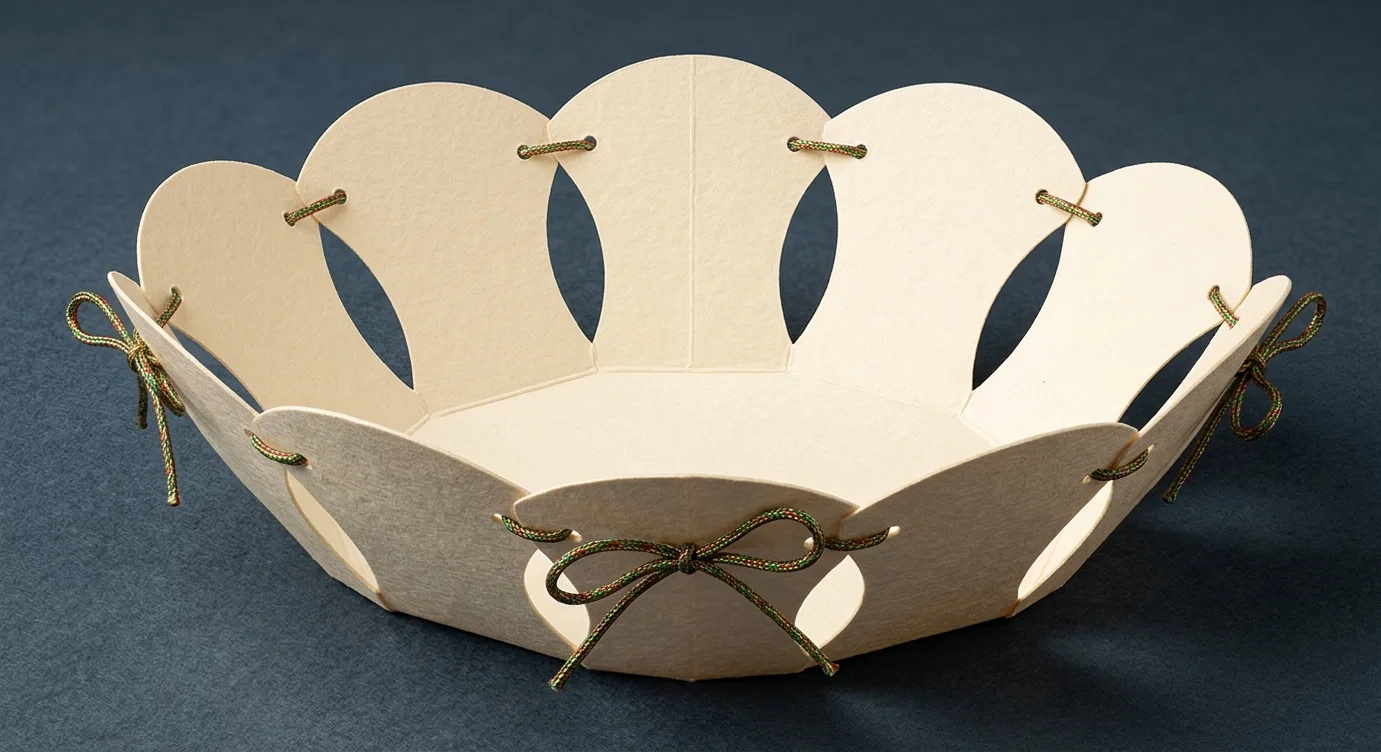
This is another card tray. Before beginning it, emphasize the importance of exact measurements, as this model can not be successfully made without them. In the exact center of the paper draw a circle with a radius of three inches. Place the ruler across each diagonal, just as in finding the center, and make a point in the circle at each place where the ruler crosses it. This exactly quarters the circle. With the three-inch radius, place the point of the compasses in turn at each of these four points, and make a point each side of each one. You now have twelve points, and they should be equal distances apart. (Fig. 1.) Test26them before proceeding further. Then with a radius of one inch use in turn each of the twelve points for a center, and draw a circle around it. These circles will overlap. Call attention to the boat-shaped parts formed by the overlapping, and see if they are the same size. Make distinct points when the circles cross each other on the inner side, and connect these points with straight lines. (Fig. 2.) Mark the places for tying. Cut the curved outline, and cut out the boat-shaped pieces. Fold the straight lines. The overlapping of the sides in tying gives a sufficient slant for the tray.
FIGURE 2
Model No. 15
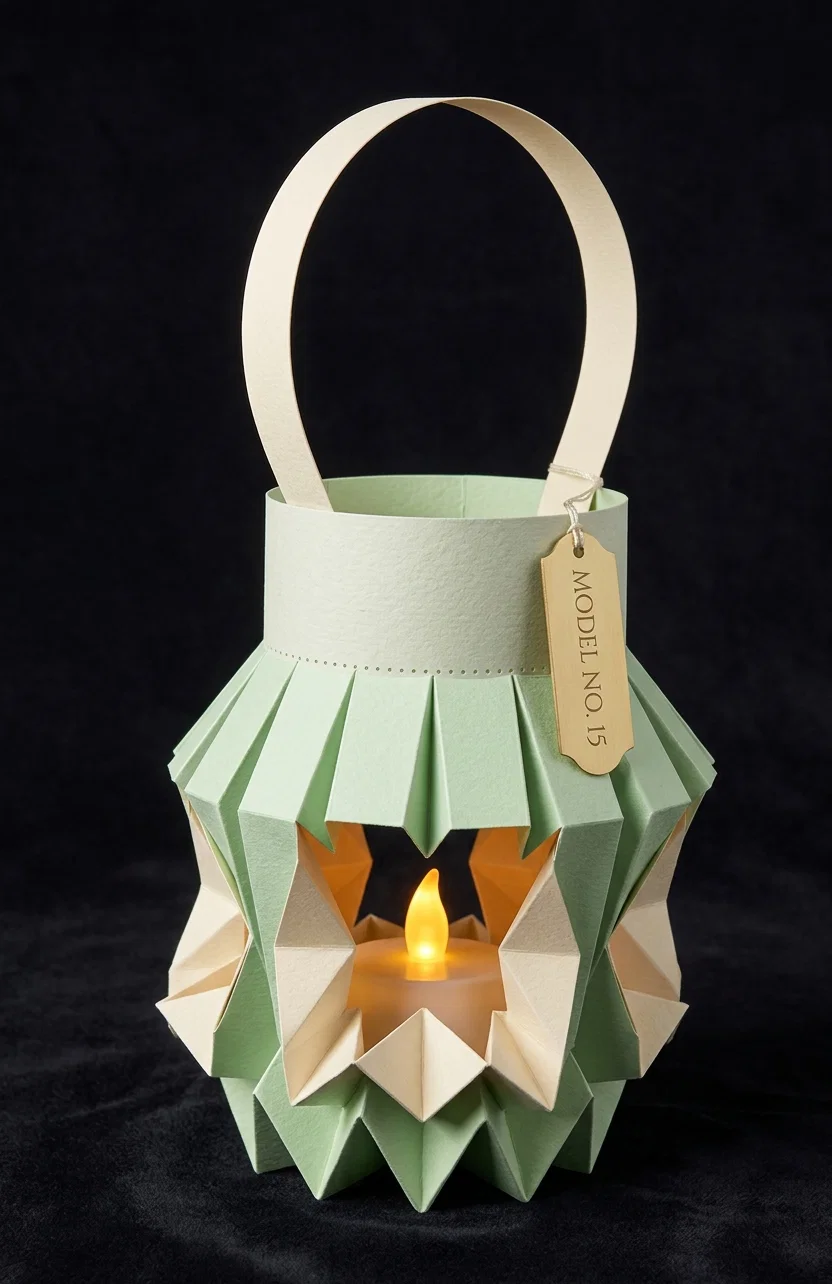
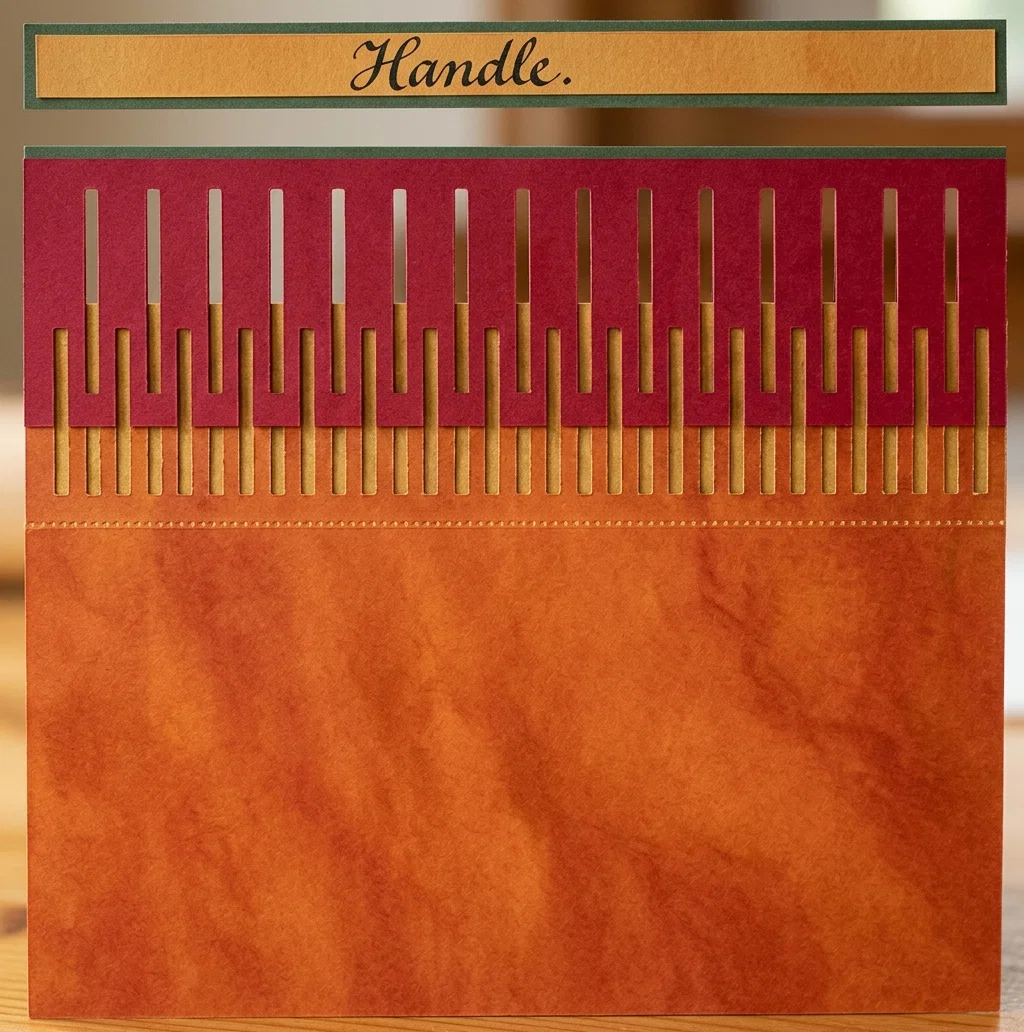
A safe lantern for school or Christmas decoration. One-half sheet of paper is sufficient for this model. After the paper is cut in half, place a point one-half inch from the upper corner on each end. Connect these points, and cut off the strip thus formed for a handle. Again place a point one-half inch from the upper corner on each end, and connect. In the center of each end, which will be one and three-fourths inches from the upper corners, place a point, and connect the two with a dotted line. On this dotted line, and also on the line near the top, place points one-half inch apart all the way across. Connect these points, as in Figure 3. Prick the dotted line near each end, and fold by the perforations thus made, so that the line will be on the outside. The upper and lower edges should just meet. With the paper folded, begin at the dotted line, and cut each of the short, upright lines. Stop exactly on the upper line. Unfold the paper, bring the two ends together with the folded edge outward. Let the ends overlap one-half inch, and either paste or tie. The handle also may be either pasted or tied (on the inside) to opposite sides of the lantern.
MODEL NO. 15
FIGURE 3
Model No. 16
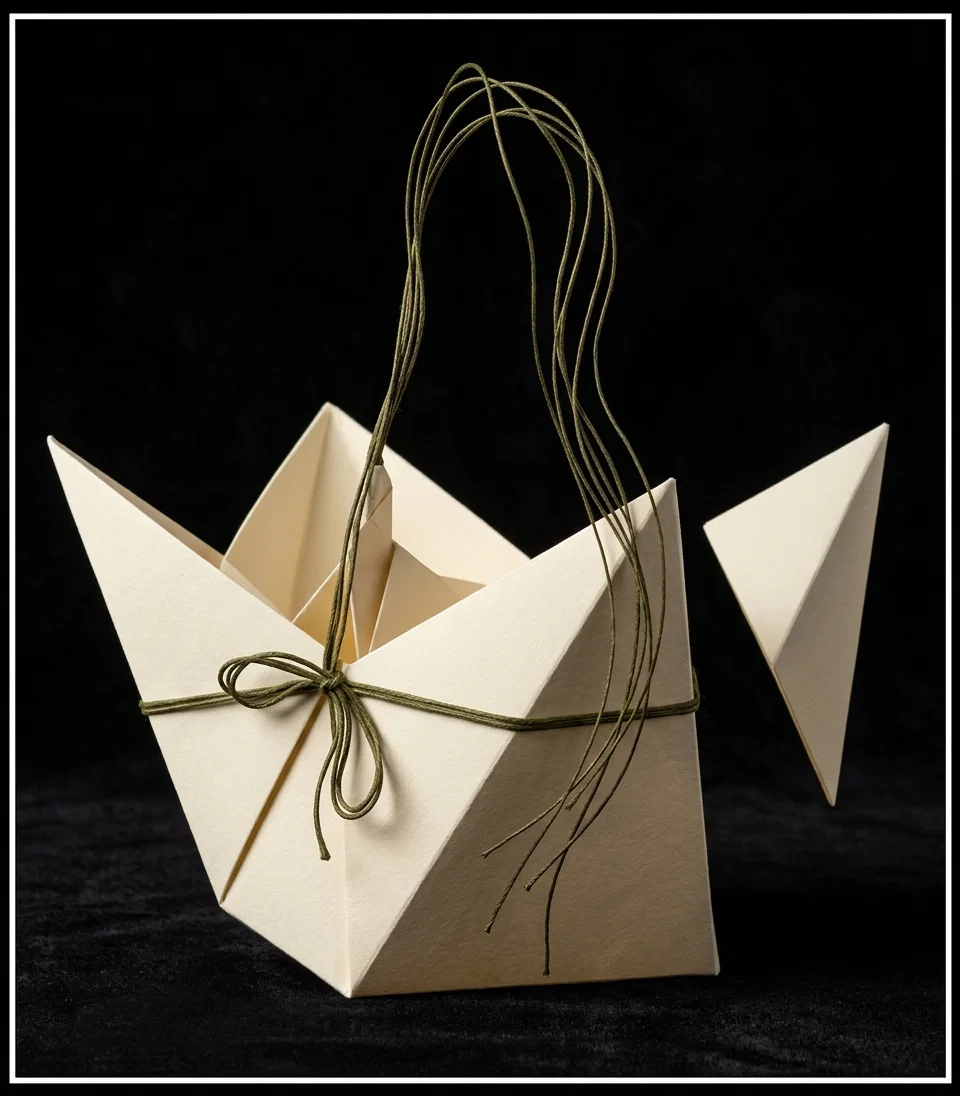
This may be used for either flowers or popcorn. For the drawing make a point in the center of each side of the paper. Place the ruler across opposite points, and draw a line two inches long, measuring from each point toward the center. Repeat in the opposite direction. Connect the inner end of these four lines. The square thus formed is the bottom of the basket. Connect each corner of the square with the two nearest corners of the paper. (Fig. 4.) Cut the four two-inch lines. Fold all other lines. To shape the basket, let any two edges made by one cut pass by each other, and on until each rests against the nearest fold. Either paste or tie them in this position. Treat all cut edges in the same way. A handle of ribbon is preferable.
MODEL NO. 16
FIGURE 4
MODEL NO. 17
Model No. 17
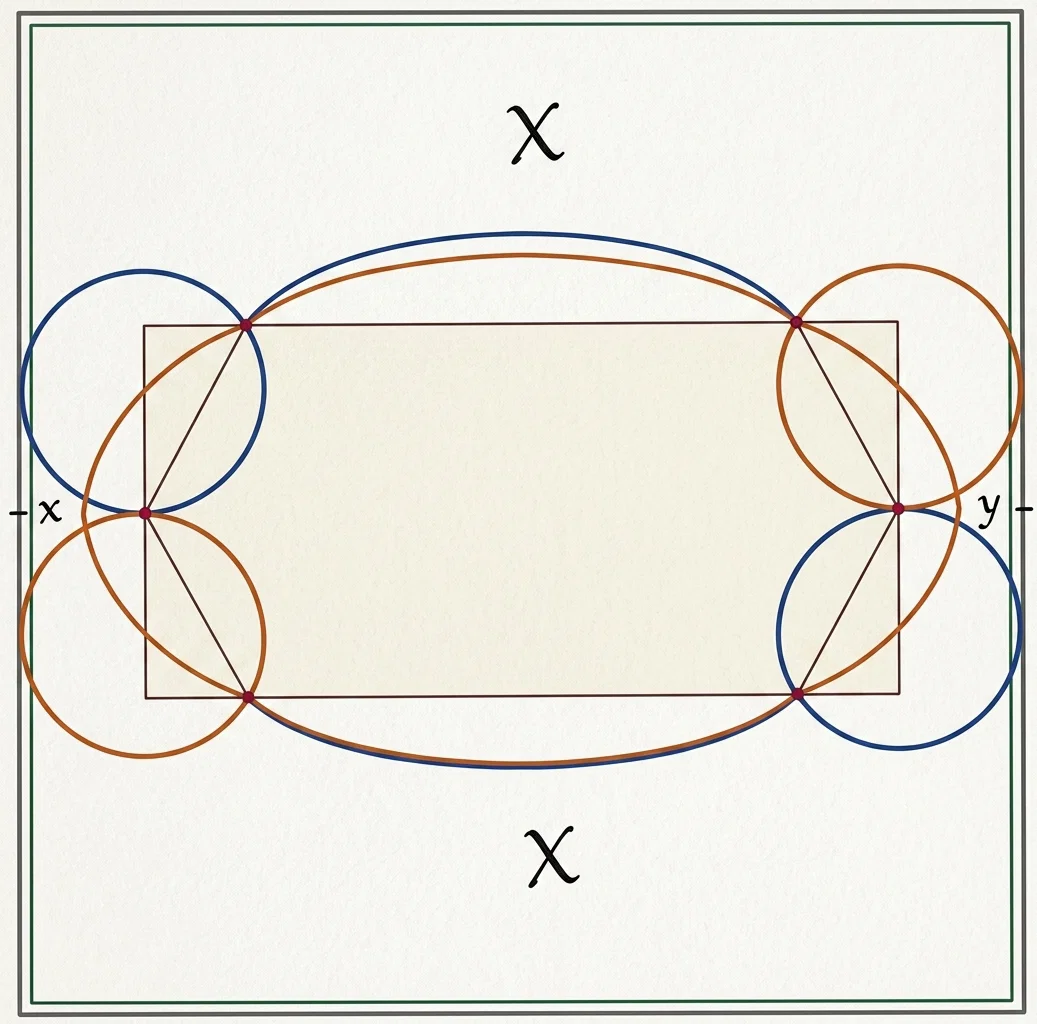
A canoe. This is not a difficult model, but the measurements must be exact. Make a point in the center of two opposite edges of the paper. Make a point one and one-half inches above and below each of those central points. (Fig. 5.) Place the ruler across the two upper points, begin one inch from the left edge of the paper, and draw a line which will end one inch from the right edge. This makes the line six inches long. Repeat across the lower points. Connect the two lines at the ends. This forms a rectangle. The connecting lines should be just three inches long. Place a point one-half inch from each corner of the rectangle on the ends. With a radius of one inch, place the point of the compasses in turn at each of the four points just made, and draw parts of circles, as shown. These should just meet in the center of the ends. Cut away the parts marked X. Do not fold. Bring the circular parts together at the ends, and paste. The canoe may be suspended by a cord or ribbon tied through the pasted edges near the ends. It may be used for hairpins, button-hooks, pencils, etc.
FIGURE 5
a MODEL NO. 18 b
The canoe shown above was made from birch-bark. If dry, dip the bark in water to prevent cracking when bent. A weight should be placed on the ends when pasted, and sufficient time given for thorough drying.
Model No. 18
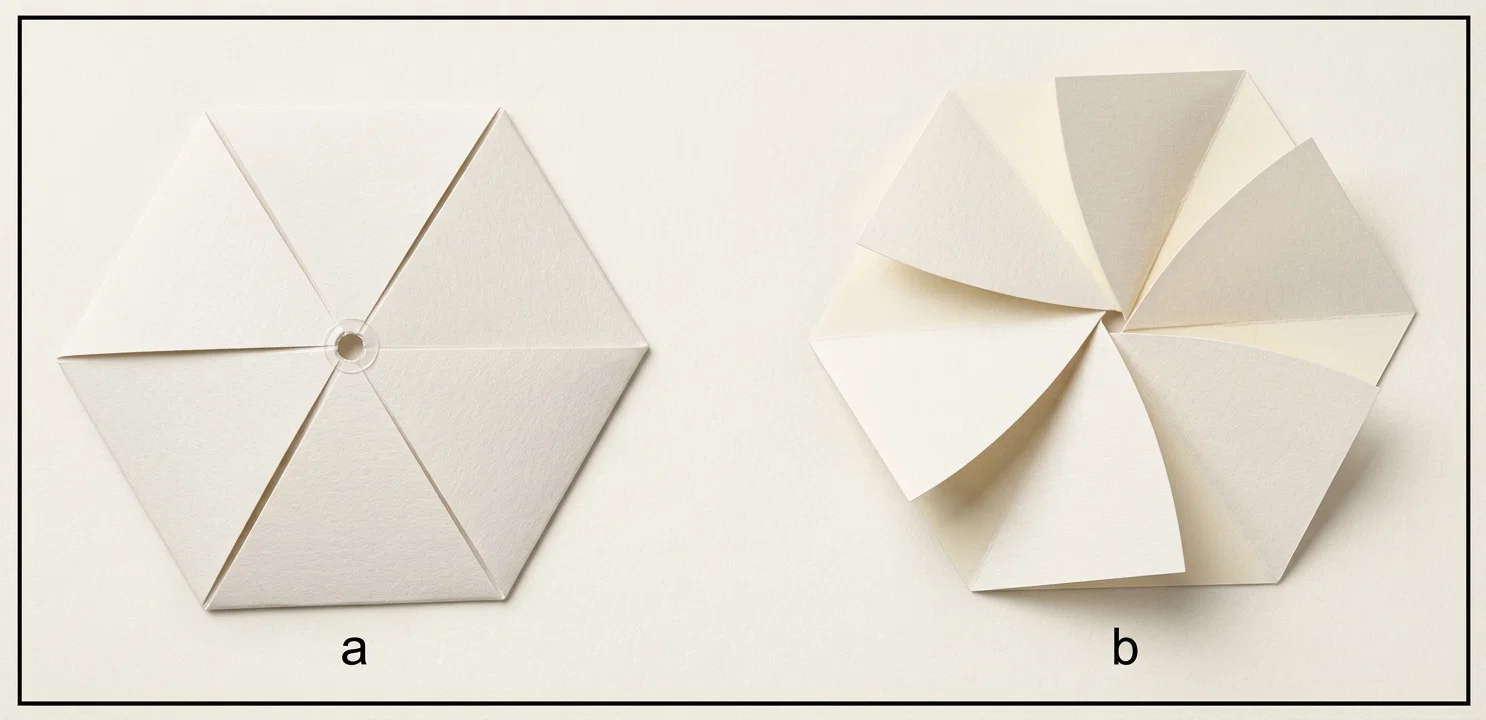
This is a coin purse. With a two-inch radius, draw a circle in the center, and divide it into six equal parts. (Fig. 6.) With a radius a trifle less than three and one-half inches (three and seven-sixteenths) draw another circle, using the same center. Place the ruler across two adjoining points in the small circle, and connect with a straight line; continue the line on to the right until it touches the outer circle. Repeat at each point around the circle.
Next place the ruler across, touching the center, and two opposite points in the small circle. Draw a dotted line from each point to the large circle. Repeat at each point around the circle.27
Fold the dotted lines on the outside. Lay the paper on the table, with the drawing up, and by the aid of the ruler fold the solid lines on the inside, working toward the right, and holding each side down as folded. You will see that the last fold must be slipped under the first. Practise this until you can do it with ease before attempting to teach it. The folding described gives you a. To make b, unfold a, and fold inside out, working toward the left.
MRS. E. M. LONG.
Winning Souls
By Ellen G. White
If you can obtain the confidence of the youth (a troublesome pupil), and bind him to your heart by cords of sympathy and love, you may win a soul to Christ. The wayward, self-willed, independent boy may become transformed in character.
But while it is necessary to manifest love and sympathy for your pupils, it is a manifest weakness to show partiality, and thus arouse suspicion and jealousy. Children are quick to discern the preferences of the teacher, and the favored student often measures his strength, his aptness and skill with that of the teacher in the management of the class. He may decide to be master, and unless the teacher has the grace of Christ, he will manifest weakness, become impatient, exacting, and severe. The leading spirit of the class will generally impart his purpose to other students, and there will be a combined effort to obtain the mastery. If the teacher, through the grace of Christ, is self-controlled, and holds the lines with a steady, patient hand, he will quell the boisterous element, keep his self-respect, and command the respect of his students. When once order is restored, let kindness, gentleness, and affection be manifested. It may be that rebellion will rise again and again, but let not the hasty temper appear. Do not speak sharply to the evil-doer, and discourage a soul who is struggling with the powers of darkness. Be still, and let your heart ascend in prayer to God for help. Angels will come close to your side, and help you to lift up the standard against the enemy, and instead of cutting off the erring one, you may be enabled to gain a soul for Christ.