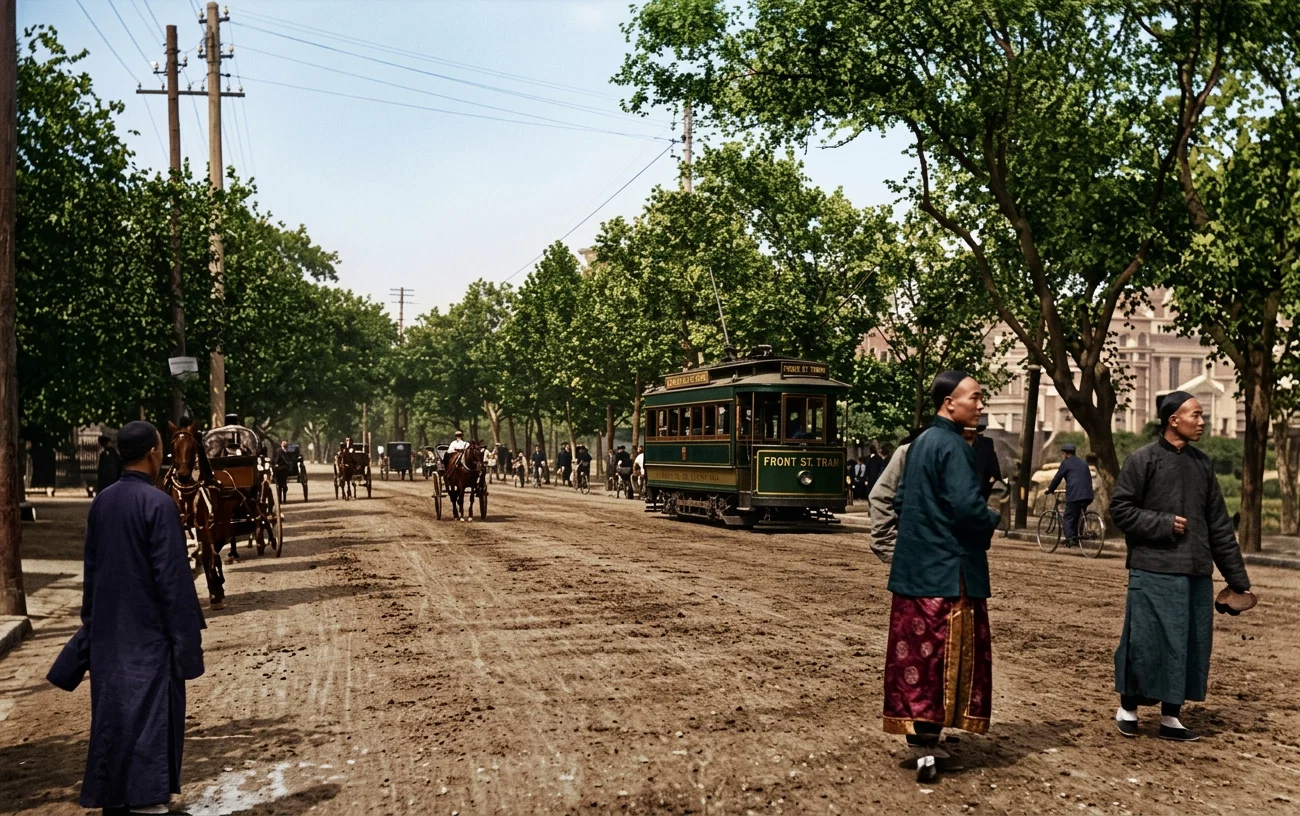
It has now been a little over six months since we located our publishing work in Shanghai, the city that is to China what New York is to America. Many centuries passed before China recognized this vantage-point as being a commercial center. Until about fifty years ago, Shanghai was simply a small district city, whose limits were confined within the wall surrounding it. Even then it was through the efforts of missionaries and a few business men, who had settled here, that it developed into a center of commercial importance. Since the population is composed almost entirely of emigrants from other parts of the empire and from abroad, it represents the commingling of numerous dialects, both foreign and Chinese. Since there seems to be no one dialect or nationality preponderating to any extent, every nationality conforms to its own customs of habit and dress, as well as its religious practices. It is not at all uncommon to see as many as fifteen different nationalities in passing down the street; and nearly all the religions of the world are represented in Shanghai.
The Japanese have their temples, the Indians their temples, and the Jews and Greeks their synagogues; other societies have their places for worship, and their club houses, some of which are as fine as are to be found anywhere.
Not only in this respect is Shanghai a very Babylon; for while missionaries laid the foundations of the city, it has now attained the reputation of being one of the most sensual and wicked cities on the face of the earth. It is becoming quite common to hear the missionaries located here say that “it is almost useless to spend efforts in missionary work in Shanghai, owing to the disgraceful example of foreigners;” and it is true that very little telling work is done for the people in Shanghai, although a number of missionaries reside here.
It is not an uncommon sight to see Chinese coolies supporting a drunken foreigner, or helping him into a jinrikisha, while another runs along by his side, steadying him, to keep him from falling out. Sometimes they go still further. About a week ago, two blocks from where we are living, on an open street a crowd of Chinese coolies surrounded an intoxicated foreigner, who was lying in his jinrikisha unconscious; they were going through his pockets, and had even taken off his shoes, when they were interrupted in their work by another foreigner.
While our chief reason for locating in Shanghai was that of commercial advantages and facilities to be found here for both the general business office and repository and the printing-office, still we have also organized a church missionary society, and are carrying on some regular missionary work for both the foreigners and the Chinese. Four hundred of the Naval Edition of the Signs of the Times were used by our church, most of this number being sold to foreigners. We are also receiving a large club of the regular Signs, and are planning to dispose of a large number of the Thanksgiving issue of the REVIEW. Some interesting experiences have attended the work of circulating these papers, and we trust that this work may serve the double purpose of warning the people and of gathering out the faithful among the foreigners of this city. We are also working the city with our monthly Chinese paper, which we find sells very readily; while Brother and Sister Parkins and Brother Mobbs are canvassing for ‘Daniel and the Revelation’ and ‘Desire of Ages.’ As a result of these lines of work, our presence has been made known in this metropolis of China, and we trust we may keep the light of truth ablaze. Some weeks ago, when registering our15church paper at the general office of the Chinese Imperial Post-office, it was with some surprise that I learned that our paper was the one hundred fifty-seventh native paper published in Shanghai, and that seventy-four papers were registered for transmission in China in foreign languages.
When it is remembered that ten years ago there were not more than five papers in Shanghai, all included, some idea can be obtained as to the advantages offered as a publishing center. There are several government schools here, besides mission universities and colleges, and public and private schools. So in drawing the best student class, some of which come from nearly all the eighteen provinces, Shanghai is exerting an influence that is penetrating into all parts of the empire.
A street-car system has been perfected within the last few months, one line being over five miles in length. At its terminus are several large Catholic institutions, one of which is a meteorological bureau. While this is a private enterprise of the Catholic Church, they have gained such skill and precision that China is dependent upon this observatory for her weather-signals.
ALONG FRONT STREET, SHANGHAI
The government has therefore placed the Chinese Imperial Telegraph Line at the command of this bureau, and has made many concessions to the Catholics, owing to its obligations to them for their services in this work. What motive other than to gain political influence could prompt the Catholic Church to establish a meteorological bureau here? In visiting their institutions a short time ago, we were taken through the industrial department, and there saw native boys carving images of Christ, the Virgin Mary, and Peter,—work which doubtless seems to them little different than carving their idols of Buddha and other gods. They were also painting screens with the many scenes so commonly found in Catholic cathedrals. The work done by these boys would be hard to excel, in the opinion of a casual observer. One of their pictures represented two Chinese boys with a marked expression of piety kneeling down before the pope. In this room were two enlarged pictures,—one of the circuit judge for this district, the other of the general inspector of the Shanghai-Nanking Railway. These were doubtless there in order to gain political favor with the Chinese. In many ways as yet unrevealed to the Protestant world, the Catholics are working to grasp universal political power. Another thing very noticeable in their industrial department was the seemingly perfect control they had over these Chinese boys. There was not so much as a whisper to be heard, and it is further known that once a native becomes a Catholic, he remains a Catholic.
The Chinese native papers and the Chinese generally are now very friendly toward America, this feeling having been created by the return of the Boxer indemnity by the United States. The Chinese government has delegated one of its foremost statesmen, Tang Shao Yi, to return thanks to the United States; and it is hoped here that his stay in America may result in some steps toward effecting an alliance between the United States and China, in order that Japanese influence may be subdued in the far East. We are certainly living in eventful times, and everything seems to be pointing to the consummation of all things in the end of the world. But the work of warning these populous countries must be done, and every facility must be employed in giving the closing message.
Shanghai, China.
The Simple Life in Mexico
By G. W. CAVINESS
G. W. CAVINESS
RECENTLY I visited San Luis Potosi. One of our native workers, having left us, was doing what he could to hinder our work here, and it was my desire to visit the brethren and counteract his work as far as possible. I found that the believers in San Luis Potosi were still holding meetings in a private house, and that the disaffected brother had had difficulty with some of them, and had separated from them. We held meetings each evening for a week, and also on the Sabbath, preaching the truth plainly, explaining the prophecies that pertain to our time. The brethren seemed interested and encouraged, and we hope that with further effort in their behalf they may be kept, and that others may be added to their numbers. Fifteen or eighteen of these brethren still hold meetings, and profess to keep the Sabbath.
From San Luis Potosi I went to Mexquitic, a place about twenty miles in the country. In Mexico, on leaving the cities and villages along the railroads, one has to resort to primitive methods of travel. In this case I had the privilege of riding a burro or walking. The burro is a very small donkey, and had I not used a pack-saddle, my feet would almost have touched the ground. After traveling in this manner for four or five hours, I arrived at Mexquitic.
The leader of the company here is the secretary of the civil court; but in this out-of-the-way place I found that the secretary was dressed like the peons of the country, with cotton trousers and shirt, sandals for the feet, and a large, wide-brimmed, tall-crowned hat. He received me in his office, and afterward took me to the brother's house where the meetings were to be held. The house was nothing but a hut made of adobe, or sun-dried bricks, the walls being four or five feet high, and roofed with poles covered with the leaves of the maguey plant. There were no windows in the house, and only one door, but the roof was sufficiently open to allow light and air to enter without difficulty. In this house they took care of me. For breakfast they gave me some bread with cinnamon tea; for dinner tortillas (corn cakes) and beans, with eggs. At night they spread on the floor, which was nothing but the naked earth, some skins and two or three blankets that I took with me, and so made a bed where I lay down for the night. I could not sleep very soundly, for the ground seemed much harder than I ever imagined it could be. I passed three nights in these quarters, and was able at last to sleep fairly well; but I can not say that I would like to continue that manner of life indefinitely.
Nevertheless it gave me real pleasure to preach the truth to these simple-minded people, for although they are poor and live in the style indicated, yet they are intelligent, and seem to have a willingness to receive instruction, and a childlike simplicity that is pleasing. I hung up the chart and preached the prophecies to them, and they seemed to understand and drink in the truth and rejoice in it. I found that this little company had been holding their meetings alone during the summer, that they were faithful as far as they knew, and I never enjoyed preaching the truth to any people more than to them. I certainly hope that in the near future further work can be done to establish them in the message. Eighteen or twenty were present in the meetings, and I understand that their entire number is about thirty. They are scattered throughout that part of the country, not all living where they can attend meetings regularly.
After this I went to Venado, a town on the railroad to the north of San Luis Potosi. At Moctezuma, one station this side of Venado, a brother met me, and together we proceeded to Venado. I found here a few who were interested in the truth, visited one family in the afternoon, and made arrangements for a meeting at night. This service was attended by about a dozen persons, and was held in the house of a man who is interested in the truth. His wife, son, and one daughter were at the meeting. After the meeting, as I walked home16with the brother who was with me, I asked him if there were any others in the family where we held the meeting. He said there was a daughter, but that she was sick with the smallpox in an adjoining room. In this country there is no quarantine against smallpox, and one is liable to come in contact with it almost any time. I felt a little peculiar on learning that I had held meetings in a place where one was sick with the smallpox; but as it has been some weeks since my exposure, and I have not come down with the disease, I think I am safe from it now.
There is an interest on the part of a few at this place, and something ought to be done for them. I hope to make them another visit; but some one should be stationed at San Luis Potosi to build up the work there, and also look after these little companies and scattered brethren round about.
The last night before leaving for home, my host and his wife got a notion that I might be in danger, and instead of sleeping in their bedroom, three or four rooms from where I was, they made a bed on the floor in the room next to which I slept, and stayed there all night, armed with a revolver. I told them that I had traveled a great deal in Mexico, and had never thought of being afraid, that I was always treated with the utmost respect, and the only fear that I had was that the people would wear themselves out trying to make it pleasant for me. But nothing happened, and I slept soundly all night. This brother said that the government had made stringent laws in favor of foreigners, and especially of Protestant missionaries, requiring them to receive protection everywhere. He himself had been a Protestant for many years, and in his earlier life had suffered some persecution. The next day I set out for home, and the host and his wife insisted on sending a present to my family, which reminded me somewhat of the present that Jacob sent to Pharaoh. It consisted of nuts, figs, and grapes, grown on his own place, and a “little honey.”
We have held our annual council, and laid plans for the work during the coming year, and have made some requests to the Mission Board, which we hope they will see their way clear to grant.
The canvassing work here in the city still continues good, last week being the best week since the work began. One young man took orders to the amount of one hundred thirty-six dollars, Mexican, and the sum of the four was about three hundred fifty dollars. This certainly shows that there is a possibility of doing a great work in this country with our literature, when young men knowing comparatively little of the language can make such a record.
We trust our brethren everywhere will remember us and the work in the republic of Mexico in their prayers, and that they will also give liberally of their means, so that the work may go forward to a triumphant conclusion.
Tacubaya, D. F.
The Hungarian Conference
By Guy Dail
WHEN Elder J. F. Huenergardt began labor in this field ten years ago, there were eight German and four Hungarian members in it. To-day there are over five hundred Seventh-day Adventists in Hungary. The Hungarian, Rumanian, German, Servian, and Slovakian nationalities were represented at the first annual session of the Hungarian Conference, held in Arad, November 4-8.
It would do the readers good to meet these simple-hearted and faithful brethren, who live together in peace. Strangers are astonished to see these persons of naturally hostile nationalities and factions so quietly assembled to hear the Word of God. Through an interpreter they told me of the love they had for the American and German brethren, who had so liberally given of their means to forward the truth in Hungary, and they wished that I should tell their unknown friends of the gratitude they felt for the third angel’s message. It would be a great pleasure to me if I could so faithfully picture these gatherings that one could get a glimpse of the beauty connected with the arduous task of winning these souls for the kingdom. This afternoon four were baptized—one German, one Rumanian, one Servian, and one Hungarian. During the last nine months, ninety-one have been received into the conference, and the net gain was eighty-five—a very good record, indeed, so far as the percentage of gain is concerned.
We have entered only one third of the country thus far, as our efforts have been confined to Lower Hungary and Transylvania. In the entire kingdom there are about twenty-one million people. There are many thousands of square miles and many millions of the inhabitants yet untouched by our efforts; and still the land of the ancient Huns is gradually feeling the influence of the living preacher. We have a nice corps of energetic and promising young workers in this field. About twelve were formerly students at the Friedensau (Germany) School. One of these, Brother F. Kessel, was ordained to the ministry Sabbath forenoon. It was an occasion of great blessing to those present. Brethren H. F. Schuberth, J. Erzberger, and Huenergardt officiated; they were assisted by Brethren J. Wolfgarten and O. Schwenecke.
As this is a young field, it is but natural that the delegates should take a deep interest in the business proceedings. We are glad six new groups could be received into the conference. There were one hundred forty of our people present. It did not take much to convince them that we need more workers for Hungary. To assist in securing these, nearly three hundred kronen was pledged, and two hundred kronen given in cash toward the Hungarian Educational fund. There was also a great desire manifested to do personal missionary work. Heretofore we have been unable to get permission for the colporteur, but now four regular canvassers are in the field, and five will give a part of their time to this branch of the work. We have a great task before us in preparing suitable literature for these various nationalities. A good beginning has been made. The Hamburg House issues a Rumanian and a Hungarian monthly paper for missionary purposes, besides the Hungarian Worker, and a few pamphlets and tracts. We would remind our American friends of the existence of this literature, and hope they will circulate it among their Hungarian, Rumanian, Servian, and Slovakian neighbors. Such literature can be secured through our New York Branch of the Review and Herald Publishing Association.
The public lectures were well visited. Health and temperance talks were held, as well as studies on the other subjects connected with the third angel’s message. From sixty to one hundred fifty strangers were at the evening and Sunday meetings. The interest awakened by this conference is to be followed up. In Hungary, as in other parts of the field we have visited this fall, there are more calls for labor than we are able to supply. Brother Huenergardt, who was re-elected president, is assisted by two ordained ministers, one licentiate, and eight Bible workers, two of whom are also able to do medical missionary work. They go forward filled with courage and good cheer, and thankful for the manifest blessing of God at this conference. They desire a part in your prayers. GUY DAIL.
Sheyenne River Academy, Harvey, N. D.
By Mrs. N. W. Lawrence.
Our school year has been a most pleasant one from the beginning; for God answered our prayers by sending us a company of earnest young people, who, we believe, came here for a definite purpose.
When the Ingathering for missions was presented, some of the students took hold most earnestly, and were much blessed in the effort, some of them having experiences they would not part with for money.
Shortly after this, Prof. P. T. Magan visited our school, and his instruction concerning the spirit of prophecy, as well as on other lines, was especially appreciated.
Following this visit came the week of prayer, and it was a most blessed season. A remarkable feature, after the second night, was the punctual attendance of every student. It seemed as if none dare remain away, for fear of losing the blessing of God, which was there in rich measure. Hearts were made tender and melted before him as his goodness was revealed to them; then some sin would be shown, and quickly wrongs would be made right, and forgiveness obtained. Some who had back-slidden were reclaimed, and we feel sure they have experienced a deeper work of grace in their hearts than ever before. Others for whom we had long labored and prayed yielded to God, to be used17by him as he sees best. We are sure there was joy among the angels as they saw our boys and girls yielding themselves to him for service. Both students and teachers quickly caught the strain, and thanked God from full hearts that, even on us, had fallen some drops of the latter rain.
During the latter part of the week, the general canvassing agent made us a visit, and formed a canvassers' class of seventeen members, to begin the study of their book for the coming summer.
We thank God for the privilege of co-operating with him, in helping to prepare young men and women to go out and to help finish this work. We look forward just a little way in the future when we shall see our boys and girls going to different places in the world, with but one purpose in life, and that to tell the good news of a soon-coming Saviour. Then when the gathering time comes, we expect to be gathered with those for whom we have labored, and stand with that company on the sea of glass, and join in the song of Moses, and be permitted to follow the Lamb whithersoever he goeth.
MRS. N. W. LAWRENCE.
The Convention of Self-Supporting Workers
By Josephine Gotzian
THIS meeting was held on the Nashville Agricultural and Normal Institute farm. It opened October 15, and for several days previous, visitors had been coming. They kept coming until the rooms in the Rural Sanitarium were all full, and cots filled both bath-rooms, the dining-room, and most every available spot in both school and sanitarium. Some of these guests were able to stay the entire ten days of the meeting. Others came for only a part of the convention, and then pressed on to their individual work.
I moved among the visitors, and sought to find out as much as possible concerning them and their work. There were a number who came across the continent from the Pacific Coast. One sister from California returned to her home to arrange her business affairs so that she can devote her time to self-supporting work in the South. Two families who came from California to attend the school and the convention have since purchased property, and are now opening a farm school.
Wisconsin had several representatives. One sister in particular expressed her interest in self-supporting work by donating a cottage for the nurses at the sanitarium on the school farm. Since the convention, two other Wisconsin visitors have, so I understand, purchased a tract of land in the South for a school to educate self-supporting workers.
Nebraska sent several representatives. One of them returned to his home State to dispose of property in order to join the band of self-supporting workers in the South. An entire family from the same State will probably be in the South by the time this is read.
Among representatives from the East was a sister who became so interested in the needs of the South that she has visited different portions with a view to helping locate another farm mission school.
As might be expected, all the self-supporting workers now in the South, who could possibly spare the time and means, attended the meeting. And of these there was a goodly company. A pioneer among these was Elder D. T. Shireman, the white-haired veteran in this movement. His courageous words did good to all hearts. He has spent over twenty years in this field, and he knows its most pressing needs, and his message sounds clear and strong in behalf of self-supporting efforts.
There were representatives of medical and sanitarium work, canvassers, the Misses Lackey and McDonald, representing the paper work, and delegates from more than ten industrial schools in various parts of the South.
The words of instruction along missionary lines, as given by some of our leading brethren, were listened to with deep interest. One conference president seemed to voice the sentiment of many others when he said that he longed to see the time when individuals, moved by the Spirit of God, would take the lead in starting missionary enterprises. This, he reasoned, would greatly relieve the conferences, which are already in many cases overburdened and unable to undertake enterprises calling for a greater expenditure of means.
The effect of the convention was to strengthen the feeling that in the closing work of the message all God's people must have some part. We must have some part. Many can not depend upon conference support. Upon many the Spirit will yet rest, and they will answer his call, depending upon God and the work of their hands for support, while they herald the coming of the Saviour.
It is time for many to bestir themselves. The field is wide. It seems to me that the South is but a camping station and training-ground for wider fields beyond.
JOSEPHINE GOTZIAN.
Tennessee
By W. J. KEELE.
SABBATH, December 19, was a blessed day for the Leach (Tenn.) church. As I had not visited the church-members since returning from Memphis, I decided to spend the entire week in visiting the brethren, and trying to get all interested in seeking God for his Holy Spirit.
Sabbath, December 12, the church was asked to fast, and to pray earnestly all through the week. But few saw the importance of doing this; but as the end of the week was nearing, some saw their mistake. At the meeting on Friday, all were asked to fast on the Sabbath, December 19, and come for an all-day meeting. We surely experienced the greatest refreshing from the Spirit of God that the Leach church ever had. Brethren confessed their faults one to another, and prayed and asked prayer for others. All were moved by the Spirit of God to get closer to him.
Three took their stand to walk with God. We decided to continue our meeting the next day, and at this service twelve of the children and youth requested prayer.
Dear brethren and sisters, we pray for you and the Lord’s work. We can help but little with our means; but pray for us that we may give our all — even ourselves.
You can assist greatly here if you can ship by freight to Huntingdon, Tenn., on the Nashville and Chattanooga R. R., prepaid, any clothing suitable for children of any age. It is much needed. Clothes for adults will be greatly appreciated. Address Mrs. Mae Keele, R. F. D. 2, Cedar Grove, Tenn. Ship in her name to Huntingdon, Tenn.
W. J. KEELE.
South Africa
By M. C. STURDEVANT
BULAWAYO, RHODESIA.—The work here is still prospering, under the blessing of our God. The present season has been a blessed one in our school work. While we have had only the average number of boarding students, the outside attendance has been the best we have had in years. At present our first school is in charge of Brother Victor Willson, with two native teachers. This is held from eight to ten in the forenoon, is filled with outside children, and the interest seems good. The second, in charge of Brother and Sister J. R. Campbell, who lately came to us from America, is in session from 10:30 A. M. to 2 P. M. Two native teachers help in this also; and I teach one Zulu class and the general Bible class, when I can be at home. This school is composed largely of our older boys and girls, the boarding students; and these are the ones on whom our hopes depend.
Generally speaking, the interest is good, and many are working hard in their studies. While there are a few who seem to be tired of school, having been here many years, yet, rather than leave the mission, which seems to mean to leave the truth, they hold right on to their work. We have some severe struggles with the enemy, and none need think that mission work is all sunshine. Yet Christ is our captain, and we seldom lose a battle. “Happy is that missionary who, when the mere romance of the foreign aspects of his work is staled by experience, falters no whit.”
Our out-schools are doing fairly well. August 24 I started with two of my boys on a visit to these stations, first arriving at the Lushabe River, where one of our teachers is located with his18family. We found him of good courage, and pressing the work with all his might. Going on to Kupavula, where Brother C. R. Sparrow is, we visited another native teacher. We found the school very small, many of the natives having moved away. The interest is not good; yet we believe the workers are doing all they can. We stayed with Brother Sparrow that night. Waking before day, we went on about thirty miles, to see some natives who, we heard, were calling for a teacher. But on arriving there at sunset, and seeing the conditions, we concluded the people were not very anxious to be taught. We stayed at that village that night. The next day we made another trip of about thirty miles, arriving after dark with our two teachers at Magam’s village. I was so sick that day on the road I could hardly hold to my saddle, and had to lie down twice for a rest. But, in answer to prayer, were able to reach our teachers a little after dark. There we drank hot water, and lay down to rest. The interest at that place is not good, but we found the teachers working hard. I could not help thinking how many of our white teachers would keep up courage under such discouraging experiences. The work for this people is growing harder and harder every day, and we should not slacken our efforts in the least to give the message to them.
The next day we started for home, forty-five miles distant. I arrived there a little after eight at night, the boys a little later, they having gone all the way on foot. We have some faithful boys. Were it not for these, the work here would go much harder.
Our church- and Sabbath-school work is onward. Nearly one hundred attend our meetings on Sabbath. The interest is good. Our courage is good, and our only thought is to finish the work. It gives us courage to hear of the blessings of God upon our camp-meetings in the home field, and to know you are thinking of us, and helping so liberally with your means. This work is yours also. We will finish it together. Pray for us.
M. C. STURDEVANT.
Samoa
By Joseph E. Steed
APIA.— The work of carrying the last message was begun here in the year 1895, but for various reasons this island has been without a worker for some time. A little more than a year ago the Australasian Union Conference Council requested the writer and some members of his family to make this their field of labor. Since coming here we have had much to do, and much to learn. We could not hope to do much toward getting out literature in the native language, but He who called us came to our help, and raised up a young man who was interested in the truth, and by his help we have four tracts and one two-page leaflet almost ready to work with; and this young man has also become firmly established in the truth, and has identified himself with God's people.
Besides a population of nearly forty thousand natives, there are about one thousand Chinese and some three hundred whites, for whom we are working. We would be glad indeed if any of our American brethren could send us reading-matter in English or German, bearing on God's message for to-day, post-paid, to Apia, Samoa.
JOSEPH E. STEED.
Grand Cayman
By Percy Alley
OUR little island lies in a northwesterly direction from Jamaica, and has a coast-line about twenty-five miles in length. You have read and reread of Elder Eastman's visit to the island; also of Elder F. J. Hutchins and others who scattered the seeds of present truth.
Three years ago, Elder Frank Hall and his family entered this field to further prosecute the work, which was for a long time neglected. They at once began work by holding open-air meetings. A little later they had the privilege of a house in which to conduct their services. After attending once, I requested Brother Hall to hold meetings at my place, which he did. We also held Bible readings, which convinced another young man and myself of present truth. Though the battle with old habits was fierce, the victory was gained through the strength of Jesus, and we both stepped out to obey. Since that time we have rejoiced in the third angel's message.
As a result of Brother Hall's work at Georgetown, the capital of Grand Cayman, there are at present seven baptized members (others have fallen away). We sadly need a church building at that place, but the means is lacking. At East End there are six baptized members and a Sabbath-school of seventeen. They are building a small church, but require means to finish it. Brother Hall is now laboring at Bodden Town, with a good attendance and interest, which we hope and pray the Lord of the harvest to bless, that we may see sheaves gathered into his garner.
This is a very needy field, and there is much to be done for the Master. We ask the united prayers of all the brethren and sisters for the work at this place.
PERCY ALLEY.
RILEY RUSSELL, M. D
By RILEY RUSSELL, M. D.
From Oregon to Korea
WE reached Soonan, September 24, after spending just one month on our journey from Roseburg, Ore. We spent some time in Japan, as our boat stopped several days at the different Japanese ports.
Tokyo, the headquarters for our work in Japan, is a city as large as Chicago, or larger. In the distance we saw the mikado's palace. After leaving the boat at Kobe, we stayed at the sanitarium until Monday, visiting the native sanitarium and the church, where one of our native ministers preached to an interesting audience. Dr. W. C. Dunscombe is working hard, and the sanitarium is full.
Japan is interesting to a foreigner. The hustling little people, their queer ways, the green-covered mountains, and the extensive rice-fields, all impressed us very much. Korea and Japan are almost opposites in appearance; for the Korean mountains are rocky and almost bare, and there is no timber to speak of. Korea might be described as a level country covered with mountains; for everywhere are flat, fertile valleys, where rice, cotton, millet, wheat, a certain large radish, peaches, pears, and Kafir-corn, are raised. Their chestnuts are very large. The persimmons, about four inches in diameter, are excellent.
The people are about as large as Americans. They look somewhat like the American Indian. Many of them are established in the truth, and those whom we know we like very much. Our teacher refused a good government position to stay by us.
Everything here appeals to one as of great antiquity. There are ancient tablets scattered over the hillsides. The east gate in Pyong Yang was built while David was a boy. And when we see the things about us which look just like the pictures in the old family Bible of the people in Palestine, etc., and understand some of the needs of this people, we can say as never before, “The harvest is great, but the laborers are few.” The people, diseased and poor, in their little mud-walled, dirt-floored, straw-roofed houses, certainly appeal to us as needing help. Already we have had patients who have walked thirty-three miles to reach us. We are all happy, and of good courage, and feel as never before like working to win souls for the Master.
RILEY RUSSELL, M. D
Mississippi
By T. C. COLTRIN
NEW ALBANY.—We began a series of meetings, July 27, in a bush arbor ten miles from the above-named place. The meetings continued for three weeks, with good interest and attendance, although not without a great deal of opposition. The Baptists and Methodists began protracted meetings, which drew away some of our congregation; and as our camp-meeting at Amory was held August 19-25, I thought best to discontinue the effort till after camp-meeting.
After enjoying this annual feast of good things, my wife and I returned, with faith and good courage, to our place of labor. Elder F. R. Shaeffer accompanied us, and assisted in the meetings for a week.
When our meetings began, the opposition began. An arbor was built near by, and a week's revival meeting started, but we continued our meetings for three weeks, and the Lord gave success. Fourteen signed the covenant to keep all the commandments of God. Among19these is a very promising young man twenty-three years of age, who is a native of Spain, and was brought up in the Catholic faith. He came to the United States four years ago, and is now attending our industrial school at Pine Grove, near Amory, Miss. He is educating himself to help carry this last great message to his own people.
An acre of land has been given to us for our church building. We now have on the ground fourteen thousand feet of lumber, and will build as fast as the weather will permit.
I am holding some cottage meetings with good interest, and hope soon to see other Sabbath-keepers added to our number. I ask the prayers of God's people for the success of the work here.
T. C. COLTRIN.
Michigan
By M. B. BUTTERFIELD.
BALDWIN.—I began a series of lectures in the opera-house in this place, December 6, which continued two weeks. The attendance was good, and at the close of the meetings twelve had taken their stand to keep the commandments of God.
Remember this little company in prayer, that all may become fully established in the third angel’s message.
M. B. BUTTERFIELD.
Canada
By Matthew J. Allen
ONTARIO.—Having listened to Evangelist William Simpson present the doctrine of the Seventh-day Adventists during a series of meetings some three years ago at Los Angeles, Cal., my wife and I saw very clearly that the Bible is God's word, and that the doctrine of the Catholic Church, to which we then belonged, was the doctrine of men; so we both accepted the truth. We sold our business, and came to Canada, our native land, to labor for our people, who are all Catholics. We spent three months with them. They were very bitter toward us; yet some of them saw the Sabbath truth.
We then went to Toronto to engage in selling our books and papers. The conference president, Elder Eugene Leland, being pressed with calls from many towns, requested us to visit the Indian reserve during the week of prayer. Although we had not much experience in laboring in gospel work, we felt called to accept this invitation. Two companies had been raised up about ten years before by Elder W. W. Simpson, the man who had brought the truth to us. The Indians were so glad to see us because of our association with Brother Simpson, that they came out in great numbers. Many who had never heard our message also came every evening for two weeks. There are about six thousand on the reserve, and there is no worker among them. They wish us to return and labor for them, and I think that we shall go.
We are doing self-supporting work, and the Lord is blessing us abundantly.
When we think how good the Lord was to bring this precious truth to us, we pray that more of our Catholic brethren may be led to examine this message.
Pray for us as we go among the Indians. MATTHEW J. ALLEN.