Too often the obligation to give to the cause of God is kept before the church, instead of the privilege. In the conversion of Saul of Tarsus, God has shown us how he could accomplish this work without using the human agent. But he has graciously given us a part, that we may finally 'enter into the joy' over the salvation of souls. The Lord could feed his laborers with manna, could prevent their clothes from waxing old, could transport them, as he did Philip from 'the way that goeth down . . . unto Gaza' to Azotus, could supply them with any necessary money from the fish's mouth, as he did Peter. But there are many of our dear brethren who love this truth, and want to have a part in spreading it, but who can not go to the front. To them the Lord has given the privilege of furnishing these supplies, that in the future life they may share with the workers "the joy of the Lord." Were these facts impressed upon the minds of our brethren, I believe we would hear less about the "many calls for money."
When a collection is taken, too often the purpose of the collection is not fully explained. It is but natural that donors should desire to know to what cause they are donating. Frequently strangers are present, who would give liberally to our collection for missions, if they understood something of the nature of the work that we are doing. Explain the collection each time before it is taken; give some pointed missionary story, some experience of our brethren who are at the front, and see if it will not swell the offerings.
Another important help will be to have a certain sum set before your church to be raised in a given time. I have in mind a church which placed this mark at a considerably higher figure than they had hitherto ever been able to reach. The result was that they nearly always doubled the amount aimed at. Let us seek in every way possible to swell the stream, that the opening providences may be entered, and the work speedily consummated.
R. W. PARMELE.
The Relation of the Church Missionary Secretary to the Church-Members
By E. M. GRAHAM
It is the duty of the missionary secretary to get every member of the church to do some missionary work regularly. It will take much tact and hard work to accomplish this, and more still to keep the members steadily at their work. But by the help of the Lord, it can be done.
The missionary secretary should have a list of the members, and should keep it in a book that has room in it for notes on the circumstances of the members, the kind of work for which they seem best suited, or that they prefer, and other particulars that may prove helpful in working for them. This should frequently be studied, that none may be overlooked.
It is a good thing to divide the membership of the church into bands, with a leader over each band, to help them to work. The bands should be small, five or six members to each leader. In arranging the bands, care should be taken to put those who live near one another in the same band, with a leader in the same district, for convenience of working.
The leaders of the bands should be called together frequently, and should be expected to report what the members of their bands are doing. If any are not working, and can not be persuaded to work, the missionary secretary should assist the leader in working for these inactive ones. Sometimes a change to another band is all that is needed. Sometimes instruction is needed, sometimes encouragement. The missionary secretary should make a study of such cases, to see what the difficulty is, and be ready to give such advice and practical help as may be needed.
The missionary secretary should have experience in the various kinds of missionary work. He should not be content with a past experience, but should engage in practical work to the extent of20his time and ability. This is the only way in which he can become a true leader. Advice to the church-members, drawn from practical, present experience, will have far more influence than that based only on theory, or even on an experience some years old.
All these things show that this is an office of no small responsibility. It is an honor to be called to bear responsibilities in the work of God, but this honor can only be obtained through self-denial and hard work. It is not easy work to hold any office in the service of God, but the more sacrifice called for, the greater the blessing received. Let the missionary secretaries, therefore, be full of courage. Though their work is hard and responsible, it is fruitful for good, and will be the means, if faithfully done, of watering their own souls, as well as of blessing others.
E. M. GRAHAM,
Secretary Australasian Union Conf.
Field Notes
At Peoria, Ill., recently five persons were baptized, and there are others who wish to go forward in baptism a little later.
A REPORT from Grand Rapids, Mich., states that eleven persons have begun to observe the Sabbath as a result of recent work there.
SEVERAL have taken their stand for the truth, and many others are deeply interested, as a result of meetings held at Parkersburg, W. Va.
NINE young persons were baptized by Brother I. M. Martin, following the recent effort made at Hatfield, Pa. Others are keeping the Sabbath as a result of this effort.
BROTHER A. F. FRENCH reports that one more family united with the little company of Sabbath-keepers at Atlanta, Mo., as a result of a few meetings held at that place.
A LETTER dated December 4, from Brother W. L. Sims, at Fortuna, Cal., says: “Another has taken a stand for the truth. We now have a company of twenty-five, mostly adults.”
THREE persons began to keep the Sabbath as a result of recent efforts put forth at Solon Center, Ill. Seven others, all heads of families, have accepted the truth at the Hoag schoolhouse, four miles from the Center.
A REPORT from Elder S. G. Huntington states that six persons were baptized in Ogden, Utah, November 29. Ten or eleven others are to be baptized soon. He also says: “A woman and her daughter will soon unite with our church here [Salt Lake City], two others have begun to keep the Sabbath, while two are just ready to step out on the Lord’s side.”
SINCE the close of the summer’s effort among the Swedish people in the Bronx, New York City, eight persons have been baptized, others are keeping the Sabbath, and still others are interested. November 2 the church had its second anniversary, and it was found that during the two years the membership had increased from twenty-two to sixty.
Questions Answered
By T. E. BOWEN
“CAN a newly elected elder be ordained by the outgoing one?”
In answer to this question, we should say, No. All officers of the church requiring ordination should be set apart to their work by an ordained minister. That no quarterly meeting service should be neglected or unnecessarily postponed, it is the usual custom in all our churches for the old officers to continue their services until the newly elected ones are prepared to enter upon their duties. Where new elders or deacons are chosen, the elder of the church should at once notify the president of the conference, that these officers may be set apart to the sacred work for which they are chosen, by some ordained minister of the conference.
“Are not deaconesses elected who are not the wives of deacons, the same as those who are?”
Yes. It sometimes is the case that other sisters in the church are better adapted for the work of deaconess than the wife of the deacon. The qualification of the individual should determine who should be chosen for deaconess, the same as in the selection of other officers.
It might be added in this connection that the work of the deaconess, properly carried on, is of great importance, and will bring much blessing into the church. Her duty is not done when the quarterly meeting services are over. We believe every church, though small, would be profited by selecting at least two deaconesses, who, together, or in counsel with each other, can visit and assist the sick and those in need of loving help, both in the homes of those who are members of the church and of those who are not. They should take the lead in this noble work of ministry throughout the year, and enlist the interest and help of other sisters in the church, as the needs may demand. Such loving, unselfish service will wield a powerful influence in favor of the truth wherever it is faithfully carried forward. Read Job 29.
T. E. BOWEN.
Current Mention
— The city of Roanoke, Va., has voted out its saloons, by a very close vote at the close of a vigorous campaign by both the temperance and the liquor element.
— The gold output of the United States for the year ended June 30, 1908, amounted to $90,435,700, and the silver production for the same period amounted to $37,299,700.
— A report from Paris states that the coldest weather experienced in fifty years was prevalent there on December 30. Nineteen deaths occurred, due to the freezing weather, while the streets were blocked with snow.
— It is reported from Rome that the pope has recently had a visit from Saint Joan of Arc, when she is said to have addressed to him solemn words of encouragement, exhorting him to continue his present policy, which she promised would shortly be crowned with triumph.
— As a result of an explosion of fire-damp in the Maybury mine, at Bluefield, W. Va., on December 29, eighty men are believed to have lost their lives. There were one hundred ten men in the mine when the explosion occurred. Of these, less than thirty have been taken out alive, and many of these will die from their injuries.
— Abraham Ruef, a former political boss of San Francisco, who for a long time has been on trial on the charge of bribery in that city, was sentenced, on December 29, to fourteen years in the State penitentiary at San Quentin. The trial has lasted for many weeks, and the defendants have filed a bill of probable cause, which, it is said, may extend the trial for three years.
— The national Bureau of Equipment at Washington, D. C., opened bids on January 5 for a long-distance, high-power, wireless telegraph station, which is to be erected near Washington. The station must be able to transmit messages over a radius of three thousand miles, and must also be equipped with a wireless telephone system, sending to the distance of one hundred miles.
— Prof. Percival Lowell announces that spectroscopic proof has been obtained of the presence of water on the planet Mars.
— During a battle between supporters of the deposed President Castro of Venezuela and the soldiers of the new governor, at Macuro, Venezuela, on December 29, twenty men were killed, and fifty wounded.
— Martial law has been in force at Stearns, Ky., since December 25, and soldiers are patrolling the town. This condition was brought about because of riots and bloodshed following a strike of miners and lumbermen.
— It is reported that Austria now has a force of one hundred fifty-five thousand men in Bosnia and Herzegovina ready to invade Servia at a moment's notice. The troops are said to be suffering greatly from typhus as well as from cold and exposure.
— In order to obtain still further expert opinion as to the correct method of constructing the Panama Canal, President Roosevelt has invited six civil engineers to visit the scene of operations with President-Elect Taft, make critical examination of the course of the proposed canal, and give a report of their findings.
— The commissioner of education reports that nineteen million pupils of all grades and classes were enrolled in the public and private schools of the United States one year ago. He reports that the amount of money spent in this country during that year for education of all grades, both public and private, is approximately four hundred forty-two million dollars.
— The new apparatus to prevent ships rolling at sea has been given an official test on the mail steamer “Lochiel.” This apparatus consists of a gyroscope suspended amidships and driven by electricity. The motion of the gyroscope reduces the roll of the ship so that even in moderately heavy seas very little roll is experienced. During this trial, the rolling of the vessel was reduced from thirty degrees to three degrees.
— In view of the certainty of air-ships being used in the next great war, the German war office is conducting experiments with guns specially constructed to aim upward at air-ships. Automobiles of high power are being armored and equipped with quick-firing guns, to be used as air-ship destroyers. These will be able to travel over rough country at a rapid speed, and follow the course taken by air-ships so long as they are near the highways.
— In addition to the arrests reported last week in Pittsburg, Pa., as a result of investigation of graft in the city council, seventeen others have been put under arrest on the same charges. One of the leaders in this investigation has made the following declaration: “This city is rotten to the core, and we are going to clean it up. We have the names and data, and when we get down to arresting those who gave bribes, it will create a bigger surprise than the arrest of the councilmen.” It is proposed to arrest every man in the city against whom the charge of bribe-giving or bribe-taking can be made to stand.
The Bookmen's Convention
By E. R. Palmer
THE bookmen's convention for the Review and Herald territory was held, according to appointment, at the Foreign Mission Seminary, Takoma Park, Washington, D. C., commencing Dec. 16, 1908.
Elder Morris Lukens, manager of the Review and Herald Book Department, was elected permanent chairman, and L. W. Graham and R. J. Leo were elected secretaries.
All the general missionary agents and field missionary agents under appointment from the Lake, Canadian, Atlantic, and Columbia union conferences were present. The names of the delegates, and the territory represented by unions, are as follows:—
LAKE UNION CONFERENCE
J. B. Blosser, General Missionary Agent.
F. B. Numbers and wife, Wisconsin.
O. Morris, Northern Illinois.
C. J. Tolf, Southern Illinois.
A. C. Haughey, West Michigan.
J. H. McEachern, East Michigan.
H. W. Johnson, North Michigan.
ATLANTIC UNION CONFERENCE
R. J. Bryant, General Missionary Agent.
G. W. Whitney, Maine.
A. R. Evans, Vermont.
H. C. Wilcox, Central New England.
Charles Dyer, Southern New England.
H. C. Tonjes, Greater New York.
A. R. Scott and wife, New York.
F. M. Dana, Union Missionary Secretary.
COLUMBIA UNION CONFERENCE
I. D. Richardson, General Missionary Agent.
E. R. Numbers, Ohio.
I. G. Bigelow, West Pennsylvania.
David Percy, West Virginia.
W. H. Zeidler, Virginia.
R. French, New Jersey.
G. H. Clark, Chesapeake.
G. W. Holman, Eastern Pennsylvania.
CANADIAN UNION CONFERENCE
Ira S. Jones, General Missionary Agent.
G. W. Miller, Maritime Provinces.
GENERAL
E. R. Palmer, Secretary General Conference Publishing Department.
N. Z. Town, South America.
Morris Lukens, Manager Book Department Review and Herald Publishing Association.
L. W. Graham, Manager New York Branch Review and Herald Publishing Association.
R. J. Leo, General Conference Publishing Department Assistant.
It was a real inspiration to meet such a band of leaders from the conferences of this great Eastern field. The work of the convention was entered upon with sturdy enthusiasm. The following was the program of one day's work:—
9:30-9:45 Devotional Service
9:45-10:30 Health Book Study
10:30-11:15 Study of Canvass for Health Books, and Class Drill21
11:15-11:25 Intermission
11:25-12:30 Round Table Council
12:30-2:30 Intermission for Dinner
2:30-3:15 Study of “Daniel and the Revelation”
3:15-4:00 Canvass on “Daniel and the Revelation,” and Class Drill
4:00-4:10 Intermission
4:10-5:30 Round Table Council
5:30-7:00 Intermission
7:00-7:45 Study of “Great Controversy”
7:45-8:30 “Great Controversy” Canvass, and Class Drill
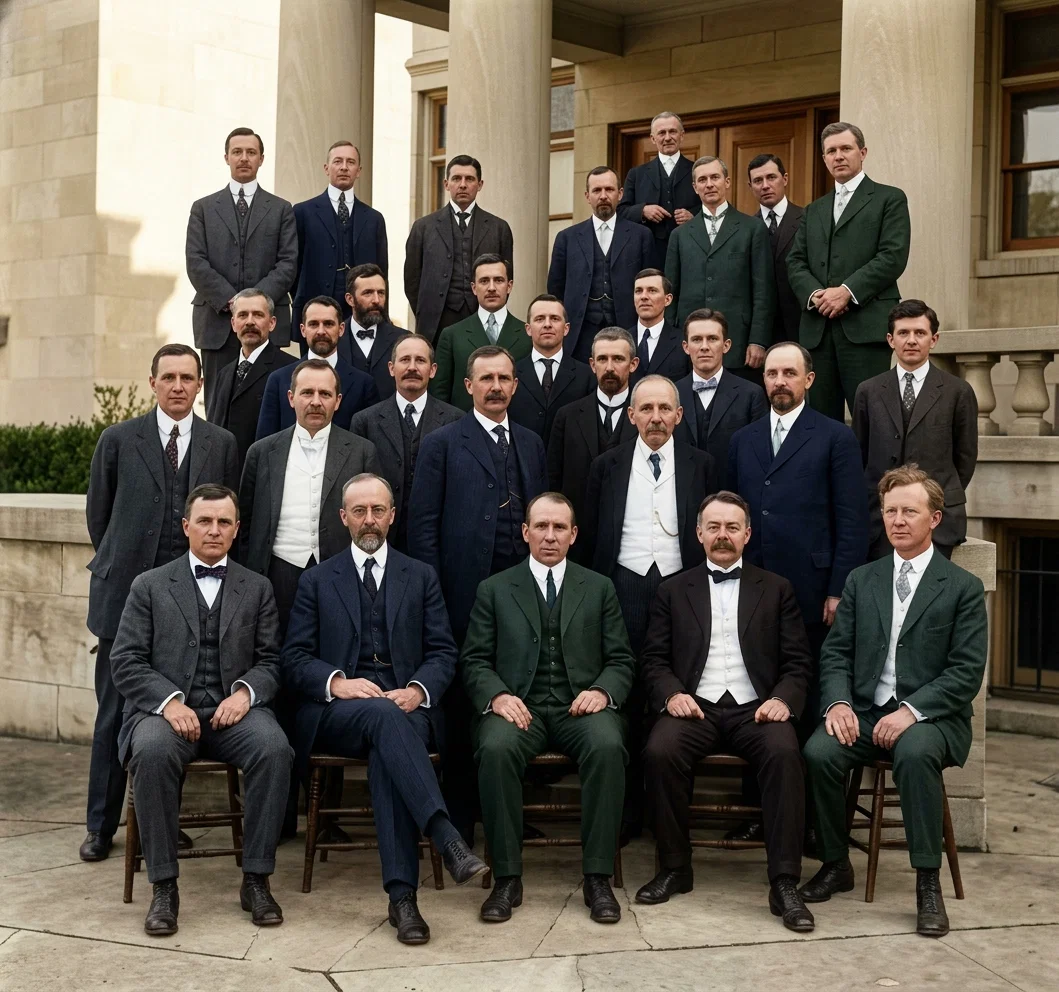
DELEGATES TO THE BOOK MEN'S CONVENTION
Brother J. B. Blosser and Elder Morris Lukens conducted a series of studies in “Great Controversy;” I. D. Richardson and R. J. Bryant, in “Thoughts on Daniel and the Revelation;” and the writer conducted a series of studies in the health books—“Ministry of Healing,” “Practical Guide to Health,” and “Home and Health.”
Two hours each day were devoted to Round Table Council, which proved both interesting and profitable. Among the most important questions considered were the following:—
The Spirit that Should Characterize Our Work.
Qualifications of Leaders and Their Canvassers.
The Selection of Agents.
The Scholarship Plan.
Training Agents in the Art of Christian Salesmanship.
Institutes.
Details of the Agent's Methods and Work.
How to Conduct Deliveries.
The Financiering of All Features of the Tract and Missionary Work.
The Importance of Reporting.
Many other interesting questions, too numerous to mention in a brief report of this kind, were also taken up.
Sabbath morning, December 19, the delegates attended the regular services in the several churches of the District of Columbia. In the afternoon a general meeting was held in the Seminary chapel, at which Elder A. G. Daniells and Prof. W. W. Prescott presented many interesting features in the rise and progress of our book work, and the possibilities before us.
Sunday morning the bookmen assembled in the chapel of the Review and Herald, and Brother S. N. Curtiss, the manager, gave a study in the art of bookmaking, illustrating the various processes by samples from the factory. This pleasant and very entertaining study was followed by a trip through the manufacturing plant.
The convention continued for one week. During this time all the delegates settled down to a careful, systematic study of the field organization and work.
December 23, after a brief closing meeting, the manager of the Book Department and his assistant treated the visitors to a trip through the beautiful city of Washington. Among the places visited were the Capitol building, the Congressional Library, the National Museum, the George Washington Monument, and the White House.
This was the best attended, and in many respects the most successful bookmen's convention the writer has had the privilege of attending. The splendid success which the Lord has given to this department of his work, in the face of no ordinary difficulties during the year 1908, seems to have given to the leaders a most distinct consciousness of the possibilities of this work, when assured that God is with them. The enthusiasm manifested in the convention work gives fair promise of another prosperous year.
May the power of God's Holy Spirit go with these workers, and enable them to do great things for the Master.
E. R. PALMER.
The Publishing Work
Conducted under the auspices of the General Conference Publishing Department.
C. H. JONES - - - - Chairman
E. R. PALMER - - - - Secretary
H. H. HALL - - - Assistant Secretary
Religious Liberty Notes
In the lecture department of the International Reform Bureau, as published in the Twentieth Century Magazine, the official organ of the bureau, the name of Hon. Henry W. Blair, of 1888-89 Sunday-bill fame, appears in the list of “lecturers for United States and Canada.”
The eleventh annual convention of the Wisconsin Federation of Churches was held in the city of Portage, November 16, 17. It was stated by the president that six reform organizations, which he designated as “the strong right arm of the church,” were affiliated with the movement. These organizations are the Anti-Saloon League, Children’s Home Society, Independent Order of Good Templars, Northwestern Purity Association, Sunday Rest Day Association, and the Woman’s Christian Temperance Union. The topics discussed and the general trend of sentiment in the convention showed the same conception of the work of the church and its relation to social and political problems as has dominated other conventions of a similar nature. Referring to the Federal Council of Churches at Philadelphia, the secretary said: “It will be indeed a re-enthroning of Jesus, a King in American Zion.” Such a statement sounds like a quotation from Eusebius, the biographer of Constantine. The history of that time is being repeated.
Christian Liberty
Reports, Notes, and Comments Pertaining to the Current History of the Rights of Conscience
Conducted by the Religious Liberty Bureau
K. C. RUSSELL . . . . . Chairman
W. A. COLCORD . . . . . Secretary
Who Are Working for Sunday Laws
By W. A. C.
The following, under the heading “Sabbath Defense,” taken from advance sheets of the next number of the Twentieth Century Quarterly, official organ of the International Reform Bureau, of Washington, D. C., Dr. Wilbur F. Crafts editor, shows clearly enough who are behind the movement to secure State and national Sunday laws in this country:—
“The Sabbath is now more attacked and less defended than ever before, but there is a plan on foot to reorganize and re-enforce the American Sabbath Union, which was organized twenty years ago by the national conferences of fourteen denominations. The most encouraging recent victory is the Idaho Sunday law, drawn and carried to victory by the Reform Bureau’s Pacific Coast secretary, Dr. G. L. Tufts, who is now leading the united forces of California, in hopeful efforts to secure a similar law. He should be heartily supported in this and other great plans for the moral betterment of the Coast.”
In both the Sunday Rest Congress, held in Pittsburg, December 1-3, and the Church Federation Council, held in Philadelphia, December 2-8, which the writer attended, the hope was expressed that a Sunday law would soon be secured both in California and from the national government. W. A. C.
Should Students Pay Tithe?
Most certainly, each and every one of them should pay tithe. God gave the Sabbath to man as a memorial of the fact that God is the Creator; he also instituted the ordinance of tithe-paying to help man to keep in mind his Creator's ownership. The Lord reserves one seventh of our time for himself, to remind us that we are indebted to him for all the time at our disposal. Likewise the tithe is reserved by God, not only for the purpose of carrying on his work in the earth, but to teach us that he is the giver of all we have, and that we are to use it only to his glory—for the advancement of his cause of truth in the earth. We feel it important to teach our students to observe and love the Sabbath; we say much about it in our schools. Is there any reason why we should not say as much about the binding obligation of the tithe and its payment?
Many of our students work for their room and board, and have but little ready cash. It certainly seems that our schools all ought to make provision for such students to receive sufficient money that their tithe may be fully paid. If in our schools we fail to teach this important truth, we are certainly coming far short of our duty. We should seek to establish23proper habits of tithe-paying and the giving of free-will offerings, as well as Sabbath-keeping and other Christian observances. There is no doubt that, if this is done, many of our schools will have to consider the question from a financial point of view. But it will pay. The proper teaching of this important subject in our schools will have a great influence throughout the whole denomination.
The Adaptation of Our School Work to Gospel Work
No work can be compared in importance with that of the gospel of Jesus Christ. The third angel's message embraces all the great issues which have appeared in the progress of this gospel work throughout all time. In its promulgation and advance are the mightiest problems which have ever been given to any people. The strongest faith, the keenest intellect, and the greatest courage are required for their solution. Our schools are charged with the training of men and women with such faculties. In the very nature of the case, such an education must be as different, in its genius and in many of its methods, from that of the world at large as the work of this message is different from that of the spirit of aggrandizement and selfish uplifting prevalent in all the earth.
This message is peculiar, and requires a peculiar education; and the better our understanding of it, the more nearly shall we be enabled to adapt our courses of study and methods of teaching to its needs. We are not to be different for the sake of being different, but as educators we are to study, first of all, the gospel message for this time, and thus so to adapt all our educational factors to it that our students may form such characters, at the same time so improving their personal qualifications, as will make them powerful in the work of the Lord.
As our knowledge of the breadth and scope and meaning of present truth increases, it will naturally and constantly call for changes in the subjects which we teach, and in the methods of teaching them, and we must ever be ready to make them. It is dangerous for us to feel for a moment that we have reached anything like perfection in our educational work.
Languages in Our Schools
THIS message is to go to every nation, kindred, tongue, and people. The greater portion of this world is to-day in ignorance of the Saviour, and of the further fact that he is soon to finish his work as mediator between God and sinful man. To every creature under heaven, and in this generation, must go this knowledge. To us has been given this great work. Young men and women—those who can readily adapt themselves to the languages, customs, and environments of these strange lands and places—are required for this work. Our schools are to assist in acquiring this adaptability. For these reasons we should give especial attention to the study of languages. First in importance is the study of the mother tongue. A thorough study of it can not be too strongly emphasized. The Latin language plays an important part in the root and construction of the majority of occidental languages. It is well that it should be studied for a time, until the construction of these modern languages is better understood. It is not necessary, or indeed advisable, that time be taken to go into the study of the literature of this language, even though that might give a greater facility and understanding of the construction of the language; for it is in the literature of that language that we come upon that which is so harmful to the Christian student. What is true of the Latin language is true to a greater or lesser extent of modern languages. A limited study of them will give to the student an understanding of their construction, and will enable him the more readily to learn, and acquire the ability to use, any language. In view of the fact that our work is world-wide, and that our workers may be called to any portion of the world, it is but reasonable that our young people and our schools should pay especial attention to this branch of study, not from a theoretical or literary point of view, but from a practical one.
Prayer and Earnest Seeking
“We receive not, because we ask not; we ask not, because we care not, else were our prayers sincerer, more fervent, and all-prevailing.” “Ye shall seek me, and find me, when ye shall search for me with all your heart.”
The Sorrowful Shepherd
“THERE is no picture presented before our imagination of a sorrowful shepherd returning without the sheep.” The Christian teacher may have souls for his hire, but these lost ones may often be found only in Gethsemane. A consuming desire for the salvation of each pupil should be the portion of every teacher; this desire is a gift of God’s love, and earnest prayer will secure it.
The Power of Prevailing Prayer
PRAYER is God's appointed way for humanity to reach his throne of favor. The answer may be deferred, not because God fails to hear, or from a lack of power; but because of the workings of his love and wisdom. To nothing can he be readier to grant an answer than to requests for the repentance and conversion of those in whom we are interested; but he forces no one to love him. He will, however, continue to send heavenly messengers, and thus heaven's atmosphere, to the one for whom we continue to pray. Thus our prayers may prevail, and we may enter into the joy of the Saviour in the salvation of souls. “The effectual fervent prayer of a righteous man availeth much.”
The Physical Welfare Committee of New York City
INVESTIGATION into the condition of the health of schoolchildren, and providing care for them, is only one of the activities of the physical welfare committee, which, since its organization, has set briskly to work to inquire into the physical conditions of the schoolchildren of the city, and to do what it can to better those conditions by trying to secure proper physical conditions for the child while at school, and to secure proper treatment for children in need of medical care, either from their parents or from free clinics. The committee was active in securing the school census, has been hard at work to get an increased appropriation for visiting nurses and medical inspectors, and has done important work in investigating into the home conditions of children reported by the board of health to be in need of medical, dental, or ocular care, and better nourishment. Investigative work being a slow process, if it is of any value, the results of the inquiries of the committee are just beginning to show.
The statement that a large percentage of New York schoolchildren come to school without any breakfast, which stirred up so much discussion about two years ago, has been kept in mind by the committee’s investigators. They have found that out of fourteen thousand cases examined, one per cent of children go to school breakfastless for the reason that they have no desire to eat, rather than that there is nothing for them to make a breakfast of. This fact is accounted for by the conditions under which many of the tenement children sleep,—bad, close, and dirty surroundings, which do not tend to stimulate appetite. Only twelve per cent had a reasonable breakfast of milk and bread, seventy-six per cent using tea and coffee for breakfast, twelve per cent using those beverages three times a day, and more than twice that percentage using tea or coffee at two meals during the day. Four per cent stated that they had no meat or eggs in their home diet.
The Americans showed the highest number of ailments to each child, being nearly twice as many as that of the Italian. The mothers questioned stated that only three per cent of the children have less than nine hours’ sleep, in spite of the noisy surroundings of the tenements, a statement that, if reliable, contradicts the rather general impression that many of the children in the crowded districts get much less sleep than is good for them. The Germans were found to have the largest percentage of mothers working to make up the family income, and, consequently, having in some degree to neglect the care of their children, the Americans coming next, then the Italian, and last, the Jew.
Of the total number of families investigated by the committee, sixty-three per cent reported that they had a family physician, and twenty-eight per cent that they are treated at a dispensary. Only twenty-four per cent out of them all reported that they had ever employed a dentist for any person in the family, a patent enough comment on the need of some outside influence to persuade the children of these families to care for their teeth.
The committee on physical welfare will not stop with providing free dental clinics for the schoolchildren, but will attempt to secure instruction on how to care for the teeth and prevent disease from creeping in. To some lookers-on, this care of the teeth of schoolchildren seems an unnecessary detail; but when one understands the important relation between good teeth and good health, that bad teeth invite infection, and that nowhere do contagious diseases and epidemics spread so rapidly as among schoolchildren, the precaution is seen to have a real significance for the public welfare.—Brooklyn Eagle.