Your ShelfYour Projects

Signs of the Times, Vol. 30, No. 38.

THE PURPOSE OF THE EVERLASTING GOSPEL

Signs of the Times

Sep 28, 1904

Pacific Press Publishing Company · Mountain View, California · Sep 28, 1904

THE PURPOSE OF THE EVERLASTING GOSPEL.
FACT and fancy are brought face to face when the everlasting Gospel is confronted by the theories of men. The Gospel is not a theory. It is the grandest living reality in the world to-day. It is not something that man has devised, but something that the Creator of the heavens and the earth has planned and established, and in the consummation of which every man and woman may participate, if they will.
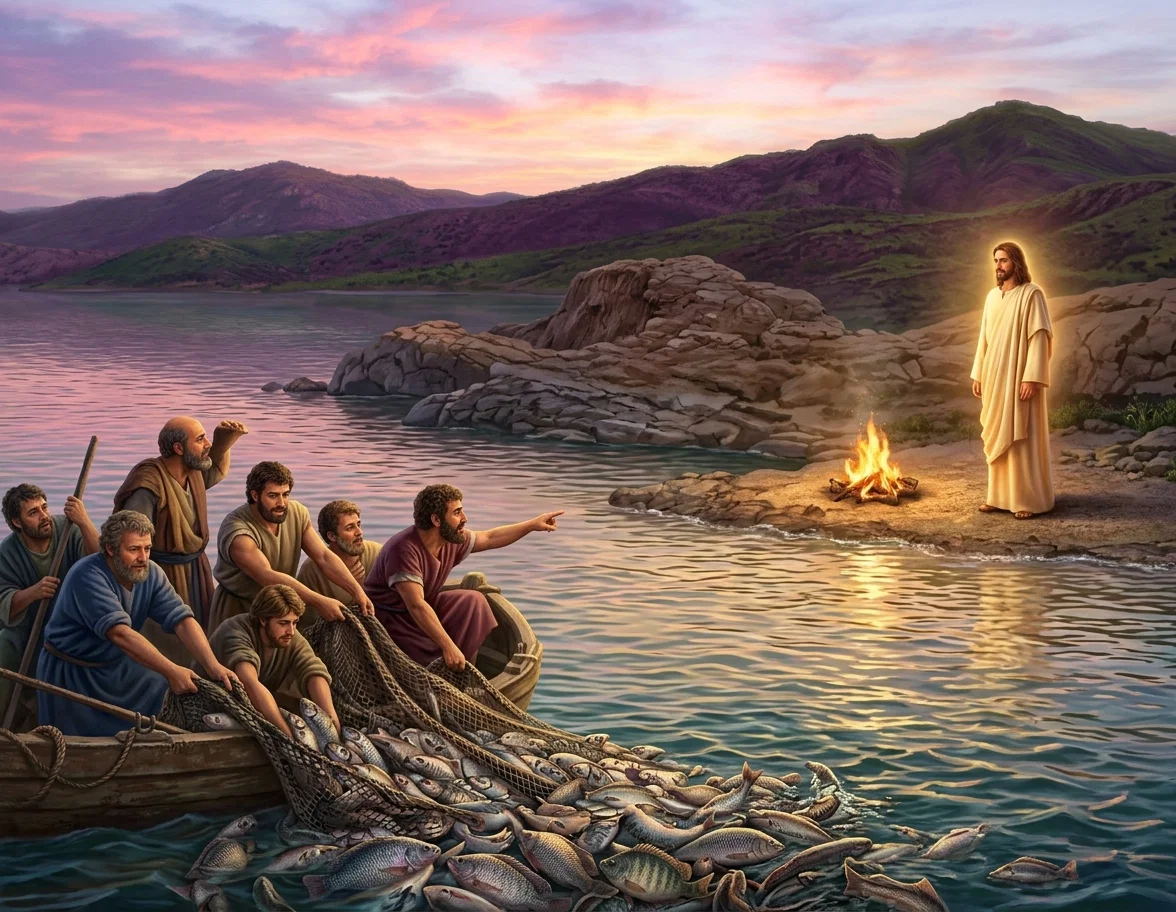
When fishing under Christ's direction the draught is a marvelous one.
FANCY has fashioned many skilful schemes to bring in harmony, but such inventions have only brought in more disunion; for they have no basis of fact upon which to build. Human schemes for the salvation of men are filling the world to-day; but they are like the Dead Sea apples, filled with the ashes of disappointment. They can not save; for they have in them nothing but the perishing human, and the perishing human has no power to grant an enduring salvation.
OUT from these discord-breeding fancies and these human theories which must bring the most bitter disappointments to the souls that trust in them, God, through His “everlasting Gospel,” is to-day calling a people for His glory and their everlasting good. The purpose of that call is to bring man back into harmony with his Maker, and bring back to the universe of God that peace and loyalty and unity and harmony which pervaded it before Satan conspired against the government of God. Incidental to that work, and crowning it, so far as man is concerned, is the transformation from mortality to immortality when Christ shall come to claim the purchase of His blood.
THE wounds which sin had made must be healed; the discords which it had brought in must be dissipated; the grafted shoots of its disloyalty must be plucked away, that only the fruits of implicit loyalty may be seen; the hatred it had engendered must give place to love; and where, through its tutelage, the service of self had swayed the soul to its own undoing, the fountains of love for mankind must be loosed, that the soul may bring life and joy to those around it; and, in so doing, honor and serve our loving Father and Redeemer. That is the purpose of the Gospel, to put away sin, and bring in the reign of everlasting righteousness. When that is accomplished, every seed and fruit of sin will be removed from the once plague-smitten universe.
MAN is not to be merely a spectator of that work—he must be a participant in it, or it is not a success. So Christ has given to every follower of His the command and the commission to bear to every corner of the earth the gracious invitation to return to the circle of our Father’s household. The Gospel has brought in the principle of brotherhood between persons who are not children of the same earthly parents. Sin made enemies of brothers; Christ, through the work of the “everlasting Gospel,” makes brothers of those who had been enemies. Where Satan put hatred, even of brother against brother, Christ has put that feeling of brotherly love which reaches out far beyond the mere circle of the earthly household, and grasps the hand of persons of every nation without regard to color, creed, or caste.
THE first feeling of the natural heart toward a person of another nationality is to set up a wall of repulsion, especially if the outward appearance of that person is unlike that with which we are familiar, and the language which he speaks is different from our own. It is that feeling that prompts the Chinaman at home to denominate all others “foreign devils;” or that prompts the unconverted in America or England or any other country to look down upon or abuse a Chinaman or a foreigner of any other nationality. That feeling is utterly opposed to the Gospel of Christ. That Gospel is set for the eradication of all such feelings from the human heart. That Gospel brings men back into brotherhood with one another, and back to the acknowledgment of the Fatherhood of God. That unites again the disrupted family relations insofar as men are willing to reunite the severed ties—but only that far. The unwilling brother will not—can not—be forced back into harmonious family relation. He remains outside, because he chooses so to do. He is still a member of the family, but still a prodigal, unwilling to return to the forsaken homestead. Persistence in that course disinherits him in the end; but the faithful brother never ceases to watch and pray for his return. If he does return, he becomes more of a brother, only in that he acknowledges the brotherhood and the Father he had disowned, and permits himself to be again a harmonious member of the household. He then brings in loyalty in the place of disloyalty, love and interest in the place of hatred and indifference.
AS SOON as the prodigal comes into full fellowship with the family of God, he begins to realize that he has other brothers and sisters who are astray on the bramble-grown moors of sin, or who, with calloused hearts, are wandering in dangerous ways of their own choosing, which must end at the dark precipice of eternal ruin.Then he begins to realize something of the burden which others have felt for him, and then he begins to sense something of the feelings which sent the Son of God down to this sin-cursed earth on the search for souls. The true brotherly feeling takes possession of his heart, and he becomes a seeker instead of a wanderer, an advocate for God instead of a recruiting officer for the ranks of the evil one. The heat of the desert will be nothing to him if only he may find the wandering footprints of his brother there. Out of all the inhospitable places of earth God’s army of searchers are seeking out—and are finding—the brothers and the sisters that are straying there, lost beyond all power of their own to find their way again. “Go ye into all the world,” says the Master; because in all the world are those who are in sore need of what the Gospel has to give. So the Gospel is making of men and women once under the power of sin joyous harbingers of better things, evangels of righteousness.
CHRIST took His followers from the various occupations of the world to make them “fishers of men,” and from then till now these faithful fishermen have been gathering souls in the Gospel net. Every true disciple of Christ becomes a searcher for souls, a fisher of men; but always under His supervision. When His immediate followers had toiled long and taken nothing, He directed them to cast their net on the right side of the ship. They did so, and the draught was a marvelous one. Still He is the immediate overseer of the work, and when His commands are obeyed, the harvest of souls is great. When they are spurned, the fisher may toil long and take nothing. But under His direction it is a glorious work. The business is very urgent, the work imperative, the time for rescue short. The Gospel will accomplish its purpose, and out of the turmoil of this earth a people be redeemed to the praise and glory of God forever. It is the privilege of every soul in the earth to triumph in the accomplished purpose of the everlasting Gospel.

Why Dr. Lorenz Avoided Alcohol

TOTAL abstinence from intoxicating liquor as a beverage is simply common sense. Wise men in all lines of life see that its use unfits them for duty. At a banquet given to Dr. Lorenz, the great surgeon, in New York, wine was served, but the doctor pushed the wine-glass aside, and, in reply to the question as to whether he was a teetotaler, he said:—
“I can not say that I am a temperance agitator, but I am a surgeon. My success depends upon my brains being clear, my muscles firm, and my nerve steady. No one can take alcoholic liquors without blunting these physical powers which I must keep always on edge.”—The Character Builder.

THE PROPHECIES OF DANIEL AND THE REVELATION CAN BE UNDERSTOOD.

BY J. L. SHULER.
Many people maintain that the prophecies of Daniel and the Revelation can not be understood. They assume that, being unlearned, they can not understand the prophecies. On the other hand, many of the learned, some of them professedly engaged in the Gospel ministry, say that the prophecies are sealed, and can not be understood. The Lord has foretold this very thing in these words: “The vision of all is become unto you as the words of a book that is sealed, which men deliver to one that is learned, saying, Read this, I pray thee; and he saith, I can not; for it is sealed; and the book is delivered to him that is not learned, saying, Read this, I pray thee; and he saith, I am not learned. Wherefore the Lord said, Forasmuch as this people draw near Me with their mouth, and with their lips do honor Me, but have removed their heart far from Me, and their fear toward Me is taught by the precept of men; therefore, behold, I will proceed to do a marvelous work among this people, even a marvelous work and a wonder; for the wisdom of their wise men shall perish, and the understanding of their prudent men shall be hid.” Isa. 29:11-14.
Had the people to whom the prophet refers followed the sure word of prophecy, they need not have drifted away from God, and substituted for His commandments the traditions and precepts of men. That the Lord purposed that the prophecies of Daniel should be understood is apparent from the words of Christ, “When ye therefore shall see the abomination of desolation, spoken of by Daniel the prophet, stand in the holy place (whoso readeth, let him understand),” etc. Matt. 24:15. Here is a positive injunction to understand the book of Daniel.
“But thou, O Daniel, shut up the words, and seal the book, even to the time of the end; many shall run to and fro, and knowledge shall be increased.” Dan. 12:4. The book of Daniel was to be sealed till the time of the end. When is the time of the end? It can not be the real end of the world, for then the prophecies of Daniel would be of no use to us. In the intense darkness just before the end, the prophecies are to be as a light unto our path; wherefore this expression, “the time of the end,” must refer to a period of time just before the end. Then let us note what is meant where the same term is used elsewhere in the same book.
In the eleventh chapter of Daniel a persecuting power is brought to view which was to hold its dominion until the time of the end. “And some of them of understanding shall fall, to try them, and to purge, and to make them white, even to the time of the end; because it is yet for a time appointed.” This persecuting power was the Papacy, which held unparalleled supremacy, the appointed time—“time, times, and an half”—the 1260 years from A.D. 538 to 1798. Its power was taken away at the end of the “time appointed,” which was 1798. So, at that time, the persecutions ceased. This marks 1798 as the period of time in prophecy called the time of the end.
According to the prophecy, knowledge was to be increased after the close of this period. So there has been a great increase in knowledge, both scientific and scriptural, since 1798. A flood of light upon God’s Word has been pouring in, enabling men to understand the prophecies. The book of Daniel is now understood, and is unsealed. There is now no excuse for not understanding the prophecies of Daniel; for it is our lot to live this side of the time to which Gabriel told Daniel to shut up the words and seal the book. That limitation has now expired. The prophecies of Daniel are now to be studied. “And none of the wicked shall understand; but the wise shall understand.” Dan. 12:10.
We hear an almost universal cry that Revelation is a sealed book. But this is not a fact, for in the Revelation John was told explicitly to “seal not the sayings of the prophecy of this book.” Rev. 22:10. “Blessed is he that readeth, and they that hear the words of this prophecy, and keep those things which are written therein: for the time is at hand.” Rev. 1:3. On no other portion of God’s Word is so direct a blessing pronounced as upon the book of Revelation. This is certainly a good encouragement for the study of this book. Shall we say that it can not be understood? It would be useless for God to promise us a blessing for the study of the Revelation, and for the keeping of the things written therein, unless we could understand and be benefited thereby. The book of Revelationis therefore to be studied, and we will be blessed in so doing, if we heed its teachings.
“The time is at hand.” Here is another reason why we should study Revelation. The importance of studying Revelation multiplies as we draw near to the end. Its object is “to show unto His servants things which must shortly come to pass.” The Lord says that it was given to show something; but, according to the views of many people, it does not show anything, because no man can understand it! No; it will accomplish the object the Lord had in giving it, and it will “show unto His servants things which must shortly come to pass.”
The very name of the book, “Revelation,” is suggestive of something revealed, something made clear or manifest; it is just the opposite of something that is hidden, dark, or obscure. The title of the book, then, is sufficient evidence that it is to be understood. “The secret things belong unto the Lord our God, but those things which are revealed belong unto us and to our children forever.” Deut. 29:29.

EARNESTNESS INDEED.

In England they have a hearty way of doing Christian work that does not seem to reach us in America. This has often been illustrated in the wonderful meetings held by Dr. Torrey. In Bristol a “torch-light procession” was organized, and it was “headed by clergy, ministers, and hundreds of volunteers.” This began at 10:30 P.M., and its principal aim was to reach the drunkards and outcasts generally. The report says that about 300 people under the power of drink were gathered in the Y. M. C. A. hall, and the sights that were seen were enough to stir the hearts of Christ’s servants with deepest pity.” Thank God for the zeal that sends men out to the highways and hedges, to barrooms and brothels, to gather in the “fagends” of the devil’s dupes! These are the last days, and what is done must be done quickly.—Selected.

“UNTO HIM BE GLORY.”

BY FRANCES E. BOLTON.
There is a world where the song flows on With the incense of flowers sweet and tender, And every face turns toward a throne, Lit with the radiance of Love’s own splendor; For a Lamb as He had been slain is there, So gentle is He, so meek, so loving, That the sinless angels, exceeding fair, Bow in their beauty for His approving, And sing the strains of an earth-known story, “Unto Him who hath loved, unto Him be glory.”
And there is a world where the sob is long, Where the darkness gathers in wavering shadows, Where there’s wailing of sin and sorrow and wrong, And the blight is thick on the fairest meadows; Yet high on a hill is a cross of sorrow, That yet Love’s splendor is ever gleaming, Piercing the gloom of the darkest horror, And brightening woe with holiest meaning, And here and there rings the heavenly story, “Unto Him who hath loved, unto Him be glory.”
So heaven and earth have a link that binds them,— ’Tis the love of the Loving upon the throne, And whether in heaven or earth it finds them It claims the lost as His very own, And nearer and nearer heaven leaneth, Till we almost hear the strains so tender, And peace falls soft as our longing gleaneth The love of the Lamb from His throne of splendor, And I burst into song with the angels o’er me, “Unto Him who hath loved, unto Him be glory.”
Yet a little while and the lonely distance, The silence of sin that keeps apart, Will lessen and lessen by Love’s insistence, And angels and men will be heart to heart; For celestial arms will about us gather, And bear the elect of the Lord above, To sing ’neath the smile of the great All-Father, To taste the reality of God’s love, And join the angels in one long story, “Unto Him who hath loved, unto Him be glory.”

THE GREAT EARTHQUAKE.

BY THE LATE D. T. TAYLOR.
“And when he had opened the sixth seal, there was a great earthquake.”—Rev. 6:12.
A universal crash As if the very ribs of nature broke, And all her dark foundations failed. —Anon.
Are there special signs of our Lord’s advent near at hand? Are there special tokens of the last days? Of what kind are they? Where are we to look for them? The world for more than a century has been witnessing unusual phenomena in nature. Is any of it prophetical? Has nature witnessed for the truth? Does not the Creator speak in the thunder (Ps. 77:18), flash His eye in the lightning, (Job 27:3) and stamp His foot in the earthquake (Isa. 29:6)? Doth not God hold the cyclone in His fist? Prov. 30:4. When a new age opened after the Deluge, was it not preceded by the most terrible convulsion of record? Was not the opening of the Jewish age accompanied by a manifestation of Deity, and with volcanic action, thunder, lightning, and a quaking of the ground? Ex. 19:18. And when Israel went out of bondage in Egypt, did not a nation march to the awful music of darkness, plague, and storm? When Jesus came the first time, was nature silent? Was not the divine presence accompanied by a rare and unparalleled starry wonder, never by science explained (Matt. 2:2), by solar obscuration (Luke 23:45), and by earthquake (Matt. 27:54)?
Can we suppose that His last advent to judge the world and change all things will be preceded and accompanied by a display of wonderful phenomena any less grand, less striking, less awful? On the contrary, are we not warned of the thunder, lightning, and hail (Rev. 16:17–21); a mighty crash as if the ribs of nature broke (2 Peter 3:10), and of the unparalleled coming earthquake “such as was not since men were upon the earth” (Rev. 16:18)? And before this final scene, are we not foretold of earthquakes, pestilence, famines, solar obscurations, lunar marvels, star-falls, roaring seas, national distress, followed by the sign of the Son of Man, who then comes in His glory? Matt. 24:29, etc.; Rev. 6:12. “Surely the Lord God will do nothing, but He revealeth His secrets unto His servants the prophets” (Amos 3:7); and “those things which are revealed belong unto us and to our children” (Deut. 29:29). Jesus and John were prophets. We are not. We do not prophesy. We only repeat their prophecies; we but demonstrate their fulfilment. The material in history with which to do so is most abundant. Let us candidly name and review the striking events occurring in nature, which the Master has foretold as tokens of His near approach. If we do this with a reasonable mind and a heart that looks with affection and desire towards “His appearing,” we shall find our place in this age’s history to be very near the end. Taking up the physical signs we havenamed in their scriptural order, we propose first to say something concerning “the great earthquake” of Rev. 6:12. Is this a prophecy of a real quaking of the earth? Is there a seismic convulsion in the past that answers to it? and when and where did it occur?
Will the reader please observe the following:—
1. The thread of figure and symbol appears to be broken at the sixth seal, and save some strong metaphors, we come down the chain of seals to literal events.
2. The earthquake is the first event under the sixth seal. It is catastrophic and ominous.
3. The seals are opened in numerical order. As the earthquake is under the “sixth,” and there are but seven in all, its place is therefore near the end.
4. It occurs in order, soon after a season of martyrdoms, as described under the fifth seal. But not at the end of the season, as we see by the answer to the martyr’s cry. Others were to shed their blood at the altar. The earthquake’s place is therefore not far from the end of the season of great martyrdoms.
5. This time of persecution and martyrdoms without doubt lies between the establishment of the Inquisition, A.D. 1200, and its extinction and the abolition of torture about A.D. 1800.
6. The earthquake occurs just prior to a remarkable solar obscuration—a sackcloth veiling—such as took place at the crucifixion of Christ.
7. It occurs also (and is named in such order) prior to the great star-falls, and not at, but before, the day of God’s wrath.
8. The earthquake is therefore marked and located, phenomenal and premonitory. It fills a special niche in the prophetic chain of six links. It can only have its place in a later link. One earthquake among many is singled out and made prophetic. It is only noticed as an awful fact—no details are given.
9. It is not styled a destructive earthquake, but a “great” one. The Greek megas denotes loud, mighty, large. Webster’s first meaning of “great” is “Large in respect to spatial quantity, solidity, surface, or linear dimensions; of wide extent.” It is as if the seer had written, “I saw an earthquake of marvelously wide extent.” Such is the kind of earthquake we are to look for in the earth’s history. We find it in the last half of the last century. Just such an one occurred near the end of the period of persecution we have named as lying between 1200 and 1800. We now call attention to the so-called earthquake of Lisbon, 1755, which might better be styled, “The earthquake of the world.”
10. This convulsion ranks also as “great” in the classifications of science, which, dividing such under three heads, calls those which convulse the globe, ruin cities, violently agitate the sea, and destroy life, as “first-class” and “great.” Hundreds of destructive earthquakes had previously occurred; one at least in A.D. 526, in which Antioch perished, and a greater destruction of life took place. It was great in destructiveness, but local in extent. The earthquake of 1755 was great in the primary sense of the word, great in the sense of “spatial quantity” of surface shaken. That no greater had ever occurred is evident. Expositors can not fail to notice that nowhere in this or any other prophetic chain running down through the centuries does the pen of Inspiration take special notice of any one earthquake until this one is reached. A new era was dawning. Nature in unison with the groaning church of God uttered a loud groan. It was responsive to the cry of the bloodstained , dying elect, “How long?” The thunder-stamp of the earthquake’s feet revealed God’s approval of the holy martyrs, and His indignation at their enemies.
I detail this mighty throb as follows:—
1. Its center was in the vast Atlantic Ocean, out from the coast of Spain and Portugal. Lisbon was its chief victim, but the wave stayed not for one city—it rolled out and took in continents.
2. No great earthquake had occurred in the Spanish peninsula for a period of one hundred and fifty years. It came without warning on Lisbon. It began with an awful roar of subterranean thunder that appalled all hearts, and with the bursting of electric flames out of the earth.
3. It came Nov. 1, 1755, on the Romish idolatrous festival of All Saints’ Day, when the churches of Lisbon and every other city were crowded with superstitious and ignorant worshipers. Its greatest destructiveness was experienced by the papal world, the authors of the previous martyrdoms.
4. Other parts of Europe were warned by shocks that for several months had been experienced. Strange and unaccountable phenomena were seen in the more northern countries, but no destruction of life occurred there.
5. Preceding and accompanying the great shock, there were halos around the sun by day, and the moon by night; water in wells and rivers would suddenly rise and fall; the land was swept by violent storms; wells of water changed their color; rats and reptiles came forth from their holes in terror; animals appeared to be filled with foreboding; all Spain and Portugal trembled violently. In England the hot well at Bristol became red as blood, and so thick and turbid that the water could not be drunk. Water in a common well turned black as ink, the tide of the river turned up stream, and all England, Ireland, and Scotland were in wonder. Loch Lomond, in Scotland, rose several feet, and then fell again. In Bohemia the warm springs of Teplitz all at once disappeared, and then furiously burst forth, and overflowed the region with water the color of ochre. The inhabitants were “struck with awe.”
6. Lisbon, having a population of 250,000 souls, was in a moment smitten. “Appleton’s Encyclopedia” says, “It is believed that 60,000 persons perished in the space of six minutes.” L. N. Thomas, a student of earthquakes, writes: “The people rushed for safety to a magnificent new quay recently erected. In a moment it sunk with all the people (6,000) beneath the waves. Afterwards the water here was found to be a hundred fathoms deep. The ships that were fastened to the quay also went down, and never rose again.” Vesuvius, then in full eruption, suddenly became quiet. The earth heaved and rolled in great waves like water, with a velocity of nearly 8,000 feet in a second, and then at a rate of 2,000 feet in a second the earth-wave passed over Europe and the seas. In two hours great fires broke out, and at the end of three days Lisbon was reduced to cinders, and the city has, it is said, never recovered from the calamity. The shocks lasted a period of forty days.
7. Ruin sped on, and ran riot. Colombo, Oporto, and Braga were shattered in pieces. St. Ubes, having a population of 20,000, was swallowed up in the sea!—Blackwood’s Magazine. July, 1844. Malaga, in Spain, was mostly destroyed; more than half the island of Madeira was laid waste. Three thousand miles eastward, in the Archipelago, so severe was the shock as to cause the utter demolition of 2,000 houses in Mitylene. Southward, 1,000 miles in distance, the city of Fez, in Morocco, was one-half thrown down, and 10,000 Moors perished.
8. From Lyell we learn that the vast mountains, Arrabida, Estrella, Julio, Marvan, and Cintra, some of the largest in Portugal, were impetuously shaken from their very foundations; some opened at their summits, split, and rent in twain; they threw down avalanches of rocks into the valleys, flames issued from them, and their tops were hidden in smoke or dust. The Alps, the British Islands, the peninsula of Sweden and Norway, the coast of the Baltic, and Germany felt the throb. Iceland, well up against the pole, trembled, while the volcano Kotluggia burst forth into a great eruption. Thus northward, for 6,000 miles, was the globe agitated. For hundreds of miles the coast of Portugal was swept by a tidal wave sixty-five feet in height. Then the wave rolled north to Ireland, and rushed into the harbor of Kinsale, whirling about the ships, and deluging the market places. On a ship forty leagues west of St. Vincent, in the Atlantic, the violent concussion threw men a foot and a half perpendicularly up from the deck! At Antigua, Barbadoes, and Martinique, in the West Indies, full 3,000 miles westward, where the tide usually rises but several feet, it suddenly rose above twenty feet, the water being of an inky blackness! Lyell says that all the great lakes of North America were sensibly agitated, and declares that “in no part of the volcanic region of Southern Europe has so tremendous an earthquake occurred in modern times.”—“Geology,” page 495.
All testify to its vast extent. Thomas writes of it as extending “from Iceland to Maggadon, in Morocco, and from Bohemia to the West Indies.” The “Cyclopedia of History” affirms, “The shock was felt nearly all over Europe, in the north part of Africa, in the Atlantic Ocean, and at the Antilles.” The author styles it, “The most terrible earthquake that ever occurred” (page 639). Blackwood styles it, “The most terrible earthquake on record.” Mungo Ponton characterizes the disturbance as of a “very violent kind,” and felt “over a vast extent of the earth’s surface.”—“History of Earthquakes.” Humboldt (in “Cosmos,” vol. 1) says that a portion of the earth “four times as great as Europe was simultaneously shaken.” Ignatius Donnelly, quoting Humboldt, styles the area covered “VERY GREAT,” while the French authors, Zurcher and Margolle, in “Volcanoes and Earthquakes,” a work of much interest, go beyond Humboldt, and testify, “It was felt over a vast area, said to be greater than four times the size of Europe.”—“Page 177.”
“The earthquake which destroyed Lisbon in the year 1755,” writes W. M. Higgins, Fellow of the Geological Society, “was the most violent that ever occurred in Europe, at least within the record of authentic history.”—“The Earth,” page 308.
“In no part of the volcanic region of southern Europe has so tremendous an earthquake occurred in modern times, as that which began on the first of November, 1755, at Lisbon; the area over which this convulsion extended is very remarkable,” says Sir Charles Lyell.—“Geology,” pages 494, 495.
The earth shook for three years, and before the land became quiet, 200,000 human beings perished. Surely this was what the Seer of Patmos beheld—“a great earthquake.” If we consider that the area of Europe is 3,755,156 square miles, this sum multiplied by four is 15,020,624 square miles, and if, as asserted, the convulsed area of land and sea was greater than four Europes, then 20,000,000of square miles of our globe experienced the mighty convulsion! We can not well question this estimate. The simultaneous shock for its vast extent has no parallel in earth’s history. Why does it fail literally to fulfil the prophecy? And is not God in the earthquake? Ps. 104:32; Hag. 2:6; Job 9:6.
And so the “great earthquake” passed into history, and is so known and recorded. Occurring at the right time, between the era of the church’s most awful tribulation and the season of special solar and stellar phenomena—transpiring in the right place, on the soil of Europe, which as all students know is the main prophetic field—celebrated in history by the highest scientific authority, of vaster area than any other registered by man—this bolt, as with a cannon’s boom or a bell’s peal, signalized the near ending of the dark and bloody days for the elect of God, and the oncoming of the era of the open Bible, the wide-spread Gospel, and the constellation of signs that herald the return of the Bridegroom. Who can doubt it?

PSALMS

BY F. D. STARR.
We now come to what will be acknowledged by all to be a most wonderful and interesting book. It is much the largest book in the Bible and contains the longest chapter to be found in the Bible, namely, Psalm 119.
As to the number of its divisions, the book of Psalms contains one-eighth of all the chapters in the Bible. It is the only book in the Bible concerning which there is any reference made to chapters or separate divisions, and that occurs but once. In Acts 13:33, reference is made to the “second psalm.” This is sufficient to show that the psalms were known by number.
In the Revised Version the book is divided into five books, in harmony with Hebrew usage. Psalms 1-41 constitute the first book; 42-72, the second; 73-89, the third; 90-106, the fourth; and 107-150, the fifth. In Psalm 119 we find the peculiarity of alliteration, the chapter being divided into twenty-two sections of eight verses each, and each verse in each section in the original writing beginning with the letter of the Hebrew alphabet standing at the head of the section. This alliteration shows the psalms to be divided into verses. It is well known that the books of the Bible were not generally divided into either chapters or verses until long after they were written. But the fact that the book of Psalms was thus divided may doubtless have suggested the propriety of so dividing the other books of the Bible, and certainly it is a very convenient and helpful arrangement and consistent with the divine plan, as carried out in the book of Psalms.
The 119th psalm is not the only one in which this peculiarity, alliteration, is found. According to the French translation, we see that the same feature exists in psalms 25, 34, 37, 111, 112, and 145. In some of these shorter psalms the verses are subdivided, having one verse answer to two letters.
The book of Psalms is decidedly a praise book. These productions were not only to be read and studied, but also to be sung. But this need not exclude the singing of other spiritual compositions; “Speaking to yourselves in psalms and hymns and spiritual songs, singing and making melody in your heart to the Lord.” Eph. 5:19.
How well adapted to family devotion are these beautiful songs! How much benefit we would individually and collectively derive from them if we should, as suggested, speak to each other, and to ourselves, in the language of these heavenly exclamations of prayer and praise! In these we are taught how to commune with God. It seems as if the request, “Lord, teach us to pray,” was quite well answered in these incense-breathing expressions of celestial origin, so completely pouring out the soul unto God. Heaven comes near to man, while thus the spirit of grace and supplication is poured upon him. “I remember Thee upon my bed, and meditate on Thee in the night watches.”
“While I lay resting on my bed, My soul arose on high. ‘My Lord, my life, my light,’ I said, ‘Bring Thy salvation nigh.’ “I strive to mount Thy holy hill, I walk the heavenly road, Thy glories all my spirit fill, While I commune with God.”
Words are inadequate to describe the rapture of the devout believer as he peruses, and makes these inspired prayers in the psalms his own.
One very prominent feature of this book is, that it is a most able and thorough defense of the Decalogue. The law of God is the golden center around which all its various portions seem to revolve.
Notice a few of these expressions of loyalty to God. Their key-note is struck in the very first psalm itself. Speaking of the man who is walking in the counsel of the Most High the statement is, “His delight is in the law of the Lord; and in His law doth he meditate day and night.” Psalm 19 contains this very pointed declaration concerning the law: “The law of the Lord is perfect, converting the soul.” God’s law being perfect, nothing can be added to it or taken from it, and it still remain perfect.
The law has an indispensable part also to perform in true conversion, for it converts the soul. One great defect in many of the so-called conversions of the present day is, that no use is made of the moral law in bringing about these conversions. This tribute is also paid in this psalm, to the excellence of the precepts of Jehovah: “More to be desired are they than gold, yea, than much fine gold; sweeter also than honey and the honeycomb.”
But the 119th psalm is the most noted of all inspired productions that set forth the excellencies of the law of God. Every one of the 176 verses seems in some way to speak of the commandments of Jehovah. Of the wisdom that accompanies the keeping of the commandments of God, the writer says, in verse 98, “Thou through Thy commandments hast made me wiser than mine enemies; for they are ever with me.” Or, as the French version reads, “Thy commandments are ever with me.” If, as James says, we continue to look into the law of God, like Daniel of old, we will be found to be wiser than those who oppose the truth. “I have more understanding than all my teachers; for Thy testimonies are my meditation.” The illiterate follower of Christ, while keeping the precepts of the Decalogue, will understand more about divine things than the most renowned theologian who transgresses that law, and teaches others to do the same. “I understand more than the ancients, because I keep Thy precepts.” Some place great stress upon the teachings of the Fathers of the Christian church; but he who is numbered among those of whom it is said, “Here are they that keep the commandments of God,” is far in advance, in divine knowledge, of those fathers who teach error and antinomianism. When beset by those who would persuade him to violate the law of God, the psalmist said, “Depart from me, ye evildoers; for I will keep the commandments of my God.” Ps. 119:115. May this be our motto.
Continue reading: A STUDY OF THE SOUL