Divine Power Gives the Birth of the Spirit — The Carnal Nature Put Under Control — A Reformation That Is Regeneration
"JESUS answered and said unto him, Verily, verily, I say unto thee, Except a man be born again, he can not see the kingdom of God." John 3:3.
There is no more important truth for men to know than the one set forth in these words of our Lord. It was to Nicodemus that Jesus said, "Except a man be born again, he can not see the kingdom of God." Nicodemus was one of the great men of the Jewish nation. He was a member of the Sanhedrin, a national council composed of seventy-one members, and constituting the highest body of council in the Jewish nation. This council had "charge over all matters pertaining to religion, and the different religious institutions." They judged the people, and gave decisions in matters of idolatry, heresy, blasphemy, etc.
In view of the great responsibilities assumed by the members of the Sanhedrin, they should have had a clear understanding of divine truth, and a rich personal experience in spiritual things. If they, the leaders, the teachers, the judges, knew not these things, what could be expected of the common people? They, like their teachers, would be bound by the cords of a dead formalism. And this was their terrible condition.
CHRIST STRUCK THE VITAL POINT
When Nicodemus came to Christ for that secret interview on matters of religion, Christ at once struck the vital point. He said, "Except a man be born again, he can not see the kingdom of God." Nicodemus at once revealed the darkness of his mind. He asked: "How can a man be born when he is old? can he enter the second time into his mother's womb, and be born?"
The Saviour explained that the birth of which He was speaking was not of the flesh, but of the Spirit. Said He, "That which is born of the flesh is flesh." The flesh is carnal, and is at enmity with God. It is not subject to His law, and it can not be. Said Paul, "I know that in me (that is, in my flesh,) dwelleth no good thing."
This is why Christ declared, "Except one be born anew ["from above," margin], he can not see the kingdom of God." R. V. That which is born from above is born of the Spirit. The Spirit is from God. Said the Saviour, "That which is born of the Spirit is spirit." It is spiritual, heavenly, not carnal and earthly. That which is born of the Holy Spirit is holy, and such may enter the kingdom.
"HOW CAN THESE THINGS BE?"
This seemed to be strange doctrine to Nicodemus; for he asked, "How can these things be?" Jesus answered, "Art thou a master in Israel, and knowest not these things?" Nicodemus must have been well advanced in years. As a Pharisee, he professed great attainments in righteousness. As a member of the Sanhedrin, he assumed the responsibility of guiding the people in spiritual things. Yet this man, this master in Israel, seemed not to understand this vital truth regarding the new birth, the change of heart, which every one must experience before he can enter the kingdom of God.
THEIR JUDGMENT WARPED
This is a sufficient explanation as to why the Jews would not receive the Messiah. Their minds were darkened. Their judgment was warped. While they claimed to be in possession of the righteousness of God, they were ignorant of the means by which righteousness was obtained, and of its effects on the heart. This ignorance was inexcusable, for the Scriptures which they possessed told them plainly of the necessity of the new birth, and the means by which it is accomplished. Jesus said, "Except a man be born of water and of the Spirit, he can not enter into the kingdom of God." John 3:5. To be born of water and of the Spirit is to be "born again." From this statement, it is seen that the Holy Spirit is an agency used by the Lord in producing this new or second birth. Birth implies life, and Paul says, "The Spirit giveth life." 2 Cor. 3:6. Man in his natural state is said to be "dead in trespasses and sins." Eph. 2:1.
A NEW HEART
The new birth resurrects man from this deadness in trespasses and sins. It quickens and enlivens the spiritual faculties. It gives sight to the blind, hearing to the deaf, and clothes the naked with the robe of Christ's righteousness. All this is wrought by giving the individual a new heart, and it is the Spirit of God that creates a new heart. The Lord says: "A new heart also will I give you, and a new spirit will I put within you: and I will take away the stony heart out of your flesh, and I will give you an heart of flesh. And I will put My Spirit within you, and cause you to walk in My statutes, and ye shall keep My judgments, and do them." Eze 36:26, 27.
God promises to put His Spirit in the heart. That will regenerate the heart. It will make it new. And the result will be that the individual will walk in the statutes and judgments of God. This is the new birth, the life in Christ which the Saviour says every one must have before he can enter the kingdom of God.
THE SPIRIT SPEAKS THROUGH AN AGENT
The Spirit of God speaks to men through the word of God. Said Jesus, "The words that I speak unto you, they are spirit, and they are life." John 6:63. And the apostle Peter, speaking of the means by which the new birth is wrought, says, "Being born again, not of corruptible seed, but of incorruptible, by the word of God, which liveth and abideth forever." 1 Peter 1:23. The word of God was given to men by the Holy Spirit. It is therefore the word of the Spirit.
Both the word of the Spirit and the Spirit itself must be received into the heart of faith. "With the heart man believeth unto righteousness." Rom. 10:10. "But without faith it is impossible to please" God. Paul says that we "receive the promise of the Spirit through faith," and by this means receive the blessing of Abraham. Gal. 3:14. The blessing of Abraham was the gift of righteousness. This was the new birth, which our Saviour said every one must experience in order to be saved.
THEY BECOME THE SONS OF GOD
Those who are "born, not of blood, nor of the will of the flesh, nor of the will of man, but of God," have the right, or privilege, to become the sons of God. John 1:12, 13, margin. "As many as are led by the Spirit of God, they are the sons of God," and "the Spirit itself beareth witness with our spirit, that we are the children of God." Rom. 8:14, 16. This is indeed a great privilege.
Reader, will you believe the words that God has spoken to you by His Holy Spirit? Will you open your heart by faith to receive the Holy Spirit? Will you consent to count all that you have hitherto counted gain, as loss, for Christ? Are you willing to be born from above, and begin life over again as a little child? If you will surrender all into the hands of Christ, He will, make you a vessel of honor for use here, and for His kingdom hereafter.
A WORD TO OUR READERS
By Editor
We send no papers from this office to individuals without pay in advance. When persons receive copies without ordering them, they are sent by other parties, and we can give no information in regard to them. Persons thus receiving copies of the SIGNS are not indebted to the office, and will not be called upon to pay for them. Please read the papers you may receive, and hand them to your friends to read.
DATE OF EXPIRATION
The SIGNS wrapper bears date of last issue due on your subscription. Unless renewed in advance, paper stops with expiration date.
If herewith is an order-blank, you will know you have overlooked sending renewal. You will not wish to miss a single issue. Back numbers often can not be furnished.
SCRIPTURE QUOTATIONS
Our authority for the doctrines we teach is the Bible. Quotations are usually from the King James Version or the American Standard Revised.
1. One new yearly subscription and one renewal, or two new, sent at one time, $3.00.
2. Two new yearly subscriptions and one renewal, or three new, sent at one time, $4.00.
3. Three new yearly subscriptions and one renewal, or four new, sent at one time, $5.00.
Five or more copies to one person, six months, each $0.60.
Five or more copies to separate addresses, six months, each $0.65.
Weekly and Monthly SIGNS one year, $2.25.
G. C. HOSKIN, Circulation Manager.
THE ONLY SATISFACTORY REST
By J. O. Corliss
PHYSICAL rest is a much desired boon to wearied muscles, as the world at large well understands. But refreshing as such ease may seem, when life's duties again press, relief must be sought anew, with no more hope of permanence than before. This is but the lame experience of life in general, summed up in few words. With some, indeed, the ordeal becomes almost unbearable as these same duties grow heavier with advancing years, until all gladness fades, and they long for the quiet of the tomb.
But for all these there is light at hand. The Saviour extends a most gracious invitation: "Come unto Me, all ye that labor and are heavy laden, and I will give you rest." The nature of this promised rest is revealed in the words that follow: "Take My yoke upon you, and learn of Me; for I am meek and lowly in heart: and ye shall find rest unto your souls." Matt. 11:28, 29.
SOUL REST
The soul rest here vouchsafed is the only real rest with satisfying consequence. With the mind at ease by such process, bodily weariness is forgotten. This is not to say that with soul ease one could not have bodily weariness, but that such rest will modify and make bearable all opposing misfortune.
Of the essence of this soul grant, one may get a glimpse by a brief consideration. It is this: Christ promises nothing that He does not have for bestowal. It is therefore His own rest that He accords to personal applicants. But in honor of the eternal Father this is designated as "God's rest." It was this rest that the Israelites, who had been released from Egyptian slavery, could not enter because of their unbelief. Heb. 3:9-11, 18, 19. In the fourth chapter of the same book, it is explained that the rest which that people failed to participate in was that which God enjoyed on the seventh day of creation week, when He rested from all His works. Verses 3, 4.
NOT FROM PHYSICAL WEARINESS
But God's rest on that occasion was not from physical weariness; for as all well know, "the Creator of the ends of the earth fainteth not, neither is weary." Isa. 40:28. It must therefore have been a soul rest—a satisfaction of delight—which was His in view of the response to His creative fiat, that produced an Eden world in which companionable creatures, formed in His own image, might live. His was, however, an undefinable joy, because of the impossibility to fathom the understanding of the Almighty.
Yet it is just this sort of rest that is offered to those who will come to Christ, and learn of His ways, which are but the legitimate fruit of His infinite mind operation. The foundation word used in the scripture under consideration to express God's rest on the first seventh day, really means to "rest down, or thoroughly cease." But in speaking of the rest now remaining to God's people, the original word for "Sabbath" is used (Heb. 4:9), which strongly indicates that the promised comfort to be given the Lord's children through Christ, is to partake of the same unspeakable joy that rested in the breast of Jehovah when He ceased from all His creative work in man's behalf. This thought is also forcibly emphasized by the verse following, which says that whoever shares in God's rest, does so because he has ceased from his own works, as God did from His.
ISRAELITES FAILED TO ENTER
The Israelites failed to enter the rest provided for them, because of unbelief; and therefore the inspired Word exhorts all to live by faith, lest any fail of success from the same cause. Israel hoped for righteousness by what they did, so failed for lack of faith. Rom. 9:31, 32. Righteousness, then, is not obtained because of something rightly done, but by receiving in faith the "Lord our righteousness" (Jer. 23:6), and thus being right, because of His indwelling. In this way faith was counted to Abraham for righteousness. Rom. 4:3. What he did afterward, in the way of performance, was but the seal of righteousness that had before been conferred on him in response to his faith in the word of Jehovah. Verses 10, 11.
In other words, what one does is simply the outgrowth of what he really is, for the reason that righteousness bestowed as the gift of God's grace, prompts the receiver to do the very things that are in harmony with the mind of Him who is the righteousness of every true believer. So then, doing does not bestow righteousness, but as in Abraham's case, simply becomes the seal, or inscription, of the righteousness already possessed. Then as God's preparatory creative work anticipated man's good, so when that was done, He rested from all His work, in faith that His eternal purpose would be met through Jesus Christ. On this ground, those seeking rest must cease from their own preparatory work as God did from His, and so rest in the word of promise given through the Lord Jesus. This well done, one can confidently say, with the sweet singer of Israel: "The Lord will perfect that which concerneth me: Thy mercy, O Lord, endureth forever: forsake not the works of Thine own hands." Ps. 138:8.
WHAT ARE YOUR HABITS OF THOUGHT?
By J. O. C.
THE present is a world of thought, and is made what it is by the combined thought of those who live in it. Each one of this number is made happy or comfortless according to the way he thinks.
If one's mind is much centered on himself, he becomes, in time, excessively sensitive to every breath of opinion regarding himself or his business engagements. What then? Well, it is quite generally known that the figure of one's face exhibits largely the trend of his mind. Therefore the constantly sad mind shows a face with11a drawn expression, while a merry mind appears outwardly in an airy, care-free aspect.
It may then be asked, Can one always carry a cheery countenance? Why not? Heaven's exhortation to all is to become transformed, or more correctly, transfigured, by the renewing of the mind, so as to be able to prove what is God's most positive desire concerning them. Rom. 12:2.
His desire is for all to engage, each in the uplift of those around him. This will be to get away from one's own self, and live for others' happiness. Such an attitude will bring a sure result; for when one's interest is drawn away from himself to become absorbed in the elevation of those nearest him, he will have no fitting time for self-inflicted misery. On the other hand, his creative thinking in behalf of others will assist to change the world about him into a holy and happy people, which will assuredly and constantly contribute to his own chief joy. J. O. C.
WHOSOEVER WILL, MAY COME
By William A. Spicer
THE gospel invitation hastens on to every creature. Whosoever will, may come; and every one who hears, is to say “Come” to every soul that has not already responded.
Again and again, in our work in dark lands, we hear reports of missionaries having opportunity to present their publications or the reasons for their faith before magistrates and officials, with the personal appeal to these men to give attention to the message for the hour.
An interesting incident is reported by the Presbyterian mission in Persia. They say their schools make no compromise with Mohammedan prejudices, and it is understood plainly that pupils attending mission schools are to be taught the Bible. In one of the cities, a magistrate summoned the young lady teacher before him, and the following conversation ensued:
Official: “We hear that you have been inviting Moslems to become Christians.”
Missionary: “It is true.”
Official: “Whom do you invite?”
Missionary: “I invite you, sir.”
The official gave no more trouble. W. A. S.
ADMISSIONS ON MODE OF BAPTISM
By George B. Thompson
CANDOR has forced many Bible commentators to make admissions that are contrary to even their own professed belief and practise in spiritual matters. As an example of this, the following in reference to baptism can be noted:
"It is needless to add that baptism was, unless in exceptional cases, administered by immersion, the convert being plunged beneath the surface of the water to represent his death to the life of sin, and then raised from this momentary burial to represent his resurrection to the life of righteousness. It must be a subject of regret that the general discontinuance of this original form of baptism, though perhaps necessary in our northern climates, has rendered obscure to popular apprehension some very important passages of Scripture."—"Life and Epistles of St. Paul," by Conybeare and Howson, People's Edition, page 384.
Again, speaking concerning the baptism of Lydia, it is stated: "Lydia, being convinced that Jesus was the Messiah, and having made a profession of her faith, was forthwith baptized. . . . The waters of Europe were 'sanctified to the mystical washing away of sin.'"—Id., page 255.
In a comment on Rom. 6: 4 we read, "This passage can not be understood unless it be borne in mind that the primitive baptism was by immersion."—Id., page 557.
These comments are quite correct. The only Scriptural mode of baptism is that of immersion. It is to be deeply deplored that this sacred rite, like the holy Sabbath of Jehovah, has been so largely set aside by tradition.
G. B. T.
SYSTEMATIC BIBLE STUDY
By Editor
As we are reading the prophecies of the Bible—and particularly in the book of Ezekiel—we may at first get the impression that these utterances were made for the ancient Jewish nation alone. We may think that they have no particular application to us. But we have a New Testament declaration that "all these things happened unto them for ensamples: and they are written for our admonition, upon whom the ends of the world are come." 1 Cor. 10:11. So, no matter how these prophetic words may seem to us at the outset, we have God's own statement that we at this time need them. With these thoughts in mind, as we continue to read the sacred Word, we find it becoming more and more interesting and helpful; for the entire book was written for us who are living to-day, just as much as for any other generation that has ever lived upon the earth—yes, even more than for any other.
Read three chapters each week-day, and five on the Sabbath.
36—CARD-PLAYING, DANCING, LODGES, ETC.
By Editor
A correspondent asks us whether it is right for Christians to play cards, dance, and belong to lodges, and wants to know what ought to be done about it.
Of course it is impossible for us to lay down rules in any individual cases. If these things are connected with the church, the church itself ought to act, if possible, so as to save the one who is bringing reproach upon the church, if such is the case, but at any rate, to keep the church free from those things that will drag down to perdition.
In and of itself, there might be no harm in card-playing. In and of itself, there might not be harm in dancing. But the real question of the Christian is not, "What can I do and still escape condemnation?" That was not the question that was asked by those who were condemned by sin in ancient times. It was not, "Lord, what can I get rid of doing and still be saved?" or, "What things may I indulge in and still be saved?" but, "What shall I do to be saved?" "What does God ask of me?" "What wilt Thou have me to do?" Any Christian life which does not place itself on the positive side is hopeless. It is not Christian; for Christianity is not a religion of negatives, but of positives. It is not a matter of putting away just as few things as we can; it is a matter of giving the whole life to the Lord Jesus Christ and His service.
Card-playing, of course, leads to excess. The wicked things about it are its associations, and the taking of time that belongs to God and giving it to that which is of no use whatever. So it is with dancing. The strength might a great deal better be put forth in exercise in the open air and in doing useful work.
As to lodges, what does he or she who belongs to the church of the Lord Jesus Christ want of a lodge of any sort? All the fulness of blessing is vouchsafed to the church of Christ. This has been promised by God. Not one single good thing does the Lord withhold from it. Why, then, should we turn from the blessings which He has given us, and try to manufacture benefits by uniting with lodges? Of course we have nothing to say regarding the world. Lodges are of the world. They are after the manner of the world, and the worldling will want them until the heart is converted. But Christians have no use for them.
A little tract published by the Pacific Press sets forth principles that may be helpful in this matter. It is entitled, "Great Popular Evils—The Ethics of the Theater, the Card Table, and the Dance." Apples of Gold, No. 89. One cent each.
37—"THERE REMAINETH A REST"
Does the rest spoken of in Heb. 4:1-12 refer to the Sabbath rest? Does it mean in verse 8 that if Christ had appointed a Sabbath day different from the seventh day, or Saturday, He would have mentioned it in His teaching? Our Lord held to the seventh day. He spoke of no other of the six days being the Sabbath day.
First of all, verse 8 of Hebrews 4 does not refer to Jesus our Lord. We know that it reads "Jesus" in our Common Version, but the margin is correct—"Joshua." "Jesus" in Greek is the same as "Joshua" in Hebrew. God wishes to give rest to His people, rest from all their enemies, rest from sin, rest from all that sin brings. When God created the heavens and the earth, He rested from all His works. Verse 4. The earth was completed. It was to be a home of rest for man. Labor would not wear upon him. Sin or any of the consequences of sin would not harass him. It was a home of sweet service of rest for God; but when sin came in, rest was taken from man, "for there is no peace, saith my God, to the wicked." Isa. 57:21.
When God called the children of Israel out of Egypt, He wanted to give them rest again. He tells us in Deuteronomy 11 that if they would but be obedient to Him, and allow His precepts to be written in their hearts, their days would be "as the days of heaven upon the earth." Deut. 11:21. When they entered into the promised land, it was that they might have rest from all their enemies. Joshua was the one who led them through the Jordan River into the promised land. They were bidden then to enter into their rest; but their carnal hearts would not permit it. Then the conclusion: If Joshua had given them rest, God would not afterward have spoken of another time of resting. That other time is specified in the quotation from Ps. 95:7, 8: "To-day if ye will hear His voice, harden not your hearts." The thought comes right home to the individual himself; and the rest is found in believing in the Lord Jesus Christ for salvation from sin. That other day is "to-day"; and from the time when the children of Israel refused to go into the promised land sinless, the day in which we can find rest has been to-day. "To-day if ye will hear His voice," "to-day" "harden not your hearts." It is duty to keep the Sabbath day still; for the very Sabbath day in which the Christian heart finds rest is also a promise of the glorious time when sin will be banished forever, the earth be restored to its Eden beauty, and the works of sin be forever obliterated. "There remaineth therefore a rest [or "keeping of a Sabbath," as the margin reads] to the people of God" (verse 9)—such a Sabbath as the Lord had when the earth was created, a rest which includes rest from sin. Then will God's children receive the kingdom given to them from the foundation of the world.
38—"THOU SHALT NOT KILL"
God's word says, "Thou shalt not kill." As war involves the taking of human life, is it any more justifiable to do wholesale killing under federal or state orders than to kill an individual? In case one should refuse to fight, he presumably would be tried and shot. Now, should we walk up bravely and be shot rather than to go and shoot others?
In ancient times, God directed His people to fight; but He Himself ruled. His people were His agents. Yet there are instances in His word which seem clearly to show that God would have interposed and preserved His people from war if they had but trusted in Him. An instance is the taking of Jericho, as recorded in the first chapters of Joshua. All that God called His children to do was to march around that city and blow trumpets. The army of heaven threw down the walls and conquered the people. When Jehoshaphat was besieged by the enemy—Moab and Ammon and others—he proclaimed a fast, and sought God; and word came from the prophet that they should not be afraid by reason of the great multitude that had come against them, "for the battle is not yours, but God's"—that they had no need to fight, but should simply stand still, and see the salvation of God. And thus they went forth, with singers in the forefront of the battle, praising God; and the Ammonites and the Moabites and the Edomites destroyed one another, and God's children were saved. See 2 Chronicles 20. That was in the olden times.
The one example we have for these days is Christ Jesus our Lord. He did not resist. He reproved His ardent disciple when he drew the sword. He healed the wound that Peter made. He has told Christians that the weapons of our warfare are not carnal, and yet they are mighty through God in pulling down strongholds that no earthly army can overthrow—the fortresses of sin within the heart.
Christian nations surely ought not to be at war, and the fact that they are at war shows that Christianity is wanting. On the other hand, those who are carnal will fight; and all the nations of the earth are carnal. In these great struggles, God often overrules. He casts down one, and sets up another. He gives the kingdoms of the earth to whom He will. He makes the wrath of man to praise Him, and that which can not be used in that way He restrains to His own glory.
As to what the duty of an individual would be, each individual must decide for himself. If one goes to the army under the command of his king, he is not obliged to kill any one. He can act as nurse in caring for the sick and the wounded. He may be able to do wonderful missionary work with the men around him, and yet He Himself cause no loss of life. The one motive which should animate the Christian should be the motive which actuated our Lord Jesus Christ,—"For the Son of man is not come to destroy men's lives, but to save them."
With the Basutos in South Africa
By W. B. White
An Independent People, Kind and Generous — Their Attendance at Divine Worship — Their Response to the Soul Winner
By W. B. WHITE
Superintendent of Our Work in South Africa
BASUTOLAND, Africa, is located in the south central part of this country, and because of its beautiful scenery and healthful climate, is called "the Switzerland of South Africa."
The Basutos are among the strongest and most progressive of the African tribes, having a well-defined country, and in a large measure making and administering their own laws. When the Union of South Africa was formed, shortly after the Boer war, the Basutos were not willing to enter the federation, and to-day have a direct relation to the imperial government of Great Britain.
DIVISION AND OWNERSHIP OF LAND
The land is divided into districts governed by prominent chiefs, and subdivided into smaller sections governed by petty chiefs. The natives live in small villages, or kraals, in houses made of sun-dried bricks and thatched with grass, many of which are very comfortable.
They have no furniture in their houses, and at night lie on their blankets or on skins on the floor. With this tribe, the blanket is indispensable, the men wearing it with trousers, and the women with skirts. Nothing else is worn. Small children, unless in the schools, dispense with clothing, while older boys and girls simply wear the blanket.
Each family receives from the chief a portion of ground, which they can improve and cultivate, but this can not be sold. The people do not own the land. It is only granted to them for their use as long as it is needed, and then reverts to the chief. On this land they raise their corn, or mealies, as it is termed here, and this is the staple article of food. The kernels are ground into flour by crushing them between two stones, and from this a porridge is made that is universally used by the African tribes.
THEIR MANNER OF EATING
The family meal is prepared in one large pot, under which the fire is placed, outside the house. When the food is sufficiently cooked, the family surround the pot, and with flat wooden spoons convey the food to their mouths, each one helping himself. As they keep flocks and herds, they also have some meat, of which they are very fond.
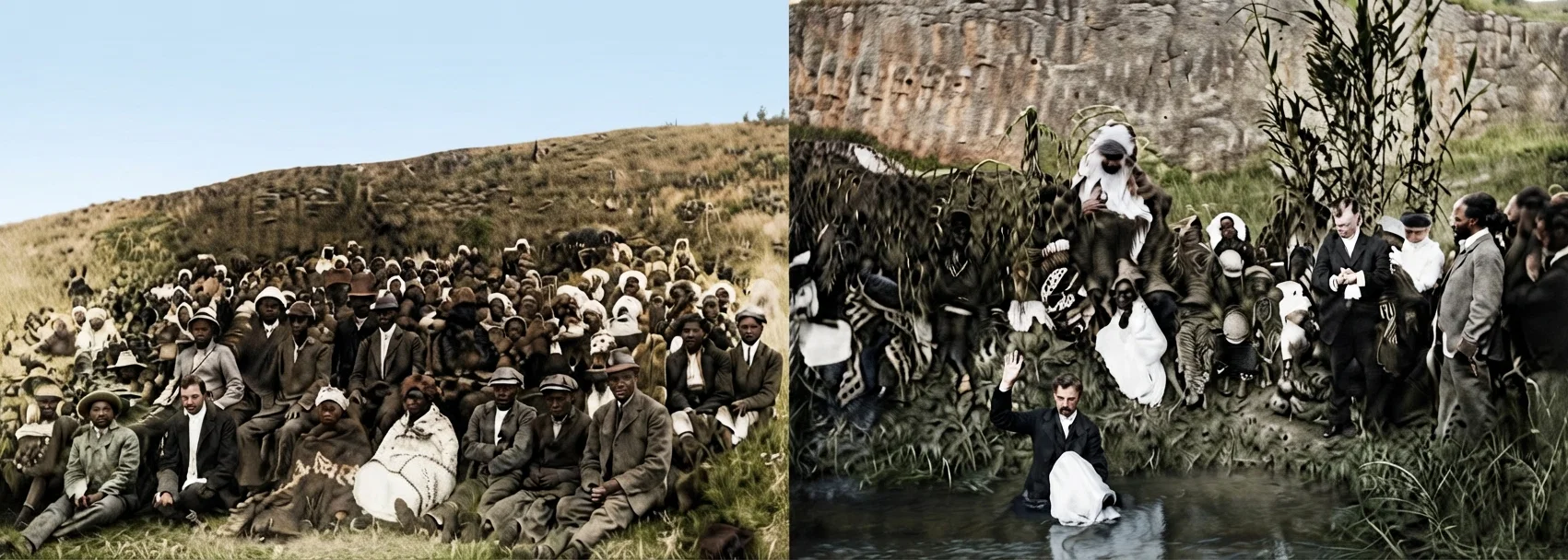
The picture on the left is a congregation of Basutos assembled on the river bank to witness a baptismal service. On the right is the baptismal scene. Elder O. K. Butler is performing the ceremony. Elder W. B. White, superintendent of our South African Mission, is the white man on the shore.
These people live a free outdoor life, and the writer has no hesitancy in saying that they are far better off and have many more comforts than the majority of colored people in the large cities of America. They are quite illiterate, few being able to read even their own language. This is especially true of the adult class; but the rising generation have more advantages, and many of the young people and children are in the schools, and are acquiring the rudiments of an education.
COURTESY AND KIND MANNERS
They are a very kind and well-mannered people, respond quickly to kindly treatment, and love those who love them; but if they discern that the missionary does not care for them nor have an interest in them, his influence over them for good is gone, and he can do nothing with them.
ATTENTIVE TO DIVINE SERVICE
They are a people who love to attend divine service; but as they have no clocks or watches, it puzzles them a little to know just when to come. So it may be that an hour or so before service, they begin to gather about the church, and in their bright colored clothing, present a unique appearance. When the bell rings and the doors are opened, the building is quickly filled; and if there are not seats enough, the people seat themselves on the floor.
During divine service, they are most attentive and well-behaved, and have their children under good control. The writer never addressed a better mannered people than a houseful of Basutos. The accompanying illustration shows a large crowd of these people who recently attended services held by him in North Basutoland. The men seated in chairs are chiefs. The five seated on the ground at the front are a baptismal class; and the European seated at the left is Pastor O. K. Butler, who administered the rite. Gradually these people are yielding to the claims of the gospel, and among them can be found many devoted Christians.
PLEASURE IN LABORING FOR THEM
To those who love the souls of men, it is a pleasure to labor among them, but Basutoland is no place for the professional minister. Only those who are indeed soul winners can hope to succeed in laboring among them. We are sure that in the great gathering day some representatives from this country will be found before the throne of God.
Killed His Own Sister — Who Was Responsible?
By R. W. PARMELE
By R. W. PARMELE
SOME months ago I was called to a jail to pray with a prisoner who was to be hanged the next day. Naturally I expected to see a hardened criminal, in whose estimation human life was worth but little. When I entered the death chamber, to my surprise, I found the sentenced man to be about twenty-six years of age, well dressed, with a kindly look, and presenting the appearance of a young man of intelligence and promise.
As I conversed with him on religious subjects, I found him well informed, and learned that during his imprisonment he had given his heart to God, and had evidently obtained pardon and a genuine Christian experience. He still hoped for the governor’s commutation of his sentence to life imprisonment. He said that if the Lord could use him to bring fellow prisoners to Him, he wanted to live; but if He could not, he was ready to mount the gallows; and whichever should come, he would accept it cheerfully.653
The prison officials told me that he was an exemplary young man, so far as his prison life was concerned. Upon further inquiry, I learned that he had been led into drink, and while crazed with liquor, he had killed his sister. No malice aforethought seemed to have been charged, but the deed was done in an irresponsible moment, while he was under the influence of the liquor that our government had licensed a man to sell him to drink.
Kind friends gave his body a respectable burial, as the governor's commutation did not come.
A few days afterward I was called upon to conduct the funeral of a baby, which was laid to rest beside his grave. At the cemetery, the undertaker whispered to me, "I suppose the parents of that child would feel horror-struck if they knew that the grave next to their child's is that of a murderer."
"Yes," thought I, "that is doubtless true. But he was once as pure and innocent as was that child. And what made him a murderer? — The accursed traffic that many professed Christian people have helped to license."
THE WATCHMAN
By Editor
A Monthly Magazine for Intelligent People
Some of the articles for November are: "After the War"; "The Present World Crisis"; "Creation and the Worship of the Creator." A number of other interesting articles. The Outlook Department will contain some very interesting notes this month. Attractive cover designs; profusely illustrated with colored war map supplement.
"LINCOLN," "ARMAGEDDON," AND "AMERICAN LIBERTIES" NUMBER
By Editor
Twenty Timely Articles, Twenty War and Other Pictures
The president of the republic of Cuba, Sr. Mario G. Menocal, writes the editor of this magazine under date of September 3, 1914:
"Religious liberty is the basis of civil and political liberty, and the best guarantee of peace and prosperity of the nations. . . . The Liberty Magazine, devoted to the defense of these essential principles of civilization, has my most heartfelt sympathies."—Extract from letter, photographic reproduction of which appears in this number.
Read also "Nicholas Murray Butler on Dangers Threatening American Liberties," "Will Carleton on Liberty," "Practical Working of State Religion," etc.
Governors and congressmen tell us they are filing every number away in their libraries for reference. An ex-mayor of Pittsburgh sat up until three o'clock to read one copy through before retiring.
Send this magazine to five friends for one year for only $1.00—regular price, $1.75. Or send in your name and those of four others.
One year, 35 cents; sample copy, 10 cents.
Liberty Magazine, Washington, D. C.
THE IMMACULATE CONCEPTION
By Editor
OF THE VIRGIN MARY
Will be the chief topic discussed in the November number of the PROTESTANT MAGAZINE
What this dogma means, its relation to salvation, the meaning of "Mariolatry," Mary the hope of sinners.
Writers and public speakers may feel safe in using these articles. Always dignified, yet fearless.
FALL OFFER: Fifteen months for $1.00. All subscribing for 1915 at $1.00 will receive free of charge the issues for October, November, and December, 1914.
To five different addresses, six months, only $1.50. Order the club and save the $1.00.
Regular subscription, one year, $1.00; sample copy, 10 cents.
Protestant Magazine, Washington, D. C.
Sanitarium Cooking Oil
"THE OIL OF QUALITY"
Pure Cotton Seed Oil direct from refinery. Sweet, wholesome, and delicious. 4 1-gallon cans, $3.60; 5-gallon can, $3.90; 2 5-gallon cans, $7.70; 30-gallon barrel, $20.80; 50-gallon barrel, $32.75. Cash with order. Sanitarium Cooking Oil Co., Louisville, Kentucky.