Bible Readings. "Seek ye out of the Book of the Lord, and read."—Isaiah. "Whoso readeth, let him understand."—Jesus.
CHRIST'S SECOND APPEARING.
Signs of His Coming.
1. WHAT light has God given us in this dark world of sin and uncertainty?
"Thy word is a lamp unto my feet, and a light unto my path." Ps. 119 : 105.
2. Through what servants does the Lord give us his Word?
"Surely the Lord God will do nothing, but he revealeth his secret unto his servants the prophets." Amos 3 : 7.
3. For how long will the word of prophecy be a light?
"We have also a more sure word of prophecy; whereunto ye do well that ye take heed, as unto a light that shineth in a dark place, until the day dawn, and the day star arise in your hearts." 2 Peter 1 : 19.
4. What prophecies has God given us which thus give us light till the day of his coming?
ANSWER.—Various lines of symbolic prophecies in the books of Daniel and the Revelation; and the literal prophecies of Matthew 24; Mark 13; Luke 21 and elsewhere. All these show that the coming of Christ is near.
5. What prominent signs of his coming were foretold by our Lord?
"And there shall be signs in the sun, and in the moon, and in the stars; and upon the earth distress of nations, with perplexity; the sea and the waves roaring; men's hearts failing them for fear, and for looking after those things which are coming on the earth; for the powers of heaven shall be shaken. And then shall they see the Son of man coming in a cloud with power and great glory." Luke 21 : 25-27. The darkening of the sun and moon (see Matt. 24 : 29; Rev. 6 : 12) took place May 19, 1780; the falling of the stars (Rev. 6 : 13), Nov. 13, 1833; and the perplexity and fear because of famine, and pestilence, and plague, and tidal wave, and earthquake, and cyclone, and rampant socialism, anarchy, and plutocracy, are everywhere manifest.
6. What plain prophecy is fulfilled in the great war preparations now taking place among the nations?
"Proclaim ye this among the Gentiles: Prepare war, wake up the mighty men, let all the men of war draw near; let them come up. Beat your plowshares into swords, and your pruning-hooks into spears; let the weak say, I am strong. . . . Let the heathen be wakened, and come up to the valley of Jehoshaphat; for there will I sit to judge all the heathen round about." Joel 3 : 9-12.
7. When will this gathering to war take place?
"Put ye in the sickle, for the harvest is ripe; come, get you down; for the press is full, the fats overflow; for their wickedness is great. Multitudes, multitudes in the valley of decision; for the day of the Lord is near in the valley of decision." Joel 3 : 13, 14.
"The harvest is the end of the world [age]." Matt. 13 : 39. See also Rev. 14 : 14-16.
8. Yet in the face of all this what cry does the Lord say 'many people' will raise and are now raising?
"And it shall come to pass in the last days, that . . . many people shall go and say, Come ye, and let us go up to the mountain of the Lord. . . . And he shall judge among the nations; . . . and they shall beat their swords into plowshares, and their spears into pruning-hooks; nation shall not lift up sword against nation, neither shall they learn war any more." See Isa. 2 : 2-6.
Note that it is not the Lord but the "many people" that say this, and because of their apostasy the Lord forsakes them; "for when they shall say, Peace and safety; then sudden destruction cometh upon them; . . . and they shall not escape." See 1 Thess. 5 : 1-5.
9. What may we know as we see these various signs?
"When ye shall see all these things, know that he is near, even at the doors." Matt. 24 : 33, margin.
THE TENDENCY OF THE FEDERAL JUDICIARY.
By W. N. G.
FEW, if any, legal questions have called out more press discussion than the injunction issued against the striking miners of West Virginia by Judge Jackson, of the U. S. Circuit Court. In the light of past strikes in the coal regions the aggregation of large bodies of men did look ominous, but the miners had as yet committed no depredation; and if they had, the State courts were the proper tribunals of appeal. On this point the Hartford Courant says:—
"Take the case of the Monongahela Company. If trespass upon their property had been committed or was threatened, the State laws were there to punish. The only peace in any possible danger of being broken was the peace of West Virginia. . . . How does Judge Jackson of the Circuit Court of the United States come to be meddling in the domestic affairs of West Virginia? His apologists now say that he did nothing but forbid acts that are unlawful. The laws themselves had done that long before the public ever heard of him. That is what the laws are for."
It is an indisputable fact that the Judicial Department of our Federal Government has been inclined to deem itself the higher of the three governmental functions. And the people have in a measure conceded this assumption by referring to the Supreme Court as the "highest authority in the land," and by taking as precedents its rulings (sometimes by the barest majority), which were contrary to the spirit of the Constitution. On this point the Kansas City Times says:—
"The Federal Judiciary does not appear now for the first time in the rôle of a usurper. From the beginning it has steadily striven for more than its due share of power. Now boldly, again craftily, it has reached out to grasp the supreme sovereignty. Foreseen by Jefferson, watched with apprehension by later patriots, this process has gone on until in our own time the Federal Judiciary aims daringly at open government."
There is another peculiarity of the Federal Courts which is worthy of attention, namely, it is practically a tribunal for the benefit of the rich and combinations that are otherwise powerful. And for this reason the laboring classes seldom have access to its bar only as they come as defendants on unequal terms with the wealthy. Hence the tendency of Federal Court proceedings in such cases is to bring on a fulfilment of the prophecy of James 5.
Still another significant characteristic of the U. S. Courts is the one point in which the State laws are held in high esteem. It is well known that State Legislatures are not, as is Congress, forbidden by the Federal Constitution to pass laws establishing religion; so when an individual is prosecuted in a State for exercising his constitutional and religious right to do honest labor on the first day of the week, the Federal Court affords him no protection, because it will not interfere with the State law and decision of the State Court. Yet we have seen that, in other respects, State law and State Courts are both ignored.
So it is manifest that the effect of Federal Court rulings (the so-called "highest authority") is to cater to the power of wealth and to set up a system of religious doctrine recognized by the government. Yet to protest against such tendency, either from a political, industrial, or religious standpoint, is more and more coming to be classed as anarchy. W. N. G.
THE ZIONIST RESTORATION.
By Christian Work
Our Zionist friends have held their congress at Basel for re-establishing the Hebrew commonwealth in Palestine, and have adjourned. The congress asks for $50,000,000 for their object. More than one Jewish firm could draw its check for the amount. But these are the very ones who will not "draw;" very likely they will not even contribute. The fact is, it is the law of economics that has converted the Jew from being an agriculturist to becoming a merchant, a manufacturer, and a banker. Where the stores and the factories and the banks are, there he lives with his wife and children; why should he change? Some transformations there may be. The poor Jews of Russia, of Austria and Bohemia, may be glad to find a home in Palestine, stake out their farms, and go to work. The colony may even be a success; it may buy its right—or wealthy Jews may purchase it for them—to self-government. But it will only be a small affair—a shadow and a dream of the old theocracy. Besides, not more silent was the voice of prophecy from Malachi to Christ than is the voice of prophecy now, and will continue to be, among those Judean hills and Galilean mountains.
And what would a Jewish Palestine be with the prophets silent and no visions? No, there can not be another Jewish Palestine; the Shekinah has dimmed, the glory has departed; shall we not say that Shiloh has come? Nor is even a Hebrew commercial Palestine a possibility if we may read the signs of the times. When you can turn on the instant a mercantile and manufacturing people into agriculturists, and so reverse the law of progression, it may be found possible to induce our Jewish citizens to give up their homes in this city and take up with the spade and hoe in Palestine—the prospect whereof is as dim as the Martian canals.—Christian Work.
The Outlook
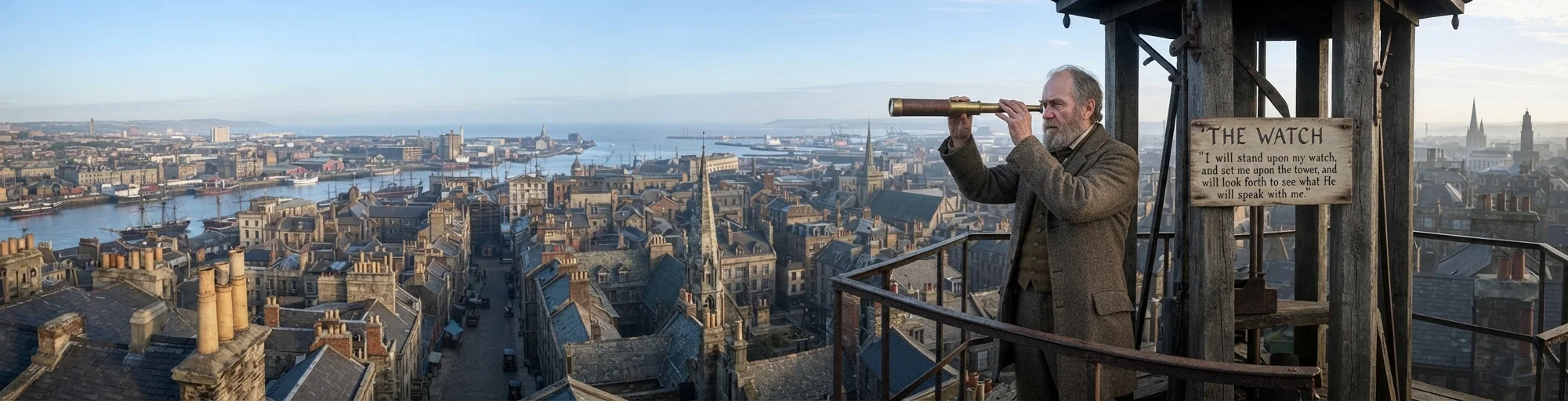
"I will stand upon my watch, and set me upon the tower, and will look forth to see what He will speak with me."
THE YOUNG PEOPLE AND CHRISTIAN CITIZENSHIP.
By Editor
THE Christian Citizen rejoices over the work of "Christian Citizenship" among the Endeavorers at the recent convention in San Francisco. It says:—
"No feature of the Sixteenth International Convention of Christian Endeavor has attracted more attention or been given more hearty reception by the many thousands assembled, than that accorded the Christian Citizenship movement. It was frequently dwelt upon at length by prominent men from all parts of this country and of the nations, and almost every mention of civic righteousness was the signal for a general burst of enthusiasm."
Of the Toronto Convention, immediately following, of Epworth Leagues, the Methodist young people's organization, it remarks:—
"The key-note of Christian Citizenship that was struck at the San Francisco Convention was faithfully followed at the Toronto gathering of Epworth Leaguers one week later."
But the Baptist Young People's Union seemed to have remembered the good old Baptist principles of the true relation of Church and State; for the Christian Citizen finds in the convention at Chattanooga little comfort. Thus it expresses itself:—
"We are sorry not to be able to report more upon Christian Citizenship from the Chattanooga Convention. The almost complete absence of all mention of the subject in the convention is probably in part explained by the correspondent for the Baptist Union, who says, 'Every convention has its own flavor. This is exceptionally devotional and fraternal.' We are sure, however, that the great host gathered at that convention are friends of our cause, and we trust the next convention will take on a little more 'flavor' of Christian Citizenship."
We hope not; but if it does we are sure that there will be less of a truly "devotional and fraternal" spirit. The Christian Citizen is right; "the almost complete absence of all mention of the subject" is explained by the "exceptionally devotional and fraternal" "flavor." Where true piety is fostered, political Christianity finds no foothold. May the Baptist young people so abide.
SUMMER RELIGION.
By Editor
Is It Christianity?
WE take the following from the Christian Work; it speaks for itself: "It was at a summer hotel on the seashore. The guests were overwhelmingly professing Christians; it is a fact probably observable by the reader that hotels have their clienteles of distinctive character; some are peopled by a 'fast' crowd; others entertain mostly people of religious faith and life, as in the case of the hotel in question. Well, one guest in the hotel receiving several religious or 'family' papers—the terms have almost become interchangeable—concluded he could not render a better service to some of the guests than to distribute a few of the newspapers on the public table. So he quietly and unperceivedly deposited a copy each of some half a dozen or so of the leading religious weeklies. The reading-room was visited during the day at different times; and it is a fact that not a copy of any journal was taken away, and only two were seen in the hands of any guests, one remarking, as he put his paper down, 'It is astonishing how beautiful some of the illustrations are; they are well worth looking at!' and the other observing, 'Those "Camp-fire Musings" are just splendid!' Furthermore, of the 100 guests, or possibly fewer, just six, so far as could be learned, attended church, altho there are eight churches of different denominational proclivities in the town. What intensifies the situation is the further fact that, while no religious paper was taken away by any guest, a fountain pen that was inadvertently left on the table was missed, and was not recovered, altho a conspicuous 'Lost' notice was tacked upon the door of the parlor and of the reading-room. The question arises,—What becomes of religion during the holiday season?"
THE STRIKING COAL MINERS.
It is thus that Rev. G. W. Puddefoot, home mission secretary of the Congregationalists, writes to the Springfield Republican of the wrongs of the suffering miners:—
"In regard to the men engaged in a strike in the coal regions, last June I was called to visit the annual meeting of the Congregational churches in Pennsylvania. Many of the visiting ministers preached in mining towns, and complained of very hard times. I questioned them as to the cause. They all, without an exception, said that their membership was largely made up of miners, and that the men had not more than eight days' work a month for over nine months, and some of them made less than $1.00 a day, while some made $2.00, and in some cases $2.50 a day. Moreover, the store pay goes on, in spite of laws against it, and it is managed in this way: Some man has bought elsewhere, and at the end of the month the clerk says:—
"'Why, Thomas, only $3.00 this month!'
"'Well, my wife bought a few things from her cousin's store.'
"'O, yes, I see!'
"The next week the foreman says:—
"'Well, Thomas, I guess we won't work that pocket any longer.'
"'All right,' says Thomas, 'where shall we go next?'"
"'Well, I don't know yet,' and he never does know. Thomas is not discharged, but they are not ready for him yet.
"A little over a year ago I visited some coal mines in Illinois, and found one village called 'Kelly's Patch,' where the men were paid off in beer after their store account was settled. In one mine, where 300 men were employed, there was an average of one man killed a week. In some of these villages there was not even a day school. Now it is quite true that men make $3.00 a day for a time, but when the average for the year is taken, the wages are too small to supply the decencies of American life."
NO HELP TO SNUFF OR POPE.
His Holiness Pope Leo uses snuff. It is very fine snuff, and is made by a Baltimore firm, expressly for the pope's use. It is made from the very finest materials obtainable, and before it is packed in the elegant boxes in which it is shipped direct to the Vatican, it is sprinkled with attar of roses, the costliest perfume known to the trade. Altogether this is the finest and costliest snuff in the world.—Catholic Mirror.
A Significant Statement
A Significant Statement.—"If the following statement were made concerning the Roman Catholics of this country by a Protestant paper," remarks the Christian Advocate, "it might be denounced as the expression of bigotry, but it has a peculiar significance when made by such a paper as the Catholic Citizen: 'There are two influences among us—the saloon tending to pull us down, the public school tending to pull us up. Some of our friends would sooner quarrel with the latter influence than with the former.'"
HOW CHECKED?
"In the minds of many careful observers, there is no time to be lost if we would check the evils that now threaten the life of our republic."—Christian Citizen, September, 1897. True, but the Christian Citizenship movement is one of the greatest evils, and it can not be checked by the homeopathic principle, Similia similibus curantur. It can never be cured by itself. What is needed is good, "regular" Gospel treatment. In that alone is life.
NEVER INDORSE.
I SHALL not soon forget the family of Israel Day, who lived neighbor to my father when I was a boy. Mr. Day was working out as a laborer, and as he had a large family dependent upon his earnings for support, and sometimes it was difficult in our neighborhood to find employment, the family was poor, and the strictest economy had to be practised to furnish the bare necessities of life.
I often wondered how it happened that such a man as Mr. Day should be so poor. He had no intemperate or extravagant habits, and was a man of more than common education, and there was an air of intelligence and refinement about the entire family that commanded the respect of their neighbors. Mr. Day was industrious, but always seemed to me a man who had no ambition in life, and who expected and desired no more than a mere subsistence for his family. No one in the neighborhood knew anything of his history. The family had come from another State a few years previous, and, while polite and friendly, they were very uncommunicative as to their former life, and there was something about them that forbade inquisitiveness.
I was at this time sixteen years old, and on very intimate terms with Mr. Day's family. At the time of my story he was helping my father on the farm for a few days and boarding with us. One day when we came in from our forenoon work, we found Squire Black was to take dinner with us, and, as he was reputed to be the wealthiest man in the township, we felt quite honored. He was a very genial man and an excellent talker, and had an adroit way of flattering and making every one feel easy in his company.
On this occasion he made himself very agreeable; he praised the neat appearance of the farm and buildings, complimented mother on her good cooking, called me a fine, manly fellow, gave some small change to the children, and by the time dinner was over had gained the good-will of the entire family.
After dinner Mr. Black asked to see the stock and examine the arrangement of the barn and outbuildings, and, as father took pride in having good, well-fed stock and one of the most conveniently arranged barns in the country, he was glad to show him around, and was much pleased with the hearty commendation which Mr. Black bestowed upon them.
He finally made known the object of his visit; he had found a piece of very desirable property for sale, low, so that there was no question that within less than a year he could clear several thousand dollars on it, but he must pay all cash down, and he lacked two thousand dollars of having enough money to pay for it. He wished father to become security for him for one year, as he had found a party who was willing to lend him the amount if his signature could be had to the note.
He did not give father time to think or scarcely to answer his questions, but took out his pocket-book and handed him a paper, supposing it to be the note which he had drawn up, and signed by himself, all ready for father's signature. I verily believe that if the paper had been what Squire Black thought it to be, father could not have refused to sign it; but it so happened that he had made a mistake and left the note at home and had substituted for it another paper.
A shade of vexation passed over the squire's face when he discovered the mistake, but he at once recovered his good humor and said, "Never mind; I will call again this evening," and hastily mounted his horse and rode away.
Father looked troubled, and turning to me said: "I do not like to indorse for any one, but Squire Black will be insulted if I should refuse, and as he is rich I suppose there can be no risk about it. It is only complying with a legal form, and I suppose I shall be obliged to do it; but I wish he had not asked me to do so."
Before I could reply, the barn door opened and Mr. Day came out; he was pale and deeply agitated, and when he spoke I should not have recognized his voice. Calling my father by name he said, "I believe that you are in danger, and if you will listen to me, I will give you a chapter from my own history that I had never intended should be known to any in this neighborhood."
Father motioned for me to leave, thinking that Mr. Day wished to speak to him alone. He noticed it, however, and said: "No, let him stay, for one can not learn too soon the lesson that my experience teaches. I would be willing that it should be published to the world if thereby some could be saved from my bitter experience. I overheard, as you know, what Squire Black said to you. Listen to my story and then decide as to whether you will put your name on this note.
"Fifteen years ago, when I was married, I was not the poor man that you now know me to be. My father gave me as my share of his property $2,000, which I had increased to three, and my wife received as her wedding portion $1,000. We were both strong and willing to work, and ambitious to succeed in the world, and we bought a good farm, running in debt a few hundred dollars. For several years we were greatly prospered. We had good health, and the seasons were favorable, so that we grew heavy crops and obtained fair prices for them.
"At the end of five years we had paid off our debt and had nearly one thousand dollars in bank, and we felt that it would be safe to build a new house, altho we expected to put more than the amount of money on hand into it.
"In the meantime there had come into the neighborhood one of the most companionable men I ever met. He was familiarly known as Captain Cole. He had been a lawyer, but had been appointed by the general government to a lucrative office which he held for some years, and had the reputation of being very wealthy. He lived in good style, and was a general favorite in all the community.
"When my house was finished I found myself in debt $700, and as I had given the contract to a carpenter, he to furnish everything, he needed all his money. I went to the bank to borrow the amount until I could find some one who would let me have it for one or two years, and, not being accustomed to borrow money, it did not occur to me that an indorser would be necessary, until the cashier of the bank informed me that it was their invariable custom to require security. Captain Cole, who happened to be in at the time, overheard the conversation and came forward with a pleasant, 'Good-morning,' saying, 'I shall be only too happy to indorse for my friend, Mr. Day.' I felt both grateful and flattered, and when a few months later I happened to be in the bank when he wanted an indorser, I was glad to return the favor.
"We had two years of prosperity, and I paid the debt on my house. I now determined to build a fine barn, and, as I had always paid my debts easily and could not well get along with my old barn until I had saved the money to build the new one, I determined to borrow $1,000, and, happening to meet Captain Cole, I asked him if he knew where I could get that amount for three years. He told me he did, and offered to become my security. The money was borrowed and my barn begun.
"A few weeks later Captain Cole called to see me. Like Squire Black to-day, he seemed delighted with everything he saw. His flattery put me in the best possible humor, and when he asked me to indorse a note of $5,000 for sixty days, and assured me that he could meet it (or even twice as much) promptly, to the day, I consented, against my better judgment, and affixed my signature to the note. That act ruined me. Before the sixty days expired I learned that he was bankrupt. My farm was sold at a sacrifice, under the hammer, and when I paid the $1,000 which I had borrowed to build the barn with, I was left penniless.
"With my history in your possession, do you wonder that I was alarmed to-day when I saw you about to fall into the same trap? I tell you, I have a right to feel deeply on this subject. Would that I could make my voice be heard by every young man in the land. I would say to him, Shun as you would a serpent this evil which has brought ruin to so many families. I realize fully what it means to put my name on another man's paper, and it is just this—that I assume all the risks of his business, without any voice in its management or any possible chance of profit if he is successful, but with a fearful certainty that if from any cause he makes a failure, my earnings must make it good, even tho it reduces my family to beggary. Since my own misfortune I have made this a matter of study, and I find that a very large per cent. of the business failures of the country (and nearly all among farmers) are due to this practise."
The remainder of my story is soon told. My father was deeply impressed by Mr. Day's story, and before night I was dispatched to Squire Black's with a note from father stating that, after carefully considering the matter, he had decided not to sign the note. In less than a year after this Squire Black was declared a bankrupt, and in the final settlement of his business it did not pay ten cents on the dollar.
Father felt that he owed a debt of gratitude to Mr. Day; and he presented him with a good team and helped him to rent a farm. This encouraged11him, and he worked so industriously and managed so prudently that in a few years he was able to buy a small farm, and has since been able to support his family comfortably.
Many years have passed since these events transpired, and I am now past middle life, but I have never ceased to be thankful for the lesson taught me by Mr. Day, and in fulfilling his wish I would repeat the lesson which the story teaches,—never indorse.—Anon.
SO HE BRINGETH THEM.
By Marianne Farningham
Out in the wilderness, wandering wearily,
Hungering, shelterless, crying so drearily,
Making no progress toward home land and rest,
Often we question, Can this way be best?
Are we forsaken, or is this a guide?
Can it be true that the Lord will provide?
Ah, but the answer shall come before long,
And lips that are sighing break forth into song!
Rudderless, anchorless, how we are driven!
Winds sweep the ocean; clouds cover the heaven;
Wild is the tempest and long is the night;
The dawn still delays, tho the prayer is for light;
Tossed by the billows, cast into the deep,
Frail is the barque where we struggle and weep.
How can the voyagers reach home at last?
But the haven is ours, and the danger is past.
No one is fatherless, no one is left,
No one is utterly crushed and bereft—
We are God's children, tho out in the wild;
He who redeems us is watching each child.
Tho in the wilderness, tho on the sea,
Not far is the haven where each would fain be;
And He, if in tempest or danger we roam,
By the right way, the best way, is bringing us home.
Marianne Farningham.
FROM NORTHERN AFRICA.
By Herman Harris
THE Central Soudan Mission, headquarters in London, calls attention to the open door into this long-closed country. They are much in need of financial aid to take advantage of this opportunity to preach Christ where he has not been known. Mr. Herman Harris, the director of the mission, is at present in Gabes, Tunis, Africa, from whence he writes as follows:
“We have a hall for Gospel meetings, with good shop front on the main road. Over the entrance we have written in large Arabic characters the words, ‘House of the Gospel of Jesus, the Messiah, the Crucified;’ and on the side wall in French is written, ‘Maison de l’Évangile.’
“In the windows we display Scriptures, tracts, and text-cards in several languages, and many people come inside to read more, and to hear the Gospel; to some we give Scriptures and tracts. Many of the natives, however, can not read, and even those who can, do not easily understand the standard version of the Arabic Bible, which is in high-class Syriac Arabic, well suited to the native Christians of Syria and Asia Minor, but not adapted to the Moslems of North Africa. We long to have a revised version of at least one Gospel in simpler language suited to the people of this province.
“Our work may be well described under two distinct headings: First, the French or European work. This consists of meetings held three times a week, conducted chiefly by Mrs. Harris. On Sundays, at 6:30 P.M., the hall is always well filled by soldiers. Many have been brightly converted, and are bravely standing the test of persecution in barracks. On Wednesday evenings a converts’ meeting is well attended, and the men give bright testimonies. On Thursdays, at 3:30, there is a children’s class, when illustrated Bible lessons are given on the blackboard.
“Second, Arabic or native work. This consists of (1) reading, conversation, and personal dealing every morning with visitors at our hall, individually or in groups. (2) Four or five afternoons every week are spent in visiting the surrounding villages, and the population scattered in the oasis. The more distant places I reach on my bicycle. Sometimes I have a group of from ten to twenty or more men and lads (Arabs) to hear the Gospel. (3) Twice a week a service in Arabic is held in our hall, consisting of singing, prayer, reading of the Bible, and preaching. These meetings are attended by both Jews and Arabs; at some the numbers have been very encouraging, and the attention and behavior of the audience excellent.
“The evident signs of God’s presence and blessing with us have been accompanied by strong opposition from the authorities against our work. In November last we were forbidden to sell or to give away any Scriptures or tracts either inside our own hall or elsewhere, and for continuing to do so, we were summoned and prosecuted both in January and February, and fined sums varying from one to three dollars. We have committed the matter to God in prayer, trusting that these things may turn out rather to the furtherance of the Gospel.”
—Missionary Review.
BABY PEARY.
LITTLE Miss Peary, the daughter of the great Arctic explorer, has the distinction of having been born at a higher degree of northern latitude than any other white child living or dead. Her first toilet, given by an Eskimo nurse, consisted of a layer of superfine seal-oil, after which she was slipped into a double sealskin bag, with fur inside and out. After forty-eight hours of hibernation she announced that she was hungry, and the nurse said she was the sweetest baby that ever lived. There was no other woman about to improve on this remark, so the Innuit nurse became godmother, and bestowed her own unpronounceable name on the little white stranger. That is the reason we refrain from spelling it. The proud nurse assured the mother that, protected by that name, which has special powers within the Arctic Circle, it would be safe for the baby to take an airing.
“But it is forty degrees below zero!” said Mrs. Peary.
“Yes, so nice and mild! It will soon be noon of the year,” replied the nurse.
So little Miss Peary, who had been promoted from the bag to a garment of fur, was gently lowered into another bag of reindeer skin that was tied around the neck. Over the head was slipped a sealskin hood that enveloped the face and neck. Little holes were left to admit air. She was then put on a sledge, with a polar bear rug under her and an eider feather blanket over her, and the whole was drawn by a splendid pair of Eskimo dogs, decorated with bells, the nurse trotting along beside her charge.
The baby came back as pink as a rose, and afterwards, unless the weather was really severe, she had an airing every day. When the hour came, if she saw no preparations being made, she demanded to go “ta ta,” and the whole exploration party had to see that she got it, too.—Anon.
AN EXPENSIVE BOOK.
According to the Chicago Record, the most expensive book ever published is the official history of the War of the Rebellion, which is now being issued by the government of the United States, at a cost up to date of $2,334,328. Of this amount $1,184,291 has been paid for printing and binding. The remainder was expended for salaries, rent, stationery, and other contingent and miscellaneous expenses, and for the purchase of records from private individuals. The work will consist of one hundred and twelve volumes. Copies are sent free to public libraries.
THE LANGUAGE OF CHRIST.
By Ella Wheeler Wilcox
The wise men ask, “What language did Christ speak?”
They cavil, argue, search, and little prove.
O sages, leave your Syriac and your Greek!
Each heart contains the knowledge that you seek:
Christ spoke the universal language—Love.
—Ella Wheeler Wilcox.
HOW SWEET.
By Mrs. Melissa Barton
How SWEET to know God's Word is true,
To know His promises are sure!
How sweet to find in Him our strength,
A Saviour mighty, loving, pure!
How sweet to know God answers prayer!
How sweet to feel He is our Friend!
How sweet on Him to cast all care,
And know He'll keep us to the end!
How sweet to know that heaven is ours,
Was bought for us with Jesus' blood,
Where bloom for us immortal flowers,
And flows life's everlasting cleansing flood!
Mrs. MELISSA BARTON.
OUR WORK AND WORKERS.
By Editor
FIFTEEN persons have accepted the Sabbath of the Lord at Yarnell, A. T.
Six persons were baptized during meetings held at Fulda, Minn., by Elder J. H. Behrens.
ON Sabbath, the 11th inst., thirteen persons were baptized and united with the church in Battle Creek, Mich.
A CHURCH organization and a new house of worship are among the rich blessings of God let down on the people of Blossburg, Ala.
THE Sanitarium summer school, just closed at Battle Creek, Mich., has been such a success that it will doubtless be continued in the future.
AT West Selkirk, Manitoba, five persons, two of them missionaries, are reported as having accepted the faith proclaimed by Seventh-day Adventists.
AS PREVIOUSLY mentioned, Elder A. J. Breed and son left this city on the 31st ult., for Neillsville, Wis., on account of the reported fatal illness of Sister Breed. Under date of the 13th inst. Elder Breed writes that she was still very sick, the disease being typhoid fever, and the weather hot and sultry. The doctor said it must run another week, and if she had strength enough to stand it, she might recover. Neillsville, Wis., is Brother Breed's address for the present.
ELDER D. E. SCOLES, who recently went from Upper Columbia Conference to Minnesota, writes back to the Reaper:—
"I find my new home a busy field of labor. Six tent companies are in the field this summer in this conference. The same precious truth of the third angel's message is loved by many here, and unites our hearts in the love of Christ. . . . One thing I find here among the people that is most refreshing, and that is a spirit of hospitality that I never found in the west, as it is here."
By "the west" Brother Scoles evidently means the Pacific Coast. Now the brethren in this far west region should be thankful for this hint, kindly given, and be moved to an endeavor to emulate their brethren in Minnesota. The people of this coast have a great reputation for great entertainments on special occasions, but when it comes right down to common, every-day hospitality, they are not up to either the east or the south. We hope that at least our brethren will take the hint.
NOTWITHSTANDING the extensive floods this summer interfered to a great extent with the steamer work of Elder J. E. White and his colaborers, it is encouraging to note in his report to the Review the following feature of their labors:—
"In Vicksburg the prejudice which has heretofore made the work somewhat difficult, is breaking away, and our workers have more openings for Bible readings and small schools than they can fill. Our little company at this place are firm in the truth, and are growing spiritually. Our day-school has been a credit to the work this season, and promises to open this fall with greatly increased attendance and influence. The attention of school-teachers is being attracted to it as a place where they can gain, in the most thorough manner, just the instruction they need better to fit them for their work. The night-school runs all the year through, and is attended by those who are earnest in their efforts to learn. It is well attended by our own people, and as a result all of them can now read the Bible for themselves. One unexpected feature of the night-school last winter was the attendance of several who studied in other schools in the city through the day, and came to our evening school to get help in their day-school studies."
PUBLICATIONS WANTED.
Mrs. J. M. Ferguson, Kopperl, Texas, desires clean copies of our denominational papers and tracts for canvassing and missionary work. Send postpaid.