Your ShelfYour Projects

Signs of the Times, Vol. 23, No. 38.

Editorial
Earlier text: CHRIST'S SECOND APPEARING

The Sabbath School

International Series.

LESSON III.—SABBATH, OCTOBER 16, 1897.

THE PERSECUTOR CONVERTED.

Lesson Scripture, Acts 9:1-22, R. V.
1 "But Saul, yet breathing threatening and slaughter against the disciples of the Lord, went unto the high priest, and asked of him letters to Damascus unto the synagogues, that if he found any that were of the Way, whether men or women, he might bring them bound to Jerusalem. And as he journeyed, it came to pass that he drew nigh unto Damascus; and suddenly there shone round about him a light out of heaven; and he fell upon the earth, and heard a voice saying unto him, Saul, Saul, why persecutest thou me? And he said, Who art thou, Lord? And he said, I am Jesus whom thou persecutest; but rise, and enter into the city, and it shall be told thee what thou must do. And the men that journeyed with him stood speechless, hearing the voice, but beholding no man. And Saul arose from the earth; and when his eyes were opened, he saw nothing; and they led him by the hand, and brought him into Damascus. And he was three days without sight, and did neither eat nor drink. 10 "Now there was a certain disciple at Damascus, named Ananias; and the Lord said unto him in a vision, Ananias. And he said, Behold, I am here, Lord. And the Lord said unto him, Arise, and go to the street which is called Straight, and inquire in the house of Judas for one named Saul, a man of Tarsus; for behold, he prayeth; and he hath seen a man named Ananias coming in, and laying his hands on him, that he might receive his sight. But Ananias answered, Lord, I have heard from many of this man, how much evil he did to thy saints at Jerusalem; and here he hath authority from the chief priests to bind all that call upon thy name. But the Lord said unto him, Go thy way; for he is a chosen vessel unto me, to bear my name before the Gentiles and kings, and the children of Israel; for I will show him how many things he must suffer for my name's sake. And Ananias departed, and entered into the house; and laying his hands on him said, Brother Saul, the Lord, even Jesus, who appeared unto thee in the way which thou camest, hath sent me, that thou mayest receive thy sight, and be filled with the Holy Ghost. And straightway there fell from his eyes as it were scales, and he received his sight; and he arose and was baptized; and he took food and was strengthened. 19 "And he was certain days with the disciples which were at Damascus. And straightway in the synagogues he proclaimed Jesus, that he is the Son of God. And all that heard him were amazed, and said, Is not this he that in Jerusalem made havoc of them which called on this name? and he had come hither for this intent, that he might bring them bound before the chief priests. But Saul increased the more in strength, and confounded the Jews which dwelt at Damascus, proving that this is the Christ."

QUESTIONS.

  1. Who was prominent in the persecution of the early church? How bitter was he against the disciples?
  2. What steps did he take to make the persecution more effective? How general did he propose to make it?
  3. To what place did he proceed? What occurred as he approached the place?
  4. How did the bright light affect Saul? What did he hear? What did the voice say?
  5. What was Saul's reply? What astonishing news did Saul learn?
  6. What question did he then ask? What reply did he receive?
  7. What is said of the men who journeyed with him?
  8. What was Saul's condition when he arose from the ground? What did his companions do with him?
  9. How long was he there? In what condition?
  10. To what disciple in Damascus did the Lord speak in a vision?
  11. What did the Lord say to him? What did the Lord say Saul was doing?
  12. What objection did Ananias raise?
  13. How was this objection overruled? What was the Lord's testimony concerning Saul? What was to be his work?
  14. What strange preparations for his work did the Lord propose to give him?
  15. When Ananias came to Saul, what did he say? Give the exact words.
  16. What immediately followed?
  17. After his baptism, what did Saul do?
  18. What did he preach? and where?
  19. State the effect of his preaching on those who heard.
  20. What question did they ask?
  21. What was Saul able to prove?

SUGGESTIVE QUESTIONS.

  1. Find other texts which show the nature of Saul's feeling toward the disciples.
  2. What can we learn from this narrative as to the way we should regard those who oppose the truth?
  3. Against whom is all persecution directed?
  4. If this were always remembered by those who suffer for the faith, what effect would it have on them?
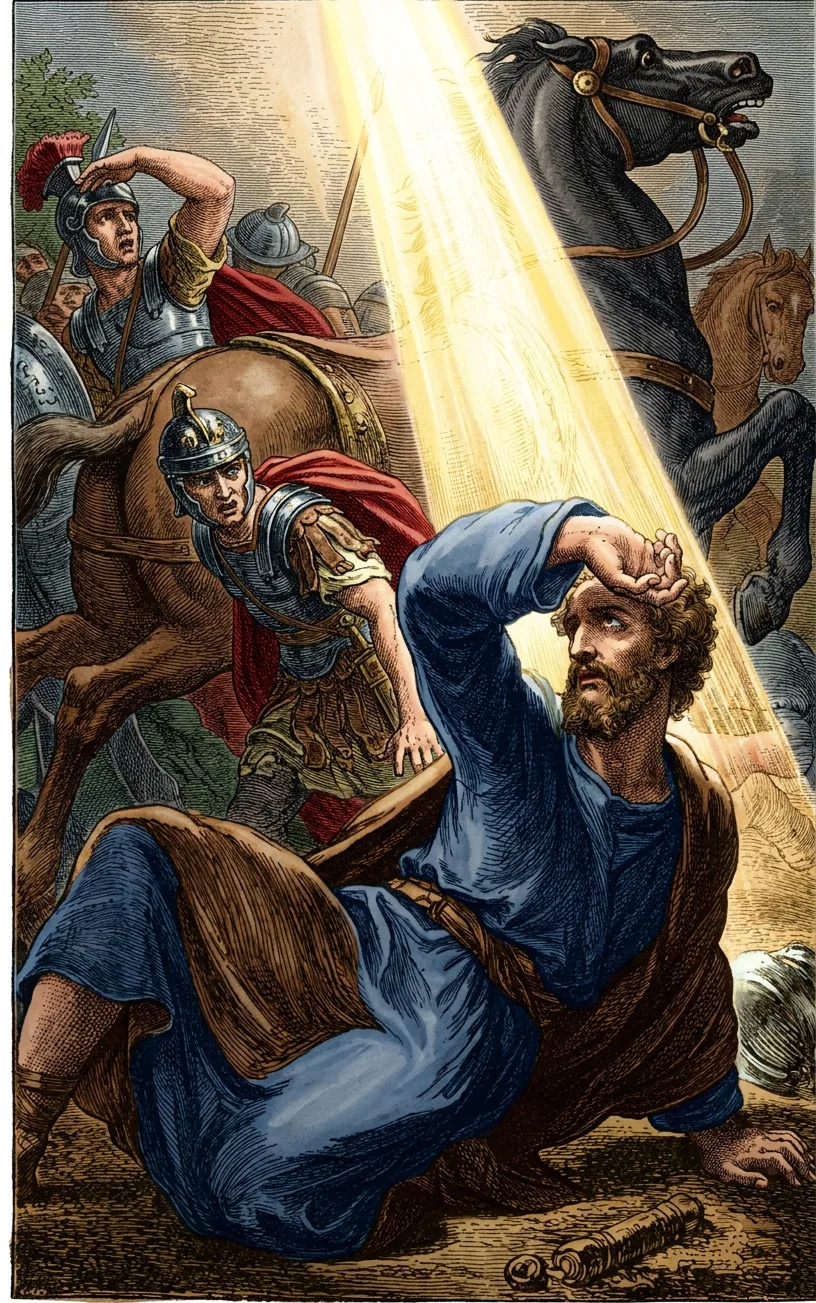
THE PERSECUTOR PERSECUTED.
5. The student may have noticed that the words contained in the last part of verse 5 and the first half of verse 6 are omitted in the Revised Version. This, however, can at the most signify no more than that these words do not occur in this part of the received Greek text; for if we examine Paul's account in chapter 22, we shall find a portion of the words which are here omitted.

The Sunday School

International Series.

LESSON III.—SUNDAY, OCTOBER 17, 1897.

PAUL BEFORE THE ROMAN GOVERNOR.

NOTE.—The lesson section includes Acts 23:12-35 and chapter 24, taking in the whole story of Paul's transference to Cæsarea, his trial before Felix, and his two years' imprisonment. Impress the truth that "all things work together for good to them that love God." Paul knew, for God had told him, that he should preach in Rome, and the steps here taken in the experience of Paul were steps toward fulfilling that promise, tho during this period it may have been difficult at times for those immediately concerned to see the reason for the circumstances which the Lord permitted. Cæsarea, the place to which Paul had been sent for trial, and where he made his defense before Felix and Agrippa, was situated forty-seven miles northwest of Jerusalem, and was one of the residences of the Roman governor of Judea.

Lesson Scripture, Acts 24:10-25.

10 "And when the governor had beckoned unto him to speak, Paul answered, "Forasmuch as I know that thou hast been of many years judge unto this nation; I do cheerfully make my defense; seeing that thou canst take knowledge, that it is not more than twelve days since I went up to worship at Jerusalem; and neither in the temple did they find me disputing with any man or stirring up a crowd, nor in the synagogs, nor in the city. Neither can they prove to thee the things whereof they now accuse me. 14 But this I confess unto thee, that after the Way which they call a sect, so serve I the God of our fathers, believing all things which are according to the law, and which are written in the 15 prophets; having hope toward God, which these also themselves look for, that there shall be a resurrection both of the just 16 and unjust. Herein do I also exercise myself to have a con- 17 science void of offense toward God and men alway. Now after many years I came to bring alms to my nation, and offerings; 18 amidst which they found me purified in the temple, with no crowd, nor yet with tumult; but there were certain Jews from 19 Asia—who ought to have been here before thee, and to make 20 accusation, if they had aught against me. Or else let these 21 men themselves say what wrongdoing they found, when I stood before the council, except it be for this one voice, that I cried standing among them, Touching the resurrection of the dead I am called in question before you this day. 22 "But Felix, having more exact knowledge concerning the Way, deferred them, saying, When Lysias the chief captain 23 shall come down, I will determine your matter. And he gave order to the centurion that he should be kept in charge, and should have indulgence; and not to forbid any of his friends to minister unto him. 24 "But after certain days, Felix came with Drusilla, his wife, which was a Jewess, and sent for Paul, and heard him concern- 25 ing the faith in Christ Jesus. And as he reasoned of righteousness, and temperance, and the judgment to come, Felix was terrified, and answered, Go thy way for this time, and when I have a convenient season, I will call thee unto me."
Golden Text.—"Fear thou not; for I am with thee." Isa. 41:10.

SUGGESTIVE QUESTIONS.

(1) Following the accusations of Tertullus, what privilege was granted Paul? Verse 10. Note 1. (2) What did Paul know in regard to the work of Felix? Same verse. (3) How did this enable him to answer the charges made against him? Same verse. (4) What could Felix know in regard to Paul's course? Verse 11. (5) What denials did Paul make to the charges of his accusers? Verse 12. (6) What did he declare in regard to his accusers' testimony? Verse 13. (7) But to what did he confess? Verse 14. Note 2. (8) What positive declaration did he make of his belief? Same verse. Note 3. (9) What hope did he have in common with his accusers? Verse 15. (10) What division will there be in this great event? Same verse. Note 4. (11) In what worthy way did Paul exercise himself? Verse 16. (12) What act of his own did Paul mention to show that he had come to Jerusalem on an errand of peace? Verse 17. (13) Who seem to have been Paul's special accusers in this matter? Verse 18. (14) In what condition did they find him in the temple? Same verse. (15) How had he conducted himself while there? Same verse. (16) What circumstance would show that their accusations were founded upon malice only? Verse 19. (17) What did he ask those to do who were before him? Verse 20. (18) What was the only thing in which they might accuse him of causing discord? Verse 21. Note 5. (19) What is said of the knowledge of Felix in regard to the Christians? Verse 22. Note 6. (20) Having heard Paul's defense, what did he do? Same verse. (21) What plausible excuse did he offer for so doing? Same verse. (22) What command did he give concerning Paul? Verse 23. (23) What opportunity did Felix give Paul for preaching the Gospel? Verse 24. (24) Who accompanied Felix on this occasion? Same verse. (25) What was the burden of Paul's discourse? Verse 25. (26) How was Felix affected, and what did he say? Same verse. Note 7.

NOTES.

1. Paul answered.—At the trial of Paul, Tertullus had made three charges against him,—treason against Rome, heresy against the Jewish religion, and sacrilege in profaning the temple.
2. But this I confess.—While Paul was ready to deny the charges of treason, heresy, and profanation, he was equally ready to let the governor, or the world, know the faith he held. He did not hide his light even in the presence of him who could take his life. "The Way,"—the belief and teachings of the Christians. Christ is the way, and his followers were known as disciples of "this Way."
3. Believing all things.—The charge of Paul's heresy could not stand in the face of his expressed belief in the "all things which are according to the law and which are written in the prophets." Paul has been accused many times of heresy in regard to the perpetuity of the law of God, of teaching that it was done away. But here is his own statement, a standing refutation of all such charges. Let us not join the accusing Jews in charging Paul with heretical positions on the law question. While Paul admits there were ceremonial laws which ceased at the "coming of the just One," yet he states also emphatically that the law of God is "perfect," "holy," "just," and "good," the "law of liberty."
4. A resurrection both of the just and unjust.—The expression, "which these also themselves look for," is parenthetical. Without it the clause would read, "having hope toward God that there shall be a resurrection," etc. This is not a groundless opinion of Paul's. It is God's truth, and is similarly expressed in other parts of the Word. Read Dan. 12:2; Isa. 26:19; John 5:29; Rev. 20:1-7.
5. This one voice.—Paul does not in this admit that he had in this done any evil; but as "this one voice," or this one expression, was an indirect occasion for the two factions of the Jews wrangling with each other, it might possibly be construed into causing the tumult between them. And yet the dissension already existed among the Jews in regard to the resurrection. Paul's statement simply gave them an excuse for the dispute in which they indulged.
6. Knowledge concerning the Way.—The reason for Felix' knowledge concerning Christ and Christian teachings may be found in the fact that Cæsarea, where Felix lived, was also the home of the centurion, Cornelius, and Philip, the evangelist, also that Felix' wife was a Jewess.
7. Go thy way for this time.—The Spirit was striving with Felix. His sins were many. He was said to be the most wicked governor the Romans had ever set over Judea. No wonder that he trembled when the Spirit showed him the sinfulness of his heart. That was a time of eternal consequences to Felix. His heart had been touched. It was a dangerous time. He had no reason of hoping for a better time than right then and there to surrender to God. He hesitated; and what a costly hesitation! When God speaks to the heart, it is time for the soul to make haste to cut loose from all that binds to earth.

News and Notes

FOREIGN.

—The eighty-seventh anniversary of the independence of Mexico was celebrated on September 16.
—Over fifty persons lost their lives in a steamboat collision at the port of Fiume, Austria, on September 22.
—A cyclone swept over the province of Lecce, Italy, on September 21, killing forty persons and wounding seventy.
—It is stated that the ameer of Afghanistan has issued orders to the "faithful," to hold themselves in readiness for a holy war.
—An apparatus has been perfected in London for saving the heat of the gas street lamps, and using it to heat water for the poor.
—The Nicaragua rebels have been defeated at the town of Managua, by the government troops, with a small loss on both sides.
—England has ordered the flag-ship of her Pacific Coast squadron to proceed to Guatemala, in view of the troubled situation there.
—Thirty persons were seriously injured, and ten killed outright, by a collision between a freight and passenger train near Kaaosvars, Austria, on September 19.
—An organization composed of French Canadians has been formed in Boston, Mass., for the purpose of making Canada a nation independent of foreign domination.
—Inhabitants of the town of Antzifirowskoje, northeastern Siberia, report having seen a large balloon on September 14, believed to be that of Professor Andree.
—Two steamers collided in the Volga River, near Astrakhan, Russia, on September 16. One of the vessels sank immediately, and forty of her passengers were drowned.
—Advices from Guatemala tend to confirm the statement that the city of Ocos has been captured by the Guatemalan rebels. President Barrios has ordered the port closed.
—President Paul Kruger, of the South African republic, is said to be suffering from advanced Bright's disease, and his physicians have given him but eighteen months to live.
—An extensive oil region has been discovered in Japan, and arrangements are to be made at once for developing the discovery, which it is claimed will rival the oil fields of Russia.
—A German torpedo boat has capsized and sunk at Cuxhaven, Germany, carrying down her crew of eight men, including her commander, Duke Frederick William of Mecklenburg-Schwerin.
—Japanese police and soldiers were compelled to resort to the use of arms in repressing a recent riot of Japanese laborers at Idamachi, Japan, and in the melée many of the coolies lost their lives.
—A large expedition is said to have landed on the coast of Matanzas, Cuba, on September 15, and all but the last boat load of ammunition and supplies was safely conveyed to the insurgent camp.
—The London Chronicle states that the czar has decided to partly abolish the Siberian exile system, and to erect large central prisons in Russia proper, the change to go into operation a year hence.
—A recent typhoon in the vicinity of Yokohama, Japan, caused great loss to shipping in the harbor and along the coast, destroyed crops, and laid waste one entire town. Many lives were lost in the furious gale.
—General Weyler has at last been forced by the pressure of the exporters of Havana, to rescind his order prohibiting the exportation of tobacco, and several large shipments to the United States have recently been made.
—The treaty of peace between the Government of Uruguay and the insurgents was signed on September 19. Congress has unanimously approved the peace conditions, and there is general enthusiasm over the result.
—Reports from Rome, Trieste, and Venice report a simultaneous earthquake shock on September 21, which did slight damage. Quite a number of shocks have been reported from various parts of the world during the past week.
—By the recent Cuban elections, Dr. D. M. Capote became Cuba's new president, with Salvador Cisneros as president of Congress, Gen. Maximo Gomez, minister of war, and Gen. Calixto Garcia, commander-in-chief of the armies.
—The Mad Mullah, with a large force of insurgent Indian tribesmen, attacked the force of General Sir Bindon Blood near Simla, on September 21, and the fighting lasted for five hours. General Woodhouse was severely injured in the encounter.
—England has ordered ten batteries of horse and field artillery to be despatched to the Afghan frontier, and the four batteries which should have left India this month have been ordered to remain. It is believed that English officials have discovered a plot between Afghanistan and Russia, and that this extraordinary armament is designed to forestall any surprises from that source along the Indian frontier.
—Many now claim to see the beginning of the end of the Cuban war in the decision of General Weyler to evacuate many of the inland towns, and to concentrate his forces near the seaport towns, where they can be assisted by the naval forces.
—The Cuban Junta at New York is having 3,000,000 silver dollars coined at a cost of 65 cents each, the profit from the sale of which will go toward aiding the cause of the insurgents. The coins are said to be beautiful specimens of numismatic art.
—The British forces under General Jeffreys met with a serious repulse near Camp Anayat, in the Gomands Valley, India, and it is feared that if the situation does not improve speedily in that section, the whole frontier will soon be up in arms.
—On September 17 General Acosta, with 600 Cubans, captured the town of Managua, scarcely three miles from Havana. The Cubans carried away with them all the arms and ammunition in the forts at that place, after defeating a column of regulars sent out to recapture the town.
—Advices from the Orient state that the Philippine rebellion is still in progress. Mrs. Rizal, whose husband was shot as the leader of the rebellion, is said to be in the United States at the present time organizing a strong filibustering expedition, which will soon depart for the islands by way of Japan.
—The conditions of peace have been signed by the ambassadors of the powers on behalf of Greece, and Tewfik Pasha on behalf of the Turkish Government; but they are universally pronounced by the Greek press to be exceedingly onerous, and there is a considerable disposition on the part of the Greek people to protest against them.
—The whaling ship Palk, which some time ago captured a pigeon supposed to have been released by Herr Andree, has touched at Hammerfest, Norway, and the message which the pigeon bore is cabled from there as follows: "July 13, 12:30 P.M., latitude 82 deg. 2 min. north, longitude, 12 deg. 5 min. east. Good voyage eastward. All well."
—On September 21 a battle was fought at Pinar de Picadura, Cuba, between 1,000 Cubans under Arango, and 1,500 Spanish, under General Molina. The latter were defeated after several hours' fighting. In Santiago de Cuba province, the Spanish, under General Luque, are meeting with defeat after defeat in attempting to recover the ground now controlled by Calixto Garcia.
—It is reported that a treaty has been signed between Great Britain and Zobein Pasha, representing the Mahdi, by which the latter will not oppose the advance of the Anglo-Egyptian expedition as far as Khartoum, of which place the Mahdi is still to remain king. Great Britain has also obtained a promise of neutrality from King Menelek by guaranteeing the western frontier of Abyssinia.
—The situation in the fever and hunger-stricken towns of Cuba is rapidly going from bad to worse. People are dying from hunger, and in the wards inhabited by the poor, the situation is described as something dreadful. Women and children cry in the streets for bread, half naked and shivering from the fever of hunger. It is also said that in the town of Aguacata, an average of eight persons are shot each day, without trial or sentence passed upon them.
—In view of the coming eclipse of the sun, the Chinese emperor has ordered the new year festivities to be abandoned, and all the court officials are commanded to dress in somber apparel. The Chinese believe that an eclipse of the sun is an indication from heaven that the emperor has been unwise and immoral. In the inner palace an altar to heaven will be erected, and the emperor and his court will prostrate themselves, beseeching the mercy of "high Heaven."
—On September 10 the Senate of Hawaii unanimously adopted the treaty of annexation to the United States. The treaty provides for the cession to the United States of all rights of sovereignty over the islands and all public lands and property. By its provisions all treaties of the United States with other countries would be substituted for the treaties of Hawaii with those countries, and the United States is to assume the Hawaiian public debt of $4,000,000.
—President Diaz of Mexico was assaulted on September 16, while taking part in a parade, by a man named Arroyo. The would-be assassin was quickly overpowered and turned over to the police, while the angry people clamored loudly for him to be given into their hands that they might wreak vengeance upon him. He was killed by unknown parties soon after being committed to jail. It is believed by Mexican officials that Arroyo was killed by some member or members of the police force, instead of by a mob. The chief of police of the City of Mexico has been imprisoned, and other arrests will follow.

DOMESTIC.

—Ali Ferras Bey has been appointed the new Turkish minister to Washington.
—Five men lost their lives in a burning coal mine at Bell Ellen, Alabama, on September 20.
—On September 22 President McKinley and party arrived at North Adams, Mass., where they will spend a few days. Large crowds of people gathered there to welcome their honored guests.
—A freight and passenger train were wrecked at Kytesville, Mo., on September 16, which resulted in the death of four men and injury of nine others.
—The flour-mills of W. S. Byers, at Pendleton, Oregon, were destroyed by fire on September 20. The loss on plant and wheat will reach $200,000.
—General Lee has been requested to return to Havana and resume the duties of consul-general at that place. He will return to Cuba about October 15.
—By a collision of freight trains on the Wisconsin Central Railroad near Howard, Wisconsin, on September 17, five men were killed and three badly injured.
—It is estimated that the strike of coal miners in the United States has cost the enormous sum of $7,000,000, about $2,500,000 of which has been lost to the miners in wages.
—Nearly 3,000 feet of snow-sheds were destroyed near Truckee, Cal., on September 20, and all overland trains were delayed, until the track beneath the sheds could be rebuilt.
—The druggists of Warren, Pennsylvania, have decided to close all their stores on Sunday except one. That is, they are to take turn and turn about at keeping their places open on Sunday.
—A mining company's store at Raton, N. M., was blown up with gunpowder on the night of September 14. It was believed to be the work of some of the 350 dissatisfied coal miners at that place.
—The city of New Orleans is suffering from a scourge of beetles, millions of them having infested the city in every quarter. The gutters are said to be filled with the festering bodies of the beetles which have been trampled upon.
—The steam sailing bark Hope, with Peary and company on board, returning from North Greenland, arrived at Sydney, Cape Breton, on September 20. The vessel brought back the huge Cape York meteorite, the largest in the world.
—Secretary of War Alger has given the necessary orders for a company of United States troops to be stationed during the coming winter at St. Michaels, Alaska, as it is feared that the scarcity of food in Alaska may lead to serious outbreaks before spring.
—A plan is now on foot to draw train loads of supplies up the Yukon River on the ice during the present winter by a locomotive now in use in many lumber camps, but which may be readily adapted to the desired work on the Yukon when it is frozen over thickly.
—A man suspected of having designs on the life of President McKinley was arrested on the White House grounds on September 20, and a loaded revolver was found in his possession. He had made repeated attempts to see the president on "important business."
—A conspiracy has been discovered at Port Townsend, Washington, by the operations of which over 600 Chinese have been brought into the country in plain violation of the Geary law. The collector of customs at that port is believed to be implicated in the illegal transactions.
—The coal miners' strike is reported to be over in the district supplying the St. Louis market. Seventeen mines in the Illinois district began operations on September 16. On the same day between 15,000 and 18,000 miners resumed work in the Pittsburg district at the rate of 65 cents per ton.
—The southern cities of the Gulf States are still suffering from the yellow fever epidemic. A number of new cases are reported each day, but the fever seems to be of a mild type, and but few of the victims succumb to it. People in some parts of Texas are said to be fleeing to the woods to escape the disease.
—From inspired articles in the German press, it is seen that the German Government does not intend to enter into a tariff war with the United States in retaliation for the Dingley tariff; but it is stated that laws will be passed which will treat American meats and preserves with great stringency, making the inspection much more rigid, and extending to every kind of food preserves.
—The white citizens of Hogansville, Georgia, objected to the colored postmaster, who was appointed by the administration for that place, and he was shot by some person unknown to the authorities. President McKinley has decided that if this colored postmaster dies, another colored man will take his place, and if he lives, he will retain his position, backed by sufficient federal power to protect him.

THE SPIRIT OF GOD

ITS OFFICES AND MANIFESTATIONS TO THE END OF THE CHRISTIAN ERA.

BY ELD. J. H. WAGGONER.
THIS is a brief but comprehensive argument on the solemn and important subject of the Spirit of God. Its chapters embrace the following heads: The Holy Spirit of Promise; The Power from on High; Circumcision of the Heart; The Unity of the Faith; The Law and the Testimony; Try the Spirits; The Great Commission; Gifts in the Reformation; In the Present Century; Spirit of Prophecy Restored. These are subjects of vital importance to all and especially to those who are looking for the return of their Lord. 144 pp. Price, 15 cents.
Address, PACIFIC PRESS, Oakland, Cal.

New Teachers' Bible

During October, November, and December, we will send the
SIGNS OF THE TIMES for one year and our

New Teachers' Bible

To New Subscribers for $3.00. Last winter we gave a Bible with the SIGNS to new subscribers only, but we received so many requests from old subscribers for a Bible that we have decided to include them also in our offer for the next few months. We will therefore send this Bible to Old Subscribers Who Renew for One Year, for the same price as to new, and if your present subscription does not expire for several months, and you wish to obtain the Bible, renew during the time of the offer, sending us $3.00, and we will extend your subscription one year from the present date of expiration.
Extravagant words are really unnecessary in describing this book, as we make no representations not in accordance with the facts. Those competent to judge, who have examined this Bible, say that we are making a

REMARKABLE OFFER

and that subscribers who get this book will get a splendid Bible for the money. If you are not satisfied we will refund your money; but we have no fears. We are positive that you will wonder that we can give such a good book and the paper for the price. The Bible is an

S. S. TEACHERS' EDITION

minion type (the style most used), with references, divinity circuit, round corners, red under gold edges, size of page 5½x8 inches, cover leather lined to edges—an important adjunct to the substantial nature of the binding. It contains over

650 Pages of Valuable Bible Helps

Including the immense

New Illustrated

Bible Treasury
Containing sections on the Old and New Testaments, History and Chronology of the Bible; Geography and Astronomy of the Bible; Birds, Animals, Plants, Fishes, Calendars, Weights, Measures, etc., in short, a

BIBLE DICTIONARY

with over 350 Illustrations, the larger part being fine half tones, clearly and beautifully printed. An entirely new and exceedingly fine feature of this Bible is the

COMBINED BIBLE CONCORDANCE

which includes, in one alphabetical list, a Concordance, Subject Index, and Dictionary of Proper Names. This must be seen to be appreciated. Besides the above is a set of
TWELVE COLORED MAPS with complete index. All told, this is a rare chance to get the SIGNS and a fine, substantial Bible at an exceedingly low figure.

To New and Old Subscribers

OUR OFFER

The SIGNS OF THE TIMES one year and the BIBLE to a new name, postpaid, $3.00. The Same Price to Old Subscribers who Renew for One Year
FREE By securing for us a few subscribers to the SIGNS you can get the Bible FREE as follows:—
We will send a Bible free, postpaid, to any one sending us Seven New Subscriptions at one time, for one year each, and $7.00.
You can get the Bible at a merely nominal cost, as follows:—
1. We will send the Bible postpaid to any one sending us $3.75 for two new subscribers to the SIGNS, or for one new name and one renewal, for one year each, all sent at one time.
2. We will send the Bible postpaid to any one sending us $4.50 for three new subscribers to the SIGNS, or for two new names and one renewal, for one year each, all sent at one time.
3. We will send the Bible postpaid to any one sending us $5.00 for four new subscribers to the SIGNS, or for three new names and one renewal, for one year each, all sent at one time.
If any subscribers under any of these offers desire Bibles, add $2.00 for each one wishing a Bible.
Note.—The Bibles and papers will be sent to different addresses if desired.
Note.—We can not sell the Bible separate from the above offers.
Address, Signs of the Times, Oakland, Cal.
This offer goes into effect Oct. 1, 1897, and will continue through October, November and December.
Send in your orders early.

THE BOOK OF EXODUS.

BY PROFESSOR JAMES ROBERTSON.
THE NAME by which the second book of the Pentateuch is usually denoted is a Greek word meaning "departure," and has been bestowed upon the book because it describes the departure of the children of Israel from Egypt. In the Hebrew Bible it is simply entitled "These are the names of . . ." or "names" from its opening words. In later Jewish literature it is sometimes called "The Book of Damages," with reference to the legislative contents of the latter half of it. Neither this name nor the current one, it will be observed, is a sufficient designation of the whole book.
CONTENTS. — The book falls naturally into two divisions by the arrangement of the matters with which it deals — the first mainly historical, the second chiefly legislative.
1. The first part embraces ch. 1-18. It begins with the oppression of Israel in Egypt, and relates the birth and upbringing of Moses, till he is called to be the deliverer of his people (1-4). The next six chapters (5-10) contain the account of the interviews with Pharaoh, the contest with his magicians, and the infliction of the plagues, culminating in the tenth plague, the death of the firstborn, and the hurried departure of the Israelites (11 to 13. 16); in close connection with which the ordinance for the Passover is given, and the firstborn are claimed as the Lord's. Then follow the accounts of the march to the Red Sea, the miraculous crossing, and the destruction of the Egyptian host (13. 17 to 14. 31), which is celebrated in the song of Moses (15. 1-21). Thereafter come the journey to Sinai, with the divine provision for the people's guidance and sustenance in the wilderness (15. 22 to 17. 7), their successful encounter with the Amalekites (17. 8-16), and the visit of Jethro, with his counsel to Moses for the regular administration of justice among the people (18. 1-27).
2. The second part (ch. 19-40) exhibits the ransomed people bound to Jehovah by solemn covenant, and provided with a system of legal ordinances for their guidance. The fundamental covenant is to preserve them as "a peculiar treasure, a kingdom of priests, and a holy nation" (19. 1-6). The condition being accepted by the people, the Lord comes down upon Mount Sinai in thunder and lightning (19. 7-25), the law of the Ten Commandments is solemnly proclaimed, and, along with other statutes, is ratified over the book of the covenant (20. 1 to 24. 8). During forty days' stay in the mountain, Moses receives from God the tables of stone and detailed instructions for the construction of the Tabernacle and its furniture (24. 9 to 31. 18). In his absence the people sin by worshipping the golden calf; Moses intercedes for them; God reveals Himself as the Merciful and Righteous One; the tables are renewed, and the covenant again confirmed (32-34). The last six chapters (35-40) relate the preparation and fitting of the Tabernacle, which is set up on the first day of the first month of the second year from the Exodus.
LITERARY FORM. — The book of Exodus is not so regular in structure as Genesis. Though the two main parts may be distinguished as historical and legislative, yet these two elements

OUR GENERAL AGENTS.

General Eastern Agency.—Pacific Press Pub. Co., 39 Bond St., N. Y. City, N. Y. General Central Agency—Pacific Press Pub. Co., 14-18 W. 5th St., Kansas City, Mo. Argentine—Señor N. Z. Town, Casilla del Correo, 481 Buenos Ayres, Argentine Republic, S. A. Arkansas Tract Society—Fayetteville, Ark. Atlantic Tract Society—39 Bond St., New York City, N. Y. Australia—Echo Publishing House, North Fitzroy, Victoria. California Tract Society—1059 Castro St., Oakland, Cal. Canada—Int. Tract Society, 268 Crawford St., Toronto, Ontario. China—A. La Rue, 22 Queen's Road, East Hongkong, China. Colorado Tract Society—1112 S. 11th St., Denver, Colo. Dakota Tract Society—Vilas, S. Dakota. England—International Tract Society, 59 Paternoster Row and 451 Holloway Road, London. Florida Tract Society—Box 508, Orlando, Florida. Foreign Mission Board, S. D. A., 1730 N. 15th St. Phila., Pa. Germany—International Tract Soc., Grindelburg, 15a, Hamburg. Illinois Tract Society—324 Dearborn St., Chicago, Illinois. Indiana Tract Society—175 Central Ave., Indianapolis, Ind. International Tract Soc.—271 W. Main St., Battle Creek, Mi Iowa Tract Society—603 East 12th St., Des Moines, Iowa. Kansas Tract Society—821 West 5th St., Topeka, Kan. Maine Tract Society—North Deering, Me. Manitoba—W. H. Falconer, 287 Burrows Ave., Winnipeg, Manit. Maritime Provinces Tract Society—Box 85, Moncton, N. B. Michigan Tract Society—271 W. Main St., Battle Creek, Mich. Minnesota Tract Society—Box 989, Minneapolis, Minn. Missouri Tract Society—14 West Fifth St., Kansas City, Mo. Montana Tract Society—307 N. Warren St., Helena, Mont. Nebraska Tract Society—1505 E St., Lincoln, Neb. Nevada—Cal. Tract Society, 1059 Castro St., Oakland, Cal. New England Tract Society—South Lancaster, Mass. New York Tract Society—317 West Bloomfield St., Rome, N. Y. New Zealand Tract Society—57 Tory St., Wellington, N. Z. North Pacific Tract Society—508 E. Everett St., Portland, Or. Ohio Tract Society—Marion, Ohio. Oklahoma Tract Society—318 4th St., Oklahoma City. Ontario Tract Society—194 Brock Ave., Toronto, Ontario. Pennsylvania Tract Society—Box 644, Williamsport, Penn. Quebec Tract Society—Fulford, P. Q., Canada. Scandinavian Tract Society—Ackersgaden 74, Christiania, Nor. South Africa Int. Tract Soc.—28 a Roeland St., Cape Town. Southern Tract Society—243 South Boulevard, Atlanta, Ga. Switzerland—Imprimerie Polyglotte, 48 Weiherweg, Basel. Tennessee River—324 Cleveland Ave., Nashville, Tenn. Texas Tract Society—Keene, Johnson Co., Texas. Upper Columbia Tract Society—College Place, Wash. Utah Tract Society—Box 1058, Salt Lake City, Utah. Vancouver Island—B. Robb, 231 Pandora St., Victoria, B. C. Vermont Tract Society—190 N. Winooski Ave. Burlington, Vt. Virginia Tract Society—501 N. 25th St., Richmond, Va. West Virginia Tract Society—Newburg, W. Va. Wisconsin Tract Society—Milton Junction, Wis.
Continue reading: TRACTS FOR THE HOUR