Your ShelfYour Projects

Signs of the Times, Vol. 23, No. 38.

Editorial
Earlier text: Editorial

THE LAMB OF GOD.

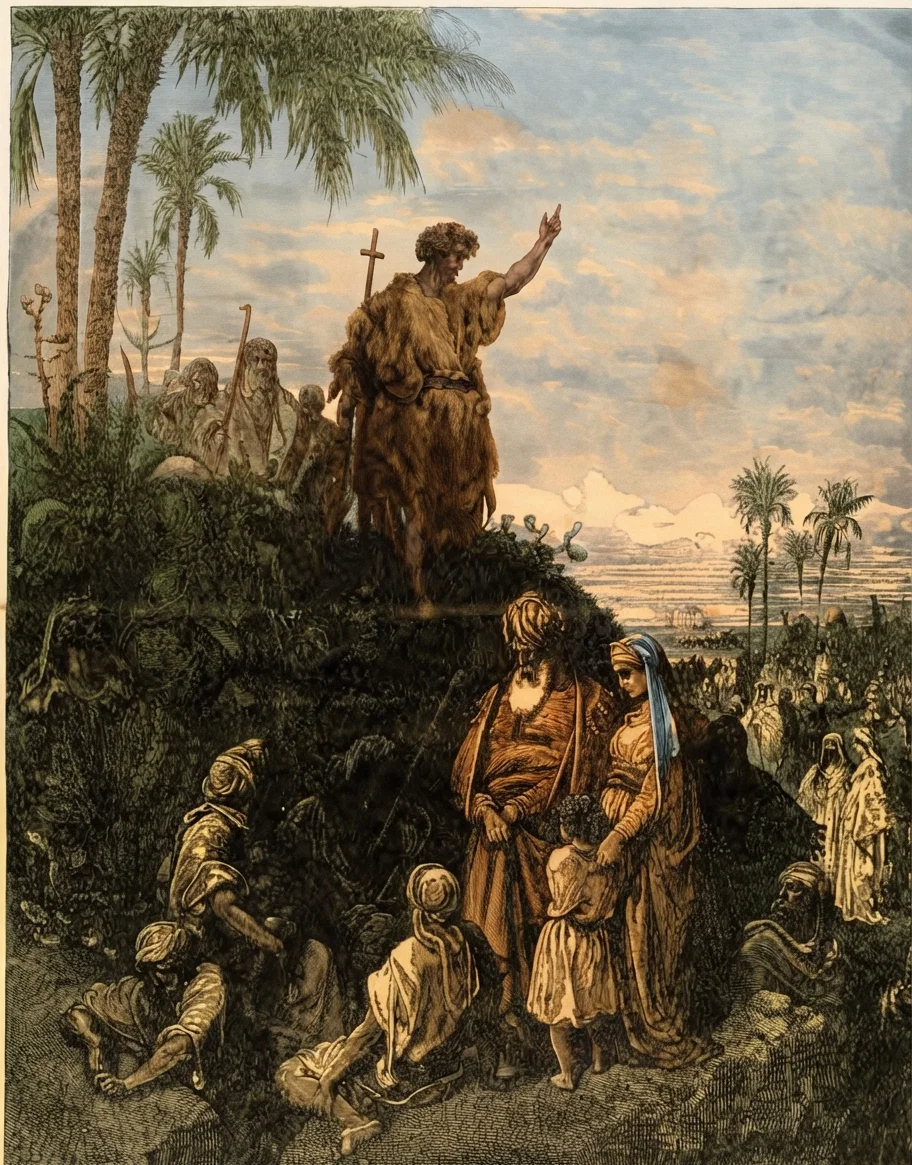
JOHN THE BAPTIST was baptizing in Jordan, and the people were flocking to him to be baptized for the remission of their sins. Suddenly One appeared among the crowd, and John, seeing him, pointed him out and exclaimed, “Behold the Lamb of God, which taketh away the sin of the world.”
John had been preaching for some time. He was a faithful preacher; he did not excuse or palliate sin. To those who came to him and asked what they should do, he was able to point out their especial duties in an unmistakable manner. When he saw coming unto him to be baptized many of the Pharisees and Sadducees, knowing the spiritual pride of race which dwelt in their hearts, and the little fruits of true holiness they manifested, he said to them, “Bring forth therefore fruits meet for repentance; and think not to say within yourselves, We have Abraham to our father; for I say unto you, that God is able of these stones to raise up children unto Abraham.” Publicans, whose business it was to collect taxes for the Romans, came to his baptism, and said, “Master, what shall we do?” and John, who knew of their unlawful exactions to secure money for themselves, replied, “Exact no more than that which is appointed you.” Roman soldiers, whose hearts had been touched by his preaching, also came to him and said, “What shall we do?” And when one has read Roman history, and knows how the Roman soldiery often put even their commanding officers in fear, and demanded a fresh donation upon every change of emperor or governor, how striking are the words of John in reply, “Do violence to no man, and be content with your wages.” By this just discrimination of the failings and needs of all those who came unto him, John laid the ax at the root of the tree. The Spirit of God enabled him always to say the right word to the right man.
But while he was thus able to specify the peculiar failings of all who came to him, and point them out for their benefit, there was only one sovereign remedy, which was alike efficacious for every one. All had some peculiar form of sin which they were particularly liable to commit; for sin has a multitude of forms, but one remedy suffices for all. So to every one,—to all within the hearing of his voice, scribe, Pharisee, soldier, publican,—he exclaimed on sight of Jesus, “Behold the Lamb of God, which taketh away the sin of the world.” The Pharisee and scribe must take their ugly pride of birth to Jesus to have it taken away. The publican could only get rid of his selfishness, which led him to make unjust exactions, at the foot of the cross. The soldier must lose his violent character by the help of Him who is all love and tenderness. In Jesus is the one and only salvation for sin, no matter in what phase it presents itself. He takes it away, and lets the sinner go free.
JOHN THE BAPTIST PREACHING.
How is it taken away?—By the “Lamb of God.” In these words the idea of a divine sacrifice for sin is clearly set forth. Under the sacrificial system, offerings were required. Of these, the lamb, token of innocence and gentleness, and thus a fitting representation of Christ, was the most conspicuous offering. Under that law, the penitent sinner brought a lamb as an offering for his sin. Another life was taken instead of his, other blood fell on the earth, while his still coursed through his veins. In this action the idea of substitution of the innocent for the guilty, and the transfer of the punishment due for sin from the sinner to the sinless, was plainly taught. Thus the idea of a sacrifice for sin had been before the people of Israel from the most remote times. Abel offered an acceptable sacrifice; Noah made sacrifices to God upon emerging from the ark after the deluge. Abraham, Isaac, and Jacob, wherever they journeyed, built an altar unto the Lord, and made offerings thereupon. Moses, under God’s direction, promoted a system of such sacrifices. And so it had come down to the days of John the Baptist. But now the typical was to give way to the real, the shadow to the substance. The lamb of Abel, the lambs of Noah, Abraham, Isaac, and Jacob,—the lambs of every penitent sinner, in all those preceding ages,—had been brought to the sacrifice, and men had beheld them; but now the Lamb of God, God’s Lamb, had come, and in the fulness of time was to be offered as a final and complete sacrifice for sin. Men had looked over their flocks, and sought out the fairest and best for sacrifice, and now the best of heaven,—the most precious Lamb in all God’s great fold, he that was “holy, harmless, undefiled, separate from sinners, and made higher than the heavens,”—was come to earth, to be “brought as a lamb to the slaughter.” The words of Abraham to Isaac, in their deep prophetic meaning, were now to be fulfilled: “My son, God will provide himself with a lamb.” That lamb was Christ, the altar upon which he was offered was Calvary, and he is the sacrifice for every penitent sinner in the world. In the olden time, each sinner brought a lamb for himself, but God’s Lamb is for all. “All we like sheep have gone astray; we have turned every one to his own way; and the Lord hath laid on him the iniquity of us all.”
Sinner, behold God’s Lamb, which he gave up as a sacrifice for you. Is he not a perfect sacrifice? Can you find one blemish in his character? Was there ever such humility, pity, love, mercy, goodness, and holiness as his? God has made no mistake. The Lamb he has provided is “without blemish and without spot.” Behold him,—the Son of the infinite God,—a babe in the manger at Bethlehem, a child in a humble home in Nazareth, a teacher of righteousness by the shores of Galilee, in the synagogue and streets; listen to the gracious words that fall from his lips, and see the miracles of healing which evince at once his divinity and his love. Behold him in the supreme hour of sacrifice. “He was led as a lamb to the slaughter.” Calvary is the altar of sacrifice for all the world, the place where the heart-aches of all humanity may be cured. Blood has flowed in thousands of places, but the blood that trickled from the temples, hands, and feet, and poured from the pierced side, of Jesus, means more to you and me than all that was ever poured out on Jewish altars, or crimsoned the world’s battle-fields, because Christ’s blood was the price of our redemption. He bore our sins in his own body on the tree, reconciling the world to himself.Lastly, behold him come forth from the tomb, a conqueror, and ascend to heaven, from whence he will come again to judge the living and dead. Tho in heaven, he is our Saviour, and if we confess and forsake our sins, he will take them away. He taketh away the sins of the world—all sins that are confessed—and, if we desire to have our sins taken away, they should be confessed while he pleads. Jesus, the Lamb of God, stands ready to bear our sins. Will we give them up to him, and receive therefor his forgiving smiles and the life everlasting? M. E. K.

SPIRITUAL DECLENSION—WHY IS IT?

THE spiritual declension so painfully manifest in the popular churches of the present day, and so often brought to the notice of the public, is a serious "thorn in the flesh" of religious thought. But the remedy most generally proposed, and now being extensively urged, is a matter that should also receive serious consideration. A candid contemplation of the acknowledged condition of the professed Christian world, and the efforts to better its spiritual standing and influence for good, will reveal the fact that not only is the situation the result of departing from God's Word, but the proposed remedy is also out of harmony with scriptural methods of reform.
The clamor of the more prominent churches and coördinate religious organizations for political power, for the framing of civil laws, to enhance the spiritual condition of the country and the world, is in direct line with the misguided wishes of Christ's disciples, before they understood the full and true meaning of his mission to earth. There was even strife among them as to who should be greatest when Christ should set up his kingdom. The sons of Zebedee had an intercessor to seek for them the positions of highest honor, as has every political aspirant of the present day.
It would seem that nothing but Christ's departure from those who had identified themselves with him on earth, could bring them to realize the full meaning of his words and acts in relation to his earthly mission. "Lord, wilt thou at this time restore again the kingdom to Israel?" was the interruption of the Saviour's last discourse with his apostles. It seemed an impossibility to them to give up the idea of Christ's becoming a ruler in the world that then was. And the history of those times is repeating itself now in the clamor of certain religious leaders for the regulation of religious duties, by the laws of the realm. Whatever is out of harmony with the outward moral life, they seek to annihilate by civil processes—which act is a virtual prayer to human rulers, to be delivered from temptation—a prayer to earthly power for what Heaven alone can give.
But is there to be no redress for the Christian, for the wrongs he suffers from the evil influences surrounding him? Must he stand quietly by and see wrongs perpetrated—suffer wrongs—without seeking to change the laws that permit them? Here is a chance for the exercise of Christian faith, an opportunity which Bible characters frequently improved, furnishing to us the most illustrious examples on record of what Christian fortitude really is, and the influence which it has upon those who witness it. Had they escaped from the situation by revising the laws of the land, they would never have been heard of as overcomers. How different would be the story of the three Hebrew worthies, and how different would have been the influence upon king and court and country had Shadrach, Meshach, and Abednego, by a successful political "pull," changed that dreadful edict of King Nebuchadnezzar! Witness the change in that mighty monarch and the opportunity for the promulgation of the Word of God in Babylon, which was brought about by the course of the captive Hebrews. Study that lesson, and reflect upon it.
How different would be the reading of the Babylonian narrative concerning Daniel himself, had he by political machinations secured his release from the awful fate to which the edict of King Darius condemned him! Another opportunity would have been lost for heralding the name of Jehovah throughout the realm of the Median king.
These worthies worshiped their God, they trusted in him and his power where they were not able to see the outcome of the course which their teachings compelled them to take. Did they despair because the law of their God was contrary to the law of the land? Did they show up the "record" of the lawmakers, and hold them up to public contempt? Examine the record and see: "We are not careful to answer thee." "Our God whom we serve is able to deliver us out of thy hand."
Peter and John by an appeal to the multitude at the time of their incarceration could have interfered very materially with the administration of the rulers of the Jews, and mayhap saved themselves from imprisonment at their hands; but the Lord had given them no such commission; and by leaving temporal things to those into whose hands they are given, and attending strictly to the work which was committed to them, a mighty miracle was wrought in their behalf, and hundreds believed in consequence.
There is a spiritual declension. It is an alarming fact. There is a reason for it, too. There is no spiritual power in the courts of common law. Such institutions are not the source of spiritual blessing. They were not instituted for the purpose of conferring such blessing. But the church is turning more and more to this source, and is seeking to attain the end for which she was established, by continued and increasing appeals to the law. She is drinking from a different source than that to which she was led by the Lord of glory. In so doing she is not slaking her thirst at the well of salvation, nor is she drinking the water of life from such a source. It is a remarkable fact that the turning of the church to the world and the law for support, and for carrying out her aims, is rapidly increasing; and the different church organizations are planning, on a more extended scale than ever before, to use the law of the land in attaining their ends. Societies of religious persons are formed for the sole purpose of influencing political action favorable to schemes of their own, in making Christian duties compulsory.
Turning from the Lord, and seeking to the world for succor, the church must expect only what the world has to give, law and legal, compulsory formality; heartless obedience to the laws of the church because of the legal force behind them. The courts of the country, not being a source of spiritual blessing, the church gets none from them, and then wonders why her spiritual life is declining. Such wonder on her part is in itself a legitimate cause of wonderment. Drinking at the intoxicating fountain of the world, why should she wonder that her vitality is ebbing fast? As the appeals of the church to the world are increased, so is the ratio of her spiritual declension.
Will she call a halt in her mad rush for the glamour of worldliness?—I fear not, as a body; it is not so written. Her history, as given in advance by the inspired apostles, indicates that this coquetry with the world will be accelerated till the end come. She will go on in this erratic career, till the ground upon which she stands will not be incompatible with a union of her forces with those of Rome, in enforcing the rules of the church by the civil constabulary. Form will take the place of feeling, and force sit sternly on the throne of love.
There is a better way. "Should not a people seek unto their God? On behalf of the living, should they seek unto the dead?" These poignant questions of Isaiah, in regard to the witchcraft of those days, are wonderfully applicable to the course of religious affairs at the present time. Why should they who have all the power of God at their command, seek for the weak, vascillating, transitory, and heartless power of the world? God lives; and, unless they have denied him, his power is theirs, his blessing is theirs, and he will so warm the hearts of his people that spiritual declension will be unknown among them.
The world is dead to things spiritual and eternal. Then let not the living, the Christian, seek to it for what God alone can give. The true Christian will reverence the law of his God. He who is not a Christian will not do so, and to compel him to act as tho he did, is making of him, in the first place, a hypocrite, and, in the second place, an inward hater of that so-called religion which makes such hypocrisy and compulsion possible.

THE EVANGELISTS AND THE SABBATH.

The Fourth Commandment.

I WISH to show first what the evangelists have taught concerning the Sabbath by teaching the law, and so we give the Sabbath command in full:—
"Remember the Sabbath day, to keep it holy. Six days shalt thou labor, and do all thy work; but the seventh day is the Sabbath of the Lord thy God; in it thou shalt not do any work, thou, nor thy son, nor thy daughter, thy manservant, nor thy maidservant, nor thy cattle, nor thy stranger that is within thy gates; for in six days the Lord made heaven and earth, the sea, and all that in them is, and rested the seventh day; wherefore the Lord blessed the Sabbath day, and hallowed it."
Will this command enforce upon the Jews one day, and upon the Gentiles some other day? If not, and the Jews keep the commandment by resting upon the seventh day, or Saturday, how can we keep the commandment by resting upon the first day, or Sunday? Christ kept the commandment as it should be kept, but he kept it by resting upon the seventh day. The commandment says, "The seventh day is the Sabbath." How, then, can the first day be the Sabbath? As long as the commandment exists, the seventh day is the Sabbath. The apostles taught that the law should be kept in the new dispensation; therefore they taught that the seventh day is the Sabbath. The commandment says, "In it [the seventh day] thou shalt not do any work;" but this day is the busy day of the week. In the timeof Christ it was not so. The world has turned away from the Sabbath of the Lord, and has been trampling under their feet one of God's holy commandments.
"If thou turn away thy foot from the Sabbath, from doing thy pleasure on my holy day; and call the Sabbath a delight, the holy of the Lord, honorable; and shalt honor him, not doing thine own ways, nor finding thine own pleasure, nor speaking thine own words; then shalt thou delight thyself in the Lord." Isa. 58:13, 14.
Then turn away thy foot from the Sabbath, if thou desirest to delight thyself in the Lord; for God will fulfil his promise.

Proposition.

The New Testament recognizes the seventh day as the Sabbath.
"And it was the Sabbath day when Jesus made the clay, and opened his eyes." John 9:14.
This is a clear, plain statement, and if we can determine what day it was that Jesus healed the blind man, then we may know which day is the Sabbath. The Jews condemned Christ for healing the man on the Sabbath. If it had been any other day than the seventh day, they would not have condemned him. In this text, therefore, the seventh day is recognized as the Sabbath.
"And when the Sabbath was past, Mary Magdalene, and Mary the mother of James, and Salome, had bought sweet spices, that they might come and anoint him. And very early in the morning the first day of the week, they came unto the sepulcher at the rising of the sun." Mark 16:1, 2.
It will be seen that the "Sabbath was past," before the "first day of the week" came. It is true that Christ was raised from the dead upon the first day of the week, but the Sabbath "was past" before his resurrection. The expression "first day of the week" proves that it is not the Sabbath. The Sabbath is the last of the week, and not the first. When the evangelists used the expression "first day of the week," it is evident they did not consider it the Sabbath day.
"In the end of the Sabbath, as it began to dawn toward the first day of the week, came Mary Magdalene and the other Mary to see the sepulcher." Matt. 28:1.
In this text, we have two days mentioned. One is called the Sabbath, and the other is called first day of the week. It is impossible for the first day of the week to be the Sabbath, if it "began to dawn towards the first day of the week," "in the end of the Sabbath." The apostle in this text recognizes the seventh day as the Sabbath.
"And, behold, there was a man named Joseph, a counselor; and he was a good man, and a just. . . . This man went unto Pilate, and begged the body of Jesus. And he took it down, and wrapped it in linen, and laid it in a sepulcher that was hewn in stone, wherein never man before was laid. And that day was the preparation, and the Sabbath drew on. And the women also, which came with him from Galilee, followed after, and beheld the sepulcher, and how his body was laid. And they returned, and prepared spices and ointments; and rested the Sabbath day according to the commandment. Now upon the first day of the week, very early in the morning, they came unto the sepulcher, bringing the spices which they had prepared, and certain others with them." Luke 23:50 to 24:1.
In this text we have three days mentioned. One is called the "preparation day;" the second is called "the Sabbath day according to the commandment;" the third is called "the first day of the week." We now give the events that occurred on each of these days. The preparation day is the day before the Sabbath. The day that Christ was crucified was the preparation day, for the Sabbath drew on. "And now when the even was come, because it was the preparation, that is, the day before the Sabbath." Mark 15:42. This day is called "preparation day," because it is the day that God had directed should be used to prepare for the Sabbath. "And he said unto them, This is that which the Lord hath said, Tomorrow is the rest of the holy Sabbath unto the Lord; bake that which ye will bake to-day, and seethe that ye will seethe; and that which remaineth over lay up for you to be kept until the morning." Ex. 16:23. On this day our Lord was crucified and buried.
The day following the crucifixion day was the Sabbath day according to the commandment. We could justly infer that some other day would not be the day according to the commandment. We are told in the commandment to "remember the Sabbath day, to keep it holy." "The seventh day is the Sabbath." Why shall we remember it?—"For in six days the Lord made heaven and earth, the sea, and all that in them is, and rested the seventh day." The Sabbath day of the commandment is the rest day of creation. When the holy women kept the day "according to the commandment," they rested upon the day that God rested upon when he created the heavens and the earth, and afterward blessed and sanctified it. We have but very little said concerning the events that occurred while Jesus was resting in the tomb. It is simply called the "Sabbath day according to the commandment." It was upon this day that the chief priests and Pharisees came unto Pilate, and desired him to make the sepulcher sure, for they remembered what Jesus had said, "After three days I will rise again." And "so they went, and made the sepulcher sure, sealing the stone, and setting a watch." Matt. 27:62-66.
We now give the events of the "first day of the week." The women, after seeing Jesus laid in the tomb, on preparation day, or Friday, started for their home, but stopped on their way in the city, and bought sweet spices, intending to come to the sepulcher and anoint Jesus at some future time. They rested the Sabbath day, and came to the sepulcher early the first day of the week, expecting to anoint the body of Jesus. The stone was rolled away, and Jesus had risen.
"Now when Jesus was risen early the first day of the week, he appeared first to Mary Magdalene, out of whom he had cast seven devils. And she went and told them that had been with him, as they mourned and wept. And they, when they had heard that he was alive, and had been seen of her, believed not. After that he appeared in another form unto two of them, as they walked, and went into the country. And they went and told it unto the residue; neither believed they them. Afterward he appeared unto the eleven as they sat at meat, and upbraided them with their unbelief and hardness of heart, because they believed not them which had seen him after he was risen." Mark 16:9-14.
It would seem from the events that transpired upon this day, that the disciples considered it a common working day. The women expected to anoint Jesus, a thing they would not do on the Sabbath. The two disciples walked to Emmaus from Jerusalem, a distance of seven and one-half miles. Luke 24:13, 14. This is more than a Sabbath day's journey. Acts 1:12. After a day of mourning, of doubts, and fears, the eleven apostles met in their home, in an upper chamber. Acts 1:13. They had closed the door, and were eating supper, when Jesus appeared in the room, and upbraided them because of their unbelief. This could not be a meeting to commemorate the resurrection, for they did not believe he was risen, and, at the close of the day, they were reproved for unbelief. It is evident, from an examination of the texts, that the Sabbath of the New Testament is bounded by the crucifixion day and the resurrection day. On the sixth day Jesus was offered as a sin-offering. On the Sabbath day he quietly rested in the tomb. On first day he took up his work again, in active life, convincing his disciples of his resurrection.
Phoenix, Arizona.

HOLY THINGS.

"As HE which hath called you is holy, so be ye holy in all manner of conversation; because it is written, Be ye holy; for I am holy." 1 Peter 1:15, 16. The apostle gives this instruction "because it is written" in the Word of God. Where is it written?—In Lev. 11:44, 45. Thus he sends us for instruction to the same source whence the literal Israel were instructed.
Then the apostle goes on to describe the exalted position of those who "have tasted that the Lord is gracious." To such he says, "Ye also, as lively stones, are built up a spiritual house, an holy priesthood, to offer up spiritual sacrifices, acceptable to God by Jesus Christ." 1 Peter 2:5. Again he says, "Ye are a chosen generation, a royal priesthood, an holy nation, a peculiar people; that ye should show forth the praises of Him who hath called you out of darkness into his marvelous light." Verse 9.
For an example of holiness the apostle points us to Christ: "For even hereunto were ye called; because Christ also suffered for us, leaving us an example, that ye should follow his steps; who did no sin, neither was guile found in his mouth." Verses 21, 22.
The Sabbath Is Holy.—"And on the seventh day God ended his work which he had made; and he rested on the seventh day from all his work which he had made. And God blessed the seventh day, and sanctified it; because that in it he had rested from all his work which God created and made." Gen. 2:2, 3. Now when God sanctified the seventh day he made it holy. Some weeks before the Israelites came to Sinai, Moses reminded them on the sixth day that "to-morrow is the rest of the holy Sabbath unto the Lord." Through centuries of Egyptian slavery and consequent darkness, the law of God had become well-nigh obliterated from their minds. And when they came to Sinai, the Lord repeated the law to them by his own voice, wrote it upon tables of stone, and otherwise provided for its being continually taught to the people. In this law there is the command to "remember the Sabbath day, to keep it holy." Again, in Isa. 58:13, God calls the Sabbath "my holy day."
Holiness of the Sanctuary.—The first apartment of the sanctuary was called the "holy place," and the second apartment was called the "most holy." Everything about the sanctuary was holy; the high priest had to wear holy garments in his ministrations, and certain persons were sanctified or set apart for all the various duties. Nadab and Abihu were stricken dead because they used common fire in their censors to burn incense. Lev. 10:1, 2. To be brief on this point, and yet comprehensive, it is only necessary to show that Israel was given into the hands of her enemies because of the defilement of the sanctuary. Eze. 5:11 is sufficient for this purpose: "Wherefore, as I live, saith the Lord God: Surely, because thou hast defiled my sanctuary with all thy detestable things, and with all thine abominations, therefore will I also diminish thee; neither shall mine eye spare, neither will I have any pity."
This carefulness in regard to the sanctuary typifies the care that should be exercised in building up the church of Christ. "Know yenot that ye are the temple of God, and that the Spirit of God dwelleth in you? If any man defile the temple of God, him shall God destroy; for the temple of God is holy, which temple ye are." 1 Cor. 3:16, 17. Again, in the same epistle, the holiness of the sanctuary is applied to the individual Christian. "What! know ye not that your body is the temple of the Holy Ghost which is in you, which ye have of God, and ye are not your own?" Chapter 6:19.
The Tithe Is Holy.—"And all the tithe of the land, whether the seed of the land, or of the fruit of the tree, is the Lord's; it is holy unto the Lord." Lev. 27:30. The Lord would have us recognize that all we have comes from him. From him cometh "every good gift and every perfect gift." James 1:17. "He giveth to all life, and breath, and all things." Acts 17:25. "Of him, and through him, and to him, are all things." Rom. 11:36. But he would have us acknowledge him in a practical way, not merely in the formality of words, but in the reality of deeds. "Faith without works is dead."
All the faithful patriarchs mentioned in Hebrews 11 demonstrated their faith by practical works. God has set his seal of sanctity upon the tithe of all our income. He has given us all, and requires a return of one-tenth as a pledge of our recognition of that fact. Our profession of such recognition is nothing without the required substantial proof. Moreover, God has pronounced a curse upon the one who withholds the tithe, that which is holy, and has pronounced a blessing upon him who is faithful in this duty.
It is well to note the similarity between the Lord's regard for the holiness of the Sabbath and that of the tithe. We will set them side by side:—
THE SABBATH.
"If thou turn away thy foot from the Sabbath, from doing thy pleasure on my holy day; and call the Sabbath a delight, the holy of the Lord, honorable; and shalt honor him, not doing thine own ways, nor finding thine own pleasure, nor speaking thine own words; then shalt thou delight thyself in the Lord; and I will cause thee to ride upon the high places of the earth, and feed thee with the heritage of Jacob thy father; for the mouth of the Lord hath spoken it." Isa. 58:13, 14.
THE TITHE.
"Will a man rob God? Yet ye have robbed me. But ye say, Wherein have we robbed thee? In tithes and offerings. Ye are cursed with a curse; for ye have robbed me, even this whole nation. Bring ye all the tithes into the storehouse, that there may be meat in mine house, and prove me now herewith, saith the Lord of hosts, if I will not open you the windows of heaven, and pour you out a blessing, that there shall not be room enough to receive it." Mal. 3:8-10.
Thus it seems clear from the Word of God that it is his pleasure that we defile not the sanctuary, which is holy; that we keep from desecrating his Sabbath day, which is holy, and that we faithfully return to him the tithe of the substance we receive from him, which he has also declared to be holy. Also, that we be ourselves holy, because he is holy. Nor has he set one of these duties above the other. No one has a right to use as common that which God has sanctified, or made holy.

A STEP AT A TIME.

IN accomplishing your day's work you have simply to take one step at a time. To take that step wisely is all that you need to think about. If I am climbing a mountain, to look down may make me dizzy; to look too far up may make me tired and discouraged. Take no anxious thought for the morrow. Sufficient for the day—yes, and for each hour in the day—is the toil or trial thereof. There is not a child of God in this world who is strong enough to stand the strain of to-day's duties and all the load of to-morrow's anxieties piled upon the top of them. Paul himself would have broken down if he had attempted the experiment. We have a perfect right to ask our heavenly Father for strength equal to the day; but we have no right to ask him for one extra ounce of strength for anything beyond it. When the morrow comes, grace will come sufficient for its tasks or for its troubles.
"Let me be strong in word and deed Just for to-day; Lord, for to-morrow and its needs I must not pray." —Theodore L. Cuyler.

EACH MOMENT.

If we may commit the days to our Lord, why not the hours, and why not the moments? We do not realize the importance of moments. Look back through the history of the church in all ages, and mark how often a great work grew out of a mere moment in the life of one of God's servants. The moment may have been spent in uttering fine words, but they have fed five thousand, or even five hundred thousand. It is not so often a whole sermon as a single sentence in it that wings God's arrows to the heart. Again, in our own quiet waiting upon God, have we not found that he can so irradiate one passing moment with his light that its rays never die away? Are not such proved to have been kept for him? And if some, why not all? O, how much we have missed by not placing them at his disposal! What might he not have done with the moments freighted with self, or loaded with emptiness, which we have carelessly let drift by? O, what might have been if they had all been kept for Jesus! How he might have filled them with his life and light, enriching our lives that have been impoverished by the waste, and using them in far-spreading blessing and power! We see something of God's greatness and wisdom when we fix our dazzled gaze on infinite space; but when we turn to the marvels of the microscope we gain a clearer view of these attributes by gazing on the perfection of his infinitesimal handiworks. Just so, while we can not realize the infinite love which fills eternity, we see that love magnified in the microscope of the moments, and revealing its unspeakable perfection of detail to our wondering sight.—F. R. Havergal.

GATHERED GEMS.

TIME to me this truth has taught ('Tis a treasure worth revealing), More offend by want of thought Than by any want of feeling. —Charles Swain.
BETTER to stem with heart and hand The roaring tide of life than lie Unmindful, on its flowery strand, Of God's occasions drifting by. —Whittier.
FULL many a day forever is lost By delaying its work till to-morrow; The minutes of sloth have often cost Long years of bootless sorrow. —Eliza Cook.
"If aught good thou canst not say Of thy brother, foe, or friend, Take thou, then, the silent way, Lest in word thou shouldst offend."
My crown is in my heart, not on my head; Not decked with diamonds and Indian stones, Nor to be seen: my crown is called content; A crown it is that seldom kings enjoy. —Shakespeare.
Continue reading: CHRIST'S SECOND APPEARING